manual radio set SAAB 9-3 2000 User Guide
[x] Cancel search | Manufacturer: SAAB, Model Year: 2000, Model line: 9-3, Model: SAAB 9-3 2000Pages: 236, PDF Size: 10.85 MB
Page 110 of 236
110 Saab 9-3 Audio SystemMobile phones and
communications radios Mobile phones and communications radios
that do not have a separate external
antenna radiate an electromagnetic field
inside the car.
Saab therefore recommends that a car
phone/radio transmitter should always be
connected to an external antenna.
An external antenna also provides
improved transmission/reception and a
greater range.
Mobile phones and communications radios
that are not supplied as standard equipment
by Saab can interfere with the car’s electri-
cal system and cause misleading fault
codes to be generated.
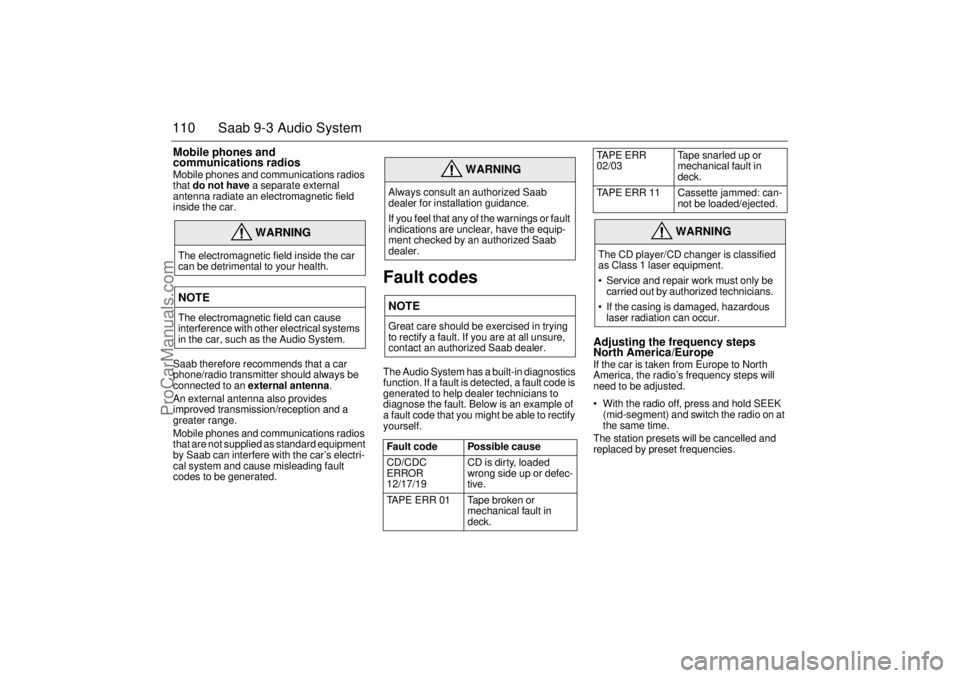
Fault codesThe Audio System has a built-in diagnostics
function. If a fault is detected, a fault code is
generated to help dealer technicians to
diagnose the fault. Below is an example of
a fault code that you might be able to rectify
yourself.
Adjusting the frequency steps
North America/Europe If the car is taken from Europe to North
America, the radio’s frequency steps will
need to be adjusted.
With the radio off, press and hold SEEK
(mid-segment) and switch the radio on at
the same time.
The station presets will be cancelled and
replaced by preset frequencies.
WARNING
The electromagnetic field inside the car
can be detrimental to your health. NOTEThe electromagnetic field can cause
interference with other electrical systems
in the car, such as the Audio System.
WARNING
Always consult an authorized Saab
dealer for installation guidance.
If you feel that any of the warnings or fault
indications are unclear, have the equip-
ment checked by an authorized Saab
dealer. NOTEGreat care should be exercised in trying
to rectify a fault. If you are at all unsure,
contact an authorized Saab dealer.
Fault code Possible cause
CD/CDC
ERROR
12/17/19 CD is dirty, loaded
wrong side up or defec-
tive.
TAPE ERR 01 Tape broken or
mechanical fault in
deck.
TAPE ERR
02/03Tape snarled up or
mechanical fault in
deck.
TAPE ERR 11 Cassette jammed: can-
not be loaded/ejected.
WARNING
The CD player/CD changer is classified
as Class 1 laser equipment.
Service and repair work must only be
carried out by authorized technicians.
If the casing is damaged, hazardous
laser radiation can occur.
ProCarManuals.com
Page 163 of 236
163 Starting and driving
To jump start your vehicle:
1 Check the other vehicle. It must have a
12-volt battery with a negative ground
system.2 Get the vehicles close enough so the
jumper cables can reach, but be sure the
vehicles are not touching each other. If
a poor connection on the negative
jumper cable should exist, it is possible
for damage to be caused to electrical
systems/components of either vehicle
should inadvertent contact be made.
You would not be able to start your car
and bad grounding could damage the
electrical systems.
3 Turn off the ignition on both vehicles.
Turn off all lights that are not needed,
and radios. This will avoid sparks and
help save both batteries and it could
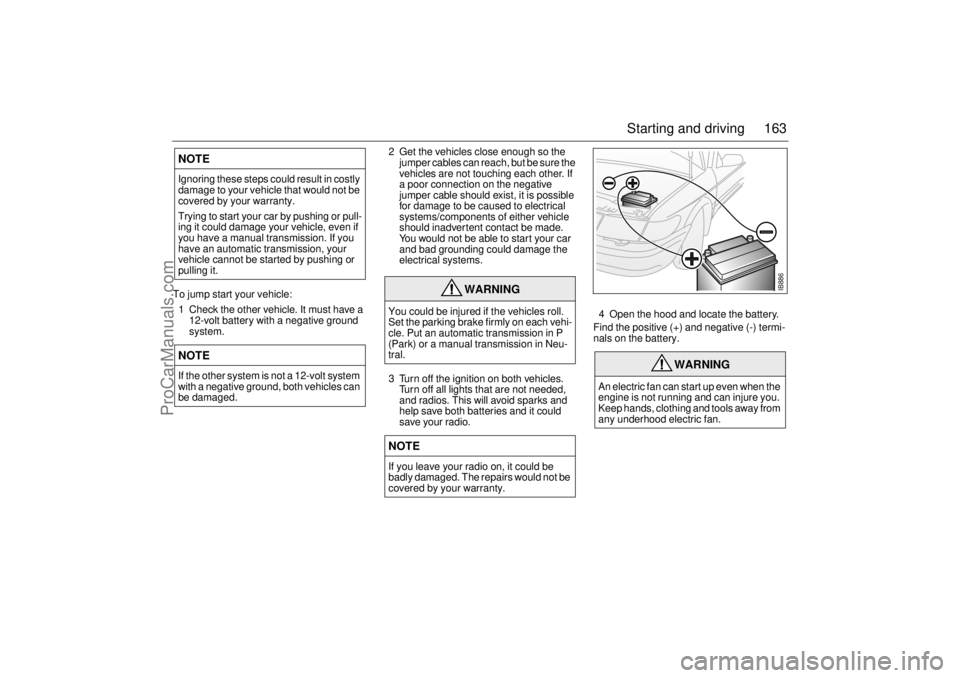
save your radio.4 Open the hood and locate the battery.
Find the positive (+) and negative (-) termi-
nals on the battery.NOTEIgnoring these steps could result in costly
damage to your vehicle that would not be
covered by your warranty.
Trying to start your car by pushing or pull-
ing it could damage your vehicle, even if
you have a manual transmission. If you
have an automatic transmission, your
vehicle cannot be started by pushing or
pulling it.NOTEIf the other system is not a 12-volt system
with a negative ground, both vehicles can
be damaged.
WARNING
You could be injured if the vehicles roll.
Set the parking brake firmly on each vehi-
cle. Put an automatic transmission in P
(Park) or a manual transmission in Neu-
tral.NOTEIf you leave your radio on, it could be
badly damaged. The repairs would not be
covered by your warranty.
WARNING
An electric fan can start up even when the
engine is not running and can injure you.
Keep hands, clothing and tools away from
any underhood electric fan.
IB886
ProCarManuals.com
Page 190 of 236

190 Car care
Relay holderUnder the instrument panel next to the steering wheel No. Amp Function
21 10 Manual A/C; soft top (Convertible)
22 15 Cruise Control; direction indicators
23 20 Soft top (Convertible); telephone
24 7.5 Radio
25 30 Central locking
26 30 Control module, engine management system; igni-
tion cassette
27 15 High beam flash; ACC
28 10 Engine management system
29 10 Right parking light; number-plate lighting
30 10 Left parking light
31 20 Reversing light; windshield wipers; headlight
beam-length adjustment
32 15 Fuel pump
33 15 Electric heating of rear seat
34 10 SID; control module; automatic transmission
35 15 DICE/TWICE; main instrument panel; interior light-
ing
36 10 Relay, starter
37 – –
38 25 Oxygen sensor (lambda probe)
39 – –Item Function
A Electric heating of rear seat
B Reversing light, cars with automatic transmission
C1 –
C2 Lock motor, trunk lid
D1 Rear wiper
D2 Rear-window washing
E Ignition switch
F–
G Windshield wipers (intermittent)
H Rear-window heating
IFuel pump
J–
KStart relay
L Main relay (injection system)
ProCarManuals.com
Page 202 of 236
202 Car care
Waxing and polishingDo not wax a new car during the first three
or four months. In fact, there is no need to
polish the car before the paintwork has
started to go dull through oxidation. Other
than in exceptional cases, do not use abra-
sive polishes containing a cutting agent on
a new car. Always wash the car thoroughly
before waxing or polishing.
Touching up the paintDamaged paintwork should be treated as
soon as it is discovered: the longer it is left,
the greater the risk of corrosion. The
anti-perforation warranty does not cover
corrosion resulting from untreated defects.
Paintwork damage sustained in a collision is
usually extensive and can only be properly
restored by professionals.
However, you can repair small scratches
and stone-chip damage yourself. The nec-
essary tools and materials, such as primer,
touch-up paint and brushes, are available
from your Saab dealer.
In the case of minor flaws in the paintwork,
where the metal has not been exposed and
an undamaged layer of paint remains,
touch-up paint can usually be applied
directly, after any dirt has been scraped
away using a pointed knife.
If corrosion has already set in, e.g. as a
result of stone-chip damage, use a pointed
knife to scrape off all surface rust. If possi-
ble, the damaged area should be taken
back to the bare metal. The metal should
then be primed with two thin coats of primer
applied by brush.
After the primer has dried, apply several thin
layers of topcoat enamel until the surface of
the repaired area is flush with the surround-
ing paintwork.
Stir both primer and touch-up enamel thor-
oughly before use and allow each coat to
dry before applying the next.
NOTE Try your brakes on leaving a car wash.
Wet brake discs reduce the braking
effect.
Turn off the radio before entering an
automatic car wash so the power
antenna mast does not get damaged.
Clean the rod of the electrically pow-
ered antenna about once a month with
a clean, dry rag.
IMPORTANT! Use no oil, nor any sili-
cone-based cleaning product.
Fixed antennas must be removed
when going through an automatic car
wash.
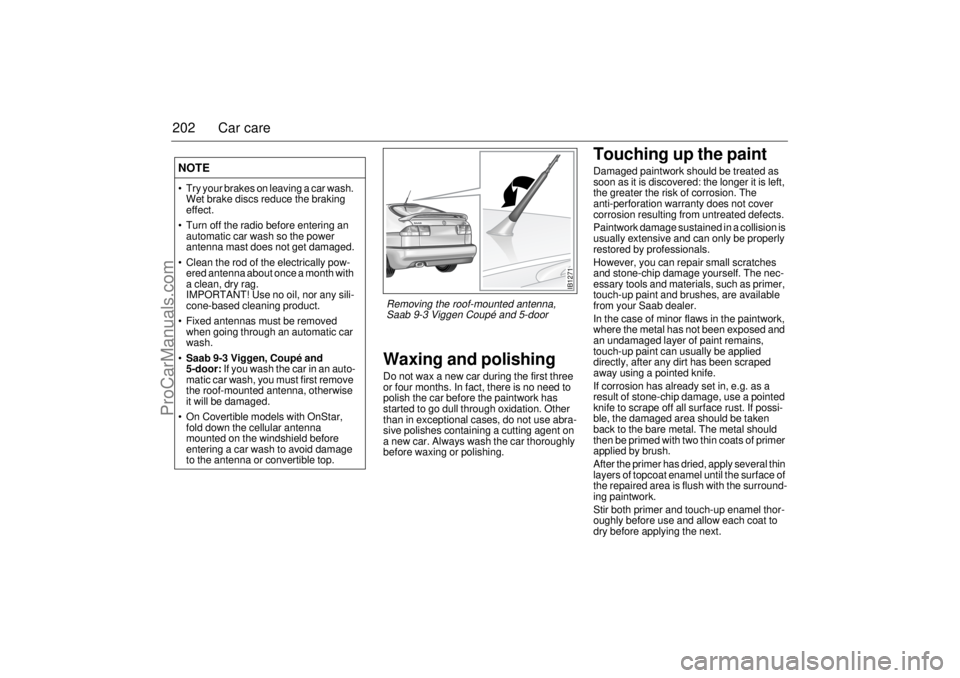
Saab 9-3 Viggen, Coupé and
5-door: If you wash the car in an auto-
matic car wash, you must first remove
the roof-mounted antenna, otherwise
it will be damaged.
On Covertible models with OnStar,
fold down the cellular antenna
mounted on the windshield before
entering a car wash to avoid damage
to the antenna or convertible top.
IB1271
Removing the roof-mounted antenna,
Saab 9-3 Viggen Coupé and 5-door
ProCarManuals.com
Page 232 of 236

232 Technical dataFollowing adjustments can be done
by the driver:Automatic Climate Control (ACC):
To alter the preprogrammed “AUTO“ start
up mode with your own preferences you can
manually select the desired settings for:
Temperature.
Fan speed.
Air distribution.
See “Programming I” on page 86 and “Pro-
gramming II” on page 87.Saab 9-3 Audio System:
The following functions can be adjusted by
the driver (see page 104):
Maximum starting volume (when the
radio is switched on).
Telephone volume (if the car is equipped
with a phone connected to the audio sys-
tem).
Speed dependent volume (volume
increases or decreases with vehicle
speed).
Loudness.Alarm System:
The glass breakage sensor can be tempo-
rarily disabled, see page 36.
Daytime Running Lights:
To disable, turn off the ignition and pull out
fuse 15, see page 189.
ProCarManuals.com