trailer SAAB 9-3 2000 User Guide
[x] Cancel search | Manufacturer: SAAB, Model Year: 2000, Model line: 9-3, Model: SAAB 9-3 2000Pages: 236, PDF Size: 10.85 MB
Page 173 of 236
173 Car care
Transmission fluidManual transmissionCheck and top up the fluid in accordance
with the service program.
If original fluid cannot be obtained for top-
ping up, Dexron III (synthetic fluid) auto-
matic transmission fluid can be used. If so,
the car should be taken to an authorized
Saab dealer as soon as possible to have the
reason for low fluid level corrected and orig-
inal fluid installed.Automatic transmissionCheck the fluid level as follows:
1 Park the car on level ground and apply
the parking brake. The automatic trans-
mission fluid must be at normal running
temperature, approximately 175°F
NOTEChange of engine oil and oil filter may be
required more frequently (5000-mile
intervals (8,000 km)) if any one of the fol-
lowing conditions apply to the car:
Most trips are less than 5 to 10 miles (8
to 16 km). This is particularly important
when outside temperatures are below
freezing.
Most trips include extensive idling
(such as frequent stop-and-go driving).
Most trips are through dusty areas.
You frequenty tow a trailer or use a car-
rier on top of your vehicle.
If the vehicle is used for delivery ser-
vice, police, taxi or other commerical
applications.
WARNING
Prolonged and repeated exposure of
the skin to engine oil can cause seri-
ous skin disorders.
Avoid prolonged skin contact when-
ever possible. Wash the affected area
thoroughly with soap and water after
any contact.
Keep oil out of reach of children.
Do not touch the turbocharger or
manifold. These get very hot when the
engine has been running.
Do not spill oil on hot parts of the
engine as this could cause a fire.
Protect the environment. Do not dis-
pose of oil in the ground or down a
drain. Dispose of all used oil and oil fil-
ters at an appropriate disposal facility.
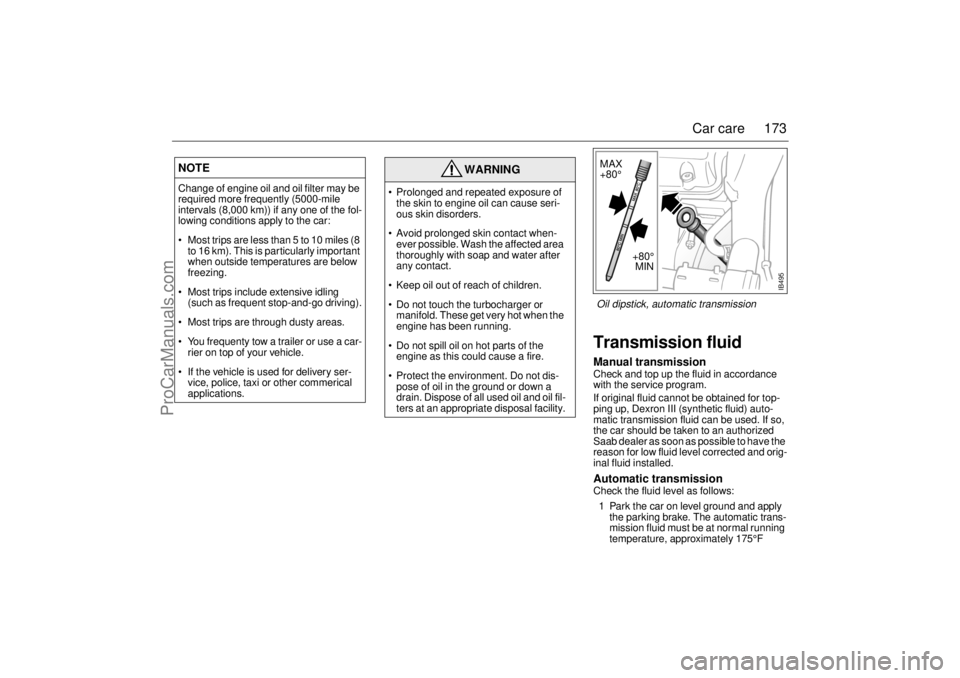
+80°
MIN MAX
+80°
IB495
Oil dipstick, automatic transmission
ProCarManuals.com
Page 189 of 236
189 Car care
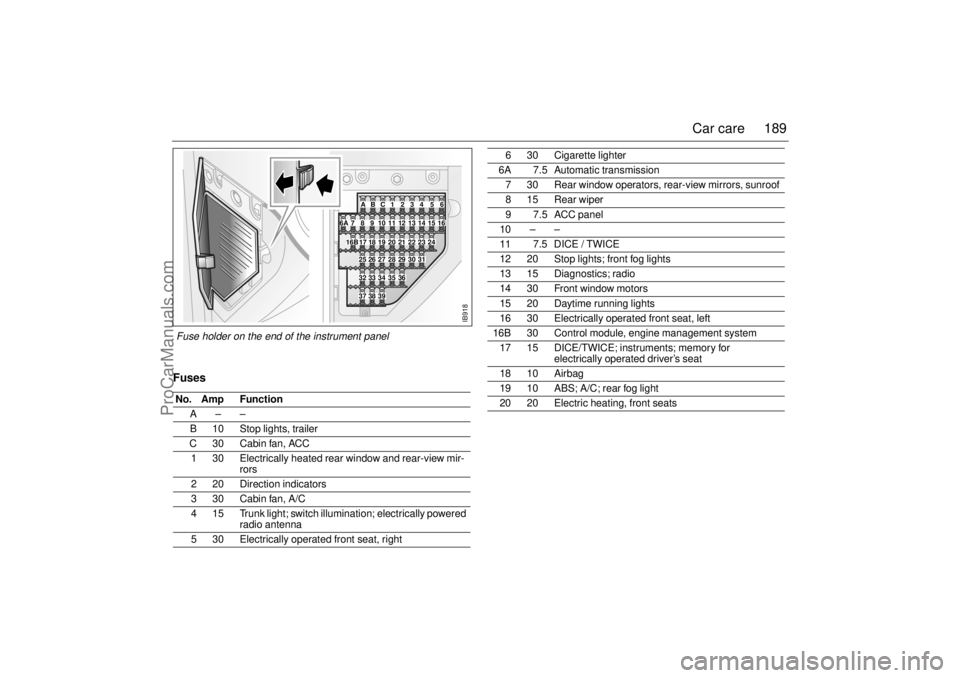
FusesNo. Amp Function
A––
B 10 Stop lights, trailer
C 30 Cabin fan, ACC
1 30 Electrically heated rear window and rear-view mir-
rors
220Direction indicators
330Cabin fan, A/C
4 15 Trunk light; switch illumination; electrically powered
radio antenna
5 30 Electrically operated front seat, right
6 30 Cigarette lighter
6A 7.5 Automatic transmission
7 30 Rear window operators, rear-view mirrors, sunroof
8 15 Rear wiper
9 7.5 ACC panel
10 – –
11 7.5 DICE / TWICE
12 20 Stop lights; front fog lights
13 15 Diagnostics; radio
14 30 Front window motors
15 20 Daytime running lights
16 30 Electrically operated front seat, left
16B 30 Control module, engine management system
17 15 DICE/TWICE; instruments; memory for
electrically operated driver’s seat
18 10 Airbag
19 10 ABS; A/C; rear fog light
20 20 Electric heating, front seats
30 10 20
30 30 15
15 15
10 10 10
10
10
10 30
30 10 20
15
15
15
10 10
20
10 20 20
20 20 15
15
30 15
15 10 15
15
IB918
1 C B A23456
7 6A 8 9 10 11 12 13 14 15 16
17 16B 18 19 20 21 22 23 2425 26 27 28 29 30 3132 33 34 35 3637 38 39
Fuse holder on the end of the instrument panel
ProCarManuals.com
Page 197 of 236
197 Car care
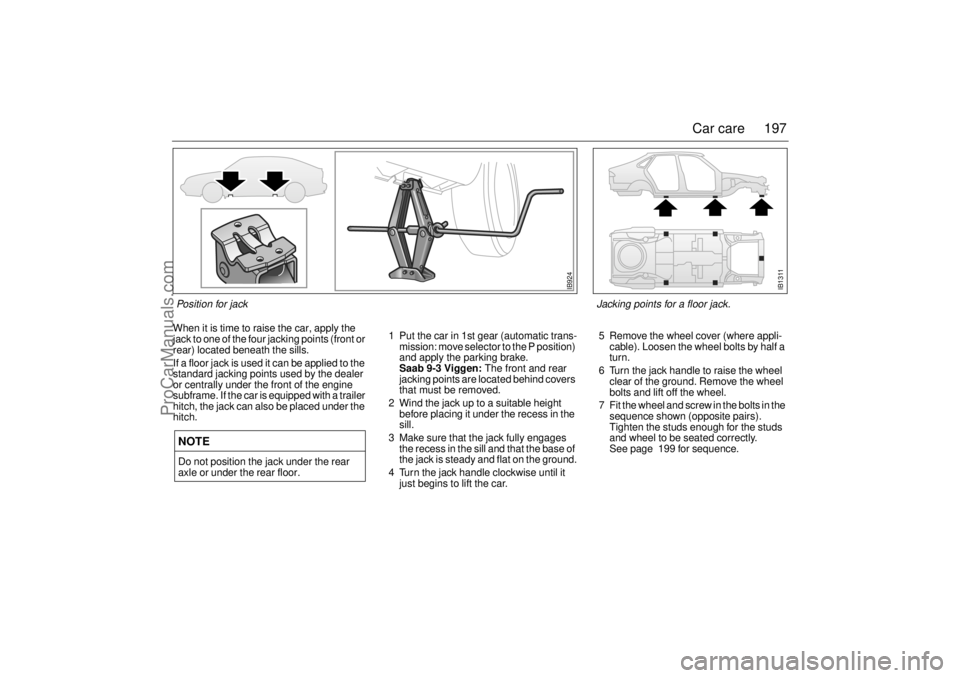
When it is time to raise the car, apply the
jack to one of the four jacking points (front or
rear) located beneath the sills.
If a floor jack is used it can be applied to the
standard jacking points used by the dealer
or centrally under the front of the engine
subframe. If the car is equipped with a trailer
hitch, the jack can also be placed under the
hitch. 1 Put the car in 1st gear (automatic trans-
mission: move selector to the P position)
and apply the parking brake.
Saab 9-3 Viggen: The front and rear
jacking points are located behind covers
that must be removed.
2 Wind the jack up to a suitable height
before placing it under the recess in the
sill.
3 Make sure that the jack fully engages
the recess in the sill and that the base of
the jack is steady and flat on the ground.
4 Turn the jack handle clockwise until it
just begins to lift the car. 5 Remove the wheel cover (where appli-
cable). Loosen the wheel bolts by half a
turn.
6 Turn the jack handle to raise the wheel
clear of the ground. Remove the wheel
bolts and lift off the wheel.
7 Fit the wheel and screw in the bolts in the
sequence shown (opposite pairs).
Tighten the studs enough for the studs
and wheel to be seated correctly.
See page 199 for sequence.NOTEDo not position the jack under the rear
axle or under the rear floor.
IB1311
Jacking points for a floor jack.
IB924
Pos i ti o n for j ack
ProCarManuals.com
Page 216 of 236

216 Maintenance and owner assistance* These are the minimum required Emission Control System maintenance steps. Saab urges that all recommended maintenance procedures be performed
according to this program.
(b.) Change automatic transmission fluid at more frequent intervals (30,000; 90,000 miles, etc.) if car is driven in dense city traffic where the outside tem-
perature regularly reaches 90°F or higher, if car is used in a mountainous/high altitude area or for trailer towing.
Service Intervals **
Miles = U.S. Cars
Kilometers = Canadian Cars
1,000
(1,600 km)
10,000
(16,000 km)
20,000
(32,000 km)
30,000
(48,000 km)
40,000
(64,000 km)
50,000
(80,000 km)
60,000
(96,000 km)
70,000
(112,000 km)
80,000
(128,000 km)
90,000
(144,000 km)
100,000
(160,000 km)
Service #
1234567891011
Engine and engine compartment (cont.)
E Evaporative emission system including filler cap, vapor
lines, EVAP canister and canister purge valve""
R Fuel system; leaks and damages""""""""""
E Fuel filter!
E Engine air cleaner element!
*
!*
!*
R Exhaust system and mountings; leaks and condition"""""""""""
Electrical
R Battery; state of charge and electrolyte level; clean termi-
nals if necessary"""""""""""
R Headlamp and fog lamp alignment"""""""""""
R Head, fog, brake, tail, turn signal, warning lights instru-
ment panel, backup and marker lamps"""""""""""
Transmission
R Automatic transmission change fluid (b.)!
R Automatic gearbox; oil level and condition""""""""""
R Manual gearbox; oil level"""
R Outer and inner driver joint boots""""""""""
ProCarManuals.com
Page 220 of 236
220 Technical dataGeneral particularsOverall length, with bumper(s):
Coupé/5-door/Convertible____________ 182.3" (4629 mm)
Viggen __________________________ 182.7” (4639 mm)
Overall width, including door mirrors _____ 76.2" (1936 mm)
Maximum height ____________________ 56.2" (1428 mm)
Maximum height when the soft top is being
operated (Convertible) ______________approx. 87"
approx. 2200 mm
Wheelbase ________________________ 102.6" (2605 mm)
Tr a c k :
front, Coupé/5-door/Convertible _______ 57.2" (1452 mm)
front, Viggen ______________________ 57.7” (1466 mm)
rear, Coupé/5-door/Convertible _______ 56.8" (1442 mm)
rear, Viggen ______________________ 57.3” (1456 mm)
Ground clearance at max. weight _______ approx. 3.9"
(100 mm)
Number of occupants, incl. driver:
Coupé and 5-door _________________ 5
Convertible _______________________ 4
Turning circle:
measured at vehicle extremities _______ 36.4 ft. (11.1 m)
curb to curb_______________________ 34.4 ft. (10.5 m)
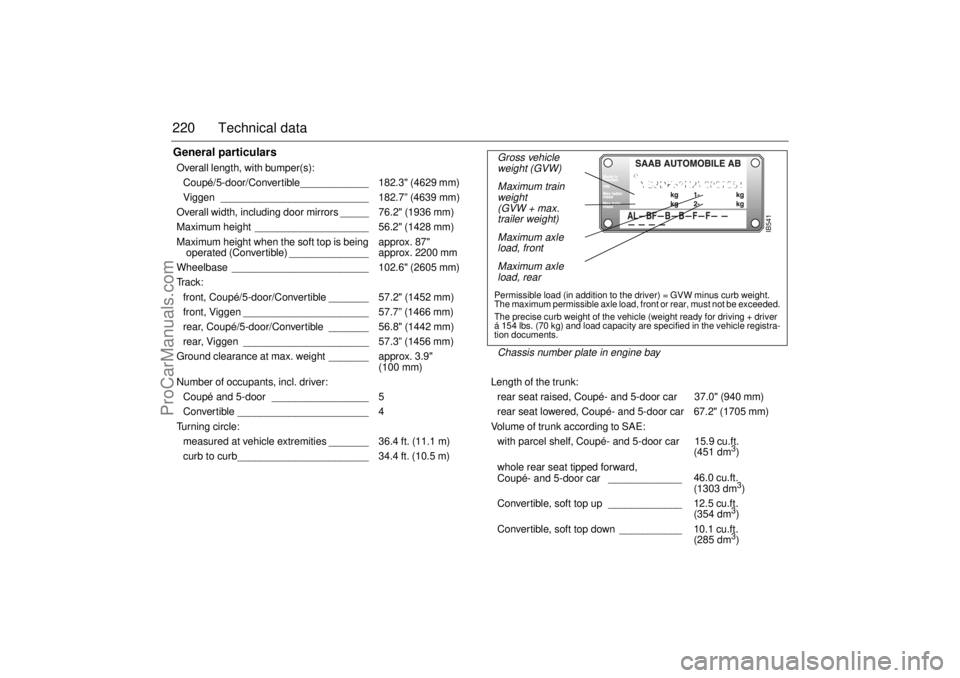
Gross vehicle
weight (GVW)
Maximum train
weight
(GVW + max.
trailer weight)
Maximum axle
load, front
Maximum axle
load, rear Permissible load (in addition to the driver) = GVW minus curb weight.
The maximum permissible axle load, front or rear, must not be exceeded.
The precise curb weight of the vehicle (weight ready for driving + driver
á 154 lbs. (70 kg) and load capacity are specified in the vehicle registra-
tion documents.Chassis number plate in engine bay Length of the trunk:
rear seat raised, Coupé- and 5-door car 37.0" (940 mm)
rear seat lowered, Coupé- and 5-door car 67.2" (1705 mm)
Volume of trunk according to SAE:
with parcel shelf, Coupé- and 5-door car 15.9 cu.ft.
(451 dm
3)
whole rear seat tipped forward,
Coupé- and 5-door car _____________ 46.0 cu.ft.
(1303 dm3)
Convertible, soft top up _____________ 12.5 cu.ft.
(354 dm3)
Convertible, soft top down ___________ 10.1 cu.ft.
(285 dm3)
IB541
ProCarManuals.com
Page 222 of 236
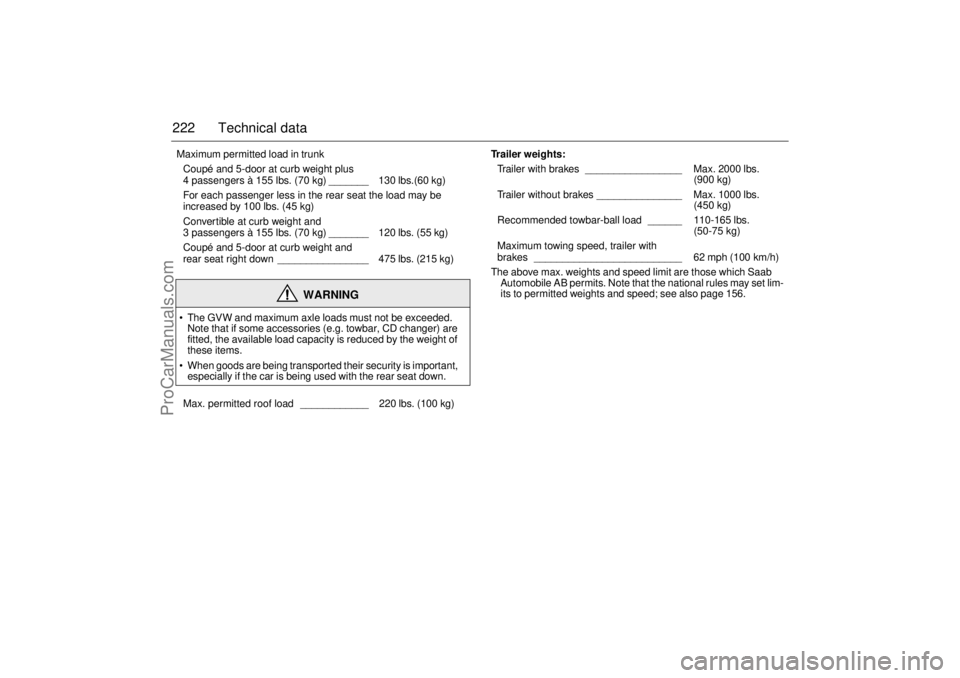
222 Technical data Maximum permitted load in trunk
Coupé and 5-door at curb weight plus
4 passengers à 155 lbs. (70 kg) _______ 130 lbs.(60 kg)
For each passenger less in the rear seat the load may be
increased by 100 lbs. (45 kg)
Convertible at curb weight and
3 passengers à 155 lbs. (70 kg) _______ 120 lbs. (55 kg)
Coupé and 5-door at curb weight and
rear seat right down ________________ 475 lbs. (215 kg)
WARNING
The GVW and maximum axle loads must not be exceeded.
Note that if some accessories (e.g. towbar, CD changer) are
fitted, the available load capacity is reduced by the weight of
these items.
When goods are being transported their security is important,
especially if the car is being used with the rear seat down.
Max. permitted roof load ____________ 220 lbs. (100 kg)
Trailer weights:
Trailer with brakes _________________ Max. 2000 lbs.
(900 kg)
Trailer without brakes _______________ Max. 1000 lbs.
(450 kg)
Recommended towbar-ball load ______ 110-165 lbs.
(50-75 kg)
Maximum towing speed, trailer with
brakes __________________________ 62 mph (100 km/h)
The above max. weights and speed limit are those which Saab
Automobile AB permits. Note that the national rules may set lim-
its to permitted weights and speed; see also page 156.
ProCarManuals.com
Page 236 of 236

236 IndexTemperature gauge
______________ 60
Textile carpeting, cleaning
________ 200
Through-load hatch
______________ 128
Tie-down eyes
_________________ 129
Tipping the rear seat
_____________ 125
Tire pressures
__________________ 192
Tires and wheels, sizes
__________ 227
Tools
_________________________ 130
Touching up paintwork
___________ 202
Towing a caravan or trailer ________ 156
Towing the car
_________________ 160
Trailer hitch load ________________ 158
Transmission, automatic
__________ 141
Transporting the car
_____________ 160
Traveling abroad
________________ 165
Trionic
________________________ 170
Trip computer, SID
_______________ 62
Trip meter
______________________ 59
Trunk
_________________________ 125
Trunk lid lock, Convertible
_________ 50
Trunk, Convertible
_______________ 50
Turbo gauge
____________________ 60
Turn signal
_____________________ 72
UUpholstery and trim
______________ 200
Upholstery and trim, care of
_______ 200
Useful tips on starting
____________ 136
Useful tips, ACC
_________________ 88
VVanity mirror
___________________ 124
WWarning labels
___________________ 7
Warning light, AIR BAG (SRS)
______ 24
Washer fluid
___________________ 179
Washer jets ____________________ 180
Washers
_______________________ 74
Washing ______________________ 201
Waxing and polishing
____________ 202
Wear indicators, brake pads
_______ 140
Wear indicators, tires
____________ 195
Wheels
_______________________ 192
Wheels and tires, sizes
___________ 227
Window glass sensor, car alarm
_____ 36
Windshield washers
______________ 74
Windshield wipers
________________ 74
Winter driving
__________________ 154
Wiper blades ___________________ 179
Wipers
_________________________ 74
ProCarManuals.com