key SAAB 9-3 2000 Owner's Manual
[x] Cancel search | Manufacturer: SAAB, Model Year: 2000, Model line: 9-3, Model: SAAB 9-3 2000Pages: 236, PDF Size: 10.85 MB
Page 119 of 236
119 Interior equipment, trunk
Electrical windows The electric window motors are equipped
with overload protection. If this protection
should trip, wait several seconds before
operating the electric windows again.To open Press the window symbol on the button.
The switches for the front windows have a
third position for automatic opening of the
window. Press the switch down all the way
to lower the window completely.
To cancel automatic lowering of the win-
dow, lift the switch briefly.To close Lift the symbol side of the button.
The actuating motor will be switched off
automatically when the window is fully
closed or when the switch is released.
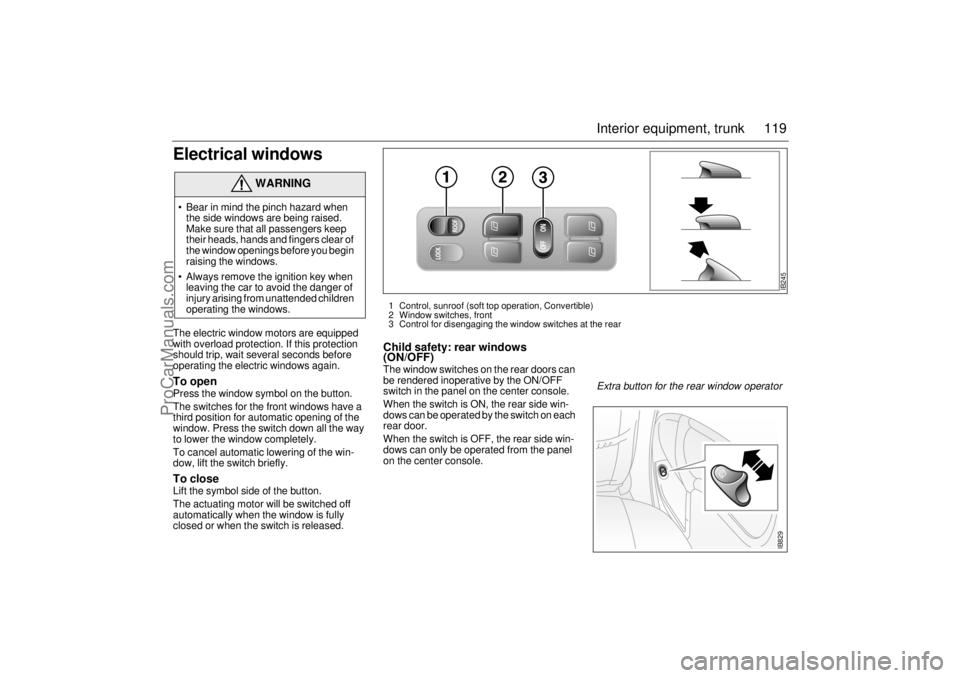
Child safety: rear windows
(ON/OFF) The window switches on the rear doors can
be rendered inoperative by the ON/OFF
switch in the panel on the center console.
When the switch is ON, the rear side win-
dows can be operated by the switch on each
rear door.
When the switch is OFF, the rear side win-
dows can only be operated from the panel
on the center console.
WARNING
Bear in mind the pinch hazard when
the side windows are being raised.
Make sure that all passengers keep
their heads, hands and fingers clear of
the window openings before you begin
raising the windows.
Always remove the ignition key when
leaving the car to avoid the danger of
injury arising from unattended children
operating the windows.
IB245
1 Control, sunroof (soft top operation, Convertible)
2 Window switches, front
3 Control for disengaging the window switches at the rear
IB829
Extra button for the rear window operator
ProCarManuals.com
Page 120 of 236
120 Interior equipment, trunkSunroof (option)The sunroof is operated electrically using
the ROOF control on the center console.
The sunroof can be opened completely or
partially. As soon as you release the control
the sunroof stops.
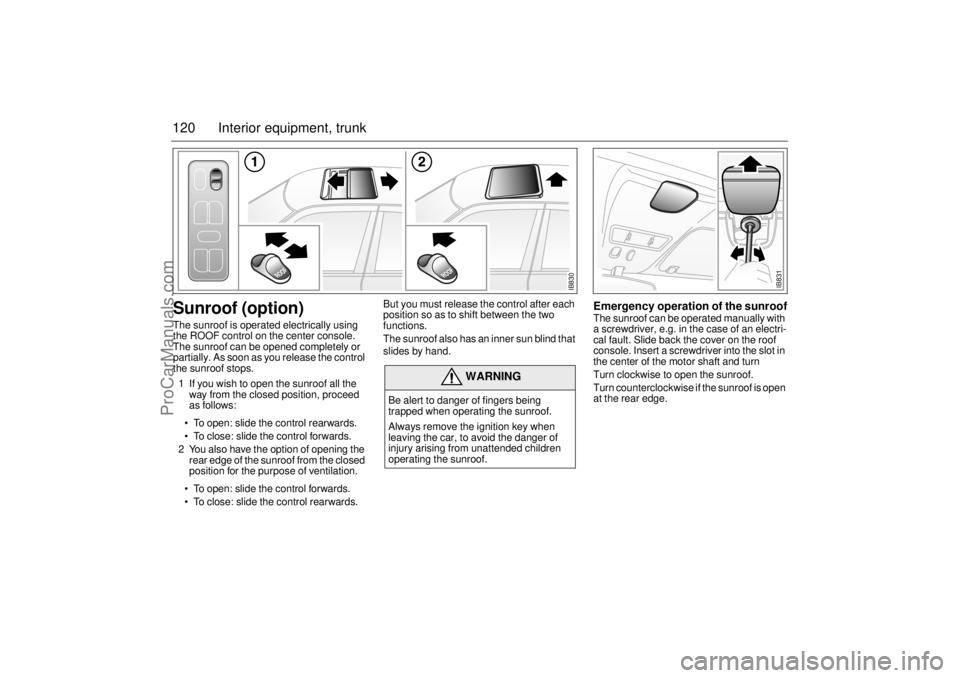
1 If you wish to open the sunroof all the
way from the closed position, proceed
as follows:
To open: slide the control rearwards.
To close: slide the control forwards.
2 You also have the option of opening the
rear edge of the sunroof from the closed
position for the purpose of ventilation.
To open: slide the control forwards.
To close: slide the control rearwards. But you must release the control after each
position so as to shift between the two
functions.
The sunroof also has an inner sun blind that
slides by hand.
Emergency operation of the sunroofThe sunroof can be operated manually with
a screwdriver, e.g. in the case of an electri-
cal fault. Slide back the cover on the roof
console. Insert a screwdriver into the slot in
the center of the motor shaft and turn
Turn clockwise to open the sunroof.
Turn counterclockwise if the sunroof is open
at the rear edge.
WARNING
Be alert to danger of fingers being
trapped when operating the sunroof.
Always remove the ignition key when
leaving the car, to avoid the danger of
injury arising from unattended children
operating the sunroof.
IB830
IB831
ProCarManuals.com
Page 121 of 236
121 Interior equipment, trunk
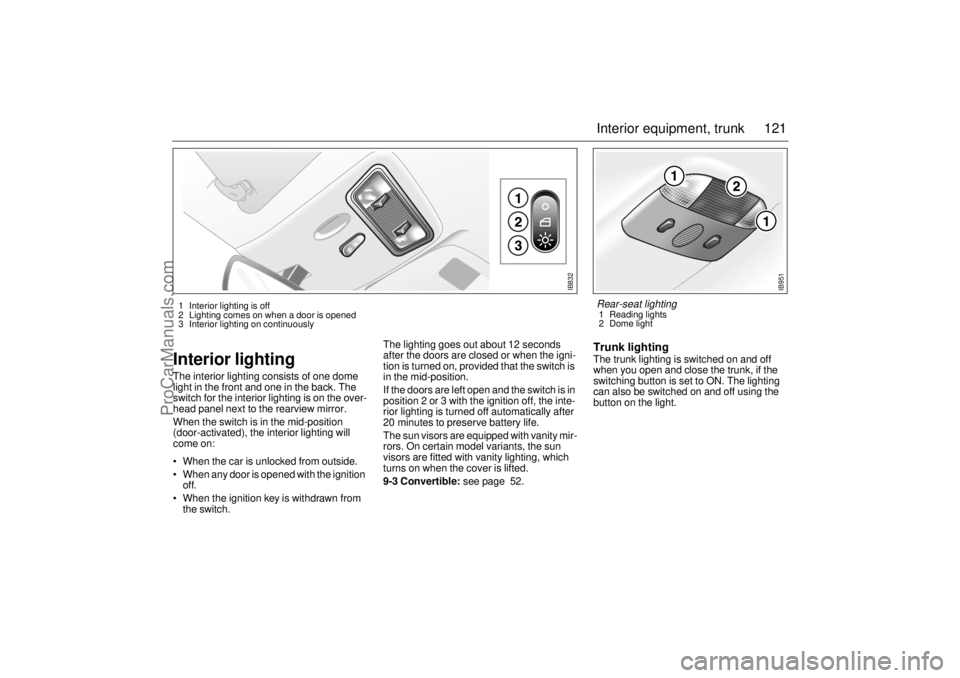
Interior lightingThe interior lighting consists of one dome
light in the front and one in the back. The
switch for the interior lighting is on the over-
head panel next to the rearview mirror.
When the switch is in the mid-position
(door-activated), the interior lighting will
come on:
When the car is unlocked from outside.
When any door is opened with the ignition
off.
When the ignition key is withdrawn from
the switch.The lighting goes out about 12 seconds
after the doors are closed or when the igni-
tion is turned on, provided that the switch is
in the mid-position.
If the doors are left open and the switch is in
position 2 or 3 with the ignition off, the inte-
rior lighting is turned off automatically after
20 minutes to preserve battery life.
The sun visors are equipped with vanity mir-
rors. On certain model variants, the sun
visors are fitted with vanity lighting, which
turns on when the cover is lifted.
9-3 Convertible: see page 52.
Trunk lightingThe trunk lighting is switched on and off
when you open and close the trunk, if the
switching button is set to ON. The lighting
can also be switched on and off using the
button on the light.
IB832
1 Interior lighting is off
2 Lighting comes on when a door is opened
3 Interior lighting on continuously
IB951
Rear-seat lighting 1 Reading lights
2 Dome light
ProCarManuals.com
Page 125 of 236
125 Interior equipment, trunk
Trunk, Coupé and 5-doorTrunk lid lockUnlock the trunk lid by pressing the lower button on the remote trans-
mitter, by pressing the remote release button on the driver’s door or
by using the key. The alarm horn sounds three times and the lights
flash when the trunk is released with the remote control.
Programming features, see page 231.
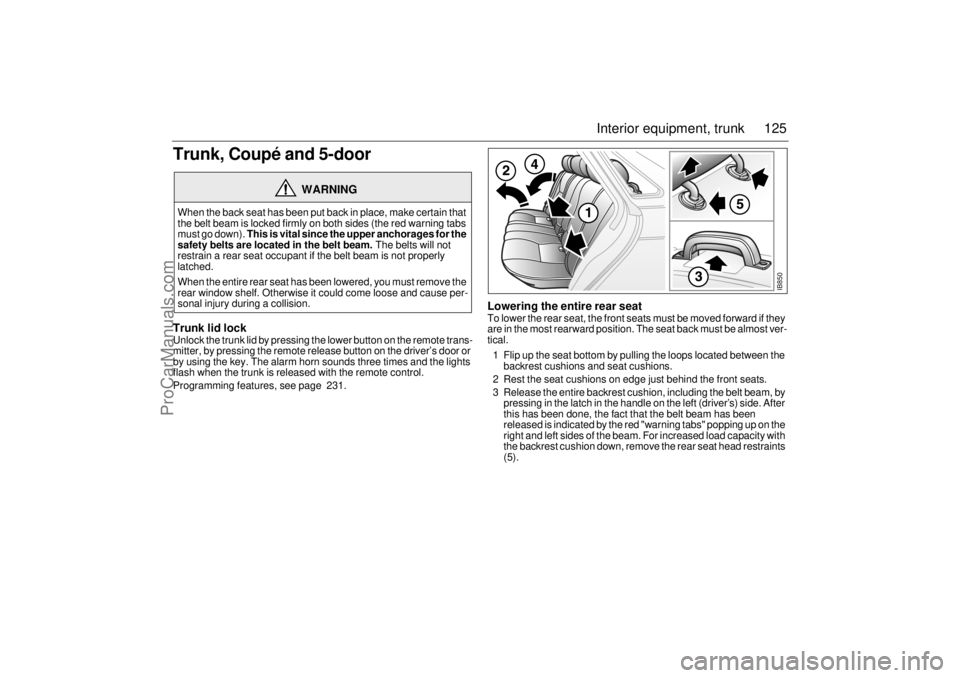
Lowering the entire rear seatTo lower the rear seat, the front seats must be moved forward if they
are in the most rearward position. The seat back must be almost ver-
tical.
1 Flip up the seat bottom by pulling the loops located between the
backrest cushions and seat cushions.
2 Rest the seat cushions on edge just behind the front seats.
3 Release the entire backrest cushion, including the belt beam, by
pressing in the latch in the handle on the left (driver’s) side. After
this has been done, the fact that the belt beam has been
released is indicated by the red "warning tabs" popping up on the
right and left sides of the beam. For increased load capacity with
the backrest cushion down, remove the rear seat head restraints
(5).
WARNING
When the back seat has been put back in place, make certain that
the belt beam is locked firmly on both sides (the red warning tabs
must go down). This is vital since the upper anchorages for the
safety belts are located in the belt beam. The belts will not
restrain a rear seat occupant if the belt beam is not properly
latched.
When the entire rear seat has been lowered, you must remove the
rear window shelf. Otherwise it could come loose and cause per-
sonal injury during a collision.
IB850
ProCarManuals.com
Page 134 of 236
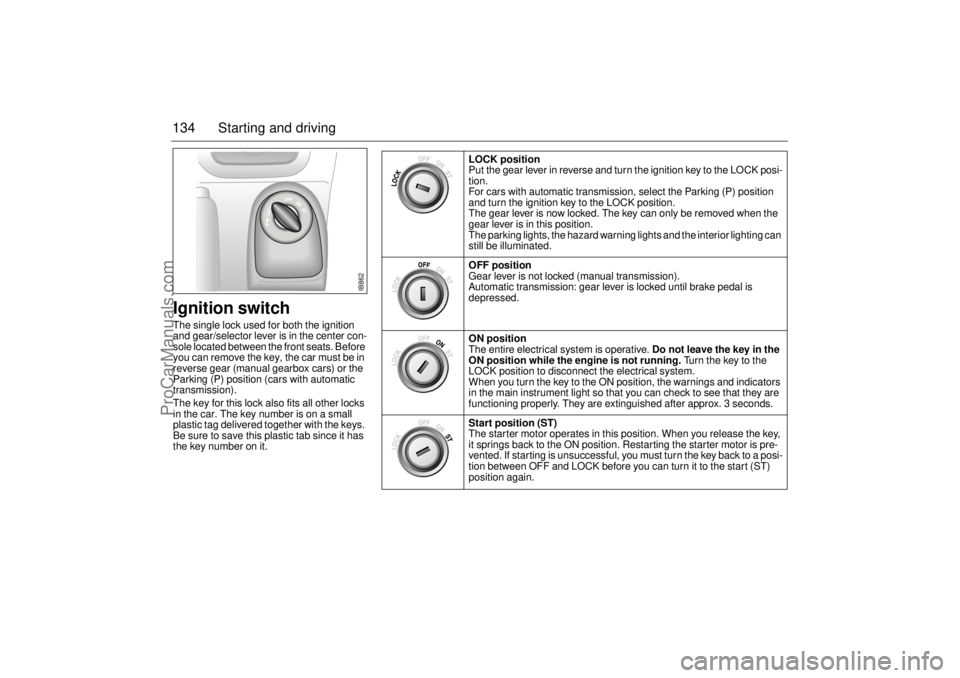
134 Starting and drivingIgnition switchThe single lock used for both the ignition
and gear/selector lever is in the center con-
sole located between the front seats. Before
you can remove the key, the car must be in
reverse gear (manual gearbox cars) or the
Parking (P) position (cars with automatic
transmission).
The key for this lock also fits all other locks
in the car. The key number is on a small
plastic tag delivered together with the keys.
Be sure to save this plastic tab since it has
the key number on it.
IB862
LOCK position
Put the gear lever in reverse and turn the ignition key to the LOCK posi-
tion.
For cars with automatic transmission, select the Parking (P) position
and turn the ignition key to the LOCK position.
The gear lever is now locked. The key can only be removed when the
gear lever is in this position.
The parking lights, the hazard warning lights and the interior lighting can
still be illuminated.
OFF position
Gear lever is not locked (manual transmission).
Automatic transmission: gear lever is locked until brake pedal is
depressed.
ON position
The entire electrical system is operative. Do not leave the key in the
ON position while the engine is not running. Turn the key to the
LOCK position to disconnect the electrical system.
When you turn the key to the ON position, the warnings and indicators
in the main instrument light so that you can check to see that they are
functioning properly. They are extinguished after approx. 3 seconds.
Start position (ST)
The starter motor operates in this position. When you release the key,
it springs back to the ON position. Restarting the starter motor is pre-
vented. If starting is unsuccessful, you must turn the key back to a posi-
tion between OFF and LOCK before you can turn it to the start (ST)
position again.
ProCarManuals.com
Page 135 of 236
135 Starting and driving
If the car does not startIf the text "KEY NOT ACCEPTED" appears
on the SID when the engine refuses to start,
the trouble may be a fault in the transponder
of the key or in the receiver of the ignition
switch. Proceed as follows:
• Turn the key back to the LOCK position.
Turn the key to the ON position.
Press one of the buttons on the remote
control (the LED on top of the dash stops
flashing).
Start the engine.
Try the other key. If it works, the trouble is in
the first key.
Call on an authorized Saab dealer for
inspection and correction.
Starting the engineDo not run the starter motor for more than
25 seconds at a time. Wait 20-30 seconds
before running the starter again, to give the
battery time to recover.
Avoid racing the engine or putting a heavy
load on it before it has warmed up. Let the
engine idle for at least 10 seconds and then
drive away as long as the engine oil warning
light has gone out to enable the engine to
attain its normal temperature as quickly as
possible.
It is possible for air to enter the lubricating
system in conjunction with an oil or oil-filter
change, or if the car has been stored for
some time. This air can cause the hydraulic
cam followers to emit a ticking noise, which
can persist for up to 15 minutes after start-
ing. Although this is quite normal and does
not indicate any malfunction, it is advisable
not to exceed 3,000 rpm before the noise
has disappeared. The hydraulic cam lifters are completely
service free; the valve clearance is set up at
the factory and will not need any subse-
quent adjustment.
Starting the engine The engine has an automatic choke and
should be started as follows:
Cars with manual gearbox
To start the engine the clutch pedal must
be fully depressed.
1 Depress the clutch pedal but do not
touch the accelerator.
2 Start the engine. Let the ignition key
spring back as soon as the engine has
started and is running smoothly – at very
low temperatures, you may need to run
the starter for up to 50 seconds.
Let the engine idle for about 10 seconds. Do
not open the throttle wide for at least
2-3 minutes after starting.
Cars with automatic transmission
The selector lever must be in the P or N
position.
1 Keep your foot on the brake pedal.
2 Start the engine. Let the ignition key
spring back as soon as the engine has
started and is running smoothly – at very
low temperatures, you may need to run
the starter for up to 50 seconds.
Let the engine idle for about 10 seconds. Do
not open the throttle wide for at least
2–3 minutes after starting.
WARNING
Always remove the key before leaving
the car.
Always apply the parking brake before
removing the ignition key.NOTETake care not to spill drinks or to drop
crumbs over the ignition switch. If dirt or
liquid gets into it, the switch may not
operate properly.
WARNING
Carbon monoxide (CO) is a colorless,
odorless, poisonous gas. Be alert to
the danger of CO – always open the
garage doors before starting the
engine in the garage.
There is also a danger of CO poison-
ing if the exhaust system is leaking.
ProCarManuals.com
Page 136 of 236

136 Starting and drivingUseful tips on cold climate startingIf the engine has failed to start after several
attempts in very cold weather, press and
hold the accelerator down to the floor and
run the starter for 5–10 seconds. This will
prevent the engine being flooded (exces-
sively rich fuel-air mixture).
Now start the engine in the normal way – do
not touch the accelerator.
If the engine stalls immediately after starting
(e.g. if the clutch was released too quickly),
do not touch the accelerator when restarting
the engine.
Every time the engine is switched off the
spark plugs are automatically cleaned. If
your attempt to start nevertheless fails, let
go of the ignition key and allow it to spring
back. This initiates more vigorous cleaning
of the sparking plugs which goes on for
about 5 seconds. Then start in the ordinary
way. Do not touch the accelerator; if the
accelerator is pressed to the floor the fuel
supply is shut off.
Important
considerations for
drivingThe engine-management system in the
Saab 9-3 is called Saab Trionic T7. The
system manages the ignition, fuel injection
and turbo boost pressure.
The Trionic T7 system developed by Saab
is an intelligent engine-management
system designed to achieve optimum drive-
ability under differing driving conditions.
The system makes adjustments automati-
cally, for instance, if the car is being driven
at altitude (oxygen-deficient air), for differ-
ent grades of fuel (AON 87–93) and for dif-
ferent load conditions.
1 Starting and driving
Refrain from using full throttle before
the engine has warmed up (before
needle is in the mid-range on tempera-
ture gauge) to avoid unnecessary
wear. If the needle of the pressure
gauge repeatedly enters the red zone
the engine may suddenly lose power,
owing to the intervention of a monitor-
ing system which curtails the charging
pressure. Get in touch with an autho-
rized Saab dealer at once.
A safety function prevents the engine
from revving faster than 6,200 rpm by
temporarily shutting of the fuel injec-
tors.2 Stopping the engine
Do not rev the engine immediately
before switching it off - stop the engine
when it is idling.
3 Regulating the charging pressure
The system is optimized for fuel with an
octane rating of AON 90. For cars with
205 hp engines and the Viggen, the
system is optimized for AON 93. One of
the advantages of the system is that it
enables the engine to be run safely on
lower-grade fuel, although not lower
than AON 87. However, engine perfor-
mance will fall off slightly, and heavy
loading should be avoided. For best
performance you should use the rec-
ommended grade of fuel, AON 90
(205 hp engine and Viggen AON 93).
The maximum boost pressure is
adjusted automatically to the knocking
or pinging tendency of the engine.
Occasional, short-lived knocking when
the engine is under a heavy load is per-
fectly normal; the extent will depend on
the grade of fuel in the tank.
Isolated instances of knocking are
more likely to occur with low-octane
fuel. This controlled form of knocking,
followed by a reduction in the boost
pressure, is a sign that the wastegate is
functioning and is perfectly safe for the
engine.
ProCarManuals.com
Page 142 of 236
142 Starting and drivingThe electronic control module for the auto-
matic transmission receives information on
engine torque and road speed. It also con-
trols the hydraulic pressure in the transmis-
sion to ensure that gear changing is as
smooth as possible.
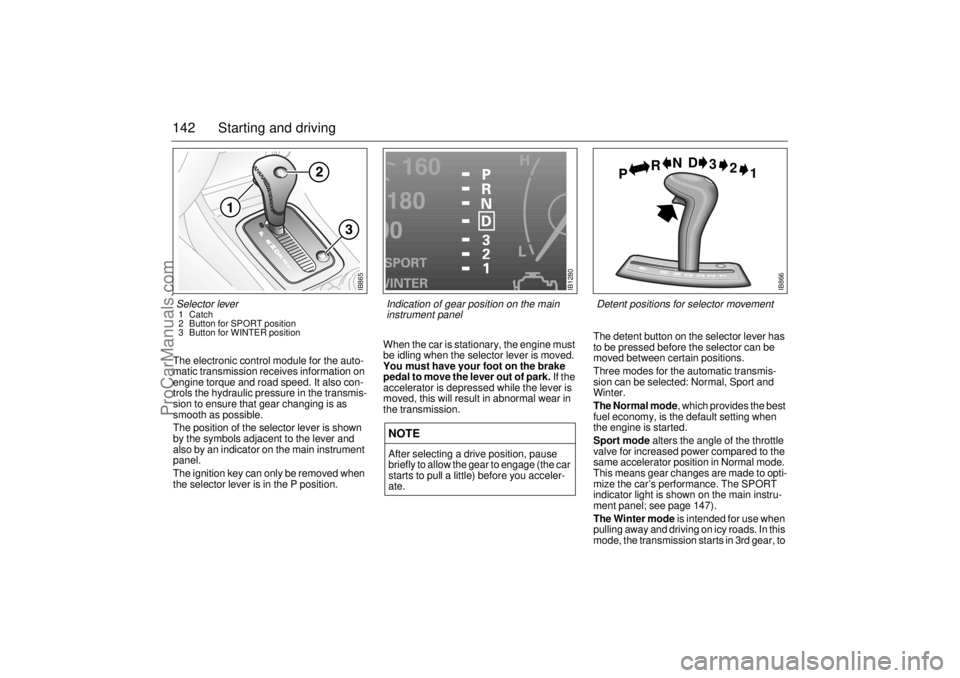
The position of the selector lever is shown
by the symbols adjacent to the lever and
also by an indicator on the main instrument
panel.
The ignition key can only be removed when
the selector lever is in the P position.When the car is stationary, the engine must
be idling when the selector lever is moved.
You must have your foot on the brake
pedal to move the lever out of park. If the
accelerator is depressed while the lever is
moved, this will result in abnormal wear in
the transmission. The detent button on the selector lever has
to be pressed before the selector can be
moved between certain positions.
Three modes for the automatic transmis-
sion can be selected: Normal, Sport and
Winter.
The Normal mode, which provides the best
fuel economy, is the default setting when
the engine is started.
Sport mode alters the angle of the throttle
valve for increased power compared to the
same accelerator position in Normal mode.
This means gear changes are made to opti-
mize the car’s performance. The SPORT
indicator light is shown on the main instru-
ment panel; see page 147).
The Winter mode is intended for use when
pulling away and driving on icy roads. In this
mode, the transmission starts in 3rd gear, to
NOTEAfter selecting a drive position, pause
briefly to allow the gear to engage (the car
starts to pull a little) before you acceler-
ate.
IB1280
Indication of gear position on the main
instrument panel
IB865
Selector lever 1 Catch
2 Button for SPORT position
3 Button for WINTER position
PRND
3
2
1
IB866
Detent positions for selector movement
ProCarManuals.com
Page 143 of 236
143 Starting and driving
provide better grip, and the WINTER indica-
tor appears on the main instrument panel.
When the ignition is turned to OFF, the auto-
matic transmission will automatically revert
to Normal mode (see page 147).
Adaptive gear change pattern is a func-
tion of the Normal and Sport modes. It
allows gear changing to be suited to the pre-
vailing driving conditions. The transmission
control module senses the engine load and
temperature of the transmission and selects
one of the four available gear change pat-
terns. Unnecessary gear changes and
undesired temperature increases in the
transmission are avoided.
The automatic transmission has a special
shift pattern during the first minute after a
cold engine is started so that the catalytic
converter will reach its correct working tem-
perature more rapidlyLock-up functionThe automatic transmission has a lock-up
function, which renders the torque con-
verter inoperative in 2nd, 3rd and 4th gears.
The result is reduction in the engine speed
and, hence, fuel consumption.
When the lock-up function comes into oper-
ation, it may give the impression of an over-
drive being engaged.
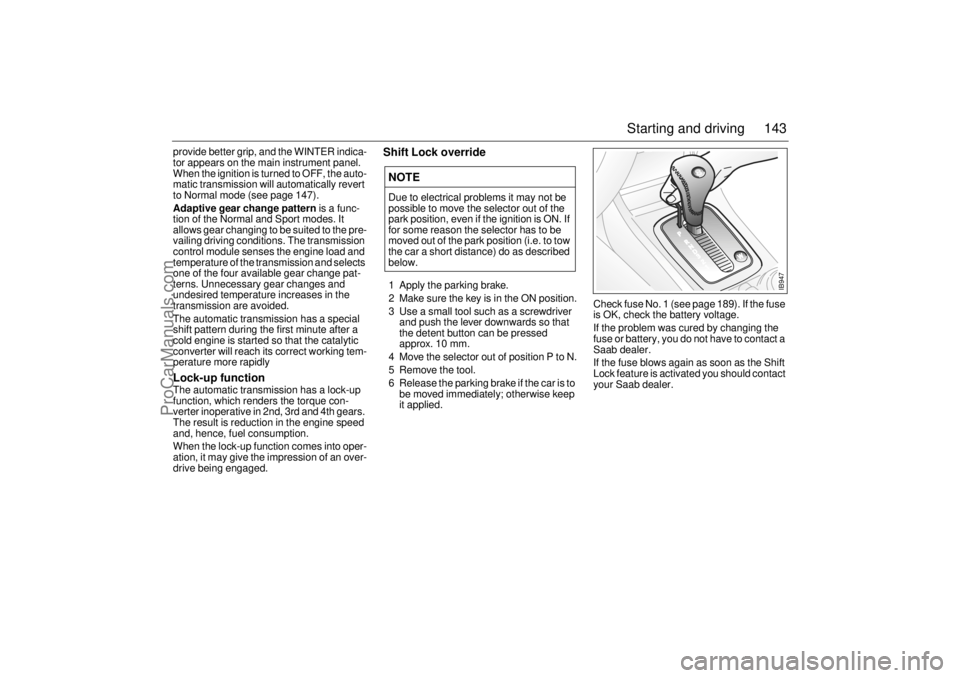
Shift Lock override1 Apply the parking brake.
2 Make sure the key is in the ON position.
3 Use a small tool such as a screwdriver
and push the lever downwards so that
the detent button can be pressed
approx. 10 mm.
4 Move the selector out of position P to N.
5 Remove the tool.
6 Release the parking brake if the car is to
be moved immediately; otherwise keep
it applied.Check fuse No. 1 (see page 189). If the fuse
is OK, check the battery voltage.
If the problem was cured by changing the
fuse or battery, you do not have to contact a
Saab dealer.
If the fuse blows again as soon as the Shift
Lock feature is activated you should contact
your Saab dealer.NOTEDue to electrical problems it may not be
possible to move the selector out of the
park position, even if the ignition is ON. If
for some reason the selector has to be
moved out of the park position (i.e. to tow
the car a short distance) do as described
below.
IB947
ProCarManuals.com
Page 151 of 236
151 Starting and driving
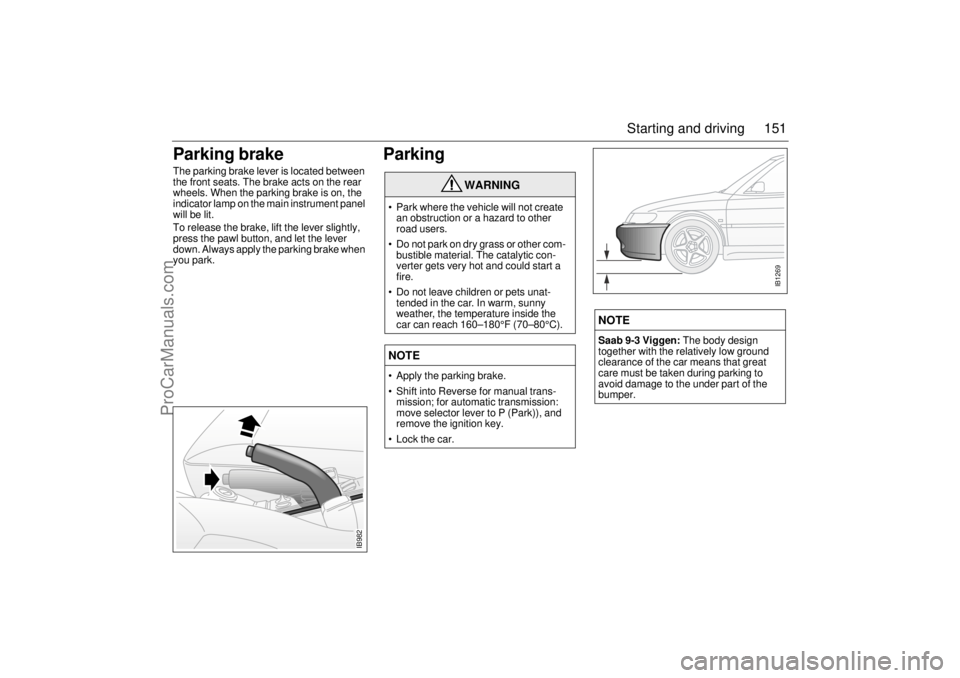
Parking brakeThe parking brake lever is located between
the front seats. The brake acts on the rear
wheels. When the parking brake is on, the
indicator lamp on the main instrument panel
will be lit.
To release the brake, lift the lever slightly,
press the pawl button, and let the lever
down. Always apply the parking brake when
you park.
Parking
WARNING
Park where the vehicle will not create
an obstruction or a hazard to other
road users.
Do not park on dry grass or other com-
bustible material. The catalytic con-
verter gets very hot and could start a
fire.
Do not leave children or pets unat-
tended in the car. In warm, sunny
weather, the temperature inside the
car can reach 160–180°F (70–80°C). NOTE Apply the parking brake.
Shift into Reverse for manual trans-
mission; for automatic transmission:
move selector lever to P (Park)), and
remove the ignition key.
Lock the car.
NOTESaab 9-3 Viggen: The body design
together with the relatively low ground
clearance of the car means that great
care must be taken during parking to
avoid damage to the under part of the
bumper.
IB1269
IB982
ProCarManuals.com