ECU SAAB 9-3 2000 Owner's Guide
[x] Cancel search | Manufacturer: SAAB, Model Year: 2000, Model line: 9-3, Model: SAAB 9-3 2000Pages: 236, PDF Size: 10.85 MB
Page 157 of 236
157 Starting and driving
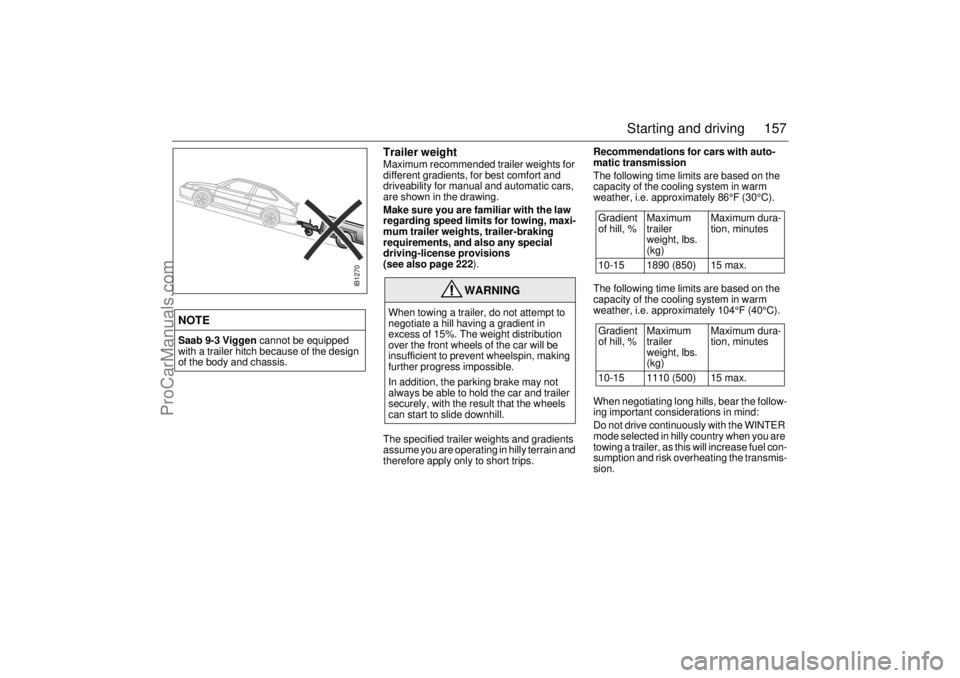
Trailer weightMaximum recommended trailer weights for
different gradients, for best comfort and
driveability for manual and automatic cars,
are shown in the drawing.
Make sure you are familiar with the law
regarding speed limits for towing, maxi-
mum trailer weights, trailer-braking
requirements, and also any special
driving-license provisions
(see also page 222).
The specified trailer weights and gradients
assume you are operating in hilly terrain and
therefore apply only to short trips.Recommendations for cars with auto-
matic transmission
The following time limits are based on the
capacity of the cooling system in warm
weather, i.e. approximately 86°F (30°C).
The following time limits are based on the
capacity of the cooling system in warm
weather, i.e. approximately 104°F (40°C).
When negotiating long hills, bear the follow-
ing important considerations in mind:
Do not drive continuously with the WINTER
mode selected in hilly country when you are
towing a trailer, as this will increase fuel con-
sumption and risk overheating the transmis-
sion.
NOTESaab 9-3 Viggen cannot be equipped
with a trailer hitch because of the design
of the body and chassis.
WARNING
When towing a trailer, do not attempt to
negotiate a hill having a gradient in
excess of 15%. The weight distribution
over the front wheels of the car will be
insufficient to prevent wheelspin, making
further progress impossible.
In addition, the parking brake may not
always be able to hold the car and trailer
securely, with the result that the wheels
can start to slide downhill.
Gradient
of hill, % Maximum
trailer
weight, lbs.
(kg)Maximum dura-
tion, minutes
10-15 1890 (850) 15 max.
Gradient
of hill, % Maximum
trailer
weight, lbs.
(kg)Maximum dura-
tion, minutes
10-15 1110 (500) 15 max.
IB1270
ProCarManuals.com
Page 158 of 236
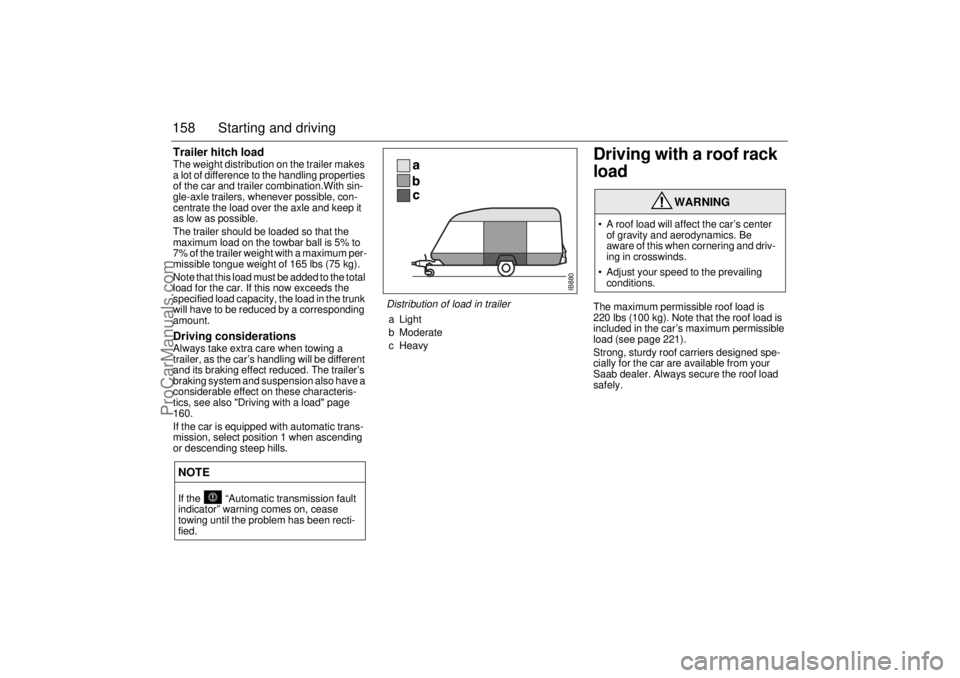
158 Starting and drivingTrailer hitch loadThe weight distribution on the trailer makes
a lot of difference to the handling properties
of the car and trailer combination.With sin-
gle-axle trailers, whenever possible, con-
centrate the load over the axle and keep it
as low as possible.
The trailer should be loaded so that the
maximum load on the towbar ball is 5% to
7% of the trailer weight with a maximum per-
missible tongue weight of 165 lbs (75 kg).
Note that this load must be added to the total
load for the car. If this now exceeds the
specified load capacity, the load in the trunk
will have to be reduced by a corresponding
amount. Driving considerationsAlways take extra care when towing a
trailer, as the car’s handling will be different
and its braking effect reduced. The trailer’s
braking system and suspension also have a
considerable effect on these characteris-
tics, see also "Driving with a load" page
160.
If the car is equipped with automatic trans-
mission, select position 1 when ascending
or descending steep hills.
Driving with a roof rack
loadThe maximum permissible roof load is
220 lbs (100 kg). Note that the roof load is
included in the car’s maximum permissible
load (see page 221).
Strong, sturdy roof carriers designed spe-
cially for the car are available from your
Saab dealer. Always secure the roof load
safely.
NOTEIf the “Automatic transmission fault
indicator” warning comes on, cease
towing until the problem has been recti-
fied.
WARNING
A roof load will affect the car’s center
of gravity and aerodynamics. Be
aware of this when cornering and driv-
ing in crosswinds.
Adjust your speed to the prevailing
conditions.
IB880
Distribution of load in trailer aLight
b Moderate
cHeavy
ProCarManuals.com
Page 160 of 236
160 Starting and drivingDriving with a loadThe driving characteristics of the car are
affected by the way it is loaded.
Place heavy loads as far forward and as
low as possible in the trunk.
Secure the load to the tie downs, see
page 129.
The load should be such that the car´s
total weight or axle weight are not
exceeded, see page 221.
Heavy loads mean that the car’s center of
gravity is further back. As a result, the car
will sway more during evasive steering.
Never exceed the permissible load in the
roof box, even if there is room for more.
Ensure that the tire pressure is correct –
slight overinflation is preferable to under-
inflation.
The braking distance of a loaded car is
always greater. Keep your distance from
the vehicle in front.
Tire pressure, see page 192 and back
cover.
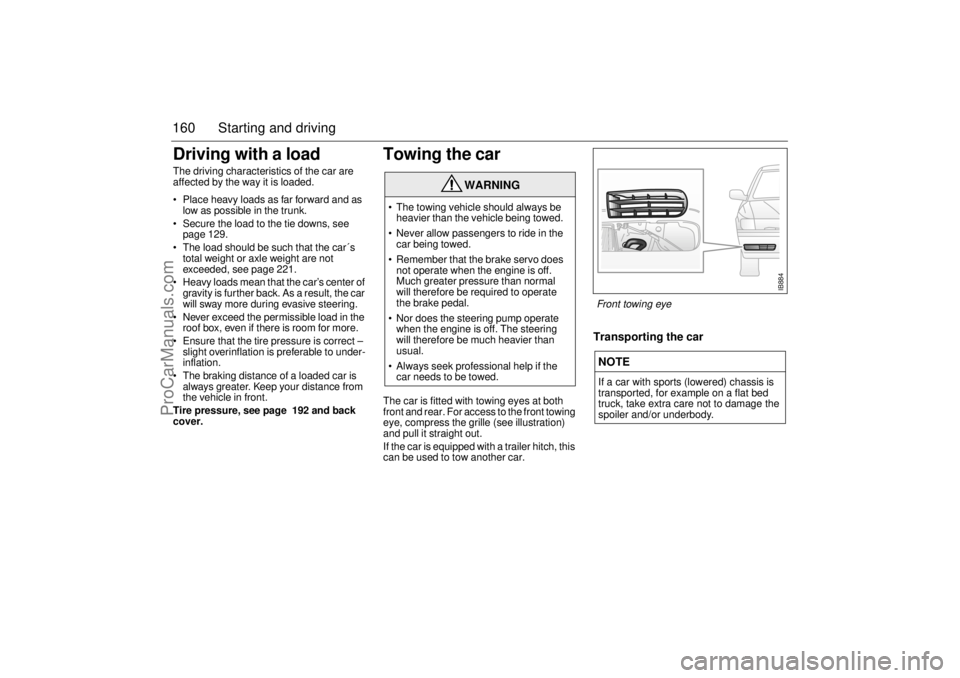
Towing the carThe car is fitted with towing eyes at both
front and rear. For access to the front towing
eye, compress the grille (see illustration)
and pull it straight out.
If the car is equipped with a trailer hitch, this
can be used to tow another car.
Transporting the car
WARNING
The towing vehicle should always be
heavier than the vehicle being towed.
Never allow passengers to ride in the
car being towed.
Remember that the brake servo does
not operate when the engine is off.
Much greater pressure than normal
will therefore be required to operate
the brake pedal.
Nor does the steering pump operate
when the engine is off. The steering
will therefore be much heavier than
usual.
Always seek professional help if the
car needs to be towed.
NOTEIf a car with sports (lowered) chassis is
transported, for example on a flat bed
truck, take extra care not to damage the
spoiler and/or underbody.
IB884
Front towing eye
ProCarManuals.com
Page 165 of 236

165 Starting and driving
Driving considerations
with compact spare
wheel/tire fitted The following should be observed when the
compact spare wheel (T115/70 R16) is
installed:
The compact spare is light and easy to
handle when changing the wheel. Do not
drive farther than necessary with the com-
pact spare fitted – the maximum life of the
wheel is only just over 2000 miles
(3,500 km). Have the standard wheel
repaired and reinstalled as soon as possi-
ble.
The car’s ground clearance is reduced with
the compact spare fitted. Note that only one
compact spare wheel may be used at any
time. Take care not to hit the curb and do not
fit snow chains. Leave the wheel cover off,
so that the warning text is readily visible.
For long tripsBefore starting off on a long journey, it is
advisable to have your car inspected over
by your Saab dealer.
Obtain a few important items to take along
on your journey such as spare bulbs, wiper
blades, fuses, a Poly-Vee-belt and the like.
You can check some points yourself before-
hand:
Make sure that the engine is in good con-
dition.
Check that no oil or fuel leaks out of the
engine or gearbox/transmission.
Inspect the Poly-Vee-belt and replace it if
it shows any signs of wear.
Check the battery charge.
Check the tires for tread pattern and air
pressure, including the compact spare
wheel.
Take an extra car key/remote control and
keep it separate, see also page 30.
Check the brakes.
Check all bulbs.
Check for the presence of the tool kit and
the jack in the car.
WARNING
Do not exceed 50 mph (80 km/h) as the
tire can overheat and adversely affect the
handling of the car.
The tire should be inflated to 60 psi
(420 kPa).
NOTETo avoid damaging a punctured alloy
wheel this can be placed outside up in the
spare-wheel well but only while driving to
the closest workshop.
A general rule is that all heavy loads must
be well secured in the luggage compart-
ment, see page 129.
ProCarManuals.com
Page 181 of 236
181 Car care
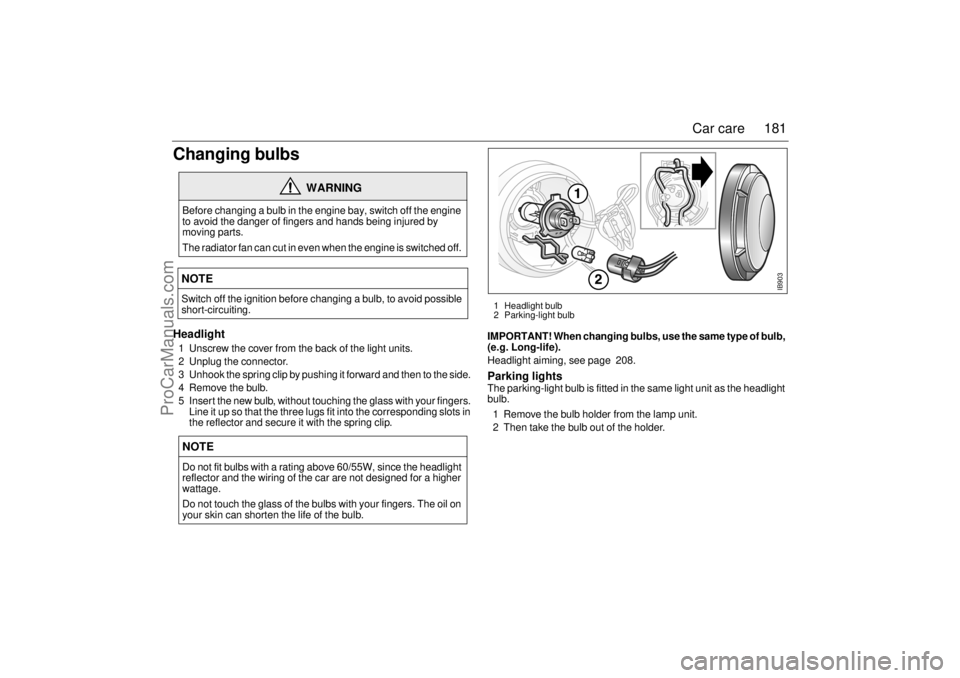
Changing bulbs Headlight 1 Unscrew the cover from the back of the light units.
2 Unplug the connector.
3 Unhook the spring clip by pushing it forward and then to the side.
4 Remove the bulb.
5 Insert the new bulb, without touching the glass with your fingers.
Line it up so that the three lugs fit into the corresponding slots in
the reflector and secure it with the spring clip.IMPORTANT! When changing bulbs, use the same type of bulb,
(e.g. Long-life).
Headlight aiming, see page 208.
Parking lights The parking-light bulb is fitted in the same light unit as the headlight
bulb.
1 Remove the bulb holder from the lamp unit.
2 Then take the bulb out of the holder.
WARNING
Before changing a bulb in the engine bay, switch off the engine
to avoid the danger of fingers and hands being injured by
moving parts.
The radiator fan can cut in even when the engine is switched off. NOTESwitch off the ignition before changing a bulb, to avoid possible
short-circuiting. NOTEDo not fit bulbs with a rating above 60/55W, since the headlight
reflector and the wiring of the car are not designed for a higher
wattage.
Do not touch the glass of the bulbs with your fingers. The oil on
your skin can shorten the life of the bulb.
IB903
1 Headlight bulb
2 Parking-light bulb
ProCarManuals.com
Page 183 of 236
183 Car care
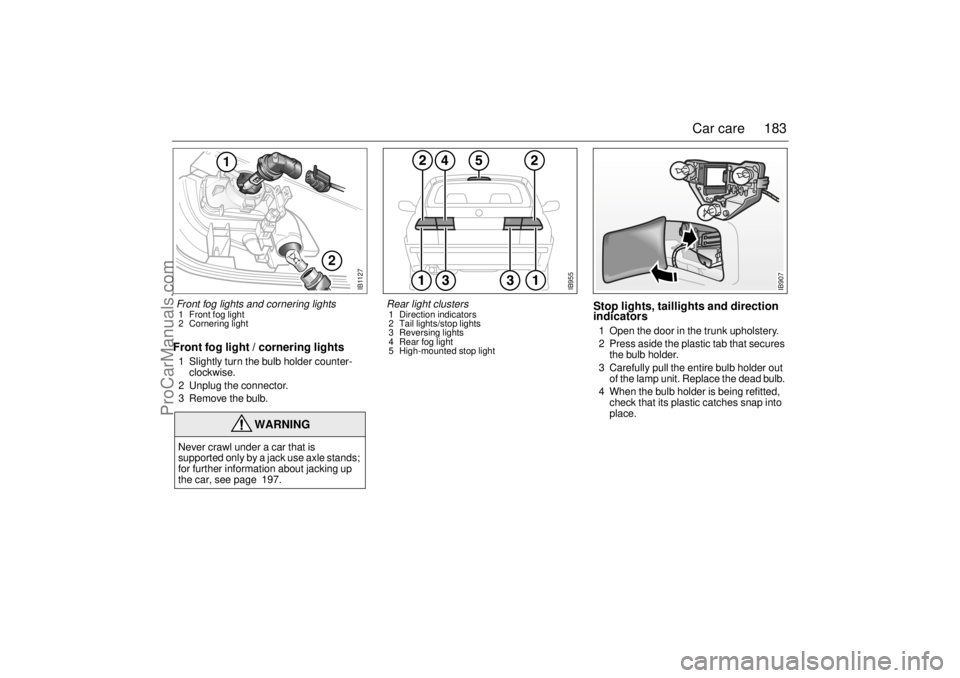
Front fog light / cornering lights1 Slightly turn the bulb holder counter-
clockwise.
2 Unplug the connector.
3 Remove the bulb.
Stop lights, taillights and direction
indicators 1 Open the door in the trunk upholstery.
2 Press aside the plastic tab that secures
the bulb holder.
3 Carefully pull the entire bulb holder out
of the lamp unit. Replace the dead bulb.
4 When the bulb holder is being refitted,
check that its plastic catches snap into
place.
WARNING
Never crawl under a car that is
supported only by a jack use axle stands;
for further information about jacking up
the car, see page 197.
IB1127
1
2
IB955
Rear light clusters 1 Direction indicators
2 Tail lights/stop lights
3 Reversing lights
4 Rear fog light
5 High-mounted stop light
IB907
Front fog lights and cornering lights1 Front fog light
2 Cornering light
ProCarManuals.com
Page 184 of 236
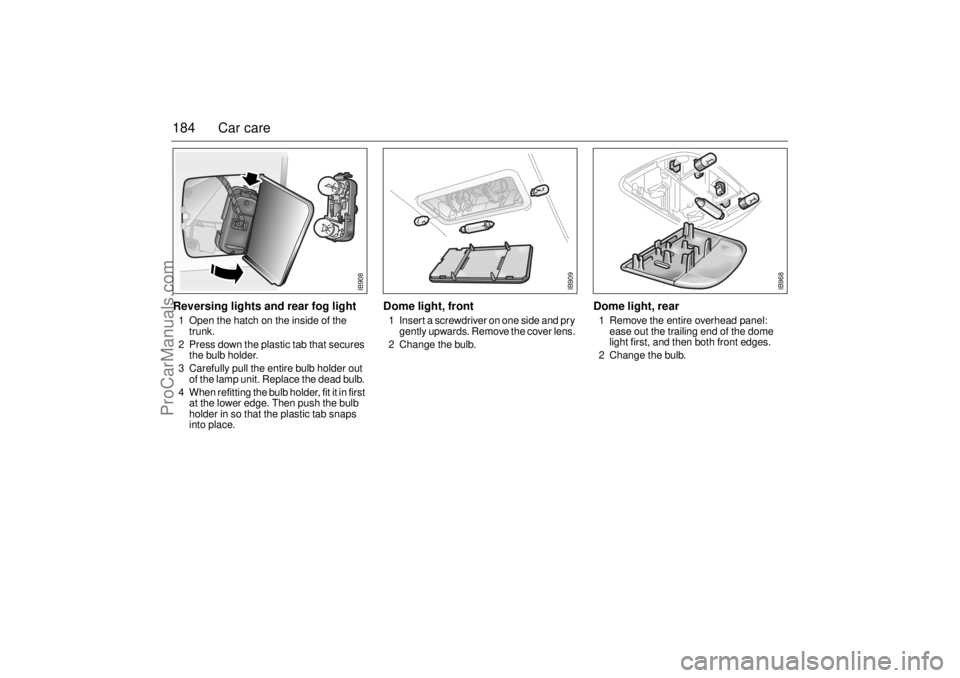
184 Car careReversing lights and rear fog light 1 Open the hatch on the inside of the
trunk.
2 Press down the plastic tab that secures
the bulb holder.
3 Carefully pull the entire bulb holder out
of the lamp unit. Replace the dead bulb.
4 When refitting the bulb holder, fit it in first
at the lower edge. Then push the bulb
holder in so that the plastic tab snaps
into place.
Dome light, front 1 Insert a screwdriver on one side and pry
gently upwards. Remove the cover lens.
2 Change the bulb.
Dome light, rear 1 Remove the entire overhead panel:
ease out the trailing end of the dome
light first, and then both front edges.
2 Change the bulb.
IB908
IB909
IB968
ProCarManuals.com
Page 196 of 236
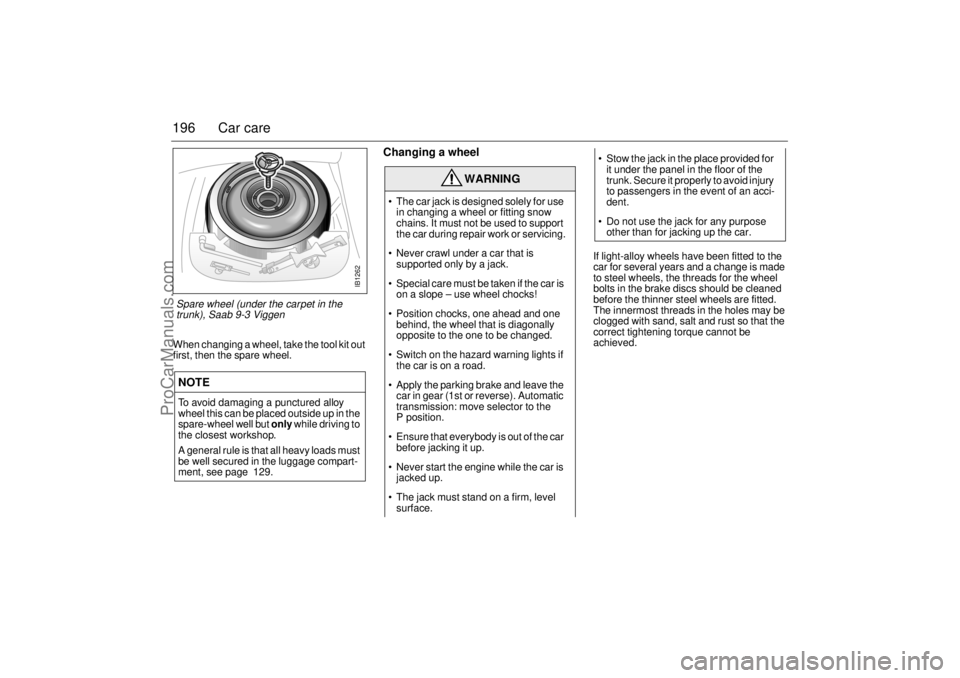
196 Car careWhen changing a wheel, take the tool kit out
first, then the spare wheel.
Changing a wheel
If light-alloy wheels have been fitted to the
car for several years and a change is made
to steel wheels, the threads for the wheel
bolts in the brake discs should be cleaned
before the thinner steel wheels are fitted.
The innermost threads in the holes may be
clogged with sand, salt and rust so that the
correct tightening torque cannot be
achieved.
NOTETo avoid damaging a punctured alloy
wheel this can be placed outside up in the
spare-wheel well but only while driving to
the closest workshop.
A general rule is that all heavy loads must
be well secured in the luggage compart-
ment, see page 129.
WARNING
The car jack is designed solely for use
in changing a wheel or fitting snow
chains. It must not be used to support
the car during repair work or servicing.
Never crawl under a car that is
supported only by a jack.
Special care must be taken if the car is
on a slope – use wheel chocks!
Position chocks, one ahead and one
behind, the wheel that is diagonally
opposite to the one to be changed.
Switch on the hazard warning lights if
the car is on a road.
Apply the parking brake and leave the
car in gear (1st or reverse). Automatic
transmission: move selector to the
P position.
Ensure that everybody is out of the car
before jacking it up.
Never start the engine while the car is
jacked up.
The jack must stand on a firm, level
surface.
Stow the jack in the place provided for
it under the panel in the floor of the
trunk. Secure it properly to avoid injury
to passengers in the event of an acci-
dent.
Do not use the jack for any purpose
other than for jacking up the car.
IB1261IB1262
Spare wheel (under the carpet in the
trunk), Saab 9-3 Viggen
ProCarManuals.com
Page 222 of 236

222 Technical data Maximum permitted load in trunk
Coupé and 5-door at curb weight plus
4 passengers à 155 lbs. (70 kg) _______ 130 lbs.(60 kg)
For each passenger less in the rear seat the load may be
increased by 100 lbs. (45 kg)
Convertible at curb weight and
3 passengers à 155 lbs. (70 kg) _______ 120 lbs. (55 kg)
Coupé and 5-door at curb weight and
rear seat right down ________________ 475 lbs. (215 kg)
WARNING
The GVW and maximum axle loads must not be exceeded.
Note that if some accessories (e.g. towbar, CD changer) are
fitted, the available load capacity is reduced by the weight of
these items.
When goods are being transported their security is important,
especially if the car is being used with the rear seat down.
Max. permitted roof load ____________ 220 lbs. (100 kg)
Trailer weights:
Trailer with brakes _________________ Max. 2000 lbs.
(900 kg)
Trailer without brakes _______________ Max. 1000 lbs.
(450 kg)
Recommended towbar-ball load ______ 110-165 lbs.
(50-75 kg)
Maximum towing speed, trailer with
brakes __________________________ 62 mph (100 km/h)
The above max. weights and speed limit are those which Saab
Automobile AB permits. Note that the national rules may set lim-
its to permitted weights and speed; see also page 156.
ProCarManuals.com
Page 235 of 236

235 Index
Manual climate-control system
______ 76
Manual raising of the soft top,
Convertible
____________________ 46
Manually opening the fuel filler door,
Convertible ____________________ 52
Manually opening the fuel filler door,
Coupé and 5-door
______________ 131
Maxi fuses
_____________________ 188
Memory, driver’s seat
____________ 117
Motoring abroad
________________ 165
NNight Panel
_____________________ 69
OOdometer
______________________ 59
Oil specification
_________________ 223
OnStar
_______________________ 109
Opening handle
_________________ 30
Owner assistance _______________ 213
PPaint touch-up
__________________ 202
Parcel shelf
____________________ 128
Parking
_______________________ 151
Parking brake
__________________ 151Parking lights
___________________ 71
Plates and labels ________________ 229
Power-steering fluid, check
________ 177
Pressure gauge
__________________ 60
Programmable driver’s seat
_______ 117
Programming, ACC
_______________ 86
RRadio
__________________________ 94
Raising the soft top, Convertible
_____ 45
Rear fog light
____________________ 73
Rear seat
_____________________ 125
Rear seat, tipping
_______________ 125
Rear window wiper _______________ 75
Rearview mirrors
________________ 124
Rear-window wiper _______________ 75
Recirculation
____________________ 78
Recycling
_____________________ 205
Refuelling _____________________ 138
Relay table ____________________ 190
Remote control __________________ 30
Remote control battery, changing
____ 32
Reporting safety defects
__________ 214
Rev counter
_____________________ 59
Reversing lights
_________________ 73
Rotating the tires ________________ 193
Running-in
_____________________ 140
SSAHR, head restraint
____________ 114
SID (Side instrument display)
_______ 62
SRS (airbag)
____________________ 22
Safety belts
_____________________ 12
Safety belts, care of
______________ 199
Seat-belt pretensioners
____________ 13
Seats
_________________________ 112
Securing a load
__________________ 33
Service costs
___________________ 213
Service information
______________ 214
Service intervals
________________ 212
Service record retention
__________ 213
Side airbag
_____________________ 27
Side airbags ____________________ 27
Ski hatch
______________________ 128
Snow tires _____________________ 227
Soft-top storage, Convertible
________ 50
Spare wheel
___________________ 130
Speedometer ____________________ 59
Starting the engine
______________ 135
Steering pump oil, grade
__________ 226
Steering-wheel adjustment ________ 118
Sunroof
_______________________ 120
TTachometer
_____________________ 59
Tailgate, opening
_________________ 33
Technical data
__________________ 220
ProCarManuals.com