trunk SAAB 9-3 2000 Service Manual
[x] Cancel search | Manufacturer: SAAB, Model Year: 2000, Model line: 9-3, Model: SAAB 9-3 2000Pages: 236, PDF Size: 10.85 MB
Page 131 of 236
131 Interior equipment, trunk
Manually opening the
fuel filler door Coupé and 5-door models If the fuel filler door (which is controlled by
the central locking system) does not unlock,
proceed as follows.
Check fuse 20. If it is blown or its replace-
ment blows, you can release the lock motor
from the door as follows:
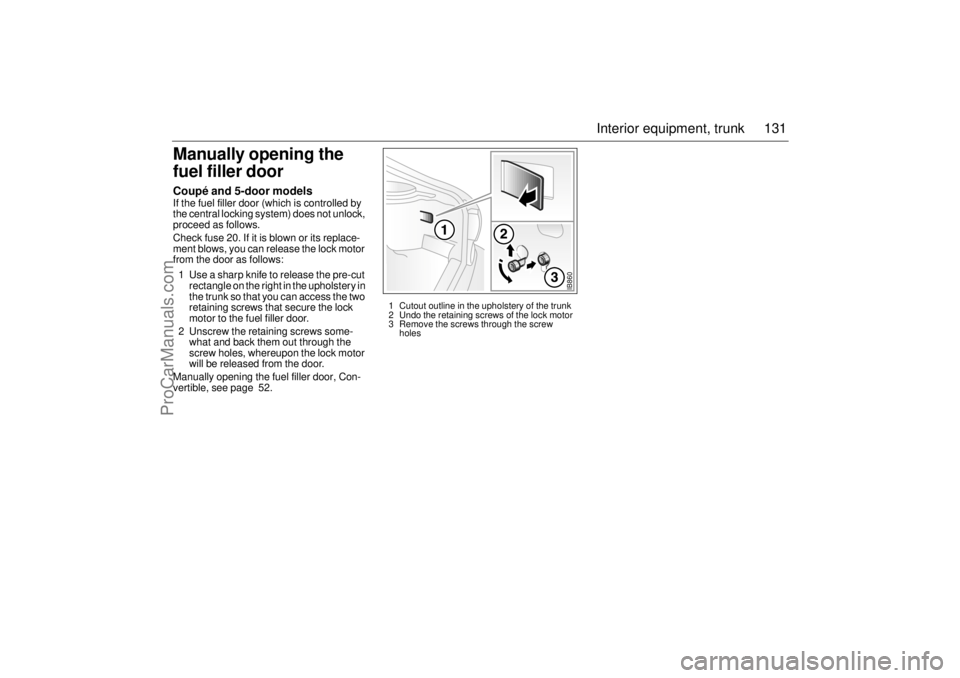
1 Use a sharp knife to release the pre-cut
rectangle on the right in the upholstery in
the trunk so that you can access the two
retaining screws that secure the lock
motor to the fuel filler door.
2 Unscrew the retaining screws some-
what and back them out through the
screw holes, whereupon the lock motor
will be released from the door.
Manually opening the fuel filler door, Con-
vertible, see page 52.
IB860
1 Cutout outline in the upholstery of the trunk
2 Undo the retaining screws of the lock motor
3 Remove the screws through the screw
holes
ProCarManuals.com
Page 132 of 236

132 Interior equipment, trunk
ProCarManuals.com
Page 133 of 236
133 Starting and driving
IB943Starting and drivingIgnition switch ................. 134
Starting the engine .......... 135
Important considerations
for driving....................... 136
Engine Break-in Period... 140
Gear changing ................. 141
Manual transmission ...... 141
Automatic transmission . 141
Cruise Control ................. 148
Braking ............................. 149
Parking ............................. 151
Economical motoring ..... 153 Driving in cold weather ... 154
Driving in hot weather ..... 156
Towing a trailer ................ 156
Driving with a roof rack
load .................................. 158
Towing the car.................. 160
Jump starting ................... 162
Driving considerations
with compact spare
wheel/tire fitted............... 165
For long trips .................... 165
Driving with the trunk lid
open ................................ 166
Driving in deep water....... 166
ProCarManuals.com
Page 152 of 236
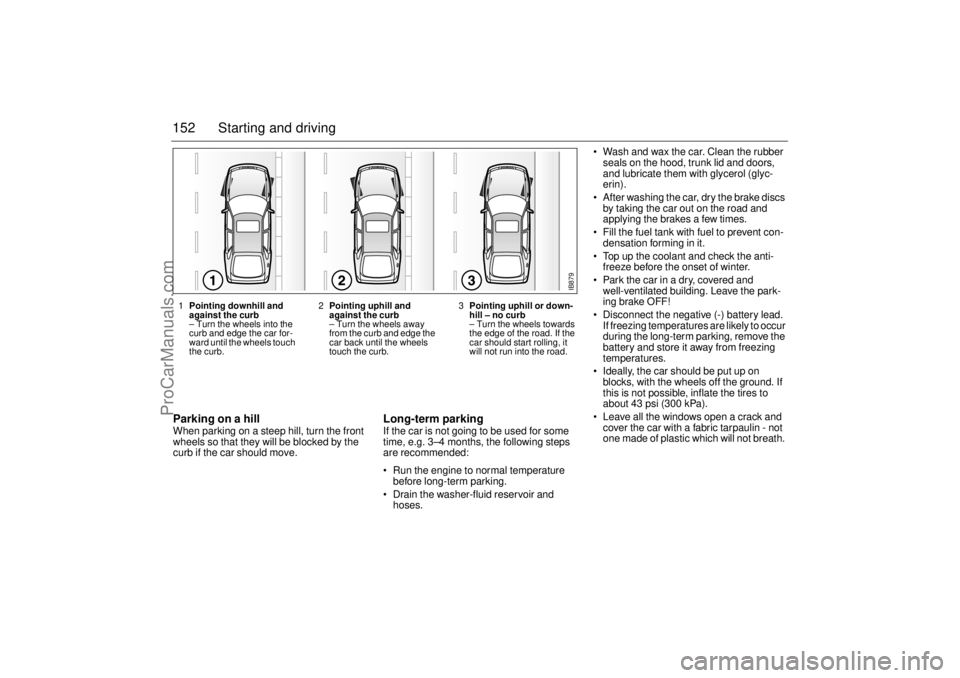
152 Starting and drivingParking on a hillWhen parking on a steep hill, turn the front
wheels so that they will be blocked by the
curb if the car should move.
Long-term parkingIf the car is not going to be used for some
time, e.g. 3–4 months, the following steps
are recommended:
Run the engine to normal temperature
before long-term parking.
Drain the washer-fluid reservoir and
hoses. Wash and wax the car. Clean the rubber
seals on the hood, trunk lid and doors,
and lubricate them with glycerol (glyc-
erin).
After washing the car, dry the brake discs
by taking the car out on the road and
applying the brakes a few times.
Fill the fuel tank with fuel to prevent con-
densation forming in it.
Top up the coolant and check the anti-
freeze before the onset of winter.
Park the car in a dry, covered and
well-ventilated building. Leave the park-
ing brake OFF!
Disconnect the negative (-) battery lead.
If freezing temperatures are likely to occur
during the long-term parking, remove the
battery and store it away from freezing
temperatures.
Ideally, the car should be put up on
blocks, with the wheels off the ground. If
this is not possible, inflate the tires to
about 43 psi (300 kPa).
Leave all the windows open a crack and
cover the car with a fabric tarpaulin - not
one made of plastic which will not breath.
IB879
1Pointing downhill and
against the curb
– Turn the wheels into the
curb and edge the car for-
ward until the wheels touch
the curb. 2Pointing uphill and
against the curb
– Turn the wheels away
from the curb and edge the
car back until the wheels
touch the curb. 3Pointing uphill or down-
hill – no curb
– Turn the wheels towards
the edge of the road. If the
car should start rolling, it
will not run into the road.
ProCarManuals.com
Page 158 of 236
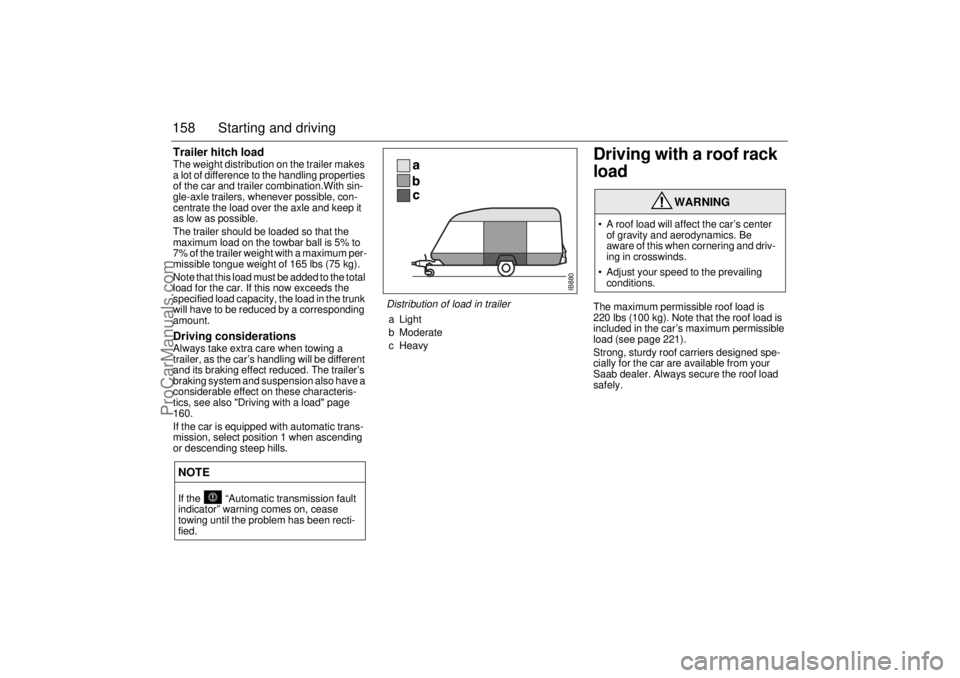
158 Starting and drivingTrailer hitch loadThe weight distribution on the trailer makes
a lot of difference to the handling properties
of the car and trailer combination.With sin-
gle-axle trailers, whenever possible, con-
centrate the load over the axle and keep it
as low as possible.
The trailer should be loaded so that the
maximum load on the towbar ball is 5% to
7% of the trailer weight with a maximum per-
missible tongue weight of 165 lbs (75 kg).
Note that this load must be added to the total
load for the car. If this now exceeds the
specified load capacity, the load in the trunk
will have to be reduced by a corresponding
amount. Driving considerationsAlways take extra care when towing a
trailer, as the car’s handling will be different
and its braking effect reduced. The trailer’s
braking system and suspension also have a
considerable effect on these characteris-
tics, see also "Driving with a load" page
160.
If the car is equipped with automatic trans-
mission, select position 1 when ascending
or descending steep hills.
Driving with a roof rack
loadThe maximum permissible roof load is
220 lbs (100 kg). Note that the roof load is
included in the car’s maximum permissible
load (see page 221).
Strong, sturdy roof carriers designed spe-
cially for the car are available from your
Saab dealer. Always secure the roof load
safely.
NOTEIf the “Automatic transmission fault
indicator” warning comes on, cease
towing until the problem has been recti-
fied.
WARNING
A roof load will affect the car’s center
of gravity and aerodynamics. Be
aware of this when cornering and driv-
ing in crosswinds.
Adjust your speed to the prevailing
conditions.
IB880
Distribution of load in trailer aLight
b Moderate
cHeavy
ProCarManuals.com
Page 160 of 236
160 Starting and drivingDriving with a loadThe driving characteristics of the car are
affected by the way it is loaded.
Place heavy loads as far forward and as
low as possible in the trunk.
Secure the load to the tie downs, see
page 129.
The load should be such that the car´s
total weight or axle weight are not
exceeded, see page 221.
Heavy loads mean that the car’s center of
gravity is further back. As a result, the car
will sway more during evasive steering.
Never exceed the permissible load in the
roof box, even if there is room for more.
Ensure that the tire pressure is correct –
slight overinflation is preferable to under-
inflation.
The braking distance of a loaded car is
always greater. Keep your distance from
the vehicle in front.
Tire pressure, see page 192 and back
cover.
Towing the carThe car is fitted with towing eyes at both
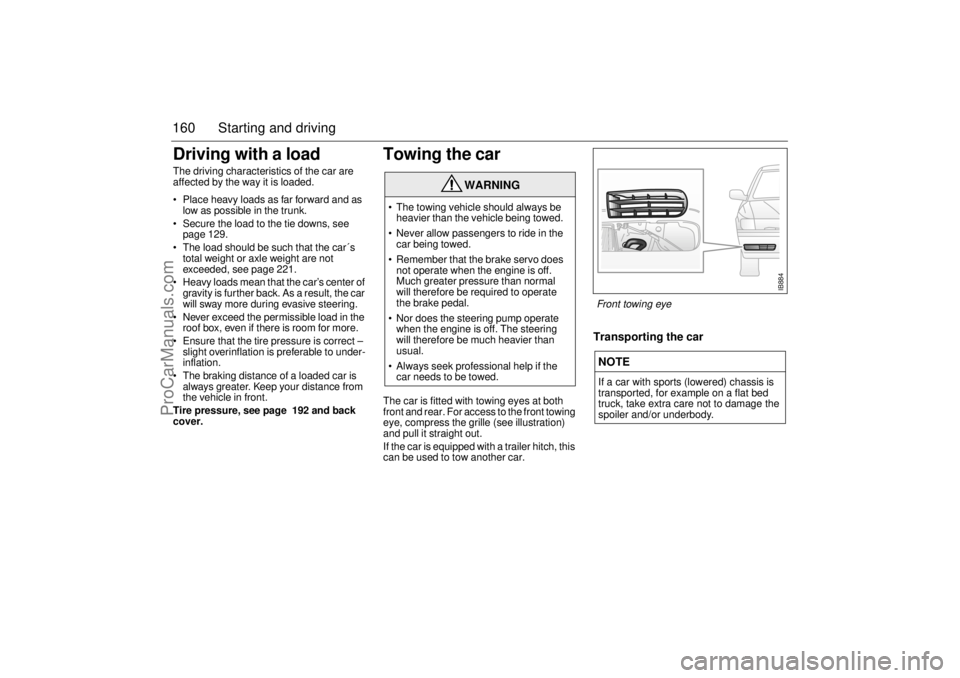
front and rear. For access to the front towing
eye, compress the grille (see illustration)
and pull it straight out.
If the car is equipped with a trailer hitch, this
can be used to tow another car.
Transporting the car
WARNING
The towing vehicle should always be
heavier than the vehicle being towed.
Never allow passengers to ride in the
car being towed.
Remember that the brake servo does
not operate when the engine is off.
Much greater pressure than normal
will therefore be required to operate
the brake pedal.
Nor does the steering pump operate
when the engine is off. The steering
will therefore be much heavier than
usual.
Always seek professional help if the
car needs to be towed.
NOTEIf a car with sports (lowered) chassis is
transported, for example on a flat bed
truck, take extra care not to damage the
spoiler and/or underbody.
IB884
Front towing eye
ProCarManuals.com
Page 166 of 236

166 Starting and drivingDriving with the trunk lid
openAvoid driving with the trunk lid partly or fully
open, since exhaust fumes can be drawn
into the cabin.
If you must drive with the trunk lid open, all
windows and the sunroof (if fitted) must be
closed and the cabin fan on at its highest
speed setting.
Driving in deep waterNOTEDo not drive in water deeper than 11”
(30 cm) and do not drive faster than at
idling speed. Water can otherwise be
sucked into the engine. The engine will be
damaged if water enters the intake sys-
tem.
ProCarManuals.com
Page 183 of 236
183 Car care
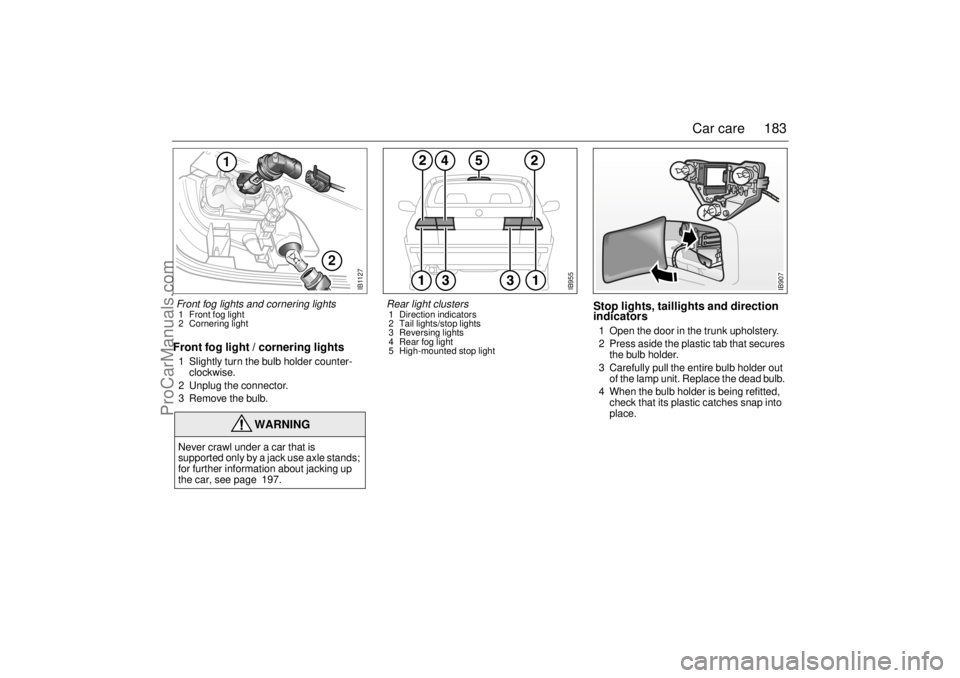
Front fog light / cornering lights1 Slightly turn the bulb holder counter-
clockwise.
2 Unplug the connector.
3 Remove the bulb.
Stop lights, taillights and direction
indicators 1 Open the door in the trunk upholstery.
2 Press aside the plastic tab that secures
the bulb holder.
3 Carefully pull the entire bulb holder out
of the lamp unit. Replace the dead bulb.
4 When the bulb holder is being refitted,
check that its plastic catches snap into
place.
WARNING
Never crawl under a car that is
supported only by a jack use axle stands;
for further information about jacking up
the car, see page 197.
IB1127
1
2
IB955
Rear light clusters 1 Direction indicators
2 Tail lights/stop lights
3 Reversing lights
4 Rear fog light
5 High-mounted stop light
IB907
Front fog lights and cornering lights1 Front fog light
2 Cornering light
ProCarManuals.com
Page 184 of 236
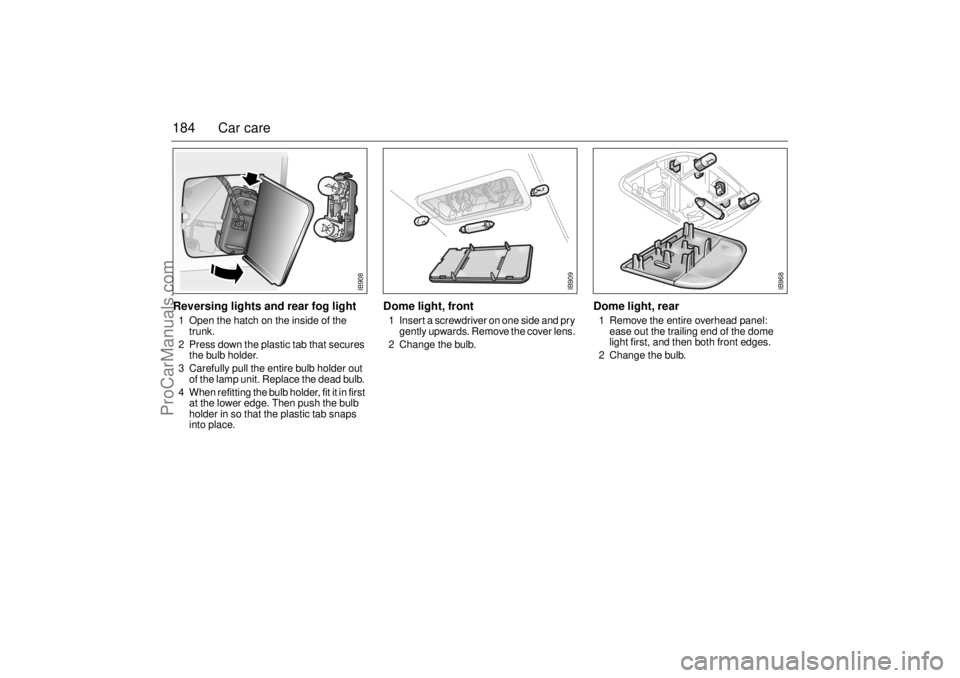
184 Car careReversing lights and rear fog light 1 Open the hatch on the inside of the
trunk.
2 Press down the plastic tab that secures
the bulb holder.
3 Carefully pull the entire bulb holder out
of the lamp unit. Replace the dead bulb.
4 When refitting the bulb holder, fit it in first
at the lower edge. Then push the bulb
holder in so that the plastic tab snaps
into place.
Dome light, front 1 Insert a screwdriver on one side and pry
gently upwards. Remove the cover lens.
2 Change the bulb.
Dome light, rear 1 Remove the entire overhead panel:
ease out the trailing end of the dome
light first, and then both front edges.
2 Change the bulb.
IB908
IB909
IB968
ProCarManuals.com
Page 185 of 236
185 Car care
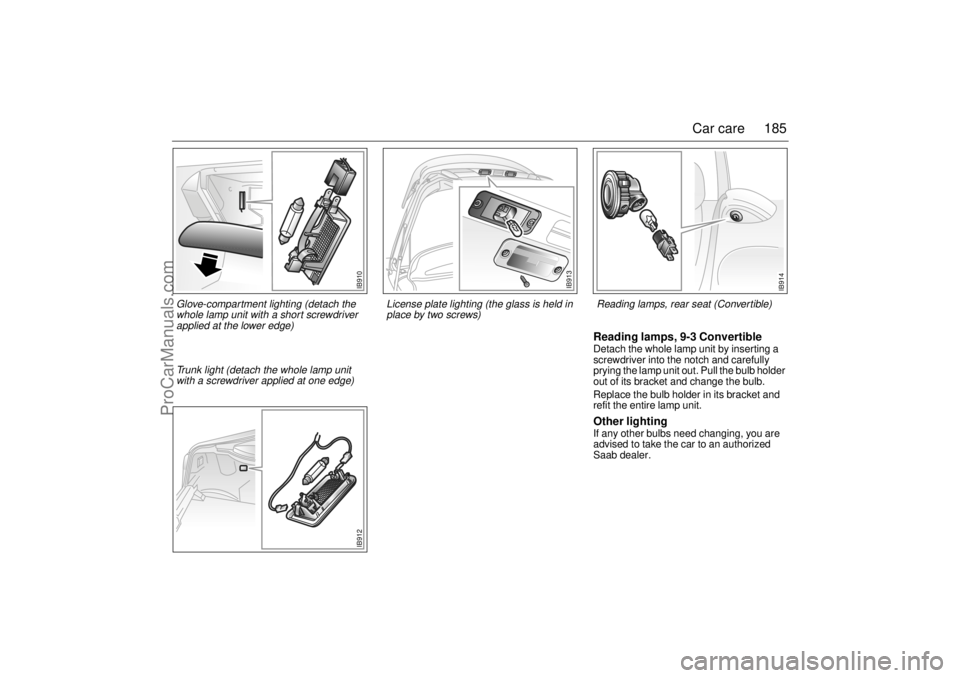
Reading lamps, 9-3 Convertible Detach the whole lamp unit by inserting a
screwdriver into the notch and carefully
prying the lamp unit out. Pull the bulb holder
out of its bracket and change the bulb.
Replace the bulb holder in its bracket and
refit the entire lamp unit. Other lightingIf any other bulbs need changing, you are
advised to take the car to an authorized
Saab dealer.
IB914
Reading lamps, rear seat (Convertible)
IB913
License plate lighting (the glass is held in
place by two screws)
IB912
Trunk light (detach the whole lamp unit
with a screwdriver applied at one edge)
IB910
Glove-compartment lighting (detach the
whole lamp unit with a short screwdriver
applied at the lower edge)
ProCarManuals.com