light SAAB 9-3 2000 Workshop Manual
[x] Cancel search | Manufacturer: SAAB, Model Year: 2000, Model line: 9-3, Model: SAAB 9-3 2000Pages: 236, PDF Size: 10.85 MB
Page 148 of 236
148 Starting and drivingCruise ControlThe system is operated by means of the
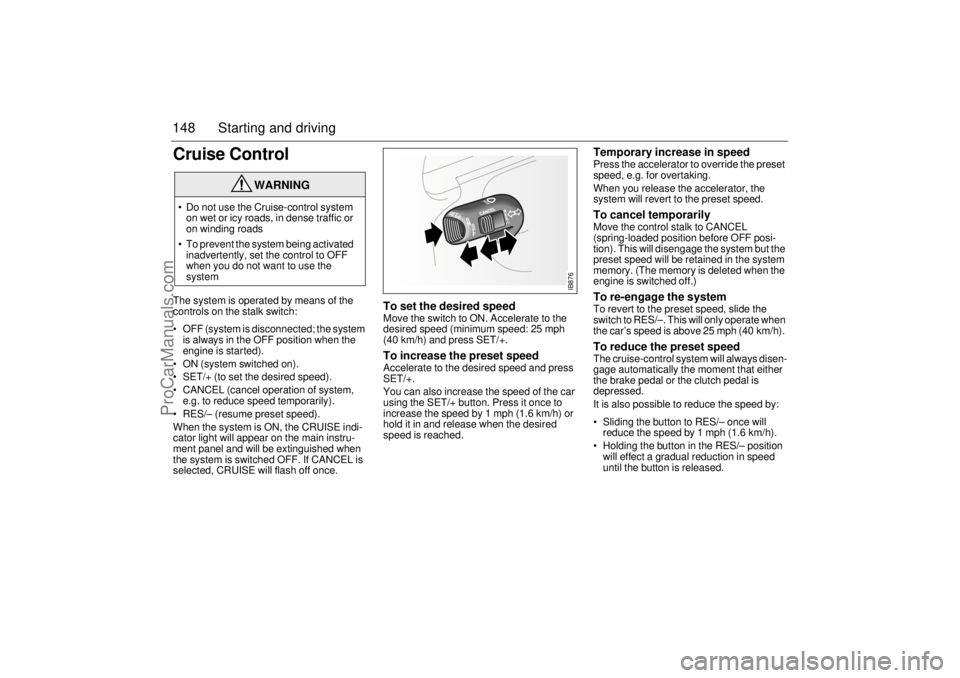
controls on the stalk switch:
OFF (system is disconnected; the system
is always in the OFF position when the
engine is started).
ON (system switched on).
SET/+ (to set the desired speed).
CANCEL (cancel operation of system,
e.g. to reduce speed temporarily).
RES/– (resume preset speed).
When the system is ON, the CRUISE indi-
cator light will appear on the main instru-
ment panel and will be extinguished when
the system is switched OFF. If CANCEL is
selected, CRUISE will flash off once.
To set the desired speed Move the switch to ON. Accelerate to the
desired speed (minimum speed: 25 mph
(40 km/h) and press SET/+. To increase the preset speed Accelerate to the desired speed and press
SET/+.
You can also increase the speed of the car
using the SET/+ button. Press it once to
increase the speed by 1 mph (1.6 km/h) or
hold it in and release when the desired
speed is reached.
Temporary increase in speed Press the accelerator to override the preset
speed, e.g. for overtaking.
When you release the accelerator, the
system will revert to the preset speed. To cancel temporarily Move the control stalk to CANCEL
(spring-loaded position before OFF posi-
tion). This will disengage the system but the
preset speed will be retained in the system
memory. (The memory is deleted when the
engine is switched off.) To re-engage the system To revert to the preset speed, slide the
switch to RES/–. This will only operate when
the car’s speed is above 25 mph (40 km/h). To reduce the preset speedThe cruise-control system will always disen-
gage automatically the moment that either
the brake pedal or the clutch pedal is
depressed.
It is also possible to reduce the speed by:
Sliding the button to RES/– once will
reduce the speed by 1 mph (1.6 km/h).
Holding the button in the RES/– position
will effect a gradual reduction in speed
until the button is released.
WARNING
Do not use the Cruise-control system
on wet or icy roads, in dense traffic or
on winding roads
To prevent the system being activated
inadvertently, set the control to OFF
when you do not want to use the
system
IB876
ProCarManuals.com
Page 150 of 236
150 Starting and drivingABS brakesABS (Antilock Braking System) modulates
the brake pressure to the respective
wheels. Wheel sensors detect if a wheel is
about to lock, and the control module
reduces the pressure to that wheel and then
increases it once more until the tendency is
detected again.
The brake system is equipped with an Elec-
tronic Brake-force Distribution device
(EBD), which distributes the brake pressure
between the front and rear wheels in such a
way as to achieve optimum braking perfor-
mance regardless of the car’s speed and
load.
The ABS system has a built-in diagnostic
function which will switch on the ABS warn-
ing light if a fault is detected in the system
(see page 56). The ABS system will not reduce the braking
distance on loose gravel or on snow or ice
but, because the wheels cannot lock up,
some steering control is retained.
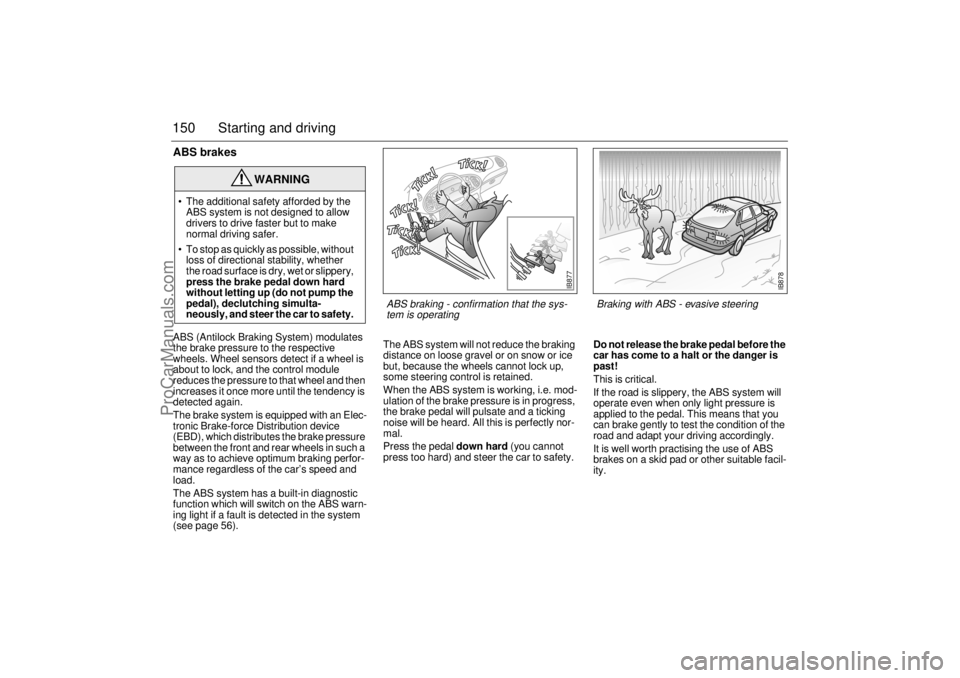
When the ABS system is working, i.e. mod-
ulation of the brake pressure is in progress,
the brake pedal will pulsate and a ticking
noise will be heard. All this is perfectly nor-
mal.
Press the pedal down hard (you cannot
press too hard) and steer the car to safety. Do not release the brake pedal before the
car has come to a halt or the danger is
past!
This is critical.
If the road is slippery, the ABS system will
operate even when only light pressure is
applied to the pedal. This means that you
can brake gently to test the condition of the
road and adapt your driving accordingly.
It is well worth practising the use of ABS
brakes on a skid pad or other suitable facil-
ity.
WARNING
The additional safety afforded by the
ABS system is not designed to allow
drivers to drive faster but to make
normal driving safer.
To stop as quickly as possible, without
loss of directional stability, whether
the road surface is dry, wet or slippery,
press the brake pedal down hard
without letting up (do not pump the
pedal), declutching simulta-
neously, and steer the car to safety.
IB877
ABS braking - confirmation that the sys-
tem is operating
IB878
Braking with ABS - evasive steering
ProCarManuals.com
Page 151 of 236
151 Starting and driving
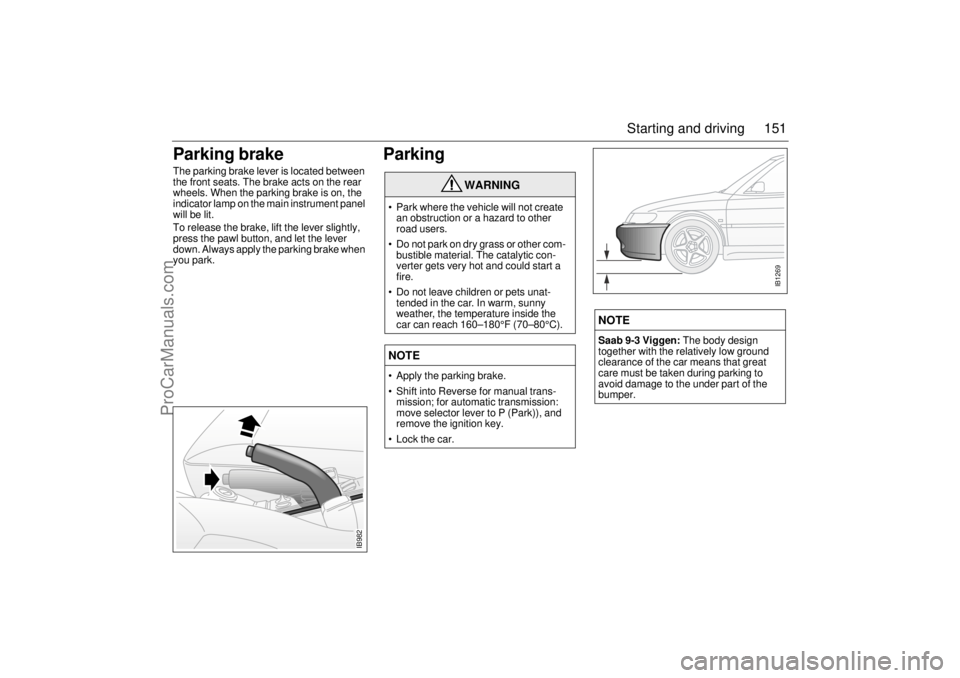
Parking brakeThe parking brake lever is located between
the front seats. The brake acts on the rear
wheels. When the parking brake is on, the
indicator lamp on the main instrument panel
will be lit.
To release the brake, lift the lever slightly,
press the pawl button, and let the lever
down. Always apply the parking brake when
you park.
Parking
WARNING
Park where the vehicle will not create
an obstruction or a hazard to other
road users.
Do not park on dry grass or other com-
bustible material. The catalytic con-
verter gets very hot and could start a
fire.
Do not leave children or pets unat-
tended in the car. In warm, sunny
weather, the temperature inside the
car can reach 160–180°F (70–80°C). NOTE Apply the parking brake.
Shift into Reverse for manual trans-
mission; for automatic transmission:
move selector lever to P (Park)), and
remove the ignition key.
Lock the car.
NOTESaab 9-3 Viggen: The body design
together with the relatively low ground
clearance of the car means that great
care must be taken during parking to
avoid damage to the under part of the
bumper.
IB1269
IB982
ProCarManuals.com
Page 154 of 236

154 Starting and driving Driving in a low gear results in higher fuel
consumption than in a high gear because
of the lower engine speed for a given road
speed. Always change up to a higher gear
as soon as traffic conditions allow and use
the highest gear as much as possible.
Check the air pressure in the tires once a
month. Incorrect pressures increase tire
wear. It is better to have slightly higher
pressure than lower.
Check fuel consumption regularly.
Increased consumption can indicate that
something is wrong and that the car
needs to be checked by an authorized
Saab dealer.
Practical tests on the roads have demon-
strated that substantial savings in fuel con-
sumption can be made if the above advice
is heeded.Road conditions Wet roads increase fuel consumption, as do
unpaved roads and driving in hilly country
(the amount of fuel saved driving downhill is
less than the additional amount required to
climb the hill).
Engine block heater (standard
equipment in Canada, accessory in
U.S.)The following are just some of the benefits
to the car and the environment of using an
engine block heater:
Lower fuel consumption.
Reduced wear on the engine.
Inside of car warms up faster.
Exhaust emissions substantially reduced
over short runs.
The engine block heater is effective with
outside temperatures up to +60 – +70°F
(+15 – +20°C). The warmer it is outside, the
shorter the time the heater need be con-
nected. Longer than 1.5 hours is unneces-
sary.
If the car is equipped with a removable elec-
trical cabin heater that is not in use, this
should be stored in the luggage compart-
ment.
Driving in cold weatherBefore starting a journey in cold weather
you should check the following:
That the wiper blades have not become
frozen to the windshield/glass.
Brush any snow away from the air intake
for the heater system (opening between
hood and windshield).
It may be advisable to lubricate the
door-lock cylinder (use molybdenum
disulphide, MoS
2) to prevent its freezing.
If the lock has frozen, take care not to
break the key (or use the remote control)
– heat it first or spray it with de-icer.
Periodically during the winter, add gaso-
line anti-freeze to the fuel to dispel any
condensation in the fuel tank which could
freeze and cause problems in the system.
Keep the tank well filled to reduce the risk
of condensation forming.
If the car is parked outside in freezing
weather, fuel additives (gasoline
anti-freeze) will not do any good as it
cannot remove water that has already fro-
zen. Park the car in a warm place so that
any ice that may have built up melts, then
add gasoline anti-freeze when filling up
the tank. Condensation is caused by
changes in the outdoor temperature or by
the car being parked alternately in a
garage and outside.
It is particularly important when the roads
are slippery that the brakes and tires be in
good condition.
ProCarManuals.com
Page 158 of 236
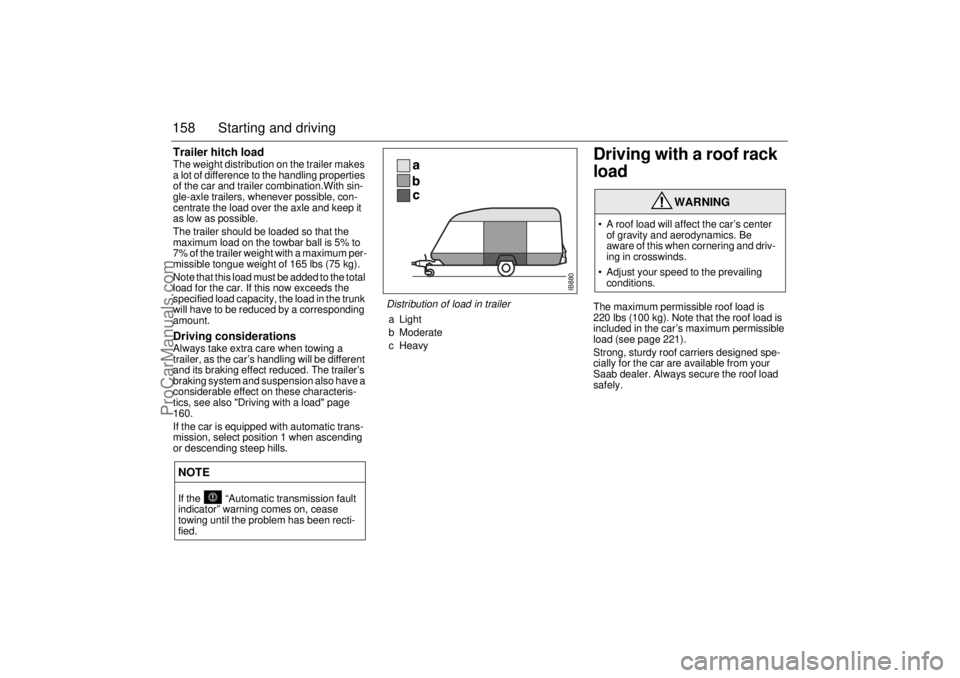
158 Starting and drivingTrailer hitch loadThe weight distribution on the trailer makes
a lot of difference to the handling properties
of the car and trailer combination.With sin-
gle-axle trailers, whenever possible, con-
centrate the load over the axle and keep it
as low as possible.
The trailer should be loaded so that the
maximum load on the towbar ball is 5% to
7% of the trailer weight with a maximum per-
missible tongue weight of 165 lbs (75 kg).
Note that this load must be added to the total
load for the car. If this now exceeds the
specified load capacity, the load in the trunk
will have to be reduced by a corresponding
amount. Driving considerationsAlways take extra care when towing a
trailer, as the car’s handling will be different
and its braking effect reduced. The trailer’s
braking system and suspension also have a
considerable effect on these characteris-
tics, see also "Driving with a load" page
160.
If the car is equipped with automatic trans-
mission, select position 1 when ascending
or descending steep hills.
Driving with a roof rack
loadThe maximum permissible roof load is
220 lbs (100 kg). Note that the roof load is
included in the car’s maximum permissible
load (see page 221).
Strong, sturdy roof carriers designed spe-
cially for the car are available from your
Saab dealer. Always secure the roof load
safely.
NOTEIf the “Automatic transmission fault
indicator” warning comes on, cease
towing until the problem has been recti-
fied.
WARNING
A roof load will affect the car’s center
of gravity and aerodynamics. Be
aware of this when cornering and driv-
ing in crosswinds.
Adjust your speed to the prevailing
conditions.
IB880
Distribution of load in trailer aLight
b Moderate
cHeavy
ProCarManuals.com
Page 160 of 236
160 Starting and drivingDriving with a loadThe driving characteristics of the car are
affected by the way it is loaded.
Place heavy loads as far forward and as
low as possible in the trunk.
Secure the load to the tie downs, see
page 129.
The load should be such that the car´s
total weight or axle weight are not
exceeded, see page 221.
Heavy loads mean that the car’s center of
gravity is further back. As a result, the car
will sway more during evasive steering.
Never exceed the permissible load in the
roof box, even if there is room for more.
Ensure that the tire pressure is correct –
slight overinflation is preferable to under-
inflation.
The braking distance of a loaded car is
always greater. Keep your distance from
the vehicle in front.
Tire pressure, see page 192 and back
cover.
Towing the carThe car is fitted with towing eyes at both
front and rear. For access to the front towing
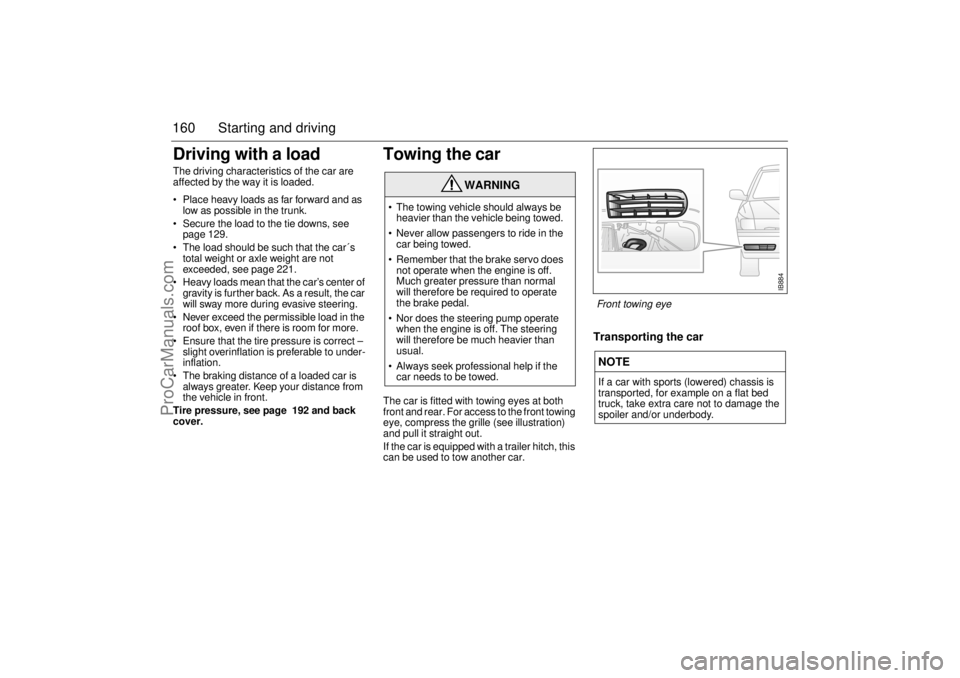
eye, compress the grille (see illustration)
and pull it straight out.
If the car is equipped with a trailer hitch, this
can be used to tow another car.
Transporting the car
WARNING
The towing vehicle should always be
heavier than the vehicle being towed.
Never allow passengers to ride in the
car being towed.
Remember that the brake servo does
not operate when the engine is off.
Much greater pressure than normal
will therefore be required to operate
the brake pedal.
Nor does the steering pump operate
when the engine is off. The steering
will therefore be much heavier than
usual.
Always seek professional help if the
car needs to be towed.
NOTEIf a car with sports (lowered) chassis is
transported, for example on a flat bed
truck, take extra care not to damage the
spoiler and/or underbody.
IB884
Front towing eye
ProCarManuals.com
Page 161 of 236
161 Starting and driving
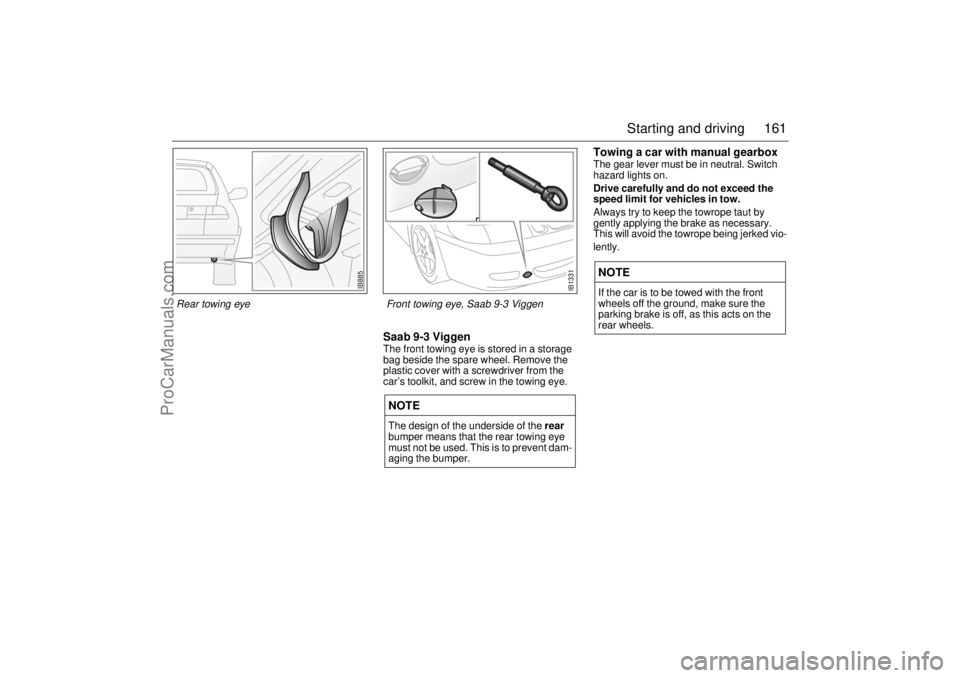
Saab 9-3 ViggenThe front towing eye is stored in a storage
bag beside the spare wheel. Remove the
plastic cover with a screwdriver from the
car’s toolkit, and screw in the towing eye.
Towing a car with manual gearboxThe gear lever must be in neutral. Switch
hazard lights on.
Drive carefully and do not exceed the
speed limit for vehicles in tow.
Always try to keep the towrope taut by
gently applying the brake as necessary.
This will avoid the towrope being jerked vio-
lently.
NOTEThe design of the underside of the rear
bumper means that the rear towing eye
must not be used. This is to prevent dam-
aging the bumper.
NOTEIf the car is to be towed with the front
wheels off the ground, make sure the
parking brake is off, as this acts on the
rear wheels.
IB885
Rear towing eye
IB1331
Front towing eye, Saab 9-3 Viggen
ProCarManuals.com
Page 162 of 236
162 Starting and drivingTowing a car with automatic
transmission The following rules must be observed if a
car with automatic transmission is to be
towed.
The gear selector must be in the N position.
Switch hazard lights on.
Drive carefully and do not exceed the
speed limit for vehicles in tow.
Always try to keep the towrope taut by
gently applying the brake as necessary.
This will avoid the towrope being jerked vio-
lently.1 Selector lever in position N.
2 Raise the oil level in the gearbox above
normal by 2 extra quarts. Use oil of type
Texaco Texamatic Dexron III.
3 The local regulations on towing speeds
must be followed.
The highest permissible towing speed is
30 mph (50 km/h), unless the legal limit
is lower. The longest permissible towing
distance is 25-30 miles (40-50 km). If the
car has to be transported farther than
that, summon a tow truck. A flat bed tow
truck is the preferred method to tow.
4 When the car is being returned to ser-
vice, check the gearbox oil, and reduce
it to the prescribed amount if necessary.
The engine cannot be started by towing or
pushing the car. In emergency, the engine
can be started as described in the section
”Jump starting”.
Jump startingIf your battery has run down, you may want
to use another vehicle and some jumper
cables to start your Saab. Follow the steps
below to do it safely.
NOTEThe car must be towed front first.
If the car is to be towed with the front
wheels off the ground, make sure the
parking brake is off, as this acts on the
rear wheels.
WARNING
Batteries can cause injury. They can be
dangerous because:
They contain acid that can burn you.
They contain gas that can explode or
ignite.
They contain enough electricity to
injure you.
If you do not follow these steps exactly,
some or all of these things can hurt you.
ProCarManuals.com
Page 163 of 236
163 Starting and driving
To jump start your vehicle:
1 Check the other vehicle. It must have a
12-volt battery with a negative ground
system.2 Get the vehicles close enough so the
jumper cables can reach, but be sure the
vehicles are not touching each other. If
a poor connection on the negative
jumper cable should exist, it is possible
for damage to be caused to electrical
systems/components of either vehicle
should inadvertent contact be made.
You would not be able to start your car
and bad grounding could damage the
electrical systems.
3 Turn off the ignition on both vehicles.
Turn off all lights that are not needed,
and radios. This will avoid sparks and
help save both batteries and it could
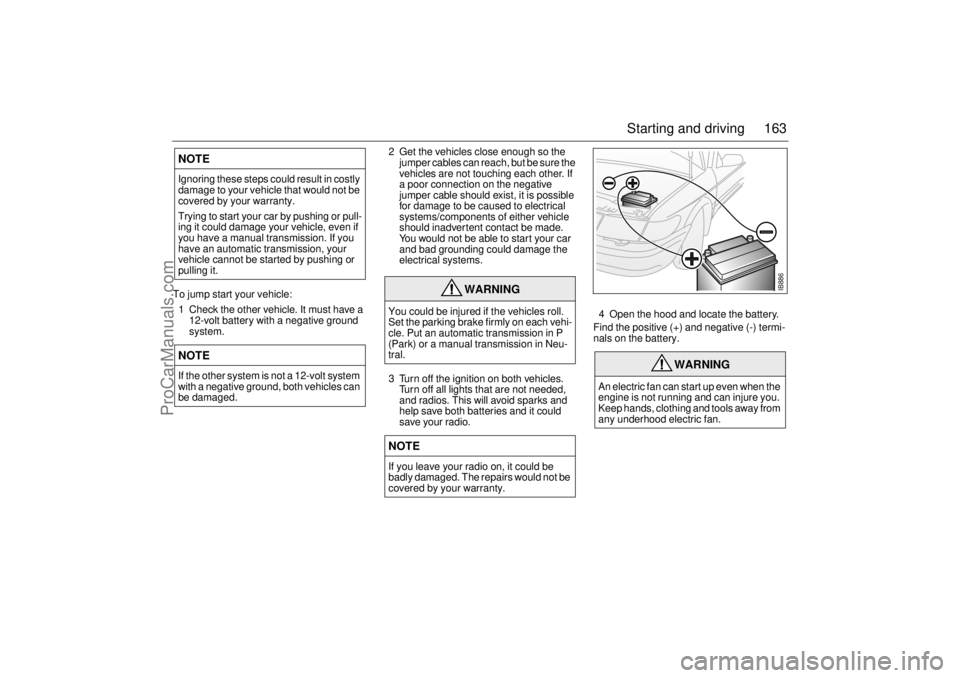
save your radio.4 Open the hood and locate the battery.
Find the positive (+) and negative (-) termi-
nals on the battery.NOTEIgnoring these steps could result in costly
damage to your vehicle that would not be
covered by your warranty.
Trying to start your car by pushing or pull-
ing it could damage your vehicle, even if
you have a manual transmission. If you
have an automatic transmission, your
vehicle cannot be started by pushing or
pulling it.NOTEIf the other system is not a 12-volt system
with a negative ground, both vehicles can
be damaged.
WARNING
You could be injured if the vehicles roll.
Set the parking brake firmly on each vehi-
cle. Put an automatic transmission in P
(Park) or a manual transmission in Neu-
tral.NOTEIf you leave your radio on, it could be
badly damaged. The repairs would not be
covered by your warranty.
WARNING
An electric fan can start up even when the
engine is not running and can injure you.
Keep hands, clothing and tools away from
any underhood electric fan.
IB886
ProCarManuals.com
Page 164 of 236

164 Starting and driving
5 Check that the jumper cables do not
have loose or missing insulation. If they
do, you could get a shock and also the
vehicles could be damaged.
Before you connect the cables, here are
some basic things you should know.
Positive (+) will go to positive (+) and
negative (-) will go to negative (-) or a
major metal engine part with a good
ground. Do not connect (+) to (-) or you
will get a short that could injure you or
would damage the battery and maybe
other parts as well.
6 Connect the red positive (+) cable to the
positive (+) terminal of the vehicle with
the discharged battery.
7 Do not let the other end touch metal.
Connect it to the positive (+) terminal of
the good battery. Use a remote positive
(+) terminal if the vehicle has one.
8 Now connect the black negative (-)
cable to the good battery’s negative ter-
minal.
Do not let the other end touch anything
until the next step. The other end of the
negative cable does not go to the dead
battery. It goes to a major metal part with
a good ground on the engine of the vehi-
cle with the discharged battery.9 Attach the cable at least 18 inches
(45 cm) away from the discharged bat-
tery, but not near engine parts that
move. The electrical connection is just
as good there, but the chance of sparks
getting back to the battery is much less.
10 Start the vehicle with the good battery
and run the engine for a while.
11 Try to start the vehicle with the dis-
charged battery. If it does not start after
a few tries, it probably needs service.
12 Remove the cables in reverse order to
prevent electrical shorting. Take care
that they do not touch each other or any
other metal.
WARNING
Using a match or flame of any kind near a
battery can cause battery gas to explode.
You can suffer burns or be blinded. Use a
flashlight if you need more light.
Be sure the battery has enough water.
The battery installed in your new Saab
has filler caps. Be sure the right amount
of water is there. Add distilled or boiled
water if the level is too low. If you don’t,
explosive gas could be present.
Be sure the electrolyte in the battery is not
frozen. Discharged batteries will freeze.
When connecting jumper cables to a
frozen battery, gas from the chemical
reaction inside the battery can build up
under the ice and cause an explosion.
Battery fluid contains acid that can burn
you. Do not get it on you. If you acciden-
tally get it in your eyes or on your skin,
flush the area with water and get medical
help immediately.
ProCarManuals.com