automatic transmission SAAB 9-3 2000 Owners Manual
[x] Cancel search | Manufacturer: SAAB, Model Year: 2000, Model line: 9-3, Model: SAAB 9-3 2000Pages: 236, PDF Size: 10.85 MB
Page 5 of 236
5
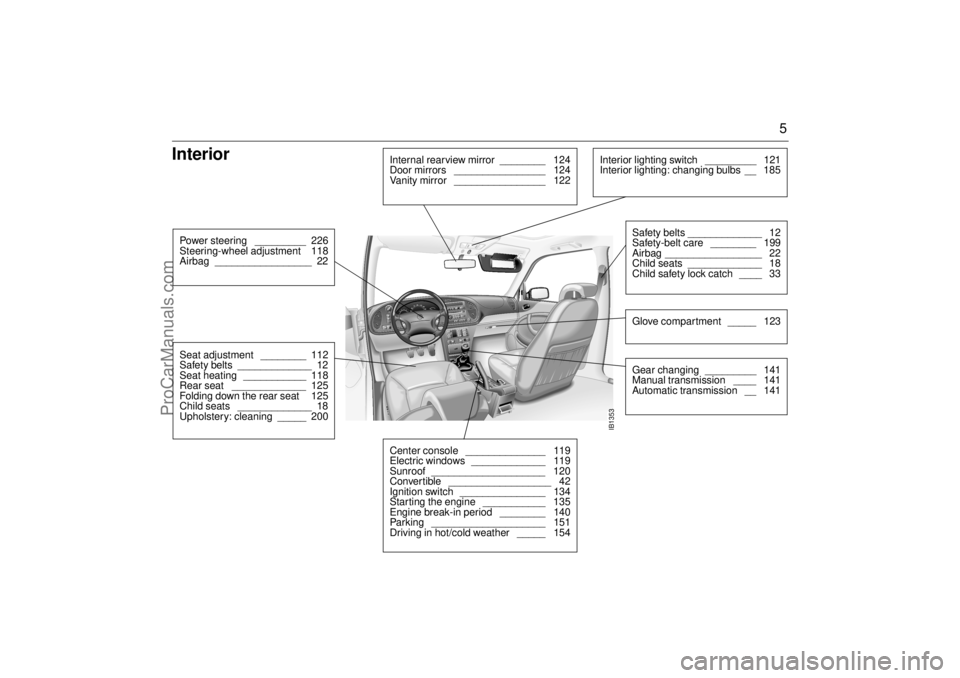
Interior Power steering _________ 226
Steering-wheel adjustment 118
Airbag _________________ 22
Internal rearview mirror ________ 124
Door mirrors ________________ 124
Vanity mirror ________________ 122
Safety belts _____________ 12
Safety-belt care ________ 199
Airbag _________________ 22
Child seats _____________ 18
Child safety lock catch ____ 33Glove compartment _____ 123Gear changing _________ 141
Manual transmission ____ 141
Automatic transmission __ 141
IB1353
Seat adjustment ________ 112
Safety belts _____________ 12
Seat heating ___________ 118
Rear seat _____________ 125
Folding down the rear seat 125
Child seats _____________ 18
Upholstery: cleaning _____ 200
Interior lighting switch _________ 121
Interior lighting: changing bulbs __ 185
Center console ______________ 119
Electric windows _____________ 119
Sunroof ____________________ 120
Convertible __________________ 42
Ignition switch _______________ 134
Starting the engine ___________ 135
Engine break-in period ________ 140
Parking ____________________ 151
Driving in hot/cold weather _____ 154
ProCarManuals.com
Page 6 of 236
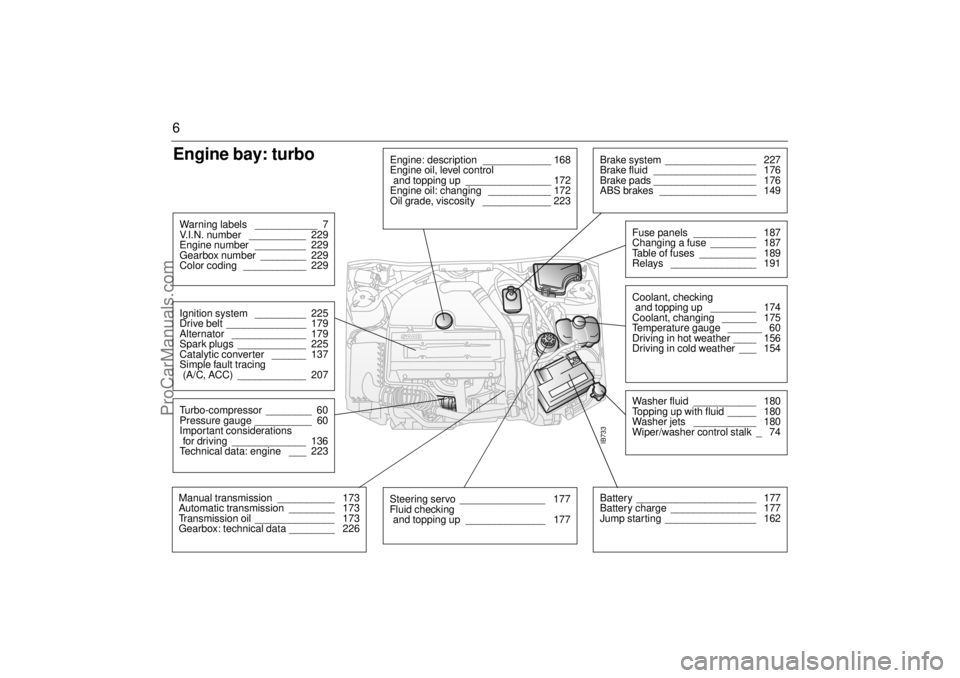
6Engine bay: turboWarning labels ___________ 7
V.I.N. number __________ 229
Engine number _________ 229
Gearbox number ________ 229
Color coding ___________ 229Ignition system _________ 225
Drive belt ______________ 179
Alternator _____________ 179
Spark plugs ____________ 225
Catalytic converter ______ 137
Simple fault tracing
(A/C, ACC) ____________ 207Turbo-compressor ________ 60
Pressure gauge __________ 60
Important considerations
for driving _____________ 136
Technical data: engine ___ 223Manual transmission __________ 173
Automatic transmission ________ 173
Transmission oil ______________ 173
Gearbox: technical data ________ 226
Battery _____________________ 177
Battery charge _______________ 177
Jump starting ________________ 162IB733
Engine: description ____________ 168
Engine oil, level control
and topping up _______________ 172
Engine oil: changing ___________ 172
Oil grade, viscosity ____________ 223
Washer fluid ___________ 180
Topping up with fluid _____ 180
Washer jets ___________ 180
Wiper/washer control stalk _ 74
Steering servo _______________ 177
Fluid checking
and topping up ______________ 177
Coolant, checking
and topping up ________ 174
Coolant, changing ______ 175
Temperature gauge ______ 60
Driving in hot weather ____ 156
Driving in cold weather ___ 154Fuse panels ___________ 187
Changing a fuse ________ 187
Table of fuses __________ 189
Relays _______________ 191
Brake system ________________ 227
Brake fluid __________________ 176
Brake pads __________________ 176
ABS brakes _________________ 149
ProCarManuals.com
Page 9 of 236
9
WL16
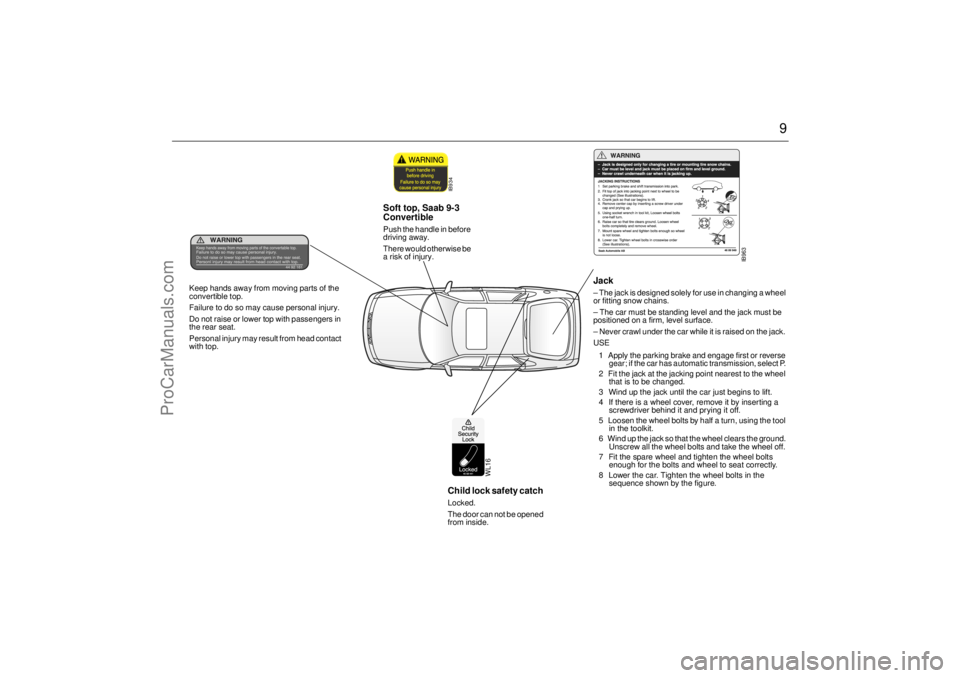
Child lock safety catch Locked.
The door can not be opened
from inside.
IB963
Jack – The jack is designed solely for use in changing a wheel
or fitting snow chains.
– The car must be standing level and the jack must be
positioned on a firm, level surface.
– Never crawl under the car while it is raised on the jack.
USE
1 Apply the parking brake and engage first or reverse
gear; if the car has automatic transmission, select P.
2 Fit the jack at the jacking point nearest to the wheel
that is to be changed.
3 Wind up the jack until the car just begins to lift.
4 If there is a wheel cover, remove it by inserting a
screwdriver behind it and prying it off.
5 Loosen the wheel bolts by half a turn, using the tool
in the toolkit.
6 Wind up the jack so that the wheel clears the ground.
Unscrew all the wheel bolts and take the wheel off.
7 Fit the spare wheel and tighten the wheel bolts
enough for the bolts and wheel to seat correctly.
8 Lower the car. Tighten the wheel bolts in the
sequence shown by the figure.
IB934
Soft top, Saab 9-3
Convertible Push the handle in before
driving away.
There would otherwise be
a risk of injury.
Keep hands away from moving parts of the
convertible top.
Failure to do so may cause personal injury.
Do not raise or lower top with passengers in
the rear seat.
Personal injury may result from head contact
with top.
ProCarManuals.com
Page 57 of 236
57 Instruments and controls
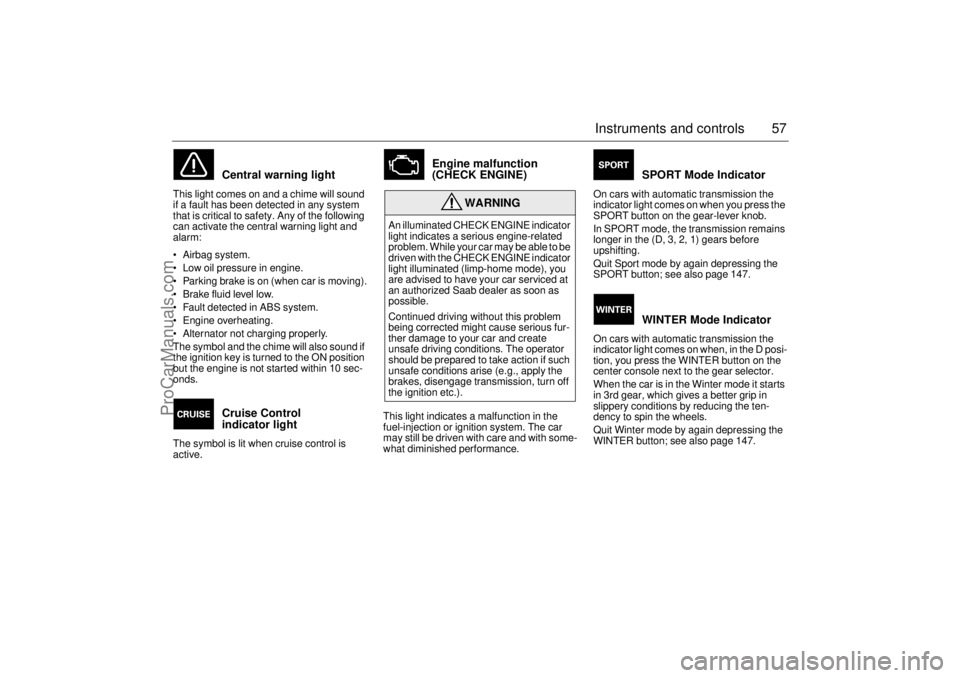
Central warning light
This light comes on and a chime will sound
if a fault has been detected in any system
that is critical to safety. Any of the following
can activate the central warning light and
alarm:
Airbag system.
Low oil pressure in engine.
Parking brake is on (when car is moving).
Brake fluid level low.
Fault detected in ABS system.
Engine overheating.
Alternator not charging properly.
The symbol and the chime will also sound if
the ignition key is turned to the ON position
but the engine is not started within 10 sec-
onds.
Cruise Control
indicator light
The symbol is lit when cruise control is
active.
Engine malfunction
(CHECK ENGINE)
This light indicates a malfunction in the
fuel-injection or ignition system. The car
may still be driven with care and with some-
what diminished performance.
SPORT Mode Indicator
On cars with automatic transmission the
indicator light comes on when you press the
SPORT button on the gear-lever knob.
In SPORT mode, the transmission remains
longer in the (D, 3, 2, 1) gears before
upshifting.
Quit Sport mode by again depressing the
SPORT button; see also page 147.
WINTER Mode Indicator
On cars with automatic transmission the
indicator light comes on when, in the D posi-
tion, you press the WINTER button on the
center console next to the gear selector.
When the car is in the Winter mode it starts
in 3rd gear, which gives a better grip in
slippery conditions by reducing the ten-
dency to spin the wheels.
Quit Winter mode by again depressing the
WINTER button; see also page 147.
WARNING
An illuminated CHECK ENGINE indicator
light indicates a serious engine-related
problem. While your car may be able to be
driven with the CHECK ENGINE indicator
light illuminated (limp-home mode), you
are advised to have your car serviced at
an authorized Saab dealer as soon as
possible.
Continued driving without this problem
being corrected might cause serious fur-
ther damage to your car and create
unsafe driving conditions. The operator
should be prepared to take action if such
unsafe conditions arise (e.g., apply the
brakes, disengage transmission, turn off
the ignition etc.).
ProCarManuals.com
Page 58 of 236
58 Instruments and controls
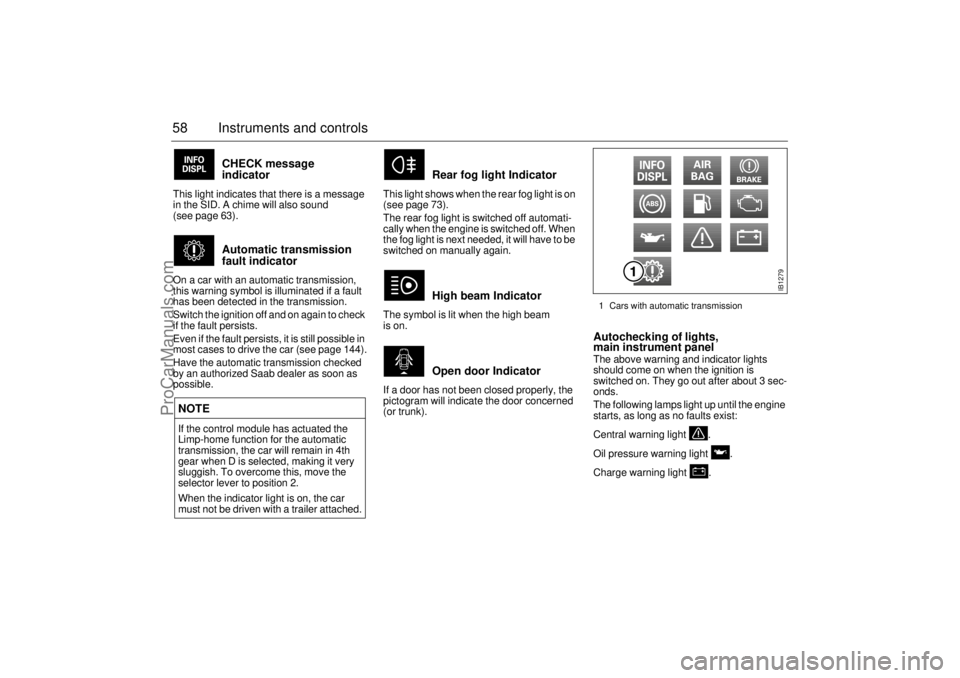
CHECK message
indicator
This light indicates that there is a message
in the SID. A chime will also sound
(see page 63).
Automatic transmission
fault indicator
On a car with an automatic transmission,
this warning symbol is illuminated if a fault
has been detected in the transmission.
Switch the ignition off and on again to check
if the fault persists.
Even if the fault persists, it is still possible in
most cases to drive the car (see page 144).
Have the automatic transmission checked
by an authorized Saab dealer as soon as
possible.
Rear fog light Indicator
This light shows when the rear fog light is on
(see page 73).
The rear fog light is switched off automati-
cally when the engine is switched off. When
the fog light is next needed, it will have to be
switched on manually again.
High beam Indicator
The symbol is lit when the high beam
is on.
Open door Indicator
If a door has not been closed properly, the
pictogram will indicate the door concerned
(or trunk).
Autochecking of lights,
main instrument panel The above warning and indicator lights
should come on when the ignition is
switched on. They go out after about 3 sec-
onds.
The following lamps light up until the engine
starts, as long as no faults exist:
Central warning light .
Oil pressure warning light .
Charge warning light .
NOTEIf the control module has actuated the
Limp-home function for the automatic
transmission, the car will remain in 4th
gear when D is selected, making it very
sluggish. To overcome this, move the
selector lever to position 2.
When the indicator light is on, the car
must not be driven with a trailer attached.
IB1279
1 Cars with automatic transmission
ProCarManuals.com
Page 61 of 236
61 Instruments and controls
Under certain barometric conditions the
needle may enter the first part of the red
zone without necessarily indicating that a
fault has arisen.
If the needle repeatedly enters the red zone
and the engine at the same time loses
power, because the monitoring system is
holding the charging pressure down, you
should contact an authorized Saab dealer.
If the speed exceeds 143 mph (230 km/h),
the increase in speed will be limited by the
lowering of the boost pressure. The pres-
sure gauge then moves towards the middle
of the orange zone, indicating reduced
engine output and thus reduces the speed
of the car as well.
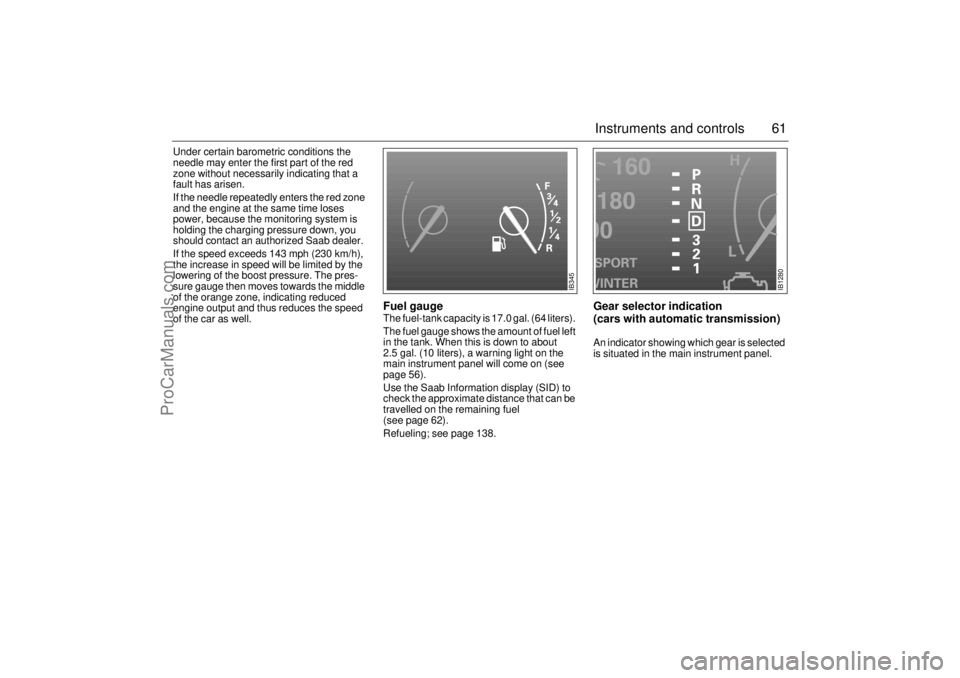
Fuel gaugeThe fuel-tank capacity is 17.0 gal. (64 liters).
The fuel gauge shows the amount of fuel left
in the tank. When this is down to about
2.5 gal. (10 liters), a warning light on the
main instrument panel will come on (see
page 56).
Use the Saab Information display (SID) to
check the approximate distance that can be
travelled on the remaining fuel
(see page 62).
Refueling; see page 138.
Gear selector indication
(cars with automatic transmission)An indicator showing which gear is selected
is situated in the main instrument panel.
IB345
IB1280
ProCarManuals.com
Page 64 of 236
64 Instruments and controls If the speed of the car exceeds 84 mph
(135 km/h), the entire speedometer will
be illuminated.
In cars with automatic transmission, if the
selector lever is moved from D to position
3, 2 or 1, the selector indication on the
main instrument panel will be illuminated.
To restore the displays and lighting to the
normal mode, press the Night-Panel button. Setting the date1 Use or to select TEMP/DATE.
2 Press the CLEAR button and for at
least one second (year starts to flash
and a chime sounds).
3 Set the year using or .
4 Touch CLEAR.
5 Set the month in the same way.
6 Touch CLEAR.
7 Set the day in the same way.
8 Press CLEAR to save the date setting.
Units and language versions The SID has four sets of units:
CHECK messages can be displayed in six
language options: English, Swedish,
German, French, Italian and Spanish. Selecting units and language 1 Depress the CLEAR button and at
the same time for 4 seconds until an
audible signal sounds.
2 Select the required units with or .
3 Briefly depress the CLEAR button.
4 Press or to select the required
language.
5 Briefly depress the CLEAR button.
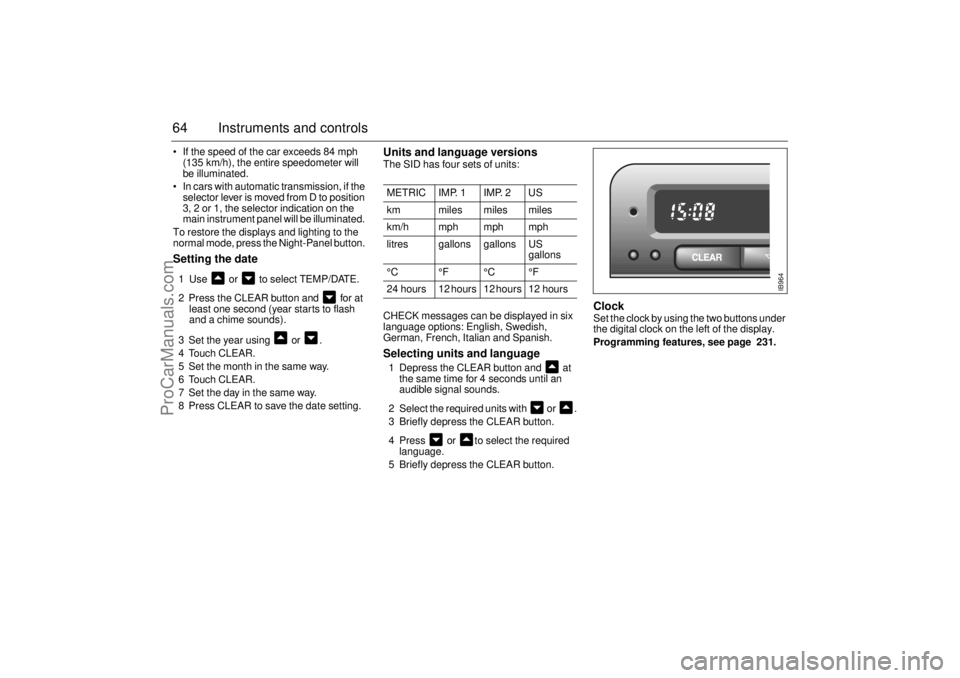
Clock Set the clock by using the two buttons under
the digital clock on the left of the display.
Programming features, see page 231.
METRIC IMP. 1 IMP. 2 US
km miles miles miles
km/h mph mph mph
litres gallons gallons US
gallons
°C °F °C °F
24 hours 12 hours 12 hours 12 hours
IB964
ProCarManuals.com
Page 69 of 236

69 Instruments and controls
Night panelTo improve night-driving conditions inside
the car, the Night Panel mode can be
selected. In this mode, the amount of infor-
mation displayed is reduced, and only the
most important instruments and displays
will be illuminated.
When the Night Panel button is pressed,
only the speedometer will be illuminated (up
to the 87-mph or 140-km/h graduation), all
the other instruments illumination will be
extinguished and their needles moved to
zero. Both the SID and the ACC displays will
be extinguished and the backlighting for
switches and other controls will be dimmed.
Note: All indicator and warning lights,
together with the display of CHECK mes-
sages, will operate as normal. The following conditions will wake up the
respective displays in the Night-Panel
mode:
Setting of the Audio System, SID or ACC
(display comes on for ten seconds).
CHECK message generated in the SID.
High engine revs cause the rev counter to
be illuminated until the engine speed has
fallen again.
If the quantity of fuel remaining falls below
4 gallons (15 liters), the fuel gauge will be
illuminated.
If the engine temperature rises above nor-
mal, the temperature gauge will be illumi-
nated.
If the speed of the car exceeds 84 mph
(135 km/h), the entire speedometer will
be illuminated.
In cars with automatic transmission, if the
selector lever is moved from D to position
3, 2 or 1, the selector indication on the
main instrument panel will be illuminated.
To restore the displays and lighting to the
normal mode, press the Night-Panel button.
Units and language versions The SID has four sets of units:
CHECK messages can be displayed in six
language options: English, Swedish,
German, French, Italian and Spanish. METRIC IMP. 1 IMP. 2 US
km miles miles miles
km/h mph mph mph
litres gallons gallons US
gallons
°C °F °C °F
24 hours 12 hours 12 hours 12 hours
ProCarManuals.com
Page 133 of 236
133 Starting and driving
IB943Starting and drivingIgnition switch ................. 134
Starting the engine .......... 135
Important considerations
for driving....................... 136
Engine Break-in Period... 140
Gear changing ................. 141
Manual transmission ...... 141
Automatic transmission . 141
Cruise Control ................. 148
Braking ............................. 149
Parking ............................. 151
Economical motoring ..... 153 Driving in cold weather ... 154
Driving in hot weather ..... 156
Towing a trailer ................ 156
Driving with a roof rack
load .................................. 158
Towing the car.................. 160
Jump starting ................... 162
Driving considerations
with compact spare
wheel/tire fitted............... 165
For long trips .................... 165
Driving with the trunk lid
open ................................ 166
Driving in deep water....... 166
ProCarManuals.com
Page 134 of 236
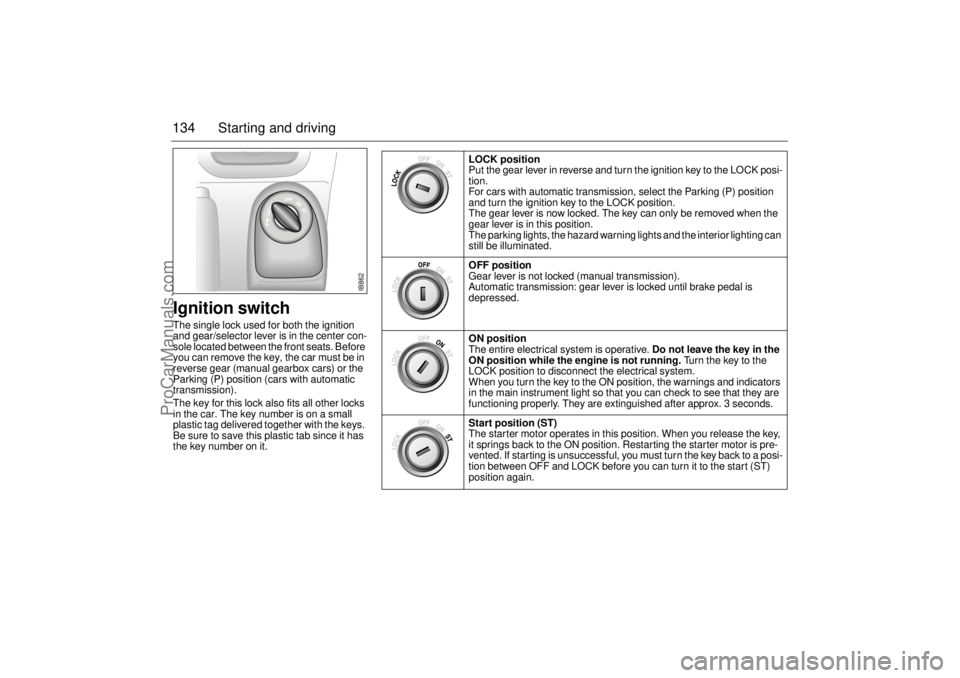
134 Starting and drivingIgnition switchThe single lock used for both the ignition
and gear/selector lever is in the center con-
sole located between the front seats. Before
you can remove the key, the car must be in
reverse gear (manual gearbox cars) or the
Parking (P) position (cars with automatic
transmission).
The key for this lock also fits all other locks
in the car. The key number is on a small
plastic tag delivered together with the keys.
Be sure to save this plastic tab since it has
the key number on it.
IB862
LOCK position
Put the gear lever in reverse and turn the ignition key to the LOCK posi-
tion.
For cars with automatic transmission, select the Parking (P) position
and turn the ignition key to the LOCK position.
The gear lever is now locked. The key can only be removed when the
gear lever is in this position.
The parking lights, the hazard warning lights and the interior lighting can
still be illuminated.
OFF position
Gear lever is not locked (manual transmission).
Automatic transmission: gear lever is locked until brake pedal is
depressed.
ON position
The entire electrical system is operative. Do not leave the key in the
ON position while the engine is not running. Turn the key to the
LOCK position to disconnect the electrical system.
When you turn the key to the ON position, the warnings and indicators
in the main instrument light so that you can check to see that they are
functioning properly. They are extinguished after approx. 3 seconds.
Start position (ST)
The starter motor operates in this position. When you release the key,
it springs back to the ON position. Restarting the starter motor is pre-
vented. If starting is unsuccessful, you must turn the key back to a posi-
tion between OFF and LOCK before you can turn it to the start (ST)
position again.
ProCarManuals.com