brakes SAAB 9-3 2000 Owners Manual
[x] Cancel search | Manufacturer: SAAB, Model Year: 2000, Model line: 9-3, Model: SAAB 9-3 2000Pages: 236, PDF Size: 10.85 MB
Page 4 of 236
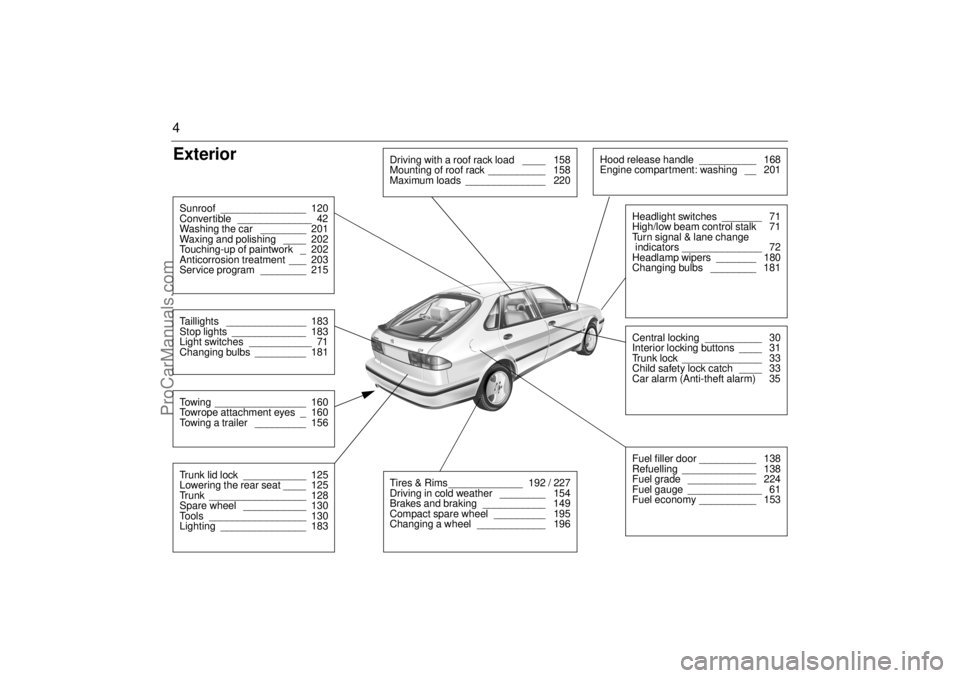
4Exterior Sunroof _______________ 120
Convertible _____________ 42
Washing the car ________ 201
Waxing and polishing ____ 202
Touching-up of paintwork _ 202
Anticorrosion treatment ___ 203
Service program ________ 215Taillights ______________ 183
Stop lights _____________ 183
Light switches ___________ 71
Changing bulbs _________ 181Towing ________________ 160
Towrope attachment eyes _ 160
Towing a trailer _________ 156Trunk lid lock ___________ 125
Lowering the rear seat ____ 125
Trunk _________________ 128
Spare wheel ___________ 130
Tools _________________ 130
Lighting _______________ 183
Driving with a roof rack load ____ 158
Mounting of roof rack __________ 158
Maximum loads ______________ 220
Hood release handle __________ 168
Engine compartment: washing __ 201
Central locking __________ 30
Interior locking buttons ____ 31
Trunk lock ______________ 33
Child safety lock catch ____ 33
Car alarm (Anti-theft alarm) 35Headlight switches _______ 71
High/low beam control stalk 71
Turn signal & lane change
indicators ______________ 72
Headlamp wipers _______ 180
Changing bulbs ________ 181Fuel filler door __________ 138
Refuelling _____________ 138
Fuel grade ____________ 224
Fuel gauge _____________ 61
Fuel economy __________ 153
Tires & Rims _____________ 192 / 227
Driving in cold weather ________ 154
Brakes and braking ___________ 149
Compact spare wheel _________ 195
Changing a wheel ____________ 196
ProCarManuals.com
Page 6 of 236
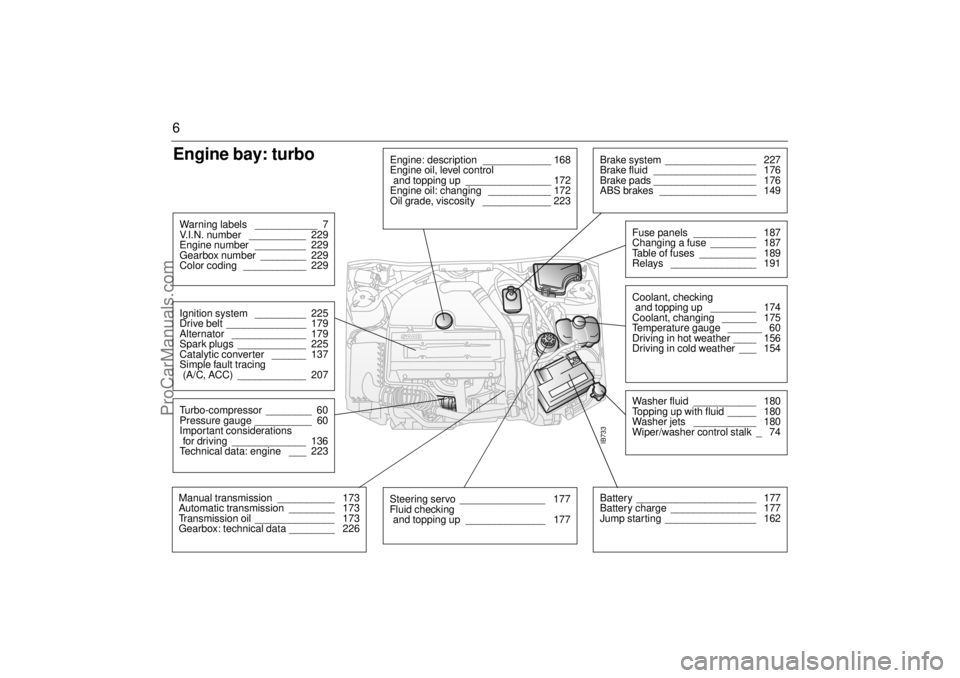
6Engine bay: turboWarning labels ___________ 7
V.I.N. number __________ 229
Engine number _________ 229
Gearbox number ________ 229
Color coding ___________ 229Ignition system _________ 225
Drive belt ______________ 179
Alternator _____________ 179
Spark plugs ____________ 225
Catalytic converter ______ 137
Simple fault tracing
(A/C, ACC) ____________ 207Turbo-compressor ________ 60
Pressure gauge __________ 60
Important considerations
for driving _____________ 136
Technical data: engine ___ 223Manual transmission __________ 173
Automatic transmission ________ 173
Transmission oil ______________ 173
Gearbox: technical data ________ 226
Battery _____________________ 177
Battery charge _______________ 177
Jump starting ________________ 162IB733
Engine: description ____________ 168
Engine oil, level control
and topping up _______________ 172
Engine oil: changing ___________ 172
Oil grade, viscosity ____________ 223
Washer fluid ___________ 180
Topping up with fluid _____ 180
Washer jets ___________ 180
Wiper/washer control stalk _ 74
Steering servo _______________ 177
Fluid checking
and topping up ______________ 177
Coolant, checking
and topping up ________ 174
Coolant, changing ______ 175
Temperature gauge ______ 60
Driving in hot weather ____ 156
Driving in cold weather ___ 154Fuse panels ___________ 187
Changing a fuse ________ 187
Table of fuses __________ 189
Relays _______________ 191
Brake system ________________ 227
Brake fluid __________________ 176
Brake pads __________________ 176
ABS brakes _________________ 149
ProCarManuals.com
Page 13 of 236
13 Safety
Safety-belt pretensionersThe belts of the front seats are fitted with
automatic pretensioners, which are acti-
vated in the event of a severe frontal colli-
sion or very violent rear-end collision. They
serve to reduce the forward movement of
the body by tensioning the belt.
The belt pretensioners do not activate in
less severe frontal collisions, nor to side col-
lisions, or rollovers.
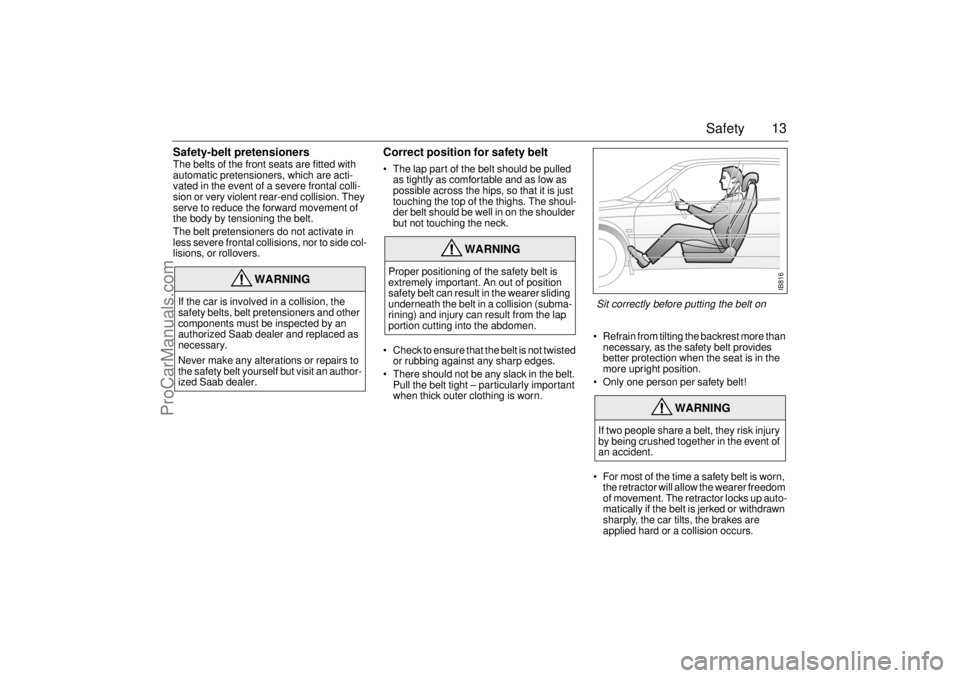
Correct position for safety belt The lap part of the belt should be pulled
as tightly as comfortable and as low as
possible across the hips, so that it is just
touching the top of the thighs. The shoul-
der belt should be well in on the shoulder
but not touching the neck.
Check to ensure that the belt is not twisted
or rubbing against any sharp edges.
There should not be any slack in the belt.
Pull the belt tight – particularly important
when thick outer clothing is worn. Refrain from tilting the backrest more than
necessary, as the safety belt provides
better protection when the seat is in the
more upright position.
Only one person per safety belt!
For most of the time a safety belt is worn,
the retractor will allow the wearer freedom
of movement. The retractor locks up auto-
matically if the belt is jerked or withdrawn
sharply, the car tilts, the brakes are
applied hard or a collision occurs.
WARNING
If the car is involved in a collision, the
safety belts, belt pretensioners and other
components must be inspected by an
authorized Saab dealer and replaced as
necessary.
Never make any alterations or repairs to
the safety belt yourself but visit an author-
ized Saab dealer.
WARNING
Proper positioning of the safety belt is
extremely important. An out of position
safety belt can result in the wearer sliding
underneath the belt in a collision (subma-
rining) and injury can result from the lap
portion cutting into the abdomen.
WARNING
If two people share a belt, they risk injury
by being crushed together in the event of
an accident.
IB816
Sit correctly before putting the belt on
ProCarManuals.com
Page 57 of 236
57 Instruments and controls
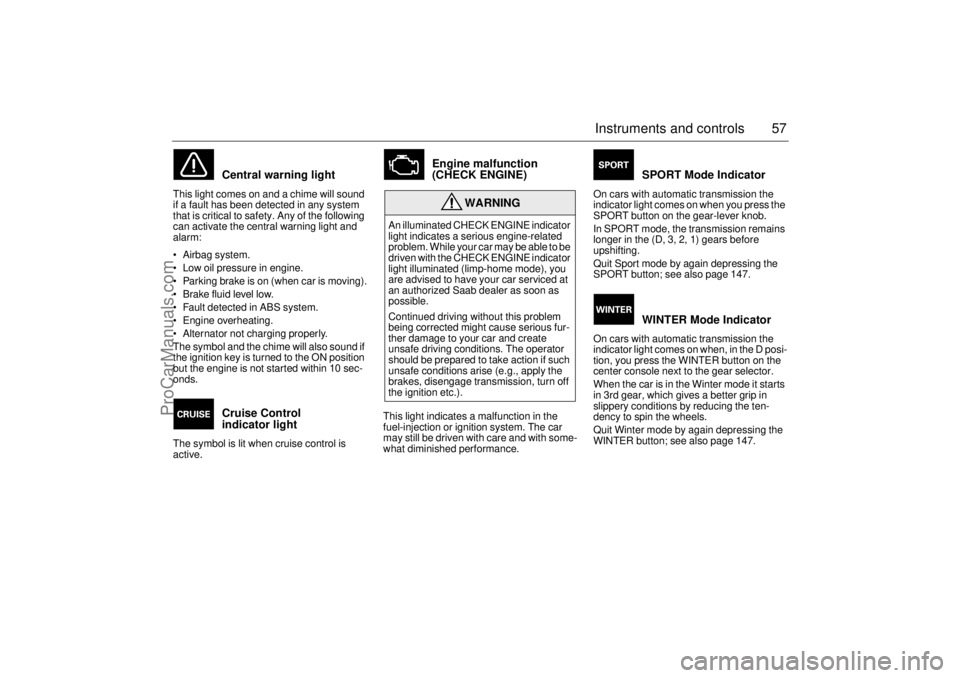
Central warning light
This light comes on and a chime will sound
if a fault has been detected in any system
that is critical to safety. Any of the following
can activate the central warning light and
alarm:
Airbag system.
Low oil pressure in engine.
Parking brake is on (when car is moving).
Brake fluid level low.
Fault detected in ABS system.
Engine overheating.
Alternator not charging properly.
The symbol and the chime will also sound if
the ignition key is turned to the ON position
but the engine is not started within 10 sec-
onds.
Cruise Control
indicator light
The symbol is lit when cruise control is
active.
Engine malfunction
(CHECK ENGINE)
This light indicates a malfunction in the
fuel-injection or ignition system. The car
may still be driven with care and with some-
what diminished performance.
SPORT Mode Indicator
On cars with automatic transmission the
indicator light comes on when you press the
SPORT button on the gear-lever knob.
In SPORT mode, the transmission remains
longer in the (D, 3, 2, 1) gears before
upshifting.
Quit Sport mode by again depressing the
SPORT button; see also page 147.
WINTER Mode Indicator
On cars with automatic transmission the
indicator light comes on when, in the D posi-
tion, you press the WINTER button on the
center console next to the gear selector.
When the car is in the Winter mode it starts
in 3rd gear, which gives a better grip in
slippery conditions by reducing the ten-
dency to spin the wheels.
Quit Winter mode by again depressing the
WINTER button; see also page 147.
WARNING
An illuminated CHECK ENGINE indicator
light indicates a serious engine-related
problem. While your car may be able to be
driven with the CHECK ENGINE indicator
light illuminated (limp-home mode), you
are advised to have your car serviced at
an authorized Saab dealer as soon as
possible.
Continued driving without this problem
being corrected might cause serious fur-
ther damage to your car and create
unsafe driving conditions. The operator
should be prepared to take action if such
unsafe conditions arise (e.g., apply the
brakes, disengage transmission, turn off
the ignition etc.).
ProCarManuals.com
Page 144 of 236
144 Starting and driving
Automatic transmission
fault indicator
If the symbol appears on the main instru-
ment panel, the system has detected a fault
in the automatic transmission or its control
module (see page 58).
This also means that the Limp-home mode
has been selected, to guard against further
damage being done to the transmission. In
this mode, the automatic transmission
starts in 4th gear, and gear changes (if nec-
essary) will have to be made manually.
It is not possible to select the SPORT or
WINTER mode when the Limp-home mode
is active.
You should have the automatic transmis-
sion checked as soon as possible by an
authorized Saab dealer.
The following gears will be engaged in the
respective selector positions when the auto-
matic transmission is in the Limp-home
mode:
Overheated transmission oilIf the transmission oil becomes overheated
while driving, the following message
appears on the SID: TRANSMISSION
OVERHEATING. In this event, stop the car
in a suitable place, switch off the engine,
open the hood and wait until the message
goes out. When driving subsequent to the
transmission oil overheating, select a
locked gear position in which the engine
speed is about 3,000 rpm.
The transmission oil can become very hot
when the car is driven with a heavy load; for
example, driving with a trailer on hilly roads
when the wrong gear has been selected,
resulting in many extra gear changes.
Select one of the positions 1, 2 or 3. A high
outside temperature or a defective oil cooler
can also cause the oil temperature to
increase. Contact an authorized Saab work-
shop, see also page 156.
Driving in hilly country with a heavy
loadOverheating of the automatic-transmission
fluid can occur when the car is towing a
heavy load, such as a trailer in hilly country,
with the wrong gear selected, resulting in
abnormally frequent gear changing. Try
selecting position 1, 2 or 3. High ambient
temperatures can also increase the temper-
ature of the transmission fluid or the oil
cooler may be faulty. As the transmission
fluid temperature increases, its useful ser-
vice life is reduced. Contact an authorized
Saab dealer (see also page 156).TowingTowing a car with automatic transmission,
see page 162. Position R D 3 2 1
Gear Reverse 4th 4th 3rd 3rd
NOTEIf the control module has actuated the
Limp-home function for the automatic
transmission, the car will remain in 4th
gear when D is selected, making it very
sluggish. To overcome this, move the
selector lever to position 2.
WARNING
Remember to use engine-braking (selec-
tor position 1, 2, or 3) to spare the brakes
when you are driving on a long or steep
downhill slope. Select the same gear as
you would on the corresponding uphill
slope.
Brake failure can result from overheated
brakes!
ProCarManuals.com
Page 149 of 236

149 Starting and driving
Disengaging the system The system will be disengaged:
When the brake or clutch pedal is
depressed.
When the switch is moved to CANCEL.
When the switch is moved to OFF.
When the engine is switched off.
When the selector lever is moved to posi-
tion N (cars with automatic transmission).
BrakingTo avoid overheating the brakes, (e.g. when
negotiating long descents with a drop of
several hundred feet), select a low gear to
use the braking effect of the engine. If the
car has automatic transmission, move the
selector lever to position 1 or 2.
When driving fast, you can help to prolong
the life of the brakes by thinking ahead and
braking harder for short periods, rather than
braking more moderately over long
stretches. Brake pad wear indicatorsThe outboard brake pads on the front
wheels incorporate pad-wear indicators.
When the lining is down to 3 mm, the pad
will produce a screeching, squealing or
scraping noise when the brakes are applied.
New pads should be installed without delay.
Brake pads should only be replaced by
an authorized Saab dealer.
To ensure optimum brake performance,
it is recommended that you use only
Saab original brake pads.
WARNING
It is prudent to try your brakes from
time to time, especially when driving in
heavy rain, on roads with a lot of sur-
face water, or in snow or slush. In such
conditions, the brakes may take
longer than normal to take effect. To
rectify this, touch the brake pedal peri-
odically to dry the brakes out.
The same applies after the car has
been washed or when the weather is
very humid.
The brakes are power assisted and it
should be kept in mind that the servo
unit only provides the power assis-
tance when the engine is running.
The brake pressure required when the
engine is off,( e.g. when the car is
being towed) is roughly four times the
normal pedal force required. The
pedal also feels hard and unrespon-
sive.
ProCarManuals.com
Page 150 of 236
150 Starting and drivingABS brakesABS (Antilock Braking System) modulates
the brake pressure to the respective
wheels. Wheel sensors detect if a wheel is
about to lock, and the control module
reduces the pressure to that wheel and then
increases it once more until the tendency is
detected again.
The brake system is equipped with an Elec-
tronic Brake-force Distribution device
(EBD), which distributes the brake pressure
between the front and rear wheels in such a
way as to achieve optimum braking perfor-
mance regardless of the car’s speed and
load.
The ABS system has a built-in diagnostic
function which will switch on the ABS warn-
ing light if a fault is detected in the system
(see page 56). The ABS system will not reduce the braking
distance on loose gravel or on snow or ice
but, because the wheels cannot lock up,
some steering control is retained.
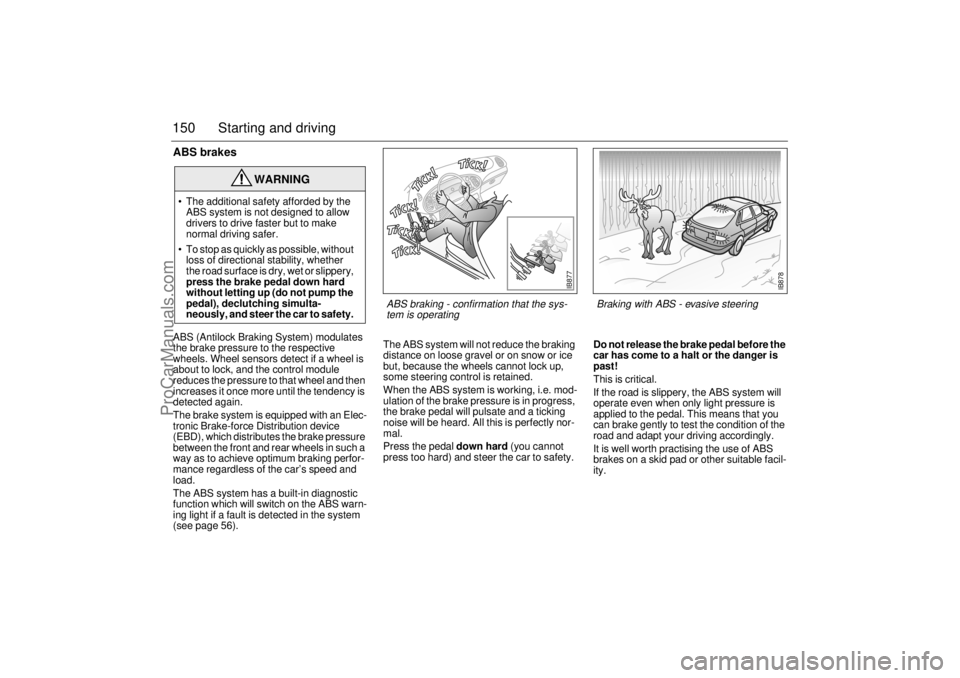
When the ABS system is working, i.e. mod-
ulation of the brake pressure is in progress,
the brake pedal will pulsate and a ticking
noise will be heard. All this is perfectly nor-
mal.
Press the pedal down hard (you cannot
press too hard) and steer the car to safety. Do not release the brake pedal before the
car has come to a halt or the danger is
past!
This is critical.
If the road is slippery, the ABS system will
operate even when only light pressure is
applied to the pedal. This means that you
can brake gently to test the condition of the
road and adapt your driving accordingly.
It is well worth practising the use of ABS
brakes on a skid pad or other suitable facil-
ity.
WARNING
The additional safety afforded by the
ABS system is not designed to allow
drivers to drive faster but to make
normal driving safer.
To stop as quickly as possible, without
loss of directional stability, whether
the road surface is dry, wet or slippery,
press the brake pedal down hard
without letting up (do not pump the
pedal), declutching simulta-
neously, and steer the car to safety.
IB877
ABS braking - confirmation that the sys-
tem is operating
IB878
Braking with ABS - evasive steering
ProCarManuals.com
Page 152 of 236
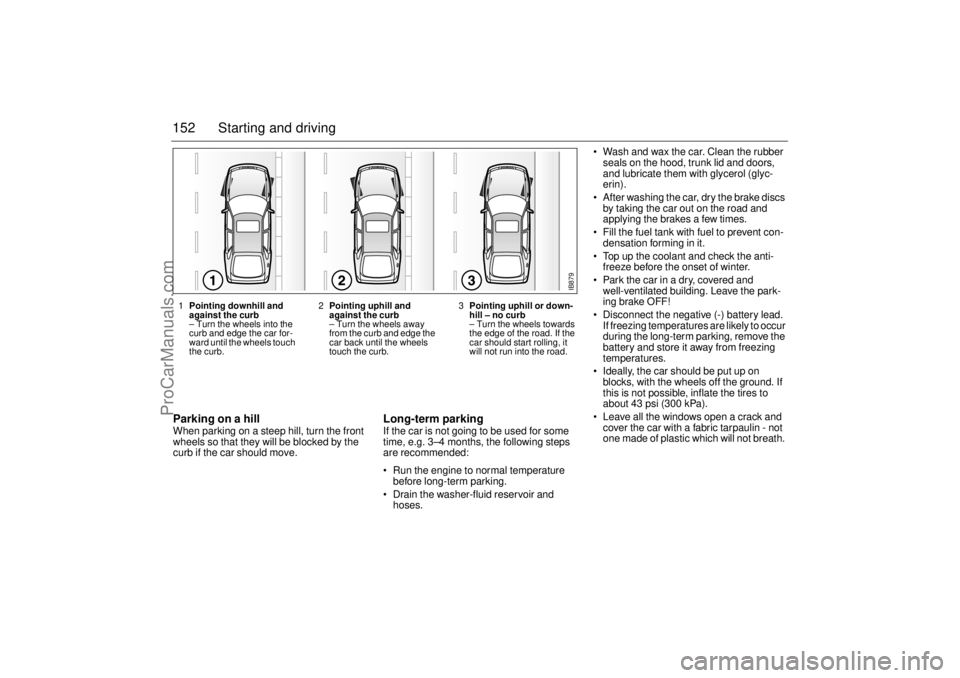
152 Starting and drivingParking on a hillWhen parking on a steep hill, turn the front
wheels so that they will be blocked by the
curb if the car should move.
Long-term parkingIf the car is not going to be used for some
time, e.g. 3–4 months, the following steps
are recommended:
Run the engine to normal temperature
before long-term parking.
Drain the washer-fluid reservoir and
hoses. Wash and wax the car. Clean the rubber
seals on the hood, trunk lid and doors,
and lubricate them with glycerol (glyc-
erin).
After washing the car, dry the brake discs
by taking the car out on the road and
applying the brakes a few times.
Fill the fuel tank with fuel to prevent con-
densation forming in it.
Top up the coolant and check the anti-
freeze before the onset of winter.
Park the car in a dry, covered and
well-ventilated building. Leave the park-
ing brake OFF!
Disconnect the negative (-) battery lead.
If freezing temperatures are likely to occur
during the long-term parking, remove the
battery and store it away from freezing
temperatures.
Ideally, the car should be put up on
blocks, with the wheels off the ground. If
this is not possible, inflate the tires to
about 43 psi (300 kPa).
Leave all the windows open a crack and
cover the car with a fabric tarpaulin - not
one made of plastic which will not breath.
IB879
1Pointing downhill and
against the curb
– Turn the wheels into the
curb and edge the car for-
ward until the wheels touch
the curb. 2Pointing uphill and
against the curb
– Turn the wheels away
from the curb and edge the
car back until the wheels
touch the curb. 3Pointing uphill or down-
hill – no curb
– Turn the wheels towards
the edge of the road. If the
car should start rolling, it
will not run into the road.
ProCarManuals.com
Page 154 of 236

154 Starting and driving Driving in a low gear results in higher fuel
consumption than in a high gear because
of the lower engine speed for a given road
speed. Always change up to a higher gear
as soon as traffic conditions allow and use
the highest gear as much as possible.
Check the air pressure in the tires once a
month. Incorrect pressures increase tire
wear. It is better to have slightly higher
pressure than lower.
Check fuel consumption regularly.
Increased consumption can indicate that
something is wrong and that the car
needs to be checked by an authorized
Saab dealer.
Practical tests on the roads have demon-
strated that substantial savings in fuel con-
sumption can be made if the above advice
is heeded.Road conditions Wet roads increase fuel consumption, as do
unpaved roads and driving in hilly country
(the amount of fuel saved driving downhill is
less than the additional amount required to
climb the hill).
Engine block heater (standard
equipment in Canada, accessory in
U.S.)The following are just some of the benefits
to the car and the environment of using an
engine block heater:
Lower fuel consumption.
Reduced wear on the engine.
Inside of car warms up faster.
Exhaust emissions substantially reduced
over short runs.
The engine block heater is effective with
outside temperatures up to +60 – +70°F
(+15 – +20°C). The warmer it is outside, the
shorter the time the heater need be con-
nected. Longer than 1.5 hours is unneces-
sary.
If the car is equipped with a removable elec-
trical cabin heater that is not in use, this
should be stored in the luggage compart-
ment.
Driving in cold weatherBefore starting a journey in cold weather
you should check the following:
That the wiper blades have not become
frozen to the windshield/glass.
Brush any snow away from the air intake
for the heater system (opening between
hood and windshield).
It may be advisable to lubricate the
door-lock cylinder (use molybdenum
disulphide, MoS
2) to prevent its freezing.
If the lock has frozen, take care not to
break the key (or use the remote control)
– heat it first or spray it with de-icer.
Periodically during the winter, add gaso-
line anti-freeze to the fuel to dispel any
condensation in the fuel tank which could
freeze and cause problems in the system.
Keep the tank well filled to reduce the risk
of condensation forming.
If the car is parked outside in freezing
weather, fuel additives (gasoline
anti-freeze) will not do any good as it
cannot remove water that has already fro-
zen. Park the car in a warm place so that
any ice that may have built up melts, then
add gasoline anti-freeze when filling up
the tank. Condensation is caused by
changes in the outdoor temperature or by
the car being parked alternately in a
garage and outside.
It is particularly important when the roads
are slippery that the brakes and tires be in
good condition.
ProCarManuals.com
Page 165 of 236

165 Starting and driving
Driving considerations
with compact spare
wheel/tire fitted The following should be observed when the
compact spare wheel (T115/70 R16) is
installed:
The compact spare is light and easy to
handle when changing the wheel. Do not
drive farther than necessary with the com-
pact spare fitted – the maximum life of the
wheel is only just over 2000 miles
(3,500 km). Have the standard wheel
repaired and reinstalled as soon as possi-
ble.
The car’s ground clearance is reduced with
the compact spare fitted. Note that only one
compact spare wheel may be used at any
time. Take care not to hit the curb and do not
fit snow chains. Leave the wheel cover off,
so that the warning text is readily visible.
For long tripsBefore starting off on a long journey, it is
advisable to have your car inspected over
by your Saab dealer.
Obtain a few important items to take along
on your journey such as spare bulbs, wiper
blades, fuses, a Poly-Vee-belt and the like.
You can check some points yourself before-
hand:
Make sure that the engine is in good con-
dition.
Check that no oil or fuel leaks out of the
engine or gearbox/transmission.
Inspect the Poly-Vee-belt and replace it if
it shows any signs of wear.
Check the battery charge.
Check the tires for tread pattern and air
pressure, including the compact spare
wheel.
Take an extra car key/remote control and
keep it separate, see also page 30.
Check the brakes.
Check all bulbs.
Check for the presence of the tool kit and
the jack in the car.
WARNING
Do not exceed 50 mph (80 km/h) as the
tire can overheat and adversely affect the
handling of the car.
The tire should be inflated to 60 psi
(420 kPa).
NOTETo avoid damaging a punctured alloy
wheel this can be placed outside up in the
spare-wheel well but only while driving to
the closest workshop.
A general rule is that all heavy loads must
be well secured in the luggage compart-
ment, see page 129.
ProCarManuals.com