child seat SAAB 9-3 2001 User Guide
[x] Cancel search | Manufacturer: SAAB, Model Year: 2001, Model line: 9-3, Model: SAAB 9-3 2001Pages: 260, PDF Size: 12.01 MB
Page 23 of 260
23 Safety
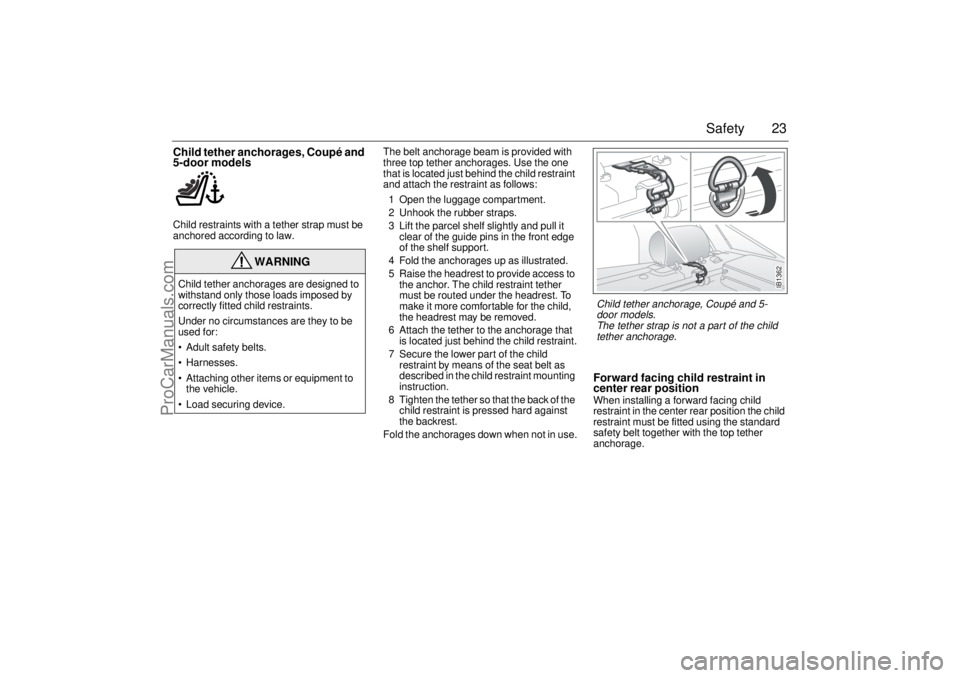
Child tether anchorages, Coupé and
5-door modelsChild restraints with a tether strap must be
anchored according to law.The belt anchorage beam is provided with
three top tether anchorages. Use the one
that is located just behind the child restraint
and attach the restraint as follows:
1 Open the luggage compartment.
2 Unhook the rubber straps.
3 Lift the parcel shelf slightly and pull it
clear of the guide pins in the front edge
of the shelf support.
4 Fold the anchorages up as illustrated.
5 Raise the headrest to provide access to
the anchor. The child restraint tether
must be routed under the headrest. To
make it more comfortable for the child,
the headrest may be removed.
6 Attach the tether to the anchorage that
is located just behind the child restraint.
7 Secure the lower part of the child
restraint by means of the seat belt as
described in the child restraint mounting
instruction.
8 Tighten the tether so that the back of the
child restraint is pressed hard against
the backrest.
Fold the anchorages down when not in use.
Forward facing child restraint in
center rear positionWhen installing a forward facing child
restraint in the center rear position the child
restraint must be fitted using the standard
safety belt together with the top tether
anchorage.
WARNING
Child tether anchorages are designed to
withstand only those loads imposed by
correctly fitted child restraints.
Under no circumstances are they to be
used for:
Adult safety belts.
Harnesses.
Attaching other items or equipment to
the vehicle.
Load securing device.
IB1362
Child tether anchorage, Coupé and 5-
door models.
The tether strap is not a part of the child
tether anchorage.
ProCarManuals.com
Page 24 of 260
24 SafetyChild tether anchorages, Convert-
ible modelsChild restraints with a tether strap must be
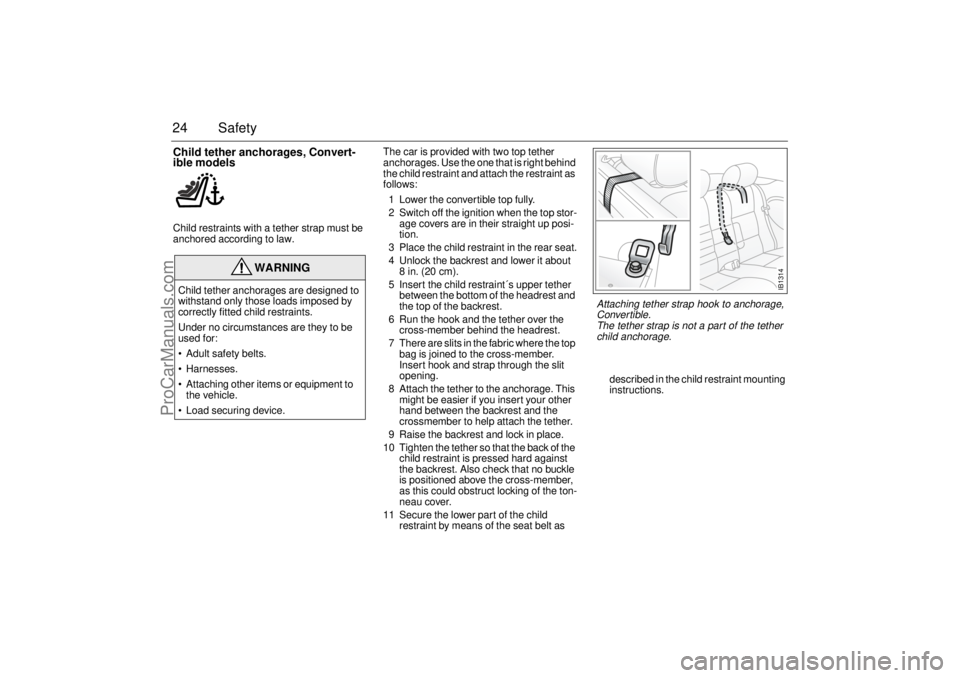
anchored according to law.The car is provided with two top tether
anchorages. Use the one that is right behind
the child restraint and attach the restraint as
follows:
1 Lower the convertible top fully.
2 Switch off the ignition when the top stor-
age covers are in their straight up posi-
tion.
3 Place the child restraint in the rear seat.
4 Unlock the backrest and lower it about
8in. (20cm).
5 Insert the child restraint´s upper tether
between the bottom of the headrest and
the top of the backrest.
6 Run the hook and the tether over the
cross-member behind the headrest.
7 There are slits in the fabric where the top
bag is joined to the cross-member.
Insert hook and strap through the slit
opening.
8 Attach the tether to the anchorage. This
might be easier if you insert your other
hand between the backrest and the
crossmember to help attach the tether.
9 Raise the backrest and lock in place.
10 Tighten the tether so that the back of the
child restraint is pressed hard against
the backrest. Also check that no buckle
is positioned above the cross-member,
as this could obstruct locking of the ton-
neau cover.
11 Secure the lower part of the child
restraint by means of the seat belt as described in the child restraint mounting
instructions.
WARNING
Child tether anchorages are designed to
withstand only those loads imposed by
correctly fitted child restraints.
Under no circumstances are they to be
used for:
Adult safety belts.
Harnesses.
Attaching other items or equipment to
the vehicle.
Load securing device.
IB1314
Attaching tether strap hook to anchorage,
Conver tible.
The tether strap is not a part of the tether
child anchorage.
ProCarManuals.com
Page 25 of 260
25 Safety
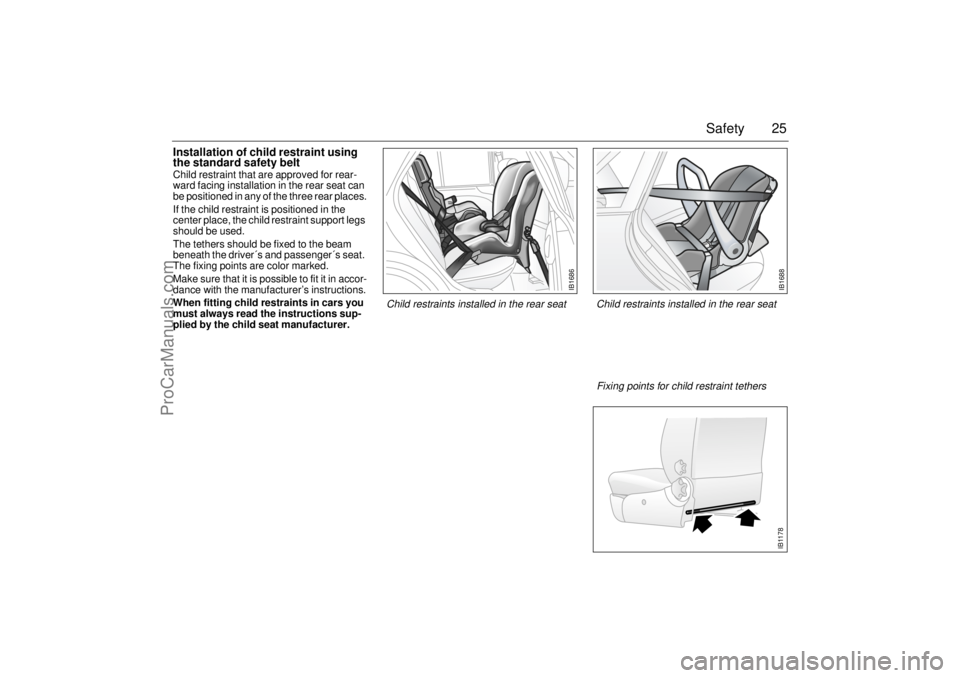
Installation of child restraint using
the standard safety beltChild restraint that are approved for rear-
ward facing installation in the rear seat can
be positioned in any of the three rear places.
If the child restraint is positioned in the
center place, the child restraint support legs
should be used.
The tethers should be fixed to the beam
beneath the driver´s and passenger´s seat.
The fixing points are color marked.
Make sure that it is possible to fit it in accor-
dance with the manufacturer’s instructions.
When fitting child restraints in cars you
must always read the instructions sup-
plied by the child seat manufacturer.
IB1686
IB1688IB1178
Child restraints installed in the rear seat Child restraints installed in the rear seat
Fixing points for child restraint tethers
ProCarManuals.com
Page 26 of 260
26 SafetyIntegrated booster seat
(accessory)Integrated booster seats are available as
part of the rear seat backrest.
This child restraint is designed for use by
children who weigh between 33 and 80 lbs.
(15 and 36 kg) and are between 38 and 54
inches (970 and 1370 mm) in height.
A child sitting in an integrated booster seat
must use the car’s regular lap and shoulder
belt. Regardless of the child’s weight and
age, proper contact between child and belt
is vital. Always make certain that the seat is
undamaged and is kept clean so that it will
function properly.
This child restraint system conforms to all
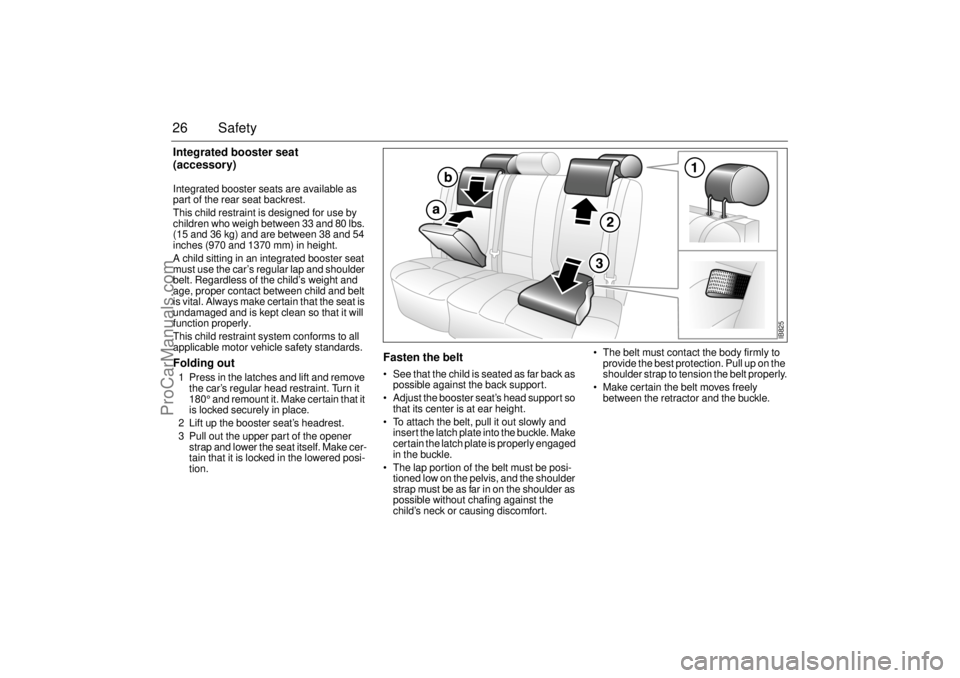
applicable motor vehicle safety standards. Folding out 1 Press in the latches and lift and remove
the car’s regular head restraint. Turn it
180° and remount it. Make certain that it
is locked securely in place.
2 Lift up the booster seat’s headrest.
3 Pull out the upper part of the opener
strap and lower the seat itself. Make cer-
tain that it is locked in the lowered posi-
tion.
Fasten the belt See that the child is seated as far back as
possible against the back support.
Adjust the booster seat’s head support so
that its center is at ear height.
To attach the belt, pull it out slowly and
insert the latch plate into the buckle. Make
certain the latch plate is properly engaged
in the buckle.
The lap portion of the belt must be posi-
tioned low on the pelvis, and the shoulder
strap must be as far in on the shoulder as
possible without chafing against the
child’s neck or causing discomfort. The belt must contact the body firmly to
provide the best protection. Pull up on the
shoulder strap to tension the belt properly.
Make certain the belt moves freely
between the retractor and the buckle.
IB825
ProCarManuals.com
Page 27 of 260
27 Safety
Folding booster seata Pull the upper part of the release strap
out and fold up the seat itself. Make sure
that it is locked firmly in its folded-up
position.
b Press the booster seat’s headrest all the
way down.
c Press in the latches on the car’s regular
head restraint. Remove it, rotate it 180°
and remount it. Make certain it is locked
correctly.
ISOFIX child restraints cannot be fitted in a
car with integrated booster seats.
WARNING
Use only the vehicle’s lap and shoul-
der belt system when restraining the
child in the booster seat.
The seat must not be modified or
changed in any way.
Do not leave a child alone in a car with-
out supervision.
The car’s regular head restraint must
always be turned 180° back to its orig-
inal position after the integrated
booster seat is folded away.
Check that the belt is not twisted or
rubbing against any sharp edges.
WARNING
Failure to follow all the manufacturer’s
instructions on the use of this child
restraint system can cause your child to
strike the vehicle´s interior during a
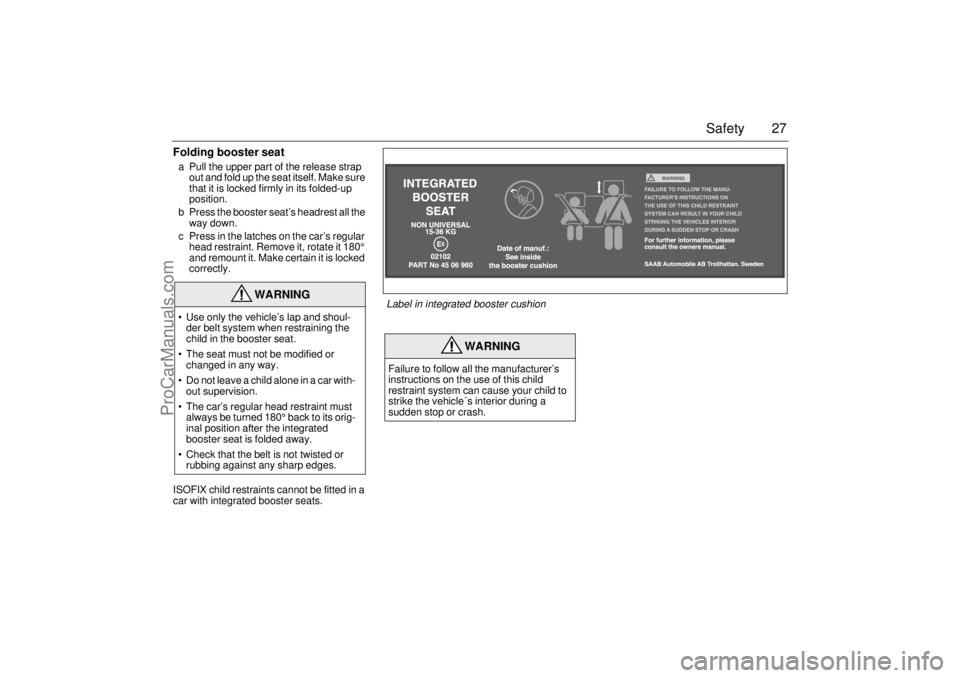
sudden stop or crash.Label in integrated booster cushion
ProCarManuals.com
Page 28 of 260
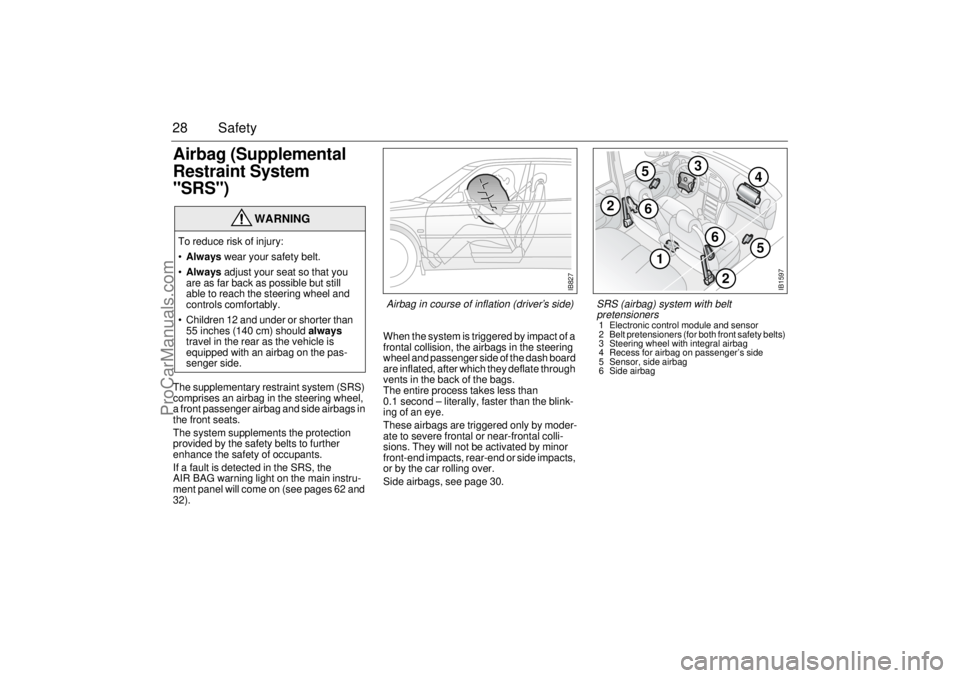
28 SafetyAirbag (Supplemental
Restraint System
"SRS") The supplementary restraint system (SRS)
comprises an airbag in the steering wheel,
a front passenger airbag and side airbags in
the front seats.
The system supplements the protection
provided by the safety belts to further
enhance the safety of occupants.
If a fault is detected in the SRS, the
AIR BAG warning light on the main instru-
ment panel will come on (see pages 62 and
32). When the system is triggered by impact of a
frontal collision, the airbags in the steering
wheel and passenger side of the dash board
are inflated, after which they deflate through
vents in the back of the bags.
The entire process takes less than
0.1 second – literally, faster than the blink-
ing of an eye.
These airbags are triggered only by moder-
ate to severe frontal or near-frontal colli-
sions. They will not be activated by minor
front-end impacts, rear-end or side impacts,
or by the car rolling over.
Side airbags, see page 30.
WARNING
To reduce risk of injury:
Always wear your safety belt.
Always adjust your seat so that you
are as far back as possible but still
able to reach the steering wheel and
controls comfortably.
Children 12 and under or shorter than
55 inches (140 cm) should always
travel in the rear as the vehicle is
equipped with an airbag on the pas-
senger side.
IB827
Airbag in course of inflation (driver’s side)
IB1597
5
1
4
2
6
3
2
6
5
SRS (airbag) system with belt
pretensioners 1 Electronic control module and sensor
2 Belt pretensioners (for both front safety belts)
3 Steering wheel with integral airbag
4 Recess for airbag on passenger’s side
5 Sensor, side airbag
6 Side airbag
ProCarManuals.com
Page 30 of 260
30 SafetyFront passenger seat The airbags are interconnected and have a
common warning light, AIR BAG. The pas-
senger airbag module is housed in the
fascia above the glove compartment and is
marked ”SRS AIR BAG”.
Both airbags will be inflated in the event of a
moderate to severe frontal, or near-frontal
collision, even if the passenger seat is unoc-
cupied.
Side airbag
WARNING
Never secure a rear-facing child seat in
the right front seat of a car equipped with
a passenger airbag. Inflation of the airbag
in the event of an accident could seriously
injure or kill a child.
WARNING
Children 12 and under can be killed by
the airbag.
The back seat is the safest place for
children.
Never allow a child to stand in front of
the seat or to sit on the lap of a
front-seat passenger. Serious injury or
death could result if the airbag is
inflated in a collision.
The glove compartment must be
closed while travelling. An open
glove-compartment door could cause
leg injuries in the event of a collision.
Never place anything on the dash or in
front of the seat as, in addition to being
a hazard to passengers, this could
interfere with the function of the airbag
in the event of an accident. The same
applies to the mounting of accessories
on the dash.
Keep feet on the floor - never put feet
up on the dash, on the seat or out of
the window.
Do not carry anything in your lap.
WARNING
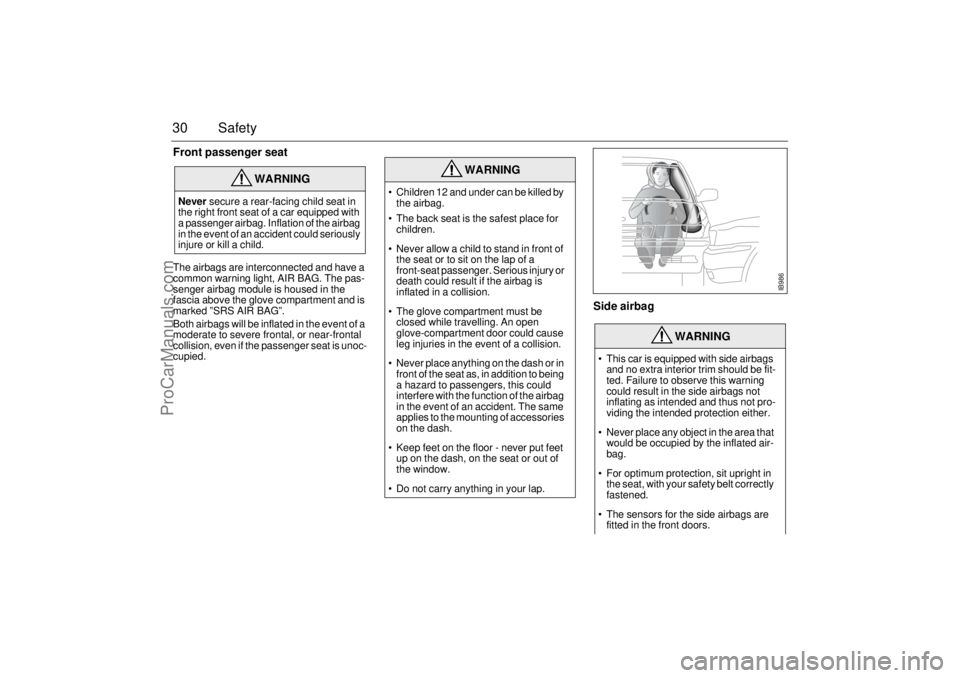
This car is equipped with side airbags
and no extra interior trim should be fit-
ted. Failure to observe this warning
could result in the side airbags not
inflating as intended and thus not pro-
viding the intended protection either.
Never place any object in the area that
would be occupied by the inflated air-
bag.
For optimum protection, sit upright in
the seat, with your safety belt correctly
fastened.
The sensors for the side airbags are
fitted in the front doors.
IB986
ProCarManuals.com
Page 33 of 260

33 Safety
Frequently asked questions on func-
tion of the airbagDo you still need to wear a safety belt if air-
bags are fitted? Yes, always! The airbag merely supple-
ments the car’s normal safety system.
Moreover, the airbag will only be actuated in
a moderate to severe frontal, or near-frontal
collision, which means, of course, that it pro-
vides no protection in minor frontal colli-
sions, major rear-end or side-on collisions
or if the car rolls over.
The safety belts help reduce the chance of
the car occupants from being thrown around
and injured inside the car.
But they also ensure that, if a collision
occurs in which the airbags are inflated, the
airbag will make the optimum contact with
the occupant, i.e. square on from the front.
If the occupant meets the airbag in an offset
position, the protection afforded will be
reduced.
In addition, airbags provide no protection
against a secondary impact occurring in the
same incident. So there is no doubt about
the benefit of wearing safety belts at all
times.
Do not sit too close to the airbag: it needs
room to inflate.
The airbag inflates very quickly and power-
fully in order to protect an adult person in a
serious frontal collision.
How do I position the seat to leave room for
the airbag to inflate?Don’t have your seat too far forward.
Recline the seat back to increase the dis-
tance between you and the airbag. For short
drivers, special accessory pedal extensions
are available through your Saab dealer.
Airbags inflate extremely rapidly and with
great force - to be fast enough to protect an
adult in the seat. When do the airbags in the steering wheel
and passenger side of the dash board
inflate? The airbag will only be inflated under certain
predetermined conditions in a moderate to
severe frontal, or near-frontal collision,
depending on such factors as the force and
angle of the impact, the speed of the car on
impact, and the resistance to deformation of
the impacting object.
The airbag can only be activated once in the
same incident.
Do not attempt to drive the car after an
airbag has been inflated, even if it is possi-
ble.
What won’t trigger the airbag? The airbag will not be activated in all
front-end collisions. For instance, if the car
has hit something relatively soft and yielding
(e.g. a snow drift or a hedge) or a solid
object at a low impact speed, the airbag will
not necessarily be triggered. How loud is the inflation? The noise of the inflation is certainly loud,
but it is very short-lived and will not damage
your hearing. For a short time afterwards
you could experience a buzzing noise in
your ears.
Most people who have experienced it
cannot remember the noise of the inflation
at all - all they remember is the noise of the
crash. Can you still use a child seat in the front if a
passenger airbag is installed? Definitely not!
Children 12 and under can be injured or
killed by the airbag.
The BACK SEAT is the SAFEST place for
children.
NEVER put a child seat in the front.
ProCarManuals.com
Page 48 of 260

48 ConvertibleConvertibleGeneral safety instructions• Never touch the hinges and struts of the
soft top nor the upper beam of the wind-
shield while operating the soft top.
After raising the soft top, always check
that it is properly secured to the top beam
of the windshield with the soft top locking
device before driving the car away.
After folding it down you should check that
the tonneau cover latches have engaged
properly. Otherwise it may come loose
while you are driving and cause injury.
Do not operate the soft top with passen-
gers in the rear seat or bystanders right
next to the car. There is a risk of head inju-
ries while the soft top is in motion.
Remove child car seats and children
before operating the soft top.
Don’t operate the soft top in temperatures
below 23°F (-5°C). Note that certain automatic carwashes
can do damage to fabric soft tops. This
applies to carwashes that use mechanical
feelers bearing against the body. We
advise against washing a Saab 9-3 Con-
vertible in automatic carwashes.
Note that certain automatic car washes
can cause water to leak in places that nor-
mally would not leak. Do not direct high
pressure streams of water at the seals for
the conver tible top.
Roof racks and ski holders must not be
mounted on the soft top.
Under no circumstances should anything
be put into the storage space for the soft
top (under the tonneau cover) since this
could cause obstruction when the soft top
is being folded away.
See that no luggage is resting against the
soft top stowage space since this could
interfere with the rasing and folding of the
soft top. When the soft top is being operated, low-
ering or raising should be completed. Do
not leave the soft top partially raised or
lowered: after 20 seconds it will quickly
"settle down" when the hydraulic pres-
sure is automatically released.
It is important that the telescopic locking
handle is completely pushed in when the
soft top is closed.
Fold down any auxilliary mounted
antenna before raising the top to avoid
possible antenna or top damage (e.g.,
OnStar cellular antenna on windshield of
Conver tible).
ProCarManuals.com
Page 56 of 260
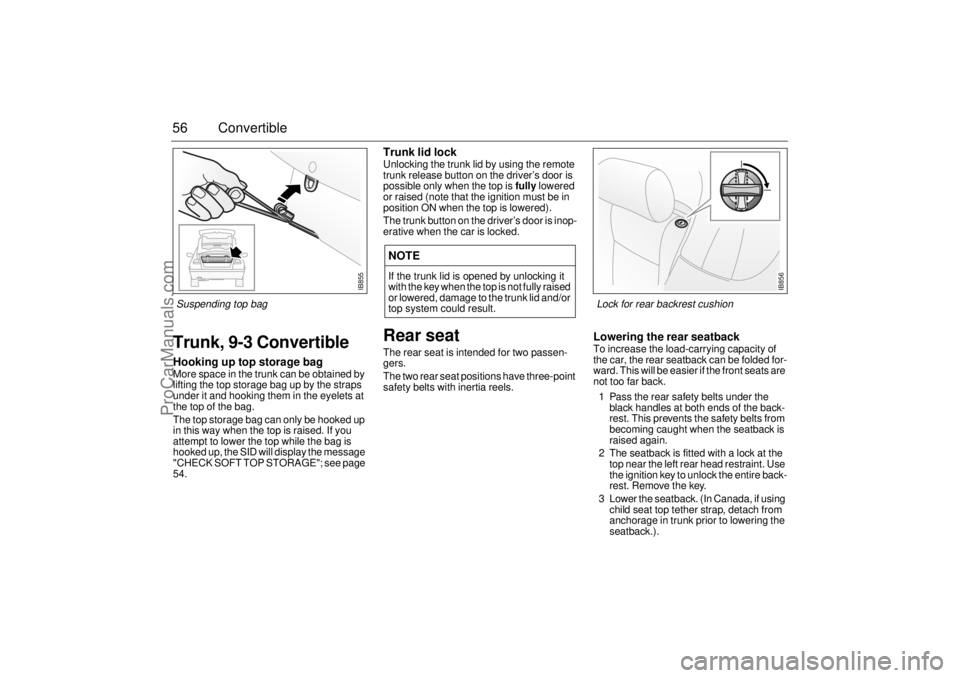
56 ConvertibleTrunk, 9-3 ConvertibleHooking up top storage bagMore space in the trunk can be obtained by
lifting the top storage bag up by the straps
under it and hooking them in the eyelets at
the top of the bag.
The top storage bag can only be hooked up
in this way when the top is raised. If you
attempt to lower the top while the bag is
hooked up, the SID will display the message
"CHECK SOFT TOP STORAGE"; see page
54.
Trunk lid lockUnlocking the trunk lid by using the remote
trunk release button on the driver’s door is
possible only when the top is fully lowered
or raised (note that the ignition must be in
position ON when the top is lowered).
The trunk button on the driver’s door is inop-
erative when the car is locked.Rear seatThe rear seat is intended for two passen-
gers.
The two rear seat positions have three-point
safety belts with inertia reels.
Lowering the rear seatbackTo increase the load-carrying capacity of
the car, the rear seatback can be folded for-
ward. This will be easier if the front seats are
not too far back.
1 Pass the rear safety belts under the
black handles at both ends of the back-
rest. This prevents the safety belts from
becoming caught when the seatback is
raised again.
2 The seatback is fitted with a lock at the
top near the left rear head restraint. Use
the ignition key to unlock the entire back-
rest. Remove the key.
3 Lower the seatback. (In Canada, if using
child seat top tether strap, detach from
anchorage in trunk prior to lowering the
seatback.).
NOTEIf the trunk lid is opened by unlocking it
with the key when the top is not fully raised
or lowered, damage to the trunk lid and/or
top system could result.
IB855
Suspending top bag
IB856
Lock for rear backrest cushion
ProCarManuals.com