ignition SAAB 9-3 2001 User Guide
[x] Cancel search | Manufacturer: SAAB, Model Year: 2001, Model line: 9-3, Model: SAAB 9-3 2001Pages: 260, PDF Size: 12.01 MB
Page 52 of 260
52 Convertible4 Raise the side windows by sliding the
ROOF button forward a second time.
Alternatively, use the central operating
switch for the side windows.
5 Check that there are no fault messages
on the SID; see page 54.Manual raising of the
soft topPoints 6 to 8 are only valid if the soft top is
operated manually when the soft top ton-
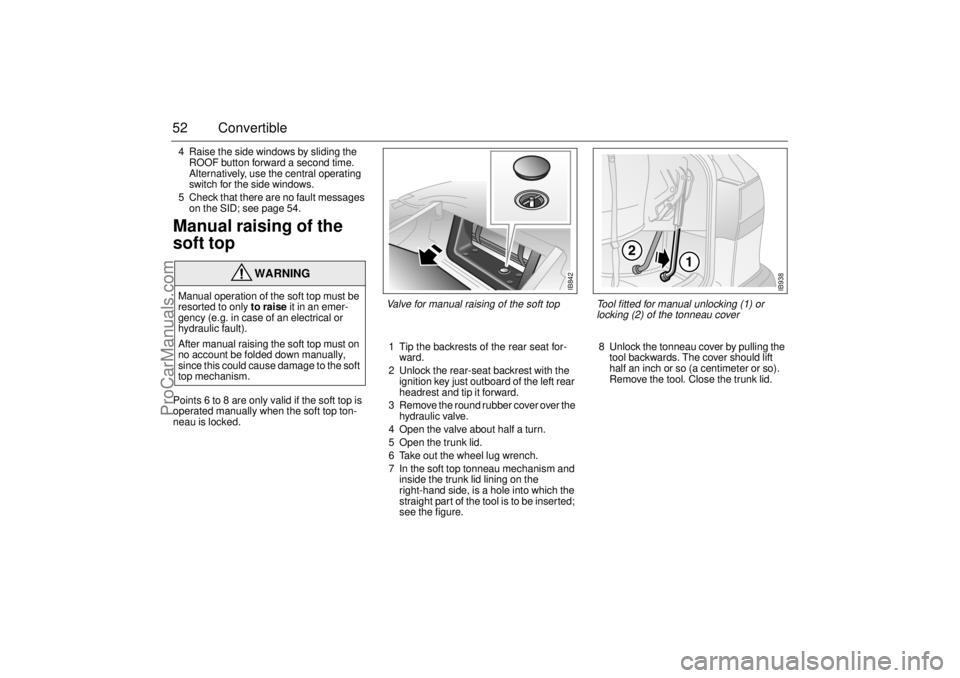
neau is locked.1 Tip the backrests of the rear seat for-
ward.
2 Unlock the rear-seat backrest with the
ignition key just outboard of the left rear
headrest and tip it forward.
3 Remove the round rubber cover over the
hydraulic valve.
4 Open the valve about half a turn.
5 Open the trunk lid.
6 Take out the wheel lug wrench.
7 In the soft top tonneau mechanism and
inside the trunk lid lining on the
right-hand side, is a hole into which the
straight part of the tool is to be inserted;
see the figure. 8 Unlock the tonneau cover by pulling the
tool backwards. The cover should lift
half an inch or so (a centimeter or so).
Remove the tool. Close the trunk lid.
WARNING
Manual operation of the soft top must be
resorted to only to raise it in an emer-
gency (e.g. in case of an electrical or
hydraulic fault).
After manual raising the soft top must on
no account be folded down manually,
since this could cause damage to the soft
top mechanism.
Valve for manual raising of the soft top
IB842
IB938
Tool fitted for manual unlocking (1) or
locking (2) of the tonneau cover
ProCarManuals.com
Page 56 of 260
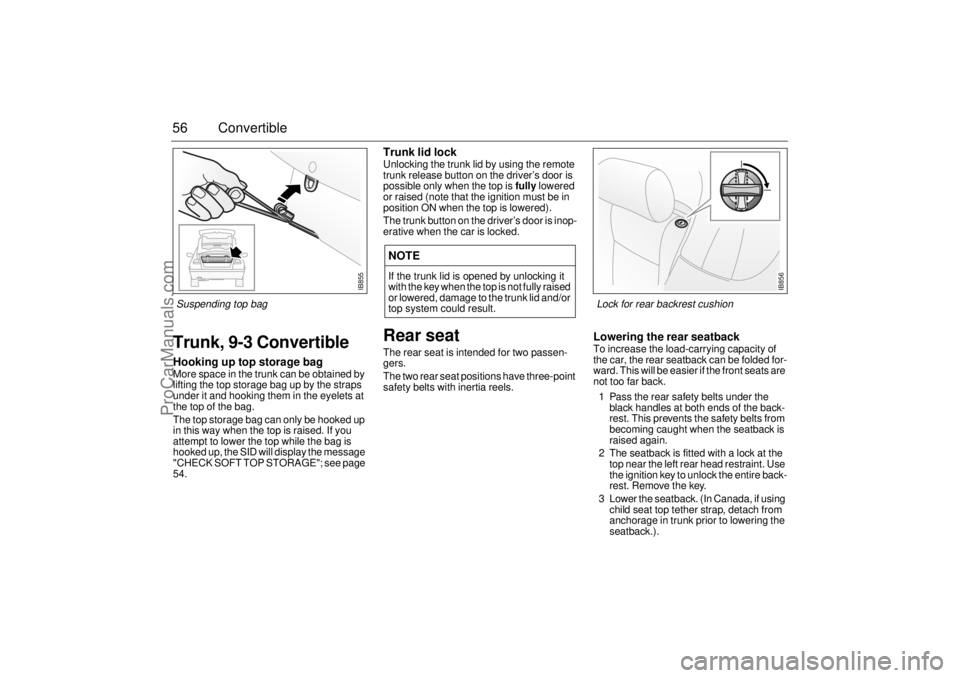
56 ConvertibleTrunk, 9-3 ConvertibleHooking up top storage bagMore space in the trunk can be obtained by
lifting the top storage bag up by the straps
under it and hooking them in the eyelets at
the top of the bag.
The top storage bag can only be hooked up
in this way when the top is raised. If you
attempt to lower the top while the bag is
hooked up, the SID will display the message
"CHECK SOFT TOP STORAGE"; see page
54.
Trunk lid lockUnlocking the trunk lid by using the remote
trunk release button on the driver’s door is
possible only when the top is fully lowered
or raised (note that the ignition must be in
position ON when the top is lowered).
The trunk button on the driver’s door is inop-
erative when the car is locked.Rear seatThe rear seat is intended for two passen-
gers.
The two rear seat positions have three-point
safety belts with inertia reels.
Lowering the rear seatbackTo increase the load-carrying capacity of
the car, the rear seatback can be folded for-
ward. This will be easier if the front seats are
not too far back.
1 Pass the rear safety belts under the
black handles at both ends of the back-
rest. This prevents the safety belts from
becoming caught when the seatback is
raised again.
2 The seatback is fitted with a lock at the
top near the left rear head restraint. Use
the ignition key to unlock the entire back-
rest. Remove the key.
3 Lower the seatback. (In Canada, if using
child seat top tether strap, detach from
anchorage in trunk prior to lowering the
seatback.).
NOTEIf the trunk lid is opened by unlocking it
with the key when the top is not fully raised
or lowered, damage to the trunk lid and/or
top system could result.
IB855
Suspending top bag
IB856
Lock for rear backrest cushion
ProCarManuals.com
Page 60 of 260
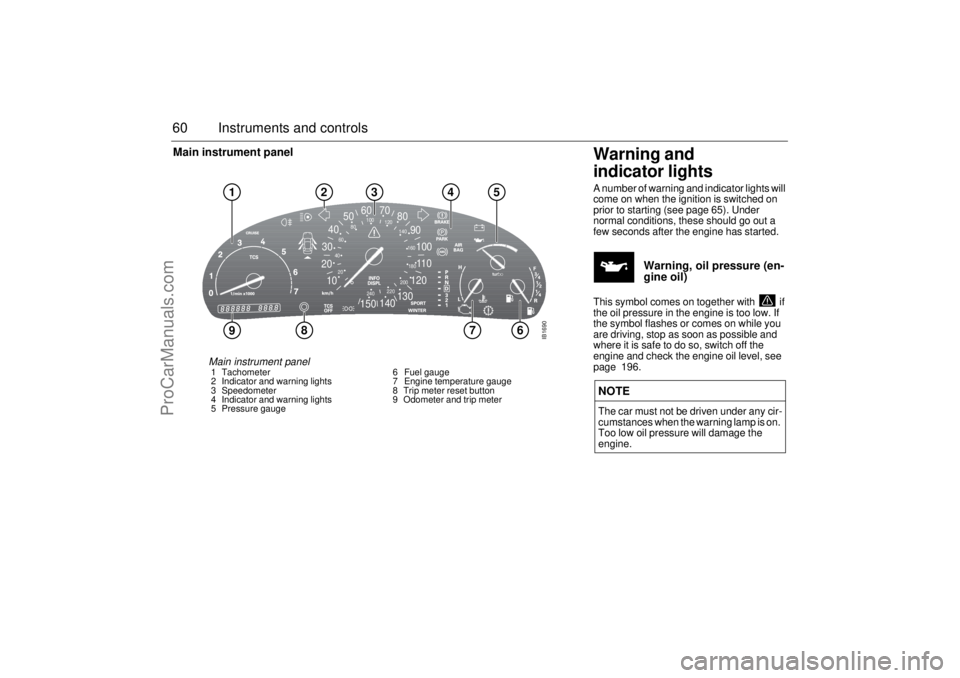
60 Instruments and controlsMain instrument panel
Warning and
indicator lightsA number of warning and indicator lights will
come on when the ignition is switched on
prior to starting (see page 65). Under
normal conditions, these should go out a
few seconds after the engine has started.
Warning, oil pressure (en-
gine oil)
This symbol comes on together with if
the oil pressure in the engine is too low. If
the symbol flashes or comes on while you
are driving, stop as soon as possible and
where it is safe to do so, switch off the
engine and check the engine oil level, see
page 196. NOTEThe car must not be driven under any cir-
cumstances when the warning lamp is on.
Too low oil pressure will damage the
engine.
2030405060 70
80
90
100
11 0
120
130
140
150
240220200180 160 140 120 100
80
60
40
20
10
9
4
5
3
2
7
8
6
1
IB1690
Main instrument panel 1 Tachometer
2 Indicator and warning lights
3 Speedometer
4 Indicator and warning lights
5 Pressure gauge6 Fuel gauge
7 Engine temperature gauge
8 Trip meter reset button
9 Odometer and trip meter
ProCarManuals.com
Page 61 of 260
61 Instruments and controls
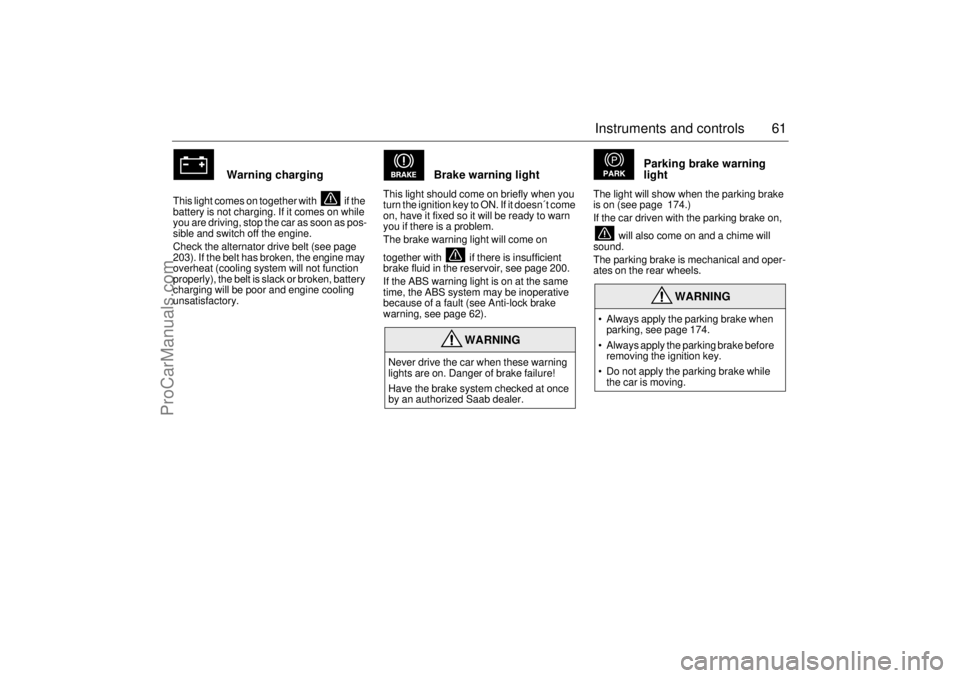
Warning charging
This light comes on together with if the
battery is not charging. If it comes on while
you are driving, stop the car as soon as pos-
sible and switch off the engine.
Check the alternator drive belt (see page
203). If the belt has broken, the engine may
overheat (cooling system will not function
properly), the belt is slack or broken, battery
charging will be poor and engine cooling
unsatisfactory.
Brake warning light
This light should come on briefly when you
turn the ignition key to ON. If it doesn´t come
on, have it fixed so it will be ready to warn
you if there is a problem.
The brake warning light will come on
together with if there is insufficient
brake fluid in the reservoir, see page 200.
If the ABS warning light is on at the same
time, the ABS system may be inoperative
because of a fault (see Anti-lock brake
warning, see page 62).
Parking brake warning
light
The light will show when the parking brake
is on (see page 174.)
If the car driven with the parking brake on,
will also come on and a chime will
sound.
The parking brake is mechanical and oper-
ates on the rear wheels.
WARNING
Never drive the car when these warning
lights are on. Danger of brake failure!
Have the brake system checked at once
by an authorized Saab dealer.
WARNING
Always apply the parking brake when
parking, see page 174.
Always apply the parking brake before
removing the ignition key.
Do not apply the parking brake while
the car is moving.
ProCarManuals.com
Page 62 of 260
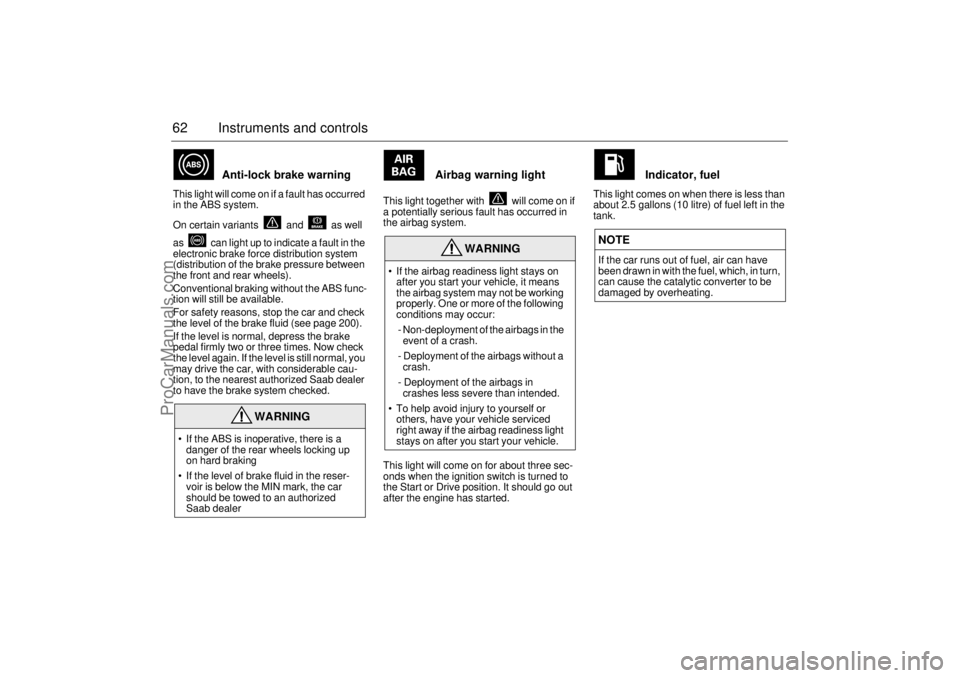
62 Instruments and controls
Anti-lock brake warning
This light will come on if a fault has occurred
in the ABS system.
On certain variants and as well
as can light up to indicate a fault in the
electronic brake force distribution system
(distribution of the brake pressure between
the front and rear wheels).
Conventional braking without the ABS func-
tion will still be available.
For safety reasons, stop the car and check
the level of the brake fluid (see page 200).
If the level is normal, depress the brake
pedal firmly two or three times. Now check
the level again. If the level is still normal, you
may drive the car, with considerable cau-
tion, to the nearest authorized Saab dealer
to have the brake system checked.
Airbag warning light
This light together with will come on if
a potentially serious fault has occurred in
the airbag system.
This light will come on for about three sec-
onds when the ignition switch is turned to
the Start or Drive position. It should go out
after the engine has started.
Indicator, fuel
This light comes on when there is less than
about 2.5 gallons (10 litre) of fuel left in the
tank.
WARNING
If the ABS is inoperative, there is a
danger of the rear wheels locking up
on hard braking
If the level of brake fluid in the reser-
voir is below the MIN mark, the car
should be towed to an authorized
Saab dealer
WARNING
If the airbag readiness light stays on
after you start your vehicle, it means
the airbag system may not be working
properly. One or more of the following
conditions may occur:
- Non-deployment of the airbags in the
event of a crash.
- Deployment of the airbags without a
crash.
- Deployment of the airbags in
crashes less severe than intended.
To help avoid injury to yourself or
others, have your vehicle serviced
right away if the airbag readiness light
stays on after you start your vehicle.
NOTEIf the car runs out of fuel, air can have
been drawn in with the fuel, which, in turn,
can cause the catalytic converter to be
damaged by overheating.
ProCarManuals.com
Page 63 of 260
63 Instruments and controls
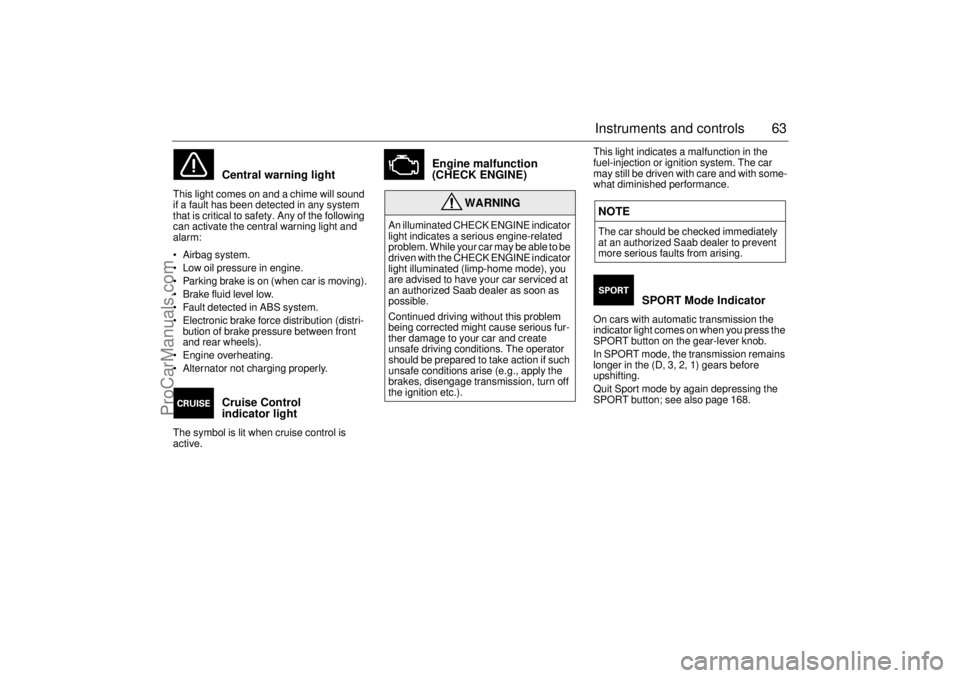
Central warning light
This light comes on and a chime will sound
if a fault has been detected in any system
that is critical to safety. Any of the following
can activate the central warning light and
alarm:
Airbag system.
Low oil pressure in engine.
Parking brake is on (when car is moving).
Brake fluid level low.
Fault detected in ABS system.
Electronic brake force distribution (distri-
bution of brake pressure between front
and rear wheels).
Engine overheating.
Alternator not charging properly.
Cruise Control
indicator light
The symbol is lit when cruise control is
active.
Engine malfunction
(CHECK ENGINE)
This light indicates a malfunction in the
fuel-injection or ignition system. The car
may still be driven with care and with some-
what diminished performance.
SPORT Mode Indicator
On cars with automatic transmission the
indicator light comes on when you press the
SPORT button on the gear-lever knob.
In SPORT mode, the transmission remains
longer in the (D, 3, 2, 1) gears before
upshifting.
Quit Sport mode by again depressing the
SPORT button; see also page 168.
WARNING
An illuminated CHECK ENGINE indicator
light indicates a serious engine-related
problem. While your car may be able to be
driven with the CHECK ENGINE indicator
light illuminated (limp-home mode), you
are advised to have your car serviced at
an authorized Saab dealer as soon as
possible.
Continued driving without this problem
being corrected might cause serious fur-
ther damage to your car and create
unsafe driving conditions. The operator
should be prepared to take action if such
unsafe conditions arise (e.g., apply the
brakes, disengage transmission, turn off
the ignition etc.).
NOTEThe car should be checked immediately
at an authorized Saab dealer to prevent
more serious faults from arising.
ProCarManuals.com
Page 64 of 260
64 Instruments and controls
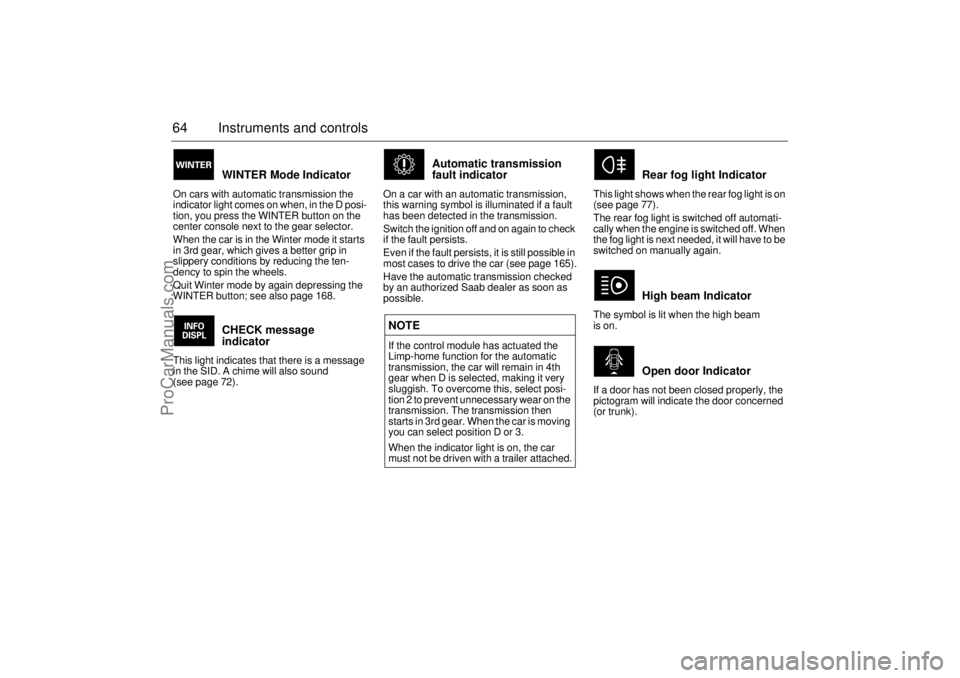
WINTER Mode Indicator
On cars with automatic transmission the
indicator light comes on when, in the D posi-
tion, you press the WINTER button on the
center console next to the gear selector.
When the car is in the Winter mode it starts
in 3rd gear, which gives a better grip in
slippery conditions by reducing the ten-
dency to spin the wheels.
Quit Winter mode by again depressing the
WINTER button; see also page 168.
CHECK message
indicator
This light indicates that there is a message
in the SID. A chime will also sound
(see page 72).
Automatic transmission
fault indicator
On a car with an automatic transmission,
this warning symbol is illuminated if a fault
has been detected in the transmission.
Switch the ignition off and on again to check
if the fault persists.
Even if the fault persists, it is still possible in
most cases to drive the car (see page 165).
Have the automatic transmission checked
by an authorized Saab dealer as soon as
possible.
Rear fog light Indicator
This light shows when the rear fog light is on
(see page 77).
The rear fog light is switched off automati-
cally when the engine is switched off. When
the fog light is next needed, it will have to be
switched on manually again.
High beam Indicator
The symbol is lit when the high beam
is on.
Open door Indicator
If a door has not been closed properly, the
pictogram will indicate the door concerned
(or trunk).
NOTEIf the control module has actuated the
Limp-home function for the automatic
transmission, the car will remain in 4th
gear when D is selected, making it very
sluggish. To overcome this, select posi-
tion 2 to prevent unnecessary wear on the
transmission. The transmission then
starts in 3rd gear. When the car is moving
you can select position D or 3.
When the indicator light is on, the car
must not be driven with a trailer attached.
ProCarManuals.com
Page 65 of 260
65 Instruments and controls
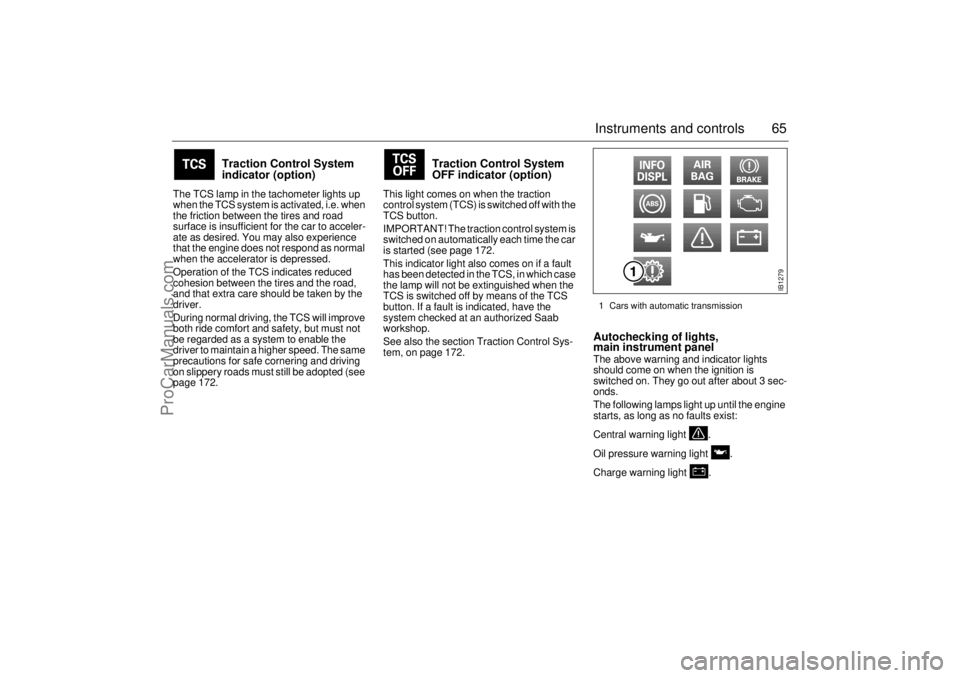
Traction Control System
indicator (option)
The TCS lamp in the tachometer lights up
when the TCS system is activated, i.e. when
the friction between the tires and road
surface is insufficient for the car to acceler-
ate as desired. You may also experience
that the engine does not respond as normal
when the accelerator is depressed.
Operation of the TCS indicates reduced
cohesion between the tires and the road,
and that extra care should be taken by the
driver.
During normal driving, the TCS will improve
both ride comfort and safety, but must not
be regarded as a system to enable the
driver to maintain a higher speed. The same
precautions for safe cornering and driving
on slippery roads must still be adopted (see
page 172.
Traction Control System
OFF indicator (option)
This light comes on when the traction
control system (TCS) is switched off with the
TCS button.
IMPORTANT! The traction control system is
switched on automatically each time the car
is started (see page 172.
This indicator light also comes on if a fault
has been detected in the TCS, in which case
the lamp will not be extinguished when the
TCS is switched off by means of the TCS
button. If a fault is indicated, have the
system checked at an authorized Saab
workshop.
See also the section Traction Control Sys-
tem, on page 172.
Autochecking of lights,
main instrument panel The above warning and indicator lights
should come on when the ignition is
switched on. They go out after about 3 sec-
onds.
The following lamps light up until the engine
starts, as long as no faults exist:
Central warning light .
Oil pressure warning light .
Charge warning light .
IB1279
1 Cars with automatic transmission
ProCarManuals.com
Page 66 of 260
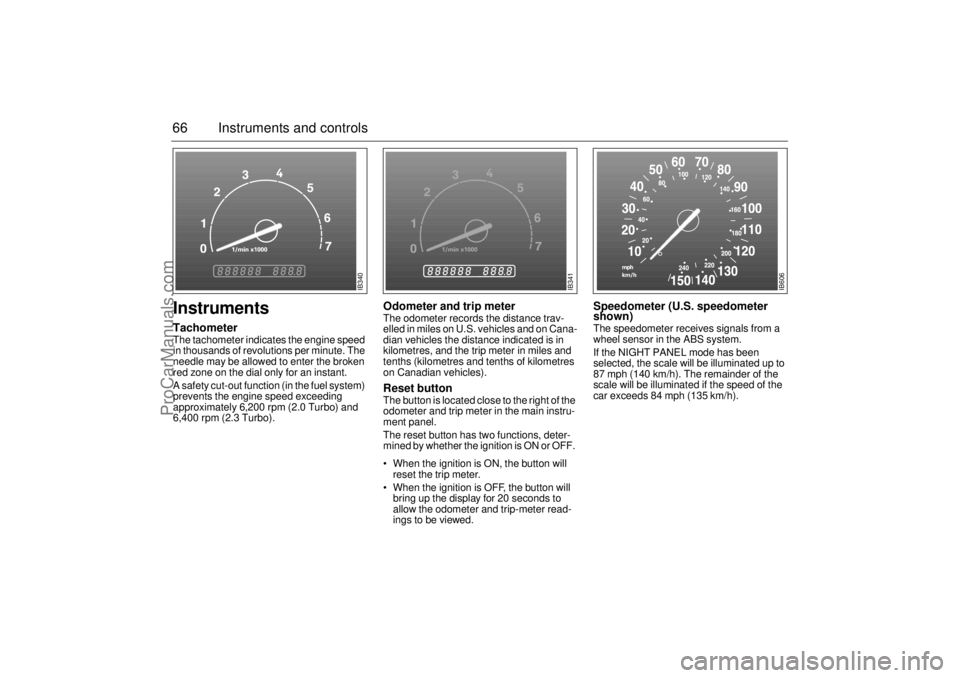
66 Instruments and controlsInstruments TachometerThe tachometer indicates the engine speed
in thousands of revolutions per minute. The
needle may be allowed to enter the broken
red zone on the dial only for an instant.
A safety cut-out function (in the fuel system)
prevents the engine speed exceeding
approximately 6,200 rpm (2.0 Turbo) and
6,400 rpm (2.3 Turbo).
Odometer and trip meterThe odometer records the distance trav-
elled in miles on U.S. vehicles and on Cana-
dian vehicles the distance indicated is in
kilometres, and the trip meter in miles and
tenths (kilometres and tenths of kilometres
on Canadian vehicles). Reset button The button is located close to the right of the
odometer and trip meter in the main instru-
ment panel.
The reset button has two functions, deter-
mined by whether the ignition is ON or OFF.
When the ignition is ON, the button will
reset the trip meter.
When the ignition is OFF, the button will
bring up the display for 20 seconds to
allow the odometer and trip-meter read-
ings to be viewed.
Speedometer (U.S. speedometer
shown)The speedometer receives signals from a
wheel sensor in the ABS system.
If the NIGHT PANEL mode has been
selected, the scale will be illuminated up to
87 mph (140 km/h). The remainder of the
scale will be illuminated if the speed of the
car exceeds 84 mph (135 km/h).
IB340
IB341
IB606
ProCarManuals.com
Page 72 of 260

72 Instruments and controlsCalculating the requisite average speed:
1 Press to select DIST.
2 Hold the SET button for two seconds.
3 Set the distance to be covered using
or .
4 Press SET to store settings.
5 Press to select ARRIV.
6 Hold the SET button for two seconds.
7 Set the desired arrival time using or
.
8 Press SET to display the average speed
you need to maintain to arrive at the
desired time.
At the beginning of a journey, the SPD Ø
and ARRIV functions will display current
values. If values are set during the journey,
the new values will be displayed after a
delay of about 10 seconds.Resetting values
To reset the values, press CLR for at least
four seconds.
The following functions will be reset
simultaneously:
Estimated range on remaining fuel
(function based on a fuel consumption of
28 mpg)
Average fuel consumption
Average speed
Arrival time (function based on current
speed)
Programmed values for DIST, ALARM and
SPD Ø will not be reset (see the respective
function).
CHECK messages When the engine is started, CHECKING will
appear on the display for about four sec-
onds, while the SID checks are being per-
formed.
When a CHECK message is generated
while the car is being driven, a chime will
sound, INFO DISPL will illuminate on the
main instrument panel, and the message
will appear on the SID. The number of mes-
sages that can be displayed by the SID
varies with the specification of the car.
If more than one CHECK message has
been generated, the
+ symbol will appear to
the left of the text on the display. The mes-
sages appear in order of priority.
If a new fault occurs while another message
is being displayed, the message relating to
the new one will appear for 10 seconds,
after which the display will return to the ear-
lier one.
Press CLR once to acknowledge a mes-
sage, whereupon it will be cleared from the
display. It will not be displayed again before
the ignition has been switched off and then
on again.
ProCarManuals.com