oil level SAAB 9-3 2001 User Guide
[x] Cancel search | Manufacturer: SAAB, Model Year: 2001, Model line: 9-3, Model: SAAB 9-3 2001Pages: 260, PDF Size: 12.01 MB
Page 202 of 260
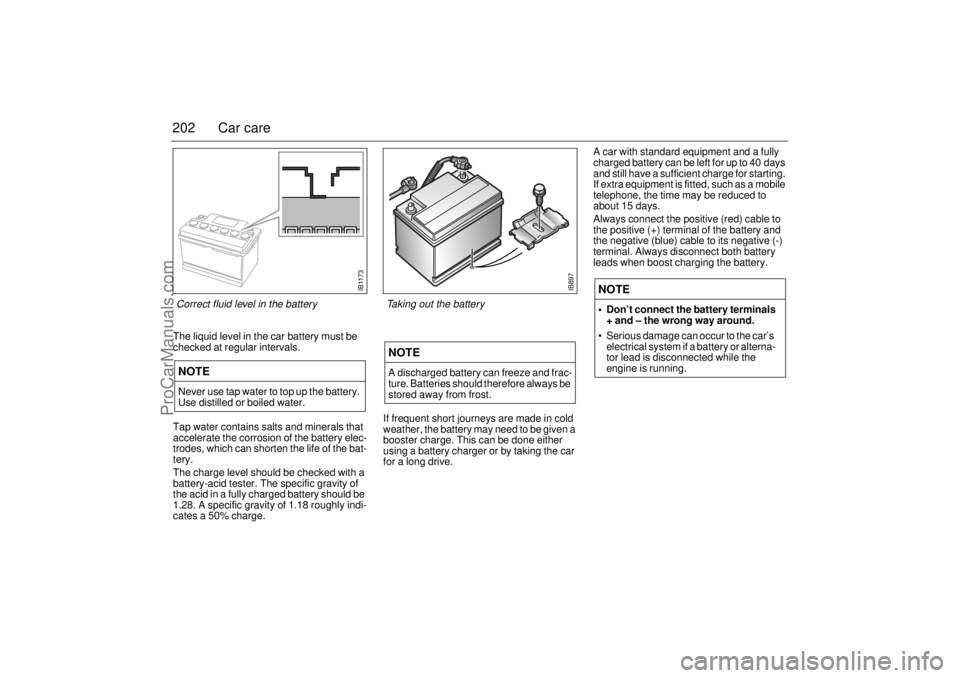
202 Car careThe liquid level in the car battery must be
checked at regular intervals.
Tap water contains salts and minerals that
accelerate the corrosion of the battery elec-
trodes, which can shorten the life of the bat-
tery.
The charge level should be checked with a
battery-acid tester. The specific gravity of
the acid in a fully charged battery should be
1.28. A specific gravity of 1.18 roughly indi-
cates a 50% charge.If frequent short journeys are made in cold
weather, the battery may need to be given a
booster charge. This can be done either
using a battery charger or by taking the car
for a long drive. A car with standard equipment and a fully
charged battery can be left for up to 40 days
and still have a sufficient charge for starting.
If extra equipment is fitted, such as a mobile
telephone, the time may be reduced to
about 15 days.
Always connect the positive (red) cable to
the positive (+) terminal of the battery and
the negative (blue) cable to its negative (-)
terminal. Always disconnect both battery
leads when boost charging the battery.NOTENever use tap water to top up the battery.
Use distilled or boiled water.
NOTEA discharged battery can freeze and frac-
ture. Batteries should therefore always be
stored away from frost.
NOTE• Don’t connect the battery terminals
+ and – the wrong way around.
Serious damage can occur to the car’s
electrical system if a battery or alterna-
tor lead is disconnected while the
engine is running.
IB897
Taking out the battery
IB1173
Correct fluid level in the battery
ProCarManuals.com
Page 239 of 260

239 Maintenance and owner assistance
Saab Original Service Program M2001 USA, Canada, (9-3 Models)* These are the minimum required Emission Control System maintenance steps. Saab urges that all recommended maintenance procedures be performed
according to this program.
(a.) Engine oil and filter should be changed at least once a year. Intermediate oil and filter changes (halfway between indicated intervals) suggested for
cars primarily used for driving in dense city traffic or for repeated short trip operation without sufficient warm up.
** Service intervals:
Refer to the Warranties & Service Record Book for service intervals beyond 100,000 miles (160,000 km).Service Intervals **
Miles = U.S. Cars
Kilometers = Canadian Cars
30 day
10,000
(16,000 km)
20,000
(32,000 km)
30,000
(48,000 km)
40,000
(64,000 km)
50,000
(80,000 km)
60,000
(96,000 km)
70,000
(112,000 km)
80,000
(128,000 km)
90,000
(144,000 km)
100,000
(160,000 km)
Service #
1234567891011
Engine and engine compartment
E Engine oil and filter (a.)!!!!!!!!!!
R Engine coolant freezing point and level""" """ ""
R Engine coolant flush and replace (max. 3-year intervals)!!
R Engine cooling system, hoses and cap""""""""""
R Drive belt; condition""""" ! """"
E Spark plugs!
*
!*
!*
E Crankcase ventilation and vacuum lines""
Application/type of service (col. 1) Service Procedure
E = emission service"= Check - top up, adjust or replace if necessary
R = regular maintenance!= Replace
#= Lubricate
ProCarManuals.com
Page 240 of 260

240 Maintenance and owner assistance* These are the minimum required Emission Control System maintenance steps. Saab urges that all recommended maintenance procedures be performed
according to this program.
(b.) Change automatic transmission fluid at more frequent intervals (30,000; 90,000 miles, etc.) if car is driven in dense city traffic where the outside tem-
perature regularly reaches 90°F or higher, if car is used in a mountainous/high altitude area or for trailer towing.
Service Intervals **
Miles = U.S. Cars
Kilometers = Canadian Cars
30 day
10,000
(16,000 km)
20,000
(32,000 km)
30,000
(48,000 km)
40,000
(64,000 km)
50,000
(80,000 km)
60,000
(96,000 km)
70,000
(112,000 km)
80,000
(128,000 km)
90,000
(144,000 km)
100,000
(160,000 km)
Service #
1234567891011
Engine and engine compartment (cont.)
E Evaporative emission system including filler cap, vapor
lines, EVAP canister and canister purge valve""
R Fuel system; leaks and damages""""""""""
E Fuel filter!
E Engine air cleaner element!
*
!*
!*
R Exhaust system and mountings; leaks and condition""""""""""
Electrical
R Battery; state of charge and electrolyte level; clean termi-
nals if necessary"""""""""""
R Headlamp and fog lamp alignment"""""
R Head, fog, brake, tail, turn signal, warning lights instru-
ment panel, backup and marker lamps"""""""""""
Transmission
R Automatic transmission change fluid (b.)!
R Automatic transmission; oil level and condition"""""" """"
R Manual transmission; oil level""
R Outer and inner driver joint boots""""""""""
ProCarManuals.com
Page 247 of 260

247 Technical data
Engine Engine oilType _____________________________ 4 cyl, 2 overhead
camshafts,
16 valves and 2 bal-
ancer shafts
Cylinder bores ______________________ 3.54" (90 mm)
Stroke:
2.0 Turbo _________________________ 3.071" (78 mm)
Viggen __________________________ 3.543” (90 mm)
Swept volume:
2.0 Turbo _________________________ 121 cu.in.
(1,985 dm
3)
Viggen __________________________ 140 cu.in.
(2.290 dm3)
Idling speed _______________________ 900 rpm
Antifreeze _________________________ Saab-approved
antifreeze
Coolant volume, cooling system ________ 8.7 qts. (8.5 l)
Oil grade: We recommend the use of oils that are available from your
Saab dealer, for the regular oil changes.
These oils fulfill the most stringent requirements set by API and
ACEA classifications.
Oil for gasoline engines is classified by the API standards
(American Petroleum Institute) into the grade classes SH (since
1993) and SJ (since 1996). The SJ class fulfils more stringent
requirements and has a lower phosphorous level.
These grade classes are most often combined with the corre-
sponding classes for diesel engines. The class designations for
diesel engines begin with the letter “C“ (Commercial). For ex-
ample a grade combination suitable for both types of engine
could be API SH/CD or SJ/CF.
Basic recommendations for Saab engines:
• SAE 5W-30 or 5W-40.
The oil should be semi or fully synthetic and fulfil the grade
requirements for ACEA A3/B3 or API SJ.
Oils which are less viscous, such as 0W/-40/50 are becoming
more common and may be used. However, the oil must be
fully-synthetic, of a well known brand, and fulfil ACEA grade re-
quirements A3/B3.
This viscosity makes starting in cold weather easier.
Oil capacity inc. filter (on changing) _____ 4.0 l
ProCarManuals.com