oil temperature SAAB 9-3 2001 User Guide
[x] Cancel search | Manufacturer: SAAB, Model Year: 2001, Model line: 9-3, Model: SAAB 9-3 2001Pages: 260, PDF Size: 12.01 MB
Page 201 of 260
201 Car care
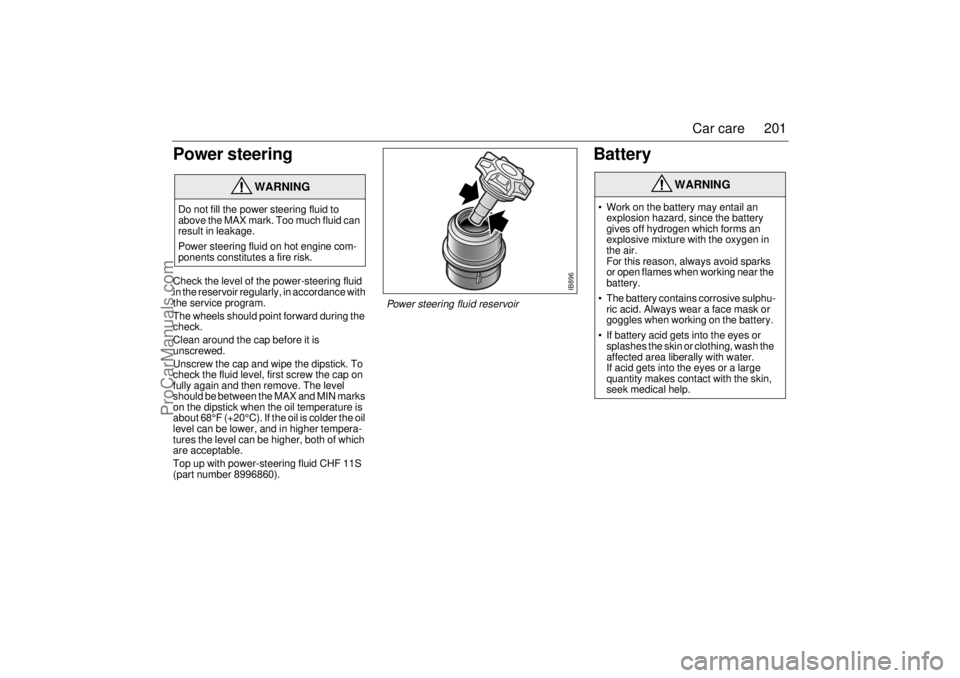
Power steeringCheck the level of the power-steering fluid
in the reservoir regularly, in accordance with
the service program.
The wheels should point forward during the
check.
Clean around the cap before it is
unscrewed.
Unscrew the cap and wipe the dipstick. To
check the fluid level, first screw the cap on
fully again and then remove. The level
should be between the MAX and MIN marks
on the dipstick when the oil temperature is
about 68°F (+20°C). If the oil is colder the oil
level can be lower, and in higher tempera-
tures the level can be higher, both of which
are acceptable.
Top up with power-steering fluid CHF 11S
(part number 8996860).
Battery
WARNING
Do not fill the power steering fluid to
above the MAX mark. Too much fluid can
result in leakage.
Power steering fluid on hot engine com-
ponents constitutes a fire risk.
WARNING
Work on the battery may entail an
explosion hazard, since the battery
gives off hydrogen which forms an
explosive mixture with the oxygen in
the air.
For this reason, always avoid sparks
or open flames when working near the
battery.
The battery contains corrosive sulphu-
ric acid. Always wear a face mask or
goggles when working on the battery.
If battery acid gets into the eyes or
splashes the skin or clothing, wash the
affected area liberally with water.
If acid gets into the eyes or a large
quantity makes contact with the skin,
seek medical help.
IB896
Power steering fluid reservoir
ProCarManuals.com
Page 236 of 260

236 Maintenance and owner assistanceMaintenance scheduleThe Maintenance Schedule prescribes a
service program to the purchaser/operator
of a Saab that is reasonable and necessary
to ensure the proper emission control sys-
tems function, safety and reliability of the
Saab automobile in normal use. Additional
maintenance is recommended for specific
components when the car is operated under
certain severe conditions. Proper mainte-
nance is always a good practice!
Authorized Saab dealers are equipped and
trained to meet your Saab’s service needs.
They regularly receive up-to-date Saab ser-
vice manuals and parts and technical ser-
vice bulletins from Saab and are able,
through their franchise agreement, to attend
Saab service schools, obtain Saab special
tools and technical assistance and pur-
chase original equipment service and
replacement parts.
Today’s complex automobiles should only
be entrusted to the most knowledgeable
service professionals. A Saab dealer is your
best choice.
Service intervalsThe maintenance schedule is comprised of
a Check -up 30 days after retail delivery, fol-
lowed by services at every 10,000 miles
(16,000 km) thereafter (10,000, 20,000,
30,000 miles/16,000 32,000, 48,000 km
etc.).
Engine oil and filter changesChanging the engine oil and filter is required
at every service point. Use only a Saab
approved long-life oil filter and engine oils
meeting the SAE viscosity ratings and API
service classifications stated in the “Techni-
cal data” section of this Owner’s Manual.
The use of extra additives in the oil is not
necessary and is not recommended, and
may be harmful to turbochargers.
More frequent oil changes are recom-
mended if your vehicle is operated under
any of the following conditions:
Most trips are less than 5-10 miles (8-16
km). This is particularly important when
outside temperatures are below freezing.
Most trips include extensive idling (fre-
quent stop-and-go traffic).
Most trips are through dusty areas (such
as construction zones).
If the vehicle is used for delivery service,
police, taxi or other commercial applica-
tions.
If your driving habits match this description,
have the engine oil and filter changed in-
between normal services at 5,000 mile
(8,000 km) intervals. These conditions
cause the engine oil to break down faster.
The Warranties and Service Record Book-
let has provisions to record extra oil
changes.
NOTEThe Check-up will be done by your Saab
dealer at no charge and should be done
as close as possible to the scheduled 30
days.
ProCarManuals.com
Page 248 of 260

248 Technical dataUnder ACEA nomenclature, oils are divided into Class A for
gasoline engines and Class B for diesel-engined passenger
cars. There is a further class for heavy diesel engines. Each
class is divided into three grades: 1, 2 and 3, where grades 2
and 3 normally encompass semi and fully-synthetic oils. The
diesel class B also has a fourth grade, B4, which encompasses
tests and regulations aimed at improving the performance of
direct injection engines.
In the same way as in the API system, gasoline and diesel
engine specifications are combined for products that can be
used in both types of engine. For example, a grade designation
could be ACEA A2/B2 or ACEA A3/B3/B4.
To afford Saab engines the best protection, with regard to lubri-
cation, the ability to dissolve residues and the neutralization of
combustion products, we recommend the following oil grades:
API SH/CD/CF or SJ/CD/CF.
ACEA A3/B3/B4.
These oils contain the additives required for the engine to
function well. We advise against the use of further addi-
tives.
Viscosity: The viscosity of oil is classified according to the SAE standard.
Nowadays, multigrade oils are always used in cars. The proper-
ties of these oils facilitate starting the car in cold weather but
mean that the oil is also viscous enough to coat all moving parts
under high pressures and with high outside air temperatures.
Multigrade oils are graded with two viscosities, e.g. 10W-30,
where the 10W meets certain viscosity requirements at -4°F
(-20°C), while the 30 fulfills requirements at a temperature of
212°F (100°C).
ProCarManuals.com