parking light SAAB 9-3 2001 User Guide
[x] Cancel search | Manufacturer: SAAB, Model Year: 2001, Model line: 9-3, Model: SAAB 9-3 2001Pages: 260, PDF Size: 12.01 MB
Page 186 of 260
186 Starting and driving
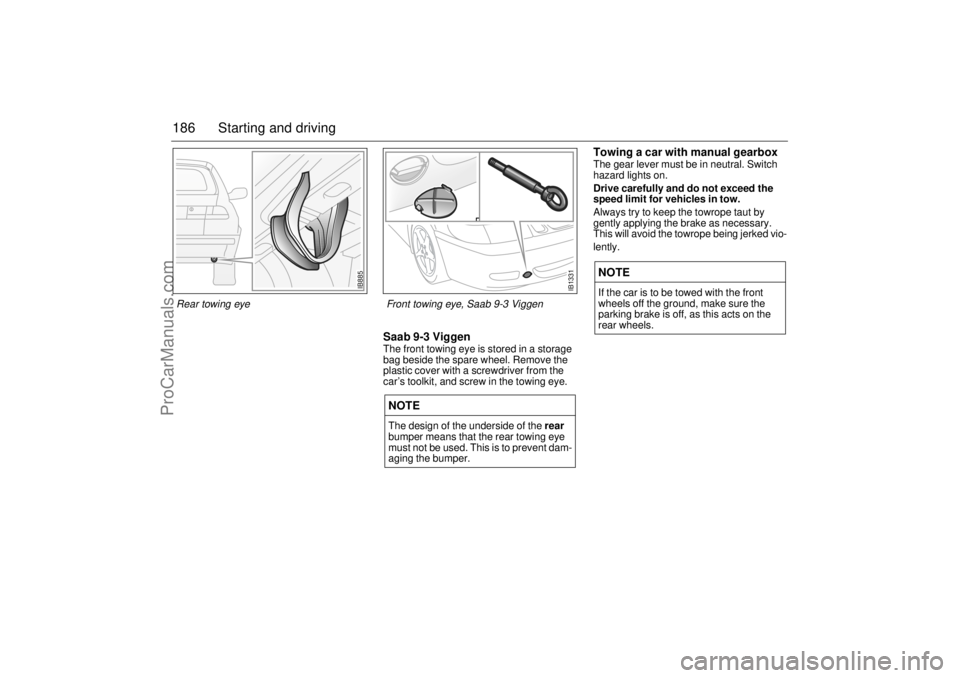
Saab 9-3 ViggenThe front towing eye is stored in a storage
bag beside the spare wheel. Remove the
plastic cover with a screwdriver from the
car’s toolkit, and screw in the towing eye.
Towing a car with manual gearboxThe gear lever must be in neutral. Switch
hazard lights on.
Drive carefully and do not exceed the
speed limit for vehicles in tow.
Always try to keep the towrope taut by
gently applying the brake as necessary.
This will avoid the towrope being jerked vio-
lently.
NOTEThe design of the underside of the rear
bumper means that the rear towing eye
must not be used. This is to prevent dam-
aging the bumper.
NOTEIf the car is to be towed with the front
wheels off the ground, make sure the
parking brake is off, as this acts on the
rear wheels.
IB885
Rear towing eye
IB1331
Front towing eye, Saab 9-3 Viggen
ProCarManuals.com
Page 187 of 260
187 Starting and driving
Towing a car with automatic
transmission The following rules must be observed if a
car with automatic transmission is to be
towed.
The gear selector must be in the N position.
Switch hazard lights on.
Drive carefully and do not exceed the
speed limit for vehicles in tow.
Always try to keep the towrope taut by
gently applying the brake as necessary.
This will avoid the towrope being jerked vio-
lently.1 Selector lever in position N.
2 Raise the oil level in the gearbox above
normal by 2 extra quarts. Use oil of type
Texaco Texamatic Dexron III.
3 The local regulations on towing speeds
must be followed.
The highest permissible towing speed is
30 mph (50 km/h), unless the legal limit
is lower. The longest permissible towing
distance is 25-30 miles (40-50 km). If the
car has to be transported farther than
that, summon a tow truck. A flat bed tow
truck is the preferred method to tow.
4 When the car is being returned to ser-
vice, check the gearbox oil, and reduce
it to the prescribed amount if necessary.
The engine cannot be started by towing or
pushing the car. In emergency, the engine
can be started as described in the section
”Jump starting”.
Jump startingIf your battery has run down, you may want
to use another vehicle and some jumper
cables to start your Saab. Follow the steps
below to do it safely.
NOTEThe car must be towed front first.
If the car is to be towed with the front
wheels off the ground, make sure the
parking brake is off, as this acts on the
rear wheels.
WARNING
Batteries can cause injury. They can be
dangerous because:
They contain acid that can burn you.
They contain gas that can explode or
ignite.
They contain enough electricity to
injure you.
If you do not follow these steps exactly,
some or all of these things can hurt you.
ProCarManuals.com
Page 188 of 260
188 Starting and drivingTo jump start your vehicle:
1 Check the other vehicle. It must have a
12-volt battery with a negative ground
system.2 Get the vehicles close enough so the
jumper cables can reach, but be sure the
vehicles are not touching each other. If
a poor connection on the negative
jumper cable should exist, it is possible
for damage to be caused to electrical
systems/components of either vehicle
should inadvertent contact be made.
You would not be able to start your car
and bad grounding could damage the
electrical systems.
3 Turn off the ignition on both vehicles.
Turn off all lights that are not needed,
and radios. This will avoid sparks and
help save both batteries and it could
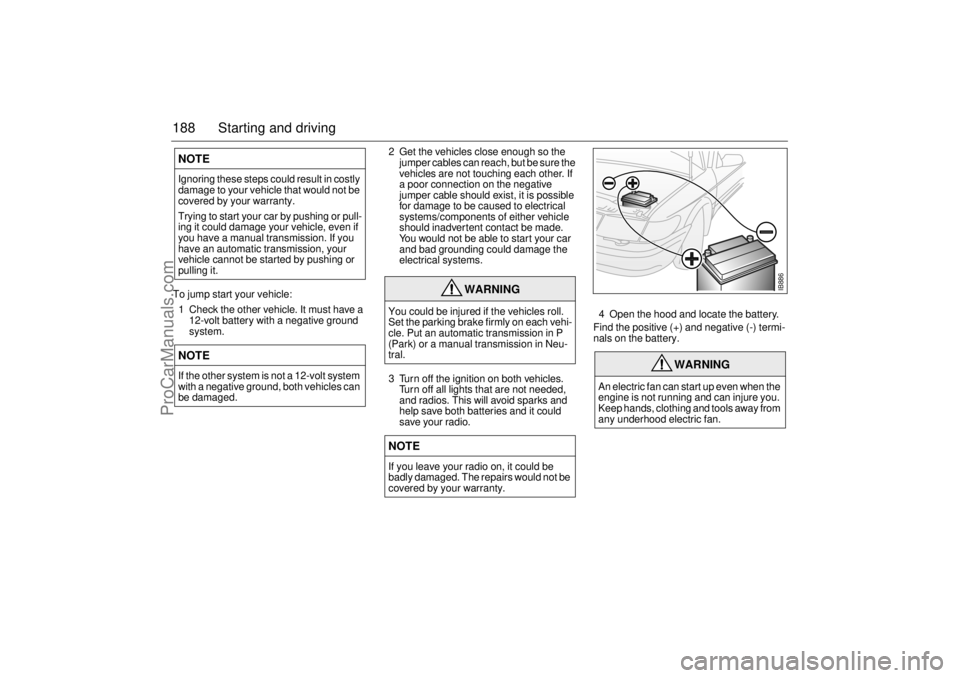
save your radio.4 Open the hood and locate the battery.
Find the positive (+) and negative (-) termi-
nals on the battery.NOTEIgnoring these steps could result in costly
damage to your vehicle that would not be
covered by your warranty.
Trying to start your car by pushing or pull-
ing it could damage your vehicle, even if
you have a manual transmission. If you
have an automatic transmission, your
vehicle cannot be started by pushing or
pulling it.NOTEIf the other system is not a 12-volt system
with a negative ground, both vehicles can
be damaged.
WARNING
You could be injured if the vehicles roll.
Set the parking brake firmly on each vehi-
cle. Put an automatic transmission in P
(Park) or a manual transmission in Neu-
tral.NOTEIf you leave your radio on, it could be
badly damaged. The repairs would not be
covered by your warranty.
WARNING
An electric fan can start up even when the
engine is not running and can injure you.
Keep hands, clothing and tools away from
any underhood electric fan.
IB886
ProCarManuals.com
Page 206 of 260
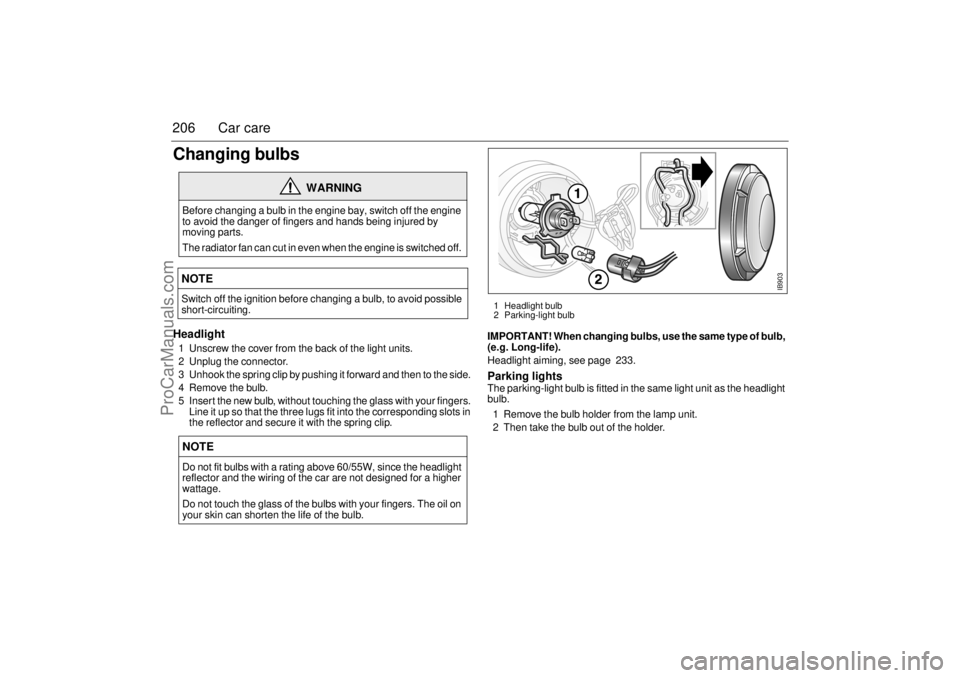
206 Car careChanging bulbs Headlight 1 Unscrew the cover from the back of the light units.
2 Unplug the connector.
3 Unhook the spring clip by pushing it forward and then to the side.
4 Remove the bulb.
5 Insert the new bulb, without touching the glass with your fingers.
Line it up so that the three lugs fit into the corresponding slots in
the reflector and secure it with the spring clip.IMPORTANT! When changing bulbs, use the same type of bulb,
(e.g. Long-life).
Headlight aiming, see page 233.
Parking lights The parking-light bulb is fitted in the same light unit as the headlight
bulb.
1 Remove the bulb holder from the lamp unit.
2 Then take the bulb out of the holder.
WARNING
Before changing a bulb in the engine bay, switch off the engine
to avoid the danger of fingers and hands being injured by
moving parts.
The radiator fan can cut in even when the engine is switched off. NOTESwitch off the ignition before changing a bulb, to avoid possible
short-circuiting. NOTEDo not fit bulbs with a rating above 60/55W, since the headlight
reflector and the wiring of the car are not designed for a higher
wattage.
Do not touch the glass of the bulbs with your fingers. The oil on
your skin can shorten the life of the bulb.
IB903
1 Headlight bulb
2 Parking-light bulb
ProCarManuals.com
Page 211 of 260
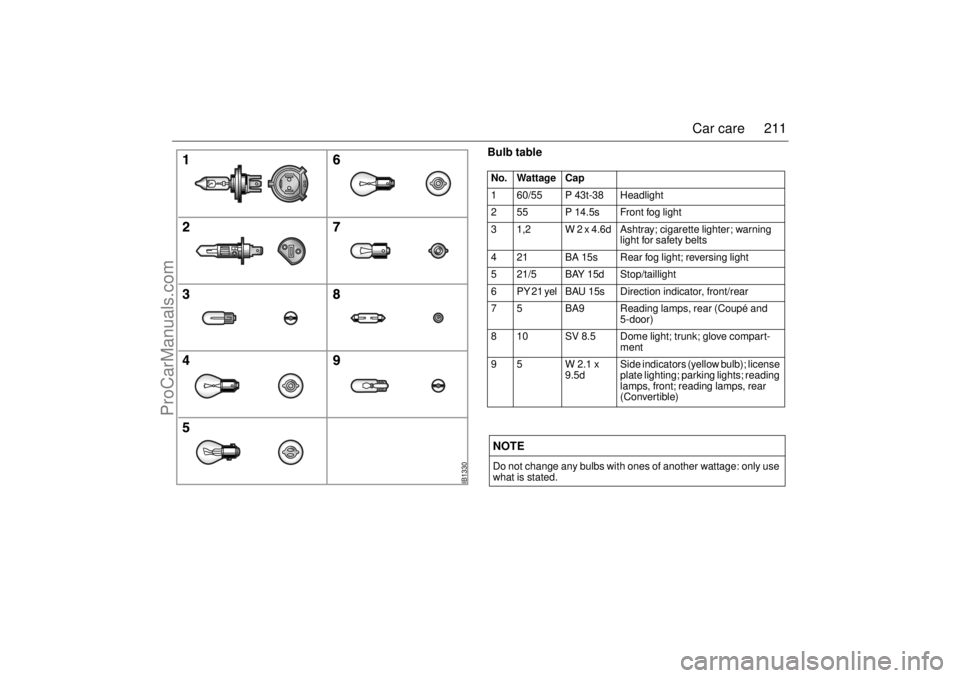
211 Car care
Bulb tableNo. Wattage Cap
1 60/55 P 43t-38 Headlight
2 55 P 14.5s Front fog light
3 1,2 W 2 x 4.6d Ashtray; cigarette lighter; warning
light for safety belts
4 21 BA 15s Rear fog light; reversing light
5 21/5 BAY 15d Stop/taillight
6 PY 21 yel BAU 15s Direction indicator, front/rear
7 5 BA9 Reading lamps, rear (Coupé and
5-door)
8 10 SV 8.5 Dome light; trunk; glove compart-
ment
95 W 2.1 x
9.5d Side indicators (yellow bulb); license
plate lighting; parking lights; reading
lamps, front; reading lamps, rear
(Convertible) NOTEDo not change any bulbs with ones of another wattage: only use
what is stated.
IB1330
ProCarManuals.com
Page 215 of 260

215 Car care
Relay holderUnder the instrument panel next to the steering wheel No. Amp Function
21 10 Switch, manual A/C; soft top (Convertible)
22 15 Direction indicators
23 20 Soft top (Convertible); telephone
24 7.5 Radio
25 30 Central locking; amplifier
26 30 Control module, engine management system
27 15 High beam flash; ACC
28 10 Control module, engine management system
29 10 Right parking light; number-plate lighting
30 10 Left parking light
31 20 Reversing light; windshield wipers; headlight
beam-length adjustment
32 15 Fuel pump
33 15 Electric heating of rear seat
34 10 SID; control module; automatic transmission
35 15 DICE/TWICE; main instrument panel; interior light-
ing
36 10 Relay, starter
37 15 Limp-home
38 25 Oxygen sensor (lambda probe)
39 – –
S–SpareItem Function
A Electric heating of rear seat
B Reversing light, cars with automatic transmission
C1 –
C2 Lock motor, trunk lid
D1 Rear wiper
D2 Rear-window washing
E Ignition switch
F–
G Windshield wipers (intermittent)
H Rear-window heating
IFuel pump
J–
KStart relay
L Main relay (injection system)
ProCarManuals.com
Page 221 of 260
221 Car care
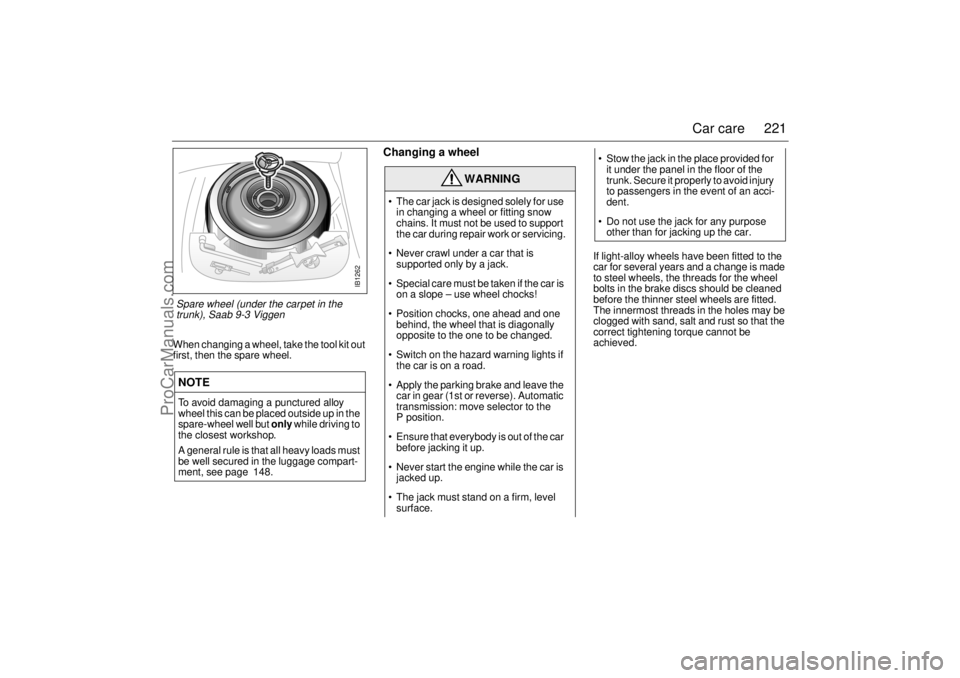
When changing a wheel, take the tool kit out
first, then the spare wheel.
Changing a wheel
If light-alloy wheels have been fitted to the
car for several years and a change is made
to steel wheels, the threads for the wheel
bolts in the brake discs should be cleaned
before the thinner steel wheels are fitted.
The innermost threads in the holes may be
clogged with sand, salt and rust so that the
correct tightening torque cannot be
achieved.
NOTETo avoid damaging a punctured alloy
wheel this can be placed outside up in the
spare-wheel well but only while driving to
the closest workshop.
A general rule is that all heavy loads must
be well secured in the luggage compart-
ment, see page 148.
WARNING
The car jack is designed solely for use
in changing a wheel or fitting snow
chains. It must not be used to support
the car during repair work or servicing.
Never crawl under a car that is
supported only by a jack.
Special care must be taken if the car is
on a slope – use wheel chocks!
Position chocks, one ahead and one
behind, the wheel that is diagonally
opposite to the one to be changed.
Switch on the hazard warning lights if
the car is on a road.
Apply the parking brake and leave the
car in gear (1st or reverse). Automatic
transmission: move selector to the
P position.
Ensure that everybody is out of the car
before jacking it up.
Never start the engine while the car is
jacked up.
The jack must stand on a firm, level
surface.
Stow the jack in the place provided for
it under the panel in the floor of the
trunk. Secure it properly to avoid injury
to passengers in the event of an acci-
dent.
Do not use the jack for any purpose
other than for jacking up the car.
IB1261IB1262
Spare wheel (under the carpet in the
trunk), Saab 9-3 Viggen
ProCarManuals.com
Page 259 of 260

259 Index
Leather upholstery, care of
________ 225
Load eyes
_____________________ 148
Locks
__________________________ 36
Lowering rear seat
______________ 144
Luggage compartment ___________ 144
Luggage compartment, Convertible
__ 56
Luggage-compartment lighting
_____ 148
MMain beam
_____________________ 75
Main instrument panel
_____________ 60
Maintenance schedule ___________ 236
Manual climate-control system
______ 80
Manual raising of the soft top,
Convertible
____________________ 52
Manual transmission
_____________ 161
Manually opening the fuel filler door,
Convertible
____________________ 58
Manually opening the fuel filler door,
Coupé and 5-door
______________ 150
Maxi fuses
_____________________ 213
Memory, driver’s seat
____________ 134
Motoring abroad
________________ 190
NNight Panel
_____________________ 73
OORVR
________________________ 195
Odometer ______________________ 66
Oil specification
_________________ 247
OnStar
________________________ 117
Opening handle
__________________ 36
Owner assistance _______________ 237
PPaint touch-up
__________________ 227
Parcel shelf
____________________ 147
Park Brake Shift Lock
____________ 164
Parking brake
__________________ 174
Parking lights ____________________ 75
Plates and labels
________________ 253
Power steering fluid, check
________ 201
Power steering oil, grade
_________ 251
Pressure gauge
__________________ 67
Programmable driver’s seat
_______ 134
Programming, ACC
_______________ 90
RRadio
__________________________ 98
Raising the soft top, Convertible
_____ 51
Rear fog light
____________________ 77
Rear seat
______________________ 144
Rear seat, tipping
_______________ 144Rearview mirrors
________________ 143
Rear-window wiper _______________ 79
Recirculation
____________________ 82
Recycling
______________________ 230
Refuelling _____________________ 157
Relay table ____________________ 215
Release handle, hood
____________ 192
Remote control
__________________ 36
Remote control battery, changing
____ 39
Removing the key
_______________ 152
Reporting safety defects
__________ 238
Rev counter
_____________________ 66
Reversing lights
__________________ 77
Roof rack
______________________ 182
Rotating the tires
________________ 218
Running-in
_____________________ 161
SSAHR, head restraint
_____________ 18
SID (Side Instrument Display)
_______ 69
SRS (airbag)
____________________ 28
Saab Audio System
_______________ 93
Saab Trionic engine
management system ____________ 195
Safety belts
_____________________ 12
Safety belts, care of
______________ 224
Seat belts
______________________ 12
Seat-belt pretensioners
____________ 13
Seats
_________________________ 130
Service costs
___________________ 237
ProCarManuals.com