door lock SAAB 9-3 2001 Owner's Manual
[x] Cancel search | Manufacturer: SAAB, Model Year: 2001, Model line: 9-3, Model: SAAB 9-3 2001Pages: 260, PDF Size: 12.01 MB
Page 143 of 260
143 Interior equipment, trunk
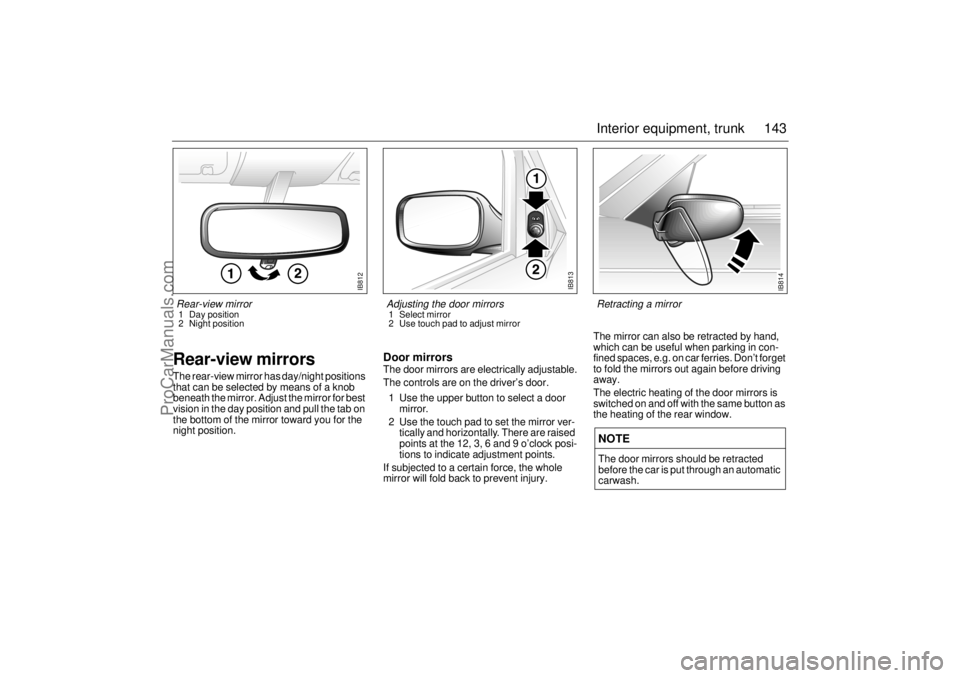
Rear-view mirrorsThe rear-view mirror has day/night positions
that can be selected by means of a knob
beneath the mirror. Adjust the mirror for best
vision in the day position and pull the tab on
the bottom of the mirror toward you for the
night position.
Door mirrorsThe door mirrors are electrically adjustable.
The controls are on the driver’s door.
1 Use the upper button to select a door
mirror.
2 Use the touch pad to set the mirror ver-
tically and horizontally. There are raised
points at the 12, 3, 6 and 9 o’clock posi-
tions to indicate adjustment points.
If subjected to a certain force, the whole
mirror will fold back to prevent injury. The mirror can also be retracted by hand,
which can be useful when parking in con-
fined spaces, e.g. on car ferries. Don’t forget
to fold the mirrors out again before driving
away.
The electric heating of the door mirrors is
switched on and off with the same button as
the heating of the rear window.
NOTEThe door mirrors should be retracted
before the car is put through an automatic
carwash.
IB813
Adjusting the door mirrors 1 Select mirror
2 Use touch pad to adjust mirror
IB814
Retracting a mirror
IB812
Rear-view mirror1 Day position
2 Night position
ProCarManuals.com
Page 144 of 260
144 Interior equipment, trunkTrunk, Coupé and 5-doorTrunk lid lockUnlock the trunk lid by pressing on the key, by pressing the
remote release button on the driver’s door or by using the key. The
alarm horn sounds three times and the lights flash when the trunk is
released with the remote control.
Programming features, see page 255.
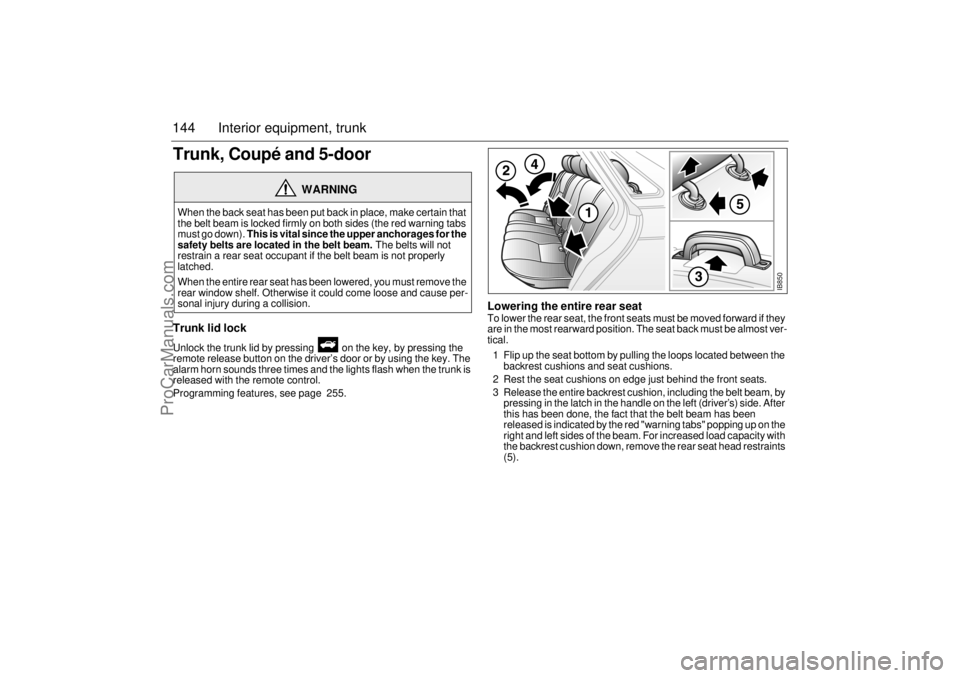
Lowering the entire rear seatTo lower the rear seat, the front seats must be moved forward if they
are in the most rearward position. The seat back must be almost ver-
tical.
1 Flip up the seat bottom by pulling the loops located between the
backrest cushions and seat cushions.
2 Rest the seat cushions on edge just behind the front seats.
3 Release the entire backrest cushion, including the belt beam, by
pressing in the latch in the handle on the left (driver’s) side. After
this has been done, the fact that the belt beam has been
released is indicated by the red "warning tabs" popping up on the
right and left sides of the beam. For increased load capacity with
the backrest cushion down, remove the rear seat head restraints
(5).
WARNING
When the back seat has been put back in place, make certain that
the belt beam is locked firmly on both sides (the red warning tabs
must go down). This is vital since the upper anchorages for the
safety belts are located in the belt beam. The belts will not
restrain a rear seat occupant if the belt beam is not properly
latched.
When the entire rear seat has been lowered, you must remove the
rear window shelf. Otherwise it could come loose and cause per-
sonal injury during a collision.
IB850
ProCarManuals.com
Page 150 of 260
150 Interior equipment, trunkManually opening the
fuel filler door Coupé and 5-door models If the fuel filler door (which is controlled by
the central locking system) does not unlock,
proceed as follows.
Check fuse 25. If it is blown or its replace-
ment blows, you can release the lock motor
from the door as follows:
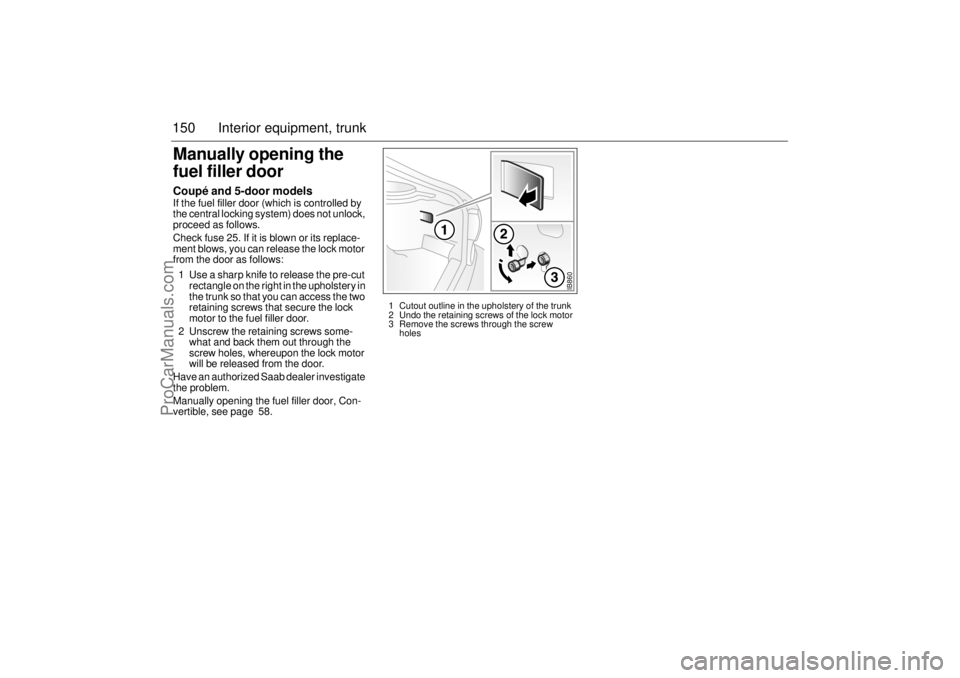
1 Use a sharp knife to release the pre-cut
rectangle on the right in the upholstery in
the trunk so that you can access the two
retaining screws that secure the lock
motor to the fuel filler door.
2 Unscrew the retaining screws some-
what and back them out through the
screw holes, whereupon the lock motor
will be released from the door.
Have an authorized Saab dealer investigate
the problem.
Manually opening the fuel filler door, Con-
vertible, see page 58.
IB860
1 Cutout outline in the upholstery of the trunk
2 Undo the retaining screws of the lock motor
3 Remove the screws through the screw
holes
ProCarManuals.com
Page 153 of 260
153 Starting and driving
If the car does not startIf the text "KEY NOT ACCEPTED" appears
on the SID when the engine refuses to start,
the trouble may be a fault in the transponder
of the key or in the receiver of the ignition
switch. Proceed as follows:
• Turn the key back to the LOCK position.
Turn the key to the ON position.
Press one of the buttons on the remote
control (the LED on top of the dash stops
flashing).
Start the engine.
Try the other key. If it works, the trouble is in
the first key.
Call on an authorized Saab dealer for
inspection and correction.
Starting the engine
Do not run the starter motor for more than
25 seconds at a time. Wait 20-30 seconds
before running the starter again, to give the
battery time to recover.
Avoid racing the engine or putting a heavy
load on it before it has warmed up. Let the
engine idle for at least 10 seconds and then
drive away as long as the engine oil warning
light has gone out to enable the engine to
attain its normal temperature as quickly as
possible.
It is possible for air to enter the lubricating
system in conjunction with an oil or oil-filter
change, or if the car has been stored for
some time. This air can cause the hydraulic
cam followers to emit a ticking noise, which
can persist for up to 15 minutes after start-
ing. Although this is quite normal and does
not indicate any malfunction, it is advisable
not to exceed 3,000 rpm before the noise
has disappeared.
The hydraulic cam lifters are completely
service free; the valve clearance is set up at
the factory and will not need any subse-
quent adjustment.
WARNING
Always remove the key before leaving
the car.
Always apply the parking brake before
removing the ignition key.NOTETake care not to spill drinks or to drop
crumbs over the ignition switch. If dirt or
liquid gets into it, the switch may not
operate properly.
WARNING
When starting the engine:
– Sit down in the driver’s seat.
– Depress the clutch pedal fully. If gear
lever is not in the neutral position, the
clutch pedal must be fully depressed
or the car will jump forwards or back-
wards, which may cause an accident.
– Never start the car from outside the
vehicle, e.g. through a wound down
window. This could lead to serious
personal injury.
Engage reverse (R) (position P for
automatic transmission) to remove the
ignition key. The key can only be
removed in this gear position.
Carbon monoxide (CO) is a colorless,
odorless, poisonous gas. Be alert to
the danger of CO – always open the
garage doors before starting the
engine in the garage.
There is also a danger of CO poison-
ing if the exhaust system is leaking.
Do not rest or sleep in the car when
parked with the engine running. There
is a risk of depressing the accelerator
which could lead to engine damage.
ProCarManuals.com
Page 175 of 260
175 Starting and driving
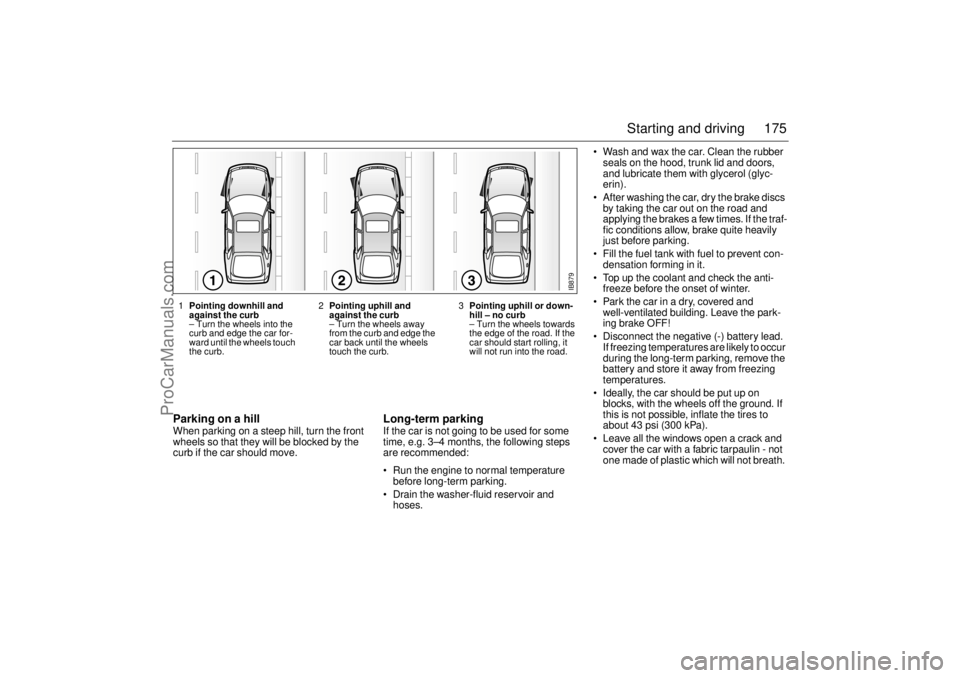
Parking on a hillWhen parking on a steep hill, turn the front
wheels so that they will be blocked by the
curb if the car should move.
Long-term parkingIf the car is not going to be used for some
time, e.g. 3–4 months, the following steps
are recommended:
Run the engine to normal temperature
before long-term parking.
Drain the washer-fluid reservoir and
hoses. Wash and wax the car. Clean the rubber
seals on the hood, trunk lid and doors,
and lubricate them with glycerol (glyc-
erin).
After washing the car, dry the brake discs
by taking the car out on the road and
applying the brakes a few times. If the traf-
fic conditions allow, brake quite heavily
just before parking.
Fill the fuel tank with fuel to prevent con-
densation forming in it.
Top up the coolant and check the anti-
freeze before the onset of winter.
Park the car in a dry, covered and
well-ventilated building. Leave the park-
ing brake OFF!
Disconnect the negative (-) battery lead.
If freezing temperatures are likely to occur
during the long-term parking, remove the
battery and store it away from freezing
temperatures.
Ideally, the car should be put up on
blocks, with the wheels off the ground. If
this is not possible, inflate the tires to
about 43 psi (300 kPa).
Leave all the windows open a crack and
cover the car with a fabric tarpaulin - not
one made of plastic which will not breath.
IB879
1Pointing downhill and
against the curb
– Turn the wheels into the
curb and edge the car for-
ward until the wheels touch
the curb. 2Pointing uphill and
against the curb
– Turn the wheels away
from the curb and edge the
car back until the wheels
touch the curb. 3Pointing uphill or down-
hill – no curb
– Turn the wheels towards
the edge of the road. If the
car should start rolling, it
will not run into the road.
ProCarManuals.com
Page 177 of 260

177 Starting and driving
Driving in a low gear results in higher fuel
consumption than in a high gear because
of the lower engine speed for a given road
speed. Always change up to a higher gear
as soon as traffic conditions allow and use
the highest gear as much as possible.
Check the air pressure in the tires once a
month. Incorrect pressures increase tire
wear. It is better to have slightly higher
pressure than lower.
Check fuel consumption regularly.
Increased consumption can indicate that
something is wrong and that the car
needs to be checked by an authorized
Saab dealer.
Practical tests on the roads have demon-
strated that substantial savings in fuel con-
sumption can be made if the above advice
is heeded.Road conditions Wet roads increase fuel consumption, as do
unpaved roads and driving in hilly country
(the amount of fuel saved driving downhill is
less than the additional amount required to
climb the hill).
Engine block heater (standard
equipment in Canada, accessory in
U.S.)The following are just some of the benefits
to the car and the environment of using an
engine block heater:
Lower fuel consumption.
Reduced wear on the engine.
Inside of car warms up faster.
Exhaust emissions substantially reduced
over short runs.
The engine block heater is effective with
outside temperatures up to +60 – +70°F
(+15 – +20°C). The warmer it is outside, the
shorter the time the heater need be con-
nected. Longer than 1.5 hours is unneces-
sary.
If the car is equipped with a removable elec-
trical cabin heater that is not in use, this
should be stored in the luggage compart-
ment.
Driving in cold weatherBefore starting a journey in cold weather
you should check the following:
That the wiper blades have not become
frozen to the windshield/glass.
Brush any snow away from the air intake
for the heater system (opening between
hood and windshield).
It may be advisable to lubricate the
door-lock cylinder (use molybdenum
disulphide, MoS
2) to prevent its freezing.
If the lock has frozen, take care not to
break the key (or use the remote control)
– heat it first or spray it with de-icer.
Periodically during the winter, add gaso-
line anti-freeze to the fuel to dispel any
condensation in the fuel tank which could
freeze and cause problems in the system.
Keep the tank well filled to reduce the risk
of condensation forming.
If the car is parked outside in freezing
weather, fuel additives (gasoline
anti-freeze) will not do any good as it
cannot remove water that has already fro-
zen. Park the car in a warm place so that
any ice that may have built up melts, then
add gasoline anti-freeze when filling up
the tank. Condensation is caused by
changes in the outdoor temperature or by
the car being parked alternately in a
garage and outside.
It is particularly important when the roads
are slippery that the brakes and tires be in
good condition.
ProCarManuals.com
Page 183 of 260
183 Starting and driving
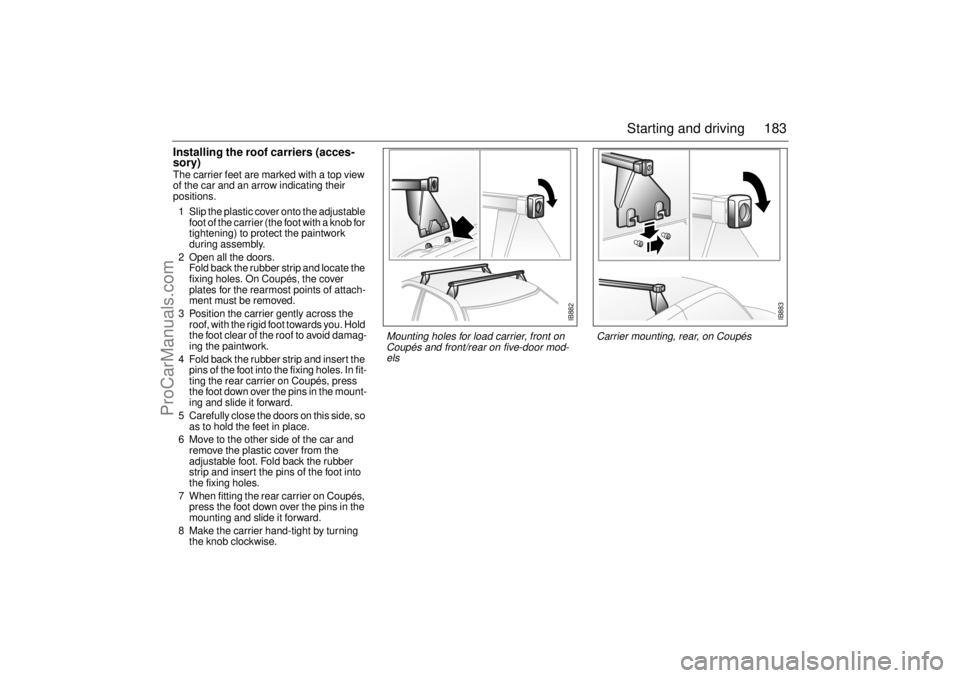
Installing the roof carriers (acces-
sory) The carrier feet are marked with a top view
of the car and an arrow indicating their
positions.
1 Slip the plastic cover onto the adjustable
foot of the carrier (the foot with a knob for
tightening) to protect the paintwork
during assembly.
2 Open all the doors.
Fold back the rubber strip and locate the
fixing holes. On Coupés, the cover
plates for the rearmost points of attach-
ment must be removed.
3 Position the carrier gently across the
roof, with the rigid foot towards you. Hold
the foot clear of the roof to avoid damag-
ing the paintwork.
4 Fold back the rubber strip and insert the
pins of the foot into the fixing holes. In fit-
ting the rear carrier on Coupés, press
the foot down over the pins in the mount-
ing and slide it forward.
5 Carefully close the doors on this side, so
as to hold the feet in place.
6 Move to the other side of the car and
remove the plastic cover from the
adjustable foot. Fold back the rubber
strip and insert the pins of the foot into
the fixing holes.
7 When fitting the rear carrier on Coupés,
press the foot down over the pins in the
mounting and slide it forward.
8 Make the carrier hand-tight by turning
the knob clockwise.
IB882
IB883
Mounting holes for load carrier, front on
Coupés and front/rear on five-door mod-
els Carrier mounting, rear, on Coupés
ProCarManuals.com
Page 208 of 260
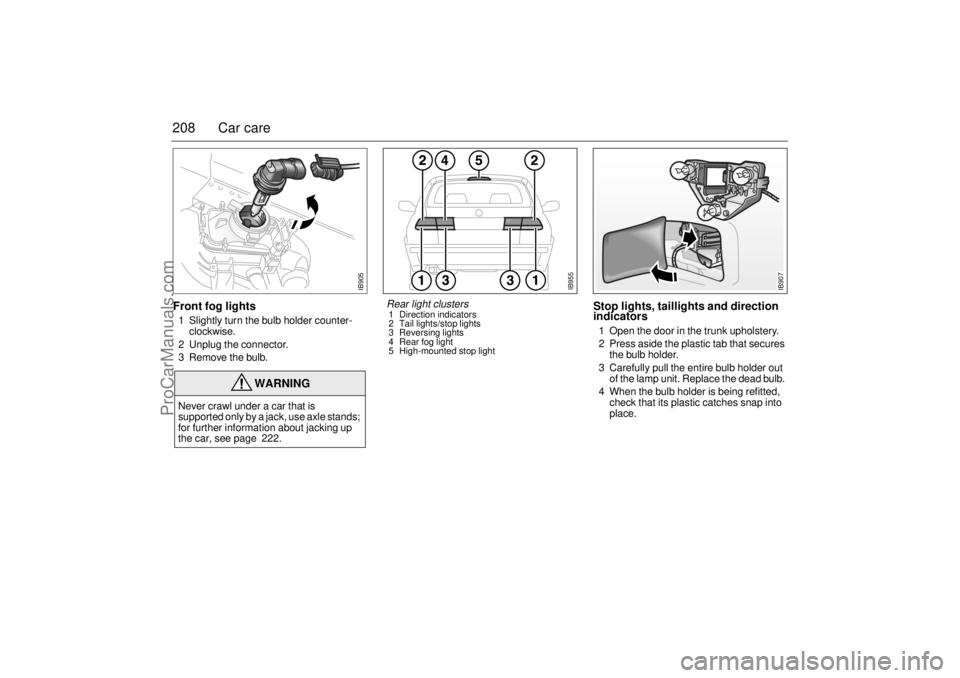
208 Car careFront fog lights1 Slightly turn the bulb holder counter-
clockwise.
2 Unplug the connector.
3 Remove the bulb.
Stop lights, taillights and direction
indicators 1 Open the door in the trunk upholstery.
2 Press aside the plastic tab that secures
the bulb holder.
3 Carefully pull the entire bulb holder out
of the lamp unit. Replace the dead bulb.
4 When the bulb holder is being refitted,
check that its plastic catches snap into
place.
WARNING
Never crawl under a car that is
supported only by a jack, use axle stands;
for further information about jacking up
the car, see page 222.
IB905
IB955
Rear light clusters 1 Direction indicators
2 Tail lights/stop lights
3 Reversing lights
4 Rear fog light
5 High-mounted stop light
IB907
ProCarManuals.com
Page 213 of 260
213 Car care
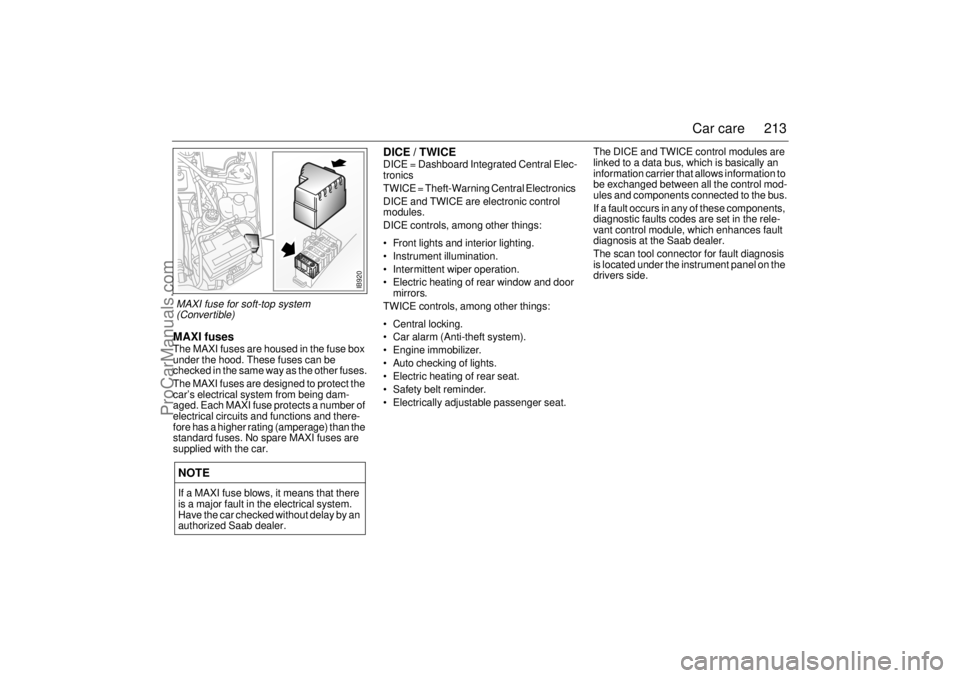
MAXI fusesThe MAXI fuses are housed in the fuse box
under the hood. These fuses can be
checked in the same way as the other fuses.
The MAXI fuses are designed to protect the
car’s electrical system from being dam-
aged. Each MAXI fuse protects a number of
electrical circuits and functions and there-
fore has a higher rating (amperage) than the
standard fuses. No spare MAXI fuses are
supplied with the car.
DICE / TWICEDICE = Dashboard Integrated Central Elec-
tronics
TWICE = Theft-Warning Central Electronics
DICE and TWICE are electronic control
modules.
DICE controls, among other things:
Front lights and interior lighting.
Instrument illumination.
Intermittent wiper operation.
Electric heating of rear window and door
mirrors.
TWICE controls, among other things:
Central locking.
Car alarm (Anti-theft system).
Engine immobilizer.
Auto checking of lights.
Electric heating of rear seat.
Safety belt reminder.
Electrically adjustable passenger seat.The DICE and TWICE control modules are
linked to a data bus, which is basically an
information carrier that allows information to
be exchanged between all the control mod-
ules and components connected to the bus.
If a fault occurs in any of these components,
diagnostic faults codes are set in the rele-
vant control module, which enhances fault
diagnosis at the Saab dealer.
The scan tool connector for fault diagnosis
is located under the instrument panel on the
drivers side.
NOTEIf a MAXI fuse blows, it means that there
is a major fault in the electrical system.
Have the car checked without delay by an
authorized Saab dealer.
IB920
MAXI fuse for soft-top system
(Convertible)
ProCarManuals.com
Page 242 of 260

242 Maintenance and owner assistance
Service Intervals **
Miles = U.S. Cars
Kilometers = Canadian Cars
30 day
10,000
(16,000 km)
20,000
(32,000 km)
30,000
(48,000 km)
40,000
(64,000 km)
50,000
(80,000 km)
60,000
(96,000 km)
70,000
(112,000 km)
80,000
(128,000 km)
90,000
(144,000 km)
100,000
(160,000 km)
Service #
1234567891011
Chassis (cont.)
RToe-in"""
R Cabin air filter!!!!!
R Door hinges, stops and locks"" # "" # "" # "
R Airbag system, SRS warning lamp, visual inspection"""""""""""
R Safety belts; operation and visual inspection of belt for
tears and fraying"""""""""""
R Wiper blades"""""""""""
R Washer system: check and top-up"""""""""""
R Reset service indicator""""""""""
Customer programming
R Carry out systems programming per customer request"
Road test
R Check performance of drive train, steering and brakes
and verify tire balance.
Check function of instruments and controls, including
horn, windshield wipers, cruise control and climate sys-
tem.
Note any noises or problems for correction."""""""""""
ProCarManuals.com