lights SAAB 9-3 2001 Owner's Manual
[x] Cancel search | Manufacturer: SAAB, Model Year: 2001, Model line: 9-3, Model: SAAB 9-3 2001Pages: 260, PDF Size: 12.01 MB
Page 152 of 260
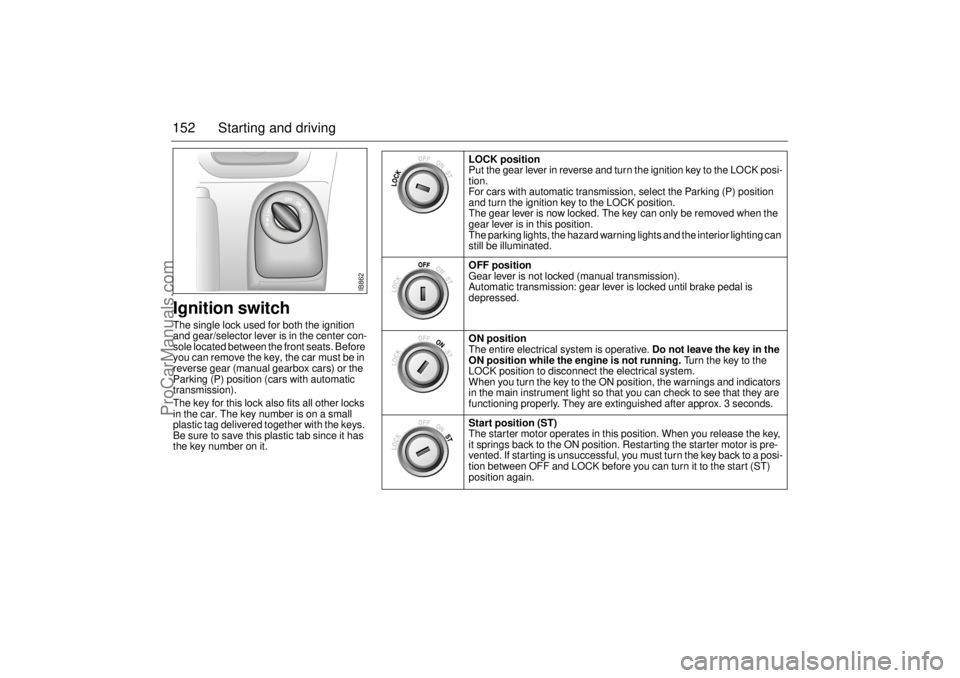
152 Starting and drivingIgnition switchThe single lock used for both the ignition
and gear/selector lever is in the center con-
sole located between the front seats. Before
you can remove the key, the car must be in
reverse gear (manual gearbox cars) or the
Parking (P) position (cars with automatic
transmission).
The key for this lock also fits all other locks
in the car. The key number is on a small
plastic tag delivered together with the keys.
Be sure to save this plastic tab since it has
the key number on it.
IB862
LOCK position
Put the gear lever in reverse and turn the ignition key to the LOCK posi-
tion.
For cars with automatic transmission, select the Parking (P) position
and turn the ignition key to the LOCK position.
The gear lever is now locked. The key can only be removed when the
gear lever is in this position.
The parking lights, the hazard warning lights and the interior lighting can
still be illuminated.
OFF position
Gear lever is not locked (manual transmission).
Automatic transmission: gear lever is locked until brake pedal is
depressed.
ON position
The entire electrical system is operative. Do not leave the key in the
ON position while the engine is not running. Turn the key to the
LOCK position to disconnect the electrical system.
When you turn the key to the ON position, the warnings and indicators
in the main instrument light so that you can check to see that they are
functioning properly. They are extinguished after approx. 3 seconds.
Start position (ST)
The starter motor operates in this position. When you release the key,
it springs back to the ON position. Restarting the starter motor is pre-
vented. If starting is unsuccessful, you must turn the key back to a posi-
tion between OFF and LOCK before you can turn it to the start (ST)
position again.
ProCarManuals.com
Page 166 of 260
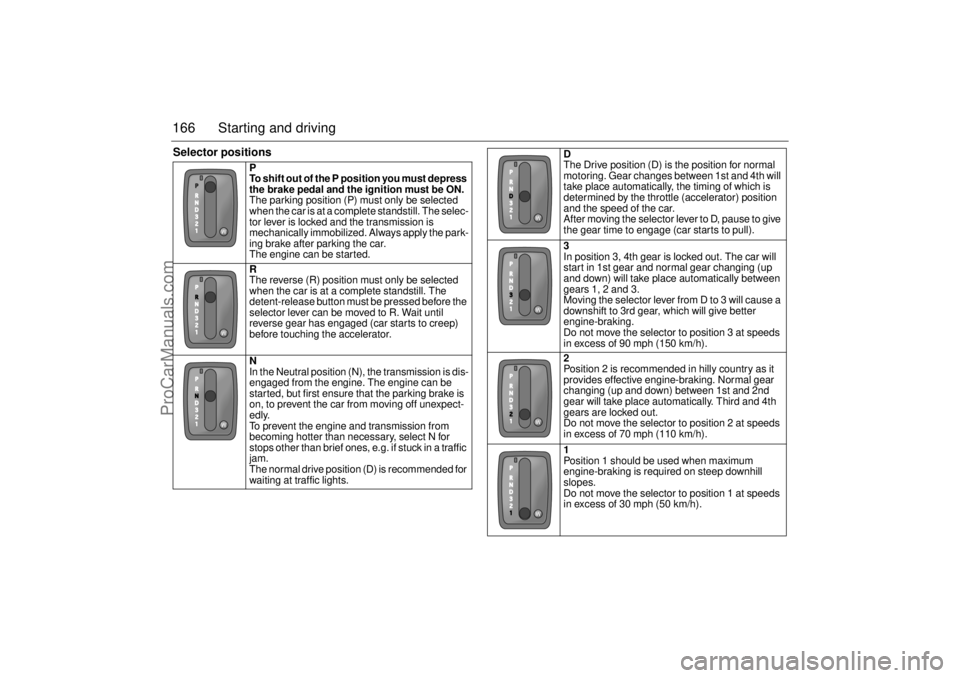
166 Starting and drivingSelector positions
P
To shift out of the P position you must depress
the brake pedal and the ignition must be ON.
The parking position (P) must only be selected
when the car is at a complete standstill. The selec-
tor lever is locked and the transmission is
mechanically immobilized. Always apply the park-
ing brake after parking the car.
The engine can be started.
R
The reverse (R) position must only be selected
when the car is at a complete standstill. The
detent-release button must be pressed before the
selector lever can be moved to R. Wait until
reverse gear has engaged (car starts to creep)
before touching the accelerator.
N
In the Neutral position (N), the transmission is dis-
engaged from the engine. The engine can be
started, but first ensure that the parking brake is
on, to prevent the car from moving off unexpect-
edly.
To prevent the engine and transmission from
becoming hotter than necessary, select N for
stops other than brief ones, e.g. if stuck in a traffic
jam.
The normal drive position (D) is recommended for
waiting at traffic lights.
D
The Drive position (D) is the position for normal
motoring. Gear changes between 1st and 4th will
take place automatically, the timing of which is
determined by the throttle (accelerator) position
and the speed of the car.
After moving the selector lever to D, pause to give
the gear time to engage (car starts to pull).
3
In position 3, 4th gear is locked out. The car will
start in 1st gear and normal gear changing (up
and down) will take place automatically between
gears 1, 2 and 3.
Moving the selector lever from D to 3 will cause a
downshift to 3rd gear, which will give better
engine-braking.
Do not move the selector to position 3 at speeds
in excess of 90 mph (150 km/h).
2
Position 2 is recommended in hilly country as it
provides effective engine-braking. Normal gear
changing (up and down) between 1st and 2nd
gear will take place automatically. Third and 4th
gears are locked out.
Do not move the selector to position 2 at speeds
in excess of 70 mph (110 km/h).
1
Position 1 should be used when maximum
engine-braking is required on steep downhill
slopes.
Do not move the selector to position 1 at speeds
in excess of 30 mph (50 km/h).
ProCarManuals.com
Page 186 of 260
186 Starting and driving
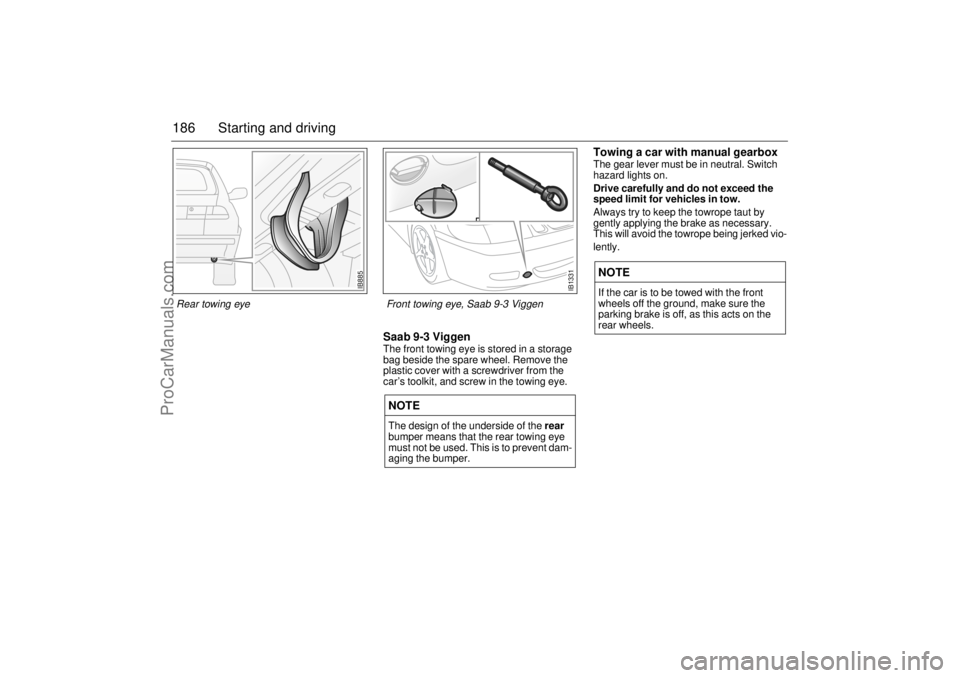
Saab 9-3 ViggenThe front towing eye is stored in a storage
bag beside the spare wheel. Remove the
plastic cover with a screwdriver from the
car’s toolkit, and screw in the towing eye.
Towing a car with manual gearboxThe gear lever must be in neutral. Switch
hazard lights on.
Drive carefully and do not exceed the
speed limit for vehicles in tow.
Always try to keep the towrope taut by
gently applying the brake as necessary.
This will avoid the towrope being jerked vio-
lently.
NOTEThe design of the underside of the rear
bumper means that the rear towing eye
must not be used. This is to prevent dam-
aging the bumper.
NOTEIf the car is to be towed with the front
wheels off the ground, make sure the
parking brake is off, as this acts on the
rear wheels.
IB885
Rear towing eye
IB1331
Front towing eye, Saab 9-3 Viggen
ProCarManuals.com
Page 187 of 260
187 Starting and driving
Towing a car with automatic
transmission The following rules must be observed if a
car with automatic transmission is to be
towed.
The gear selector must be in the N position.
Switch hazard lights on.
Drive carefully and do not exceed the
speed limit for vehicles in tow.
Always try to keep the towrope taut by
gently applying the brake as necessary.
This will avoid the towrope being jerked vio-
lently.1 Selector lever in position N.
2 Raise the oil level in the gearbox above
normal by 2 extra quarts. Use oil of type
Texaco Texamatic Dexron III.
3 The local regulations on towing speeds
must be followed.
The highest permissible towing speed is
30 mph (50 km/h), unless the legal limit
is lower. The longest permissible towing
distance is 25-30 miles (40-50 km). If the
car has to be transported farther than
that, summon a tow truck. A flat bed tow
truck is the preferred method to tow.
4 When the car is being returned to ser-
vice, check the gearbox oil, and reduce
it to the prescribed amount if necessary.
The engine cannot be started by towing or
pushing the car. In emergency, the engine
can be started as described in the section
”Jump starting”.
Jump startingIf your battery has run down, you may want
to use another vehicle and some jumper
cables to start your Saab. Follow the steps
below to do it safely.
NOTEThe car must be towed front first.
If the car is to be towed with the front
wheels off the ground, make sure the
parking brake is off, as this acts on the
rear wheels.
WARNING
Batteries can cause injury. They can be
dangerous because:
They contain acid that can burn you.
They contain gas that can explode or
ignite.
They contain enough electricity to
injure you.
If you do not follow these steps exactly,
some or all of these things can hurt you.
ProCarManuals.com
Page 188 of 260
188 Starting and drivingTo jump start your vehicle:
1 Check the other vehicle. It must have a
12-volt battery with a negative ground
system.2 Get the vehicles close enough so the
jumper cables can reach, but be sure the
vehicles are not touching each other. If
a poor connection on the negative
jumper cable should exist, it is possible
for damage to be caused to electrical
systems/components of either vehicle
should inadvertent contact be made.
You would not be able to start your car
and bad grounding could damage the
electrical systems.
3 Turn off the ignition on both vehicles.
Turn off all lights that are not needed,
and radios. This will avoid sparks and
help save both batteries and it could
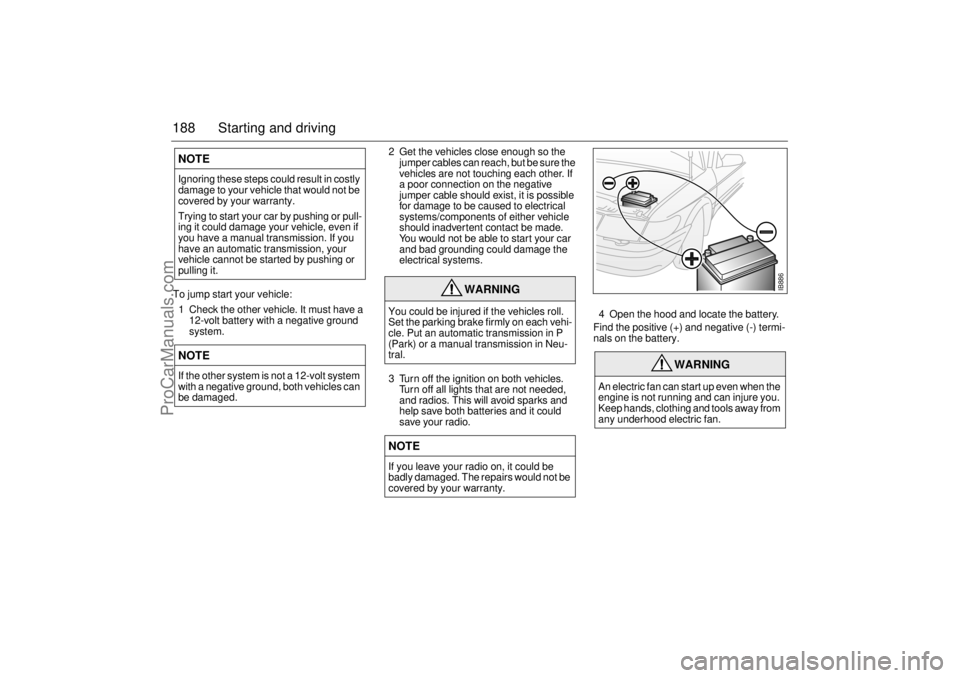
save your radio.4 Open the hood and locate the battery.
Find the positive (+) and negative (-) termi-
nals on the battery.NOTEIgnoring these steps could result in costly
damage to your vehicle that would not be
covered by your warranty.
Trying to start your car by pushing or pull-
ing it could damage your vehicle, even if
you have a manual transmission. If you
have an automatic transmission, your
vehicle cannot be started by pushing or
pulling it.NOTEIf the other system is not a 12-volt system
with a negative ground, both vehicles can
be damaged.
WARNING
You could be injured if the vehicles roll.
Set the parking brake firmly on each vehi-
cle. Put an automatic transmission in P
(Park) or a manual transmission in Neu-
tral.NOTEIf you leave your radio on, it could be
badly damaged. The repairs would not be
covered by your warranty.
WARNING
An electric fan can start up even when the
engine is not running and can injure you.
Keep hands, clothing and tools away from
any underhood electric fan.
IB886
ProCarManuals.com
Page 206 of 260
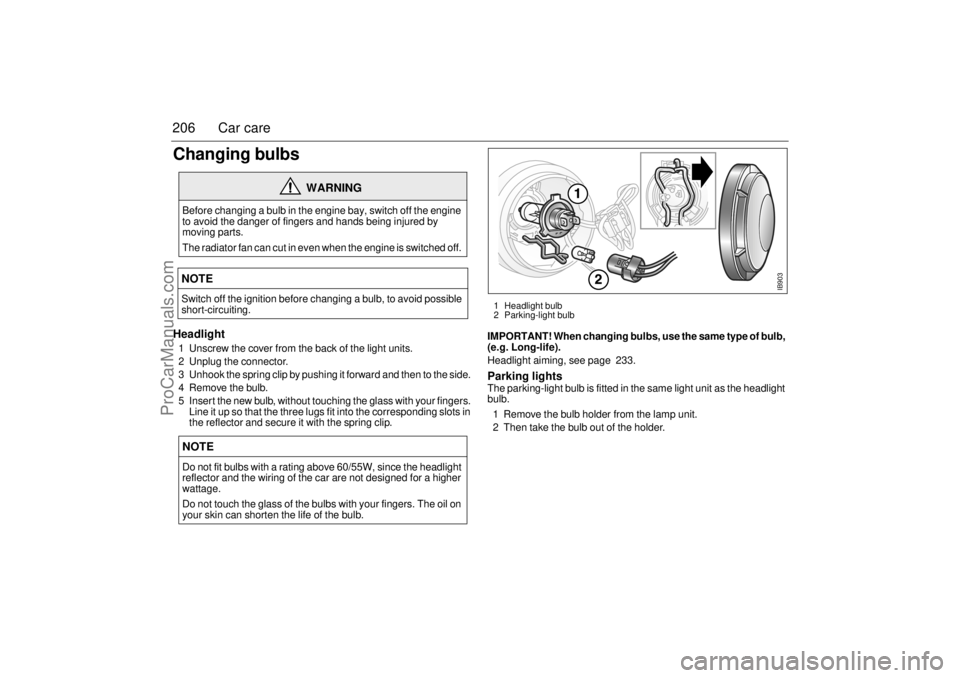
206 Car careChanging bulbs Headlight 1 Unscrew the cover from the back of the light units.
2 Unplug the connector.
3 Unhook the spring clip by pushing it forward and then to the side.
4 Remove the bulb.
5 Insert the new bulb, without touching the glass with your fingers.
Line it up so that the three lugs fit into the corresponding slots in
the reflector and secure it with the spring clip.IMPORTANT! When changing bulbs, use the same type of bulb,
(e.g. Long-life).
Headlight aiming, see page 233.
Parking lights The parking-light bulb is fitted in the same light unit as the headlight
bulb.
1 Remove the bulb holder from the lamp unit.
2 Then take the bulb out of the holder.
WARNING
Before changing a bulb in the engine bay, switch off the engine
to avoid the danger of fingers and hands being injured by
moving parts.
The radiator fan can cut in even when the engine is switched off. NOTESwitch off the ignition before changing a bulb, to avoid possible
short-circuiting. NOTEDo not fit bulbs with a rating above 60/55W, since the headlight
reflector and the wiring of the car are not designed for a higher
wattage.
Do not touch the glass of the bulbs with your fingers. The oil on
your skin can shorten the life of the bulb.
IB903
1 Headlight bulb
2 Parking-light bulb
ProCarManuals.com
Page 208 of 260
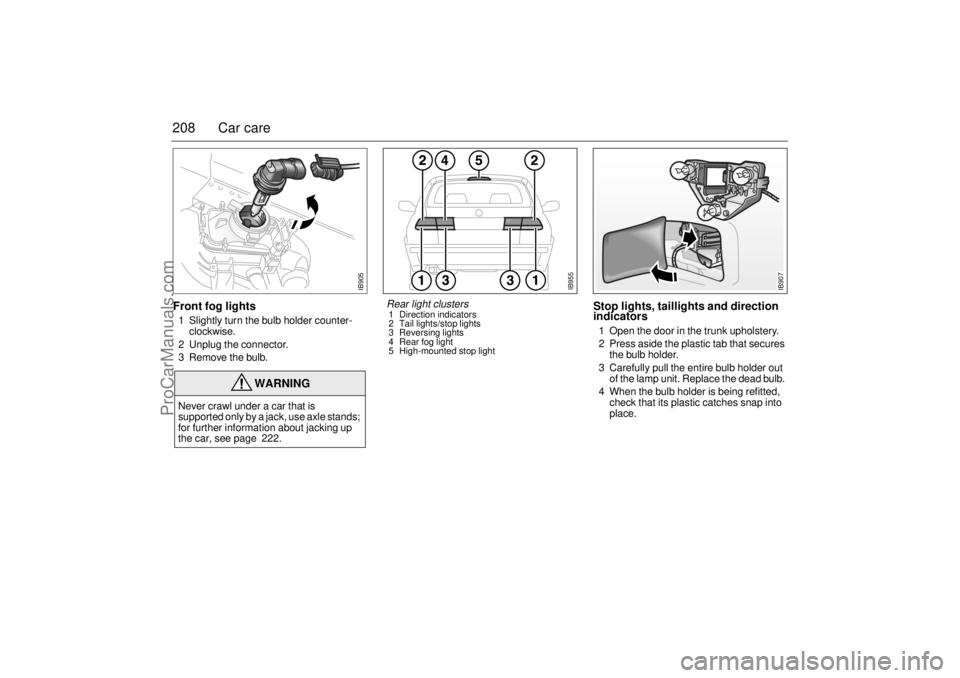
208 Car careFront fog lights1 Slightly turn the bulb holder counter-
clockwise.
2 Unplug the connector.
3 Remove the bulb.
Stop lights, taillights and direction
indicators 1 Open the door in the trunk upholstery.
2 Press aside the plastic tab that secures
the bulb holder.
3 Carefully pull the entire bulb holder out
of the lamp unit. Replace the dead bulb.
4 When the bulb holder is being refitted,
check that its plastic catches snap into
place.
WARNING
Never crawl under a car that is
supported only by a jack, use axle stands;
for further information about jacking up
the car, see page 222.
IB905
IB955
Rear light clusters 1 Direction indicators
2 Tail lights/stop lights
3 Reversing lights
4 Rear fog light
5 High-mounted stop light
IB907
ProCarManuals.com
Page 209 of 260
209 Car care
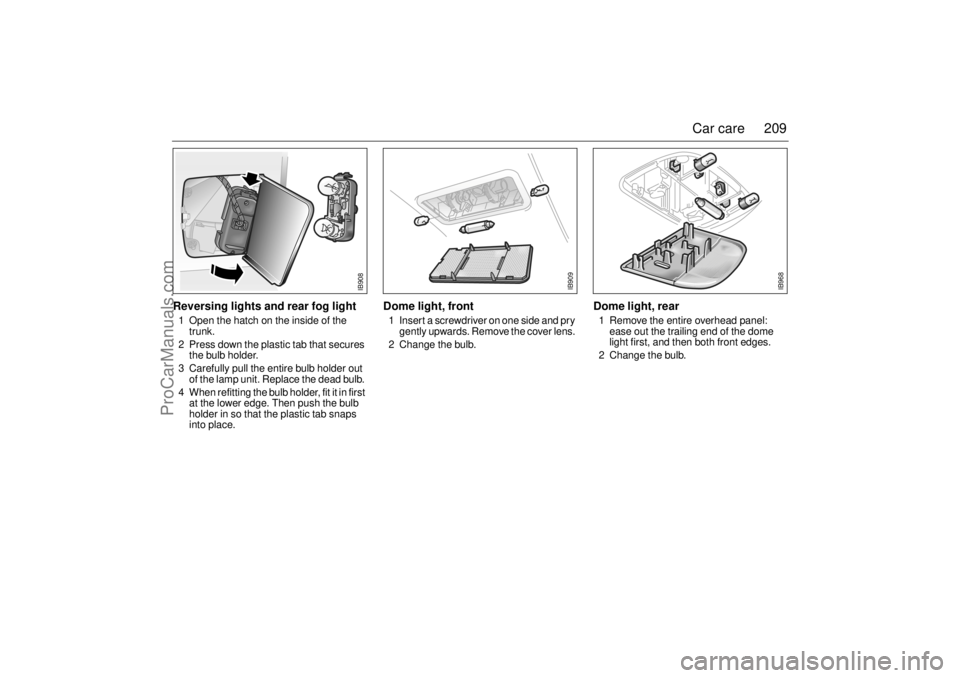
Reversing lights and rear fog light 1 Open the hatch on the inside of the
trunk.
2 Press down the plastic tab that secures
the bulb holder.
3 Carefully pull the entire bulb holder out
of the lamp unit. Replace the dead bulb.
4 When refitting the bulb holder, fit it in first
at the lower edge. Then push the bulb
holder in so that the plastic tab snaps
into place.
Dome light, front 1 Insert a screwdriver on one side and pry
gently upwards. Remove the cover lens.
2 Change the bulb.
Dome light, rear 1 Remove the entire overhead panel:
ease out the trailing end of the dome
light first, and then both front edges.
2 Change the bulb.
IB908
IB909
IB968
ProCarManuals.com
Page 211 of 260
211 Car care
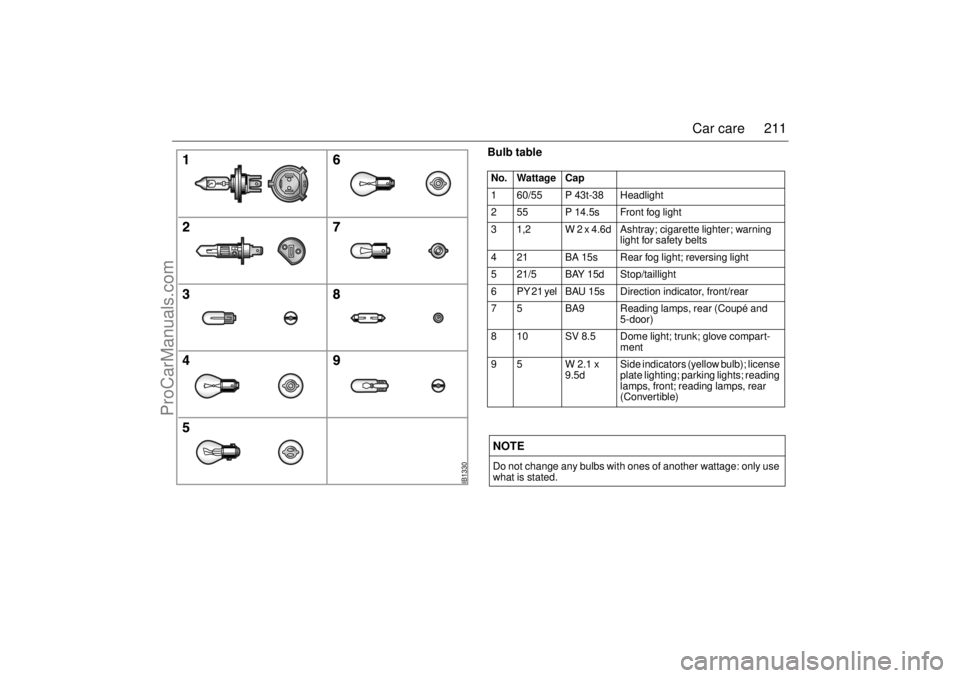
Bulb tableNo. Wattage Cap
1 60/55 P 43t-38 Headlight
2 55 P 14.5s Front fog light
3 1,2 W 2 x 4.6d Ashtray; cigarette lighter; warning
light for safety belts
4 21 BA 15s Rear fog light; reversing light
5 21/5 BAY 15d Stop/taillight
6 PY 21 yel BAU 15s Direction indicator, front/rear
7 5 BA9 Reading lamps, rear (Coupé and
5-door)
8 10 SV 8.5 Dome light; trunk; glove compart-
ment
95 W 2.1 x
9.5d Side indicators (yellow bulb); license
plate lighting; parking lights; reading
lamps, front; reading lamps, rear
(Convertible) NOTEDo not change any bulbs with ones of another wattage: only use
what is stated.
IB1330
ProCarManuals.com
Page 213 of 260
213 Car care
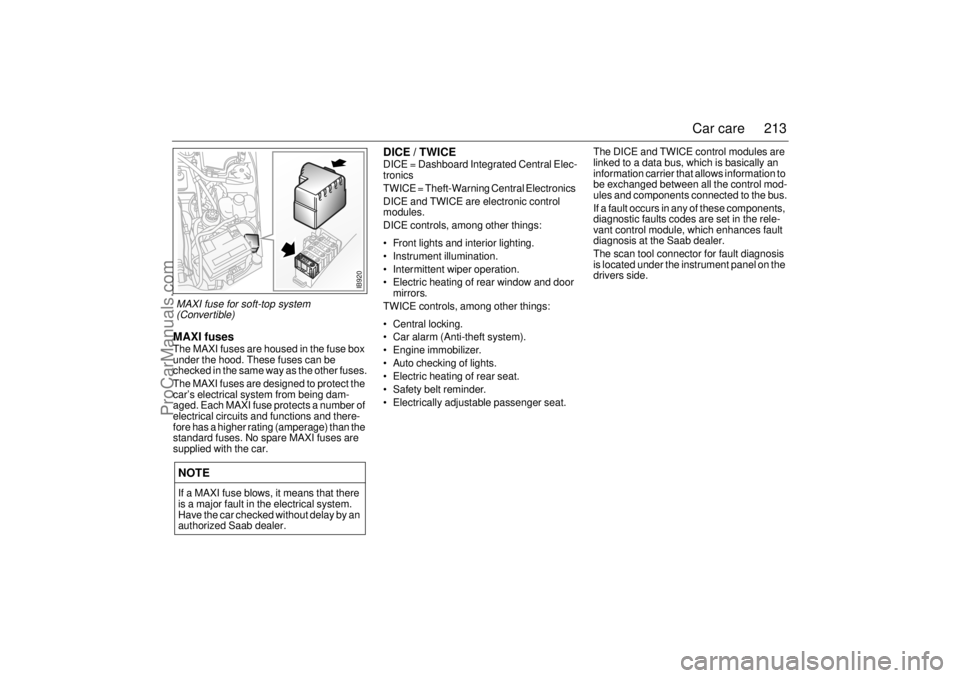
MAXI fusesThe MAXI fuses are housed in the fuse box
under the hood. These fuses can be
checked in the same way as the other fuses.
The MAXI fuses are designed to protect the
car’s electrical system from being dam-
aged. Each MAXI fuse protects a number of
electrical circuits and functions and there-
fore has a higher rating (amperage) than the
standard fuses. No spare MAXI fuses are
supplied with the car.
DICE / TWICEDICE = Dashboard Integrated Central Elec-
tronics
TWICE = Theft-Warning Central Electronics
DICE and TWICE are electronic control
modules.
DICE controls, among other things:
Front lights and interior lighting.
Instrument illumination.
Intermittent wiper operation.
Electric heating of rear window and door
mirrors.
TWICE controls, among other things:
Central locking.
Car alarm (Anti-theft system).
Engine immobilizer.
Auto checking of lights.
Electric heating of rear seat.
Safety belt reminder.
Electrically adjustable passenger seat.The DICE and TWICE control modules are
linked to a data bus, which is basically an
information carrier that allows information to
be exchanged between all the control mod-
ules and components connected to the bus.
If a fault occurs in any of these components,
diagnostic faults codes are set in the rele-
vant control module, which enhances fault
diagnosis at the Saab dealer.
The scan tool connector for fault diagnosis
is located under the instrument panel on the
drivers side.
NOTEIf a MAXI fuse blows, it means that there
is a major fault in the electrical system.
Have the car checked without delay by an
authorized Saab dealer.
IB920
MAXI fuse for soft-top system
(Convertible)
ProCarManuals.com