instrument panel SAAB 9-3 2001 Owner's Guide
[x] Cancel search | Manufacturer: SAAB, Model Year: 2001, Model line: 9-3, Model: SAAB 9-3 2001Pages: 260, PDF Size: 12.01 MB
Page 167 of 260

167 Starting and driving
If the gear selector lever is moved from position D to 1, a
change-down to 3rd gear will occur at about 110 mph (180 km/h).
A change-down to 2nd gear will occur at about 75 mph (120 km/h)
and to 1st gear at about 40 mph (65 km/h).
When position 1 is selected, all the other gears will be locked out.
Manual gear-changing is not recommended on slippery roads.
If one of the drive wheels spins excessively, the engine torque will
be reduced to avoid damaging the transmission
Adaptive gear-change patternsAdaptive gear-change patterns are selected automatically depend-
ing on the engine load. This function applies in the Normal and Sport
modes.
The change occurs at a higher rotation speed and the gear remains
engaged for a longer period, if the control module senses that the
load does not drop. These change patterns avoid unnecessary gear
changes when, for example, driving on long inclines with a trailer,
and to prevent overheating of the transmission oil. This function cuts
in automatically if the oil becomes too hot, to protect the transmis-
sion from damage, and lowers the oil temperature.
The adaptive change pattern function is not activated at speeds over
93 mph (150 km/h). If a pattern is in operation when this speed is
exceeded, it will be maintained until the control module senses that
a more suitable one can be activated.
The adaptive gear-change pattern function is deselected when:
Winter mode is selected.
The engine is switched off.
The load is reduced by so much that this function is no longer
required.
“Automatic transmission fault indicator” appears on the
main instrument panel, see page 165.
ProCarManuals.com
Page 168 of 260
168 Starting and drivingThe SPORT and WINTER modes
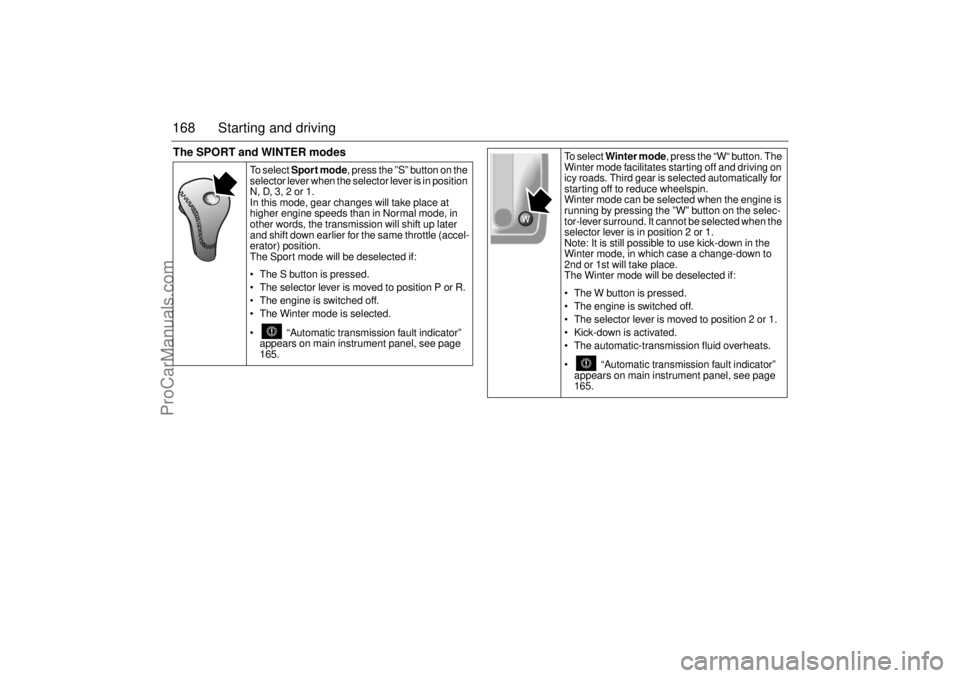
To s e l e c t Sport mode, press the ”S” button on the
selector lever when the selector lever is in position
N, D, 3, 2 or 1.
In this mode, gear changes will take place at
higher engine speeds than in Normal mode, in
other words, the transmission will shift up later
and shift down earlier for the same throttle (accel-
erator) position.
The Sport mode will be deselected if:
The S button is pressed.
The selector lever is moved to position P or R.
The engine is switched off.
The Winter mode is selected.
“Automatic transmission fault indicator”
appears on main instrument panel, see page
165.
To select Winter mode, press the “W“ button. The
Winter mode facilitates starting off and driving on
icy roads. Third gear is selected automatically for
starting off to reduce wheelspin.
Winter mode can be selected when the engine is
running by pressing the ”W” button on the selec-
tor-lever surround. It cannot be selected when the
selector lever is in position 2 or 1.
Note: It is still possible to use kick-down in the
Winter mode, in which case a change-down to
2nd or 1st will take place.
The Winter mode will be deselected if:
The W button is pressed.
The engine is switched off.
The selector lever is moved to position 2 or 1.
Kick-down is activated.
The automatic-transmission fluid overheats.
“Automatic transmission fault indicator”
appears on main instrument panel, see page
165.
ProCarManuals.com
Page 173 of 260
173 Starting and driving
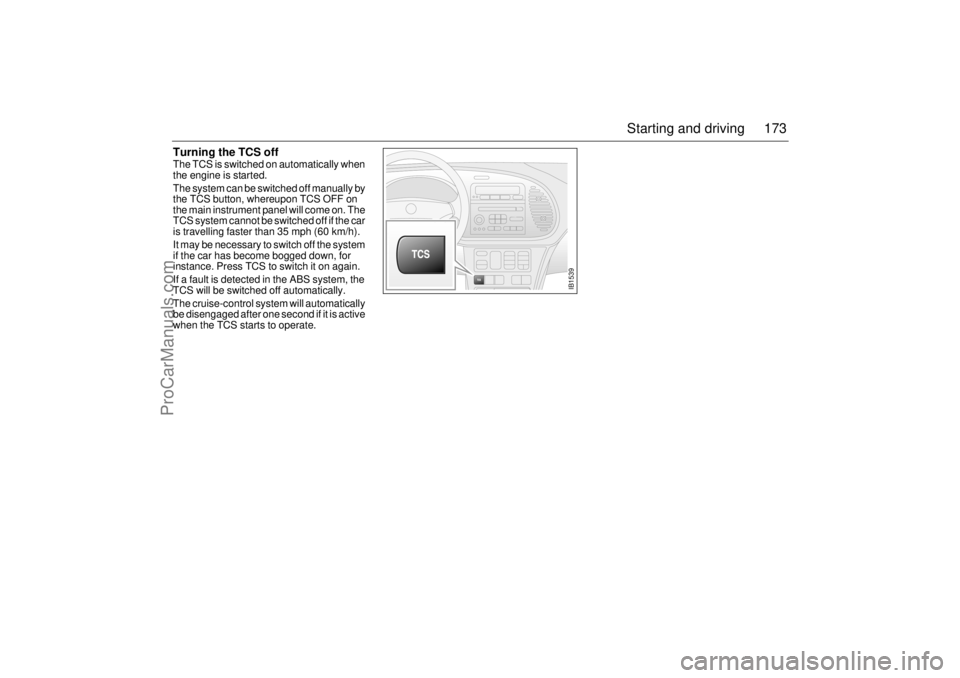
Turning the TCS off The TCS is switched on automatically when
the engine is started.
The system can be switched off manually by
the TCS button, whereupon TCS OFF on
the main instrument panel will come on. The
TCS system cannot be switched off if the car
is travelling faster than 35 mph (60 km/h).
It may be necessary to switch off the system
if the car has become bogged down, for
instance. Press TCS to switch it on again.
If a fault is detected in the ABS system, the
TCS will be switched off automatically.
The cruise-control system will automatically
be disengaged after one second if it is active
when the TCS starts to operate.
IB1539
ProCarManuals.com
Page 174 of 260
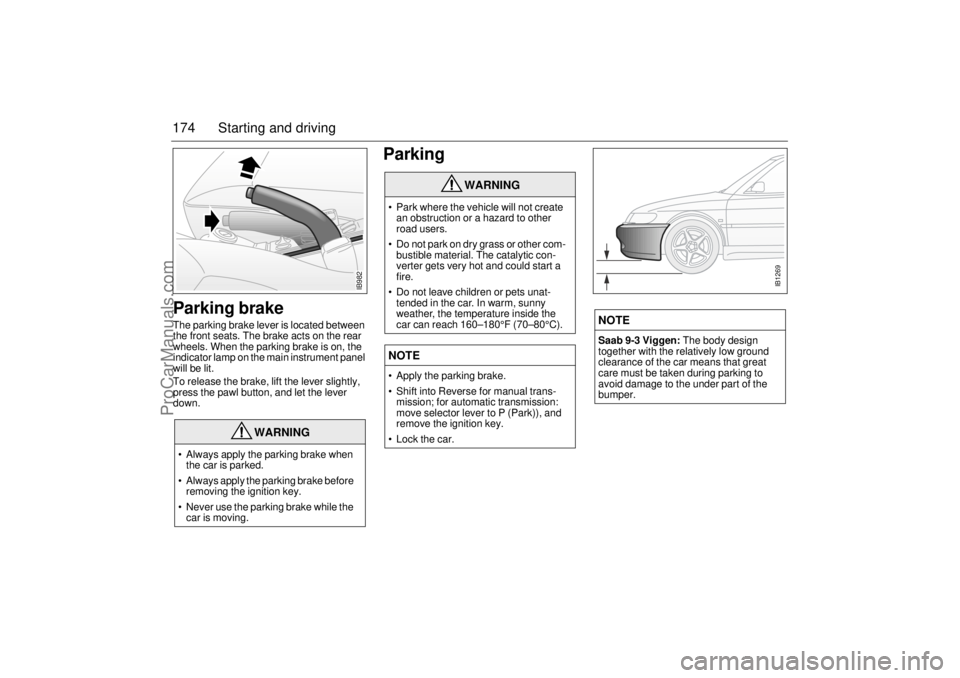
174 Starting and drivingParking brakeThe parking brake lever is located between
the front seats. The brake acts on the rear
wheels. When the parking brake is on, the
indicator lamp on the main instrument panel
will be lit.
To release the brake, lift the lever slightly,
press the pawl button, and let the lever
down.
Parking
WARNING
Always apply the parking brake when
the car is parked.
Always apply the parking brake before
removing the ignition key.
Never use the parking brake while the
car is moving.
WARNING
Park where the vehicle will not create
an obstruction or a hazard to other
road users.
Do not park on dry grass or other com-
bustible material. The catalytic con-
verter gets very hot and could start a
fire.
Do not leave children or pets unat-
tended in the car. In warm, sunny
weather, the temperature inside the
car can reach 160–180°F (70–80°C). NOTE Apply the parking brake.
Shift into Reverse for manual trans-
mission; for automatic transmission:
move selector lever to P (Park)), and
remove the ignition key.
Lock the car.
NOTESaab 9-3 Viggen: The body design
together with the relatively low ground
clearance of the car means that great
care must be taken during parking to
avoid damage to the under part of the
bumper.
IB1269
IB982
ProCarManuals.com
Page 192 of 260
192 Car careHood release handleThe handle of the hood lock is located on the
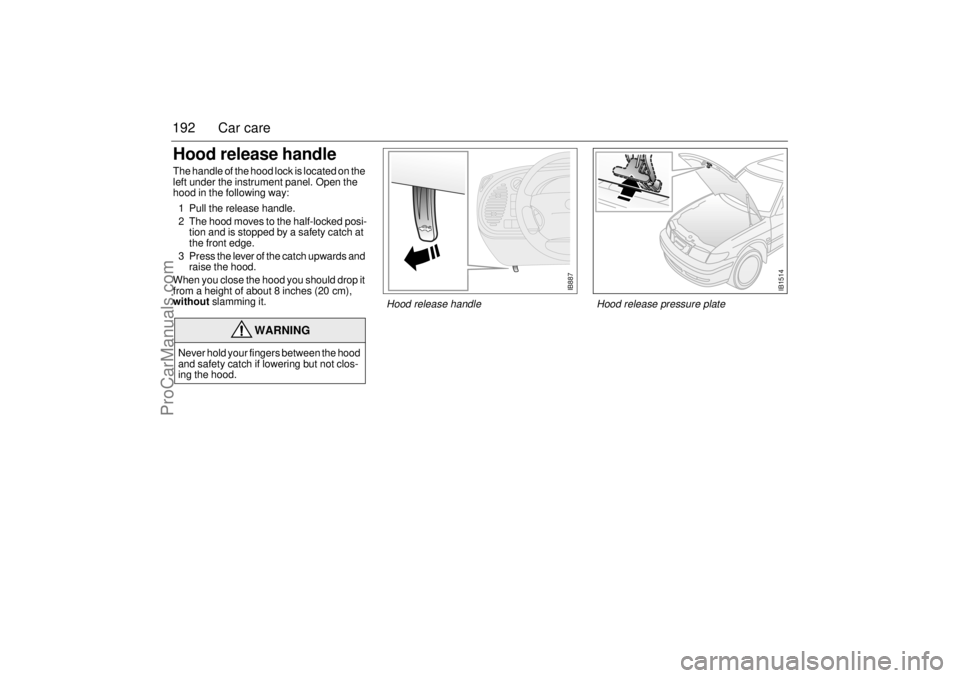
left under the instrument panel. Open the
hood in the following way:
1 Pull the release handle.
2 The hood moves to the half-locked posi-
tion and is stopped by a safety catch at
the front edge.
3 Press the lever of the catch upwards and
raise the hood.
When you close the hood you should drop it
from a height of about 8 inches (20 cm),
without slamming it.
WARNING
Never hold your fingers between the hood
and safety catch if lowering but not clos-
ing the hood.
IB1514
Hood release pressure plate
IB887
Hood release handle
ProCarManuals.com
Page 212 of 260
212 Car careFusesThe fuses are housed in two fuse panels:
one at the end of the instrument panel on the
driver’s side, and one under the hood.
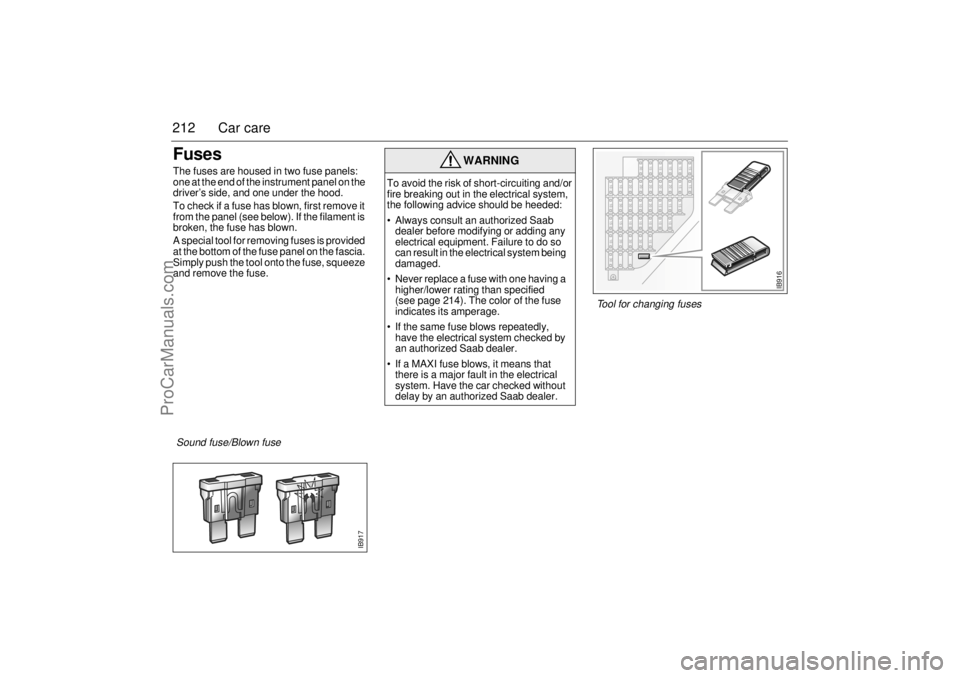
To check if a fuse has blown, first remove it
from the panel (see below). If the filament is
broken, the fuse has blown.
A special tool for removing fuses is provided
at the bottom of the fuse panel on the fascia.
Simply push the tool onto the fuse, squeeze
and remove the fuse.
WARNING
To avoid the risk of short-circuiting and/or
fire breaking out in the electrical system,
the following advice should be heeded:
Always consult an authorized Saab
dealer before modifying or adding any
electrical equipment. Failure to do so
can result in the electrical system being
damaged.
Never replace a fuse with one having a
higher/lower rating than specified
(see page 214). The color of the fuse
indicates its amperage.
If the same fuse blows repeatedly,
have the electrical system checked by
an authorized Saab dealer.
If a MAXI fuse blows, it means that
there is a major fault in the electrical
system. Have the car checked without
delay by an authorized Saab dealer.
301020303015
15151010101010
1030301020151515
101020202020201515
301515101515
IB916
IB917
Sound fuse/Blown fuse Tool for changing fuses
ProCarManuals.com
Page 213 of 260
213 Car care
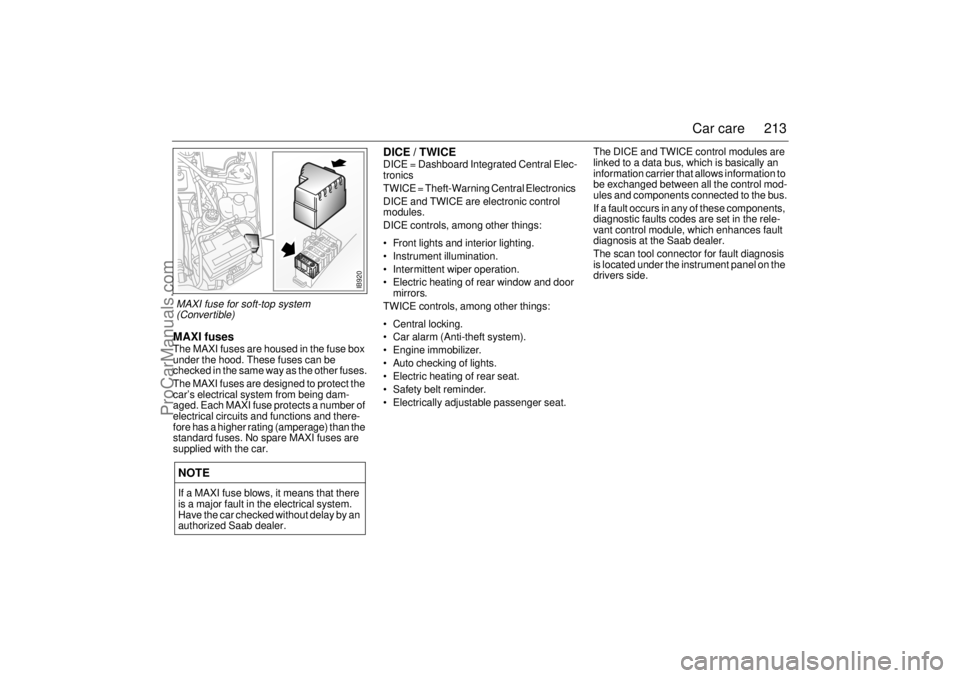
MAXI fusesThe MAXI fuses are housed in the fuse box
under the hood. These fuses can be
checked in the same way as the other fuses.
The MAXI fuses are designed to protect the
car’s electrical system from being dam-
aged. Each MAXI fuse protects a number of
electrical circuits and functions and there-
fore has a higher rating (amperage) than the
standard fuses. No spare MAXI fuses are
supplied with the car.
DICE / TWICEDICE = Dashboard Integrated Central Elec-
tronics
TWICE = Theft-Warning Central Electronics
DICE and TWICE are electronic control
modules.
DICE controls, among other things:
Front lights and interior lighting.
Instrument illumination.
Intermittent wiper operation.
Electric heating of rear window and door
mirrors.
TWICE controls, among other things:
Central locking.
Car alarm (Anti-theft system).
Engine immobilizer.
Auto checking of lights.
Electric heating of rear seat.
Safety belt reminder.
Electrically adjustable passenger seat.The DICE and TWICE control modules are
linked to a data bus, which is basically an
information carrier that allows information to
be exchanged between all the control mod-
ules and components connected to the bus.
If a fault occurs in any of these components,
diagnostic faults codes are set in the rele-
vant control module, which enhances fault
diagnosis at the Saab dealer.
The scan tool connector for fault diagnosis
is located under the instrument panel on the
drivers side.
NOTEIf a MAXI fuse blows, it means that there
is a major fault in the electrical system.
Have the car checked without delay by an
authorized Saab dealer.
IB920
MAXI fuse for soft-top system
(Convertible)
ProCarManuals.com
Page 214 of 260
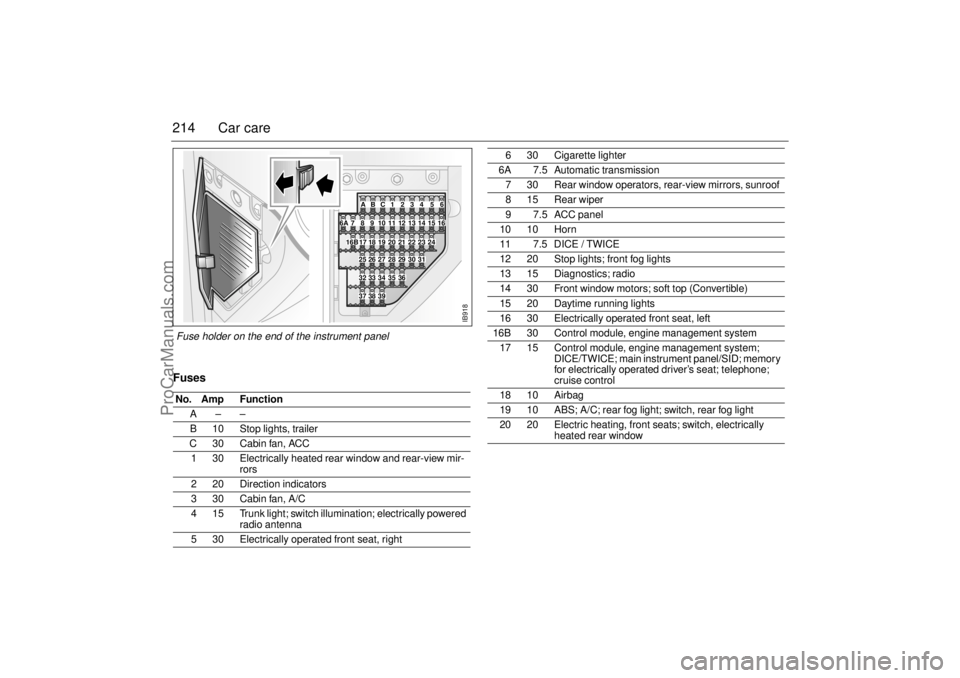
214 Car careFusesNo. Amp Function
A––
B 10 Stop lights, trailer
C 30 Cabin fan, ACC
1 30 Electrically heated rear window and rear-view mir-
rors
220Direction indicators
330Cabin fan, A/C
4 15 Trunk light; switch illumination; electrically powered
radio antenna
5 30 Electrically operated front seat, right
6 30 Cigarette lighter
6A 7.5 Automatic transmission
7 30 Rear window operators, rear-view mirrors, sunroof
8 15 Rear wiper
9 7.5 ACC panel
10 10 Horn
11 7.5 DICE / TWICE
12 20 Stop lights; front fog lights
13 15 Diagnostics; radio
14 30 Front window motors; soft top (Convertible)
15 20 Daytime running lights
16 30 Electrically operated front seat, left
16B 30 Control module, engine management system
17 15 Control module, engine management system;
DICE/TWICE; main instrument panel/SID; memory
for electrically operated driver’s seat; telephone;
cruise control
18 10 Airbag
19 10 ABS; A/C; rear fog light; switch, rear fog light
20 20 Electric heating, front seats; switch, electrically
heated rear window
30 10 20
30 30 15
15 15
10 10 10
10
10
10 30
30 10 20
15
15
15
10 10
20
10 20 20
20 20 15
15
30 15
15 10 15
15
IB918
1 C B A23456
7 6A 8 9 10 11 12 13 14 15 16
17 16B 18 19 20 21 22 23 2425 26 27 28 29 30 3132 33 34 35 3637 38 39
Fuse holder on the end of the instrument panel
ProCarManuals.com
Page 215 of 260

215 Car care
Relay holderUnder the instrument panel next to the steering wheel No. Amp Function
21 10 Switch, manual A/C; soft top (Convertible)
22 15 Direction indicators
23 20 Soft top (Convertible); telephone
24 7.5 Radio
25 30 Central locking; amplifier
26 30 Control module, engine management system
27 15 High beam flash; ACC
28 10 Control module, engine management system
29 10 Right parking light; number-plate lighting
30 10 Left parking light
31 20 Reversing light; windshield wipers; headlight
beam-length adjustment
32 15 Fuel pump
33 15 Electric heating of rear seat
34 10 SID; control module; automatic transmission
35 15 DICE/TWICE; main instrument panel; interior light-
ing
36 10 Relay, starter
37 15 Limp-home
38 25 Oxygen sensor (lambda probe)
39 – –
S–SpareItem Function
A Electric heating of rear seat
B Reversing light, cars with automatic transmission
C1 –
C2 Lock motor, trunk lid
D1 Rear wiper
D2 Rear-window washing
E Ignition switch
F–
G Windshield wipers (intermittent)
H Rear-window heating
IFuel pump
J–
KStart relay
L Main relay (injection system)
ProCarManuals.com
Page 259 of 260

259 Index
Leather upholstery, care of
________ 225
Load eyes
_____________________ 148
Locks
__________________________ 36
Lowering rear seat
______________ 144
Luggage compartment ___________ 144
Luggage compartment, Convertible
__ 56
Luggage-compartment lighting
_____ 148
MMain beam
_____________________ 75
Main instrument panel
_____________ 60
Maintenance schedule ___________ 236
Manual climate-control system
______ 80
Manual raising of the soft top,
Convertible
____________________ 52
Manual transmission
_____________ 161
Manually opening the fuel filler door,
Convertible
____________________ 58
Manually opening the fuel filler door,
Coupé and 5-door
______________ 150
Maxi fuses
_____________________ 213
Memory, driver’s seat
____________ 134
Motoring abroad
________________ 190
NNight Panel
_____________________ 73
OORVR
________________________ 195
Odometer ______________________ 66
Oil specification
_________________ 247
OnStar
________________________ 117
Opening handle
__________________ 36
Owner assistance _______________ 237
PPaint touch-up
__________________ 227
Parcel shelf
____________________ 147
Park Brake Shift Lock
____________ 164
Parking brake
__________________ 174
Parking lights ____________________ 75
Plates and labels
________________ 253
Power steering fluid, check
________ 201
Power steering oil, grade
_________ 251
Pressure gauge
__________________ 67
Programmable driver’s seat
_______ 134
Programming, ACC
_______________ 90
RRadio
__________________________ 98
Raising the soft top, Convertible
_____ 51
Rear fog light
____________________ 77
Rear seat
______________________ 144
Rear seat, tipping
_______________ 144Rearview mirrors
________________ 143
Rear-window wiper _______________ 79
Recirculation
____________________ 82
Recycling
______________________ 230
Refuelling _____________________ 157
Relay table ____________________ 215
Release handle, hood
____________ 192
Remote control
__________________ 36
Remote control battery, changing
____ 39
Removing the key
_______________ 152
Reporting safety defects
__________ 238
Rev counter
_____________________ 66
Reversing lights
__________________ 77
Roof rack
______________________ 182
Rotating the tires
________________ 218
Running-in
_____________________ 161
SSAHR, head restraint
_____________ 18
SID (Side Instrument Display)
_______ 69
SRS (airbag)
____________________ 28
Saab Audio System
_______________ 93
Saab Trionic engine
management system ____________ 195
Safety belts
_____________________ 12
Safety belts, care of
______________ 224
Seat belts
______________________ 12
Seat-belt pretensioners
____________ 13
Seats
_________________________ 130
Service costs
___________________ 237
ProCarManuals.com