warning SAAB 9-3 2001 Repair Manual
[x] Cancel search | Manufacturer: SAAB, Model Year: 2001, Model line: 9-3, Model: SAAB 9-3 2001Pages: 260, PDF Size: 12.01 MB
Page 146 of 260
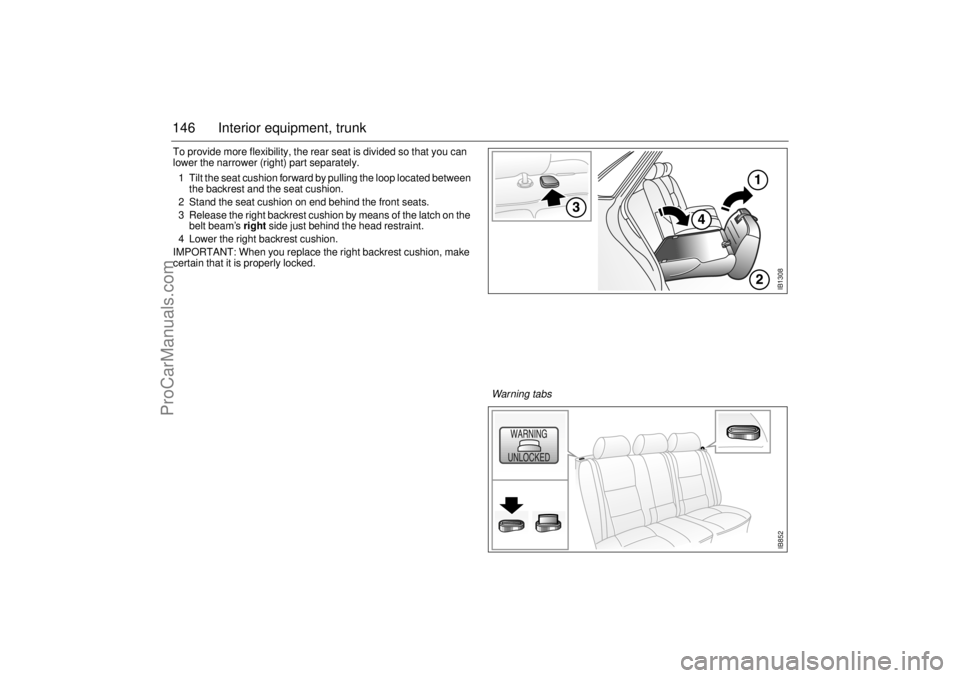
146 Interior equipment, trunkTo provide more flexibility, the rear seat is divided so that you can
lower the narrower (right) part separately.
1 Tilt the seat cushion forward by pulling the loop located between
the backrest and the seat cushion.
2 Stand the seat cushion on end behind the front seats.
3 Release the right backrest cushion by means of the latch on the
belt beam’s right side just behind the head restraint.
4 Lower the right backrest cushion.
IMPORTANT: When you replace the right backrest cushion, make
certain that it is properly locked.
IB1308IB852
Warning tabs
ProCarManuals.com
Page 148 of 260
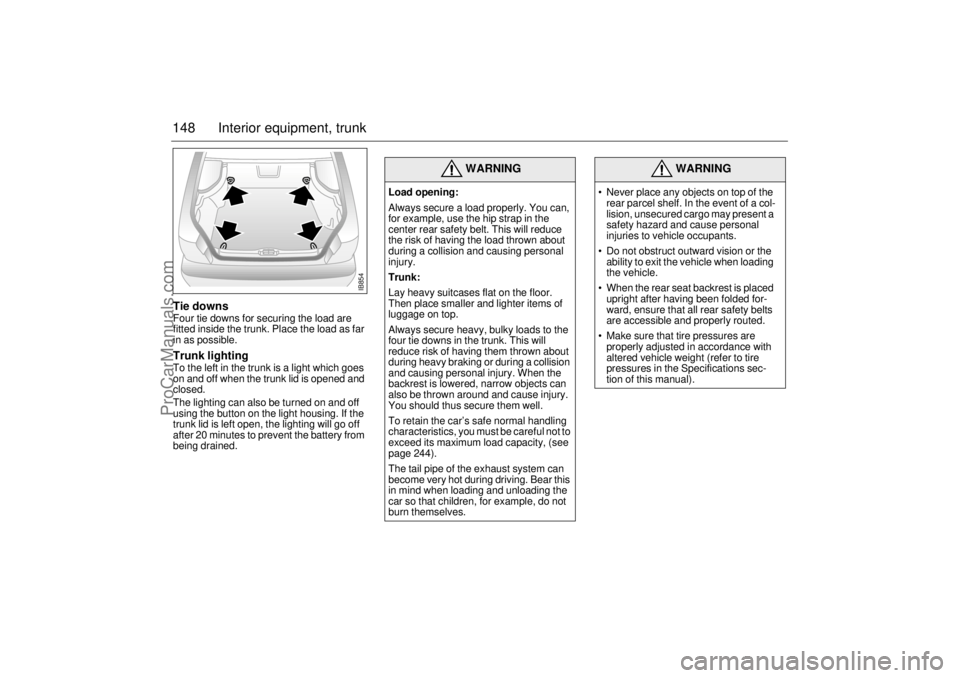
148 Interior equipment, trunkTie downsFour tie downs for securing the load are
fitted inside the trunk. Place the load as far
in as possible.Trunk lightingTo the left in the trunk is a light which goes
on and off when the trunk lid is opened and
closed.
The lighting can also be turned on and off
using the button on the light housing. If the
trunk lid is left open, the lighting will go off
after 20 minutes to prevent the battery from
being drained.
WARNING
Load opening:
Always secure a load properly. You can,
for example, use the hip strap in the
center rear safety belt. This will reduce
the risk of having the load thrown about
during a collision and causing personal
injury.
Trunk:
Lay heavy suitcases flat on the floor.
Then place smaller and lighter items of
luggage on top.
Always secure heavy, bulky loads to the
four tie downs in the trunk. This will
reduce risk of having them thrown about
during heavy braking or during a collision
and causing personal injury. When the
backrest is lowered, narrow objects can
also be thrown around and cause injury.
You should thus secure them well.
To retain the car’s safe normal handling
characteristics, you must be careful not to
exceed its maximum load capacity, (see
page 244).
The tail pipe of the exhaust system can
become very hot during driving. Bear this
in mind when loading and unloading the
car so that children, for example, do not
burn themselves.
WARNING
Never place any objects on top of the
rear parcel shelf. In the event of a col-
lision, unsecured cargo may present a
safety hazard and cause personal
injuries to vehicle occupants.
Do not obstruct outward vision or the
ability to exit the vehicle when loading
the vehicle.
When the rear seat backrest is placed
upright after having been folded for-
ward, ensure that all rear safety belts
are accessible and properly routed.
Make sure that tire pressures are
properly adjusted in accordance with
altered vehicle weight (refer to tire
pressures in the Specifications sec-
tion of this manual).
IB854
ProCarManuals.com
Page 149 of 260
149 Interior equipment, trunk
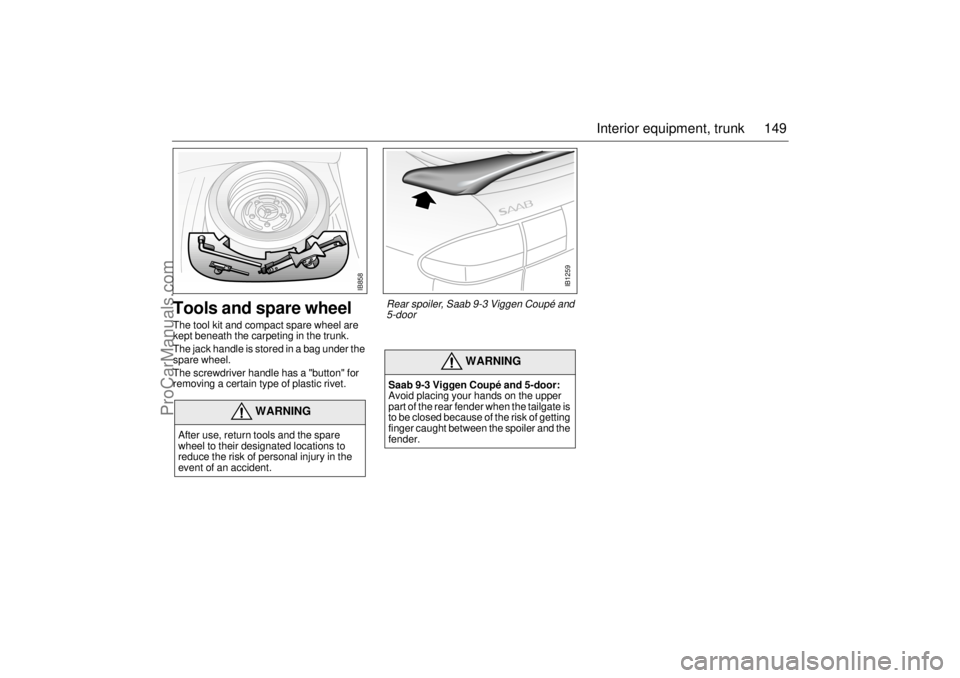
Tools and spare wheelThe tool kit and compact spare wheel are
kept beneath the carpeting in the trunk.
The jack handle is stored in a bag under the
spare wheel.
The screwdriver handle has a "button" for
removing a certain type of plastic rivet.
WARNING
After use, return tools and the spare
wheel to their designated locations to
reduce the risk of personal injury in the
event of an accident.
WARNING
Saab 9-3 Viggen Coupé and 5-door:
Avoid placing your hands on the upper
part of the rear fender when the tailgate is
to be closed because of the risk of getting
finger caught between the spoiler and the
fender.
IB858
IB1259
Rear spoiler, Saab 9-3 Viggen Coupé and
5-door
ProCarManuals.com
Page 152 of 260
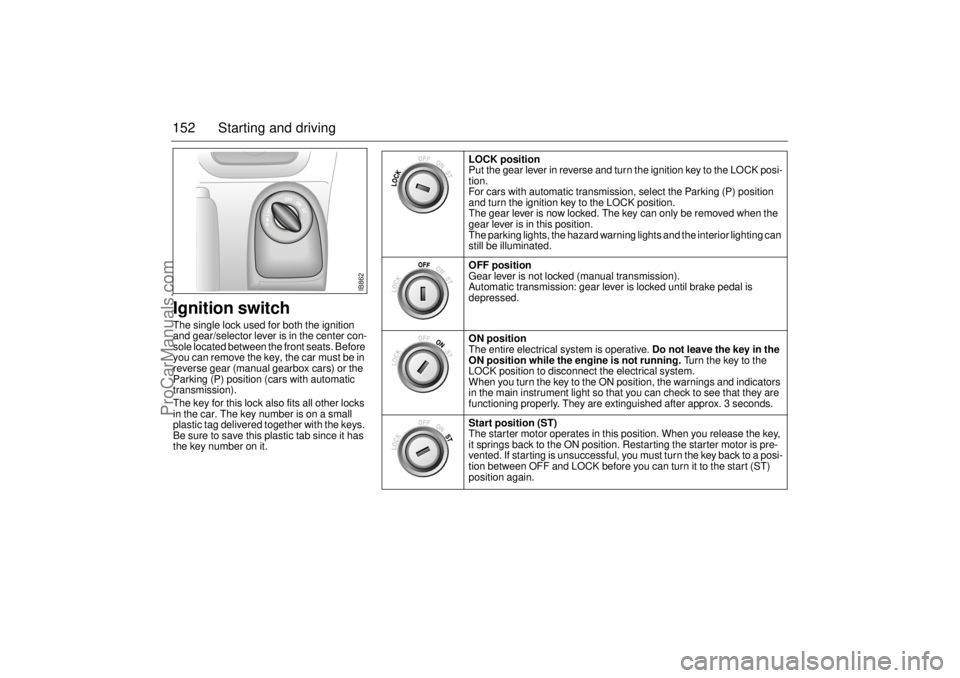
152 Starting and drivingIgnition switchThe single lock used for both the ignition
and gear/selector lever is in the center con-
sole located between the front seats. Before
you can remove the key, the car must be in
reverse gear (manual gearbox cars) or the
Parking (P) position (cars with automatic
transmission).
The key for this lock also fits all other locks
in the car. The key number is on a small
plastic tag delivered together with the keys.
Be sure to save this plastic tab since it has
the key number on it.
IB862
LOCK position
Put the gear lever in reverse and turn the ignition key to the LOCK posi-
tion.
For cars with automatic transmission, select the Parking (P) position
and turn the ignition key to the LOCK position.
The gear lever is now locked. The key can only be removed when the
gear lever is in this position.
The parking lights, the hazard warning lights and the interior lighting can
still be illuminated.
OFF position
Gear lever is not locked (manual transmission).
Automatic transmission: gear lever is locked until brake pedal is
depressed.
ON position
The entire electrical system is operative. Do not leave the key in the
ON position while the engine is not running. Turn the key to the
LOCK position to disconnect the electrical system.
When you turn the key to the ON position, the warnings and indicators
in the main instrument light so that you can check to see that they are
functioning properly. They are extinguished after approx. 3 seconds.
Start position (ST)
The starter motor operates in this position. When you release the key,
it springs back to the ON position. Restarting the starter motor is pre-
vented. If starting is unsuccessful, you must turn the key back to a posi-
tion between OFF and LOCK before you can turn it to the start (ST)
position again.
ProCarManuals.com
Page 153 of 260
153 Starting and driving
If the car does not startIf the text "KEY NOT ACCEPTED" appears
on the SID when the engine refuses to start,
the trouble may be a fault in the transponder
of the key or in the receiver of the ignition
switch. Proceed as follows:
• Turn the key back to the LOCK position.
Turn the key to the ON position.
Press one of the buttons on the remote
control (the LED on top of the dash stops
flashing).
Start the engine.
Try the other key. If it works, the trouble is in
the first key.
Call on an authorized Saab dealer for
inspection and correction.
Starting the engine
Do not run the starter motor for more than
25 seconds at a time. Wait 20-30 seconds
before running the starter again, to give the
battery time to recover.
Avoid racing the engine or putting a heavy
load on it before it has warmed up. Let the
engine idle for at least 10 seconds and then
drive away as long as the engine oil warning
light has gone out to enable the engine to
attain its normal temperature as quickly as
possible.
It is possible for air to enter the lubricating
system in conjunction with an oil or oil-filter
change, or if the car has been stored for
some time. This air can cause the hydraulic
cam followers to emit a ticking noise, which
can persist for up to 15 minutes after start-
ing. Although this is quite normal and does
not indicate any malfunction, it is advisable
not to exceed 3,000 rpm before the noise
has disappeared.
The hydraulic cam lifters are completely
service free; the valve clearance is set up at
the factory and will not need any subse-
quent adjustment.
WARNING
Always remove the key before leaving
the car.
Always apply the parking brake before
removing the ignition key.NOTETake care not to spill drinks or to drop
crumbs over the ignition switch. If dirt or
liquid gets into it, the switch may not
operate properly.
WARNING
When starting the engine:
– Sit down in the driver’s seat.
– Depress the clutch pedal fully. If gear
lever is not in the neutral position, the
clutch pedal must be fully depressed
or the car will jump forwards or back-
wards, which may cause an accident.
– Never start the car from outside the
vehicle, e.g. through a wound down
window. This could lead to serious
personal injury.
Engage reverse (R) (position P for
automatic transmission) to remove the
ignition key. The key can only be
removed in this gear position.
Carbon monoxide (CO) is a colorless,
odorless, poisonous gas. Be alert to
the danger of CO – always open the
garage doors before starting the
engine in the garage.
There is also a danger of CO poison-
ing if the exhaust system is leaking.
Do not rest or sleep in the car when
parked with the engine running. There
is a risk of depressing the accelerator
which could lead to engine damage.
ProCarManuals.com
Page 156 of 260
156 Starting and driving
Important considerations with cata-
lytic convertersThe catalytic converter is an emission-con-
trol device incorporated in the car’s exhaust
system. It consists of a metal canister with a
honeycomb insert, the cells of which have
walls coated in a catalytic layer (mixture of
precious metals).
To ensure that the catalytic converter con-
tinues to function properly, and also to avoid
damage to the converter and its associated
components, the following points must be
observed:
Have the car serviced regularly in accor-
dance with the service program. The fuel
and ignition systems are particularly
important in this context.
Always be alert to any misfiring of the
engine (not running on all cylinders) and
any loss of power or performance. At the
first sign of a malfunction, reduce speed
and take the car to an authorized Saab
dealer as soon as possible. If the engine fails to start (in very cold
weather or if the battery is dead), the car
can be push started (manual gearbox
only) or started using jumper cables to a
donor battery. However, as soon as you
have started the engine, it is important
that it runs on all cylinders. If it is misfiring,
allow it to idle for up to five minutes to give
it time to settle and run smoothly. If, after
this time, the engine still fails to run prop-
erly, turn off the engine and get in touch
with an authorized Saab dealer for
advice.
NOTEIf the CHECK ENGINE warning light
starts to flash, ease off the accelerator
slightly. If the light does not cease to flash
within 5 seconds, stop the car in a suita-
ble place as soon as possible and turn off
the engine. The car must be towed to an
authorized Saab dealer.
If the CHECK ENGINE warning light
flashes, it indicates that the engine is
misfiring which can result in damage to
the catalytic converter.
NOTEUse only unleaded gasoline. Leaded gas-
oline is detrimental to the catalyst and
oxygen sensor and will seriously impair
the function of the catalytic converter.
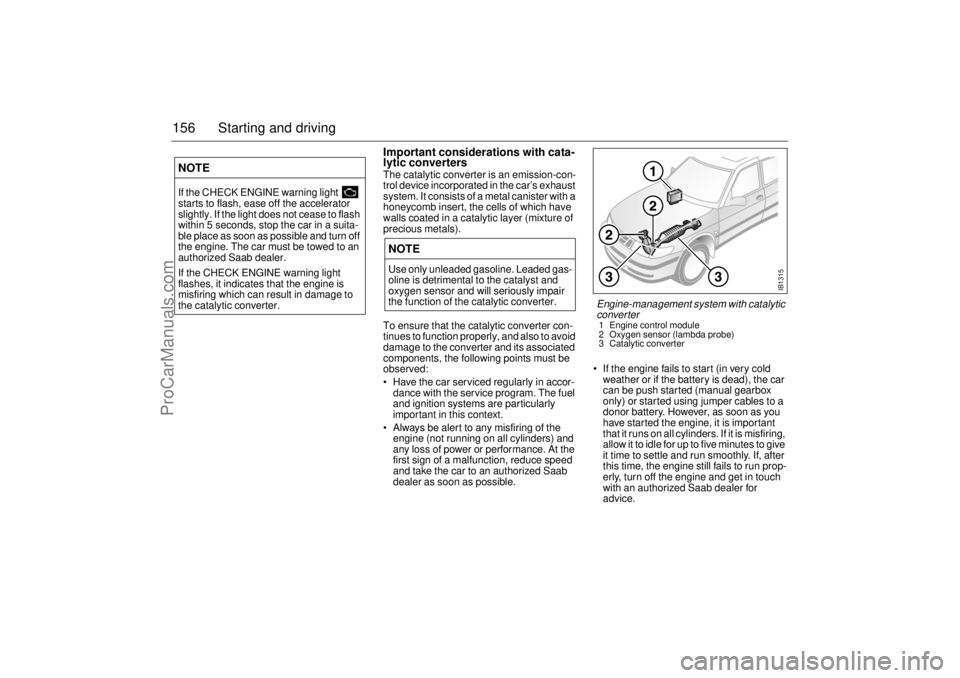
IB1315
Engine-management system with catalytic
converter 1 Engine control module
2 Oxygen sensor (lambda probe)
3 Catalytic converter
ProCarManuals.com
Page 157 of 260

157 Starting and driving
Never park the car on dry grass or other
combustible material. The catalytic con-
verter gets very hot and could therefore
start a fire.
Never drive off if the engine is misfiring.
If you jump start the car when the engine
is already up to normal temperature, the
engine must start to run on all cylinders.
Stop jump-starting if the engine fails to
start immediately.
Failure to follow these directions could
result in the catalytic converter and asso-
ciated components being damaged, and
could represent a breach of the warranty
conditions.
RefuelingOnly fuel from well-known oil companies
should be used.
All Saab gasoline engines can be driven on
fuel of grade AON 87-93.
For optimum performance we recommend:
AO N 90 for 2.0 Turbo 185 hp.
AO N 93 for 2.0 Turbo 205 hp and
2.3 Turbo Viggen.
If fuel containing a mixture of alcohol is
used, the following restrictions apply:
Methanol: max. 5% by volume.
Ethanol: max. 10% by volume.
MTBE: max. 15% by volume.The fuel filler cap is located in the right rear
quarter panel.
Switch off engine.
Insert the fuel-pump nozzle beyond the
flange on the filler pipe. Do not withdraw the
nozzle while filling is in progress.
Cease refueling the first time the pump
stops.
Fuel-tank capacity: 17.0 US gal. (64 liters)
Screw on the filler cap and keep turning until
it has clicked at least three times.
Manually opening the fuel filler door, see
page 150, Convertible, page 58.
The most effective way to prevent conden-
sation forming in the tank (and thus avoid
possible running problems) is to keep the
tank well filled.
Before the onset of freezing temperatures in
winter, it may be advisable to add gasoline
anti-freeze to the fuel a few times to dispel
any condensation in the system.
NOTEIf the car runs out of fuel, it is possible for
air to get into the fuel system. If this
happens, the catalytic converter may
overheat and be damaged.
WARNING
Never use fuel for any purpose other
than as engine fuel.
Gasoline is highly flammable and can
cause severe burns. Never use an
exposed flame in the vicinity of gaso-
line. Never smoke when filling the
vehicle up with gasoline.
Do not use the phone when refueling
with gasoline. Gasoline fuels are
highly explosive.
NOTEDo not overfill. Fuel should not come right
up the filler pipe as expansion room is
needed.
ProCarManuals.com
Page 162 of 260
162 Starting and drivingAutomatic transmission
The electronic control module for the auto-
matic transmission receives information on
engine torque and road speed. It also con-
trols the hydraulic pressure in the transmis-
sion to ensure that gear changing is as
smooth as possible.
The position of the selector lever is shown
by the symbols adjacent to the lever and
also by an indicator on the main instrument
panel.
The ignition key can only be removed when
the selector lever is in the P position.When the car is stationary, the engine must
be idling when the selector lever is moved.
You must have your foot on the brake
pedal to move the lever out of park. If the
accelerator is depressed while the lever is
moved, this will result in abnormal wear in
the transmission.
WARNING
Make it a habit to keep your foot on the
brake when selecting a drive position,
to prevent the car from creeping for-
ward (or backwards if reverse is
selected).
The car must be at a standstill before
P, R or N is selected. You have to have
your foot on the brake pedal to move
the lever out of park. If the car is still
moving when a drive position is subse-
quently selected, this could cause an
accident or damage the automatic
transmission.
Never park the car with the selector
lever in a drive position, even if the
parking brake is on.
If you want to leave the car with the
engine running, move the selector
lever to P or N and apply the parking
brake.
NOTEAfter selecting a drive position, pause
briefly to allow the gear to engage (the car
starts to pull a little) before you acceler-
ate.
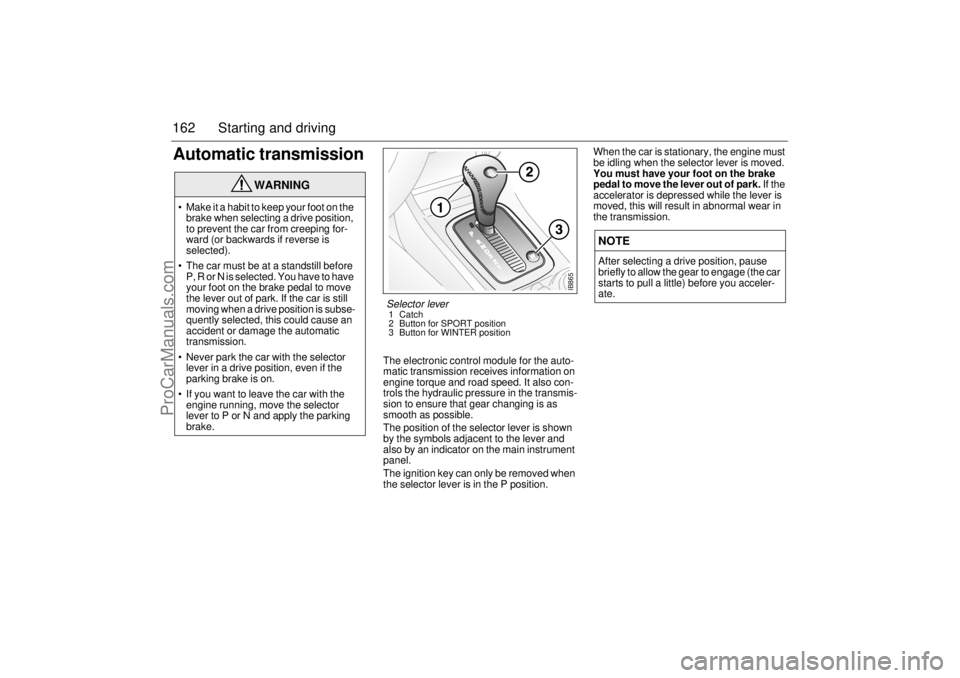
IB865
Selector lever 1Catch
2 Button for SPORT position
3 Button for WINTER position
ProCarManuals.com
Page 165 of 260
165 Starting and driving
Automatic transmission
fault indicator
If the symbol appears on the main instru-
ment panel, the system has detected a fault
in the automatic transmission or its control
module (see page 64).
This also means that the Limp-home mode
has been selected, to guard against further
damage being done to the transmission. In
this mode, the automatic transmission
starts in 4th gear, and gear changes (if nec-
essary) will have to be made manually.
It is not possible to select the SPORT or
WINTER mode when the Limp-home mode
is active.
You should have the automatic transmis-
sion checked as soon as possible by an
authorized Saab dealer.
The following gears will be engaged in the
respective selector positions when the auto-
matic transmission is in the Limp-home
mode:
Overheated transmission oilIf the transmission oil becomes overheated
while driving, the following message
appears on the SID: TRANSMISSION
OVERHEATING. In this event, stop the car
in a suitable place, switch off the engine,
open the hood and wait until the message
goes out. When driving subsequent to the
transmission oil overheating, select either
3rd gear or Drive, whichever will allow the
engine to run at 3,000 rpm and maintain the
speed of traffic or a safe speed.
The transmission oil can become very hot
when the car is driven with a heavy load; for
example, driving with a trailer on hilly roads
when the wrong gear has been selected,
resulting in many extra gear changes.
Select one of the positions 1, 2 or 3. A high
outside temperature or a defective oil cooler
can also cause the oil temperature to
increase. Contact an authorized Saab work-
shop, see also page 179.
Driving in hilly country with a heavy
loadOverheating of the automatic-transmission
fluid can occur when the car is towing a
heavy load, such as a trailer in hilly country,
with the wrong gear selected, resulting in
abnormally frequent gear changing. To
avoid the transmission oil from overheating
always drive in Normal mode, then the
adaptive gear change pattern is active.
High ambient temperatures can also
increase the temperature of the transmis-
sion fluid or the oil cooler may be faulty. As
the transmission fluid temperature
increases, its useful service life is reduced.
Contact an authorized Saab dealer (see
also page 179).TowingTowing a car with automatic transmission,
see page 187. Position R D 3 2 1
Gear Reverse 4th 4th 3rd 3rd
NOTEIf the control module has actuated the
Limp-home function for the automatic
transmission, the car will remain in 4th
gear when D is selected, making it very
sluggish. To overcome this, move the
selector lever to position 2. The transmis-
sion then starts in 3rd gear. When the car
is moving you can select position D or 3.
WARNING
Remember to use engine-braking (selec-
tor position 1, 2, or 3) to spare the brakes
when you are driving on a long or steep
downhill slope.
Brake failure can result from overheated
brakes!
ProCarManuals.com
Page 169 of 260
169 Starting and driving
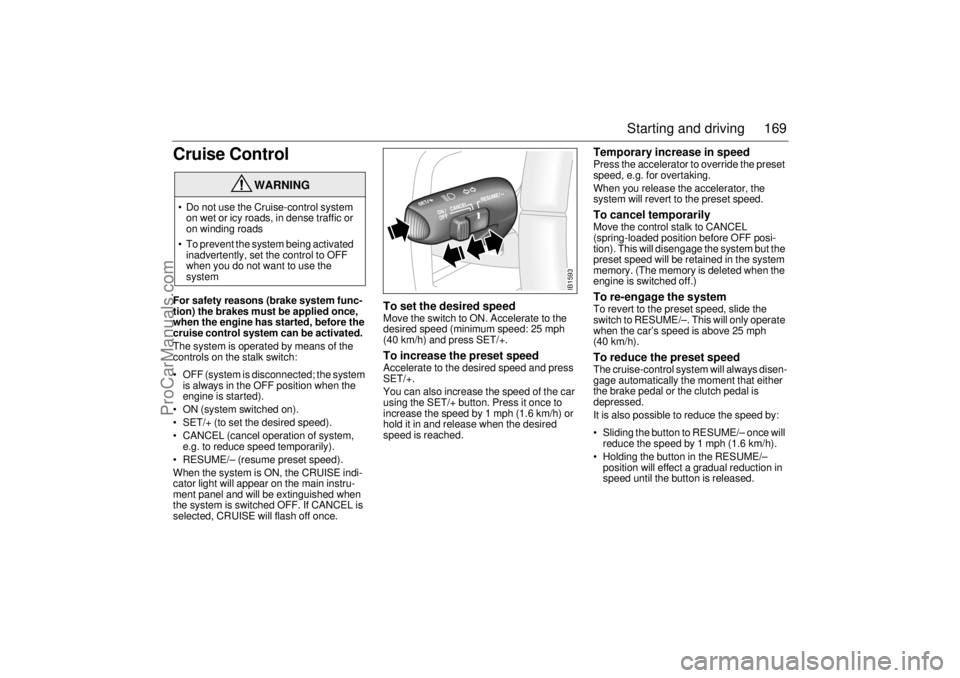
Cruise ControlFor safety reasons (brake system func-
tion) the brakes must be applied once,
when the engine has started, before the
cruise control system can be activated.
The system is operated by means of the
controls on the stalk switch:
OFF (system is disconnected; the system
is always in the OFF position when the
engine is started).
ON (system switched on).
SET/+ (to set the desired speed).
CANCEL (cancel operation of system,
e.g. to reduce speed temporarily).
RESUME/– (resume preset speed).
When the system is ON, the CRUISE indi-
cator light will appear on the main instru-
ment panel and will be extinguished when
the system is switched OFF. If CANCEL is
selected, CRUISE will flash off once.
To set the desired speed Move the switch to ON. Accelerate to the
desired speed (minimum speed: 25 mph
(40 km/h) and press SET/+. To increase the preset speed Accelerate to the desired speed and press
SET/+.
You can also increase the speed of the car
using the SET/+ button. Press it once to
increase the speed by 1 mph (1.6 km/h) or
hold it in and release when the desired
speed is reached.
Temporary increase in speed Press the accelerator to override the preset
speed, e.g. for overtaking.
When you release the accelerator, the
system will revert to the preset speed. To cancel temporarily Move the control stalk to CANCEL
(spring-loaded position before OFF posi-
tion). This will disengage the system but the
preset speed will be retained in the system
memory. (The memory is deleted when the
engine is switched off.) To re-engage the system To revert to the preset speed, slide the
switch to RESUME/–. This will only operate
when the car’s speed is above 25 mph
(40 km/h). To reduce the preset speedThe cruise-control system will always disen-
gage automatically the moment that either
the brake pedal or the clutch pedal is
depressed.
It is also possible to reduce the speed by:
Sliding the button to RESUME/– once will
reduce the speed by 1 mph (1.6 km/h).
Holding the button in the RESUME/–
position will effect a gradual reduction in
speed until the button is released.
WARNING
Do not use the Cruise-control system
on wet or icy roads, in dense traffic or
on winding roads
To prevent the system being activated
inadvertently, set the control to OFF
when you do not want to use the
system
IB1593
ProCarManuals.com