ABS SAAB 9-3 2002 User Guide
[x] Cancel search | Manufacturer: SAAB, Model Year: 2002, Model line: 9-3, Model: SAAB 9-3 2002Pages: 256, PDF Size: 11.55 MB
Page 165 of 256
165 Starting and driving
ABS brakes ABS (Antilock Braking System) modulates
the brake pressure to the respective
wheels. Wheel sensors detect if a wheel is
about to lock, and the control module
reduces the pressure to that wheel and then
increases it once more until the tendency is
detected again.
The brake system is equipped with an Elec-
tronic Brake-force Distribution device
(EBD), which distributes the brake pressure
between the front and rear wheels in such a
way as to achieve optimum braking per-
formance irrespective of the car’s speed
and load.
The ABS system has a built-in diagnostic
function which will switch on the ABS warn-
ing light if a fault is detected in the system
(see page 62). The ABS system will not reduce the braking
distance on loose gravel or on snow or ice
but, because the wheels cannot lock up,
some steering control is retained.
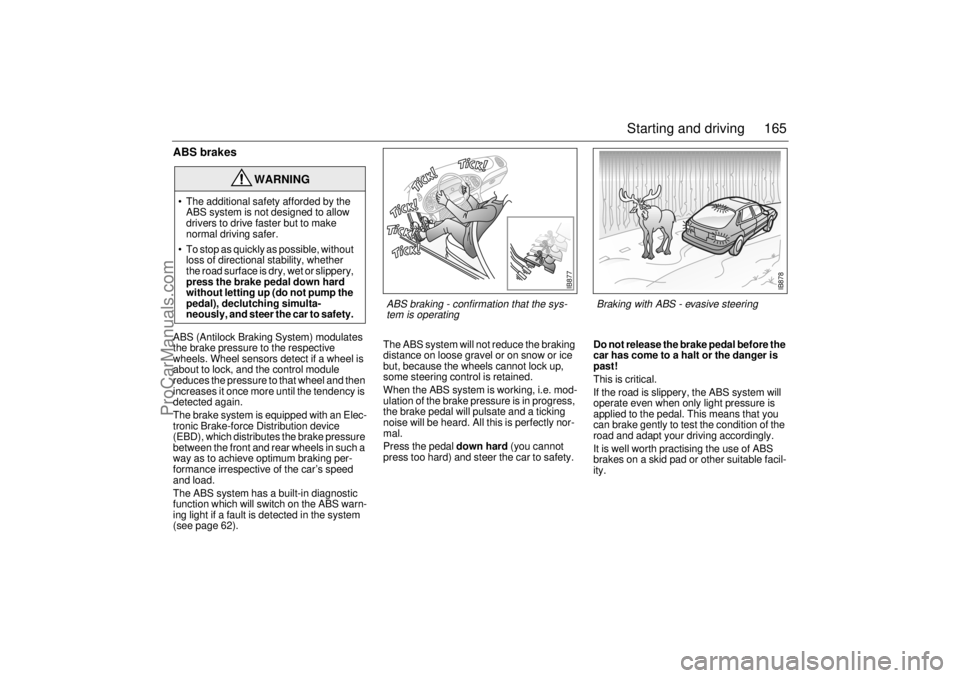
When the ABS system is working, i.e. mod-
ulation of the brake pressure is in progress,
the brake pedal will pulsate and a ticking
noise will be heard. All this is perfectly nor-
mal.
Press the pedal down hard (you cannot
press too hard) and steer the car to safety. Do not release the brake pedal before the
car has come to a halt or the danger is
past!
This is critical.
If the road is slippery, the ABS system will
operate even when only light pressure is
applied to the pedal. This means that you
can brake gently to test the condition of the
road and adapt your driving accordingly.
It is well worth practising the use of ABS
brakes on a skid pad or other suitable facil-
ity.
WARNING
The additional safety afforded by the
ABS system is not designed to allow
drivers to drive faster but to make
normal driving safer.
To stop as quickly as possible, without
loss of directional stability, whether
the road surface is dry, wet or slippery,
press the brake pedal down hard
without letting up (do not pump the
pedal), declutching simulta-
neously, and steer the car to safety.
IB877
ABS braking - confirmation that the sys-
tem is operating
IB878
Braking with ABS - evasive steering
ProCarManuals.com
Page 166 of 256
166 Starting and drivingTraction Control SystemHow the system works The traction control system (TCS) is
designed to minimize wheelspin. This
enables the car to achieve the best possible
grip and, hence, maximum tractive effort,
together with greater stability.
The TCS system uses information from the
ABS system’s wheel sensors to detect
when the front (driving) wheels are rotating
faster then the rear wheels. It then monitors
whether one driving wheel is rotating faster
than the other. If so, the faster wheel is
retarded until both wheels are rotating at the
same speed.
If the two front wheels are rotating at the
same speed but are turning faster than the
rear wheels, the torque from the engine is
reduced to eliminate the difference.
The process continues until all the wheels
are rotating at the same speed. The advantages of the TCS system become
most apparent when the cohesion between
the front wheels and the road surface is so
low that one or both of the wheels would
lose their grip were the car not equipped
with the TCS, e.g.:
When the car is pulling away or accelerat-
ing with the front wheels on different sur-
faces (e.g. one slippery and one dry). The
TCS then functions like an electronic dif-
ferential lock.
When the car is pulling away or accelerat-
ing on a slippery road, in which case the
TCS eliminates wheelspin. The same
applies when the car is reversing.
On cornering, if there is a tendency for the
inner front wheel to rotate faster than the
other wheels.
On overtaking.
TCS OFF The indicator on the main instrument
panel will come on:
If a fault has been detected and the
system has therefore been switched off.
If there is a fault in the ABS system.
If the system has been switched off man-
ually.
The indicator light will also come on for
4 seconds when the ignition key is turned to
ON, while an internal system check is per-
formed. TCS indicator The in the tachometer comes on when
the system is operative, i.e. when the
wheels are not rotating at the same speed.
The fact that the TCS system is operative
indicates that the limit for grip has been
exceeded and that the driver must exert
greater care.
WARNING
When driving normally, the TCS helps to
imrove the safety of the car. This does
not mean that car can be driven faster.
The same care and prudence normally
applied should be displayed on corner-
ing and when driving on slippery roads.
ProCarManuals.com
Page 167 of 256
167 Starting and driving
Turning the TCS off The is switched on automatically when
the engine is started.
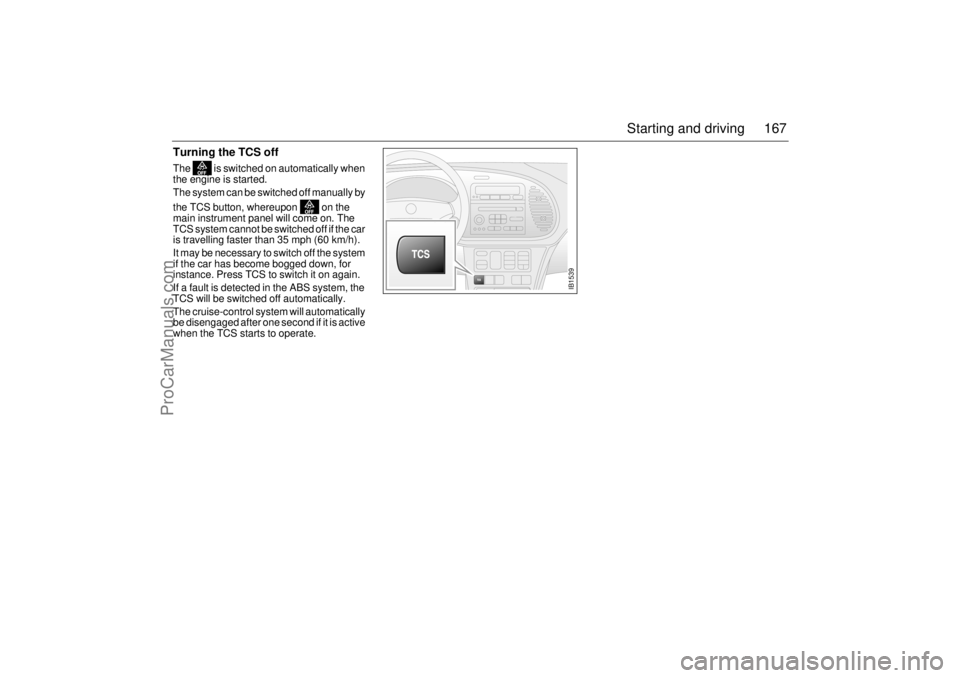
The system can be switched off manually by
the TCS button, whereupon on the
main instrument panel will come on. The
TCS system cannot be switched off if the car
is travelling faster than 35 mph (60 km/h).
It may be necessary to switch off the system
if the car has become bogged down, for
instance. Press TCS to switch it on again.
If a fault is detected in the ABS system, the
TCS will be switched off automatically.
The cruise-control system will automatically
be disengaged after one second if it is active
when the TCS starts to operate.
IB1539
ProCarManuals.com
Page 189 of 256

189 Car care
Saab Trionic engine management
systemThe Saab Trionic engine management
system is a unique Saab development that
combines sequential multiport fuel injection,
electronic distributorless ignition and turbo-
charger boost pressure control into one sys-
tem.
The Trionic engine control module (ECM)
monitors many different engine parameters
such as:
Intake manifold pressure.
Intake air temperature.
Crankshaft position.
Engine coolant temperature.
Throttle position.
The oxygen content of the exhaust gases.
The ECM receives information regarding
engine knocking from a sophisticated feed-
back function in the ignition discharge unit.
By processing all of this information, the Tri-
onic system can control fuel injector open-
ing duration, ignition timing and turbo-
charger boost pressure to provide excellent
engine performance while maintaining low
emissions and fuel consumption.
ORVR (Onboard Refueling Vapor
Recovery)All hydrocarbons formed when refueling will
be recovered by the car and not released
into the atmosphere. The hydrocarbons are
absorbed in an evaporative emission canis-
ter. When the engine is subsequently
started, the evaporative emission canister is
gradually purged as air is sucked into it
through a shut-off valve. The hydrocar-
bon/air mixture passes through the evap
canister purge valve and into the engine
where it is burned. "Refueling", see page
151.
When refueling, make sure you screw the
filler cap on and keep turning until it has
clicked at least 3 times. Otherwise, it is pos-
sible for the CHECK ENGINE light to illumi-
nate and a TIGHTEN FUEL FILLER CAP
message to appear on SID.
NOTEThe Trionic engine management system
continuously monitors the operation of
these systems and has on-board diag-
nostic capabilities (OBD II). If the CHECK
ENGINE light in the main instrument illu-
minates, the Trionic ECM has detected a
problem. The car will continue to operate,
but performance may be diminished. You
should have your car checked by a Saab
dealer as soon as possible.
ProCarManuals.com
Page 194 of 256
194 Car careBrake- clutch fluid and
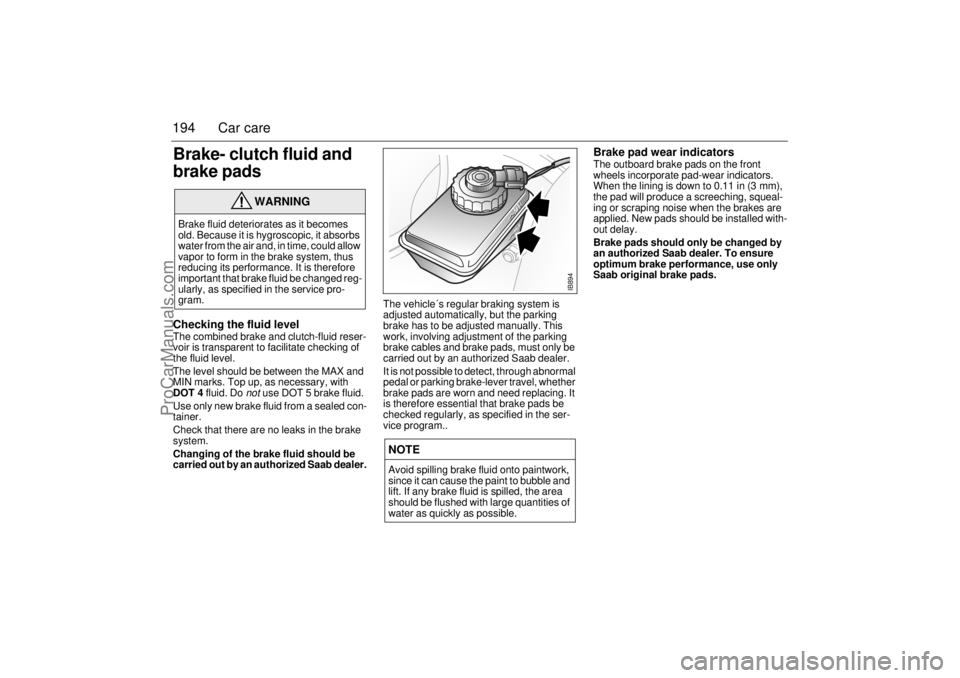
brake padsChecking the fluid level The combined brake and clutch-fluid reser-
voir is transparent to facilitate checking of
the fluid level.
The level should be between the MAX and
MIN marks. Top up, as necessary, with
DOT 4 fluid. Do
not
use DOT 5 brake fluid.
Use only new brake fluid from a sealed con-
tainer.
Check that there are no leaks in the brake
system.
Changing of the brake fluid should be
carried out by an authorized Saab dealer.The vehicle´s regular braking system is
adjusted automatically, but the parking
brake has to be adjusted manually. This
work, involving adjustment of the parking
brake cables and brake pads, must only be
carried out by an authorized Saab dealer.
It is not possible to detect, through abnormal
pedal or parking brake-lever travel, whether
brake pads are worn and need replacing. It
is therefore essential that brake pads be
checked regularly, as specified in the ser-
vice program..
Brake pad wear indicators The outboard brake pads on the front
wheels incorporate pad-wear indicators.
When the lining is down to 0.11 in (3 mm),
the pad will produce a screeching, squeal-
ing or scraping noise when the brakes are
applied. New pads should be installed with-
out delay.
Brake pads should only be changed by
an authorized Saab dealer. To ensure
optimum brake performance, use only
Saab original brake pads.
WARNING
Brake fluid deteriorates as it becomes
old. Because it is hygroscopic, it absorbs
water from the air and, in time, could allow
vapor to form in the brake system, thus
reducing its performance. It is therefore
important that brake fluid be changed reg-
ularly, as specified in the service pro-
gram.
NOTEAvoid spilling brake fluid onto paintwork,
since it can cause the paint to bubble and
lift. If any brake fluid is spilled, the area
should be flushed with large quantities of
water as quickly as possible.
IB894
ProCarManuals.com
Page 201 of 256
201 Car care
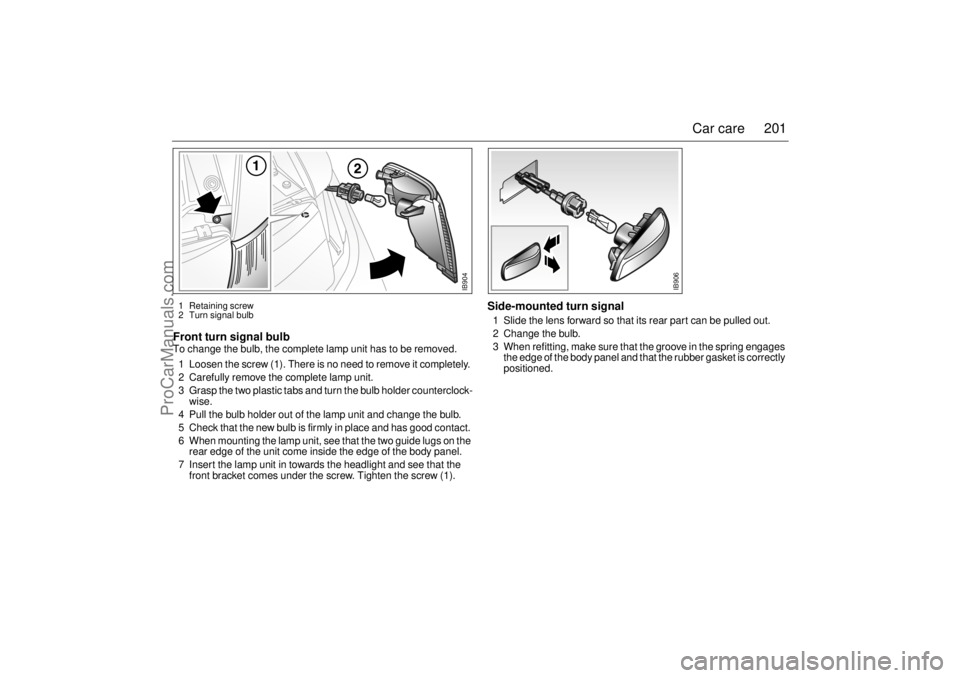
Front turn signal bulb To change the bulb, the complete lamp unit has to be removed.
1 Loosen the screw (1). There is no need to remove it completely.
2 Carefully remove the complete lamp unit.
3 Grasp the two plastic tabs and turn the bulb holder counterclock-
wise.
4 Pull the bulb holder out of the lamp unit and change the bulb.
5 Check that the new bulb is firmly in place and has good contact.
6 When mounting the lamp unit, see that the two guide lugs on the
rear edge of the unit come inside the edge of the body panel.
7 Insert the lamp unit in towards the headlight and see that the
front bracket comes under the screw. Tighten the screw (1).
Side-mounted turn signal1 Slide the lens forward so that its rear part can be pulled out.
2 Change the bulb.
3 When refitting, make sure that the groove in the spring engages
the edge of the body panel and that the rubber gasket is correctly
positioned.
IB904
1 Retaining screw
2 Turn signal bulb
IB906
ProCarManuals.com
Page 208 of 256
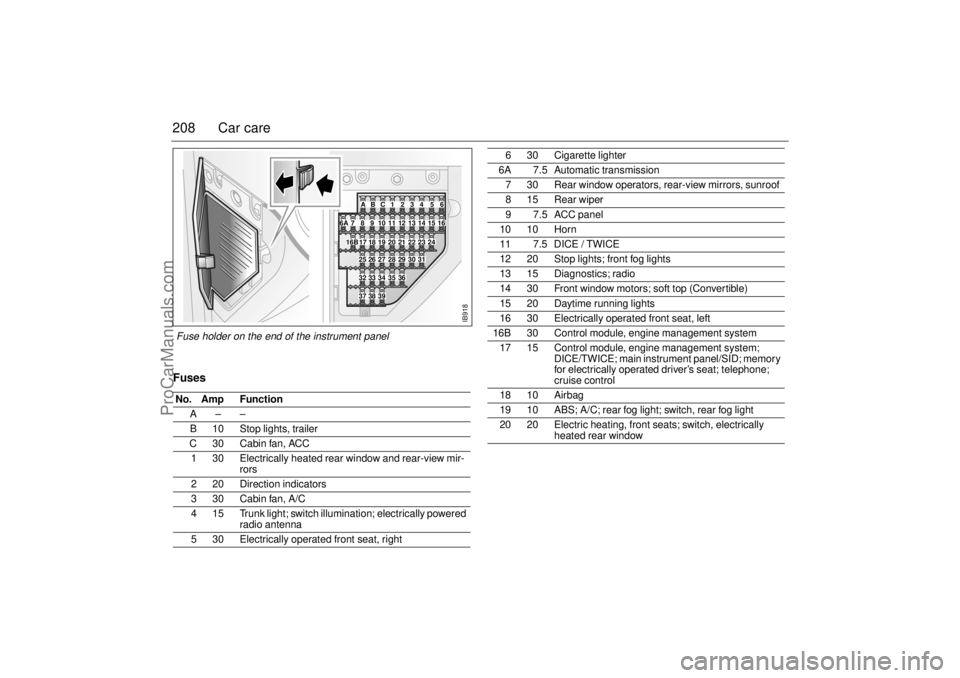
208 Car careFusesNo. Amp Function
A––
B 10 Stop lights, trailer
C 30 Cabin fan, ACC
1 30 Electrically heated rear window and rear-view mir-
rors
220Direction indicators
330Cabin fan, A/C
4 15 Trunk light; switch illumination; electrically powered
radio antenna
5 30 Electrically operated front seat, right
6 30 Cigarette lighter
6A 7.5 Automatic transmission
7 30 Rear window operators, rear-view mirrors, sunroof
8 15 Rear wiper
9 7.5 ACC panel
10 10 Horn
11 7.5 DICE / TWICE
12 20 Stop lights; front fog lights
13 15 Diagnostics; radio
14 30 Front window motors; soft top (Convertible)
15 20 Daytime running lights
16 30 Electrically operated front seat, left
16B 30 Control module, engine management system
17 15 Control module, engine management system;
DICE/TWICE; main instrument panel/SID; memory
for electrically operated driver’s seat; telephone;
cruise control
18 10 Airbag
19 10 ABS; A/C; rear fog light; switch, rear fog light
20 20 Electric heating, front seats; switch, electrically
heated rear window
30 10 20
30 30 15
15 15
10 10 10
10
10
10 30
30 10 20
15
15
15
10 10
20
10 20 20
20 20 15
15
30 15
15 10 15
15
IB918
1 C B A23456
7 6A 8 9 10 11 12 13 14 15 16
17 16B 18 19 20 21 22 23 2425 26 27 28 29 30 3132 33 34 35 3637 38 39
Fuse holder on the end of the instrument panel
ProCarManuals.com
Page 210 of 256
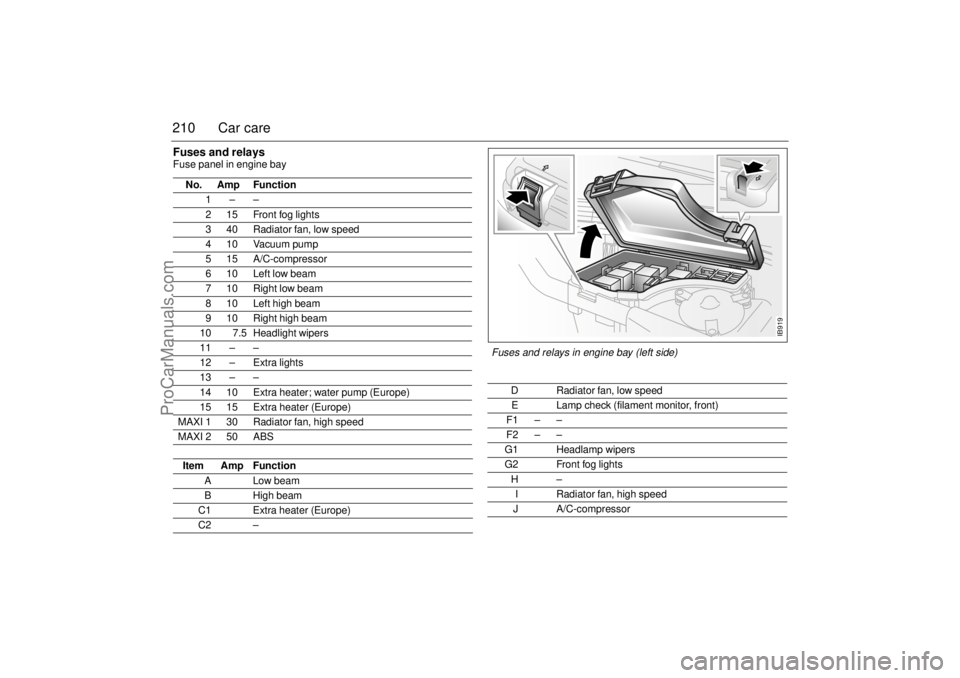
210 Car careFuses and relays Fuse panel in engine bay
No. Amp Function
1––
2 15 Front fog lights
3 40 Radiator fan, low speed
4 10 Vacuum pump
5 15 A/C-compressor
610Left low beam
7 10 Right low beam
8 10 Left high beam
9 10 Right high beam
10 7.5 Headlight wipers
11 – –
12 – Extra lights
13 – –
14 10 Extra heater; water pump (Europe)
15 15 Extra heater (Europe)
MAXI 1 30 Radiator fan, high speed
MAXI 2 50 ABS
Item Amp Function
A Low beam
B High beam
C1 Extra heater (Europe)
C2 –
D Radiator fan, low speed
E Lamp check (filament monitor, front)
F1 – –
F2 – –
G1 Headlamp wipers
G2 Front fog lights
H–
I Radiator fan, high speed
J A/C-compressor
IB919
Fuses and relays in engine bay (left side)
ProCarManuals.com
Page 211 of 256

211 Car care
WheelsAlternative wheels and tiresIf you wish to fit other tires or wheels than
those supplied with the car, consult your
Saab dealer first as to the possibilities avail-
able.
Wheels/tires combinations that are not
approved by Saab can negatively affect the
car´s directional stability, steering and brak-
ing in both wet and dry conditions.
Do not assume that a wheel/tire combina-
tion will function properly just because it will
bolt on.
To ensure that the speedometer is as accu-
rate as possible it should be reprogrammed
if wheels of a different dimension are fitted.
Contact an authorized Saab dealer.
The wheels and tires have been carefully
matched to the characteristics of the car and
play a key role in its outstanding roadhold-
ing and handling.
Tire pressureTires need to be inflated to suit the load car-
ried and the maximum speed the car will be
driven (see the recommended tire pres-
sures on the back cover). Tire pressure
label, see page 243.
Note that all values apply to cold tires. For
tires with an aspect ratio less than /60,
increase the tire pressure by 3 psi (20 kPa)
for rough roads with potholes to minimize
the risk of rim damage.
Never reduce the pressure of a hot tire. If the
tires are hot when you check them, only
increase the pressure, if necessary.
Soft tires will cause faster wear than
over-pressurized tires. They also increase
fuel consumption.
If a valve is leaking, simply unscrew it and fit
a new one.
Important! Remember to adjust the tire
pressures if you change the load in the car
or intend to cruise at a substantially higher
or lower speed than normal.
NOTEFor wide wheels and/or low-profile tires,
bear in mind the following:
Tires and wheels can be damaged in
potholes etc.
Springs, shock absorbers and wheel
bearings and body mountings can be
overloaded.
The wheels can come into contact with
chassis and body components.
The speed and load limits for the tires
must not be exceeded; see page 212.
Wheels larger than 17” must not be
fitted on the Saab 9-3. For Viggen
models the wheel should not be larger
than 17”. The maximum permissible
offset for the 9-3 is 49 mm and for the
Viggen 42 mm.
Wheels smaller than 16” must not be
fitted on Viggen models. Fitting a
smaller size wheel on a Viggen is not
possible due to the size of the brake
discs.
NOTECheck the tire pressures at least once
per month.
Underinflation is the main cause of:
Tires wearing out prematurely.
Damage to the sidewalls.
Damage to the wheels.
ProCarManuals.com
Page 219 of 256

219 Car care
Upholstery and trimTo remove fluff or hairs from the seat uphol-
stery or headlining, use a moist, lint-free
cloth or a special lint remover (brush or
roller). Remove any dirty marks using a
cloth moistened with lukewarm soapy
water.
When using a stain remover, always work
from the outside towards the center to avoid
leaving a ring. If a soiled ring or spot should
remain, it can usually be removed using
lukewarm soapy water or water alone.
Wet patches left by spilled soft drinks or thin
oil must be wiped off immediately using an
absorbent material, such as paper toweling,
and treated with stain remover.
Isopropyl alcohol is recommended for
removing grease or oil stains, and a
semi-stiff brush may also be used.
Cleaning and caring for leather
upholsteryThe principal reason for treating leather
upholstery is to maintain its elegant appear-
ance and to provide it with a protective film.
Discoloration caused by dust and wear
mainly affects the lighter shades, although
this is not detrimental to the leather –
indeed, the patina resulting from use is often
considered desirable in leather. But if the
leather is allowed to become too grubby, it
can start to look shabby.
The leather upholstery should be cleaned
and reconditioned twice a year in conjunc-
tion with spring and autumn inspections. In
very warm, dry climates the leather may
need more regular reconditioning. Recom-
mended conditioner - Saab Leather Care
Lotion.
Do not use unknown harsh polishing
agents, cleaning agents, sprays, coarse
soap or hot water.
The leather will be clean and attractive for
many years.
Textile carpetingVacuum clean the carpeting regularly. Car-
pets can also be cleaned using a brush, or
carpet shampoo applied with a sponge. Do
not use vacuum cleaners outdoors unless
they are properly grounded.
ProCarManuals.com