key battery SAAB 9-3 2002 User Guide
[x] Cancel search | Manufacturer: SAAB, Model Year: 2002, Model line: 9-3, Model: SAAB 9-3 2002Pages: 256, PDF Size: 11.55 MB
Page 133 of 256
133 Interior equipment, trunk
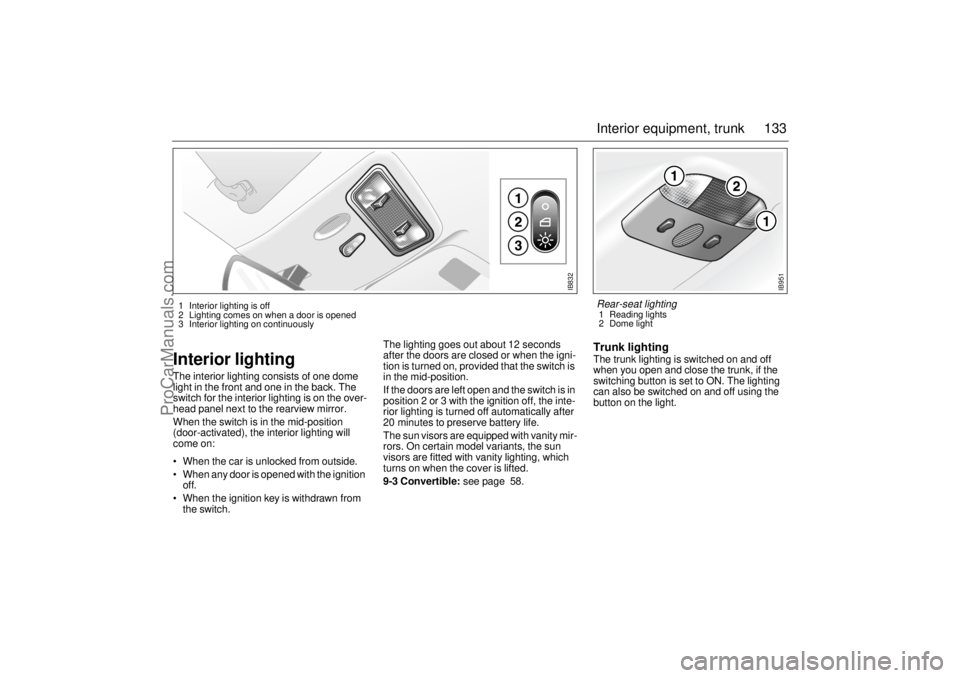
Interior lightingThe interior lighting consists of one dome
light in the front and one in the back. The
switch for the interior lighting is on the over-
head panel next to the rearview mirror.
When the switch is in the mid-position
(door-activated), the interior lighting will
come on:
When the car is unlocked from outside.
When any door is opened with the ignition
off.
When the ignition key is withdrawn from
the switch.The lighting goes out about 12 seconds
after the doors are closed or when the igni-
tion is turned on, provided that the switch is
in the mid-position.
If the doors are left open and the switch is in
position 2 or 3 with the ignition off, the inte-
rior lighting is turned off automatically after
20 minutes to preserve battery life.
The sun visors are equipped with vanity mir-
rors. On certain model variants, the sun
visors are fitted with vanity lighting, which
turns on when the cover is lifted.
9-3 Convertible: see page 58.
Trunk lightingThe trunk lighting is switched on and off
when you open and close the trunk, if the
switching button is set to ON. The lighting
can also be switched on and off using the
button on the light.
IB832
1 Interior lighting is off
2 Lighting comes on when a door is opened
3 Interior lighting on continuously
IB951
Rear-seat lighting 1 Reading lights
2 Dome light
ProCarManuals.com
Page 147 of 256
147 Starting and driving
If the car does not startIf the text "KEY NOT ACCEPTED" appears
on the SID when the engine refuses to start,
the trouble may be a fault in the transponder
of the key or in the receiver of the ignition
switch. Proceed as follows:
• Turn the key back to the LOCK position.
Turn the key to the ON position.
Press one of the buttons on the remote
control (the LED on top of the dash stops
flashing).
Start the engine.
Try the other key. If it works, the trouble is in
the first key.
Call on an authorized Saab dealer for
inspection and correction.
Starting the engine
Do not run the starter motor for more than
25 seconds at a time. Wait 20-30 seconds
before running the starter again, to give the
battery time to recover.
Avoid racing the engine or putting a heavy
load on it before it has warmed up. Let the
engine idle for at least 10 seconds and then
drive away as long as the engine oil warning
light has gone out to enable the engine to
attain its normal temperature as quickly as
possible.
It is possible for air to enter the lubricating
system in conjunction with an oil or oil-filter
change, or if the car has been stored for
some time. This air can cause the hydraulic
cam followers to emit a ticking noise, which
can persist for up to 15 minutes after start-
ing. Although this is quite normal and does
not indicate any malfunction, it is advisable
not to exceed 3,000 rpm before the noise
has disappeared.
The hydraulic cam lifters are completely
service free; the valve clearance is set up at
the factory and will not need any subse-
quent adjustment.
WARNING
Always remove the key before leaving
the car.
Always apply the parking brake before
removing the ignition key.NOTETake care not to spill drinks or to drop
crumbs over the ignition switch. If dirt or
liquid gets into it, the switch may not
operate properly.
WARNING
When starting the engine:
– Sit down in the driver’s seat.
– Depress the clutch pedal fully. If the
gear lever is not in the neutral posi-
tion, the clutch pedal must be fully
depressed or the car will jump
forwards or backwards, which may
cause a crash.
– Never start the car from outside the
vehicle, e.g. through a lowered
window. This could lead to serious
personal injury.
Engage reverse (R) (position P for
automatic transmission) to remove the
ignition key. The key can only be
removed in this gear position.
Carbon monoxide (CO) is a colorless,
odorless, poisonous gas. Be alert to
the danger of CO – always open the
garage doors before starting the
engine in the garage.
There is also a danger of CO poison-
ing if the exhaust system is leaking.
Do not rest or sleep in the car when
parked with the engine running. There
is a risk of depressing the accelerator
which could lead to engine damage.
ProCarManuals.com
Page 158 of 256
158 Starting and drivingLock-up functionThe automatic transmission has a lock-up
function, which renders the torque con-
verter inoperative in 3rd and 4th gears. The
result is reduction in the engine speed and,
hence, fuel consumption.
When the lock-up function comes into oper-
ation, it may give the impression of an over-
drive being engaged.Kick-downWhen the accelerator is pressed down hard,
a downshift to the next lower gear will occur
to provide maximum acceleration, e.g. for
overtaking.
The change-up to the next gear again will
take place either when the accelerator is
released or when maximum engine speed
for that gear is reached.
Park Brake Shift LockThe transmission has a safety function
called Park Brake Shift Lock. For the selec-
tor lever to be moved out of the P position,
the brake pedal must be depressed at the
same time as the detent button is lifted.
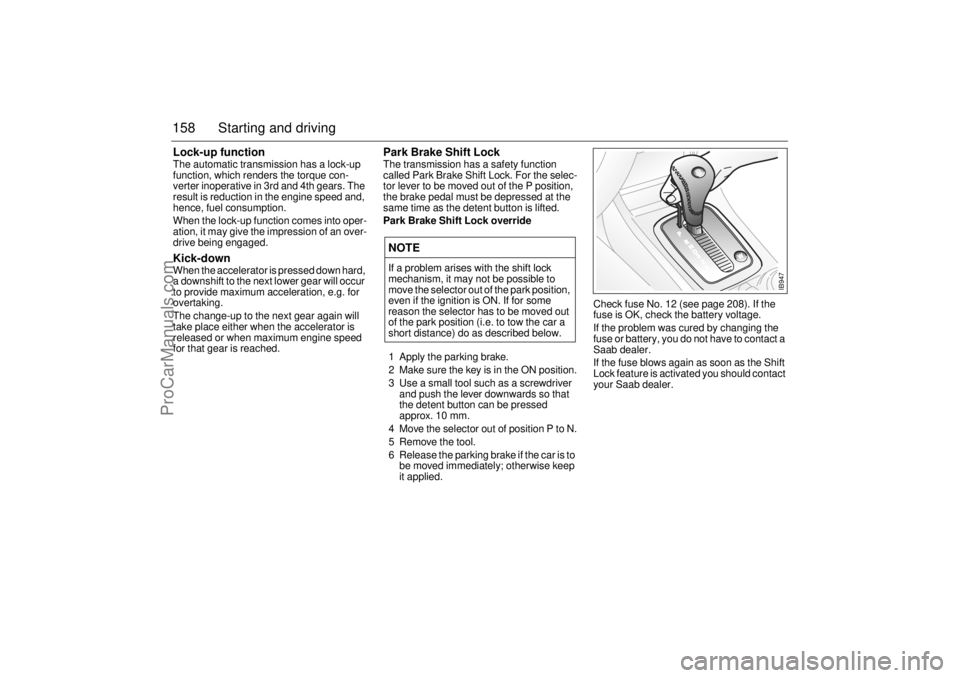
Park Brake Shift Lock override
1 Apply the parking brake.
2 Make sure the key is in the ON position.
3 Use a small tool such as a screwdriver
and push the lever downwards so that
the detent button can be pressed
approx. 10 mm.
4 Move the selector out of position P to N.
5 Remove the tool.
6 Release the parking brake if the car is to
be moved immediately; otherwise keep
it applied.Check fuse No. 12 (see page 208). If the
fuse is OK, check the battery voltage.
If the problem was cured by changing the
fuse or battery, you do not have to contact a
Saab dealer.
If the fuse blows again as soon as the Shift
Lock feature is activated you should contact
your Saab dealer.NOTEIf a problem arises with the shift lock
mechanism, it may not be possible to
move the selector out of the park position,
even if the ignition is ON. If for some
reason the selector has to be moved out
of the park position (i.e. to tow the car a
short distance) do as described below.
IB947
ProCarManuals.com
Page 184 of 256
184 Starting and drivingDriving considerations
with compact spare
wheel/tire fitted The following should be observed when the
compact spare wheel (T115/70 R16) is
installed:
The compact spare is light and easy to
handle when changing the wheel. Do not
drive farther than necessary with the com-
pact spare fitted – the maximum life of the
wheel is only just over 2000 miles
(3,500 km). Have the standard wheel
repaired and reinstalled as soon as possi-
ble.Points to bear in mind when driving with a
compact spare wheel:
The car’s ground clearance is reduced
with the compact spare fitted.
Only one compact spare wheel may be
used at any time.
Take care not to hit the curb.
Do not fit snow chains.
Leave the wheel cover off, so that the
warning text is readily visible.
For long tripsBefore starting off on a long journey, it is
advisable to have your car inspected by
your Saab dealer.
Obtain a few important items to take along
on your journey such as spare bulbs, wiper
blades, fuses, a Poly-V belt and the like.
You can check some points yourself before-
hand:
Make sure that the engine is in good con-
dition.
Check that no oil or fuel leaks out of the
engine or gearbox/transmission.
Check the coolant and power steering
fluid levels. Check also for leaks.
Inspect the Poly-V belt and replace it if it
shows any signs of wear.
Check the battery charge.
Check the tires for tread pattern and air
pressure, including the compact spare
wheel.
Take an extra car key/remote control and
keep it separate, see also page 36.
Check the brakes.
Check all bulbs.
Check for the presence of the tool kit and
the jack in the car.
WARNING
Do not exceed 50 mph (80 km/h) as the
tire can overheat and adversely affect the
handling of the car.
The tire should be inflated to 60 psi
(420 kPa).
NOTETo avoid damaging a punctured alloy
wheel this can be placed outside up in the
spare-wheel well but only while driving to
the closest dealer.
A general rule is that all heavy loads must
be well secured in the luggage compart-
ment, see page 142.
ProCarManuals.com
Page 247 of 256

247 Index
IndexAA/C system, fault diagnosis
________ 226
A/C system, maintenance _________ 226
ACC
__________________________ 84
ACC, useful tips
_________________ 92
Adjustment, steering wheel
________ 131
Air conditioning (A/C), fault diagnosis
and maintenance
______________ 226
Airbag
_________________________ 28
Alarm __________________________ 41
Alarm functions
__________________ 44
Alarm signals
___________________ 44
Anti-corrosion treatment
__________ 222
Anti-theft system
_________________ 41
Ashtray
_______________________ 135
Audio System
___________________ 93
Automatic climate control (ACC)
_____ 84
Automatic transmission
___________ 156
BBattery
________________________ 195
Boost starting from donor battery
___ 181
Brake fluid, check
_______________ 194
Brake fluid, grade _______________ 241
Brake pad wear indicators
___ 164
, 194
Brakes
________________________ 164Braking
_______________________164
Bulb table _____________________205
CCD changer
____________________102
CD player
_____________________100
CHECK messages
_______________72
CHECKING
_____________________72
Cabin lighting __________________133
Calibration, ACC _________________90
Car alarm
______________________41
Care of safety belts
______________218
Central locking
__________________36
Change of address notification
_____232
Changing a wheel
_______________215
Changing bulbs
_________________200
Changing the engine oil
__________190
Changing the key battery __________39
Changing the wheels round _______212
Changing wiper blades
___________198
Chassis number
________________243
Child car seats
__________________19
Child safety
_____________________19
Child safety locks, rear doors
_______39
Child seats
_____________________19
Cigar lighter ____________________135
Cleaning the soft top, Convertible
____57
Climate-control system, manual
_____80
Compact spare wheel
____________214
Condensation water, A/C __________82Condensation water, ACC
_________ 85
Convertible
____________________ 47
Coolant
______________________ 192
Courtesy Headlight Feature
_______ 76
Cruise Control
_________________ 163
Cup holder
____________________ 134
DDICE/TWICE
__________________ 207
Date code, tires ________________ 214
Dim low beam
__________________ 75
Dimmer
_______________________ 78
Direction indicators
______________ 76
Direction-indicator stalk
___________ 76
Dome lighting
_________________ 133
Door mirrors
__________________ 137
Drive belt
_____________________ 197
Driving in deep water
____________ 179
Driving in hot weather ___________ 173
Driving technique
_______________ 170
Driving with a compact spare wheel
184
Driving with a load
______________ 178
Driving with a roof load
__________ 176
Driving with the trunk lid open
_____ 179
EEconomical motoring
____________ 170
Electrical system, technical data
___ 240
Electrical window
_______________ 130
ProCarManuals.com
Page 249 of 256

249 Index
MMain beam
_____________________ 75
Main instrument panel
_____________ 60
Maintenance schedule ___________ 230
Manual climate-control system
______ 80
Manual raising of the soft top,
Convertible
____________________ 52
Manual transmission
_____________ 155
Manually opening the fuel filler door,
Convertible
____________________ 58
Manually opening the fuel filler door,
Coupé and 5-door
______________ 144
Maxi fuses
_____________________ 207
Memory, driver’s seat
____________ 128
Motoring abroad
________________ 184
NNight Panel
_____________________ 73
OORVR
________________________ 189
Odometer ______________________ 66
Oil specification
_________________ 237
OnStar
________________________ 111
Opening handle
__________________ 36
Owner assistance _______________ 231
PPaint touch-up
__________________221
Parcel shelf
____________________141
Park Brake Shift Lock
____________158
Parking brake
__________________168
Parking lights ____________________75
Plates and labels
________________243
Power steering fluid, check
________195
Power steering oil, grade
_________241
Pressure gauge
__________________67
Programmable driver’s seat
_______128
Programming, ACC
_______________90
RRadio
__________________________98
Raising the soft top, Convertible
_____51
Rear fog light
____________________77
Rear seat
______________________138
Rear seat, tipping
_______________138
Rearview mirrors ________________137
Rear-window wiper _______________79
Recirculation
____________________82
Recycling
______________________224
Refuelling _____________________151
Relay table ____________________209
Release handle, hood
____________186
Remote control
__________________36
Remote control battery, changing
____39
Removing the key
_______________146
Reporting safety defects
__________232Rev counter
____________________ 66
Reversing lights
_________________ 77
Roof rack
_____________________ 176
Rotating the tires
_______________ 212
Running-in
____________________ 155
SSAHR, head restraint
____________ 18
SID (Side Instrument Display)
______ 69
SRS (airbag)
___________________ 28
Saab Audio System
______________ 93
Saab Trionic engine management
system
______________________ 189
Safety belts ____________________ 12
Safety belts, care of
_____________ 218
Seat belts
_____________________ 12
Seat-belt pretensioners
___________ 13
Seats
________________________ 124
Service costs
__________________ 231
Service information
_____________ 232
Service intervals
_______________ 230
Service record retention
_________ 231
Side airbags
___________________ 30
Ski hatch
_____________________ 141
Snow tires ____________________ 242
Soft top storage, Convertible
_______ 56
Spare wheel
__________________ 143
Speedometer ___________________ 66
Starting the engine
_____________ 147
Steering-wheel adjustment
_______ 131
ProCarManuals.com