instrument panel SAAB 9-3 2002 Owner's Manual
[x] Cancel search | Manufacturer: SAAB, Model Year: 2002, Model line: 9-3, Model: SAAB 9-3 2002Pages: 256, PDF Size: 11.55 MB
Page 89 of 256
89 Instruments and controls
Starting in cold weather: The automatic
climate control system selects the defroster
position, max. heating and low fan speed to
begin with.
As the engine temperature rises, the fan
speed is increased and air is routed towards
the floor.
As the temperature inside the car nears the
selected value, both the fan speed and the
heat will be decreased to a level determined
by the system.
Starting in hot weather: The automatic cli-
mate control system selects air to the panel
vents and high fan speed. Recirculation is
switched on about 30 seconds after starting
if the selected cabin temperature is mark-
edly lower than the actual temperature.
Unless the ECON button has been
depressed, the A/C compressor is always
switched on at outside temperatures above
32°F (0°C) in order to cool and dehumidify
the incoming air, unless the ECON button
has been depressed.
As the temperature inside the car nears the
selected value, the fan speed will be
decreased to a value determined by the
system.
Action to be taken in special types of
weather Normally, misting and icing problems on the
windows do not occur other than in extreme
situations, e.g. when you are driving in
heavy rain or severe cold in combination
with high air humidity or when those travel-
ling in the car are sweaty and wet. If you
have trouble with misting or icing in such
cases we suggest the following counter-
measures:
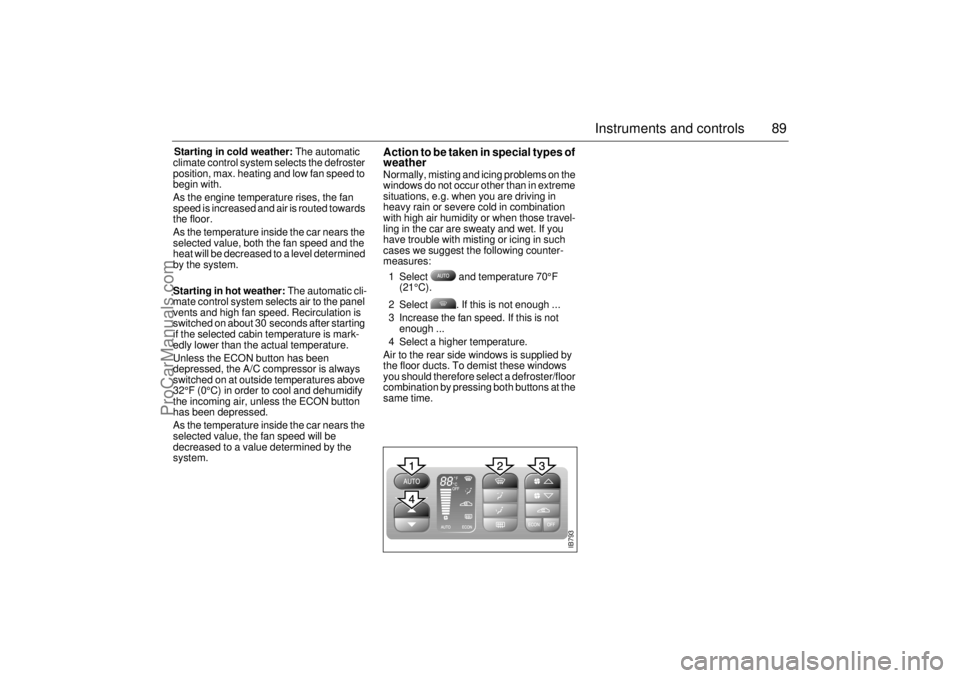
1 Select and temperature 70°F
(21°C).
2 Select . If this is not enough ...
3 Increase the fan speed. If this is not
enough ...
4 Select a higher temperature.
Air to the rear side windows is supplied by
the floor ducts. To demist these windows
you should therefore select a defroster/floor
combination by pressing both buttons at the
same time.
IB793
ProCarManuals.com
Page 92 of 256
92 Instruments and controlsUseful tips: If the ACC system is not functioning
satisfactorily the following should be tried
before you take the car to an authorized
Saab dealer.
If the indication AUTO does not light up
after starting (the ignition must have been
switched off for at least 10 minutes): See
“Cancelling program I”, page 90.
If you think that the ACC system is not
functioning satisfactorily you should:
1 Check that the cigarette lighter plug is in
its socket (since if the socket is empty
heated air can flow out and affect the
cabin sensor).
2 Recalibrate: See the section headed
Calibration, page 90.
If the battery has been disconnected or
has died, the ACC system should be reca-
librated: See Calibration, pag 90.
Programmed settings are not deleted if the
battery has been disconnected. Extinguishing the lighting in ACC See section Night panel, page 73.
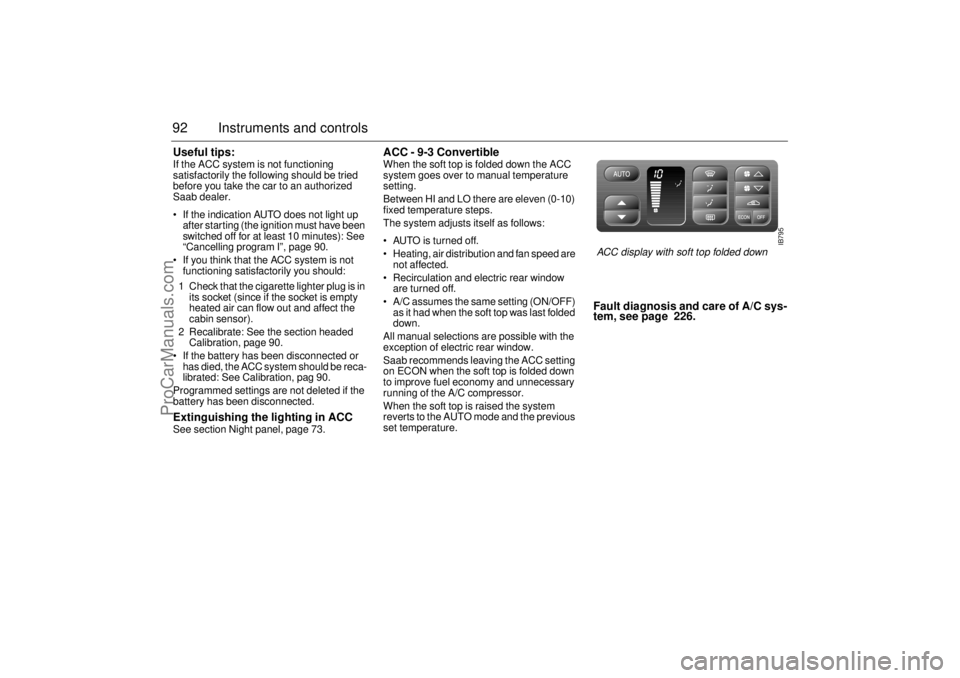
ACC - 9-3 Convertible When the soft top is folded down the ACC
system goes over to manual temperature
setting.
Between HI and LO there are eleven (0-10)
fixed temperature steps.
The system adjusts itself as follows:
AUTO is turned off.
Heating, air distribution and fan speed are
not affected.
Recirculation and electric rear window
are turned off.
A/C assumes the same setting (ON/OFF)
as it had when the soft top was last folded
down.
All manual selections are possible with the
exception of electric rear window.
Saab recommends leaving the ACC setting
on ECON when the soft top is folded down
to improve fuel economy and unnecessary
running of the A/C compressor.
When the soft top is raised the system
reverts to the AUTO mode and the previous
set temperature.
Fault diagnosis and care of A/C sys-
tem, see page 226.
IB795
ACC display with soft top folded down
ProCarManuals.com
Page 94 of 256
94 Saab 9-3 Audio SystemSaab 9-3 Audio SystemThe Saab 9-3 Audio System comes in two
levels, Premium and Prestige. They are
specially adapted to the cabin space in the
Saab 9-3.
The Saab 9-3 Audio System consists of a
main unit with a radio and an in-dash CD
player. There is a also a CD player and a CD
changer for 6 CD discs available as an
accessory.
The Premium Audio System has two loud-
speakers at the front and two at the rear.
Output is 4x20 watts.
The Prestige Audio System 3 has two addi-
tional loudspeakers. They are mounted in
the front doors and reproduce bass tones
below 200 Hz. These subwoofers have their
own amplifier of 2x40 watts. The Audio Systems are interconnected with
SID (Saab Information Display) which is
located above the radio in the instrument
panel. The Audio Systems uses the display
of the SID instrument to show text/charac-
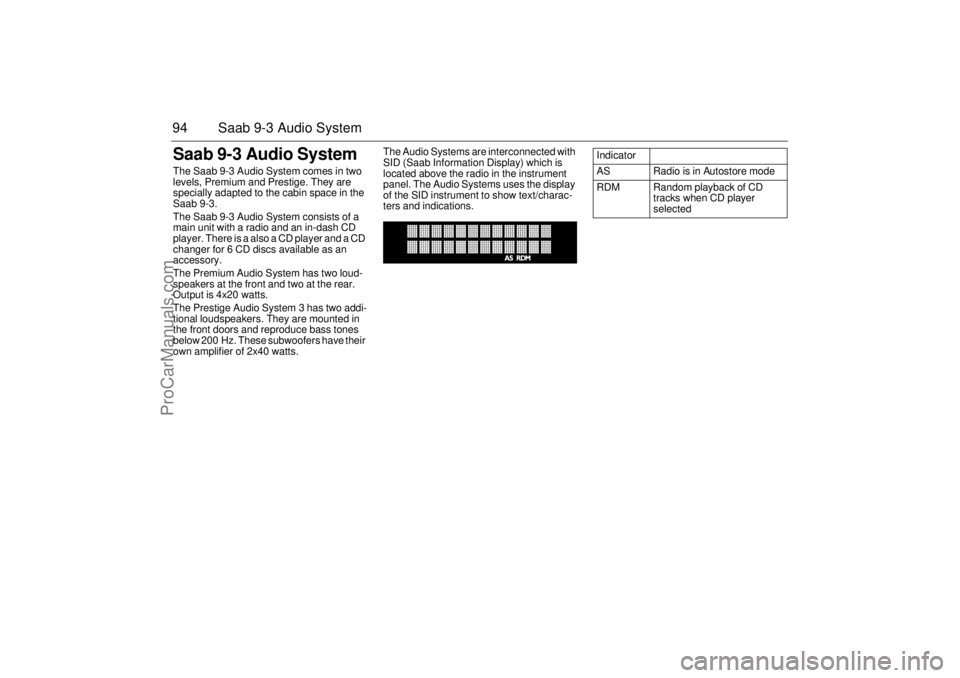
ters and indications.
Indicator
AS Radio is in Autostore mode
RDM Random playback of CD
tracks when CD player
selected
ProCarManuals.com
Page 129 of 256
129 Interior equipment, trunk
Electrically heated front seats
(option on some model vari-
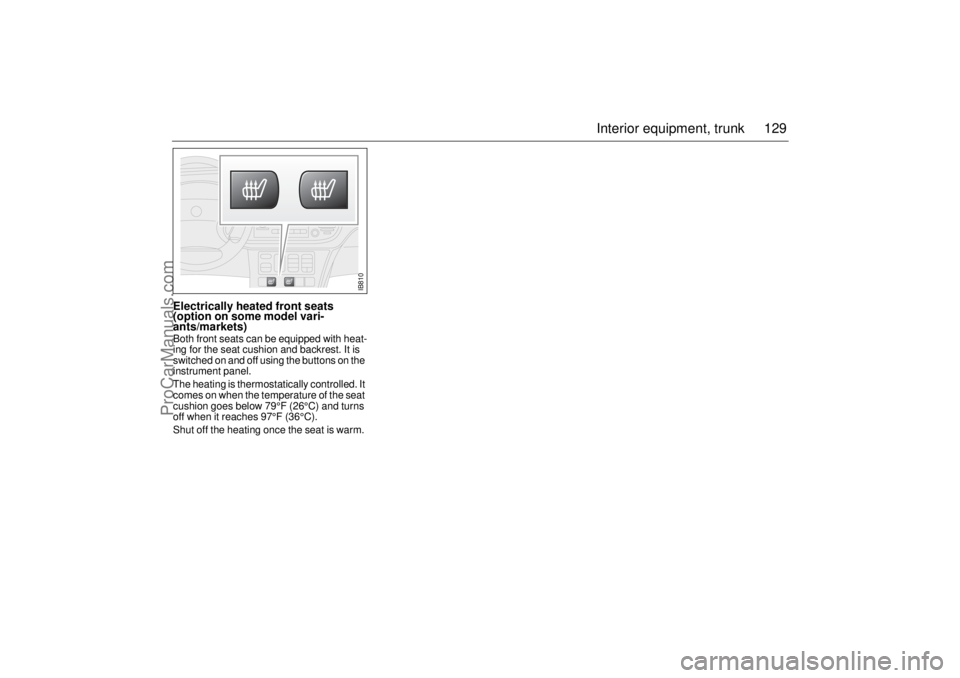
ants/markets)Both front seats can be equipped with heat-
ing for the seat cushion and backrest. It is
switched on and off using the buttons on the
instrument panel.
The heating is thermostatically controlled. It
comes on when the temperature of the seat
cushion goes below 79°F (26°C) and turns
off when it reaches 97°F (36°C).
Shut off the heating once the seat is warm.
IB810
ProCarManuals.com
Page 149 of 256
149 Starting and driving
2 Stopping the engine
Do not rev the engine immediately
before switching it off - stop the engine
when it is idling.
3 Regulating the charging pressure
The system is optimized for fuel with an
octane rating of AON 90. For cars with
205 hp engines and the Viggen, the
system is optimized for AON 93. One of
the advantages of the system is that it
enables the engine to be run safely on
lower-grade fuel, although not lower
than AON 87. However, engine perfor-
mance will fall off slightly, and heavy
loading should be avoided. For best
performance you should use the rec-
ommended grade of fuel, AON 90
(205 hp engine and Viggen AON 93).
The maximum boost pressure is
adjusted automatically to the knocking
or pinging tendency of the engine.
Occasional, short-lived knocking when
the engine is under a heavy load is per-
fectly normal; the extent will depend on
the grade of fuel in the tank.
Isolated instances of knocking are
more likely to occur with low-octane
fuel. This controlled form of knocking,
followed by a reduction in the boost
pressure, is a sign that the wastegate is
functioning and is perfectly safe for the
engine.Saab 9-3 Viggen: The Saab 9-3 Viggen has
a high-performance engine which means
that a certain amount of care should be
exercised, in particular when accelerating in
the lower gears. This is especially important
when the road surface is slippery to avoid
the driving wheels from losing their grip.
Limp-homeThe car’s engine management system has
a diagnostics function that, once the engine
has been switched off, checks a number of
internal functions. If a throttle valve fault is
detected, the engine management system
will initiate limp-home mode for the valve.
This means, for example, that idling speed
regulation will be impaired, the cruise con-
trol system will be inoperative, and the
capacity of the A/C compressor will be lim-
ited.
When starting the car in limp-home mode at
temperatures below 32°F (0°C), depress
the accelerator slightly.
If the diagnosis function detects any faults in
the engine management system, the
“Engine malfunction (CHECK ENGINE)
“ indicator in the main instrument panel
will light up (see page 63). The car should
be checked as soon as possible at an
authorized Saab dealer.
NOTEIf constant knocking occurs every time a
load is put on the engine, this indicates a
malfunction in the system.
Have the car checked without delay by an
authorized Saab dealer. NOTEIf the engine is being run with the car on a
rolling road or dynamometer, longer than
for a standard state emission inspection,
to ensure adequate cooling, air must be
blown into the engine compartment and
under the car at a rate equivalent to the
ram-air effect that would be obtained at
the corresponding road speed.
ProCarManuals.com
Page 153 of 256

153 Starting and driving
Other, less common, fuel additives used by
some gasoline dealers are also acceptable,
provided that the resultant gasoline is not
more than 2.7% oxygen by weight. In many
cases, you may not be able to determine the
exact type or percentage by volume of fuel
additive in the gasoline you purchase for
your car.
Some Canadian and U.S. gasolines contain
an octane enhancing additive called meth-
lycyclopentadienyl manganese tricarbonyl
(MMT). If such fuel is used, your emission
control system performance may deterio-
rate and the malfunction indicator lamp on
your instrument panel may turn on. If this
occurs, return to your authorized Saab
dealer for service.
However, these blended gasolines are reg-
ulated and should never exceed these rec-
ommended blend percentages and service
station operators should know if their gaso-
lines contain detergents and oxygenates,
and have been reformulated to reduce vehi-
cle emissions. Nevertheless, if you begin to
notice a problem with the way your car starts
or runs shortly after it has been refueled, try
a different brand of gasoline.
NOTEHigher concentrations of methanol than
listed above, or the use of methanol-
blended gasoline without suitable
co-solvents and corrosion inhibitors,
can damage your car’s fuel system,
leading to the need for repairs which are
not covered by Saab’s product warranty.
NOTEThe engine control module (ECM) mon-
itoring the engine parameters also
stores fault codes.
Under certain circumstances, this may
cause constant illumination of the
Engine malfunction (CHECK ENGINE)
lamp , thus indicating a fault that
must be checked by your Saab dealer,
see page 63.
NOTE: always observe the following two
measures:
Make sure that the fuel filler cap is
screwed on correctly before the
engine is started. Screw on the fuel
filler cap until you hear three distinct
clicks.
Avoid driving with the fuel low level
indicator illuminated. The symbol
illuminates when less than approxi-
mately 2.5 gallons (10 litres) of fuel
remains in the tank.
ProCarManuals.com
Page 154 of 256

154 Starting and drivingFuel (Gasoline Engine)Use regular unleaded gasoline rated at 87
octane or higher. It is recommended that the
gasoline meet specifications which were
developed by the American Automobile
Manufacturers Association (AAMA) and
endorsed by the Canadian Motor Vehicle
Manufacturers Association for better vehi-
cle performance and engine protection.
Gasolines meeting the AAMA specification
could provide improved driveability and
emission control system performance com-
pared to other gasolines.Canada Only
Be sure the posted octane is at least 87. If
the octane is less than 87, you may get a
heavy knocking noise when you drive. If it’s
bad enough, it can damage your engine. If
you’re using fuel rated at 87 octane or
higher and you hear heavy knocking, your
engine needs service. But don’t worry if you
hear a little pinging noise when you’re accel-
erating or driving up a hill. That’s normal,
and you don’t have to buy a higher octane
fuel to get rid of pinging. It’s the heavy, con-
stant knock that means you have a problem.
If your vehicle is certified to meet California
Emission Standards (indicated on the
underhood emission control label), it is
designed to operate on fuels that meet Cal-
ifornia specifications. If such fuels are not
available in states adopting California emis-
sions standards, your vehicle will operate
satisfactorily on fuels meeting federal spec-
ifications, but emission control system per-
formance may be affected. The malfunction
indicator lamp on your instrument panel
may turn on and/or your vehicle may fail a
smog-check test. See "Malfunction Indica-
tor Lamp" in the Index. If this occurs, return
to your authorized Saab dealer for diagno-
sis to determine the cause of failure. In the
event it is determined that the cause of the
condition is the type of fuels used, repairs
may not be covered by your warranty. Some gasolines that are not reformulated
for low emissions may contain an
octane-enhancing additive called methylcy-
clopentadienyl manganese tricarbonyl
(MMT); ask your service station operator
whether or not the fuel contains MMT. Saab
does not recommend the use of such gaso-
lines. If fuels containing MMT are used,
spark plug life may be reduced and your
emission control system performance may
be affected. The Engine malfunction
(CHECK ENGINE) light on your instrument
panel may turn on. If this occurs, return to
your authorized Saab dealer for service.
In Canada, look for the
"Auto Makers’ Choice" label
on the fuel pump.
ProCarManuals.com
Page 155 of 256
155 Starting and driving
Engine Break-in PeriodPistons, cylinder bores and bearings need
time to obtain uniform, wear-resistant sur-
faces.
If a new engine is driven too hard, this grad-
ual process of bedding-in will not be possi-
ble and the life of the engine will be short-
ened.
During the first 1,200 miles (2,000 km), do
not exceed 5,000 rpm.
In addition, refrain from driving the car at full
throttle, other than for brief instances,
during the first 1,800 miles (3,000 km).Wearing in new brake padsNew brake pads take time to bed in, about
90 miles (150 km) if the car is driven largely
under stop-and-go conditions or about
300 miles (500 km) of highway driving.
To extend the useful life of the pads, avoid
hard braking as much as possible.
Manual transmissionTo start the engine the clutch pedal must
be fully depressed.
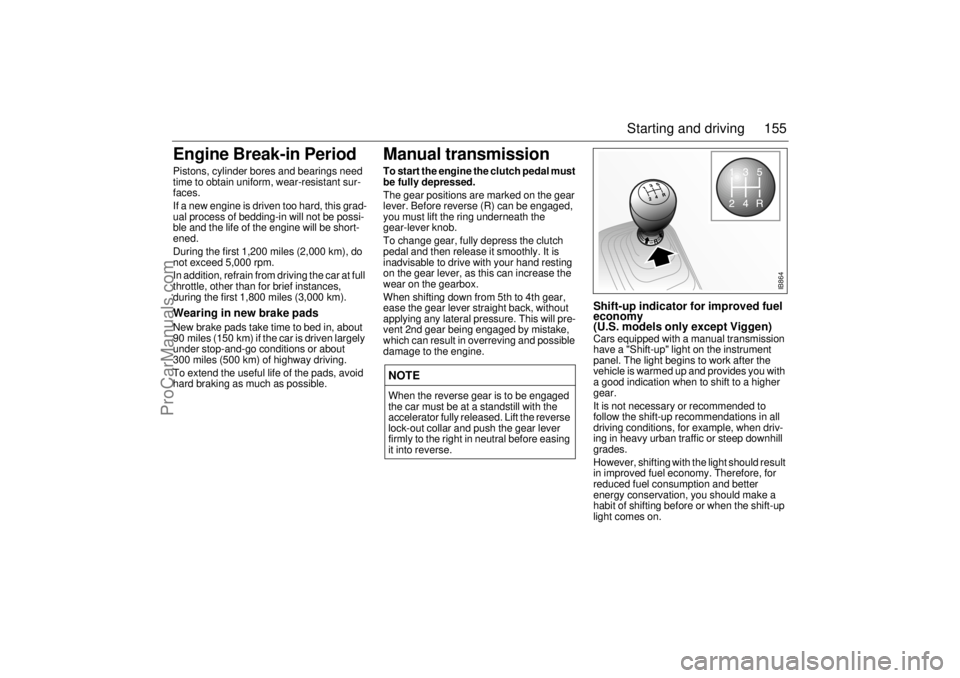
The gear positions are marked on the gear
lever. Before reverse (R) can be engaged,
you must lift the ring underneath the
gear-lever knob.
To change gear, fully depress the clutch
pedal and then release it smoothly. It is
inadvisable to drive with your hand resting
on the gear lever, as this can increase the
wear on the gearbox.
When shifting down from 5th to 4th gear,
ease the gear lever straight back, without
applying any lateral pressure. This will pre-
vent 2nd gear being engaged by mistake,
which can result in overreving and possible
damage to the engine.
Shift-up indicator for improved fuel
economy
(U.S. models only except Viggen)Cars equipped with a manual transmission
have a "Shift-up" light on the instrument
panel. The light begins to work after the
vehicle is warmed up and provides you with
a good indication when to shift to a higher
gear.
It is not necessary or recommended to
follow the shift-up recommendations in all
driving conditions, for example, when driv-
ing in heavy urban traffic or steep downhill
grades.
However, shifting with the light should result
in improved fuel economy. Therefore, for
reduced fuel consumption and better
energy conservation, you should make a
habit of shifting before or when the shift-up
light comes on.
NOTEWhen the reverse gear is to be engaged
the car must be at a standstill with the
accelerator fully released. Lift the reverse
lock-out collar and push the gear lever
firmly to the right in neutral before easing
it into reverse.
IB864
ProCarManuals.com
Page 156 of 256
156 Starting and drivingAutomatic transmission
The electronic control module for the auto-
matic transmission receives information on
engine torque and road speed. It also con-
trols the hydraulic pressure in the transmis-
sion to ensure that gear changing is as
smooth as possible.
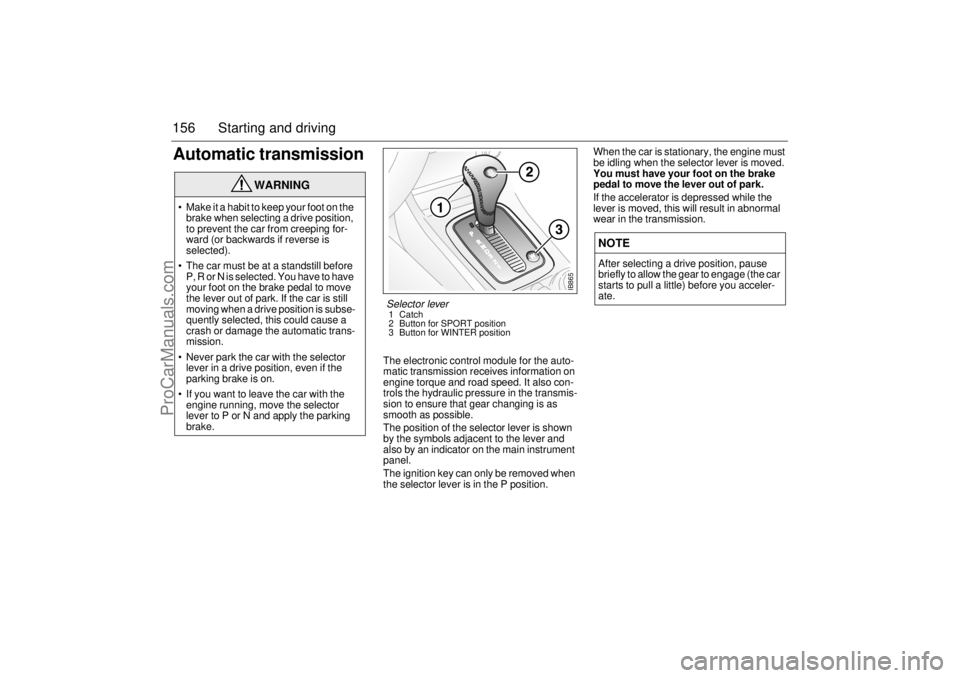
The position of the selector lever is shown
by the symbols adjacent to the lever and
also by an indicator on the main instrument
panel.
The ignition key can only be removed when
the selector lever is in the P position.When the car is stationary, the engine must
be idling when the selector lever is moved.
You must have your foot on the brake
pedal to move the lever out of park.
If the accelerator is depressed while the
lever is moved, this will result in abnormal
wear in the transmission.
WARNING
Make it a habit to keep your foot on the
brake when selecting a drive position,
to prevent the car from creeping for-
ward (or backwards if reverse is
selected).
The car must be at a standstill before
P, R or N is selected. You have to have
your foot on the brake pedal to move
the lever out of park. If the car is still
moving when a drive position is subse-
quently selected, this could cause a
crash or damage the automatic trans-
mission.
Never park the car with the selector
lever in a drive position, even if the
parking brake is on.
If you want to leave the car with the
engine running, move the selector
lever to P or N and apply the parking
brake.
NOTEAfter selecting a drive position, pause
briefly to allow the gear to engage (the car
starts to pull a little) before you acceler-
ate.
IB865
Selector lever 1Catch
2 Button for SPORT position
3 Button for WINTER position
ProCarManuals.com
Page 157 of 256
157 Starting and driving
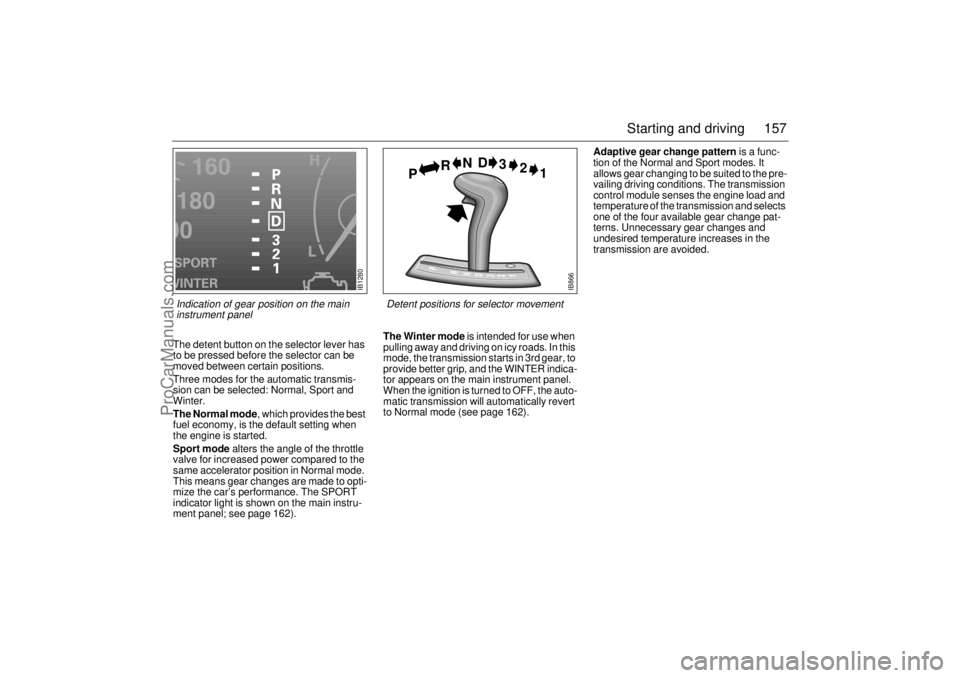
The detent button on the selector lever has
to be pressed before the selector can be
moved between certain positions.
Three modes for the automatic transmis-
sion can be selected: Normal, Sport and
Winter.
The Normal mode, which provides the best
fuel economy, is the default setting when
the engine is started.
Sport mode alters the angle of the throttle
valve for increased power compared to the
same accelerator position in Normal mode.
This means gear changes are made to opti-
mize the car’s performance. The SPORT
indicator light is shown on the main instru-
ment panel; see page 162). The Winter mode is intended for use when
pulling away and driving on icy roads. In this
mode, the transmission starts in 3rd gear, to
provide better grip, and the WINTER indica-
tor appears on the main instrument panel.
When the ignition is turned to OFF, the auto-
matic transmission will automatically revert
to Normal mode (see page 162).Adaptive gear change pattern is a func-
tion of the Normal and Sport modes. It
allows gear changing to be suited to the pre-
vailing driving conditions. The transmission
control module senses the engine load and
temperature of the transmission and selects
one of the four available gear change pat-
terns. Unnecessary gear changes and
undesired temperature increases in the
transmission are avoided.
IB1280
Indication of gear position on the main
instrument panel
PRND
3
2
1
IB866
Detent positions for selector movement
ProCarManuals.com