warning light SAAB 9-3 2002 Owner's Manual
[x] Cancel search | Manufacturer: SAAB, Model Year: 2002, Model line: 9-3, Model: SAAB 9-3 2002Pages: 256, PDF Size: 11.55 MB
Page 67 of 256
67 Instruments and controls
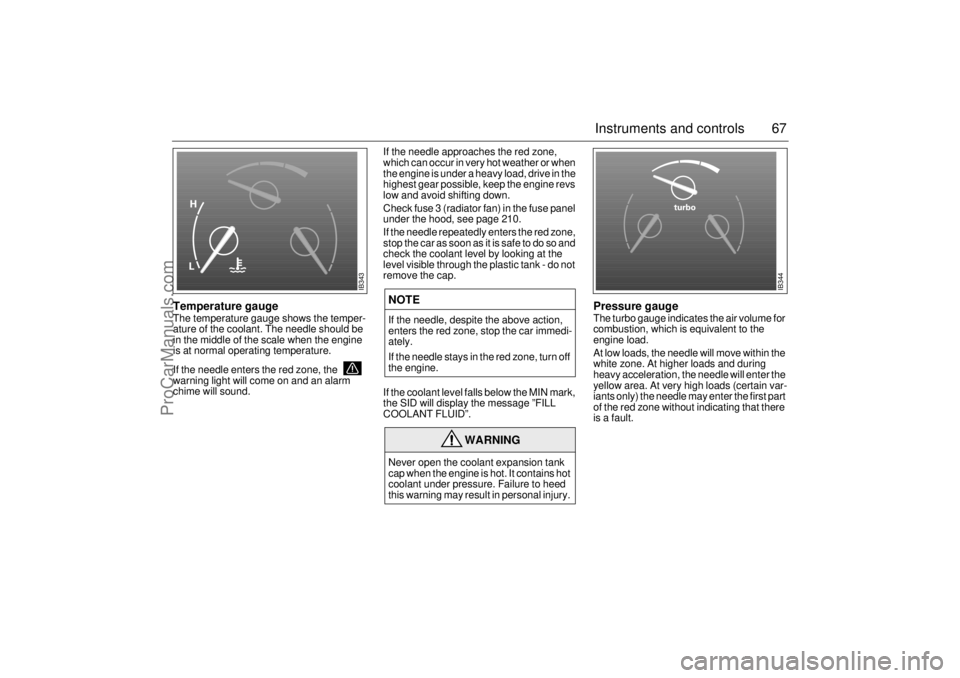
Temperature gaugeThe temperature gauge shows the temper-
ature of the coolant. The needle should be
in the middle of the scale when the engine
is at normal operating temperature.
If the needle enters the red zone, the
warning light will come on and an alarm
chime will sound. If the needle approaches the red zone,
which can occur in very hot weather or when
the engine is under a heavy load, drive in the
highest gear possible, keep the engine revs
low and avoid shifting down.
Check fuse 3 (radiator fan) in the fuse panel
under the hood, see page 210.
If the needle repeatedly enters the red zone,
stop the car as soon as it is safe to do so and
check the coolant level by looking at the
level visible through the plastic tank - do not
remove the cap.
If the coolant level falls below the MIN mark,
the SID will display the message ”FILL
COOLANT FLUID”.
Pressure gaugeThe turbo gauge indicates the air volume for
combustion, which is equivalent to the
engine load.
At low loads, the needle will move within the
white zone. At higher loads and during
heavy acceleration, the needle will enter the
yellow area. At very high loads (certain var-
iants only) the needle may enter the first part
of the red zone without indicating that there
is a fault.
NOTEIf the needle, despite the above action,
enters the red zone, stop the car immedi-
ately.
If the needle stays in the red zone, turn off
the engine.
WARNING
Never open the coolant expansion tank
cap when the engine is hot. It contains hot
coolant under pressure. Failure to heed
this warning may result in personal injury.
IB343
IB344
ProCarManuals.com
Page 68 of 256
68 Instruments and controlsUnder certain barometric conditions the
needle may enter the first part of the red
zone without necessarily indicating that a
fault has arisen.
If the needle repeatedly enters the red zone
and the engine at the same time loses
power, because the monitoring system is
holding the charging pressure down, you
should contact an authorized Saab dealer.
If the speed exceeds 143 mph (230 km/h),
the increase in speed will be limited by the
lowering of the boost pressure. The pres-
sure gauge then moves towards the middle
of the orange zone, indicating reduced
engine output and thus reduces the speed
of the car as well.
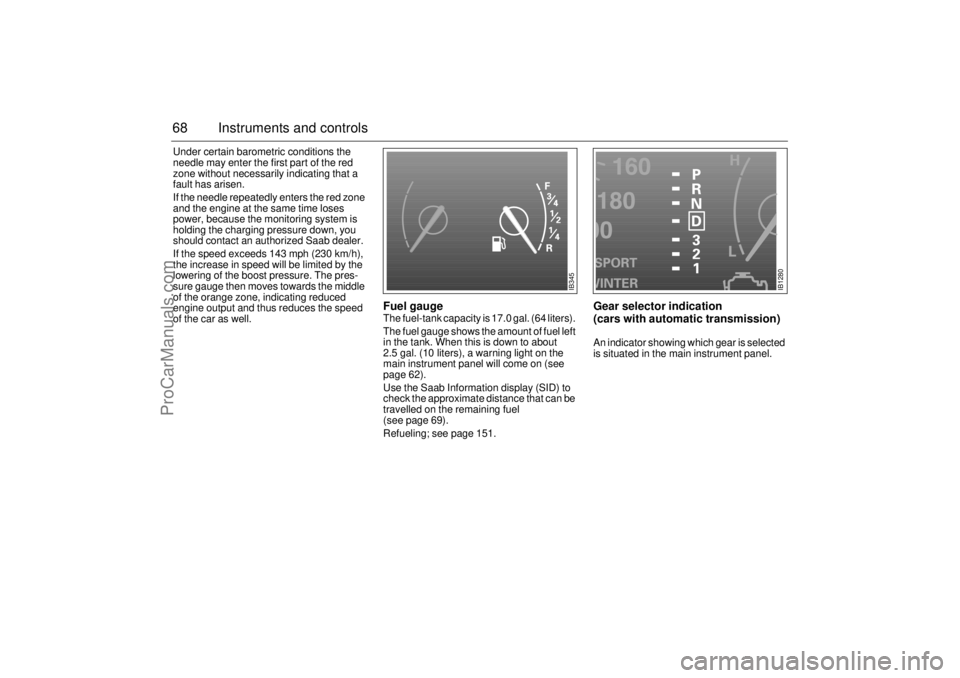
Fuel gaugeThe fuel-tank capacity is 17.0 gal. (64 liters).
The fuel gauge shows the amount of fuel left
in the tank. When this is down to about
2.5 gal. (10 liters), a warning light on the
main instrument panel will come on (see
page 62).
Use the Saab Information display (SID) to
check the approximate distance that can be
travelled on the remaining fuel
(see page 69).
Refueling; see page 151.
Gear selector indication
(cars with automatic transmission)An indicator showing which gear is selected
is situated in the main instrument panel.
IB345
IB1280
ProCarManuals.com
Page 73 of 256

73 Instruments and controls
The following CHECK messages may be
displayed: 1) This message will be displayed approximately
600 miles (1,000 km) before the next sched-
uled service is due, or when 365 days have
elapsed since the last service. The message
should be cleared at the time of that service
(see the Saab Warranties & Service Record
Booklet).
This message can also be deleted by first
briefly pressing the CLR button, then depress-
ing it a second time for at least eight seconds
until "SERVICE" appears on the display and a
chime sounds. The message can only be
deleted when it is shown on the SID.
Night panelTo improve night-driving conditions inside
the car, the Night Panel mode can be
selected. In this mode, the amount of infor-
mation displayed is reduced, and only the
most important instruments and displays
will be illuminated.
When the Night Panel button is pressed,
only the speedometer will be illuminated (up
to the 87-mph or 140-km/h graduation), all
the other instruments illumination will be
extinguished and their needles moved to
zero. Both the SID and the ACC displays will
be extinguished and the backlighting for
switches and other controls will be dimmed.
Note: All indicator and warning lights,
together with the display of CHECK mes-
sages, will operate as normal. The following conditions will wake up the
respective displays in the Night-Panel
mode:
Setting of the Audio System, SID or ACC
(display comes on for ten seconds).
CHECK message generated in the SID.
High engine revs cause the rev counter to
be illuminated until the engine speed has
fallen again.
If the quantity of fuel remaining falls below
4 gallons (15 liters), the fuel gauge will be
illuminated.
If the engine temperature rises above nor-
mal, the temperature gauge will be illumi-
nated.
If the speed of the car exceeds 84 mph
(135 km/h), the entire speedometer will
be illuminated.
In cars with automatic transmission, if the
selector lever is moved from D to position
3, 2 or 1, the selector indication on the
main instrument panel will be illuminated.
To restore the displays and lighting to the
normal mode, press the Night-Panel button. Display shows: See
page
BRAKE LIGHT FAILURE 202
FRONT LIGHT FAILURE 200
REAR LIGHT FAILURE 202
FOG LIGHT FAILURE 203
WASHER FLUID LEVEL LOW 199
TIGHTEN FUEL FILLER CAP 151
FILL COOLANT FLUID 192
KEY NOT ACCEPTED 45
REPLACE KEY BATTERY 45
SERVICE THEFT ALARM 45
TRANSMISSION OVERHEATING 159
TIME FOR SERVICE
1)
230
ProCarManuals.com
Page 76 of 256
76 Instruments and controlsCourtesy Headlamp Feature A delay function allows the headlights to
remain on low beam for about 30 seconds
after the driver’s door has been closed.
To activate this function,
Switch off the ignition and remove the key
Open the driver’s door
Pull the high/low beam control stalk
towards the steering wheel like you are
flashing the high beam, see page 75. The
low beam headlights will now come on
immediately after the driver’s door has
been closed (within 30 seconds) and will
remain on for about 30 seconds.
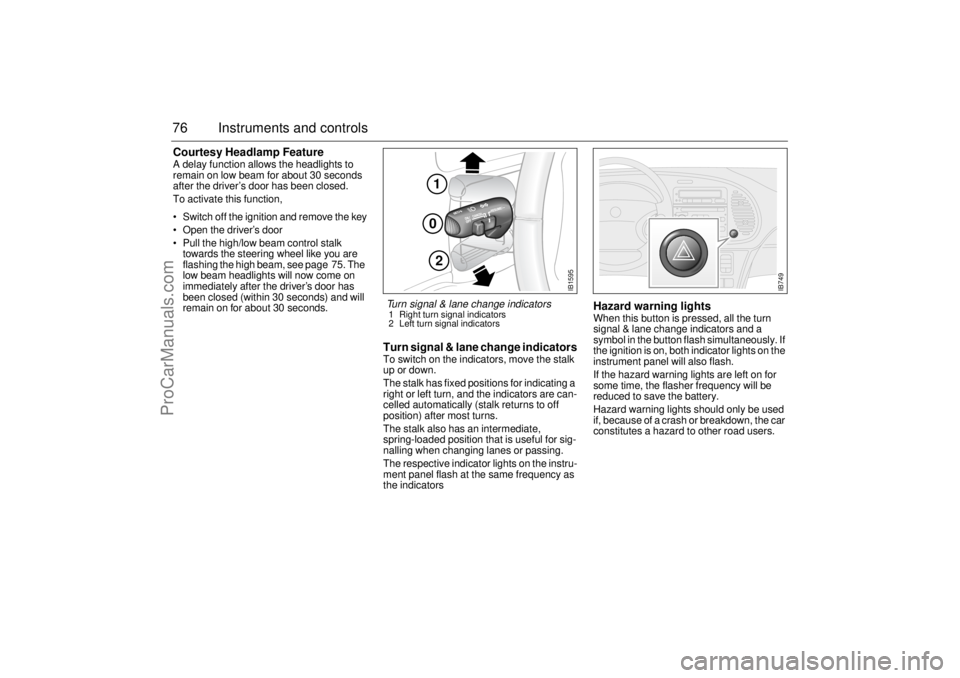
Turn signal & lane change indicatorsTo switch on the indicators, move the stalk
up or down.
The stalk has fixed positions for indicating a
right or left turn, and the indicators are can-
celled automatically (stalk returns to off
position) after most turns.
The stalk also has an intermediate,
spring-loaded position that is useful for sig-
nalling when changing lanes or passing.
The respective indicator lights on the instru-
ment panel flash at the same frequency as
the indicators
Hazard warning lightsWhen this button is pressed, all the turn
signal & lane change indicators and a
symbol in the button flash simultaneously. If
the ignition is on, both indicator lights on the
instrument panel will also flash.
If the hazard warning lights are left on for
some time, the flasher frequency will be
reduced to save the battery.
Hazard warning lights should only be used
if, because of a crash or breakdown, the car
constitutes a hazard to other road users.
102
IB1595
Turn signal & lane change indicators 1 Right turn signal indicators
2 Left turn signal indicators
IB749
ProCarManuals.com
Page 77 of 256
77 Instruments and controls
Back-UpThe back-up lights come on automatically
when reverse gear is engaged or selected
with the ignition switched on.
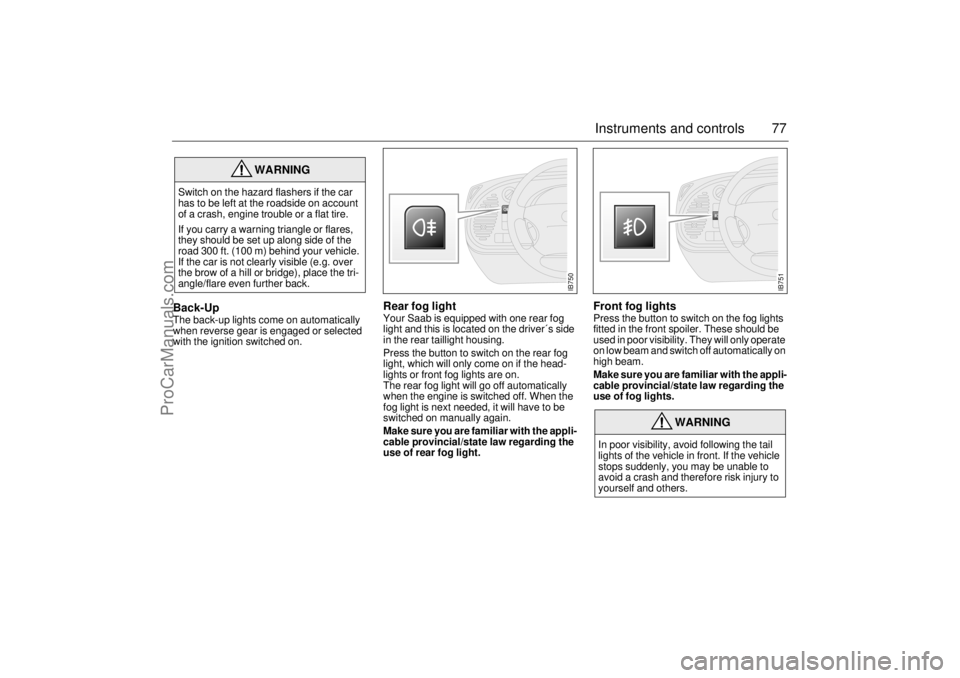
Rear fog lightYour Saab is equipped with one rear fog
light and this is located on the driver´s side
in the rear taillight housing.
Press the button to switch on the rear fog
light, which will only come on if the head-
lights or front fog lights are on.
The rear fog light will go off automatically
when the engine is switched off. When the
fog light is next needed, it will have to be
switched on manually again.
Make sure you are familiar with the appli-
cable provincial/state law regarding the
use of rear fog light.
Front fog lightsPress the button to switch on the fog lights
fitted in the front spoiler. These should be
used in poor visibility. They will only operate
on low beam and switch off automatically on
high beam.
Make sure you are familiar with the appli-
cable provincial/state law regarding the
use of fog lights.
WARNING
Switch on the hazard flashers if the car
has to be left at the roadside on account
of a crash, engine trouble or a flat tire.
If you carry a warning triangle or flares,
they should be set up along side of the
road 300 ft. (100 m) behind your vehicle.
If the car is not clearly visible (e.g. over
the brow of a hill or bridge), place the tri-
angle/flare even further back.
WARNING
In poor visibility, avoid following the tail
lights of the vehicle in front. If the vehicle
stops suddenly, you may be unable to
avoid a crash and therefore risk injury to
yourself and others.
IB750
IB751
ProCarManuals.com
Page 108 of 256
108 Saab 9-3 Audio SystemAntennaThe antenna of the Audio System is motor-
ized.
Saab 9-3 Viggen Coupé and 5-door: The
antenna is located on the roof.
For the cleaning of the motorized antenna,
see the section headed "Washing", page
220.
The car has a factory-fitted roof antenna for
a car phone. Roof loads may negatively
affect telecommunication.
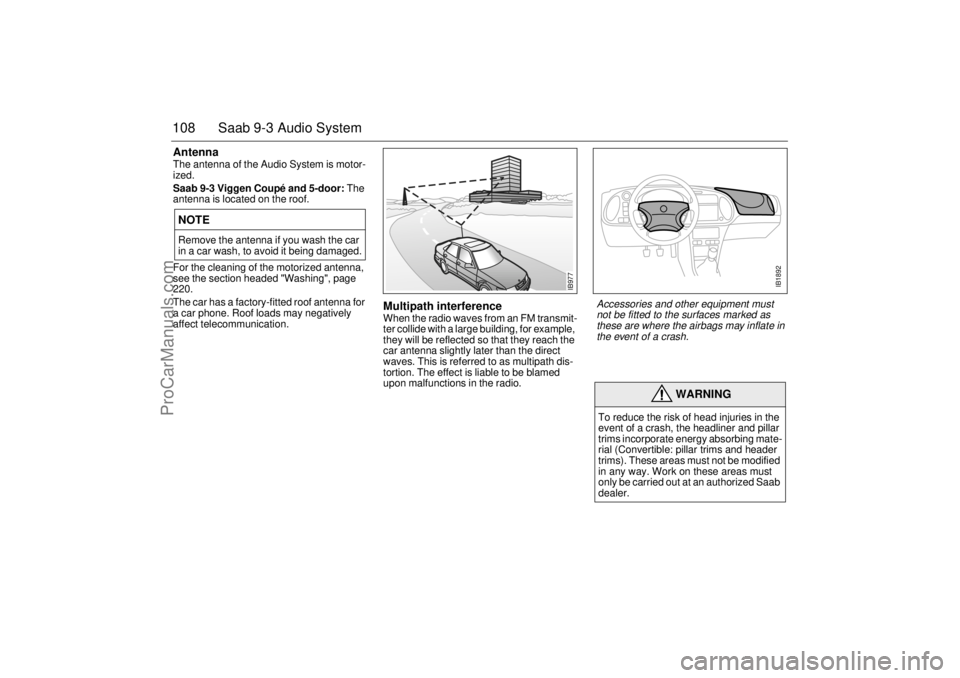
Multipath interference When the radio waves from an FM transmit-
ter collide with a large building, for example,
they will be reflected so that they reach the
car antenna slightly later than the direct
waves. This is referred to as multipath dis-
tortion. The effect is liable to be blamed
upon malfunctions in the radio.
NOTERemove the antenna if you wash the car
in a car wash, to avoid it being damaged.
WARNING
To reduce the risk of head injuries in the
event of a crash, the headliner and pillar
trims incorporate energy absorbing mate-
rial (Convertible: pillar trims and header
trims). These areas must not be modified
in any way. Work on these areas must
only be carried out at an authorized Saab
dealer.
IB977
IB1892
Accessories and other equipment must
not be fitted to the surfaces marked as
these are where the airbags may inflate in
the event of a crash.
ProCarManuals.com
Page 135 of 256
135 Interior equipment, trunk
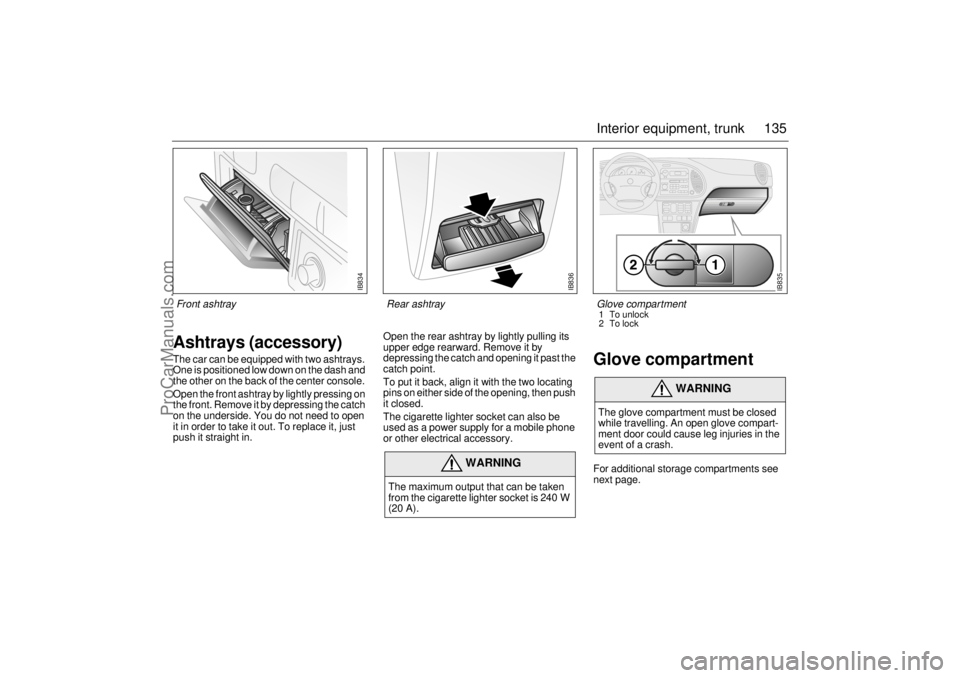
Ashtrays (accessory)The car can be equipped with two ashtrays.
One is positioned low down on the dash and
the other on the back of the center console.
Open the front ashtray by lightly pressing on
the front. Remove it by depressing the catch
on the underside. You do not need to open
it in order to take it out. To replace it, just
push it straight in. Open the rear ashtray by lightly pulling its
upper edge rearward. Remove it by
depressing the catch and opening it past the
catch point.
To put it back, align it with the two locating
pins on either side of the opening, then push
it closed.
The cigarette lighter socket can also be
used as a power supply for a mobile phone
or other electrical accessory.
Glove compartmentFor additional storage compartments see
next page.
WARNING
The maximum output that can be taken
from the cigarette lighter socket is 240 W
(20 A).
WARNING
The glove compartment must be closed
while travelling. An open glove compart-
ment door could cause leg injuries in the
event of a crash.
IB835
Glove compartment 1 To unlock
2To lock
IB836
Rear ashtray
IB834
Front ashtray
ProCarManuals.com
Page 138 of 256
138 Interior equipment, trunkTrunk, Coupé and 5-doorTrunk lid lockUnlock the trunk lid by pressing on the key, by pressing the
remote release button on the driver’s door or by using the key. The
alarm horn sounds three times and the lights flash when the trunk is
released with the remote control.
Programming features, see page 245.
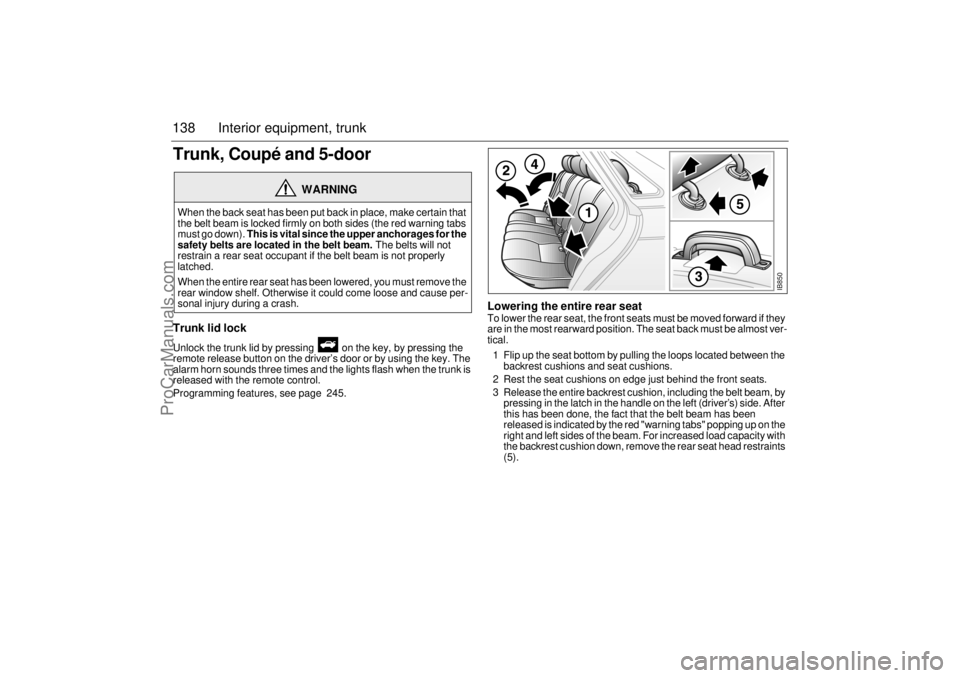
Lowering the entire rear seatTo lower the rear seat, the front seats must be moved forward if they
are in the most rearward position. The seat back must be almost ver-
tical.
1 Flip up the seat bottom by pulling the loops located between the
backrest cushions and seat cushions.
2 Rest the seat cushions on edge just behind the front seats.
3 Release the entire backrest cushion, including the belt beam, by
pressing in the latch in the handle on the left (driver’s) side. After
this has been done, the fact that the belt beam has been
released is indicated by the red "warning tabs" popping up on the
right and left sides of the beam. For increased load capacity with
the backrest cushion down, remove the rear seat head restraints
(5).
WARNING
When the back seat has been put back in place, make certain that
the belt beam is locked firmly on both sides (the red warning tabs
must go down). This is vital since the upper anchorages for the
safety belts are located in the belt beam. The belts will not
restrain a rear seat occupant if the belt beam is not properly
latched.
When the entire rear seat has been lowered, you must remove the
rear window shelf. Otherwise it could come loose and cause per-
sonal injury during a crash.
IB850
ProCarManuals.com
Page 142 of 256
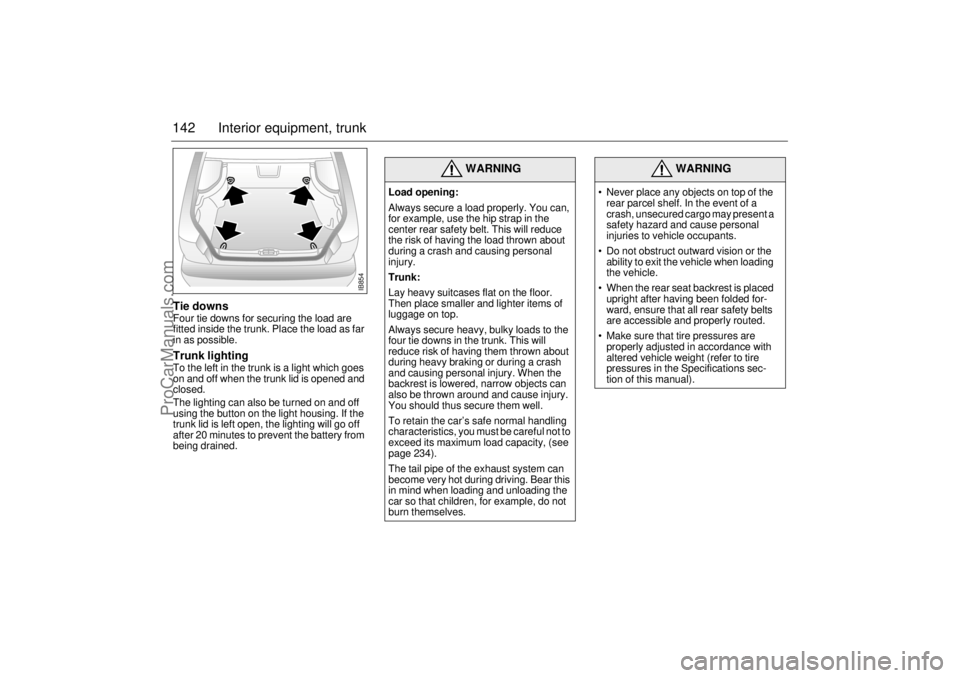
142 Interior equipment, trunkTie downsFour tie downs for securing the load are
fitted inside the trunk. Place the load as far
in as possible.Trunk lightingTo the left in the trunk is a light which goes
on and off when the trunk lid is opened and
closed.
The lighting can also be turned on and off
using the button on the light housing. If the
trunk lid is left open, the lighting will go off
after 20 minutes to prevent the battery from
being drained.
WARNING
Load opening:
Always secure a load properly. You can,
for example, use the hip strap in the
center rear safety belt. This will reduce
the risk of having the load thrown about
during a crash and causing personal
injury.
Trunk:
Lay heavy suitcases flat on the floor.
Then place smaller and lighter items of
luggage on top.
Always secure heavy, bulky loads to the
four tie downs in the trunk. This will
reduce risk of having them thrown about
during heavy braking or during a crash
and causing personal injury. When the
backrest is lowered, narrow objects can
also be thrown around and cause injury.
You should thus secure them well.
To retain the car’s safe normal handling
characteristics, you must be careful not to
exceed its maximum load capacity, (see
page 234).
The tail pipe of the exhaust system can
become very hot during driving. Bear this
in mind when loading and unloading the
car so that children, for example, do not
burn themselves.
WARNING
Never place any objects on top of the
rear parcel shelf. In the event of a
crash, unsecured cargo may present a
safety hazard and cause personal
injuries to vehicle occupants.
Do not obstruct outward vision or the
ability to exit the vehicle when loading
the vehicle.
When the rear seat backrest is placed
upright after having been folded for-
ward, ensure that all rear safety belts
are accessible and properly routed.
Make sure that tire pressures are
properly adjusted in accordance with
altered vehicle weight (refer to tire
pressures in the Specifications sec-
tion of this manual).
IB854
ProCarManuals.com
Page 143 of 256
143 Interior equipment, trunk
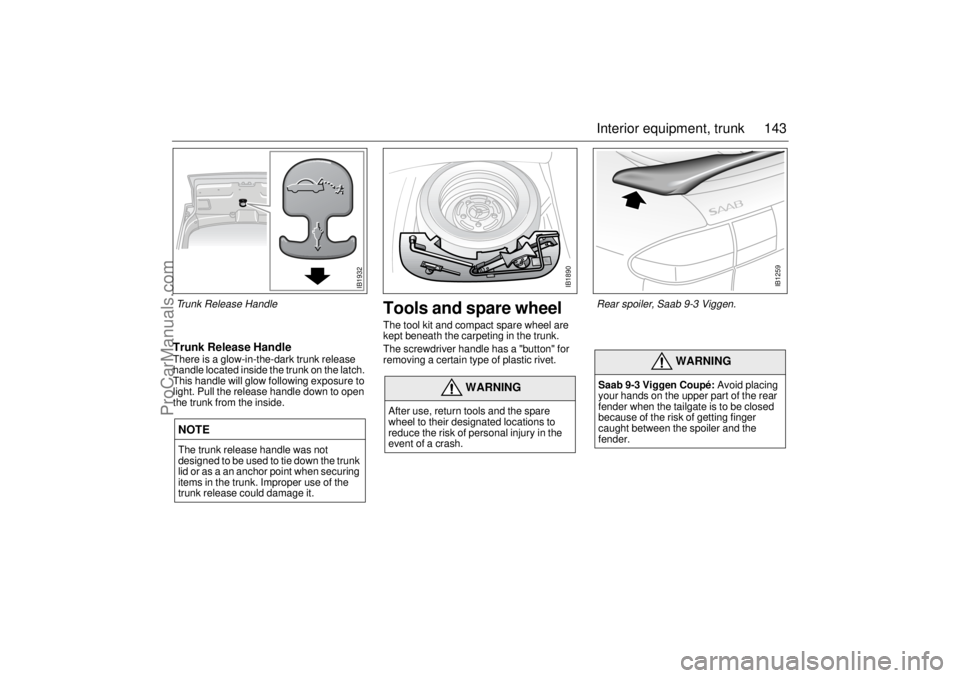
Trunk Release HandleThere is a glow-in-the-dark trunk release
handle located inside the trunk on the latch.
This handle will glow following exposure to
light. Pull the release handle down to open
the trunk from the inside.
Tools and spare wheelThe tool kit and compact spare wheel are
kept beneath the carpeting in the trunk.
The screwdriver handle has a "button" for
removing a certain type of plastic rivet.
NOTEThe trunk release handle was not
designed to be used to tie down the trunk
lid or as a an anchor point when securing
items in the trunk. Improper use of the
trunk release could damage it.
WARNING
After use, return tools and the spare
wheel to their designated locations to
reduce the risk of personal injury in the
event of a crash.
WARNING
Saab 9-3 Viggen Coupé: Avoid placing
your hands on the upper part of the rear
fender when the tailgate is to be closed
because of the risk of getting finger
caught between the spoiler and the
fender.
IB1890
IB1259
Rear spoiler, Saab 9-3 Viggen.
IB1932
Trunk Release Handle
ProCarManuals.com