ignition SAAB 9-3 2002 Service Manual
[x] Cancel search | Manufacturer: SAAB, Model Year: 2002, Model line: 9-3, Model: SAAB 9-3 2002Pages: 256, PDF Size: 11.55 MB
Page 156 of 256
156 Starting and drivingAutomatic transmission
The electronic control module for the auto-
matic transmission receives information on
engine torque and road speed. It also con-
trols the hydraulic pressure in the transmis-
sion to ensure that gear changing is as
smooth as possible.
The position of the selector lever is shown
by the symbols adjacent to the lever and
also by an indicator on the main instrument
panel.
The ignition key can only be removed when
the selector lever is in the P position.When the car is stationary, the engine must
be idling when the selector lever is moved.
You must have your foot on the brake
pedal to move the lever out of park.
If the accelerator is depressed while the
lever is moved, this will result in abnormal
wear in the transmission.
WARNING
Make it a habit to keep your foot on the
brake when selecting a drive position,
to prevent the car from creeping for-
ward (or backwards if reverse is
selected).
The car must be at a standstill before
P, R or N is selected. You have to have
your foot on the brake pedal to move
the lever out of park. If the car is still
moving when a drive position is subse-
quently selected, this could cause a
crash or damage the automatic trans-
mission.
Never park the car with the selector
lever in a drive position, even if the
parking brake is on.
If you want to leave the car with the
engine running, move the selector
lever to P or N and apply the parking
brake.
NOTEAfter selecting a drive position, pause
briefly to allow the gear to engage (the car
starts to pull a little) before you acceler-
ate.
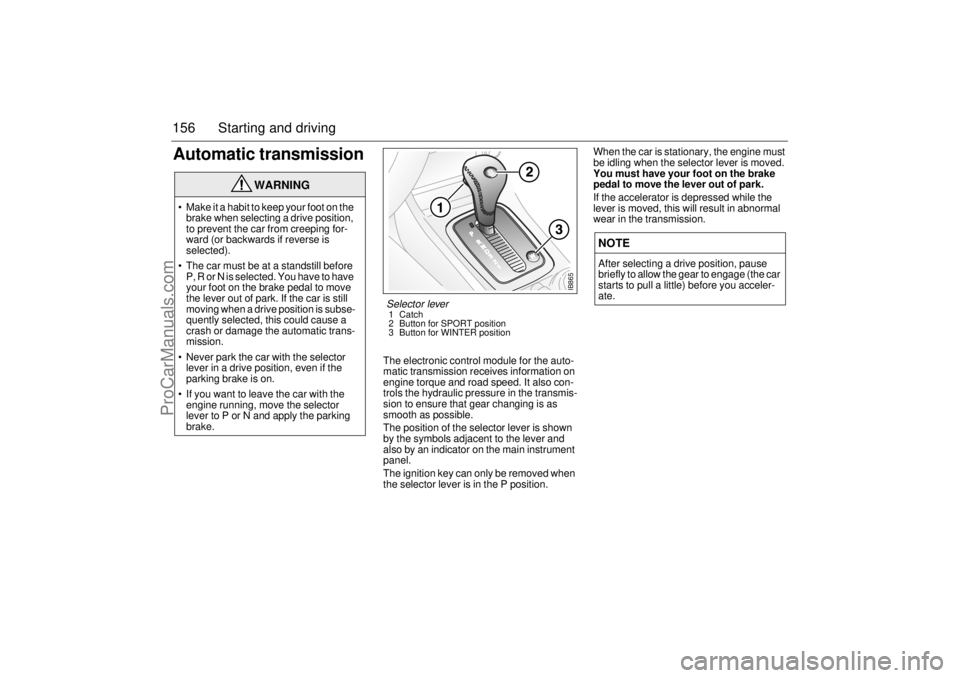
IB865
Selector lever 1Catch
2 Button for SPORT position
3 Button for WINTER position
ProCarManuals.com
Page 157 of 256
157 Starting and driving
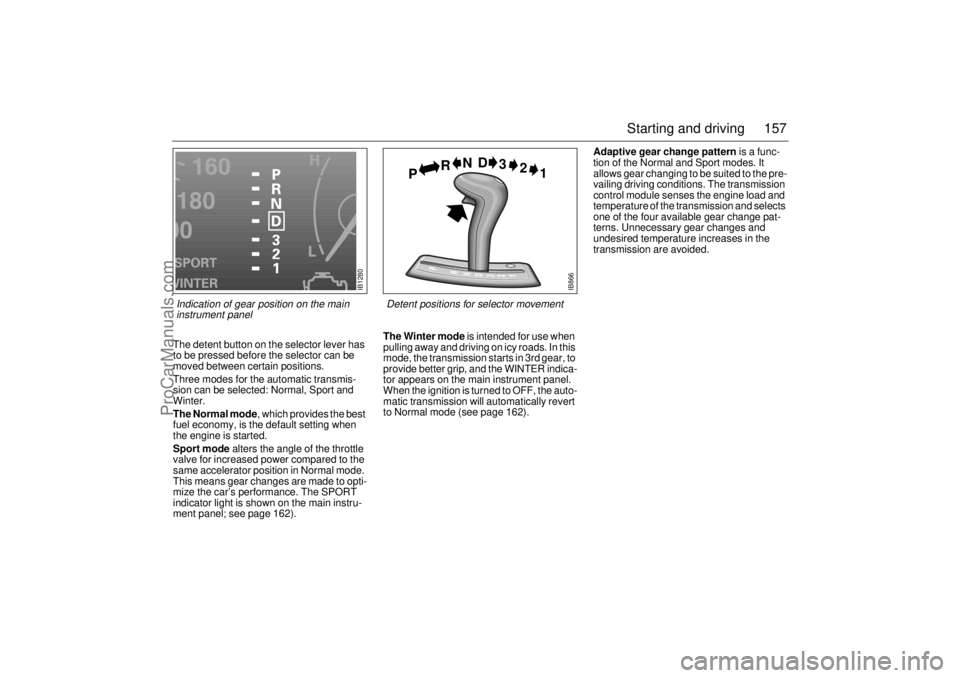
The detent button on the selector lever has
to be pressed before the selector can be
moved between certain positions.
Three modes for the automatic transmis-
sion can be selected: Normal, Sport and
Winter.
The Normal mode, which provides the best
fuel economy, is the default setting when
the engine is started.
Sport mode alters the angle of the throttle
valve for increased power compared to the
same accelerator position in Normal mode.
This means gear changes are made to opti-
mize the car’s performance. The SPORT
indicator light is shown on the main instru-
ment panel; see page 162). The Winter mode is intended for use when
pulling away and driving on icy roads. In this
mode, the transmission starts in 3rd gear, to
provide better grip, and the WINTER indica-
tor appears on the main instrument panel.
When the ignition is turned to OFF, the auto-
matic transmission will automatically revert
to Normal mode (see page 162).Adaptive gear change pattern is a func-
tion of the Normal and Sport modes. It
allows gear changing to be suited to the pre-
vailing driving conditions. The transmission
control module senses the engine load and
temperature of the transmission and selects
one of the four available gear change pat-
terns. Unnecessary gear changes and
undesired temperature increases in the
transmission are avoided.
IB1280
Indication of gear position on the main
instrument panel
PRND
3
2
1
IB866
Detent positions for selector movement
ProCarManuals.com
Page 158 of 256
158 Starting and drivingLock-up functionThe automatic transmission has a lock-up
function, which renders the torque con-
verter inoperative in 3rd and 4th gears. The
result is reduction in the engine speed and,
hence, fuel consumption.
When the lock-up function comes into oper-
ation, it may give the impression of an over-
drive being engaged.Kick-downWhen the accelerator is pressed down hard,
a downshift to the next lower gear will occur
to provide maximum acceleration, e.g. for
overtaking.
The change-up to the next gear again will
take place either when the accelerator is
released or when maximum engine speed
for that gear is reached.
Park Brake Shift LockThe transmission has a safety function
called Park Brake Shift Lock. For the selec-
tor lever to be moved out of the P position,
the brake pedal must be depressed at the
same time as the detent button is lifted.
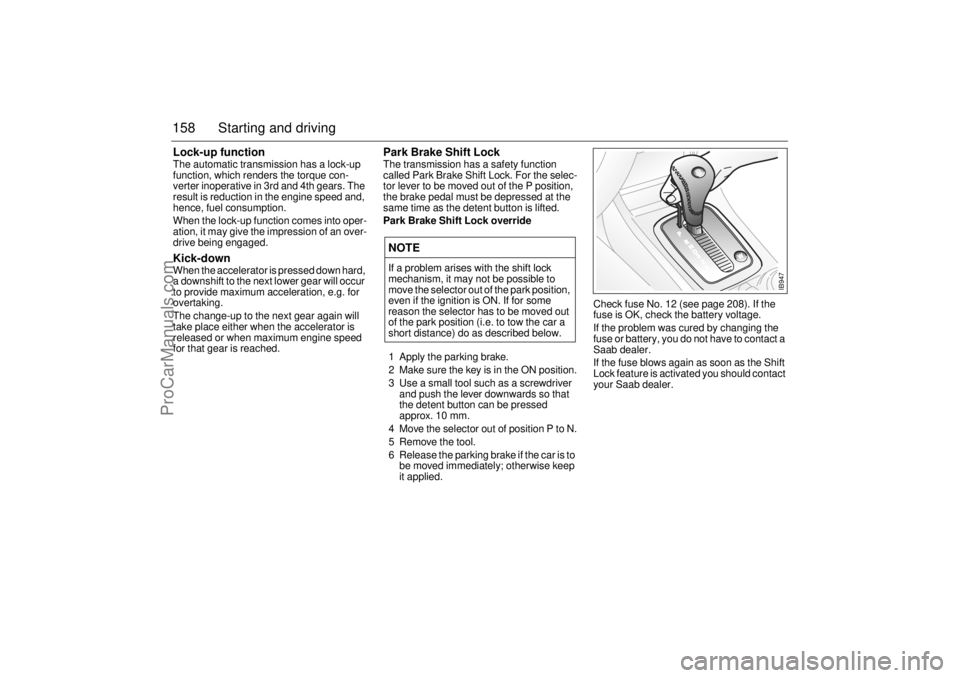
Park Brake Shift Lock override
1 Apply the parking brake.
2 Make sure the key is in the ON position.
3 Use a small tool such as a screwdriver
and push the lever downwards so that
the detent button can be pressed
approx. 10 mm.
4 Move the selector out of position P to N.
5 Remove the tool.
6 Release the parking brake if the car is to
be moved immediately; otherwise keep
it applied.Check fuse No. 12 (see page 208). If the
fuse is OK, check the battery voltage.
If the problem was cured by changing the
fuse or battery, you do not have to contact a
Saab dealer.
If the fuse blows again as soon as the Shift
Lock feature is activated you should contact
your Saab dealer.NOTEIf a problem arises with the shift lock
mechanism, it may not be possible to
move the selector out of the park position,
even if the ignition is ON. If for some
reason the selector has to be moved out
of the park position (i.e. to tow the car a
short distance) do as described below.
IB947
ProCarManuals.com
Page 160 of 256

160 Starting and drivingSelector positions
P
To shift out of the P position you must depress
the brake pedal and the ignition must be OFF.
The parking position (P) must only be selected
when the car is at a complete standstill. The selec-
tor lever is locked and the transmission is
mechanically immobilized. Always apply the park-
ing brake after parking the car.
The engine can be started.
R
The reverse (R) position must only be selected
when the car is at a complete standstill. The
detent-release button must be pressed before the
selector lever can be moved to R. Wait until
reverse gear has engaged (car starts to creep)
before touching the accelerator.
N
In the Neutral position (N), the transmission is dis-
engaged from the engine. The engine can be
started, but first ensure that the parking brake is
on, to prevent the car from moving off unexpect-
edly.
To prevent the engine and transmission from
becoming hotter than necessary, select N for
stops other than brief ones, e.g. if stuck in a traffic
jam.
The normal drive position (D) is recommended for
waiting at traffic lights.
D
The Drive position (D) is the position for normal
motoring. Gear changes between 1st and 4th will
take place automatically, the timing of which is
determined by the throttle (accelerator) position
and the speed of the car.
After moving the selector lever to D, pause to give
the gear time to engage (car starts to pull).
3
In position 3, 4th gear is locked out. The car will
start in 1st gear and normal gear changing (up
and down) will take place automatically between
gears 1, 2 and 3.
Moving the selector lever from D to 3 will cause a
downshift to 3rd gear, which will give better
engine-braking.
Do not move the selector to position 3 at speeds
in excess of 90 mph (150 km/h).
2
Position 2 is recommended in hilly country as it
provides effective engine-braking. Normal gear
changing (up and down) between 1st and 2nd
gear will take place automatically. Third and 4th
gears are locked out.
Do not move the selector to position 2 at speeds
in excess of 70 mph (110 km/h).
1
Position 1 should be used when maximum
engine-braking is required on steep downhill
slopes.
Do not move the selector to position 1 at speeds
in excess of 30 mph (50 km/h).
ProCarManuals.com
Page 166 of 256
166 Starting and drivingTraction Control SystemHow the system works The traction control system (TCS) is
designed to minimize wheelspin. This
enables the car to achieve the best possible
grip and, hence, maximum tractive effort,
together with greater stability.
The TCS system uses information from the
ABS system’s wheel sensors to detect
when the front (driving) wheels are rotating
faster then the rear wheels. It then monitors
whether one driving wheel is rotating faster
than the other. If so, the faster wheel is
retarded until both wheels are rotating at the
same speed.
If the two front wheels are rotating at the
same speed but are turning faster than the
rear wheels, the torque from the engine is
reduced to eliminate the difference.
The process continues until all the wheels
are rotating at the same speed. The advantages of the TCS system become
most apparent when the cohesion between
the front wheels and the road surface is so
low that one or both of the wheels would
lose their grip were the car not equipped
with the TCS, e.g.:
When the car is pulling away or accelerat-
ing with the front wheels on different sur-
faces (e.g. one slippery and one dry). The
TCS then functions like an electronic dif-
ferential lock.
When the car is pulling away or accelerat-
ing on a slippery road, in which case the
TCS eliminates wheelspin. The same
applies when the car is reversing.
On cornering, if there is a tendency for the
inner front wheel to rotate faster than the
other wheels.
On overtaking.
TCS OFF The indicator on the main instrument
panel will come on:
If a fault has been detected and the
system has therefore been switched off.
If there is a fault in the ABS system.
If the system has been switched off man-
ually.
The indicator light will also come on for
4 seconds when the ignition key is turned to
ON, while an internal system check is per-
formed. TCS indicator The in the tachometer comes on when
the system is operative, i.e. when the
wheels are not rotating at the same speed.
The fact that the TCS system is operative
indicates that the limit for grip has been
exceeded and that the driver must exert
greater care.
WARNING
When driving normally, the TCS helps to
imrove the safety of the car. This does
not mean that car can be driven faster.
The same care and prudence normally
applied should be displayed on corner-
ing and when driving on slippery roads.
ProCarManuals.com
Page 168 of 256
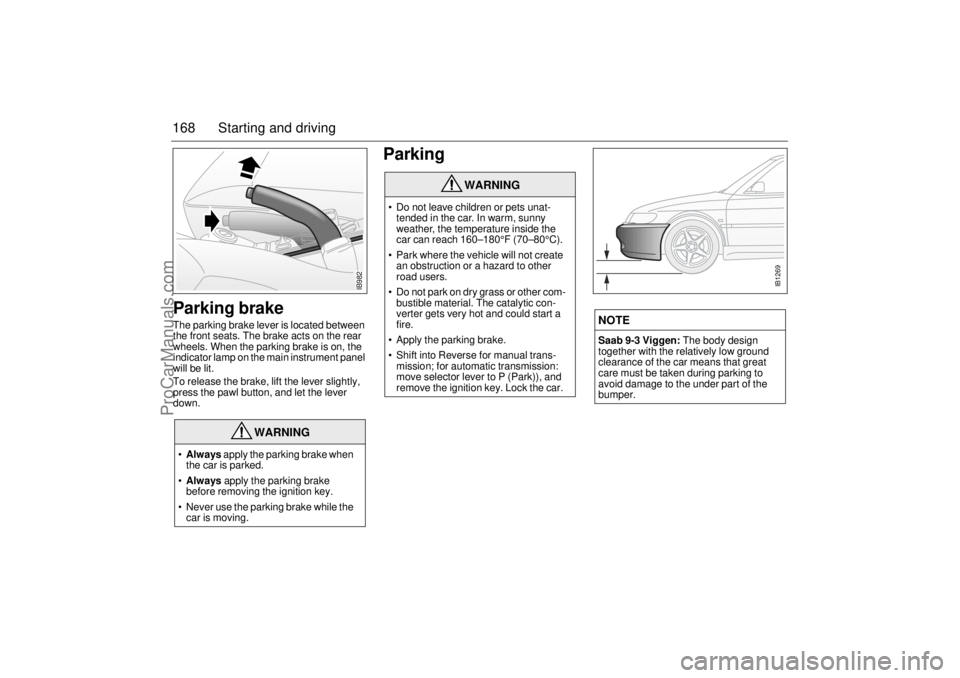
168 Starting and drivingParking brakeThe parking brake lever is located between
the front seats. The brake acts on the rear
wheels. When the parking brake is on, the
indicator lamp on the main instrument panel
will be lit.
To release the brake, lift the lever slightly,
press the pawl button, and let the lever
down.
Parking
WARNING
Always apply the parking brake when
the car is parked.
Always apply the parking brake
before removing the ignition key.
Never use the parking brake while the
car is moving.
WARNING
Do not leave children or pets unat-
tended in the car. In warm, sunny
weather, the temperature inside the
car can reach 160–180°F (70–80°C).
Park where the vehicle will not create
an obstruction or a hazard to other
road users.
Do not park on dry grass or other com-
bustible material. The catalytic con-
verter gets very hot and could start a
fire.
Apply the parking brake.
Shift into Reverse for manual trans-
mission; for automatic transmission:
move selector lever to P (Park)), and
remove the ignition key. Lock the car.
NOTESaab 9-3 Viggen: The body design
together with the relatively low ground
clearance of the car means that great
care must be taken during parking to
avoid damage to the under part of the
bumper.
IB1269
IB982
ProCarManuals.com
Page 182 of 256
182 Starting and drivingTo jump start your vehicle:
1 Check the other vehicle. It must have a
12-volt battery with a negative ground
system.2 Get the vehicles close enough so the
jumper cables can reach, but be sure the
vehicles are not touching each other. If
a poor connection on the negative
jumper cable should exist, it is possible
for damage to be caused to electrical
systems/components of either vehicle
should inadvertent contact be made.
You would not be able to start your car
and bad grounding could damage the
electrical systems.
3 Turn off the ignition on both vehicles.
Turn off all lights that are not needed,
and radios. This will avoid sparks and
help save both batteries and it could
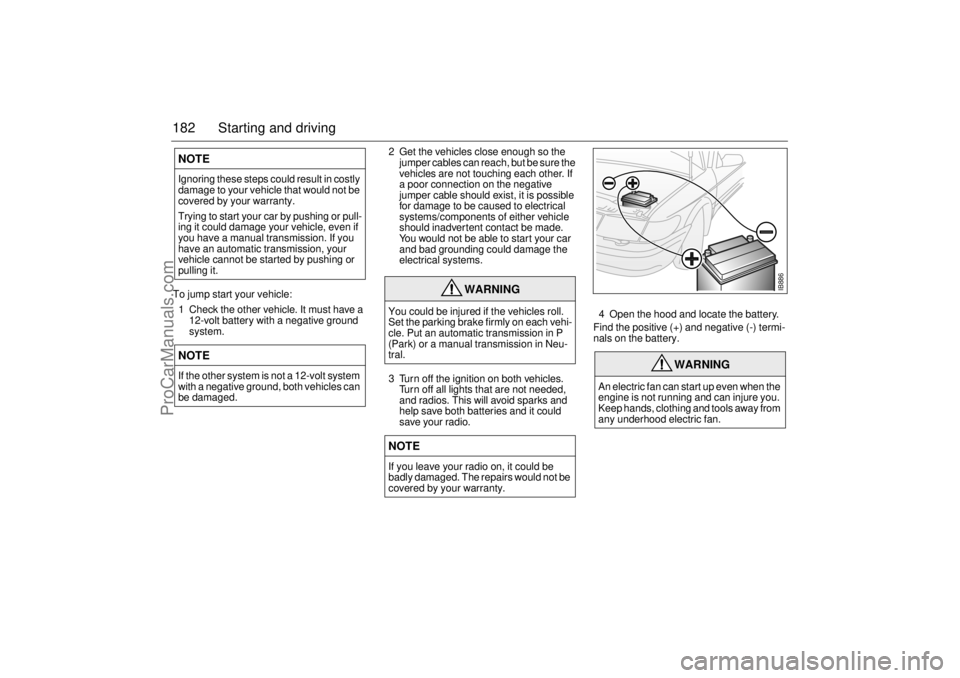
save your radio.4 Open the hood and locate the battery.
Find the positive (+) and negative (-) termi-
nals on the battery.NOTEIgnoring these steps could result in costly
damage to your vehicle that would not be
covered by your warranty.
Trying to start your car by pushing or pull-
ing it could damage your vehicle, even if
you have a manual transmission. If you
have an automatic transmission, your
vehicle cannot be started by pushing or
pulling it.NOTEIf the other system is not a 12-volt system
with a negative ground, both vehicles can
be damaged.
WARNING
You could be injured if the vehicles roll.
Set the parking brake firmly on each vehi-
cle. Put an automatic transmission in P
(Park) or a manual transmission in Neu-
tral.NOTEIf you leave your radio on, it could be
badly damaged. The repairs would not be
covered by your warranty.
WARNING
An electric fan can start up even when the
engine is not running and can injure you.
Keep hands, clothing and tools away from
any underhood electric fan.
IB886
ProCarManuals.com
Page 189 of 256

189 Car care
Saab Trionic engine management
systemThe Saab Trionic engine management
system is a unique Saab development that
combines sequential multiport fuel injection,
electronic distributorless ignition and turbo-
charger boost pressure control into one sys-
tem.
The Trionic engine control module (ECM)
monitors many different engine parameters
such as:
Intake manifold pressure.
Intake air temperature.
Crankshaft position.
Engine coolant temperature.
Throttle position.
The oxygen content of the exhaust gases.
The ECM receives information regarding
engine knocking from a sophisticated feed-
back function in the ignition discharge unit.
By processing all of this information, the Tri-
onic system can control fuel injector open-
ing duration, ignition timing and turbo-
charger boost pressure to provide excellent
engine performance while maintaining low
emissions and fuel consumption.
ORVR (Onboard Refueling Vapor
Recovery)All hydrocarbons formed when refueling will
be recovered by the car and not released
into the atmosphere. The hydrocarbons are
absorbed in an evaporative emission canis-
ter. When the engine is subsequently
started, the evaporative emission canister is
gradually purged as air is sucked into it
through a shut-off valve. The hydrocar-
bon/air mixture passes through the evap
canister purge valve and into the engine
where it is burned. "Refueling", see page
151.
When refueling, make sure you screw the
filler cap on and keep turning until it has
clicked at least 3 times. Otherwise, it is pos-
sible for the CHECK ENGINE light to illumi-
nate and a TIGHTEN FUEL FILLER CAP
message to appear on SID.
NOTEThe Trionic engine management system
continuously monitors the operation of
these systems and has on-board diag-
nostic capabilities (OBD II). If the CHECK
ENGINE light in the main instrument illu-
minates, the Trionic ECM has detected a
problem. The car will continue to operate,
but performance may be diminished. You
should have your car checked by a Saab
dealer as soon as possible.
ProCarManuals.com
Page 200 of 256
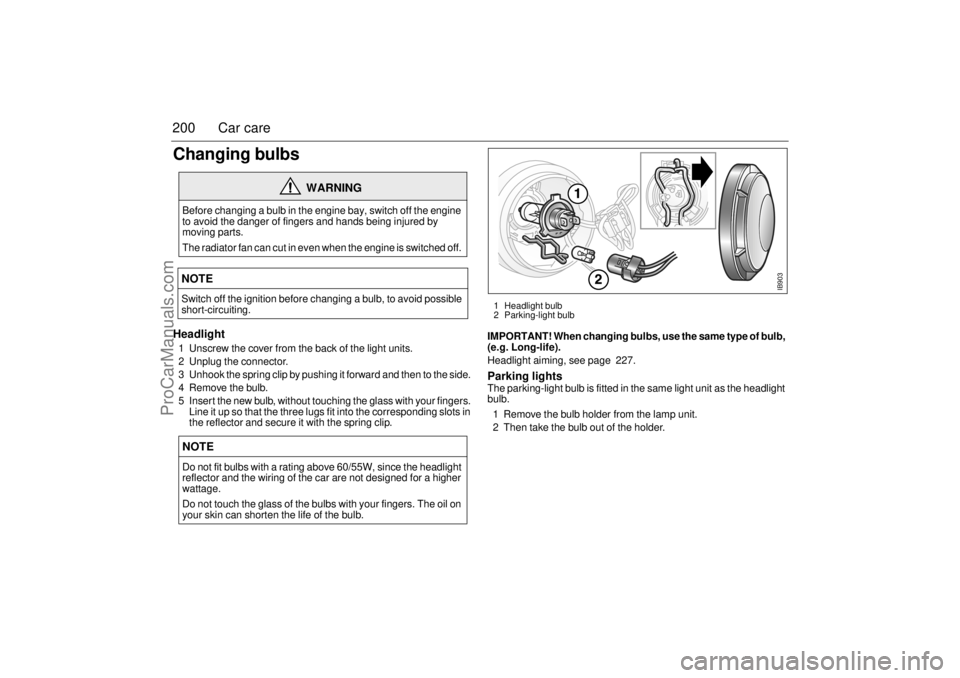
200 Car careChanging bulbs Headlight 1 Unscrew the cover from the back of the light units.
2 Unplug the connector.
3 Unhook the spring clip by pushing it forward and then to the side.
4 Remove the bulb.
5 Insert the new bulb, without touching the glass with your fingers.
Line it up so that the three lugs fit into the corresponding slots in
the reflector and secure it with the spring clip.IMPORTANT! When changing bulbs, use the same type of bulb,
(e.g. Long-life).
Headlight aiming, see page 227.
Parking lights The parking-light bulb is fitted in the same light unit as the headlight
bulb.
1 Remove the bulb holder from the lamp unit.
2 Then take the bulb out of the holder.
WARNING
Before changing a bulb in the engine bay, switch off the engine
to avoid the danger of fingers and hands being injured by
moving parts.
The radiator fan can cut in even when the engine is switched off. NOTESwitch off the ignition before changing a bulb, to avoid possible
short-circuiting. NOTEDo not fit bulbs with a rating above 60/55W, since the headlight
reflector and the wiring of the car are not designed for a higher
wattage.
Do not touch the glass of the bulbs with your fingers. The oil on
your skin can shorten the life of the bulb.
IB903
1 Headlight bulb
2 Parking-light bulb
ProCarManuals.com
Page 209 of 256

209 Car care
Relay holderUnder the instrument panel next to the steering wheel No. Amp Function
21 10 Switch, manual A/C; soft top (Convertible)
22 15 Direction indicators; Cruise Control
23 20 Soft top (Convertible); telephone
24 7.5 Radio
25 30 Central locking; amplifier
26 30 Control module, engine management system
27 15 High beam flash; ACC
28 10 Control module, engine management system
29 10 Right parking light; license plate lighting
30 10 Left parking light
31 20 Reversing light; windshield wipers; headlight
beam-length adjustment
32 15 Fuel pump
33 15 Electric heating of rear seat
34 10 SID; control module; automatic transmission
35 15 DICE/TWICE; main instrument panel; interior light-
ing
36 10 Relay, starter
37 15 Limp-home
38 25 Oxygen sensor (lambda probe)
39 – –
S–SpareItem Function
A Electric heating of rear seat
B Reversing light, cars with automatic transmission
C1 –
C2 Lock motor, trunk lid
D1 Rear wiper
D2 Rear-window washing
E Ignition switch
F–
G1 Horn
G2 Windshield wipers (intermittent)
H Rear-window heating
IFuel pump
J–
KStart relay
L Main relay (injection system)
ProCarManuals.com