sunroof SAAB 9-3 2002 Owners Manual
[x] Cancel search | Manufacturer: SAAB, Model Year: 2002, Model line: 9-3, Model: SAAB 9-3 2002Pages: 256, PDF Size: 11.55 MB
Page 4 of 256
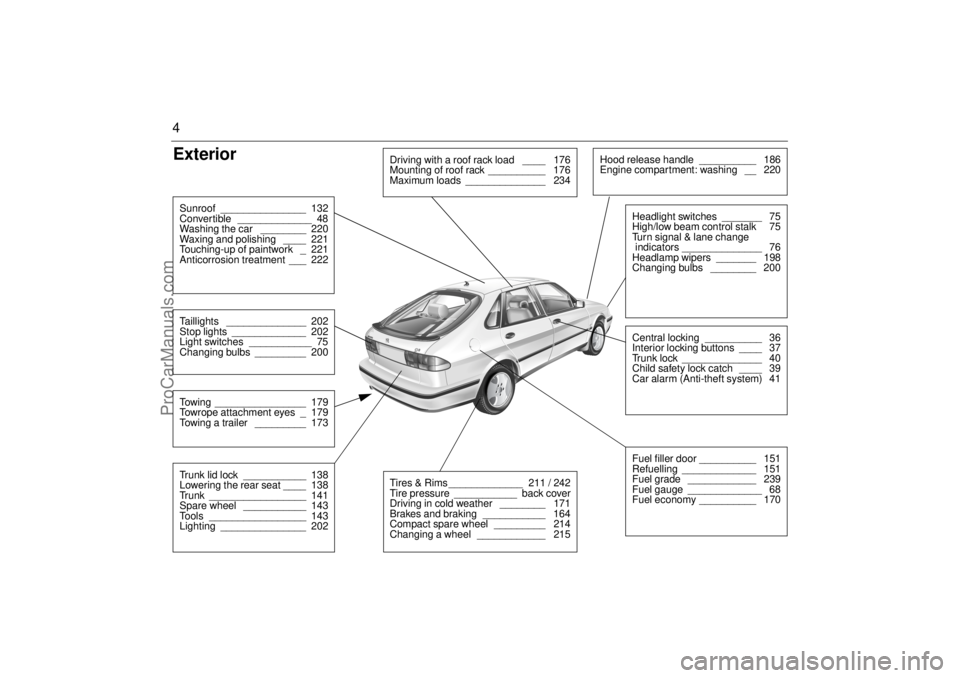
4Exterior Sunroof _______________ 132
Convertible _____________ 48
Washing the car ________ 220
Waxing and polishing ____ 221
Touching-up of paintwork _ 221
Anticorrosion treatment ___ 222Taillights ______________ 202
Stop lights _____________ 202
Light switches ___________ 75
Changing bulbs _________ 200Towing ________________ 179
Towrope attachment eyes _ 179
Towing a trailer _________ 173Trunk lid lock ___________ 138
Lowering the rear seat ____ 138
Trunk _________________ 141
Spare wheel ___________ 143
Tools _________________ 143
Lighting _______________ 202
Driving with a roof rack load ____ 176
Mounting of roof rack __________ 176
Maximum loads ______________ 234
Hood release handle __________ 186
Engine compartment: washing __ 220
Central locking __________ 36
Interior locking buttons ____ 37
Trunk lock ______________ 40
Child safety lock catch ____ 39
Car alarm (Anti-theft system) 41Headlight switches _______ 75
High/low beam control stalk 75
Turn signal & lane change
indicators ______________ 76
Headlamp wipers _______ 198
Changing bulbs ________ 200Fuel filler door __________ 151
Refuelling _____________ 151
Fuel grade ____________ 239
Fuel gauge _____________ 68
Fuel economy __________ 170
Tires & Rims _____________ 211 / 242
Tire pressure ___________ back cover
Driving in cold weather ________ 171
Brakes and braking ___________ 164
Compact spare wheel _________ 214
Changing a wheel ____________ 215
ProCarManuals.com
Page 5 of 256

5
Interior Power steering _________ 241
Steering-wheel adjustment 131
Airbag _________________ 28
Internal rearview mirror ________ 137
Door mirrors ________________ 137
Vanity mirror ________________ 134
Safety belts _____________ 12
Safety-belt care ________ 218
Airbag _________________ 28
Child seats _____________ 19
Child safety lock catch ____ 39Glove compartment _____ 135Manual transmission ____ 155
Automatic transmission __ 156
IB1353
Seat adjustment ________ 124
Safety belts _____________ 12
Seat heating ___________ 129
Rear seat _____________ 138
Folding down the rear seat 138
Child seats _____________ 19
Upholstery: cleaning _____ 219
Interior lighting switch _________ 133
Interior lighting: changing bulbs __ 204
Center console ______________ 130
Electric windows _____________ 130
Sunroof ____________________ 132
Convertible __________________ 48
Ignition switch _______________ 146
Starting the engine ___________ 147
Engine break-in period ________ 155
Parking ____________________ 168
Driving in hot/cold weather _____ 171
ProCarManuals.com
Page 84 of 256
84 Instruments and controlsAutomatic climate
control (ACC)The air is drawn in through an intake at the
bottom edge of the windshield. It passes
through an efficient filter before being
routed through the climate-control system
and into the cabin. The cabin discharge vent
is located on the right behind the rear
bumper. The air discharge vents should be
kept free of snow and ice in the winter.
ACC (Automatic Climate Control) automati-
cally maintains the desired cabin tempera-
ture, regardless of the weather outside.
The system will achieve the desired temper-
ature in the quickest possible way.
Note that heating or cooling is not
speeded up by setting the temperature
higher or lower than you really want.
For the ACC system to be most effective, all
windows, and the sunroof if there is one,
must be closed, and the panel vents must
be open.
The incoming air is treated in three stages:
first it passes through a filter; it is then dehu-
midified and cooled and, finally, if required,
heated. The temperature interval within which you
can make adjustments is 58-82°F
(15-27°C). Outside it, there is the HI position
(max. heat and high fan speed) and the LO
position (max. cooling and max. fan speed).
The displayed temperature is not the actual
temperature but corresponds to the comfort
level normally experienced at that tempera-
ture after allowance has been made for the
air flow, relative humidity, solar radiation,
etc., currently prevailing inside the car.
The most usual temperature setting is
66-74°F (19-23°C), depending on per-
sonal preference and what clothing is
worn. It is recommended that changes in the
temperature setting be made in steps of
2°F (1°C).
Conversion between °C and °F is done in
the SID unit; see ”Units and language ver-
sions”, page 74.
During the cooling phase in warm
weather the panel vents must be open.
Do not manually select recirculation in
cold/wintery weather. The reduced air
flow can cause misting and ice on the
inside of the windows.
IB794
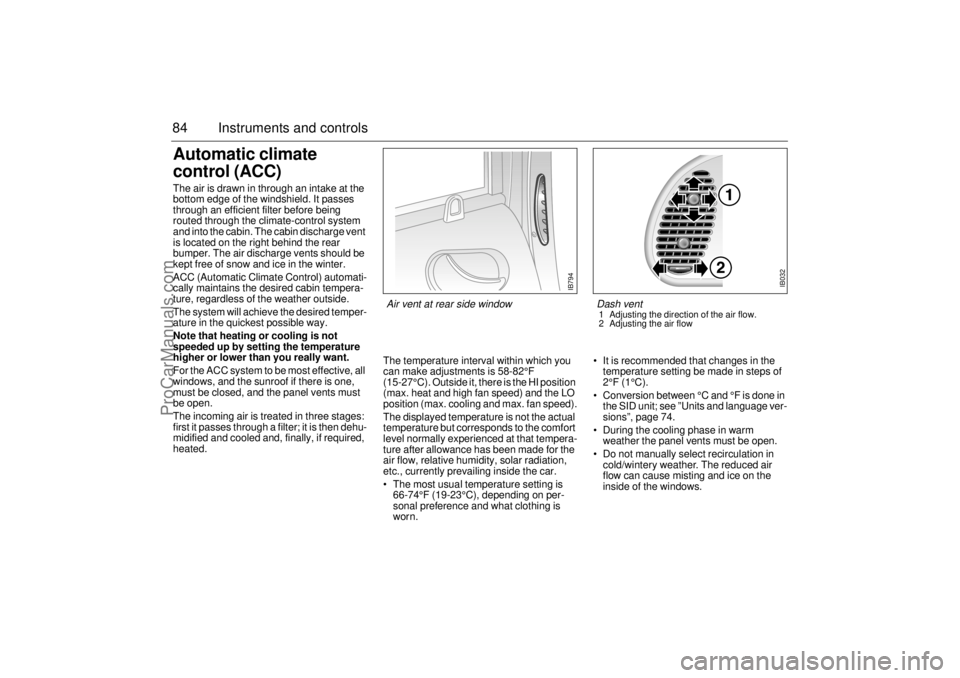
Air vent at rear side window
IB032
Dash vent 1 Adjusting the direction of the air flow.
2 Adjusting the air flow
ProCarManuals.com
Page 123 of 256
123 Interior equipment, trunk
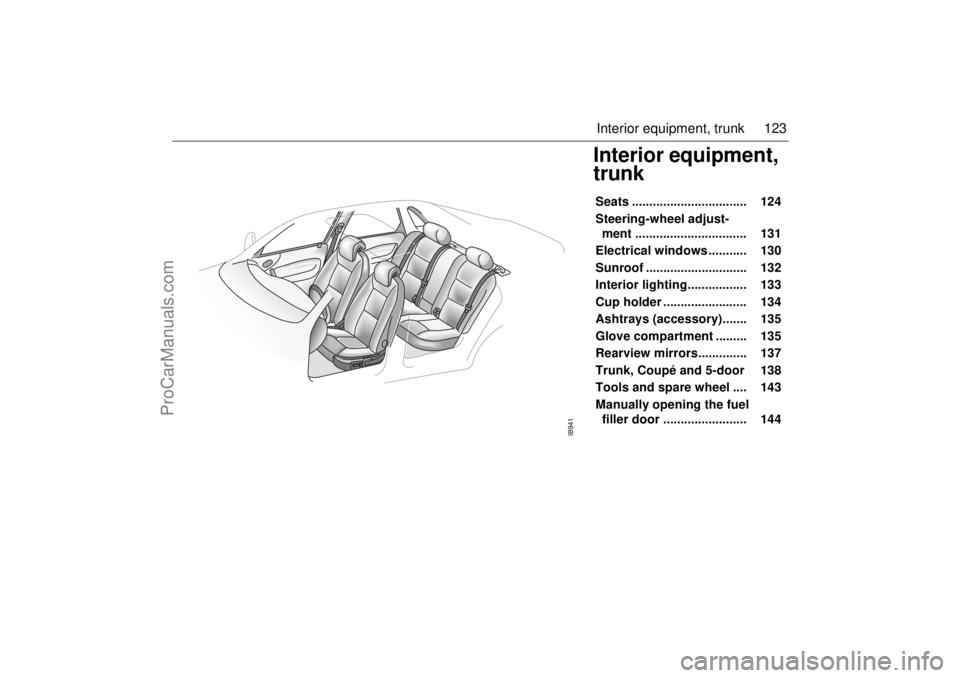
Interior equipment,
trunkSeats ................................. 124
Steering-wheel adjust-
ment ................................ 131
Electrical windows ........... 130
Sunroof ............................. 132
Interior lighting................. 133
Cup holder ........................ 134
Ashtrays (accessory)....... 135
Glove compartment ......... 135
Rearview mirrors.............. 137
Trunk, Coupé and 5-door 138
Tools and spare wheel .... 143
Manually opening the fuel
filler door ........................ 144
IB941
ProCarManuals.com
Page 130 of 256
130 Interior equipment, trunkElectrical windows The electric window motors are equipped
with overload protection. If this protection
should trip, wait several seconds before
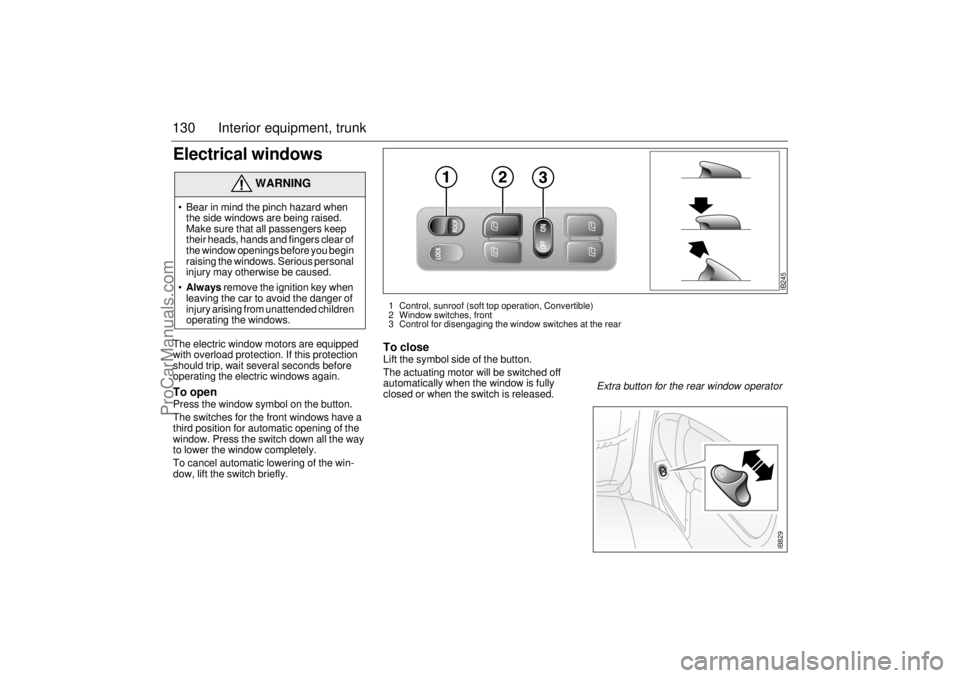
operating the electric windows again.To open Press the window symbol on the button.
The switches for the front windows have a
third position for automatic opening of the
window. Press the switch down all the way
to lower the window completely.
To cancel automatic lowering of the win-
dow, lift the switch briefly.
To close Lift the symbol side of the button.
The actuating motor will be switched off
automatically when the window is fully
closed or when the switch is released.
WARNING
Bear in mind the pinch hazard when
the side windows are being raised.
Make sure that all passengers keep
their heads, hands and fingers clear of
the window openings before you begin
raising the windows. Serious personal
injury may otherwise be caused.
Always remove the ignition key when
leaving the car to avoid the danger of
injury arising from unattended children
operating the windows.
IB245
1 Control, sunroof (soft top operation, Convertible)
2 Window switches, front
3 Control for disengaging the window switches at the rear
IB829
Extra button for the rear window operator
ProCarManuals.com
Page 132 of 256
132 Interior equipment, trunkSunroof
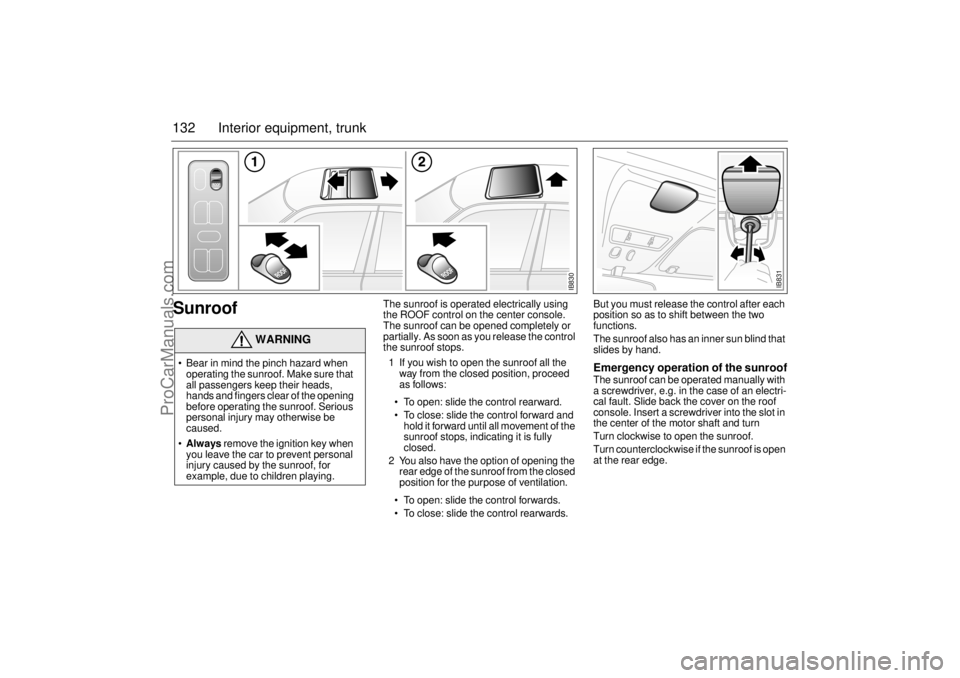
The sunroof is operated electrically using
the ROOF control on the center console.
The sunroof can be opened completely or
partially. As soon as you release the control
the sunroof stops.
1 If you wish to open the sunroof all the
way from the closed position, proceed
as follows:
To open: slide the control rearward.
To close: slide the control forward and
hold it forward until all movement of the
sunroof stops, indicating it is fully
closed.
2 You also have the option of opening the
rear edge of the sunroof from the closed
position for the purpose of ventilation.
To open: slide the control forwards.
To close: slide the control rearwards. But you must release the control after each
position so as to shift between the two
functions.
The sunroof also has an inner sun blind that
slides by hand.
Emergency operation of the sunroofThe sunroof can be operated manually with
a screwdriver, e.g. in the case of an electri-
cal fault. Slide back the cover on the roof
console. Insert a screwdriver into the slot in
the center of the motor shaft and turn
Turn clockwise to open the sunroof.
Turn counterclockwise if the sunroof is open
at the rear edge.
WARNING
Bear in mind the pinch hazard when
operating the sunroof. Make sure that
all passengers keep their heads,
hands and fingers clear of the opening
before operating the sunroof. Serious
personal injury may otherwise be
caused.
Always remove the ignition key when
you leave the car to prevent personal
injury caused by the sunroof, for
example, due to children playing.
IB830
IB831
ProCarManuals.com
Page 179 of 256
179 Starting and driving
Driving with the trunk lid
openAvoid driving with the trunk lid partly or fully
open, since exhaust fumes can be drawn
into the cabin.
If you must drive with the trunk lid open, all
windows and the sunroof (if fitted) must be
closed and the cabin fan on at its highest
speed setting.Driving in deep waterTowing the car
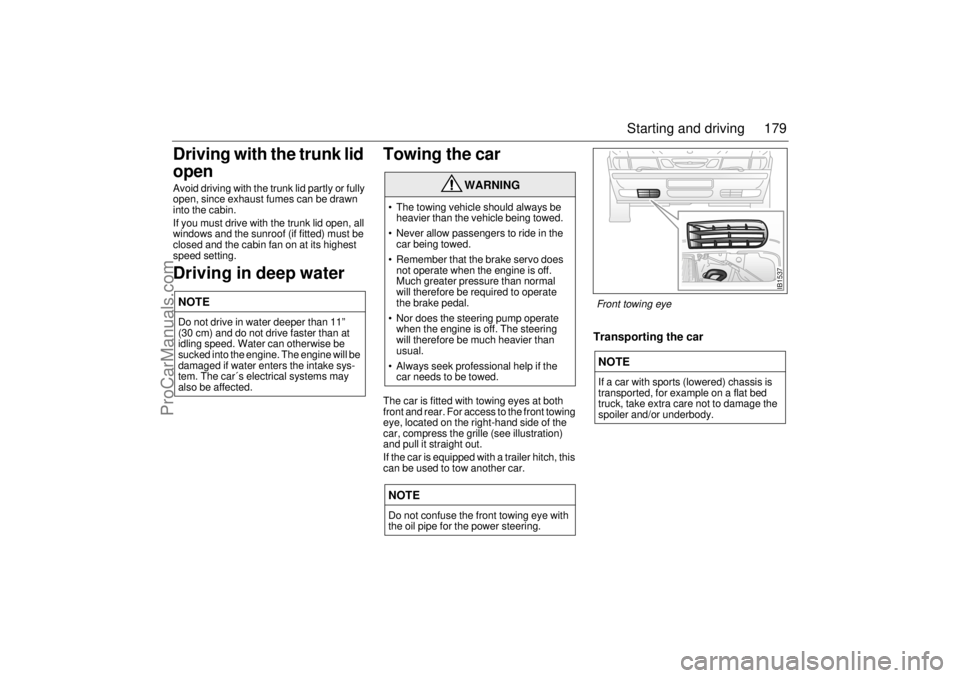
The car is fitted with towing eyes at both
front and rear. For access to the front towing
eye, located on the right-hand side of the
car, compress the grille (see illustration)
and pull it straight out.
If the car is equipped with a trailer hitch, this
can be used to tow another car.
Transporting the car NOTE
Do not drive in water deeper than 11”
(30 cm) and do not drive faster than at
idling speed. Water can otherwise be
sucked into the engine. The engine will be
damaged if water enters the intake sys-
tem. The car´s electrical systems may
also be affected.
WARNING
The towing vehicle should always be
heavier than the vehicle being towed.
Never allow passengers to ride in the
car being towed.
Remember that the brake servo does
not operate when the engine is off.
Much greater pressure than normal
will therefore be required to operate
the brake pedal.
Nor does the steering pump operate
when the engine is off. The steering
will therefore be much heavier than
usual.
Always seek professional help if the
car needs to be towed. NOTEDo not confuse the front towing eye with
the oil pipe for the power steering.
NOTEIf a car with sports (lowered) chassis is
transported, for example on a flat bed
truck, take extra care not to damage the
spoiler and/or underbody.
IB1537
Front towing eye
ProCarManuals.com
Page 208 of 256
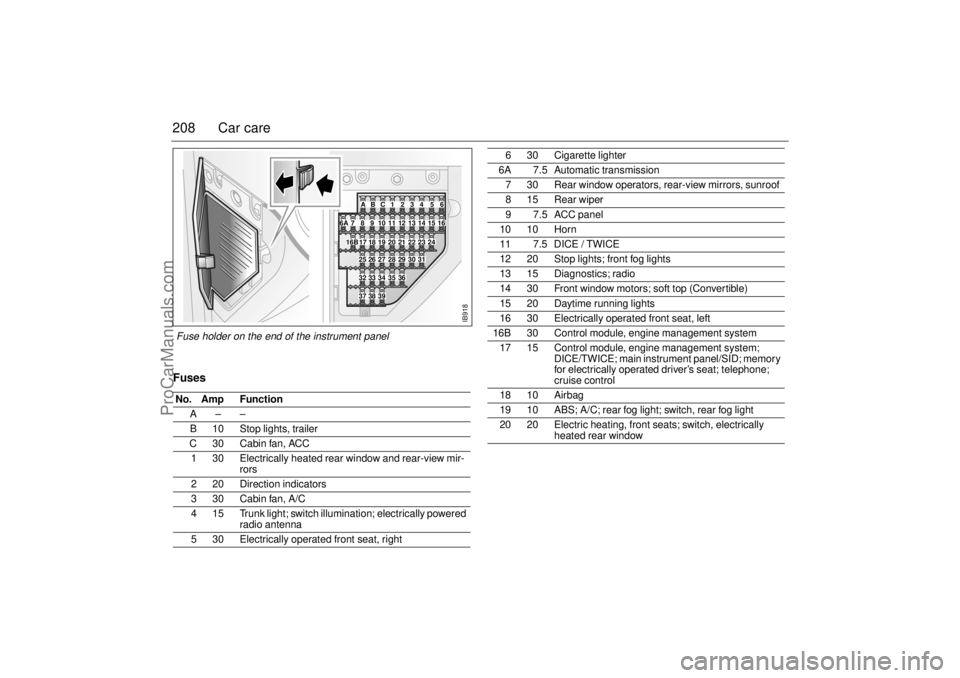
208 Car careFusesNo. Amp Function
A––
B 10 Stop lights, trailer
C 30 Cabin fan, ACC
1 30 Electrically heated rear window and rear-view mir-
rors
220Direction indicators
330Cabin fan, A/C
4 15 Trunk light; switch illumination; electrically powered
radio antenna
5 30 Electrically operated front seat, right
6 30 Cigarette lighter
6A 7.5 Automatic transmission
7 30 Rear window operators, rear-view mirrors, sunroof
8 15 Rear wiper
9 7.5 ACC panel
10 10 Horn
11 7.5 DICE / TWICE
12 20 Stop lights; front fog lights
13 15 Diagnostics; radio
14 30 Front window motors; soft top (Convertible)
15 20 Daytime running lights
16 30 Electrically operated front seat, left
16B 30 Control module, engine management system
17 15 Control module, engine management system;
DICE/TWICE; main instrument panel/SID; memory
for electrically operated driver’s seat; telephone;
cruise control
18 10 Airbag
19 10 ABS; A/C; rear fog light; switch, rear fog light
20 20 Electric heating, front seats; switch, electrically
heated rear window
30 10 20
30 30 15
15 15
10 10 10
10
10
10 30
30 10 20
15
15
15
10 10
20
10 20 20
20 20 15
15
30 15
15 10 15
15
IB918
1 C B A23456
7 6A 8 9 10 11 12 13 14 15 16
17 16B 18 19 20 21 22 23 2425 26 27 28 29 30 3132 33 34 35 3637 38 39
Fuse holder on the end of the instrument panel
ProCarManuals.com
Page 248 of 256

248 IndexElectrically adjustable seats
_______ 127
Electrically heated front seats ______ 129
Electrically heated rear window _____ 83
Electronic starting interlock
_________ 37
Emergency opening, fuel filler door
_144
Emergency operation of the soft top,
Convertible
____________________ 52
Emergency operation of the sunroof
_132
Emission control systems
_________ 188
Engine bay
____________________ 187
Engine bay, cleaning
_____________ 220
Engine break-in period ______ 155
, 170
Engine number
_________________ 243
Engine oil, changing
_____________ 190
Engine oil, checking _____________ 190
Engine oil, grade
________________ 237
Engine oil, volume _______________ 238
Engine variants
_________________ 239
Engine, description ______________ 188
Engine, technical data ____________ 237
FFault codes, Audio System
________ 109
Flat spot
______________________ 218
Folding the soft top, Convertible
_____ 49
For long trips
___________________ 184
Front fog lights __________________ 77
Fuel filler door, emergency opening
_144
Fuel gauge
_____________________ 68
Fuel grade _____________________ 239Fueling
_______________________151
Fuel-tank capacity
_______________239
Fuse table
_____________________208
Fuses
________________________206
GGearbox number
________________243
Gearbox oil, checking
____________191
Gearbox oil, grade
_______________240
General particulars ______________234
General safety instructions, Convertible
48
Glove compartment
______________135
HHandbrake
_____________________168
Hazard warning lights
_____________76
Head restraint
___________________18
Headlight flasher _________________75
Hood
_________________________186
Horn signal
____________________131
IIf the car does not start
___________147
Ignition switch
__________________146
Immobilizer
_____________________37
Important considerations concerning
cars with catalytic converters
_____150Important considerations for driving
148
Indicator lights
__________________ 60
Instrument lighting
_______________ 78
Integrated booster seat
___________ 26
Interior equipment
______________ 123
Interior lighting
_________________ 133
Interior lighting, Convertible
________ 58
Interior rearview mirror
__________ 137
JJack
_________________________ 215
Jump starting
__________________ 181
KKey
__________________________ 36
Key, removing
_________________ 146
LLATCH (child safety)
_____________ 21
Labels and plates
______________ 243
Leather upholstery, care of
_______ 219
Load eyes
____________________ 142
Locks
_________________________ 36
Lowering rear seat
______________ 138
Luggage compartment
__________ 138
Luggage compartment, Convertible
_56
Luggage-compartment lighting
____ 142
ProCarManuals.com
Page 250 of 256

250 IndexStorage compartments
___________ 136
Sunroof
_______________________ 132
Switches _______________________ 75
TTachometer
_____________________ 66
Technical data __________________ 233
Telematics
_____________________ 111
Temperature gauge
______________ 67
Textile carpeting, cleaning
________ 219
Through-load hatch
______________ 141
Tie-down eyes
__________________ 142
Tipping the rear seat
_____________ 138
Tire markings
__________________ 212
Tire pressure ___________________ 178
Tire pressures __________________ 211
Tires and wheels, sizes
___________ 242
Tools
_________________________ 143
Top tether
______________________ 23
Touching up paintwork
___________ 221
Towing a caravan or trailer ________ 173
Towing the car
_________________ 179
Traction Control System
__________ 166
Trailer hitch attachment __________ 173
Trailer hitch load
________________ 176
Transmission, automatic
__________ 156
Transmission, manual
____________ 155
Transporting the car
_____________ 179
Traveling abroad
________________ 184
Trip computer, SID _______________ 69Trip meter
______________________66
Trunk
_________________________138
Trunk lid lock, Convertible
__________56
Trunk lighting
___________________133
Trunk, Convertible
________________56
Trunk, opening
__________________40
Turbo gauge
____________________67
Turn signal
_____________________76
UUpholstery and trim
______________219
Upholstery and trim, care of
_______219
Useful tips on starting
____________148
Useful tips, ACC
_________________92
VVanity mirror
___________________137
WWarning and indicator lights
________60
Warning labels
___________________7
Warning light, AIR BAG (SRS)
______32
Washer fluid
___________________199
Washer jets ____________________199
Washers
_______________________78
Washing ______________________220
Waxing and polishing
____________221Wear indicators, brake pads
______ 194
Wear indicators, tires
____________ 214
Wheel, change
________________ 215
Wheels
______________________ 211
Wheels and tires, sizes
__________ 242
Window glass sensor, car alarm
____ 42
Windshield washers
_____________ 78
Windshield wipers
_______________ 78
Winter driving
_________________ 171
Wiper blades
__________________ 198
Wipers
________________________ 78
ProCarManuals.com