air condition SAAB 9-3 2003 User Guide
[x] Cancel search | Manufacturer: SAAB, Model Year: 2003, Model line: 9-3, Model: SAAB 9-3 2003Pages: 256, PDF Size: 21.66 MB
Page 171 of 256
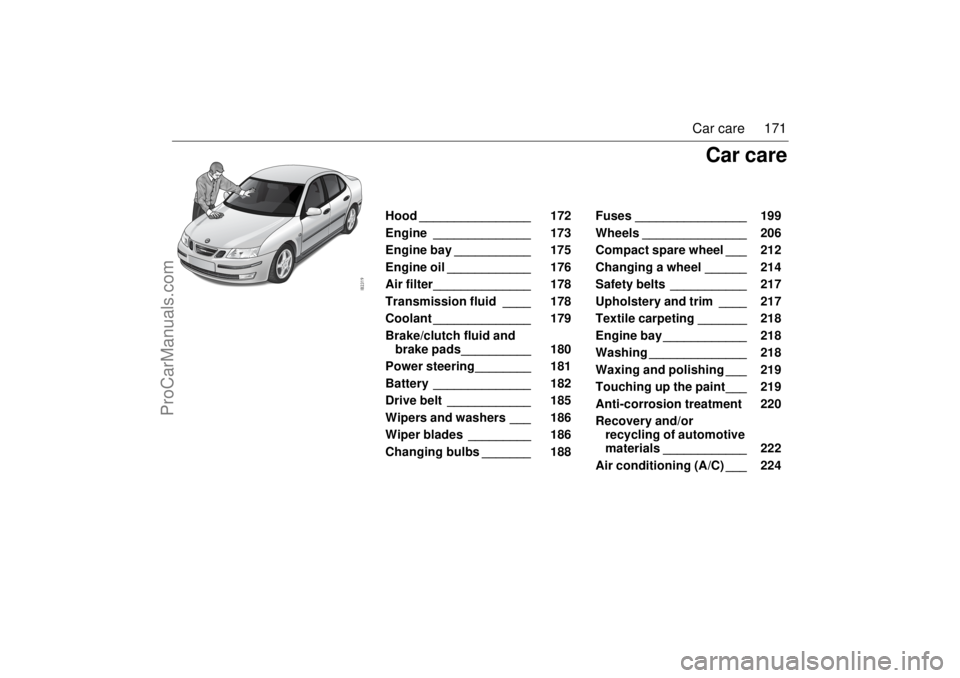
171 Car care
Hood ________________ 172
Engine ______________ 173
Engine bay ___________ 175
Engine oil ____________ 176
Air filter______________ 178
Transmission fluid ____ 178
Coolant ______________ 179
Brake/clutch fluid and
brake pads__________ 180
Power steering________ 181
Battery ______________ 182
Drive belt ____________ 185
Wipers and washers ___ 186
Wiper blades _________ 186
Changing bulbs _______ 188 Fuses ________________ 199
Wheels _______________ 206
Compact spare wheel ___ 212
Changing a wheel ______ 214
Safety belts ___________ 217
Upholstery and trim ____ 217
Textile carpeting _______ 218
Engine bay ____________ 218
Washing ______________ 218
Waxing and polishing ___ 219
Touching up the paint___ 219
Anti-corrosion treatment 220
Recovery and/or
recycling of automotive
materials ____________ 222
Air conditioning (A/C) ___ 224
Car care
ProCarManuals.com
Page 209 of 256

209 Car care
Malfunction
The message shown above will be dis-
played on the SID if:
a wheel without pressure sensor is fitted
(e.g. spare wheel)
one, two or three pressure sensors are
broken or missing
two or more detectors are missing or
broken
the receiver malfunctions
a fault arises in the system.
The message shown above is not displayed
if none of the wheels have sensors, such as
if winter wheels without sensors are fitted.
Shifting the wheelsBecause of front wheel drive, the front tires
tend to wear faster than the rear ones. New
tires should always be fitted in pairs, so that
tires on the same axle have the same
amount of tread.
The wheels should be marked, L (left) and
R (right), when changing between summer
and winter (snow) tires. This ensures that
the direction of rotation of the wheels is the
same when they are refitted. Fit the tires in
best condition to the rear wheels.
Store wheels lying flat or hanging – never
standing upright.
Tire markingsAn example of the meaning of the different
markings in a tire size is given below for a
tire size of 195/65 R15 91H: Tire pressure
system failure.
Contact Saab dealer.
WARNING
When fitting just one new pair of tires,
these should be fitted to the rear wheels,
as these are more critical to the direc-
tional stability of the car (e.g. on braking
or in a skid). The existing rear wheels
should therefore be moved to the front.
Always move rear left to front left and rear
right to front right, so that the direction of
rotation remains the same.
195 Tire section width, mm
65 Aspect ratio, i.e. the section height
as a percentage of the section
width
R Radial ply
15 Wheel rim diameter 15 in at bead
seats
91 Tire load index
H Speed rating
Tire load indices
91 Tire approved for max. 1355 lbs.
(615 kg)
93 Max. 1433 lbs. (650 kg)
94 Max. 1477 lbs. (670 kg)
Speed ratings
S Tire approved for speeds up to
110 mph (180 km/h)
T Max. 118 mph (190 km/h)
H Max. 130 mph (210 km/h)
V Max. 149 mph (240 km/h)
W Max. 168 mph (270 km/h)
Y Max. 186 mph (300 km/h)
ProCarManuals.com
Page 218 of 256

218 Car careCleaning and caring for leather
upholsteryThe principal reason for treating leather
upholstery is to maintain its elegant appear-
ance and to provide it with a protective film.
Discolouration caused by dust and wear
mainly affects the lighter shades, although
this is not detrimental to the leather, indeed,
the patina resulting from use is often consid-
ered desirable in leather. But if the leather is
allowed to become too grubby, it can start to
look shabby.
The leather upholstery should be cleaned
and reconditioned twice a year in conjunc-
tion with spring and autumn inspections. In
very warm, dry climates the leather may
need more regular reconditioning. Recom-
mended conditioner – Saab Leather Care
Lotion.
Do not use unknown harsh polishing
agents, cleaning agents, sprays, coarse
soap or hot water.
Textile carpetingTextile carpeting should be vacuum
cleaned regularly. Carpeting can also be
cleaned using a brush or sponge and carpet
shampoo.
For safety reasons, vacuum cleaners that
are not earthed (grounded) must not be
used out of doors.Engine bayThe engine bay should be cleaned with an
engine degreasant and rinsed with hot
water. The headlights must be covered
over. Do not use a pressure washer.
Do not use petrol as a cleaning agent or sol-
vent when carrying out repairs or mainte-
nance. Saab recommends the use of envi-
ronmentally-friendly degreasants.
WashingThe bodywork must be washed frequently.
When the car is new, the body should be
washed by hand using plain cold water and
a clean, soft brush through which the water
flows. Automatic carwashes should be
avoided when the car is new.
After 5–6 months the paintwork will have
hardened. To facilitate cleaning, a suitable
detergent can be added to the water, which
should be lukewarm.
Remove any bird droppings without delay,
as these can discolour the paintwork and
prove difficult to polish out. Lay a wad of wet
paper on the patch of dirt and leave it for a
minute or so. It will then be easy to wash off
the dirt.
Use a soft cloth moistened with white spirit
to remove splashes of tar or asphalt. Do not
use strong cleaners, as these can dry out
the paintwork.
The underside of the car also needs wash-
ing regularly, and this should be done extra NOTICEDo not use alcohol-based cleaners on the
plastic lenses of the front or rear lights, as
these can cause a crackling effect on the
lenses.
The door mirrors should be folded in
before the car enters an automatic car
wash.
ProCarManuals.com
Page 221 of 256

221 Car care
Use a hose to clean the underside of the car
thoroughly. After it has dried, use a brush or
spray to apply a viscous anti-corrosion
agent to any worn or damaged areas, to
prevent the onset of corrosion.
Even after the anti-corrosion warranty has
expired, it makes good sense to continue to
maintain the rustproofing.
Seams in the body, especially those in the
doors and trunk lid, are particularly vulnera-
ble to corrosion from the outside, caused by
grit and salt thrown up from the road, and to
corrosion from the inside, largely as a result
of condensation. Keep the seams clean and
at the first sign of any rust, apply a thin, pen-
etrating, anti-corrosion oil. Your Saab
dealer will be pleased to give you further
advice.
What causes rust?Steel body panels of automobiles are sub-
ject to rusting whenever air and moisture
manage to penetrate the protective finish.
Body panels may rust through if the process
is unchecked. Rusting can occur wherever
water is trapped or where the car’s panels
are continuously damp.
Damage to paint and undercoating by
stones, gravel and minor crashes immedi-
ately exposes metal to air and moisture.
Road salts used for de-icing will collect on
the bottom of the car and promote rusting.
Areas of the country with high humidity have
a greater potential for rust problems, espe-
cially where salt is used on roads or there is
moist sea air. Industrial pollution (fallout)
may also damage paint and promote rust-
ing.
Preventive maintenanceThe following procedures are necessary to
help protect against rusting. Refer also to
the terms and conditions of the Performa-
tion Limited Warranty described in the war-
ranty booklet.
1Wash the car frequently, and wax at
least twice a year. Under adverse
conditions, where there is a rapid
buildup of dirt, sand or road salt, wash
your car at least once a week. After
extreme exposure to salted snow or
slush, evidenced by a white film on the
car, wash the car immediately. Frequent
washing will prevent paint damage from
acid rain and other airborne contami-
nants such as tree sap and bird drop-
pings. If any of these contaminants are
noticed on the car the finish should be
washed immediately.
Begin washing by rinsing the entire car
with water to loosen and flush off heavy
concentrations of dirt (include the
underbody).
Sponge the car with a solution of either
a good quality car soap or mild general
purpose (dish washing) detergent and
water.
Rinse car thoroughly with clean water.
After washing, check and clear all
drains in doors and body panels.
Wipe the car dry, preferably using a
chamois.
ProCarManuals.com
Page 224 of 256

224 Car careAir conditioning (A/C)
TroubleshootingIf a fault occurs in the A/C system, there are
a number of checks you can perform your-
self. If the fault persists, however, have the
system checked at a Saab dealer.
Note:
When the A/C system is running, the intake
air is dehumidified. The resultant condensa-
tion that forms on the evaporator is drained
off under the car. When the car is parked,
this may result in a small puddle forming on
the ground. The warmer the air and the
higher the relative humidity, the more con-
densation will be produced.
Inadequate coolinga Check that the controls for temperature
and air distribution are correctly set; see
"Manual climate-control system" on
page 79.
b Check that the condenser (in front of the
radiator) has not become clogged with
dirt and insects.
c Make sure that the compressor drive
belt does not slip (see page 185).
d Check the fuses for the ventilation fans
and compressor (see page 201).
WARNING
All repairs and adjustments to the A/C
system must be carried out at a Saab
dealer authorized for this kind of work.
The A/C system is pressurized. Do not
break any connections or undo A/C
system components.
Escaping gas can cause eye injury or
other personal injury.NOTICE The A/C system is designed for use
with R134a refrigerant.
Refrigerant handling requires special
equipment and special procedures for
charging and draining the system.
Never mix R 134a with other refriger-
ants.
ProCarManuals.com
Page 230 of 256

230 Maintenance and owner assistanceMaintenance scheduleThe Maintenance Schedule prescribes a
service program to the purchaser/operator
of a Saab that is reasonable and necessary
to ensure the proper emission control sys-
tems function, safety and reliability of the
Saab automobile in normal use. Additional
maintenance is recommended for specific
components when the car is operated under
certain severe conditions. Proper mainte-
nance is always a good practice!
Authorized Saab dealers are equipped and
trained to meet your Saab’s service needs.
They regularly receive up-to-date Saab ser-
vice manuals and parts and technical ser-
vice bulletins from Saab and are able,
through their franchise agreement, to attend
Saab service schools, obtain Saab special
tools and technical assistance and pur-
chase original equipment service and
replacement parts.
Today’s complex automobiles should only
be entrusted to the most knowledgeable
service professionals. A Saab dealer is your
best choice.
SERVICE INTERVALSThe maintenance schedule begins with an
Inspection Service at 30 days. A time for
service message will illuminate on the Saab
Instrument Display (SID) when the car is
due for regular maintenance. There are twi
different messages that will appear:
TIME FOR INTERMEDIATE SERVICE
indicates that an oil/filter change is required
along with several inspections. This mes-
sage is set by the engine management
system which calculates service intervals
based on several factors including driving
habits, ambient temperature, number of
cold starts, mileage driven and elapsed time
since the last service. Based on this algo-
rithm, this message may appear at mileage
as low a 8,000 or as high as 15,000 miles.
If mileage accumulation does not occur, the
message will be set, and maintenance
required at a maximum of 2 years.
TIME FOR MAJOR SERVICE will be set
when additional maintenance is necessary,
such as air filter or spark plug replacement.
This message will appear at 30,000 mile
intervals. When either message is dis-
played, contact your Saab Dealer for a ser-
vice appointment.
Failure to perform scheduled maintenance
in a timely manner may result in serious
damage to key components or systems.
.NOTICEThe Check-up will be done by your Saab
dealer at no charge and should be done
as close as possible to the scheduled 30
days.
ProCarManuals.com
Page 231 of 256

231 Maintenance and owner assistance
Engine oil and filter changesChanging the engine oil and filter is required
at every service point. Use only a Saab
approved long-life oil filter and engine oils
meeting the SAE viscosity ratings and API
service classifications stated in the “Techni-
cal data” section of this Owner’s Manual.
The use of extra additives in the oil is not
necessary and is not recommended, and
may be harmful to turbochargers.
More frequent oil changes are recom-
mended if your vehicle is operated under
any of the following conditions:
Most trips are less than 5–10 miles (8–
16 km). This is particularly important
when outside temperatures are below
freezing.
Most trips include extensive idling
(frequent stop-and-go traffic).
Most trips are through dusty areas (such
as construction zones).
If the vehicle is used for delivery service,
police, taxi or other commercial applica-
tions.
If your driving habits match this description,
have the engine oil and filter changed in-
between normal services at 5,000 mile
(8,000 km) intervals. These conditions
cause the engine oil to break down faster.
The Warranties and Service Record Book-
let has provisions to record extra oil
changes.
Service record retentionIt is the owner’s responsibility to retain ser-
vice records. If possible, you should keep
copies of all shop work orders for all service
and repairs, whenever performed. As indi-
cated in the new car and emission control
system warranties, it is important to docu-
ment that all necessary maintenance has
been done.
HOW THE SERVICE RECORD IS ORGA-
NIZED
The service record is comprised of a main-
tenance log and a separate log sheet for list-
ing any additional service and repairs.
There are five coupons at the front of the
section, three of which are for documenting
extra engine oil and filter changes, one for
extra automatic transmission fluid services
necessary for severe service conditions,
one for brake fluid changes and one for
coolant flushes. These are followed by log
sheets for all normal scheduled mainte-
nance in the order it is to be performed,
beginning with the “First Service”.HOW TO USE THE SERVICE RECORD
COUPONS
When the car is brought to a Saab dealer for
scheduled maintenance, present the War-
ranties & Service Record Booklet to the ser-
vice manager. When the technician has
completed the service, the technician will
sign the maintenance record. The person
responsible for quality assurance at the
dealership will also sign and stamp the
record with the dealer identification stamp.
ProCarManuals.com
Page 251 of 256

251 Index
Index
AA/C
__________________________ 82
ABS brakes
___________________ 142
ACC
_________________________ 84
Adjustment, steering wheel
________ 98
Air conditioning
_________________ 82
Air filter
______________________ 178
Air pressure, tyres
______________ 207
Airbag
________________________ 26
Anchorage eyes
_______________ 118
Anti-corrosion treatment
_________ 220
Antilock braking system _________ 142
Anti-spin
_____________________ 144
Ashtrays _____________________ 108
Autochecking of lights, warning and
indicator lights
_________________ 58
Autodimming
______________ 111
, 112
Automatic climate control (ACC)
____ 84
Automatic transmission
__________ 134
Automatic tyre pressure monitoring
207
BBattery
______________________ 182
Bedding-in of new brake pads
____ 132
Before towing a trailer
___________ 160
Bonnet
______________________ 172Bootlid, driving when open
_______ 163
Bootlid, opening
________________ 41
Brake fluid, grade ______________ 242
Brakes
_______________________ 141
Braking ______________________ 141
Bulb changing
_________________ 188
Bulb table
____________________ 198
CCabin lighting
_________________ 105
Car alarm
_____________________ 46
Car transport __________________ 166
Care of air conditioning
__________ 225
Change of address notification
____ 232
Changing bulbs
________________ 188
Changing engine oil
____________ 177
Changing the battery, remote control
44
Changing wheels
______________ 214
Changing wiper blades
__________ 186
Checking the number of
remote controls
________________ 43
Checks before towing a trailer
____ 160
Child safety
____________________ 21
Child safety locks, rear doors
______ 42
Child seats
____________________ 21
Cigarette lighter
________________ 108
Cleaning the engine bay
_________ 218
Cleaning upholstery
____________ 217
Climate control system, manual
____ 79
Compact spare
________________ 212Compass
_____________________ 115
Condensation water, A/C
_________ 82
Coolant
______________________ 179
Cruise control
_________________ 140
Cup holder
____________________ 107
DDate codes, tyres
______________ 212
Deep water, driving through
______ 163
Direction indicator stalk switch _____ 75
Direction indicators
______________ 75
Donor battery, boost starting
______ 168
Door handles
___________________ 38
Door mirrors __________________ 110
Drive belt
_____________________ 185
Drive belt, length
_______________ 240
Driver’s seat with memory
_________ 19
Driving at night
________________ 163
Driving in cold climates
__________ 155
Driving in deep water
____________ 163
Driving in hot climates ___________ 156
Driving techniques
______________ 153
Driving with a heavy load on
hilly roads
___________________ 136
Driving with a load
______________ 162
Driving with a roof load
__________ 161
Driving with the bootlid open
______ 163
Driving with the compact
spare wheel
__________________ 167
ProCarManuals.com