automatic transmission SAAB 9-3 2003 User Guide
[x] Cancel search | Manufacturer: SAAB, Model Year: 2003, Model line: 9-3, Model: SAAB 9-3 2003Pages: 256, PDF Size: 21.66 MB
Page 136 of 256

136 Starting and drivingLock-upThe transmission’s torque converter has a
lock-up function. This can lock the torque
converter in 3rd, 4th and 5th gears, thus
reducing the engine speed and fuel con-
sumption.Kick-downWhen the accelerator is pressed down fully,
a down change is made to optimize acceler-
ation, e.g. for overtaking.
Following this, the next higher gear will be
selected at the optimum engine speed,
unless you ease off the accelerator before
reaching this. Kick-down works in manual
mode in 4th and 5th gears if the engine
speed is lower than 2,000 rpm.
Driving in hilly country with a heavy
loadThe transmission fluid can overheat when
the gearbox is strained, for example, when
driving with a trailer on hilly roads. To avoid
the transmission fluid overheating, always
drive with the selector lever in the D posi-
tion. The adaptive gear change patterns are
then active.
High air temperatures or a faulty oil cooler
can also cause the transmission fluid to
overheat. Overheating reduces the service
life of the fluid.TowingTowing of cars with automatic transmission,
see page 164.
Descending hillsIf the speed of the car increases while
descending a steep hill, despite the acceler-
ator being released, the control module will
change down to 4th gear. If you desire more
powerful engine braking, manually select a
lower gear (see page 139).
WARNING
Remember to use the braking effect of the
engine (1st, 2nd or 3rd gear) when you
are descending long or steep hills to
spare the brakes.
Overheating can cause the brakes to
fade!
ProCarManuals.com
Page 138 of 256
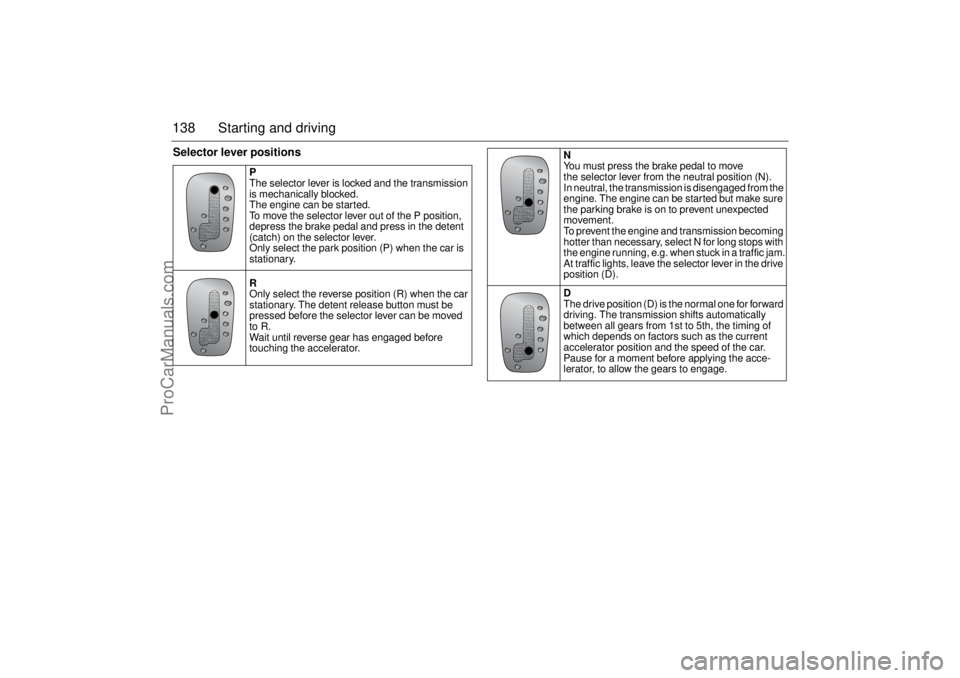
138 Starting and drivingSelector lever positions
P
The selector lever is locked and the transmission
is mechanically blocked.
The engine can be started.
To move the selector lever out of the P position,
depress the brake pedal and press in the detent
(catch) on the selector lever.
Only select the park position (P) when the car is
stationary.
R
Only select the reverse position (R) when the car
stationary. The detent release button must be
pressed before the selector lever can be moved
to R.
Wait until reverse gear has engaged before
touching the accelerator.
N
You must press the brake pedal to move
the selector lever from the neutral position (N).
In neutral, the transmission is disengaged from the
engine. The engine can be started but make sure
the parking brake is on to prevent unexpected
movement.
To prevent the engine and transmission becoming
hotter than necessary, select N for long stops with
the engine running, e.g. when stuck in a traffic jam.
At traffic lights, leave the selector lever in the drive
position (D).
D
The drive position (D) is the normal one for forward
driving. The transmission shifts automatically
between all gears from 1st to 5th, the timing of
which depends on factors such as the current
accelerator position and the speed of the car.
Pause for a moment before applying the acce-
lerator, to allow the gears to engage.
ProCarManuals.com
Page 141 of 256

141 Starting and driving
To reduce the preset speedYou can reduce speed in any of the follow-
ing ways:
Brake to the desired speed. Jog the
control to SET/+ or SET/–.
Jog the control to SET/– to reduce the
speed by 1 mph (1.6 km/h).
Hold the control in the SET/– position until
the desired speed is reached.Temporary increase in speedAccelerate, without shifting down (manual
transmission), to exceed the set speed such
as for overtaking. When you release the
accelerator, the car will return to the set
speed.To disengage the system
temporarilySlide the switch to the left towards OFF, but
only as far as to disengage the cruise con-
trol. Allow the switch to spring back.
To re-engage the systemSlide the switch to RESUME. The car will
return to the previously set speed. Vehicle
speed must exceed 15 mph (25 km/h).To disengage the systemThe system will be disengaged:
As soon as the brake or clutch pedal is
depressed (cars with manual transmis-
sion).
When the switch is slid to To disengage
the system temporarily.
When the switch is slid to OFF.
When the TCS/ESP system is operative.
When position N is selected (cars with
automatic transmission).
BrakingIt is good practice to try your brakes period-
ically while driving. This is particularly
important when driving in heavy rain, on
roads with a lot of surface water, in snow or
in salty slush. In such conditions a slight
delay in the braking effect may be noticed.
To minimize this delay, dry the brakes by
applying them lightly now and again. This
should also be done after the car has been
washed, and in extremely damp weather.
To avoid the brakes becoming overheated,
such as when negotiating long descents
with a drop of several hundred yards (hun-
dred metres), select a low gear to utilize the
braking effect of the engine. If the car has
automatic transmission, select 1st or 2nd
gear.
You can help to prolong the life of the brakes
by thinking ahead and braking harder over
short periods, rather than braking more
moderately over long stretches.
ProCarManuals.com
Page 155 of 256

155 Starting and driving
Driving in cold weatherIn cold weather, special attention should be
paid to the following:
Before driving off, make sure that the
wiper blades have not frozen to the wind-
shield.
Remove any snow from the heating
system air intakes between the hood and
the windshield.
If necessary, inject oil into the locks to
prevent them from freezing. Use molyb-
denum-sulphide oil (MoS
2). If the locks
freeze, exercise care when unlocking the
car (manual unlocking) to avoid breaking
the key. Warm up the key or use a de-icer.
It is particularly important when the roads
are slippery that the brakes and tires are
in good condition.
For how to check the level of antifreeze in
the engine coolant, see page 179. Add gasoline anti-freeze when refueling
several times before the onset of winter.
This will prevent condensation water in
the fuel tank from freezing and causing
interruptions in the fuel supply. The likeli-
hood of condensation is lowest when the
fuel tank is full.
If the car is parked outside and the
temperature is below zero, carburettor
spirit is of little use as it cannot remove
water that has already frozen. Park the
car in a warm place so that any ice that
may have built up melts, then add carbu-
rettor spirit when refueling.
Condensation is caused by temperature
fluctuations, either in the outside temper-
ature alone or when the car is alternately
parked outdoors and in a garage.
The car is equipped with tires designed to
provide optimum grip on both wet and dry
roads, although this has been achieved at
the expense of somewhat reduced grip on
snow and ice. For regular driving on snow
and ice, we therefore recommend that
winter (snow) tires be fitted.Winter tires, particularly studded tires,
generally make driving safer on snow and
ice.
Acquaint yourself with the legal provi-
sions governing the use of different
types of winter tires and snow chains.
Studded tires are not allowed in some
countries. If winter tires are fitted, the same
type must be fitted to all four wheels. Your
Saab dealer will be pleased to advise you on
the best tires for your car.
Remember that tires age: it may therefore
be necessary to change winter tires before
they reach the legal wear limit, as they grad-
ually lose their friction properties with age.
If you get into a front wheel skid and the car
has a manual transmission, the best
response is to freewheel, which means
declutching so that the wheels neither drive
nor brake, and to cautiously steer in the
desired direction.
If the car has automatic transmission, ease
off the accelerator slightly and steer cau-
tiously in the desired direction.
If you get into a rear wheel skid, steer in the
same direction as the movement of the rear
of the car.
ProCarManuals.com
Page 158 of 256
158 Starting and driving
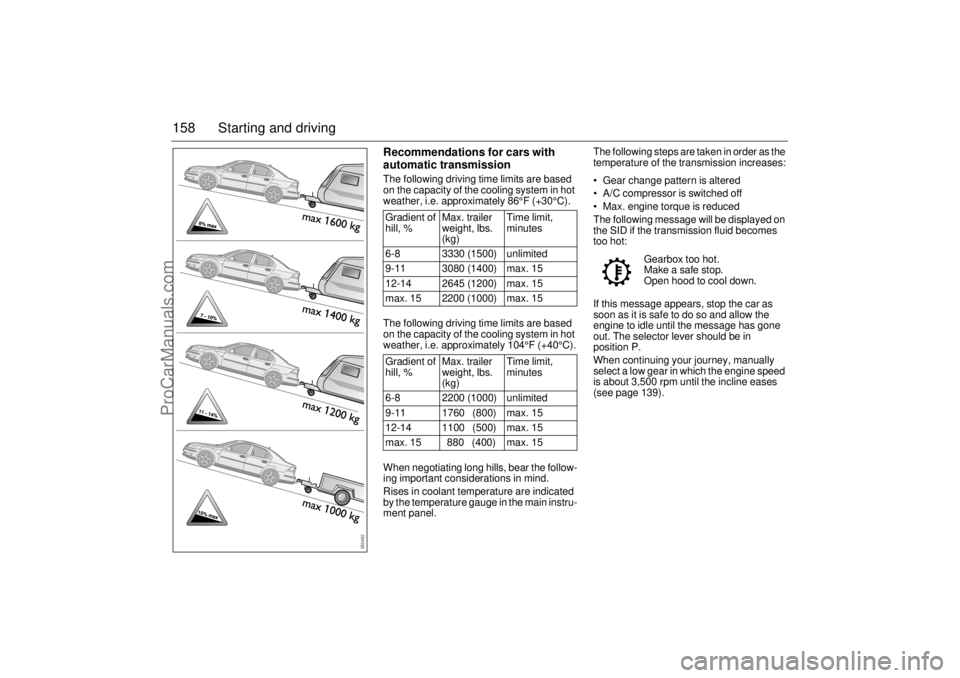
Recommendations for cars with
automatic transmissionThe following driving time limits are based
on the capacity of the cooling system in hot
weather, i.e. approximately 86°F (+30°C).
The following driving time limits are based
on the capacity of the cooling system in hot
weather, i.e. approximately 104°F (+40°C).
When negotiating long hills, bear the follow-
ing important considerations in mind.
Rises in coolant temperature are indicated
by the temperature gauge in the main instru-
ment panel.The following steps are taken in order as the
temperature of the transmission increases:
Gear change pattern is altered
A/C compressor is switched off
Max. engine torque is reduced
The following message will be displayed on
the SID if the transmission fluid becomes
too hot:
If this message appears, stop the car as
soon as it is safe to do so and allow the
engine to idle until the message has gone
out. The selector lever should be in
position P.
When continuing your journey, manually
select a low gear in which the engine speed
is about 3,500 rpm until the incline eases
(see page 139). Gradient of
hill, %Max. trailer
weight, lbs.
(kg)Time limit,
minutes
6-8 3330 (1500) unlimited
9-11 3080 (1400) max. 15
12-14 2645 (1200) max. 15
max. 15 2200 (1000) max. 15
Gradient of
hill, %Max. trailer
weight, lbs.
(kg)Time limit,
minutes
6-8 2200 (1000) unlimited
9-11 1760 (800) max. 15
12-14 1100 (500) max. 15
max. 15 880 (400) max. 15
Gearbox too hot.
Make a safe stop.
Open hood to cool down.
ProCarManuals.com
Page 160 of 256

160 Starting and drivingChecks before drivingMake sure that the car and trailer are in
good working order. This is essential since
towing a trailer increases the strain on the
car.
Check and if necessary adjust the tire
pressure of the car and trailer.
Make sure all wheel bolts are properly
tightened.
Make sure that the equipment joining the
car and trailer is properly secured and
adjusted.
Make sure the trailer’s electrical cable is
properly connected and is not so long that
it drags along the ground. Also, make
sure the cable is not too short and risks
breaking when turning a corner.
Check all bulbs.
Check the car and trailer brakes.
Make sure that all items on or in the cara-
van or trailer are properly secured.
Make sure that the trailer’s jockey wheel
is raised and locked.
Check the distribution of the load so that
the car and trailer are well balanced.
Check that the rearview mirrors provide
the best possible rearward vision.
Make sure the trailer’s safety cable is
correctly attached.
Driving considerationsAlways take extra care when towing a
trailer, as the car’s handling will be different
and its braking performance reduced. The
trailer’s braking system and suspension
also have a considerable effect on these
characteristics. See also "Driving with a
load" on page 162.
Drive carefully:
descending hills
on uneven roads
over railway crossings
when meeting large vehicles
If the car has automatic transmission, select
gear M1 when ascending or descending
steep hills.ReversingGet someone to help you keep an eye out
behind the trailer as the door mirrors do not
always provide sufficient rearward vision
when reversing.
ProCarManuals.com
Page 165 of 256
165 Starting and driving
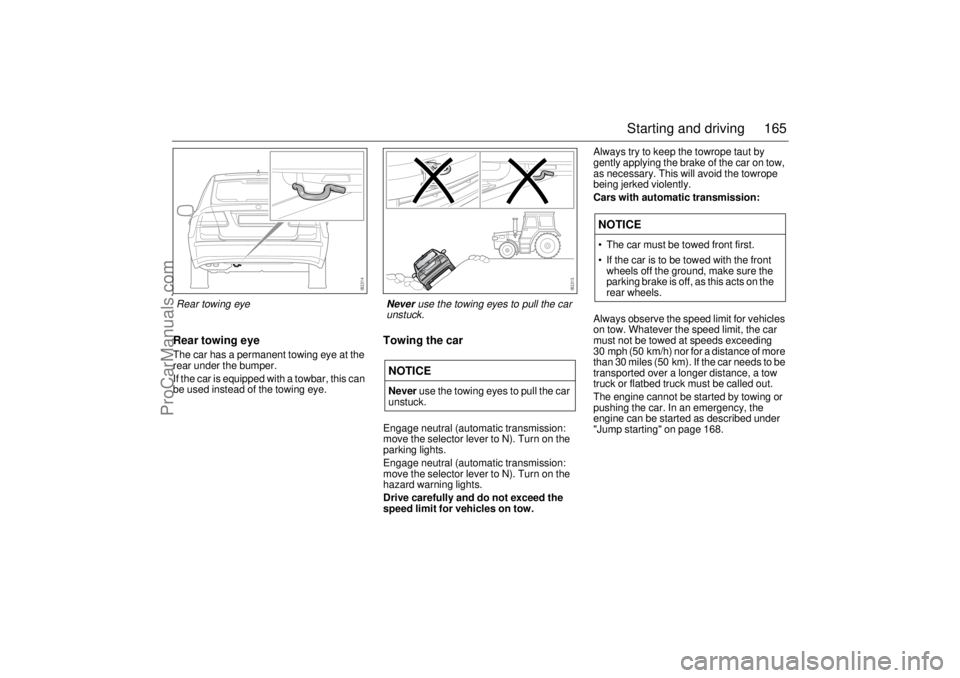
Rear towing eyeThe car has a permanent towing eye at the
rear under the bumper.
If the car is equipped with a towbar, this can
be used instead of the towing eye.
Towing the carEngage neutral (automatic transmission:
move the selector lever to N). Turn on the
parking lights.
Engage neutral (automatic transmission:
move the selector lever to N). Turn on the
hazard warning lights.
Drive carefully and do not exceed the
speed limit for vehicles on tow.Always try to keep the towrope taut by
gently applying the brake of the car on tow,
as necessary. This will avoid the towrope
being jerked violently.
Cars with automatic transmission:
Always observe the speed limit for vehicles
on tow. Whatever the speed limit, the car
must not be towed at speeds exceeding
30 mph (50 km/h) nor for a distance of more
than 30 miles (50 km). If the car needs to be
transported over a longer distance, a tow
truck or flatbed truck must be called out.
The engine cannot be started by towing or
pushing the car. In an emergency, the
engine can be started as described under
"Jump starting" on page 168.NOTICENever use the towing eyes to pull the car
unstuck.
NOTICE The car must be towed front first.
If the car is to be towed with the front
wheels off the ground, make sure the
parking brake is off, as this acts on the
rear wheels.
Rear towing eye
Never use the towing eyes to pull the car
unstuck.
ProCarManuals.com
Page 168 of 256
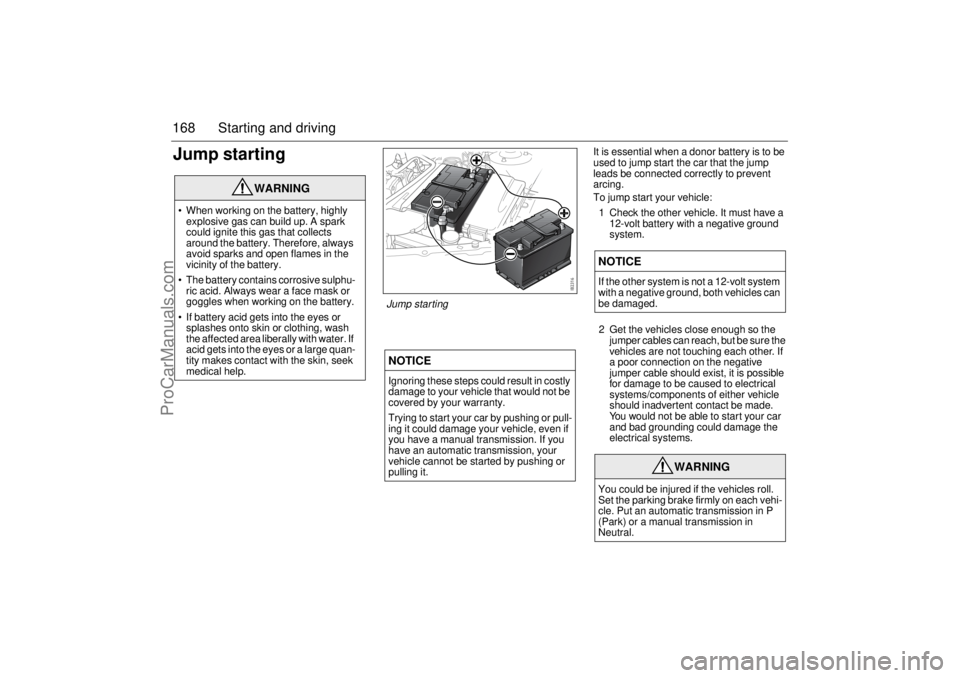
168 Starting and drivingJump starting
It is essential when a donor battery is to be
used to jump start the car that the jump
leads be connected correctly to prevent
arcing.
To jump start your vehicle:
1 Check the other vehicle. It must have a
12-volt battery with a negative ground
system.
2 Get the vehicles close enough so the
jumper cables can reach, but be sure the
vehicles are not touching each other. If
a poor connection on the negative
jumper cable should exist, it is possible
for damage to be caused to electrical
systems/components of either vehicle
should inadvertent contact be made.
You would not be able to start your car
and bad grounding could damage the
electrical systems.
WARNING
When working on the battery, highly
explosive gas can build up. A spark
could ignite this gas that collects
around the battery. Therefore, always
avoid sparks and open flames in the
vicinity of the battery.
The battery contains corrosive sulphu-
ric acid. Always wear a face mask or
goggles when working on the battery.
If battery acid gets into the eyes or
splashes onto skin or clothing, wash
the affected area liberally with water. If
acid gets into the eyes or a large quan-
tity makes contact with the skin, seek
medical help.
NOTICEIgnoring these steps could result in costly
damage to your vehicle that would not be
covered by your warranty.
Trying to start your car by pushing or pull-
ing it could damage your vehicle, even if
you have a manual transmission. If you
have an automatic transmission, your
vehicle cannot be started by pushing or
pulling it.
NOTICEIf the other system is not a 12-volt system
with a negative ground, both vehicles can
be damaged.
WARNING
You could be injured if the vehicles roll.
Set the parking brake firmly on each vehi-
cle. Put an automatic transmission in P
(Park) or a manual transmission in
Neutral.
Jump starting
ProCarManuals.com
Page 178 of 256
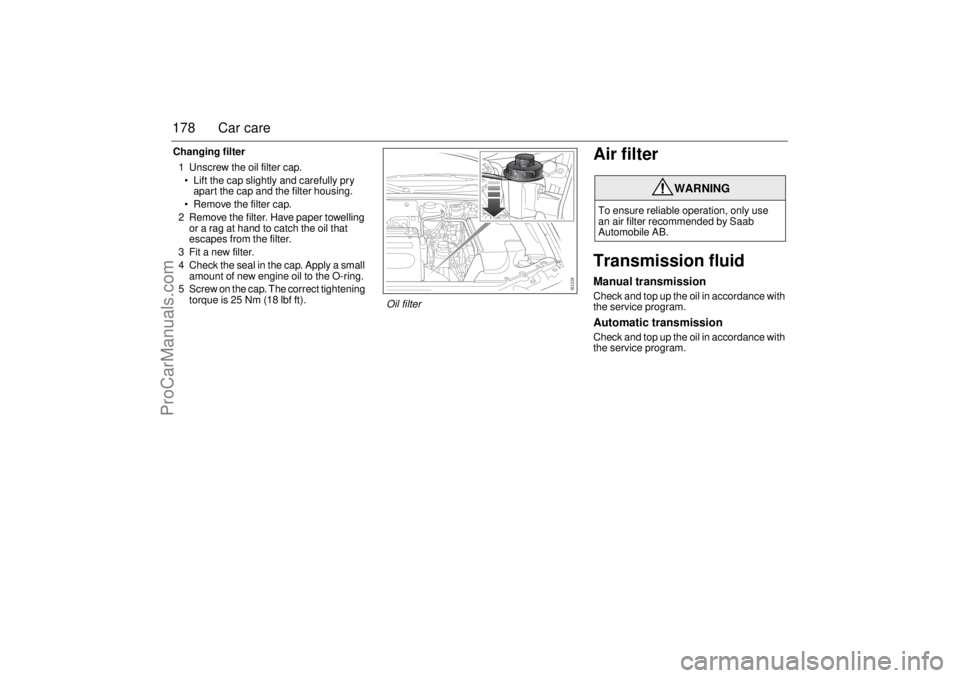
178 Car careChanging filter
1 Unscrew the oil filter cap.
Lift the cap slightly and carefully pry
apart the cap and the filter housing.
Remove the filter cap.
2 Remove the filter. Have paper towelling
or a rag at hand to catch the oil that
escapes from the filter.
3 Fit a new filter.
4 Check the seal in the cap. Apply a small
amount of new engine oil to the O-ring.
5 Screw on the cap. The correct tightening
torque is 25 Nm (18 lbf ft).
Air filter
Transmission fluidManual transmissionCheck and top up the oil in accordance with
the service program.Automatic transmissionCheck and top up the oil in accordance with
the service program.
WARNING
To ensure reliable operation, only use
an air filter recommended by Saab
Automobile AB.
Oil filter
ProCarManuals.com
Page 201 of 256
201 Car care
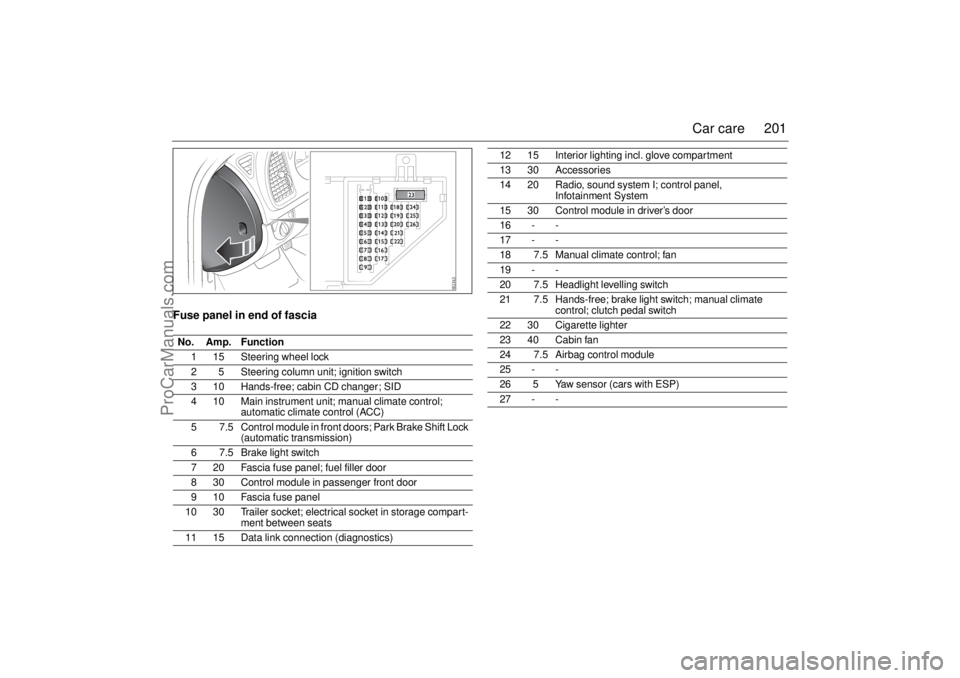
Fuse panel in end of fasciaNo. Amp. Function
1 15 Steering wheel lock
2 5 Steering column unit; ignition switch
3 10 Hands-free; cabin CD changer; SID
4 10 Main instrument unit; manual climate control;
automatic climate control (ACC)
5 7.5 Control module in front doors; Park Brake Shift Lock
(automatic transmission)
6 7.5 Brake light switch
7 20 Fascia fuse panel; fuel filler door
8 30 Control module in passenger front door
9 10 Fascia fuse panel
10 30 Trailer socket; electrical socket in storage compart-
ment between seats
11 15 Data link connection (diagnostics)
12 15 Interior lighting incl. glove compartment
13 30 Accessories
14 20 Radio, sound system I; control panel,
Infotainment System
15 30 Control module in driver’s door
16 - -
17 - -
18 7.5 Manual climate control; fan
19 - -
20 7.5 Headlight levelling switch
21 7.5 Hands-free; brake light switch; manual climate
control; clutch pedal switch
22 30 Cigarette lighter
23 40 Cabin fan
24 7.5 Airbag control module
25 - -
26 5 Yaw sensor (cars with ESP)
27 - -
ProCarManuals.com