brake fluid SAAB 9-3 2003 User Guide
[x] Cancel search | Manufacturer: SAAB, Model Year: 2003, Model line: 9-3, Model: SAAB 9-3 2003Pages: 256, PDF Size: 21.66 MB
Page 219 of 256

219 Car care
thoroughly at the end of winter. Clean the
underside of the car by hand if the car is usu-
ally washed in an automatic car wash with-
out special facilities for underbody cleaning.
Never wash or leave the car to dry in the
sun, but wipe it dry with a chamois leather
immediately after washing to avoid smears
and streaks.
Clean the inside of window glass using a
proprietary window cleaner. This is particu-
larly important when the car is new, as
upholstery and trim have a tendency to
sweat a little at first.
Keep the glass well polished, as this helps
to prevent misting.
Clean the outside of the windows with Saab
washer fluid. This is especially important if
the car has been washed in an automatic
car wash, as sometimes a wax treatment is
used that can contaminate the windshield
and impair the performance of the wipers.
Waxing and polishingDo not wax a new car during the first three
or four months. In fact, there is no need to
polish the car before the paintwork has
started to go dull through oxidation. Other
than in exceptional cases, do not use abra-
sive polishes containing a cutting agent on
a new car. Always wash the car thoroughly
before waxing or polishing.
Touching up the paintDamaged paintwork should be treated as
soon as it is discovered: the longer it is left,
the greater the risk of corrosion. The anti-
corrosion warranty does not cover corrosion
resulting from untreated defects.
Paintwork damage sustained in a crash is
usually extensive and can only be properly
restored by professionals.
However, you can repair small scratches
and stone chip damage yourself. The nec-
essary tools and materials, such as primer,
touch-up paint and brushes, are available
from your Saab dealer.
In the case of minor flaws in the paintwork,
where the metal has not been exposed and
an undamaged layer of paint remains,
touch-up paint can usually be applied
directly, after any dirt has been scraped
away using a pointed knife.
If corrosion has already set in, such as the
result of stone-chip damage, use a pointed
knife to scrape off all surface rust. If possi-
ble, the damaged area should be taken
back to the bare metal. The metal should
then be primed with two thin coats of primer
applied by brush.
After the primer has dried, apply several thin
layers of topcoat until the surface of the
repaired area is flush with the surrounding
paintwork.
Stir both primer and touch-up paint thor-
oughly before use and allow each coat to
dry before applying the next.
NOTICE Try your brakes on leaving a car wash.
Wet brake discs reduce the perfor-
mance of the brakes.
Fixed antennae, such as for a mobile
phone, must be removed if the car
goes through an automatic car wash.
Cars with Saab Parking Assistance:
Do not spray the sensors or closer
than 8 in. (20 cm) to the sensors with
a pressure washer, as this can
damage them.
ProCarManuals.com
Page 231 of 256

231 Maintenance and owner assistance
Engine oil and filter changesChanging the engine oil and filter is required
at every service point. Use only a Saab
approved long-life oil filter and engine oils
meeting the SAE viscosity ratings and API
service classifications stated in the “Techni-
cal data” section of this Owner’s Manual.
The use of extra additives in the oil is not
necessary and is not recommended, and
may be harmful to turbochargers.
More frequent oil changes are recom-
mended if your vehicle is operated under
any of the following conditions:
Most trips are less than 5–10 miles (8–
16 km). This is particularly important
when outside temperatures are below
freezing.
Most trips include extensive idling
(frequent stop-and-go traffic).
Most trips are through dusty areas (such
as construction zones).
If the vehicle is used for delivery service,
police, taxi or other commercial applica-
tions.
If your driving habits match this description,
have the engine oil and filter changed in-
between normal services at 5,000 mile
(8,000 km) intervals. These conditions
cause the engine oil to break down faster.
The Warranties and Service Record Book-
let has provisions to record extra oil
changes.
Service record retentionIt is the owner’s responsibility to retain ser-
vice records. If possible, you should keep
copies of all shop work orders for all service
and repairs, whenever performed. As indi-
cated in the new car and emission control
system warranties, it is important to docu-
ment that all necessary maintenance has
been done.
HOW THE SERVICE RECORD IS ORGA-
NIZED
The service record is comprised of a main-
tenance log and a separate log sheet for list-
ing any additional service and repairs.
There are five coupons at the front of the
section, three of which are for documenting
extra engine oil and filter changes, one for
extra automatic transmission fluid services
necessary for severe service conditions,
one for brake fluid changes and one for
coolant flushes. These are followed by log
sheets for all normal scheduled mainte-
nance in the order it is to be performed,
beginning with the “First Service”.HOW TO USE THE SERVICE RECORD
COUPONS
When the car is brought to a Saab dealer for
scheduled maintenance, present the War-
ranties & Service Record Booklet to the ser-
vice manager. When the technician has
completed the service, the technician will
sign the maintenance record. The person
responsible for quality assurance at the
dealership will also sign and stamp the
record with the dealer identification stamp.
ProCarManuals.com
Page 232 of 256

232 Maintenance and owner assistanceService costsDealer pricing practices and labor for ser-
vice work vary. Saab’s recommended ser-
vice times for each service point do not
include the labor required to replace wear
items, such as wiper blades, brake pads or
tires. Nor is labor to perform other service or
repairs found to be necessary as a result of
the inspections included in these times.
Additional labor and parts will be charged
for such work when necessary, except as
covered under an applicable Saab warranty
or any optional extended service contract.
Transmission fluid changes or suspension
alignment, when necessary, are also addi-
tional.
Dealer charges for general shop material,
regulated hazardous waste removal, recy-
cling expenses or other operation costs may
also be applied to service and repair
invoices and are apt to vary by dealer and
location.
Owner assistanceWarranties and service problem
assistanceFor complete information about all applica-
ble warranties, including the New Car War-
ranty, Perforation Warranty, Vehicle Emis-
sion Warranty and Emission Perforation
Warranty, consult the Warranties and Ser-
vice Record Booklet which accompanies
this Owner’s Manual. It also contains owner
assistance information including Saab
Roadside Assistance. If the booklet is lost or
misplaced, a new one may be ordered
through a Saab dealer or by contacting
Saab.
In the U.S. there is a national Customer
Assistance Center at Saab Cars USA, Inc.
The toll-free number to call from all 50 states
is 1-800-955-9007.
In Canada, please call the Saab Customer
Assistance Centre at 1-800-263-1999.
A list of authorized Saab sales and service
dealers is available for those planning to
travel in the United States and Canada.
Canadian or U.S. travelers may call the
Customer Assistance Center in the country
in which they are traveling.
Change of Address Notification
(U.S. and Canada)Two change of address cards are provided
at the end of the Warranties and Service
Record Booklet. Knowing your current
address allows Saab to contact you in the
event of a recall or service campaign.
Please help us keep our records up to date
for your own peace of mind.Service informationFactory Service Manuals for the Saab 9-3
and 9-5 car lines can be ordered through the
dealer. These are comprehensive manuals
on CD rom, geared to use by professional
technicians.
Consult your Saab dealer for prices for your
model.
ProCarManuals.com
Page 237 of 256
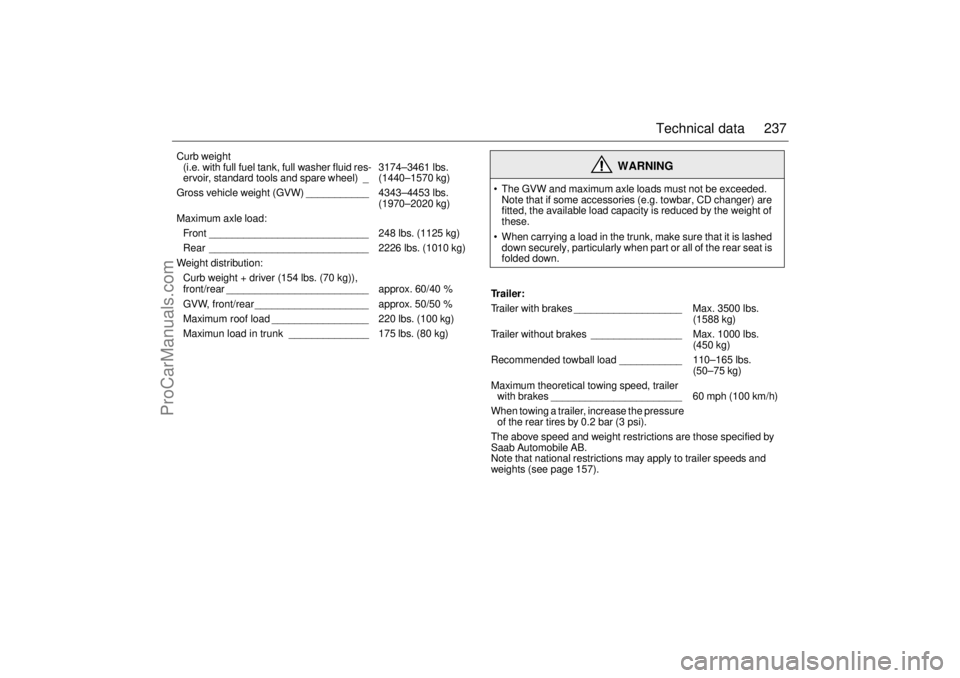
237 Technical data
Curb weight
(i.e. with full fuel tank, full washer fluid res-
ervoir, standard tools and spare wheel) _3174–3461 lbs.
(1440–1570 kg)
Gross vehicle weight (GVW) ___________ 4343–4453 lbs.
(1970–2020 kg)
Maximum axle load:
Front ____________________________ 248 lbs. (1125 kg)
Rear ____________________________ 2226 lbs. (1010 kg)
Weight distribution:
Curb weight + driver (154 lbs. (70 kg)),
front/rear _________________________ approx. 60/40 %
GVW, front/rear ____________________ approx. 50/50 %
Maximum roof load _________________ 220 lbs. (100 kg)
Maximun load in trunk ______________ 175 lbs. (80 kg)
WARNING
The GVW and maximum axle loads must not be exceeded.
Note that if some accessories (e.g. towbar, CD changer) are
fitted, the available load capacity is reduced by the weight of
these.
When carrying a load in the trunk, make sure that it is lashed
down securely, particularly when part or all of the rear seat is
folded down.
Trailer:
Trailer with brakes ___________________ Max. 3500 lbs.
(1588 kg)
Trailer without brakes ________________ Max. 1000 lbs.
(450 kg)
Recommended towball load ___________ 110–165 lbs.
(50–75 kg)
Maximum theoretical towing speed, trailer
with brakes _______________________ 60 mph (100 km/h)
When towing a trailer, increase the pressure
of the rear tires by 0.2 bar (3 psi).
The above speed and weight restrictions are those specified by
Saab Automobile AB.
Note that national restrictions may apply to trailer speeds and
weights (see page 157).
ProCarManuals.com
Page 242 of 256

242 Technical dataSuspension
SteeringBrake systemSpring type, front and rear_____________ Coil springs
Maximum deflection of springs:
Front ____________________________ 7.0'' (178 mm)
Rear ____________________________ 8.3'' (212 mm)
Dampers, front and rear ______________ Gas-filled dampers
Steering___________________________ Power-assisted
steering gear of
rack-pinion type and
telescopic jointed
steering column
Number of turns, lock to lock ___________ 3.0
Oil type ___________________________ Power steering fluid
CHF 11SFoot brake (ABS) ___________________ Hydraulic disc
brakes with vacuum
servo unit. Diago-
nally split circuits;
ventilated discs on
front wheels (some
variants also have
ventilated rear
discs). EBD function
(see page 142).
Handbrake ________________________ Acts on rear wheels
Brake fluid _________________________ To DOT 4.
Do not use DOT 5.
Disc diameter, 2.0t:
Front ____________________________ 11.22 in. (285 mm)
Rear ____________________________ 10.94 in. (278 mm)
Total friction area of brake pads:
Front ____________________________ 9.30 in.² (60 cm²)
Rear ____________________________ 4.96 in.² (32 cm²)
Disc diameter, 2.0 Turbo:
Front ____________________________ 11.89 in. (302 mm)
Rear ____________________________ 11.57 in. (294 mm)
Total friction area of brake pads:
Front ____________________________ 9.30 in.² (60 cm²)
Rear ____________________________ 4.96 in.² (32 cm²)
ProCarManuals.com
Page 249 of 256
249 Technical data
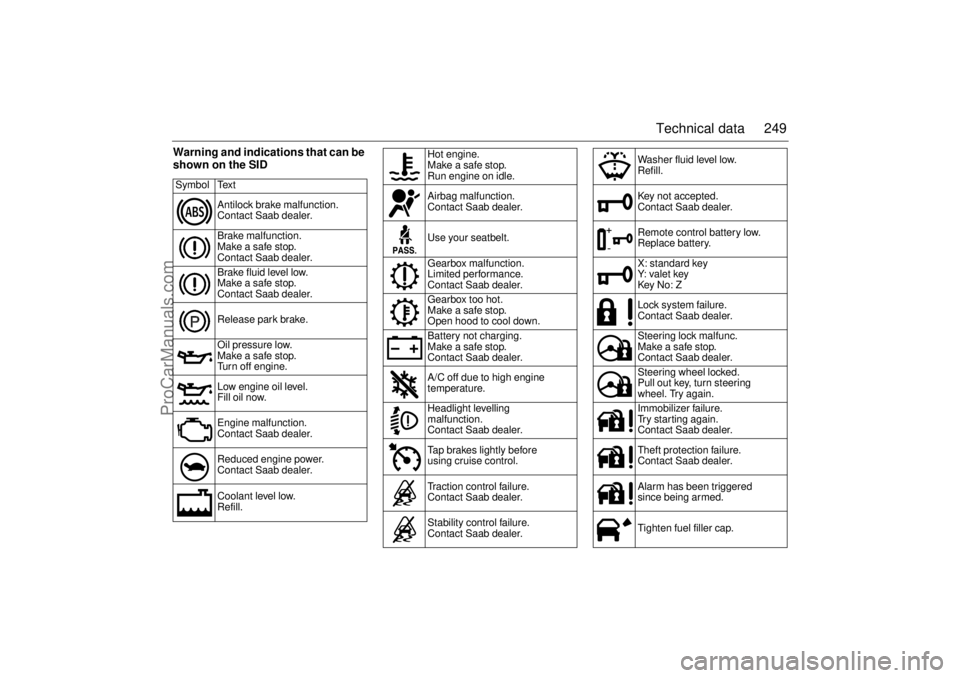
Warning and indications that can be
shown on the SIDSymbol Text
Antilock brake malfunction.
Contact Saab dealer.
Brake malfunction.
Make a safe stop.
Contact Saab dealer.
Brake fluid level low.
Make a safe stop.
Contact Saab dealer.
Release park brake.
Oil pressure low.
Make a safe stop.
Turn off engine.
Low engine oil level.
Fill oil now.
Engine malfunction.
Contact Saab dealer.
Reduced engine power.
Contact Saab dealer.
Coolant level low.
Refill.
Hot engine.
Make a safe stop.
Run engine on idle.
Airbag malfunction.
Contact Saab dealer.
Use your seatbelt.
Gearbox malfunction.
Limited performance.
Contact Saab dealer.
Gearbox too hot.
Make a safe stop.
Open hood to cool down.
Battery not charging.
Make a safe stop.
Contact Saab dealer.
A/C off due to high engine
temperature.
Headlight levelling
malfunction.
Contact Saab dealer.
Tap brakes lightly before
using cruise control.
Traction control failure.
Contact Saab dealer.
Stability control failure.
Contact Saab dealer.
Washer fluid level low.
Refill.
Key not accepted.
Contact Saab dealer.
Remote control battery low.
Replace battery.
X: standard key
Y: va l e t key
Key No: Z
Lock system failure.
Contact Saab dealer.
Steering lock malfunc.
Make a safe stop.
Contact Saab dealer.
Steering wheel locked.
Pull out key, turn steering
wheel. Try again.
Immobilizer failure.
Try starting again.
Contact Saab dealer.
Theft protection failure.
Contact Saab dealer.
Alarm has been triggered
since being armed.
Tighten fuel filler cap.
ProCarManuals.com
Page 251 of 256

251 Index
Index
AA/C
__________________________ 82
ABS brakes
___________________ 142
ACC
_________________________ 84
Adjustment, steering wheel
________ 98
Air conditioning
_________________ 82
Air filter
______________________ 178
Air pressure, tyres
______________ 207
Airbag
________________________ 26
Anchorage eyes
_______________ 118
Anti-corrosion treatment
_________ 220
Antilock braking system _________ 142
Anti-spin
_____________________ 144
Ashtrays _____________________ 108
Autochecking of lights, warning and
indicator lights
_________________ 58
Autodimming
______________ 111
, 112
Automatic climate control (ACC)
____ 84
Automatic transmission
__________ 134
Automatic tyre pressure monitoring
207
BBattery
______________________ 182
Bedding-in of new brake pads
____ 132
Before towing a trailer
___________ 160
Bonnet
______________________ 172Bootlid, driving when open
_______ 163
Bootlid, opening
________________ 41
Brake fluid, grade ______________ 242
Brakes
_______________________ 141
Braking ______________________ 141
Bulb changing
_________________ 188
Bulb table
____________________ 198
CCabin lighting
_________________ 105
Car alarm
_____________________ 46
Car transport __________________ 166
Care of air conditioning
__________ 225
Change of address notification
____ 232
Changing bulbs
________________ 188
Changing engine oil
____________ 177
Changing the battery, remote control
44
Changing wheels
______________ 214
Changing wiper blades
__________ 186
Checking the number of
remote controls
________________ 43
Checks before towing a trailer
____ 160
Child safety
____________________ 21
Child safety locks, rear doors
______ 42
Child seats
____________________ 21
Cigarette lighter
________________ 108
Cleaning the engine bay
_________ 218
Cleaning upholstery
____________ 217
Climate control system, manual
____ 79
Compact spare
________________ 212Compass
_____________________ 115
Condensation water, A/C
_________ 82
Coolant
______________________ 179
Cruise control
_________________ 140
Cup holder
____________________ 107
DDate codes, tyres
______________ 212
Deep water, driving through
______ 163
Direction indicator stalk switch _____ 75
Direction indicators
______________ 75
Donor battery, boost starting
______ 168
Door handles
___________________ 38
Door mirrors __________________ 110
Drive belt
_____________________ 185
Drive belt, length
_______________ 240
Driver’s seat with memory
_________ 19
Driving at night
________________ 163
Driving in cold climates
__________ 155
Driving in deep water
____________ 163
Driving in hot climates ___________ 156
Driving techniques
______________ 153
Driving with a heavy load on
hilly roads
___________________ 136
Driving with a load
______________ 162
Driving with a roof load
__________ 161
Driving with the bootlid open
______ 163
Driving with the compact
spare wheel
__________________ 167
ProCarManuals.com
Page 253 of 256

253 Index
LLATCH (child safety)
_____________ 22
Labels and plates, location
_______ 246
Lashing eyes
__________________ 118
Laying the car up
______________ 150
Leather upholstery, cleaning
______ 218
Limp-home
___________________ 126
Limp-home, automatic transmission
137
Load carriers, roof
______________ 161
Load indices, tyres _____________ 209
Load-through hatch _____________ 117
Locking a car with flat battery
______ 41
Locks
________________________ 38
Long-term parking
______________ 150
Luggage compartment
__________ 116
Luggage compartment lighting
106
, 119
Luggage compartment lighting,
changing
____________________ 197
MMAXI fuses
___________________ 200
Main instrument panel
___________ 54
Main/dipped beam
______________ 72
Maintenance schedule __________ 230
Manual climate control ___________ 79
Manual gear selection ___________ 139
Manual gearbox
_______________ 133
Manual tripping of car alarm
_______ 49
Materials used in the car, reclamation
222Memory, driver’s seat
____________ 19
Milometer
_____________________ 59
Movement sensor, car alarm
______ 48
Mug holder
___________________ 107
NNight driving
__________________ 163
Number plate lighting, changing
___ 196
OORVR
_______________________ 174
Oil capacity, engine
_____________ 239
Opening handles
________________ 38
Opening the fuel filler flap manually
_52
Owner assistance
______________ 232
PPanic function, car alarm
_________ 49
Park Brake Shift Lock
___________ 135
Park Brake Shift Lock,
temporary override
____________ 137
Parking
______________________ 148
Parking aid ___________________ 151
Parking brake _________________ 148
Parking on a hill _______________ 149
Pinch protection, electric windows
_100
Pinch protection, sunroof
________ 104Plates and labels, location
________ 246
Polishing and waxing
____________ 219
Poly-V-belt
____________________ 185
Position lights __________________ 72
Power steering fluid, checking
_____ 181
Power steering fluid, grade
_______ 242
Pressure gauge
_________________ 61
Profiles, customized settings
_______ 64
Puncture, changing wheels _______ 214
QQuick guide, remote control
_______ 39
RRain sensor
____________________ 77
Rear fog light ___________________ 74
Rear seats, folding down
_________ 116
Rear towing eye
_______________ 165
Rear window heating
_____________ 83
Rearview mirrors
_______________ 110
Recirculation
___________________ 82
Recommendations for automatic
transmission, towing a trailer
____ 158
Recommendations for manual
gearbox, towing a trailer
________ 159
Recommended fuel grades _______ 128
Recommended snow chains ______ 243
Refueling
_____________________ 128
ProCarManuals.com