tires SAAB 9-3 2003 User Guide
[x] Cancel search | Manufacturer: SAAB, Model Year: 2003, Model line: 9-3, Model: SAAB 9-3 2003Pages: 256, PDF Size: 21.66 MB
Page 209 of 256

209 Car care
Malfunction
The message shown above will be dis-
played on the SID if:
a wheel without pressure sensor is fitted
(e.g. spare wheel)
one, two or three pressure sensors are
broken or missing
two or more detectors are missing or
broken
the receiver malfunctions
a fault arises in the system.
The message shown above is not displayed
if none of the wheels have sensors, such as
if winter wheels without sensors are fitted.
Shifting the wheelsBecause of front wheel drive, the front tires
tend to wear faster than the rear ones. New
tires should always be fitted in pairs, so that
tires on the same axle have the same
amount of tread.
The wheels should be marked, L (left) and
R (right), when changing between summer
and winter (snow) tires. This ensures that
the direction of rotation of the wheels is the
same when they are refitted. Fit the tires in
best condition to the rear wheels.
Store wheels lying flat or hanging – never
standing upright.
Tire markingsAn example of the meaning of the different
markings in a tire size is given below for a
tire size of 195/65 R15 91H: Tire pressure
system failure.
Contact Saab dealer.
WARNING
When fitting just one new pair of tires,
these should be fitted to the rear wheels,
as these are more critical to the direc-
tional stability of the car (e.g. on braking
or in a skid). The existing rear wheels
should therefore be moved to the front.
Always move rear left to front left and rear
right to front right, so that the direction of
rotation remains the same.
195 Tire section width, mm
65 Aspect ratio, i.e. the section height
as a percentage of the section
width
R Radial ply
15 Wheel rim diameter 15 in at bead
seats
91 Tire load index
H Speed rating
Tire load indices
91 Tire approved for max. 1355 lbs.
(615 kg)
93 Max. 1433 lbs. (650 kg)
94 Max. 1477 lbs. (670 kg)
Speed ratings
S Tire approved for speeds up to
110 mph (180 km/h)
T Max. 118 mph (190 km/h)
H Max. 130 mph (210 km/h)
V Max. 149 mph (240 km/h)
W Max. 168 mph (270 km/h)
Y Max. 186 mph (300 km/h)
ProCarManuals.com
Page 210 of 256
210 Car careWinter tiresWinter (snow) tires are recommended for
winter climates where the majority of your
driving will be done on snow and ice. Winter
tires should be fitted to all four wheels to
maintain a proper balance. Your Saab
dealer can advise you of to the correct size
tire for your car (if different from the original
size) and also supply Saab approved winter
tires pre-mounted on steel or alloy rims.Tire quality grading (cars sold in
U.S.)New tires must be graded and labeled in
accordance with new Federal regulations.
Standard tests are conducted to measure
performance in the areas of traction and
temperature resistance. Refer to the tire
sidewall for the specific quality grades of the
tires provided on your new Saab. Compact
spare tires are exempt.
DOT QUALITY GRADES
Treadwear.
Traction AA, A, B, C.
Temperature A, B, C.
All passenger car tires must conform to Fed-
eral safety requirements in addition to these
grades.
Uniform Tire Quality Grading (US)Quality grades can be found where applica-
ble on the tire sidewall between tread shoul-
der and maximum section width. For exam-
ple:
Treadwear 200 Traction AA
Temperature ATreadwearThe treadwear grade is a comparative
rating based on the wear rate of the tire
when tested under controlled conditions on
a specified government test course. For
example, a tire graded 150 would wear one
and one half (1 1/2) times as well on the gov-
ernment course as a tire graded 100. The
relative performance of tires depends upon
the actual conditions of their use, however,
and may depart significantly from the norm
due to variations in driving habits, service
practices and differences in road character-
istics and climate.
TractionThe traction grades, from highest to lowest,
are AA, A, B and C. These grades represent
the tire’s ability to stop on wet pavement as
measured under controlled conditions on
specified government test surfaces of
asphalt and concrete. A tire marked C may
have poor traction performance.
WARNING
The traction grade assigned to a tire is
based on straight-ahead braking, traction
test and does not include acceleration,
cornering, hydroplaning or peak traction
characteristics.
ProCarManuals.com
Page 211 of 256
211 Car care
TemperatureThe temperature grades are A (the highest),
B, and C, representing the tire’s resistance
to the generation of heat and its ability to dis-
sipate heat when tested under controlled
conditions on a specified indoor laboratory
test wheel. Sustained high temperature can
cause the material of the tire to degenerate
and reduce tire life. Excessive temperature
can lead to sudden tire failure. The grade C
corresponds to a level of performance
which all passenger car tires must meet
under the Federal Motor Vehicle Safety
Standard No. 109.
Grades B and A represent higher levels of
performance on the laboratory test wheel
than the minimum required by law.
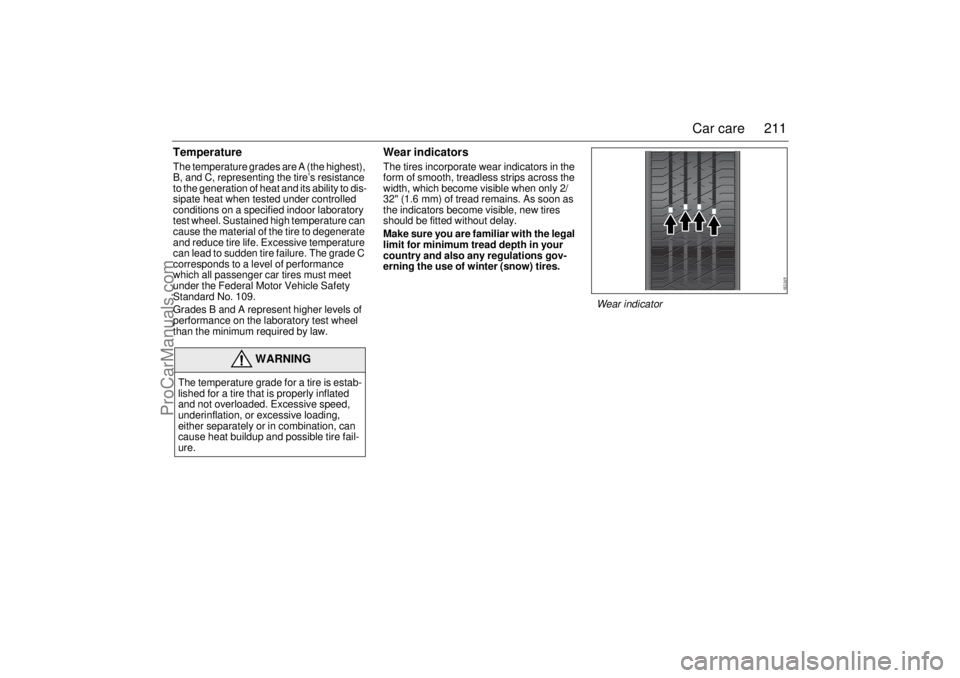
Wear indicatorsThe tires incorporate wear indicators in the
form of smooth, treadless strips across the
width, which become visible when only 2/
32" (1.6 mm) of tread remains. As soon as
the indicators become visible, new tires
should be fitted without delay.
Make sure you are familiar with the legal
limit for minimum tread depth in your
country and also any regulations gov-
erning the use of winter (snow) tires.
WARNING
The temperature grade for a tire is estab-
lished for a tire that is properly inflated
and not overloaded. Excessive speed,
underinflation, or excessive loading,
either separately or in combination, can
cause heat buildup and possible tire fail-
ure.
Wear indicator
ProCarManuals.com
Page 212 of 256
212 Car careTire date codeTires should be regarded as perishable
goods. As the tires age, the rubber becomes
progressively harder, and the roadholding
ability of the tires diminishes. This is partic-
ularly true on winter tires.
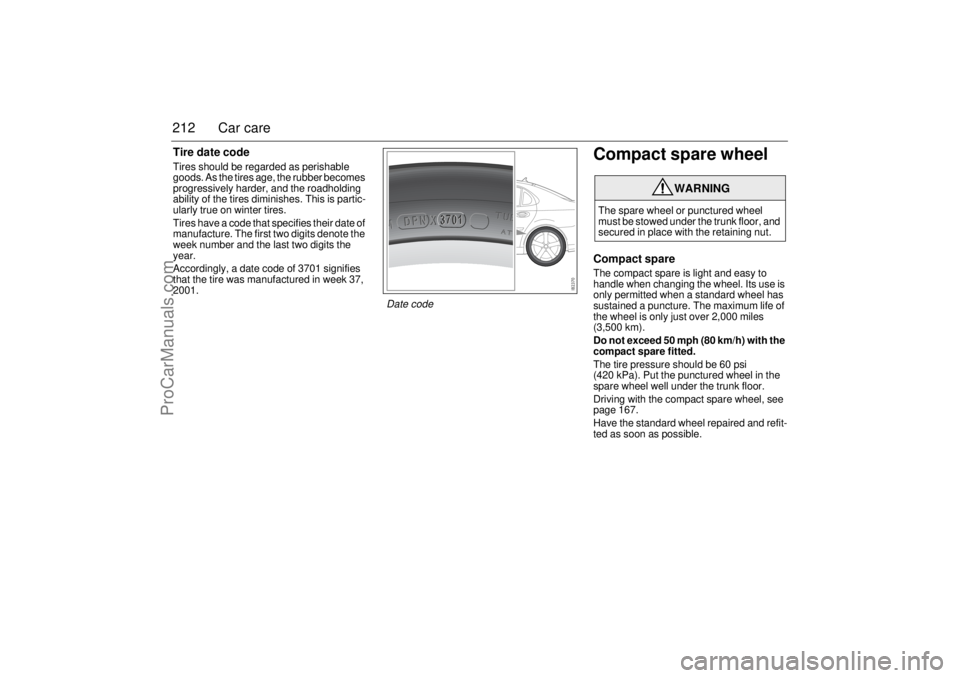
Tires have a code that specifies their date of
manufacture. The first two digits denote the
week number and the last two digits the
year.
Accordingly, a date code of 3701 signifies
that the tire was manufactured in week 37,
2001.
Compact spare wheelCompact spareThe compact spare is light and easy to
handle when changing the wheel. Its use is
only permitted when a standard wheel has
sustained a puncture. The maximum life of
the wheel is only just over 2,000 miles
(3,500 km).
Do not exceed 50 mph (80 km/h) with the
compact spare fitted.
The tire pressure should be 60 psi
(420 kPa). Put the punctured wheel in the
spare wheel well under the trunk floor.
Driving with the compact spare wheel, see
page 167.
Have the standard wheel repaired and refit-
ted as soon as possible.
WARNING
The spare wheel or punctured wheel
must be stowed under the trunk floor, and
secured in place with the retaining nut.
Date code
ProCarManuals.com
Page 217 of 256

217 Car care
Flat spottingAll tires get hot, especially on long journeys
or when the car is driven hard. After the car
has been parked with hot tires and the tires
have cooled down, a flat spot can form in the
tire, where it is in contact with the ground.
The same can occur if the car has not been
moved for a long time.
Flat spots can cause vibration that can be
felt through the steering wheel, similar to
that experienced when the wheels need bal-
ancing.
Flat spots of this type disappear once the
tires get hot again, usually after 10–15 miles
(20–25 km) of driving at cruising speed.
Safety beltsCheck the function of the safety belts regu-
larly as follows:
Hold the diagonal strap and pull it sharply.
The safety belt should lock and it should
not be possible to withdraw it further.
Check the anchorage points in the floor.
They must not have suffered rust damage.
If a belt is worn or has any fraying edges, it
should be replaced.
Safety belts must not come into contact with
substances such as polishes, oil or chemi-
cals. If the belts get dirty, wash them with
warm water and a detergent or have them
replaced.
Upholstery and trimTo remove fluff and hairs from the seats,
door armrests and headlining, use a
vacuum cleaner, a moist lint-free cloth, or a
clothes brush. Remove spots and dirt using
a cloth moistened with lukewarm soapy
water.
When using a stain remover, always work
from the outside towards the centre to avoid
leaving a ring. If a soiled ring or spot should
remain, it can usually be removed using
lukewarm soapy water or water alone.
Spots left by liquids, such as soft drinks or
thin oil, must be removed at once with an
absorbent material, such as kitchen towel-
ling. Then clean with a stain remover.
White spirit is recommended for removing
grease and oil stains. A medium stiff brush
may also be used.
WARNING
If the car is involved in a crash, the safety
belts, belt pretensioners and other asso-
ciated components must be inspected at
a Saab dealer.
Never make any alterations or repairs to
the safetybelts yourself but visit a Saab
dealer.
ProCarManuals.com
Page 226 of 256

226 Car careHeadlight aimingThe vehicle has a visual optical headlight
aiming system equipped with vertical
aiming device. The aim has been preset at
the factory and should normally not need
further adjustments.
If your headlights are damaged in a crash,
the headlight aim may be affected. If you
believe your headlights need to be re-
aimed, we recommend that you take it to
your Saab dealer for service. However, it is
possible for you to re-aim your headlights as
described in the following procedure.To check the aim, the vehicle should be
properly prepared as follows:
The vehicle shall be placed so that the
headlights are 25 ft (7.6 m) from a light
colored wall or other flat surface. The
aiming area should be darkened, this will
improve your ability to see the beam of the
low beam headlight being aimed.
An optical headlamp aimer can also be
used and will than replace the wall.
The vehicle must have all four wheels on
a perfectly level surface which is level all
the way to the wall or other flat surface.
The vehicle should be placed so it is per-
pendicular to the wall or other flat surface.
The vehicle should be unloaded and fuel
tank full, and one person or 160 lbs.
(75 kg) on the drivers seat. The vehicle should be fully assembled
and all other work stopped while headlight
aiming is being done.
The vehicle should not have any snow, ice
or mud attached to it.
Tires should be inflated to the prescribed
pressure.
Close all doors.
Rock the vehicle to stabilize the suspen-
sion.
Headlight aiming is done with the vehicle
low beam lamps. The high beam lamps will
be correctly aimed if the low beam lamps
are aimed properly.
WARNING
Before checking/adjusting the headlight
aiming, switch off the engine to avoid
danger of fingers and hands being injured
by moving parts.
The radiator fan can start up even when
the engine is switched off.NOTICETo make sure that your headlights are
aimed properly read all instructions
before beginning. Failure to follow these
instructions could cause damage to
headlight parts or a not correctly aimed
headlight.
ProCarManuals.com
Page 232 of 256

232 Maintenance and owner assistanceService costsDealer pricing practices and labor for ser-
vice work vary. Saab’s recommended ser-
vice times for each service point do not
include the labor required to replace wear
items, such as wiper blades, brake pads or
tires. Nor is labor to perform other service or
repairs found to be necessary as a result of
the inspections included in these times.
Additional labor and parts will be charged
for such work when necessary, except as
covered under an applicable Saab warranty
or any optional extended service contract.
Transmission fluid changes or suspension
alignment, when necessary, are also addi-
tional.
Dealer charges for general shop material,
regulated hazardous waste removal, recy-
cling expenses or other operation costs may
also be applied to service and repair
invoices and are apt to vary by dealer and
location.
Owner assistanceWarranties and service problem
assistanceFor complete information about all applica-
ble warranties, including the New Car War-
ranty, Perforation Warranty, Vehicle Emis-
sion Warranty and Emission Perforation
Warranty, consult the Warranties and Ser-
vice Record Booklet which accompanies
this Owner’s Manual. It also contains owner
assistance information including Saab
Roadside Assistance. If the booklet is lost or
misplaced, a new one may be ordered
through a Saab dealer or by contacting
Saab.
In the U.S. there is a national Customer
Assistance Center at Saab Cars USA, Inc.
The toll-free number to call from all 50 states
is 1-800-955-9007.
In Canada, please call the Saab Customer
Assistance Centre at 1-800-263-1999.
A list of authorized Saab sales and service
dealers is available for those planning to
travel in the United States and Canada.
Canadian or U.S. travelers may call the
Customer Assistance Center in the country
in which they are traveling.
Change of Address Notification
(U.S. and Canada)Two change of address cards are provided
at the end of the Warranties and Service
Record Booklet. Knowing your current
address allows Saab to contact you in the
event of a recall or service campaign.
Please help us keep our records up to date
for your own peace of mind.Service informationFactory Service Manuals for the Saab 9-3
and 9-5 car lines can be ordered through the
dealer. These are comprehensive manuals
on CD rom, geared to use by professional
technicians.
Consult your Saab dealer for prices for your
model.
ProCarManuals.com
Page 235 of 256
235 Technical data
General particulars _____ 236
Engine _______________ 238
Engine oil _____________ 238
Fuel__________________ 240
Engines ______________ 240
Electrical system_______ 240
Drive belt _____________ 240
Manual transmission ___ 241
Automatic transmission _ 241
Suspension ___________ 242
Steering ______________ 242
Brake system__________ 242
Wheels and tires _______ 243
Plates and labels _______ 246
Technical data
ProCarManuals.com
Page 237 of 256
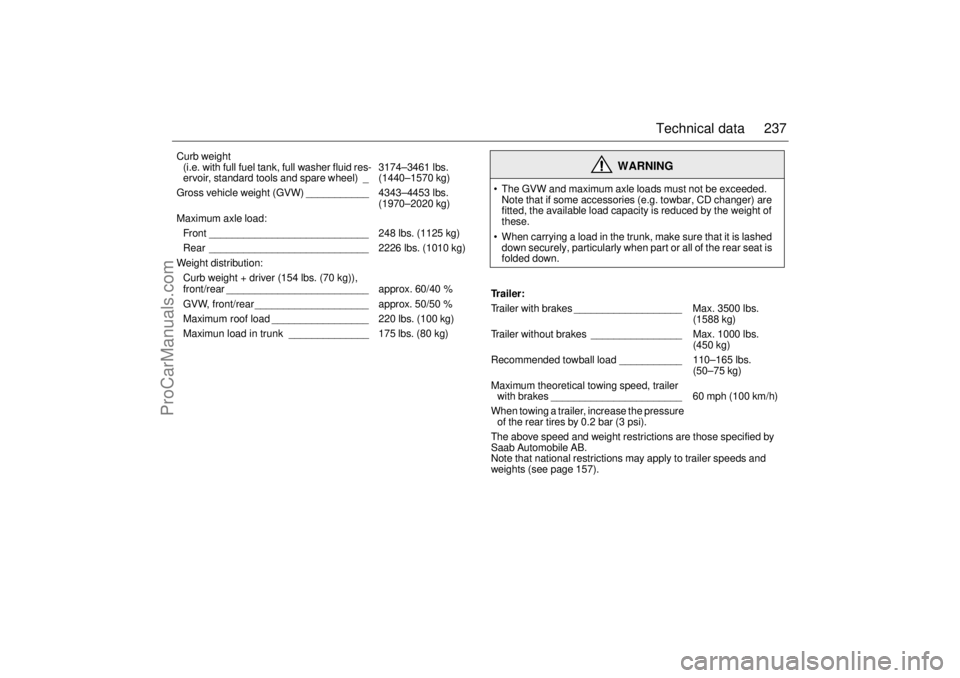
237 Technical data
Curb weight
(i.e. with full fuel tank, full washer fluid res-
ervoir, standard tools and spare wheel) _3174–3461 lbs.
(1440–1570 kg)
Gross vehicle weight (GVW) ___________ 4343–4453 lbs.
(1970–2020 kg)
Maximum axle load:
Front ____________________________ 248 lbs. (1125 kg)
Rear ____________________________ 2226 lbs. (1010 kg)
Weight distribution:
Curb weight + driver (154 lbs. (70 kg)),
front/rear _________________________ approx. 60/40 %
GVW, front/rear ____________________ approx. 50/50 %
Maximum roof load _________________ 220 lbs. (100 kg)
Maximun load in trunk ______________ 175 lbs. (80 kg)
WARNING
The GVW and maximum axle loads must not be exceeded.
Note that if some accessories (e.g. towbar, CD changer) are
fitted, the available load capacity is reduced by the weight of
these.
When carrying a load in the trunk, make sure that it is lashed
down securely, particularly when part or all of the rear seat is
folded down.
Trailer:
Trailer with brakes ___________________ Max. 3500 lbs.
(1588 kg)
Trailer without brakes ________________ Max. 1000 lbs.
(450 kg)
Recommended towball load ___________ 110–165 lbs.
(50–75 kg)
Maximum theoretical towing speed, trailer
with brakes _______________________ 60 mph (100 km/h)
When towing a trailer, increase the pressure
of the rear tires by 0.2 bar (3 psi).
The above speed and weight restrictions are those specified by
Saab Automobile AB.
Note that national restrictions may apply to trailer speeds and
weights (see page 157).
ProCarManuals.com
Page 243 of 256

243 Technical data
Wheels and tires Summer tires
6.5 x 15" _________________________ 215/60R15 94 H
6.5 x 16" _________________________ 215/55R16 93 H
7 x 17"___________________________ 215/50R17 91 W or
225/45R17 91 W
7.5 x 18" (accessory) _______________ 225/45 R18 91 W
Always contact a Saab dealer if you plan to fit other wheels or
tires than those fitted as standard.
Winter (snow) tires:
6.5 x 15" wheel ____________________ 195/65 R15 91 Q
M+S
6.5 x 16" wheel ____________________ 205/55 R16 91 Q
M+S or
215/55 R16 93 Q
M+S
7 x 17" wheel _____________________ 205/50 R17 93 Q RF
M+S
Compact spare:
Wheel ___________________________ 4 x 16"
Tire _____________________________ 125/80 R16 97 M or
125/85 R16 97 M
Pressure _________________________ 4.2 bar (60 psi)
Maximum life______________________ 2200 miles
(3500 km)
Maximum speed ___________________ 50 mph (80 km/h)
NOTICEContact your Saab dealer regarding suitable snow chains.
Max. permissible speed with snow chains fitted is 30 mph
(50 km/h).
Snow chains must not be fitted to wheels larger than 17".
Snow chains must not be used on the rear wheels.NOTICEWheels larger than 18" must not be fitted.
Exercise care when driving on uneven roads or against the curb
if the car is heavily laden. This particularly applies to cars with
18" wheels.
Permitted wheel offset is 41 mm.
ProCarManuals.com