trunk SAAB 9-3 2003 User Guide
[x] Cancel search | Manufacturer: SAAB, Model Year: 2003, Model line: 9-3, Model: SAAB 9-3 2003Pages: 256, PDF Size: 21.66 MB
Page 50 of 256

50 SecurityOverview of functionsLocking/arming Direction indicators flash once.
Unlocking/
disarmingHazard warning lights flash twice.
Unlocking/
disarming trunk
lidHazard warning lights flash three times.
Alarm triggered Direction indicators flash for 5 min.
The horn sounds for 30-second intervals with
10-second breaks (max. 10 cycles) or until you
press one of the remote control buttons or turn
the remote control ON in the ignition switch.
Movement
sensorThe movement sensor trips the alarm if it regis-
ters a movement in the cabin.
Remote control Normal range: 5–16 yds. (5–15 metres).
In favorable conditions the range can be signif-
icantly greater.
Remote control
batteryNormal life: approx. 4 years.
Change the battery when the SID displays:
Remote control battery low. Replace battery.
See Changing the key battery, page 44.
Car battery The alarm will trip if the battery is disconnected
when the alarm is armed.
Some car alarm functions and indications can be reprogrammed.
Contact a Saab dealer for details of the possibilities and refer to
page 248.
ProCarManuals.com
Page 52 of 256
52 SecurityManually opening the
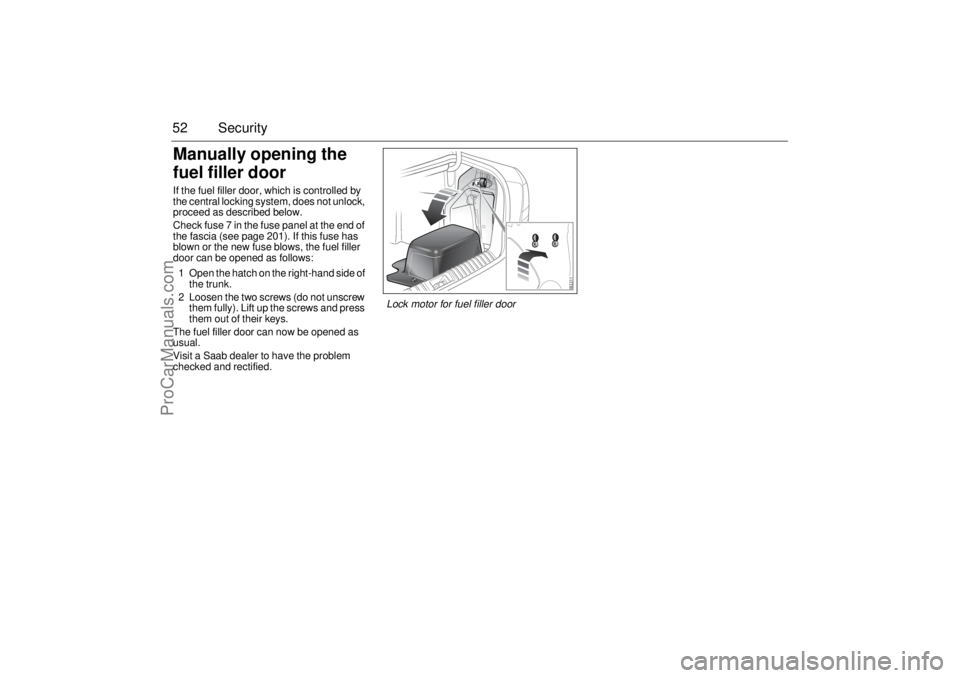
fuel filler doorIf the fuel filler door, which is controlled by
the central locking system, does not unlock,
proceed as described below.
Check fuse 7 in the fuse panel at the end of
the fascia (see page 201). If this fuse has
blown or the new fuse blows, the fuel filler
door can be opened as follows:
1 Open the hatch on the right-hand side of
the trunk.
2 Loosen the two screws (do not unscrew
them fully). Lift up the screws and press
them out of their keys.
The fuel filler door can now be opened as
usual.
Visit a Saab dealer to have the problem
checked and rectified.
Lock motor for fuel filler door
ProCarManuals.com
Page 97 of 256
97 Interior equipment
Steering wheel
adjustment _________ 98
Electric windows ______ 99
Sunroof _____________ 102
Interior lighting _______ 105
Cup holder ___________ 107
Ashtray______________ 108
Storage compartments _ 109
Rearview mirrors______ 110
Trunk _______________ 116
Interior equipment
ProCarManuals.com
Page 106 of 256
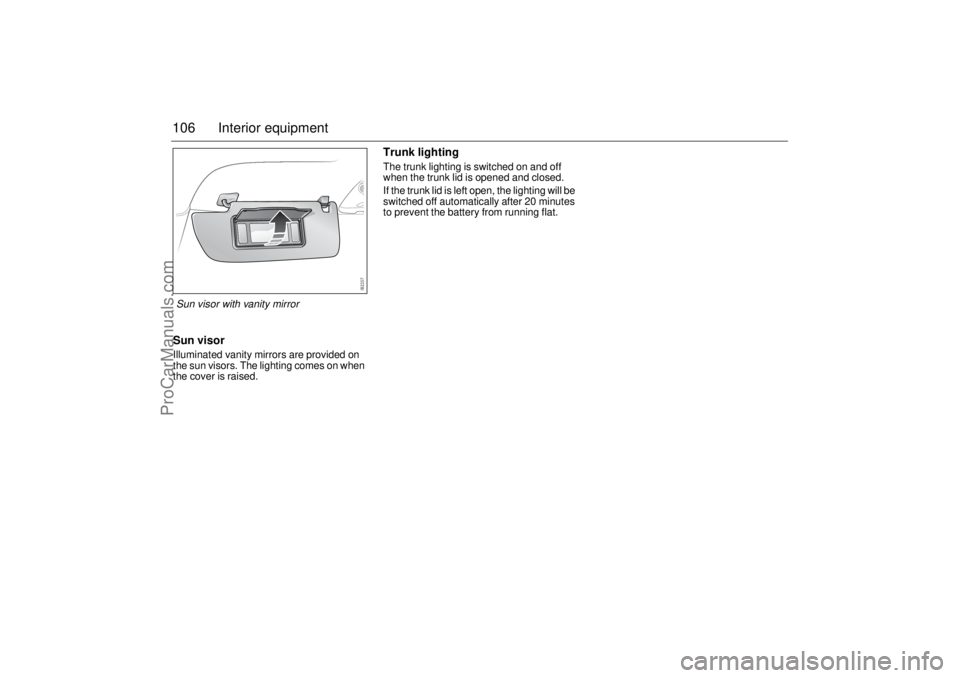
106 Interior equipmentSun visorIlluminated vanity mirrors are provided on
the sun visors. The lighting comes on when
the cover is raised.
Trunk lightingThe trunk lighting is switched on and off
when the trunk lid is opened and closed.
If the trunk lid is left open, the lighting will be
switched off automatically after 20 minutes
to prevent the battery from running flat.
Sun visor with vanity mirror
ProCarManuals.com
Page 116 of 256
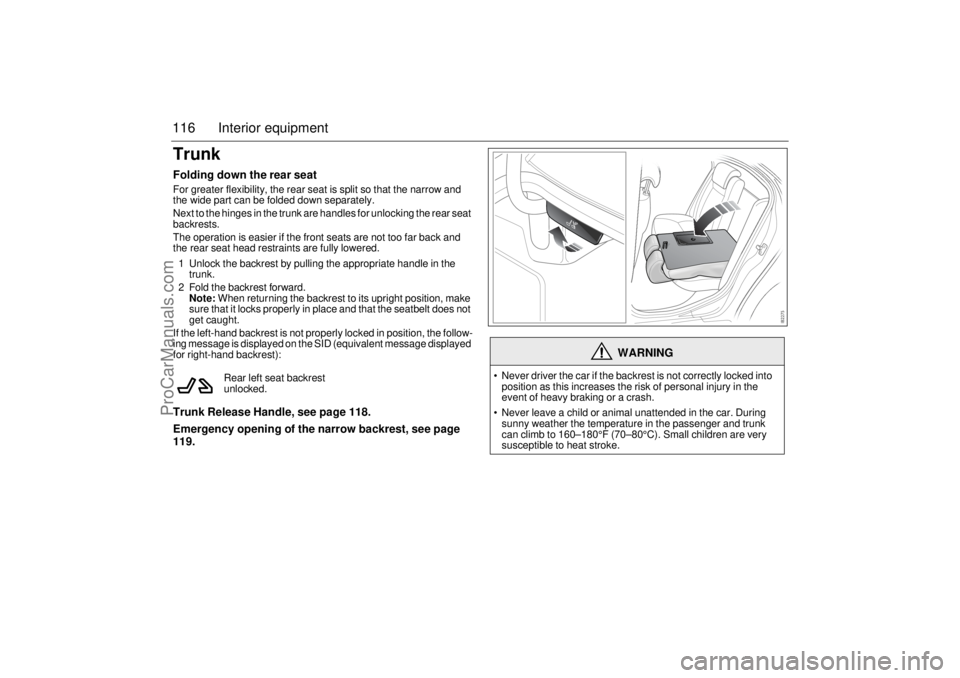
116 Interior equipmentTrunkFolding down the rear seatFor greater flexibility, the rear seat is split so that the narrow and
the wide part can be folded down separately.
Next to the hinges in the trunk are handles for unlocking the rear seat
backrests.
The operation is easier if the front seats are not too far back and
the rear seat head restraints are fully lowered.
1 Unlock the backrest by pulling the appropriate handle in the
trunk.
2 Fold the backrest forward.
Note: When returning the backrest to its upright position, make
sure that it locks properly in place and that the seatbelt does not
get caught.
If the left-hand backrest is not properly locked in position, the follow-
ing message is displayed on the SID (equivalent message displayed
for right-hand backrest):Trunk Release Handle, see page 118.
Emergency opening of the narrow backrest, see page
119.
Rear left seat backrest
unlocked.
WARNING
Never driver the car if the backrest is not correctly locked into
position as this increases the risk of personal injury in the
event of heavy braking or a crash.
Never leave a child or animal unattended in the car. During
sunny weather the temperature in the passenger and trunk
can climb to 160–180°F (70–80°C). Small children are very
susceptible to heat stroke.
ProCarManuals.com
Page 117 of 256
117 Interior equipment
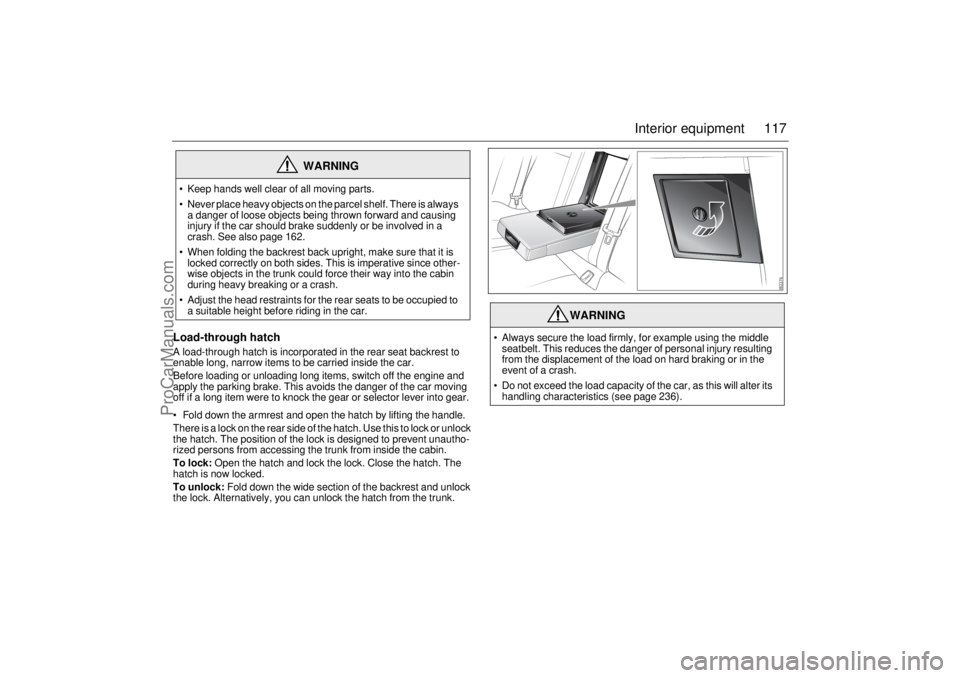
Load-through hatchA load-through hatch is incorporated in the rear seat backrest to
enable long, narrow items to be carried inside the car.
Before loading or unloading long items, switch off the engine and
apply the parking brake. This avoids the danger of the car moving
off if a long item were to knock the gear or selector lever into gear.
Fold down the armrest and open the hatch by lifting the handle.
There is a lock on the rear side of the hatch. Use this to lock or unlock
the hatch. The position of the lock is designed to prevent unautho-
rized persons from accessing the trunk from inside the cabin.
To lock: Open the hatch and lock the lock. Close the hatch. The
hatch is now locked.
To unlock: Fold down the wide section of the backrest and unlock
the lock. Alternatively, you can unlock the hatch from the trunk.
WARNING
Keep hands well clear of all moving parts.
Never place heavy objects on the parcel shelf. There is always
a danger of loose objects being thrown forward and causing
injury if the car should brake suddenly or be involved in a
crash. See also page 162.
When folding the backrest back upright, make sure that it is
locked correctly on both sides. This is imperative since other-
wise objects in the trunk could force their way into the cabin
during heavy breaking or a crash.
Adjust the head restraints for the rear seats to be occupied to
a suitable height before riding in the car.
WARNING
Always secure the load firmly, for example using the middle
seatbelt. This reduces the danger of personal injury resulting
from the displacement of the load on hard braking or in the
event of a crash.
Do not exceed the load capacity of the car, as this will alter its
handling characteristics (see page 236).
ProCarManuals.com
Page 118 of 256
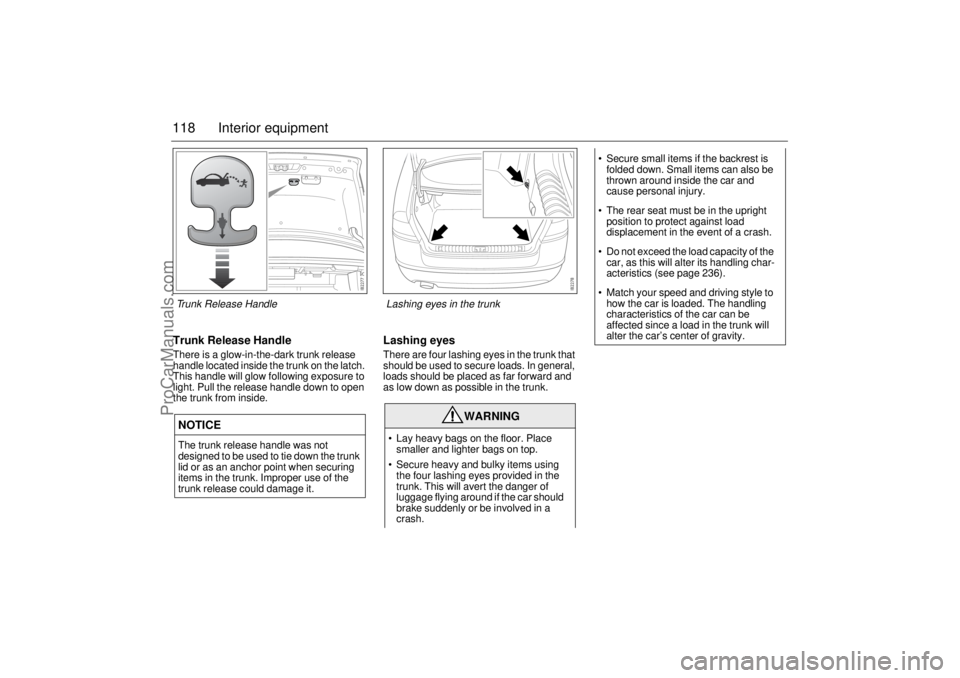
118 Interior equipmentTrunk Release HandleThere is a glow-in-the-dark trunk release
handle located inside the trunk on the latch.
This handle will glow following exposure to
light. Pull the release handle down to open
the trunk from inside.
Lashing eyesThere are four lashing eyes in the trunk that
should be used to secure loads. In general,
loads should be placed as far forward and
as low down as possible in the trunk.
NOTICEThe trunk release handle was not
designed to be used to tie down the trunk
lid or as an anchor point when securing
items in the trunk. Improper use of the
trunk release could damage it.
WARNING
Lay heavy bags on the floor. Place
smaller and lighter bags on top.
Secure heavy and bulky items using
the four lashing eyes provided in the
trunk. This will avert the danger of
luggage flying around if the car should
brake suddenly or be involved in a
crash.
Secure small items if the backrest is
folded down. Small items can also be
thrown around inside the car and
cause personal injury.
The rear seat must be in the upright
position to protect against load
displacement in the event of a crash.
Do not exceed the load capacity of the
car, as this will alter its handling char-
acteristics (see page 236).
Match your speed and driving style to
how the car is loaded. The handling
characteristics of the car can be
affected since a load in the trunk will
alter the car’s center of gravity.
Trunk Release Handle Lashing eyes in the trunk
ProCarManuals.com
Page 119 of 256
119 Interior equipment
Trunk lightingOn the underside of the parcel shelf is a light
that is switched on and off when the trunk is
opened and closed.
If the trunk lid is left open, the lighting will be
switched off automatically after 20 minutes
to prevent the battery from running flat.
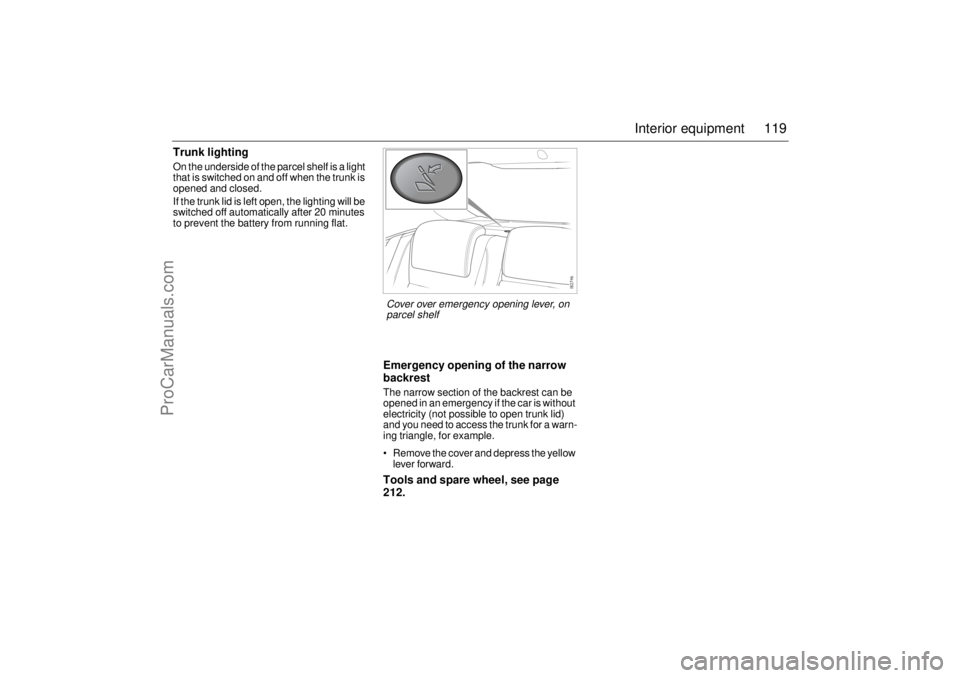
Emergency opening of the narrow
backrestThe narrow section of the backrest can be
opened in an emergency if the car is without
electricity (not possible to open trunk lid)
and you need to access the trunk for a warn-
ing triangle, for example.
Remove the cover and depress the yellow
lever forward.Tools and spare wheel, see page
212.Cover over emergency opening lever, on
parcel shelf
ProCarManuals.com
Page 121 of 256
121 Starting and driving
Ignition switch ________ 122
Steering wheel lock ____ 123
Starting the engine ____ 123
Important considerations
for driving __________ 125
Refueling ____________ 128
Engine Break-in Period _ 132
Manual transmission___ 133
Automatic transmission 134
Cruise control ________ 140
Braking ______________ 141
Traction Control System
(TCS) ______________ 144
Electronic Stability
Program (ESP) ______ 146
Parking brake_________ 148
Parking ______________ 148 Economical driving _____ 153
Driving in cold weather__ 155
Driving in hot climates __ 156
Towing a trailer ________ 157
Driving with a roof rack
load ________________ 161
Driving with a load _____ 162
Driving with the trunk lid
open________________ 163
Driving in deep water ___ 163
Driving at night ________ 163
Towing the car _________ 164
Driving with the compact
spare wheel__________ 167
Jump starting _________ 168
For long trips __________ 170
Starting and driving
ProCarManuals.com
Page 150 of 256

150 Starting and drivingLong-term parkingIf the car is not going to be used for some
time, e.g. three to four months, the following
steps are recommended:
Drain the washer fluid reservoir and
hoses.
Wash and wax the car. Clean the rubber
seals on the hood, trunk lid and doors,
and lubricate them with glycerol
(glycerine).
After washing the car, dry the brake discs
to avoid corrosion by taking the car out on
the road and applying the brakes a few
times.
Fill the fuel tank to prevent condensation
forming in it.
Top up the coolant and check the anti-
freeze before the onset of winter. Park the car in a dry, covered and well-
ventilated building. Leave the parking
brake OFF!
If necessary, use wheel chocks.
Disconnect the negative (–) battery lead.
If frost is likely to occur during the storage
period, remove the battery and store it in
a frost-free place.
If it is not possible to stand the car on axle
stands, increase the tire pressure to
43 psi (3 bar).
Leave all the door windows open a crack
and cover the car with a non-plastic
tarpaulin – not one made of plastic which will
not breath.
ProCarManuals.com