ESP SAAB 9-3 2003 Owner's Manual
[x] Cancel search | Manufacturer: SAAB, Model Year: 2003, Model line: 9-3, Model: SAAB 9-3 2003Pages: 256, PDF Size: 21.66 MB
Page 147 of 256
147 Starting and driving
ESP OFF
lights up under the speedometer if:
a fault has been detected and the system
has therefore been switched off
the system has been switched off
manually
when the remote control is turned to the
ON position, the lamp is lit for about
4 seconds while the system performs
self-diagnosis.
ESP indicator lightThe light under the speedometer
comes on for a short period of time when the
ESP system is operative.
Operation of the ESP indicates reduced
cohesion between the tires and the road,
and that extra care should be taken by the
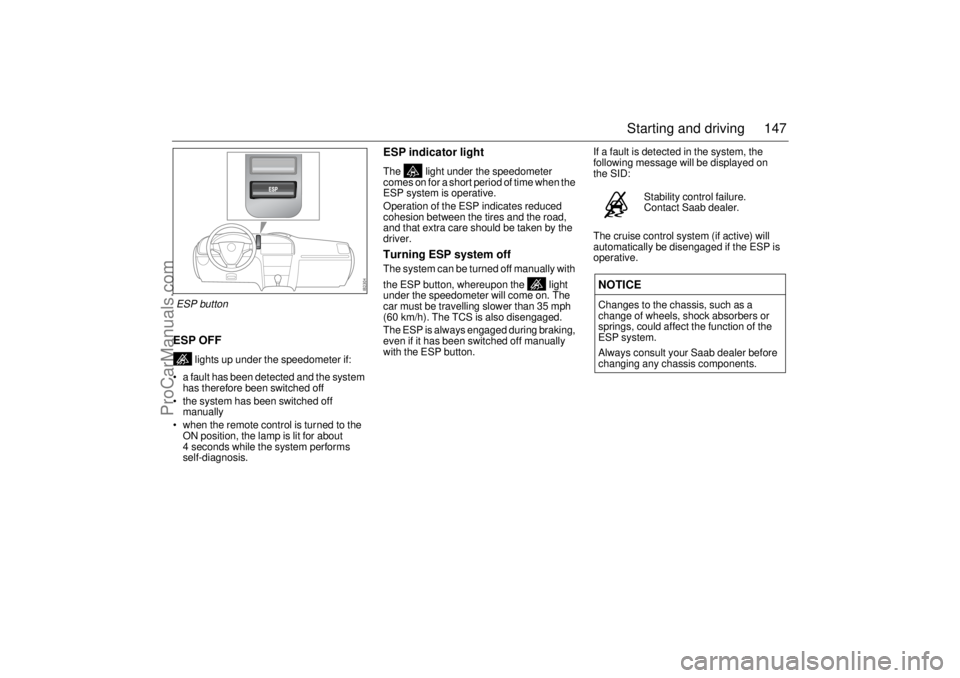
driver.Turning ESP system offThe system can be turned off manually with
the ESP button, whereupon the light
under the speedometer will come on. The
car must be travelling slower than 35 mph
(60 km/h). The TCS is also disengaged.
The ESP is always engaged during braking,
even if it has been switched off manually
with the ESP button.If a fault is detected in the system, the
following message will be displayed on
the SID:
The cruise control system (if active) will
automatically be disengaged if the ESP is
operative.
Stability control failure.
Contact Saab dealer.
NOTICEChanges to the chassis, such as a
change of wheels, shock absorbers or
springs, could affect the function of the
ESP system.
Always consult your Saab dealer before
changing any chassis components.
ESP button
ProCarManuals.com
Page 151 of 256
151 Starting and driving
Saab Parking
AssistanceSaab Parking Assistance
(option)Saab Parking Assistance facilitates parking
and reversing. There are four sensors in the
rear bumper that detect objects up to 6 ft
(1.8 meters) behind the car.
If the car is heavily laden, the system may
falsely indicate that there is an object within
the detection range. This is since the sen-
sors are angled towards the ground when
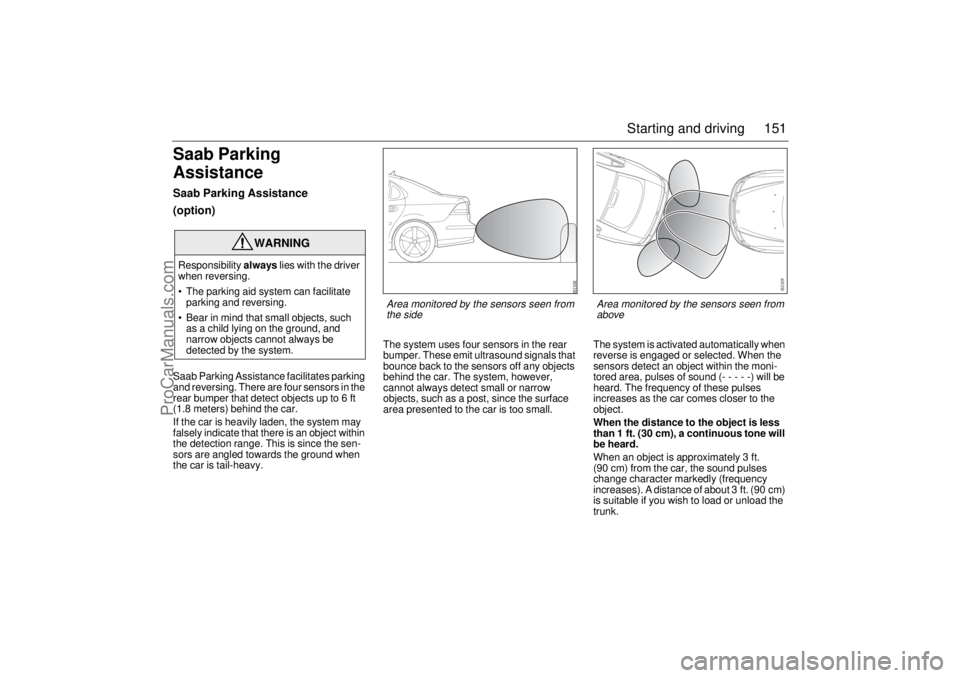
the car is tail-heavy.The system uses four sensors in the rear
bumper. These emit ultrasound signals that
bounce back to the sensors off any objects
behind the car. The system, however,
cannot always detect small or narrow
objects, such as a post, since the surface
area presented to the car is too small.The system is activated automatically when
reverse is engaged or selected. When the
sensors detect an object within the moni-
tored area, pulses of sound (- - - - -) will be
heard. The frequency of these pulses
increases as the car comes closer to the
object.
When the distance to the object is less
than 1 ft. (30 cm), a continuous tone will
be heard.
When an object is approximately 3 ft.
(90 cm) from the car, the sound pulses
change character markedly (frequency
increases). A distance of about 3 ft. (90 cm)
is suitable if you wish to load or unload the
trunk.
WARNING
Responsibility always lies with the driver
when reversing.
The parking aid system can facilitate
parking and reversing.
Bear in mind that small objects, such
as a child lying on the ground, and
narrow objects cannot always be
detected by the system.
Area monitored by the sensors seen from
the side
Area monitored by the sensors seen from
above
ProCarManuals.com
Page 155 of 256

155 Starting and driving
Driving in cold weatherIn cold weather, special attention should be
paid to the following:
Before driving off, make sure that the
wiper blades have not frozen to the wind-
shield.
Remove any snow from the heating
system air intakes between the hood and
the windshield.
If necessary, inject oil into the locks to
prevent them from freezing. Use molyb-
denum-sulphide oil (MoS
2). If the locks
freeze, exercise care when unlocking the
car (manual unlocking) to avoid breaking
the key. Warm up the key or use a de-icer.
It is particularly important when the roads
are slippery that the brakes and tires are
in good condition.
For how to check the level of antifreeze in
the engine coolant, see page 179. Add gasoline anti-freeze when refueling
several times before the onset of winter.
This will prevent condensation water in
the fuel tank from freezing and causing
interruptions in the fuel supply. The likeli-
hood of condensation is lowest when the
fuel tank is full.
If the car is parked outside and the
temperature is below zero, carburettor
spirit is of little use as it cannot remove
water that has already frozen. Park the
car in a warm place so that any ice that
may have built up melts, then add carbu-
rettor spirit when refueling.
Condensation is caused by temperature
fluctuations, either in the outside temper-
ature alone or when the car is alternately
parked outdoors and in a garage.
The car is equipped with tires designed to
provide optimum grip on both wet and dry
roads, although this has been achieved at
the expense of somewhat reduced grip on
snow and ice. For regular driving on snow
and ice, we therefore recommend that
winter (snow) tires be fitted.Winter tires, particularly studded tires,
generally make driving safer on snow and
ice.
Acquaint yourself with the legal provi-
sions governing the use of different
types of winter tires and snow chains.
Studded tires are not allowed in some
countries. If winter tires are fitted, the same
type must be fitted to all four wheels. Your
Saab dealer will be pleased to advise you on
the best tires for your car.
Remember that tires age: it may therefore
be necessary to change winter tires before
they reach the legal wear limit, as they grad-
ually lose their friction properties with age.
If you get into a front wheel skid and the car
has a manual transmission, the best
response is to freewheel, which means
declutching so that the wheels neither drive
nor brake, and to cautiously steer in the
desired direction.
If the car has automatic transmission, ease
off the accelerator slightly and steer cau-
tiously in the desired direction.
If you get into a rear wheel skid, steer in the
same direction as the movement of the rear
of the car.
ProCarManuals.com
Page 159 of 256
159 Starting and driving
Recommendations for cars with
manual transmissionRises in coolant temperature are indicated
by the temperature gauge in the main instru-
ment panel.
When the needle is just outside the red
zone, the A/C compressor will be switched
off and, on certain engine variants, the max-
imum engine torque will be limited.
When continuing your journey, select a low
gear in which the engine speed is about
3,500 rpm until the incline eases.
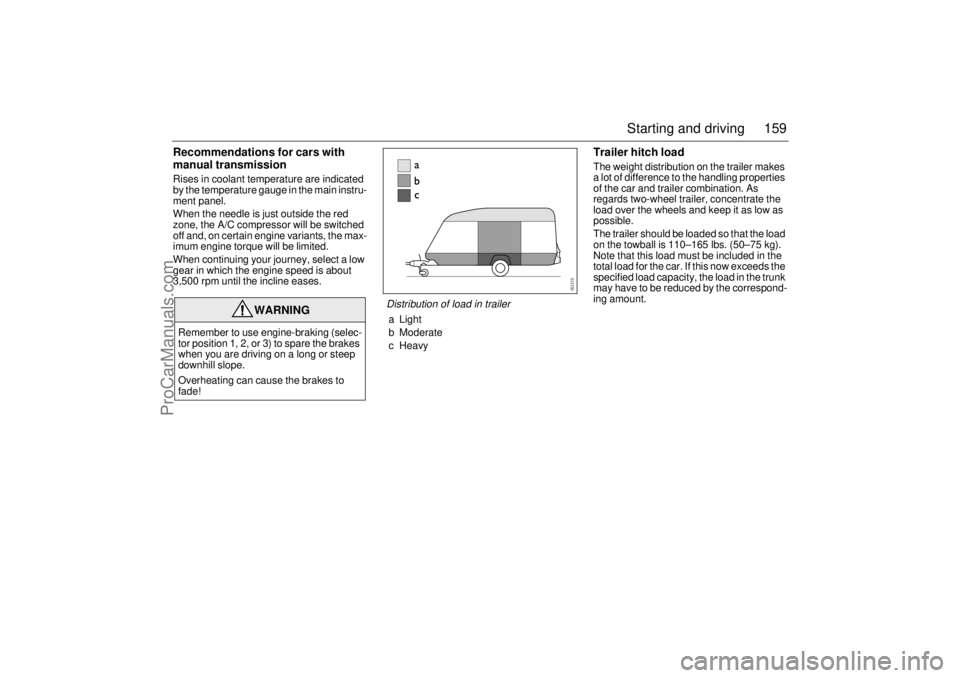
Trailer hitch loadThe weight distribution on the trailer makes
a lot of difference to the handling properties
of the car and trailer combination. As
regards two-wheel trailer, concentrate the
load over the wheels and keep it as low as
possible.
The trailer should be loaded so that the load
on the towball is 110–165 lbs. (50–75 kg).
Note that this load must be included in the
total load for the car. If this now exceeds the
specified load capacity, the load in the trunk
may have to be reduced by the correspond-
ing amount.
WARNING
Remember to use engine-braking (selec-
tor position 1, 2, or 3) to spare the brakes
when you are driving on a long or steep
downhill slope.
Overheating can cause the brakes to
fade!
Distribution of load in traileraLight
b Moderate
cHeavy
ProCarManuals.com
Page 163 of 256

163 Starting and driving
Driving with the trunk lid
openAvoid driving with the trunk lid partly or fully
open, since exhaust fumes can be drawn
into the cabin.
If you must drive with the trunk lid open,
close all windows and the sunroof (if fitted)
and set the cabin fan to its highest speed
setting.
Driving in deep water Driving at night
Bear in mind the following points, especially
when driving at night:
Nighttime driving requires your full
concentration
Do not rush. Count on your journey taking
slightly longer.
The number of drivers under the influence
of drugs is likely to be greater at night than
during the day.
Do not stare at the headlights of oncom-
ing vehicles.
Avoid driving at night if you have poor
eyesight. Night vision deteriorates with
age.
Keep your car’s headlights, windows and
mirrors clean. Also, if you wear glasses,
make sure they are clean.
Make sure you are well rested before
starting a long journey. Take a break
every other hour.
Only eat light meals. Heavy meals have a
tendency to induce tiredness.
Wild animals prefer to move at dusk and
dawn.
Check the headlight levelling setting (see
page 73).
NOTICEDo not drive in puddles or water deeper
than 7 in. (20 cm) and do not drive faster
than at idling speed. Water can otherwise
be sucked into the engine. The engine will
be damaged if water enters the intake
system.
ProCarManuals.com
Page 180 of 256
180 Car careNote:
If incorrect coolant is used or added, the life-
time properties will be affected. Even if the
coolant is flushed from the system and
replaced with life-time coolant, life-time
properties are no longer retained and the
coolant must then be drained and replaced
at regular intervals.
Brake/clutch fluid and
brake padsCheckingBrake fluid should be changed according to
the service program. Refer to the Warranty
and Service Book.
The brake and clutch fluid reservoir is trans-
parent to facilitate checking of the fluid level.
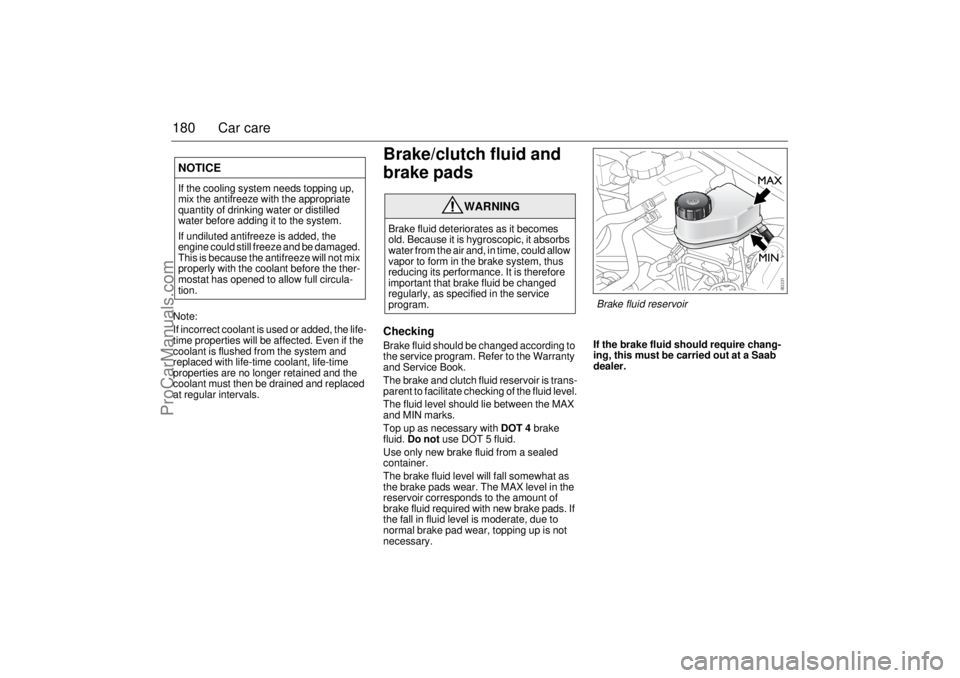
The fluid level should lie between the MAX
and MIN marks.
Top up as necessary with DOT 4 brake
fluid. Do not use DOT 5 fluid.
Use only new brake fluid from a sealed
container.
The brake fluid level will fall somewhat as
the brake pads wear. The MAX level in the
reservoir corresponds to the amount of
brake fluid required with new brake pads. If
the fall in fluid level is moderate, due to
normal brake pad wear, topping up is not
necessary.If the brake fluid should require chang-
ing, this must be carried out at a Saab
dealer.
NOTICEIf the cooling system needs topping up,
mix the antifreeze with the appropriate
quantity of drinking water or distilled
water before adding it to the system.
If undiluted antifreeze is added, the
engine could still freeze and be damaged.
This is because the antifreeze will not mix
properly with the coolant before the ther-
mostat has opened to allow full circula-
tion.
WARNING
Brake fluid deteriorates as it becomes
old. Because it is hygroscopic, it absorbs
water from the air and, in time, could allow
vapor to form in the brake system, thus
reducing its performance. It is therefore
important that brake fluid be changed
regularly, as specified in the service
program.
Brake fluid reservoir
ProCarManuals.com
Page 201 of 256
201 Car care
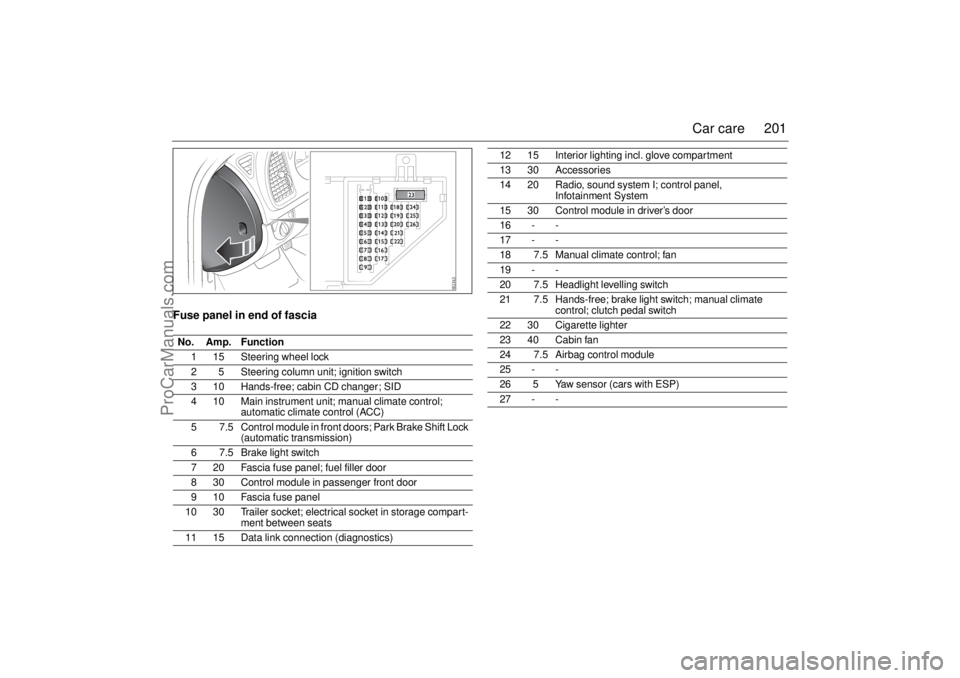
Fuse panel in end of fasciaNo. Amp. Function
1 15 Steering wheel lock
2 5 Steering column unit; ignition switch
3 10 Hands-free; cabin CD changer; SID
4 10 Main instrument unit; manual climate control;
automatic climate control (ACC)
5 7.5 Control module in front doors; Park Brake Shift Lock
(automatic transmission)
6 7.5 Brake light switch
7 20 Fascia fuse panel; fuel filler door
8 30 Control module in passenger front door
9 10 Fascia fuse panel
10 30 Trailer socket; electrical socket in storage compart-
ment between seats
11 15 Data link connection (diagnostics)
12 15 Interior lighting incl. glove compartment
13 30 Accessories
14 20 Radio, sound system I; control panel,
Infotainment System
15 30 Control module in driver’s door
16 - -
17 - -
18 7.5 Manual climate control; fan
19 - -
20 7.5 Headlight levelling switch
21 7.5 Hands-free; brake light switch; manual climate
control; clutch pedal switch
22 30 Cigarette lighter
23 40 Cabin fan
24 7.5 Airbag control module
25 - -
26 5 Yaw sensor (cars with ESP)
27 - -
ProCarManuals.com
Page 206 of 256

206 Car careWheelsAlternative wheels and tiresIf you wish to fit other tires or wheels than
those supplied with the car, consult your
Saab dealer first as to the possibilities
available.
Wheels/tires combinations that are not
approved by Saab can negatively affect the
car’s directional stability, steering and brak-
ing in both wet and dry conditions.The wheels and tires have been carefully
matched to the characteristics of the car and
play a key role in its outstanding roadhold-
ing and handling.
Do not take it for granted that a wheel/tire
combination will work in the best possible
way, just because it can be fitted to the car.
To ensure that the speedometer is as accu-
rate as possible it should be reprogrammed
if wheels of a different dimension are fitted.
Contact a Saab dealer.
NOTICEAlways consult your Saab dealer before
changing the car’s wheels or tires on your
Saab.
Wide wheels and tires with side walls that
are too low can:
be damaged in potholes, etc.
cause springs, shock absorbers and
wheel bearings and body mountings
to be overloaded
cause the wheels to come into contact
with chassis and body components
affect the function of the Electronic
Stability Program (ESP).
The speed and load limits of the tires
must not be exceeded; see page 209.
Wheels larger than 18" must not be fitted
on the Saab 9-3. The permissible offset is
1.61 inch (41 mm).
ProCarManuals.com
Page 207 of 256

207 Car care
Tire pressure
Note: Low tire pressure also causes prema-
ture tire wear and increased fuel consump-
tion.
Adjust the tire pressure to match the current
load and speed of the car (see page 245).
The stated tire pressures apply to cold tires,
i.e. tires that are the same temperature as
the outside air temperature. Tire pressure
increases as the tires become warm (e.g.
during highway driving) by approximately
0.3 bar (4 psi). When the temperature of the
tires changes by 50°F (10°C), the tire pres-
sure will change 0.1 bar (2 psi).
Never reduce the pressure of a hot tire. If the
tires are hot when you check them, only
increase the pressure, if necessary.
Soft tires will cause faster wear than over-
pressurized tires.
If a valve is leaking, simply unscrew it and fit
a new one.
Note: Remember to adjust the tire pressure
if you change the load in the car or intend to
cruise at a speed that is substantially differ-
ent from normal.
Automatic tire pressure monitoring(option, certain variants only)
The pressure monitoring system consists of
a sensor in each wheel, a detector in each
wheel housing and a receiver. The sensors
are located inside the wheels directly adja-
cent to the air valves.
WARNING
Check the tire pressure at least once a
month and before long journeys. Under-
inflation can result in:
punctures
separation of the tire and tread
damage to the sidewalls
damage to the rims on poor roads
poor handling characteristics.
WARNING
The system is intended to aid the driver.
The driver is always ultimately responsi-
ble for ensuring that the tire pressure is
correct.NOTICEGreat care must be taken when changing
tires so as not to damage the sensors that
are integrated in the valves.
ProCarManuals.com
Page 211 of 256
211 Car care
TemperatureThe temperature grades are A (the highest),
B, and C, representing the tire’s resistance
to the generation of heat and its ability to dis-
sipate heat when tested under controlled
conditions on a specified indoor laboratory
test wheel. Sustained high temperature can
cause the material of the tire to degenerate
and reduce tire life. Excessive temperature
can lead to sudden tire failure. The grade C
corresponds to a level of performance
which all passenger car tires must meet
under the Federal Motor Vehicle Safety
Standard No. 109.
Grades B and A represent higher levels of
performance on the laboratory test wheel
than the minimum required by law.
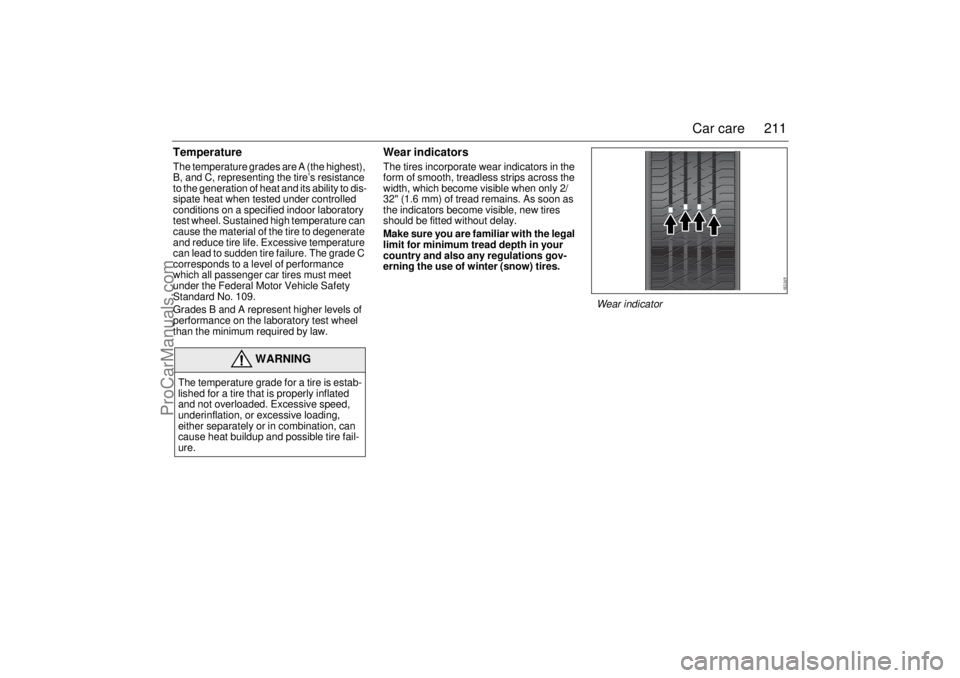
Wear indicatorsThe tires incorporate wear indicators in the
form of smooth, treadless strips across the
width, which become visible when only 2/
32" (1.6 mm) of tread remains. As soon as
the indicators become visible, new tires
should be fitted without delay.
Make sure you are familiar with the legal
limit for minimum tread depth in your
country and also any regulations gov-
erning the use of winter (snow) tires.
WARNING
The temperature grade for a tire is estab-
lished for a tire that is properly inflated
and not overloaded. Excessive speed,
underinflation, or excessive loading,
either separately or in combination, can
cause heat buildup and possible tire fail-
ure.
Wear indicator
ProCarManuals.com