belt SAAB 9-3 2003 Owner's Manual
[x] Cancel search | Manufacturer: SAAB, Model Year: 2003, Model line: 9-3, Model: SAAB 9-3 2003Pages: 256, PDF Size: 21.66 MB
Page 30 of 256
30 Safety
Front passenger seatThe system is the same as that used on the
driver’s side.
The airbag systems are interconnected and
have a common warning light . The pas-
senger airbag module is housed in the
fascia above the glove compartment and is
marked "AIRBAG".
Both airbags will be inflated in the event of a
moderate to severe frontal, or near-frontal
crash, even if the passenger seat is unoccu-
pied.
The car is equipped as standard with
a passenger airbag.
WARNING
Never secure a rear-facing child seat in
the right front seat of a car equipped with
a passenger airbag. Inflation of the airbag
in the event of a crash could seriously
injure or kill a child.
WARNING
DEATH or SERIOUS
INJURY can occur
Children 12 and under or
shorter than 55 inches
(140 cm) can be killed by the airbag
The BACK SEAT is the SAFEST place
for children
NEVER put a rear-facing child seat in
the front
Sit as far back as possible from the
airbag
ALWAYS use SAFETY BELTS and
CHILD RESTRAINTS
Never allow a child to stand in front of
the seat or to sit on the lap of a front
seat passenger. Serious injury or
death could result if the airbag is
inflated in a crash.
The glove compartment must be
closed while travelling. An open glove
compartment door could cause leg
injuries in the event of a crash.
Never place anything on the dash or in
front of the seat as, in addition to being
a hazard to passengers, this could
interfere with the function of the airbag
in the event of a crash. The same
applies to the mounting of accessories
on the dash.
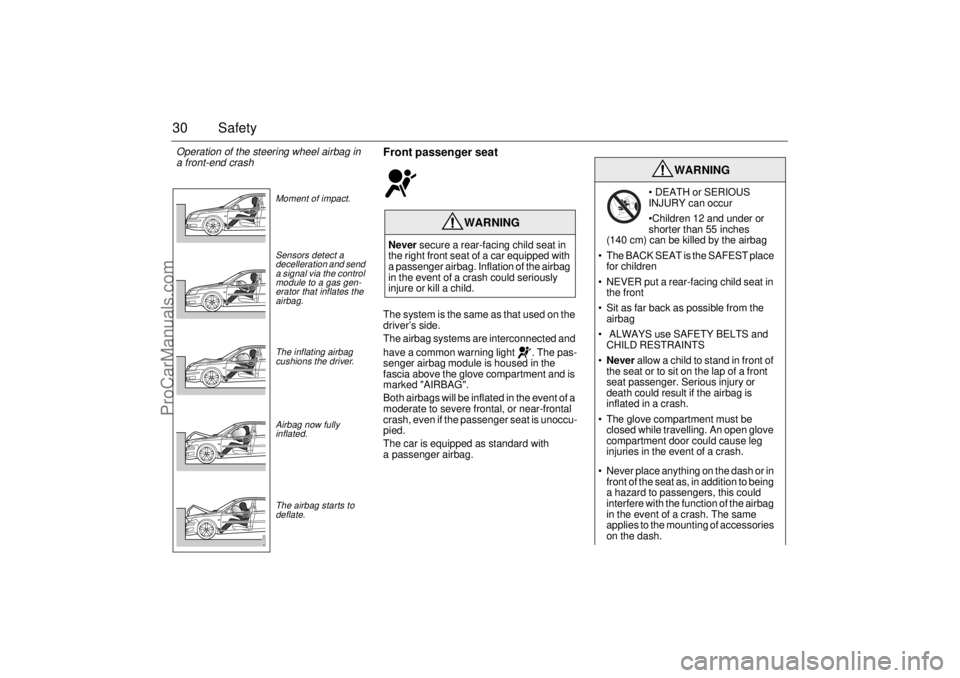
Operation of the steering wheel airbag in
a front-end crash
Moment of impact.
Sensors detect a
decelleration and send
a signal via the control
module to a gas gen-
erator that inflates the
airbag.
The inflating airbag
cushions the driver.
Airbag now fully
inflated.
The airbag starts to
deflate.
ProCarManuals.com
Page 31 of 256

31 Safety
Head protectionThe pillar trim and headlining are designed
to absorb energy, softening possible blows
to the head. After a crash, these items must
be changed in the seat positions that were
occupied. Never fit accessories to the pillar
trim or headlining as these could reduce the
effectiveness of the head protection and
inflatable curtain.
Side airbags
The side airbags, which protect the upper
body, are integrated in the outside edges of
the front seat backrests.
The front seats have safety belt pretension-
ers.
There are two sensors on each side of the
car, one at the rear of each door sill. The
side-impact protection is only activated on
the side of impact, while the safety belt pre-
tensioners on both sides are deployed. Keep feet on the floor – never put feet
up on the dash, on the seat or out of
the window.
Do not carry anything in your lap.
WARNING
This car is equipped with side airbags
and no extra seat cover should be
fitted. Failure to observe this warning
could result in the side airbags not
inflating as intended and thus not
providing the intended protection
either.
Never place any object in the area that
would be occupied by the inflated air-
bag.
For optimum protection, sit upright in
the seat, with your safety belt correctly
fastened.
The side-impact protection will only be
activated in the event of a side-on
crash or high-speed frontal crash
(airbags inflated to Stage II), but not in
the event of a rear-end crash or the car
rolling over.
Damage or wear to the seat cover, or
the seat seam, in the area of the side
airbag must immediately be repaired
by an authorized Saab dealer.
ProCarManuals.com
Page 34 of 256

34 SafetyAirbag warning lamp Crash sensing
Crash sensing and diagnostic modules
have been used in automobiles since air-
bags were first produced. The technical
information gained from these modules can
be useful to understanding the circum-
stances that led to the airbag deployment. In
addition, information from many field events
can be used in the aggregate to help manu-
facturers and others better understand real
world crashes. This, in turn, can lead to
improved automotive safety.
Your vehicle is equipped with two electronic
frontal sensors, which helps the sensing
system distinguish between a moderate
frontal impact and a more severe frontal
impact. Your vehicle is also equipped with a
crash sensing and diagnostic module,
which records information about the frontal
airbag system. The module records infor-
mation about the readiness of the system,
when the system commands airbag inflation
and driver’s safety belt usage at deployment
or in a near-deployment crash. The module
also records speed, engine rpm, brake and
throttle data etc.
Servicing the airbag systemThe airbag system must be inspected as
part of the normal service program but oth-
erwise may be regarded as maintenance-
free.
WARNING
If the airbag readiness light stays on
after you start your vehicle, it means
the airbag system may not be working
properly. See page 57.
The airbags in your vehicle may not
inflate in a crash, or they could even
inflate without a crash.
To help avoid injury to yourself or
others, have your vehicle serviced
right away if the airbag readiness light
stays on after you start your vehicle.
ProCarManuals.com
Page 35 of 256

35 Safety
Scrapping or working on airbag and
belt pretensionersFrequently asked questions on
function of the airbag
Do you still need to wear a safety belt if air-
bags are fitted?Yes, always! The airbag system compo-
nents merely supplement the car’s normal
safety system. Moreover, the front airbags
will only be actuated in a moderate to severe
frontal, or near-frontal crash, which means,
of course, that they provide no protection in
minor frontal crashes, major rear- or side-
crashes or if the car rolls over.
The safety belts help to reduce the sideway
movement of the body in a crash.
But they also ensure that, if a crash occurs
in which the airbags are inflated, the airbag
will make the optimum contact with the
occupant, i.e. square on from the front. If the
occupant meets the airbag in an offset posi-
tion, the protection afforded will be reduced.In addition, airbags provide no protection
against a secondary impact occurring in the
same incident. So there is no doubt about
the benefit of wearing safety belts at all
times.
Do not sit too close to the airbag: it needs
room to inflate.
The airbag inflates very quickly and power-
fully in order to protect an adult , before they
are thrown forward, in a serious frontal
crash.
How do I position the seat to leave room for
the airbag to inflate?Don’t have your seat too far forward.
Recline the seat back to increase the dis-
tance between you and the airbag. For short
drivers, special accessory pedal extensions
are available through your Saab dealer.
Airbags inflate extremely rapidly and with
great force – to be fast enough to protect an
adult in the seat.
WARNING
Under no circumstances should any
modifications be made that affect the
steering wheel or the airbag’s electri-
cal circuitry.
During any welding, both battery
cables must be disconnected and
covered.
Before quick drying paint in the vicinity
of the electronic control module, the
module’s grounding points and wiring
must be covered.
Airbags and safety belt pretensioners
must be deployed under controlled
conditions before the car is scrapped
or any of the system’s components are
removed. Airbags or belt pretension-
ers that have been deployed as a
result of a crash must be replaced by
new ones.
Airbag-system components must
never be transferred for use in another
vehicle.
All work involving the scrapping or
replacement of airbags or belt preten-
sioners must be carried out by autho-
rized personnel only.
ProCarManuals.com
Page 36 of 256

36 SafetyWhen do the airbags in the steering wheel
and passenger side of the dash board
inflate? The airbag will only be inflated under certain
predetermined conditions in a moderate to
severe frontal, or near-frontal crash,
depending on such factors as the force and
angle of the impact, the speed of the car on
impact, and the resistance to deformation of
the impacting object.
The airbag can only be activated once in the
same incident.
Do not attempt to drive the car after an
airbag has been inflated, even if it is possi-
ble.What won’t trigger the airbag? The airbag will not be activated in all frontal
crashes. For instance, if the car has hit
something relatively soft and yielding (e.g. a
snow drift or a hedge) or a solid object at a
low impact speed, the airbag will not neces-
sarily be triggered.
How loud is the inflation? The noise of the inflation is certainly loud,
but it is of an very short duration and will not
damage your hearing. For a short time after-
wards you could experience a buzzing
noise in your ears.
Most people who have experienced it
cannot remember the noise of the inflation
at all – all they remember is the noise of the
crash. Can you still use a child seat in the front if a
passenger airbag is installed? Definitely not!
Children 12 and under or shorter
than55 inches (140 cn) can be killed by the
airbag.
The back seat is the safest place for chil-
dren.
Never put a rear-facing child seat in the
front.
Sit as far back as possible from the air bag.
Always use seat belts and child restraints.
What should I do if the AIR-BAG warning
light comes on? If the warning light is on, it means that a fault
has been detected in the system. The
airbag cannot be relied on to operate as
intended and it might even be activated
erroneously. You should therefore take the
car to an authorized Saab dealer as soon as
possible.Are the dust and fumes given off when the
airbag operates at all harmful? Most people who have remained in a car
with little or no ventilation for several min-
utes complained only of minor irritation of
the throat and eyes. Avoid as much as pos-
sible getting dust on your skin as there is a
risk of skin irritation.
If you suffer from asthma, the incident may
bring on an attack, in which case you should
follow the normal procedure advised by
your doctor. It is advisable to consult a
doctor afterwards.
ProCarManuals.com
Page 57 of 256
57 Instruments and controls
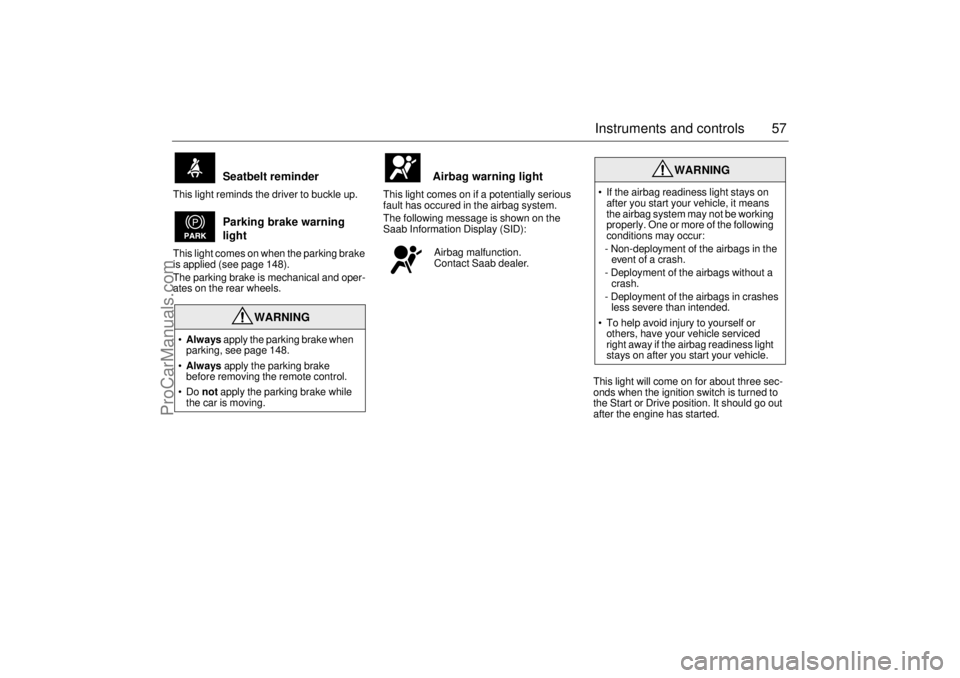
This light reminds the driver to buckle up.
This light comes on when the parking brake
is applied (see page 148).
The parking brake is mechanical and oper-
ates on the rear wheels.This light comes on if a potentially serious
fault has occured in the airbag system.
The following message is shown on the
Saab Information Display (SID):
This light will come on for about three sec-
onds when the ignition switch is turned to
the Start or Drive position. It should go out
after the engine has started.
Seatbelt reminder
Parking brake warning
light
WARNING
Always apply the parking brake when
parking, see page 148.
Always apply the parking brake
before removing the remote control.
Do not apply the parking brake while
the car is moving.
Airbag warning lightAirbag malfunction.
Contact Saab dealer.
WARNING
If the airbag readiness light stays on
after you start your vehicle, it means
the airbag system may not be working
properly. One or more of the following
conditions may occur:
- Non-deployment of the airbags in the
event of a crash.
- Deployment of the airbags without a
crash.
- Deployment of the airbags in crashes
less severe than intended.
To help avoid injury to yourself or
others, have your vehicle serviced
right away if the airbag readiness light
stays on after you start your vehicle.
ProCarManuals.com
Page 116 of 256
116 Interior equipmentTrunkFolding down the rear seatFor greater flexibility, the rear seat is split so that the narrow and
the wide part can be folded down separately.
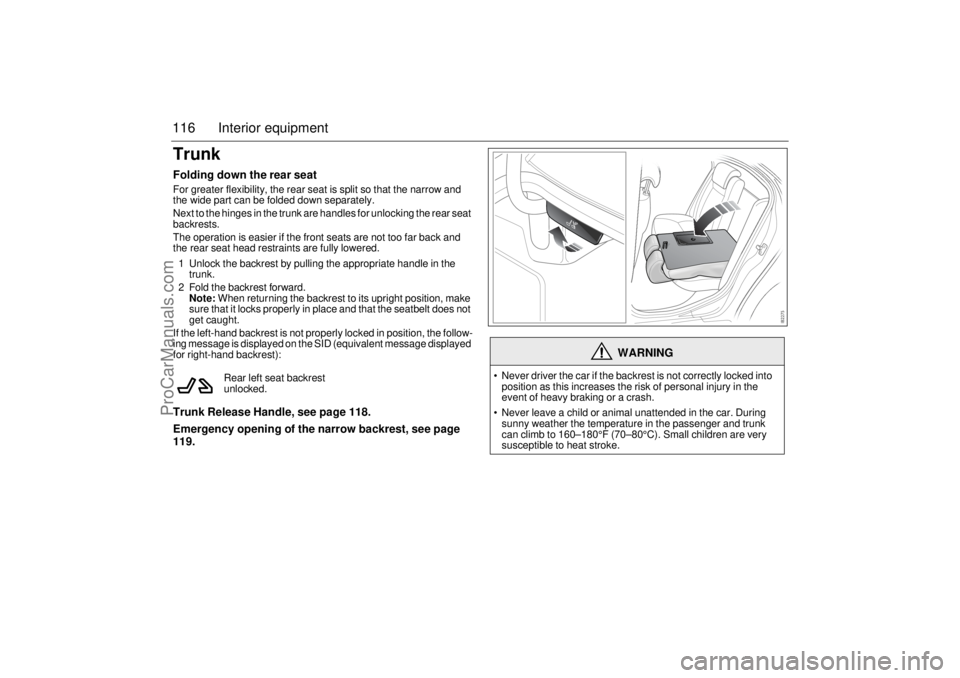
Next to the hinges in the trunk are handles for unlocking the rear seat
backrests.
The operation is easier if the front seats are not too far back and
the rear seat head restraints are fully lowered.
1 Unlock the backrest by pulling the appropriate handle in the
trunk.
2 Fold the backrest forward.
Note: When returning the backrest to its upright position, make
sure that it locks properly in place and that the seatbelt does not
get caught.
If the left-hand backrest is not properly locked in position, the follow-
ing message is displayed on the SID (equivalent message displayed
for right-hand backrest):Trunk Release Handle, see page 118.
Emergency opening of the narrow backrest, see page
119.
Rear left seat backrest
unlocked.
WARNING
Never driver the car if the backrest is not correctly locked into
position as this increases the risk of personal injury in the
event of heavy braking or a crash.
Never leave a child or animal unattended in the car. During
sunny weather the temperature in the passenger and trunk
can climb to 160–180°F (70–80°C). Small children are very
susceptible to heat stroke.
ProCarManuals.com
Page 117 of 256
117 Interior equipment
Load-through hatchA load-through hatch is incorporated in the rear seat backrest to
enable long, narrow items to be carried inside the car.
Before loading or unloading long items, switch off the engine and
apply the parking brake. This avoids the danger of the car moving
off if a long item were to knock the gear or selector lever into gear.
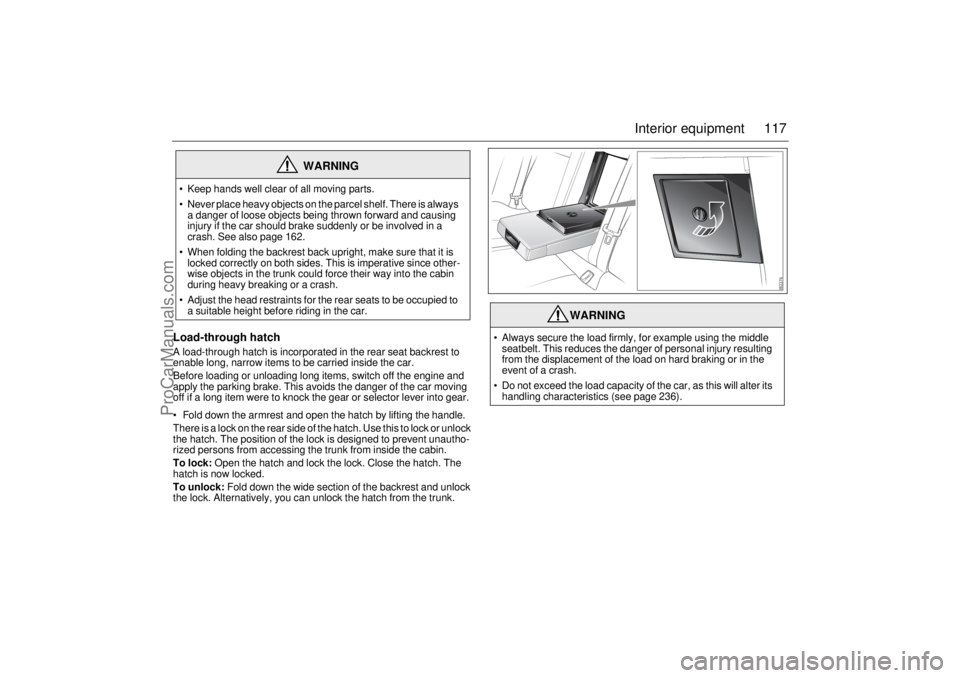
Fold down the armrest and open the hatch by lifting the handle.
There is a lock on the rear side of the hatch. Use this to lock or unlock
the hatch. The position of the lock is designed to prevent unautho-
rized persons from accessing the trunk from inside the cabin.
To lock: Open the hatch and lock the lock. Close the hatch. The
hatch is now locked.
To unlock: Fold down the wide section of the backrest and unlock
the lock. Alternatively, you can unlock the hatch from the trunk.
WARNING
Keep hands well clear of all moving parts.
Never place heavy objects on the parcel shelf. There is always
a danger of loose objects being thrown forward and causing
injury if the car should brake suddenly or be involved in a
crash. See also page 162.
When folding the backrest back upright, make sure that it is
locked correctly on both sides. This is imperative since other-
wise objects in the trunk could force their way into the cabin
during heavy breaking or a crash.
Adjust the head restraints for the rear seats to be occupied to
a suitable height before riding in the car.
WARNING
Always secure the load firmly, for example using the middle
seatbelt. This reduces the danger of personal injury resulting
from the displacement of the load on hard braking or in the
event of a crash.
Do not exceed the load capacity of the car, as this will alter its
handling characteristics (see page 236).
ProCarManuals.com
Page 170 of 256

170 Starting and drivingFor long tripsBefore starting off on a long journey, it is
advisable to have your car inspected by
your Saab dealer.
Obtain a few important items to take along
on your journey, such as spare bulbs, wiper
blades, fuses, a drive belt (poly-V-belt) and
the like.
You can check some points yourself before-
hand:
Check that no oil or fuel leaks out of the
engine or gearbox/transmission.
Check the coolant and power steering
fluid levels. Check also for leaks.
Inspect the drive belt (poly-V-belt) and
replace if it shows any signs of wear.
Check the battery charge.
Check the tires for tread pattern and air
pressure, including the compact spare
wheel.
Take an extra remote control and keep it
separate.
Check the brakes.
Check all bulbs.
Check for the presence of the tool kit and
jack in the car.
ProCarManuals.com
Page 171 of 256
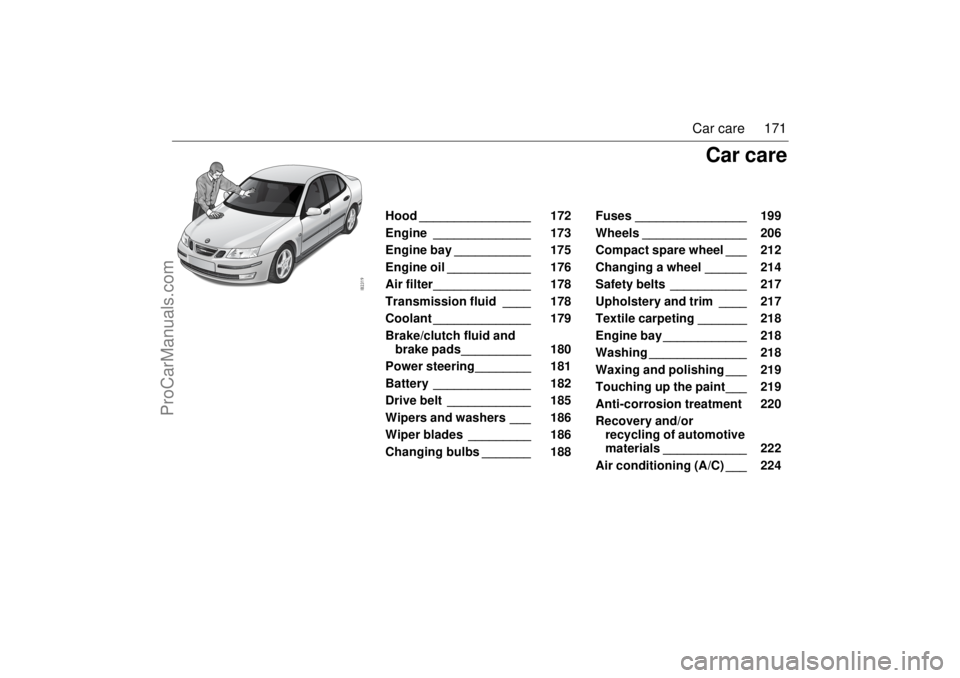
171 Car care
Hood ________________ 172
Engine ______________ 173
Engine bay ___________ 175
Engine oil ____________ 176
Air filter______________ 178
Transmission fluid ____ 178
Coolant ______________ 179
Brake/clutch fluid and
brake pads__________ 180
Power steering________ 181
Battery ______________ 182
Drive belt ____________ 185
Wipers and washers ___ 186
Wiper blades _________ 186
Changing bulbs _______ 188 Fuses ________________ 199
Wheels _______________ 206
Compact spare wheel ___ 212
Changing a wheel ______ 214
Safety belts ___________ 217
Upholstery and trim ____ 217
Textile carpeting _______ 218
Engine bay ____________ 218
Washing ______________ 218
Waxing and polishing ___ 219
Touching up the paint___ 219
Anti-corrosion treatment 220
Recovery and/or
recycling of automotive
materials ____________ 222
Air conditioning (A/C) ___ 224
Car care
ProCarManuals.com