steering wheel SAAB 9-3 2003 Owner's Manual
[x] Cancel search | Manufacturer: SAAB, Model Year: 2003, Model line: 9-3, Model: SAAB 9-3 2003Pages: 256, PDF Size: 21.66 MB
Page 139 of 256
139 Starting and driving
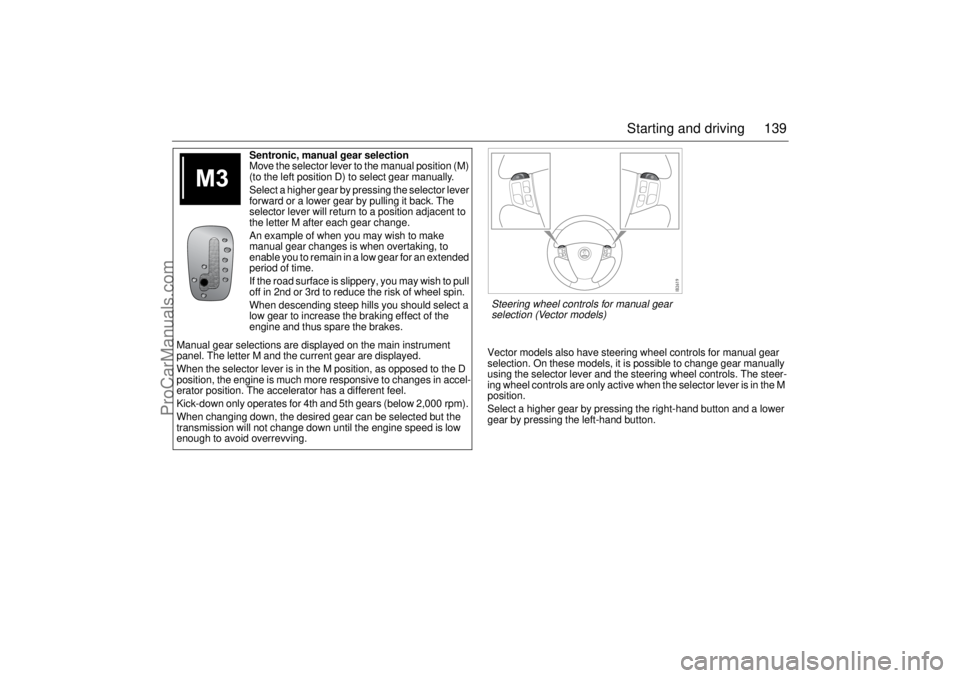
Vector models also have steering wheel controls for manual gear
selection. On these models, it is possible to change gear manually
using the selector lever and the steering wheel controls. The steer-
ing wheel controls are only active when the selector lever is in the M
position.
Select a higher gear by pressing the right-hand button and a lower
gear by pressing the left-hand button. Sentronic, manual gear selection
Move the selector lever to the manual position (M)
(to the left position D) to select gear manually.
Select a higher gear by pressing the selector lever
forward or a lower gear by pulling it back. The
selector lever will return to a position adjacent to
the letter M after each gear change.
An example of when you may wish to make
manual gear changes is when overtaking, to
enable you to remain in a low gear for an extended
period of time.
If the road surface is slippery, you may wish to pull
off in 2nd or 3rd to reduce the risk of wheel spin.
When descending steep hills you should select a
low gear to increase the braking effect of the
engine and thus spare the brakes.
Manual gear selections are displayed on the main instrument
panel. The letter M and the current gear are displayed.
When the selector lever is in the M position, as opposed to the D
position, the engine is much more responsive to changes in accel-
erator position. The accelerator has a different feel.
Kick-down only operates for 4th and 5th gears (below 2,000 rpm).
When changing down, the desired gear can be selected but the
transmission will not change down until the engine speed is low
enough to avoid overrevving.Steering wheel controls for manual gear
selection (Vector models)
ProCarManuals.com
Page 143 of 256
143 Starting and driving
The ABS system will not reduce the braking
distance on loose gravel, snow or ice but,
because the wheels cannot lock up, steer-
ing control is retained.
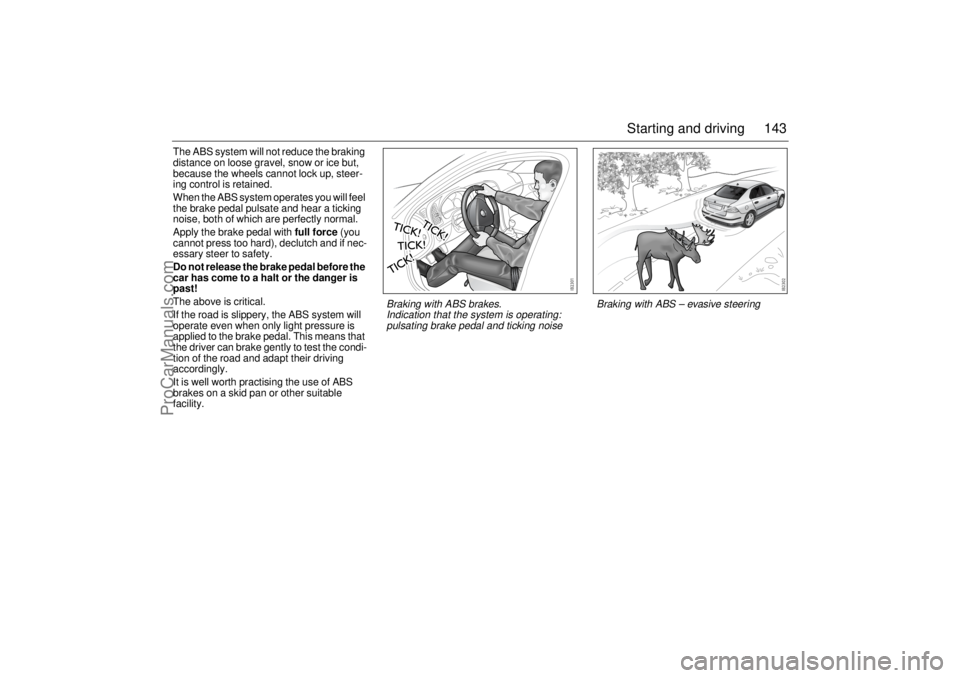
When the ABS system operates you will feel
the brake pedal pulsate and hear a ticking
noise, both of which are perfectly normal.
Apply the brake pedal with full force (you
cannot press too hard), declutch and if nec-
essary steer to safety.
Do not release the brake pedal before the
car has come to a halt or the danger is
past!
The above is critical.
If the road is slippery, the ABS system will
operate even when only light pressure is
applied to the brake pedal. This means that
the driver can brake gently to test the condi-
tion of the road and adapt their driving
accordingly.
It is well worth practising the use of ABS
brakes on a skid pan or other suitable
facility.
Braking with ABS – evasive steering
Braking with ABS brakes.
Indication that the system is operating:
pulsating brake pedal and ticking noise
ProCarManuals.com
Page 146 of 256
146 Starting and drivingElectronic Stability
Program (ESP)Anti-skid systemThe Electronic Stability Program employs
both the antilock braking system (ABS) and
the traction control system (TCS). It is a
safety system that helps the driver to stabi-
lize the car in unusual circumstances that
can otherwise be difficult to handle.
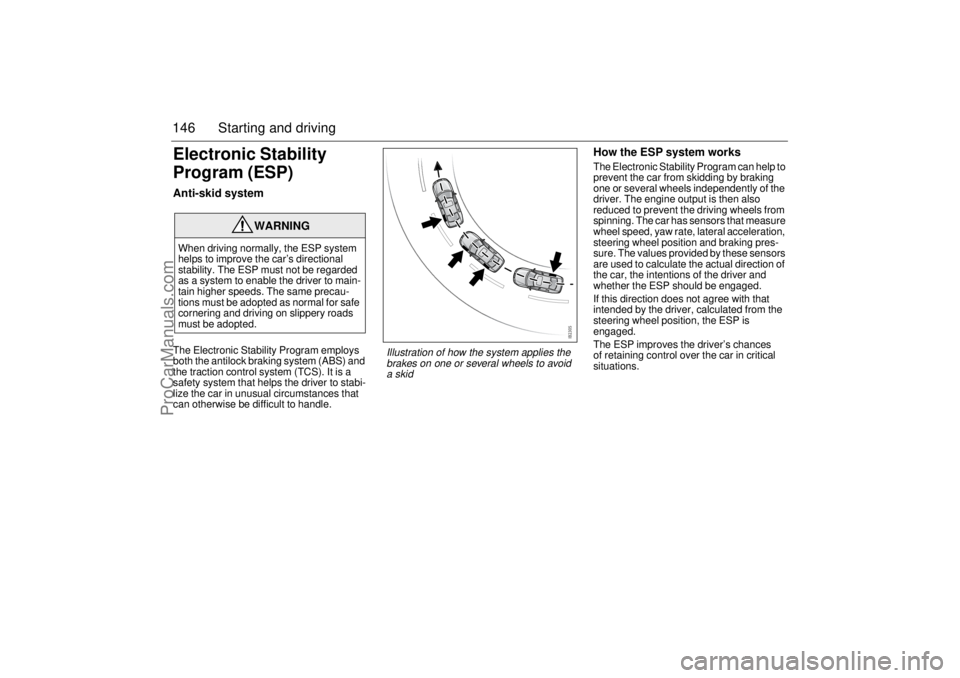
How the ESP system worksThe Electronic Stability Program can help to
prevent the car from skidding by braking
one or several wheels independently of the
driver. The engine output is then also
reduced to prevent the driving wheels from
spinning. The car has sensors that measure
wheel speed, yaw rate, lateral acceleration,
steering wheel position and braking pres-
sure. The values provided by these sensors
are used to calculate the actual direction of
the car, the intentions of the driver and
whether the ESP should be engaged.
If this direction does not agree with that
intended by the driver, calculated from the
steering wheel position, the ESP is
engaged.
The ESP improves the driver’s chances
of retaining control over the car in critical
situations.
WARNING
When driving normally, the ESP system
helps to improve the car’s directional
stability. The ESP must not be regarded
as a system to enable the driver to main-
tain higher speeds. The same precau-
tions must be adopted as normal for safe
cornering and driving on slippery roads
must be adopted.
Illustration of how the system applies the
brakes on one or several wheels to avoid
a skid
ProCarManuals.com
Page 149 of 256
149 Starting and driving
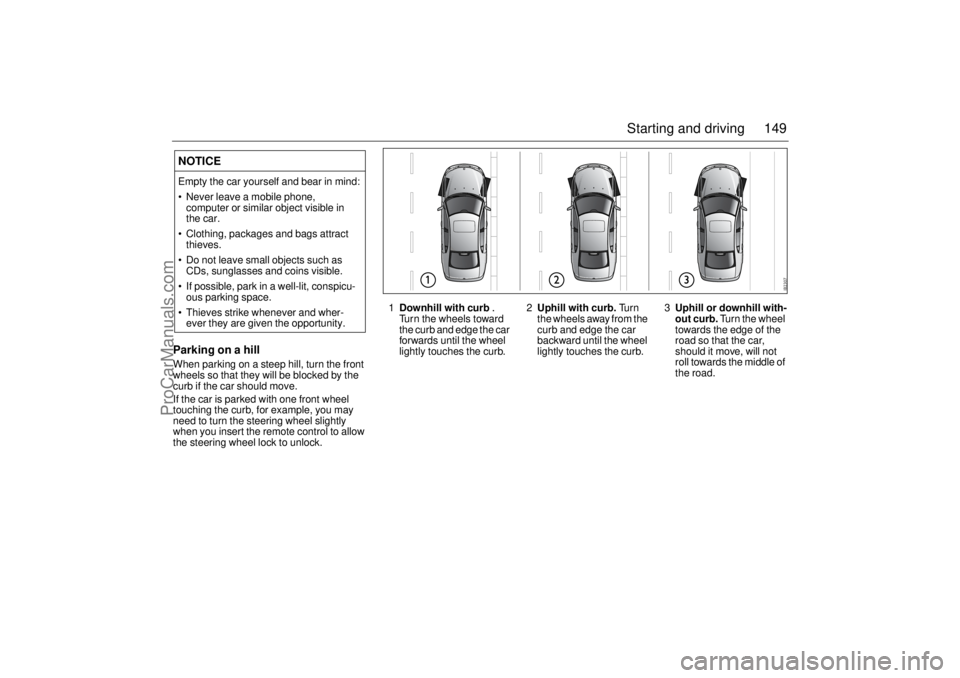
Parking on a hillWhen parking on a steep hill, turn the front
wheels so that they will be blocked by the
curb if the car should move.
If the car is parked with one front wheel
touching the curb, for example, you may
need to turn the steering wheel slightly
when you insert the remote control to allow
the steering wheel lock to unlock.NOTICEEmpty the car yourself and bear in mind:
Never leave a mobile phone,
computer or similar object visible in
the car.
Clothing, packages and bags attract
thieves.
Do not leave small objects such as
CDs, sunglasses and coins visible.
If possible, park in a well-lit, conspicu-
ous parking space.
Thieves strike whenever and wher-
ever they are given the opportunity.
1Downhill with curb
.
Turn the wheels toward
the curb and edge the car
forwards until the wheel
lightly touches the curb.2Uphill with curb. Tu r n
the wheels away from the
curb and edge the car
backward until the wheel
lightly touches the curb.3Uphill or downhill with-
out curb. Turn the wheel
towards the edge of the
road so that the car,
should it move, will not
roll towards the middle of
the road.
ProCarManuals.com
Page 164 of 256
164 Starting and drivingTowing the car
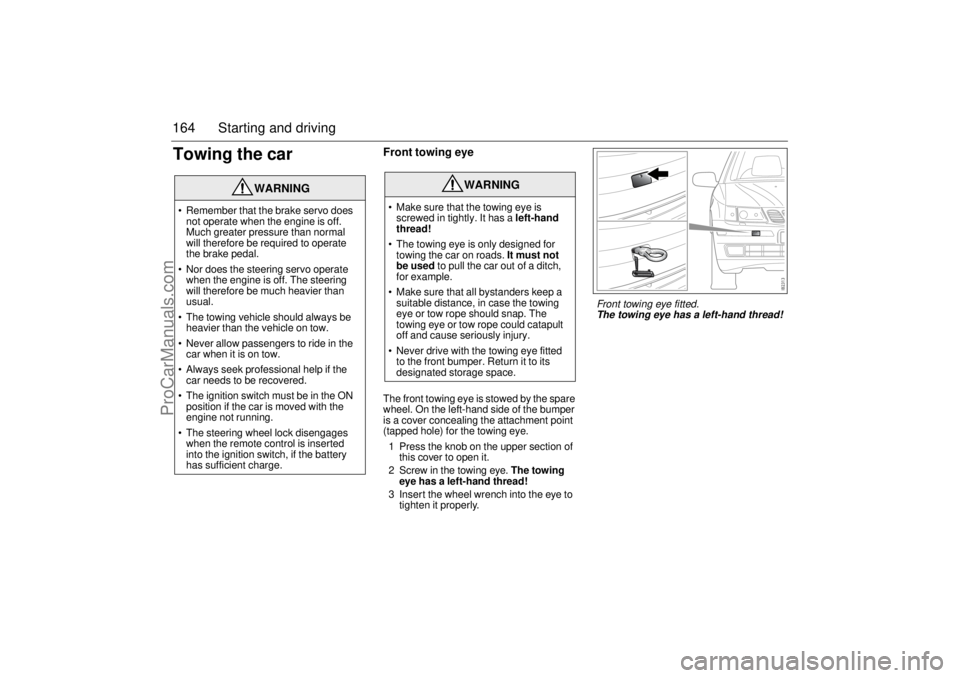
Front towing eyeThe front towing eye is stowed by the spare
wheel. On the left-hand side of the bumper
is a cover concealing the attachment point
(tapped hole) for the towing eye.
1 Press the knob on the upper section of
this cover to open it.
2 Screw in the towing eye. The towing
eye has a left-hand thread!
3 Insert the wheel wrench into the eye to
tighten it properly.
WARNING
Remember that the brake servo does
not operate when the engine is off.
Much greater pressure than normal
will therefore be required to operate
the brake pedal.
Nor does the steering servo operate
when the engine is off. The steering
will therefore be much heavier than
usual.
The towing vehicle should always be
heavier than the vehicle on tow.
Never allow passengers to ride in the
car when it is on tow.
Always seek professional help if the
car needs to be recovered.
The ignition switch must be in the ON
position if the car is moved with the
engine not running.
The steering wheel lock disengages
when the remote control is inserted
into the ignition switch, if the battery
has sufficient charge.
WARNING
Make sure that the towing eye is
screwed in tightly. It has a left-hand
thread!
The towing eye is only designed for
towing the car on roads. It must not
be used to pull the car out of a ditch,
for example.
Make sure that all bystanders keep a
suitable distance, in case the towing
eye or tow rope should snap. The
towing eye or tow rope could catapult
off and cause seriously injury.
Never drive with the towing eye fitted
to the front bumper. Return it to its
designated storage space.
Front towing eye fitted.
The towing eye has a left-hand thread!
ProCarManuals.com
Page 170 of 256

170 Starting and drivingFor long tripsBefore starting off on a long journey, it is
advisable to have your car inspected by
your Saab dealer.
Obtain a few important items to take along
on your journey, such as spare bulbs, wiper
blades, fuses, a drive belt (poly-V-belt) and
the like.
You can check some points yourself before-
hand:
Check that no oil or fuel leaks out of the
engine or gearbox/transmission.
Check the coolant and power steering
fluid levels. Check also for leaks.
Inspect the drive belt (poly-V-belt) and
replace if it shows any signs of wear.
Check the battery charge.
Check the tires for tread pattern and air
pressure, including the compact spare
wheel.
Take an extra remote control and keep it
separate.
Check the brakes.
Check all bulbs.
Check for the presence of the tool kit and
jack in the car.
ProCarManuals.com
Page 171 of 256
171 Car care
Hood ________________ 172
Engine ______________ 173
Engine bay ___________ 175
Engine oil ____________ 176
Air filter______________ 178
Transmission fluid ____ 178
Coolant ______________ 179
Brake/clutch fluid and
brake pads__________ 180
Power steering________ 181
Battery ______________ 182
Drive belt ____________ 185
Wipers and washers ___ 186
Wiper blades _________ 186
Changing bulbs _______ 188 Fuses ________________ 199
Wheels _______________ 206
Compact spare wheel ___ 212
Changing a wheel ______ 214
Safety belts ___________ 217
Upholstery and trim ____ 217
Textile carpeting _______ 218
Engine bay ____________ 218
Washing ______________ 218
Waxing and polishing ___ 219
Touching up the paint___ 219
Anti-corrosion treatment 220
Recovery and/or
recycling of automotive
materials ____________ 222
Air conditioning (A/C) ___ 224
Car care
ProCarManuals.com
Page 181 of 256
181 Car care
The foot brake and parking brake are self-
adjusting.
It is not possible to detect, through abnormal
pedal or parking brake lever travel, whether
the brake pads are worn and need replac-
ing. It is therefore essential that brake pads
be checked regularly, as specified in the
service program.
Brake pads should only be changed at a
Saab dealer. To ensure optimum brake
performance, use only Saab genuine
brake pads.
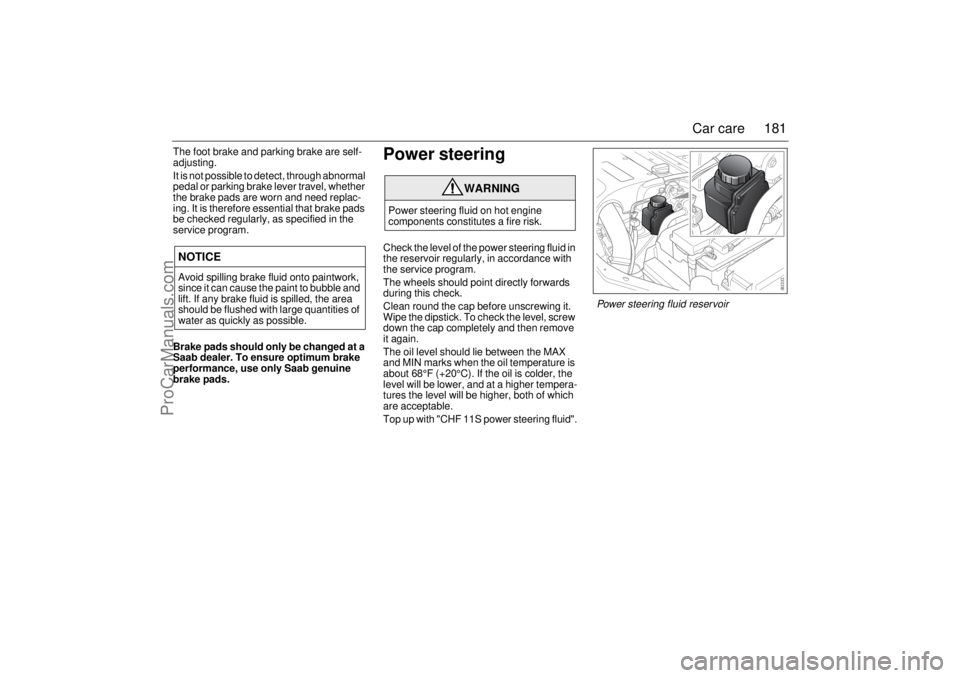
Power steeringCheck the level of the power steering fluid in
the reservoir regularly, in accordance with
the service program.
The wheels should point directly forwards
during this check.
Clean round the cap before unscrewing it.
Wipe the dipstick. To check the level, screw
down the cap completely and then remove
it again.
The oil level should lie between the MAX
and MIN marks when the oil temperature is
about 68°F (+20°C). If the oil is colder, the
level will be lower, and at a higher tempera-
tures the level will be higher, both of which
are acceptable.
Top up with "CHF 11S power steering fluid".
NOTICEAvoid spilling brake fluid onto paintwork,
since it can cause the paint to bubble and
lift. If any brake fluid is spilled, the area
should be flushed with large quantities of
water as quickly as possible.
WARNING
Power steering fluid on hot engine
components constitutes a fire risk.
Power steering fluid reservoir
ProCarManuals.com
Page 201 of 256
201 Car care
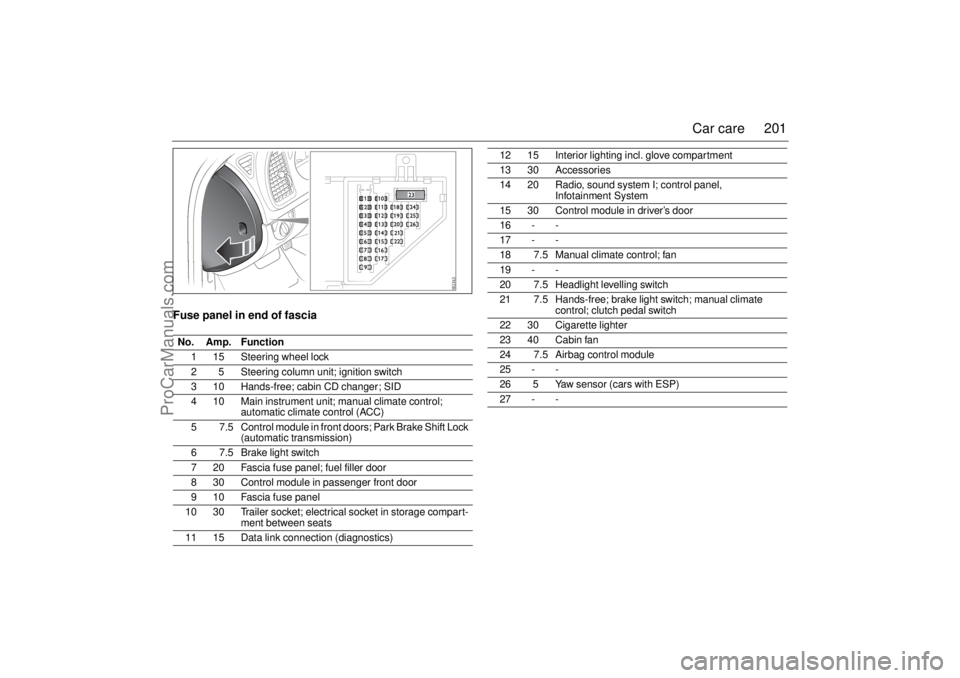
Fuse panel in end of fasciaNo. Amp. Function
1 15 Steering wheel lock
2 5 Steering column unit; ignition switch
3 10 Hands-free; cabin CD changer; SID
4 10 Main instrument unit; manual climate control;
automatic climate control (ACC)
5 7.5 Control module in front doors; Park Brake Shift Lock
(automatic transmission)
6 7.5 Brake light switch
7 20 Fascia fuse panel; fuel filler door
8 30 Control module in passenger front door
9 10 Fascia fuse panel
10 30 Trailer socket; electrical socket in storage compart-
ment between seats
11 15 Data link connection (diagnostics)
12 15 Interior lighting incl. glove compartment
13 30 Accessories
14 20 Radio, sound system I; control panel,
Infotainment System
15 30 Control module in driver’s door
16 - -
17 - -
18 7.5 Manual climate control; fan
19 - -
20 7.5 Headlight levelling switch
21 7.5 Hands-free; brake light switch; manual climate
control; clutch pedal switch
22 30 Cigarette lighter
23 40 Cabin fan
24 7.5 Airbag control module
25 - -
26 5 Yaw sensor (cars with ESP)
27 - -
ProCarManuals.com
Page 206 of 256

206 Car careWheelsAlternative wheels and tiresIf you wish to fit other tires or wheels than
those supplied with the car, consult your
Saab dealer first as to the possibilities
available.
Wheels/tires combinations that are not
approved by Saab can negatively affect the
car’s directional stability, steering and brak-
ing in both wet and dry conditions.The wheels and tires have been carefully
matched to the characteristics of the car and
play a key role in its outstanding roadhold-
ing and handling.
Do not take it for granted that a wheel/tire
combination will work in the best possible
way, just because it can be fitted to the car.
To ensure that the speedometer is as accu-
rate as possible it should be reprogrammed
if wheels of a different dimension are fitted.
Contact a Saab dealer.
NOTICEAlways consult your Saab dealer before
changing the car’s wheels or tires on your
Saab.
Wide wheels and tires with side walls that
are too low can:
be damaged in potholes, etc.
cause springs, shock absorbers and
wheel bearings and body mountings
to be overloaded
cause the wheels to come into contact
with chassis and body components
affect the function of the Electronic
Stability Program (ESP).
The speed and load limits of the tires
must not be exceeded; see page 209.
Wheels larger than 18" must not be fitted
on the Saab 9-3. The permissible offset is
1.61 inch (41 mm).
ProCarManuals.com