remote control SAAB 9-3 2003 Owner's Guide
[x] Cancel search | Manufacturer: SAAB, Model Year: 2003, Model line: 9-3, Model: SAAB 9-3 2003Pages: 256, PDF Size: 21.66 MB
Page 145 of 256
145 Starting and driving
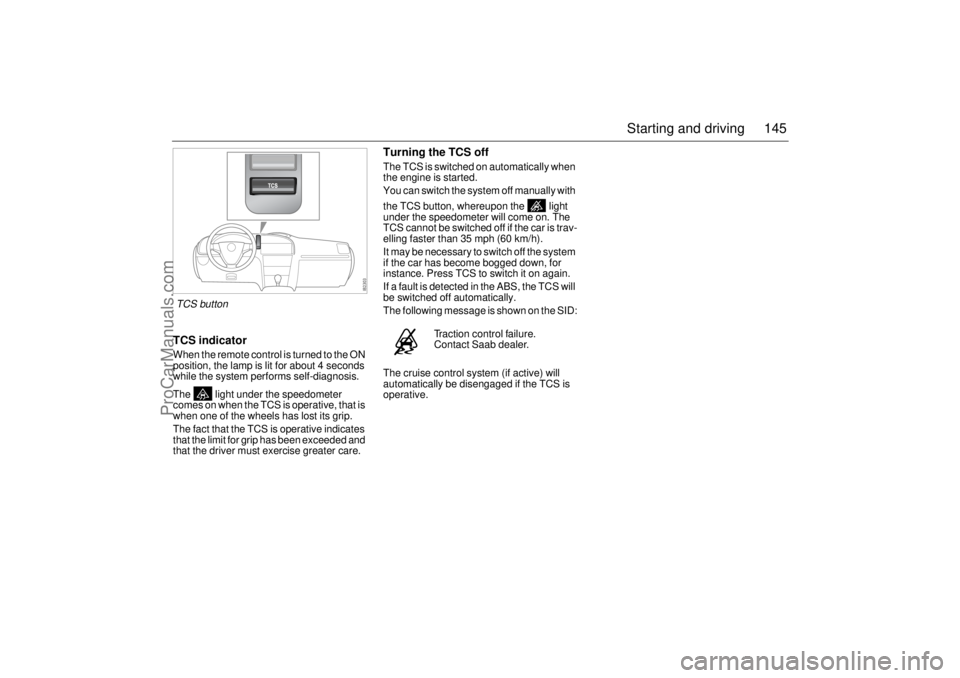
TCS indicatorWhen the remote control is turned to the ON
position, the lamp is lit for about 4 seconds
while the system performs self-diagnosis.
The light under the speedometer
comes on when the TCS is operative, that is
when one of the wheels has lost its grip.
The fact that the TCS is operative indicates
that the limit for grip has been exceeded and
that the driver must exercise greater care.
Turning the TCS offThe TCS is switched on automatically when
the engine is started.
You can switch the system off manually with
the TCS button, whereupon the light
under the speedometer will come on. The
TCS cannot be switched off if the car is trav-
elling faster than 35 mph (60 km/h).
It may be necessary to switch off the system
if the car has become bogged down, for
instance. Press TCS to switch it on again.
If a fault is detected in the ABS, the TCS will
be switched off automatically.
The following message is shown on the SID:
The cruise control system (if active) will
automatically be disengaged if the TCS is
operative.
Traction control failure.
Contact Saab dealer.
TCS button
ProCarManuals.com
Page 147 of 256
147 Starting and driving
ESP OFF
lights up under the speedometer if:
a fault has been detected and the system
has therefore been switched off
the system has been switched off
manually
when the remote control is turned to the
ON position, the lamp is lit for about
4 seconds while the system performs
self-diagnosis.
ESP indicator lightThe light under the speedometer
comes on for a short period of time when the
ESP system is operative.
Operation of the ESP indicates reduced
cohesion between the tires and the road,
and that extra care should be taken by the
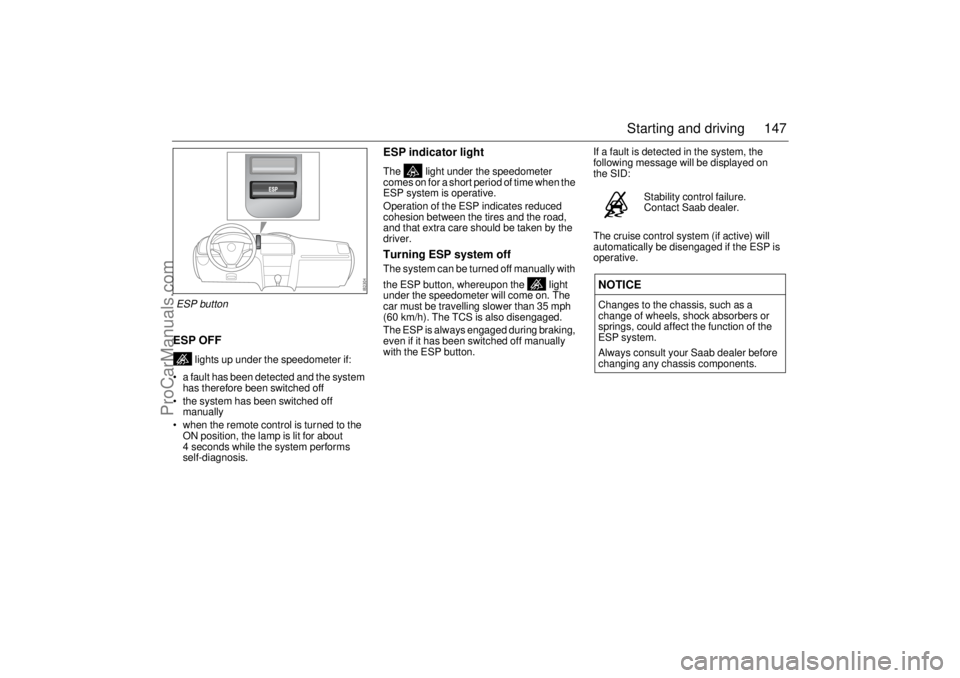
driver.Turning ESP system offThe system can be turned off manually with
the ESP button, whereupon the light
under the speedometer will come on. The
car must be travelling slower than 35 mph
(60 km/h). The TCS is also disengaged.
The ESP is always engaged during braking,
even if it has been switched off manually
with the ESP button.If a fault is detected in the system, the
following message will be displayed on
the SID:
The cruise control system (if active) will
automatically be disengaged if the ESP is
operative.
Stability control failure.
Contact Saab dealer.
NOTICEChanges to the chassis, such as a
change of wheels, shock absorbers or
springs, could affect the function of the
ESP system.
Always consult your Saab dealer before
changing any chassis components.
ESP button
ProCarManuals.com
Page 148 of 256
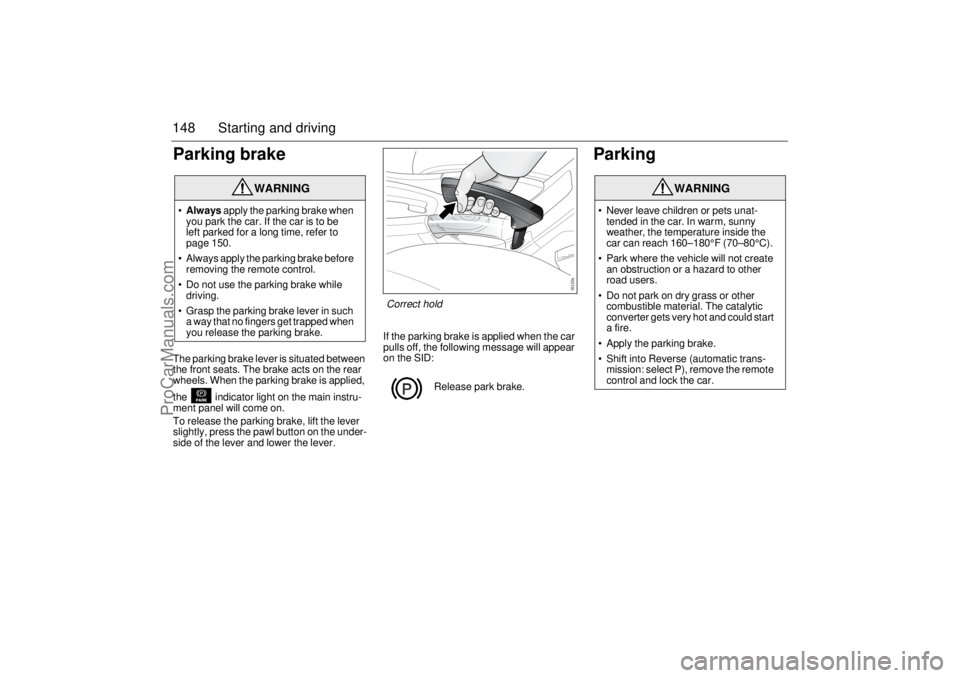
148 Starting and drivingParking brakeThe parking brake lever is situated between
the front seats. The brake acts on the rear
wheels. When the parking brake is applied,
the indicator light on the main instru-
ment panel will come on.
To release the parking brake, lift the lever
slightly, press the pawl button on the under-
side of the lever and lower the lever.If the parking brake is applied when the car
pulls off, the following message will appear
on the SID:
Parking
WARNING
Always apply the parking brake when
you park the car. If the car is to be
left parked for a long time, refer to
page 150.
Always apply the parking brake before
removing the remote control.
Do not use the parking brake while
driving.
Grasp the parking brake lever in such
a way that no fingers get trapped when
you release the parking brake.
Release park brake.
WARNING
Never leave children or pets unat-
tended in the car. In warm, sunny
weather, the temperature inside the
car can reach 160–180°F (70–80°C).
Park where the vehicle will not create
an obstruction or a hazard to other
road users.
Do not park on dry grass or other
combustible material. The catalytic
converter gets very hot and could start
a fire.
Apply the parking brake.
Shift into Reverse (automatic trans-
mission: select P), remove the remote
control and lock the car.
Correct hold
ProCarManuals.com
Page 149 of 256
149 Starting and driving
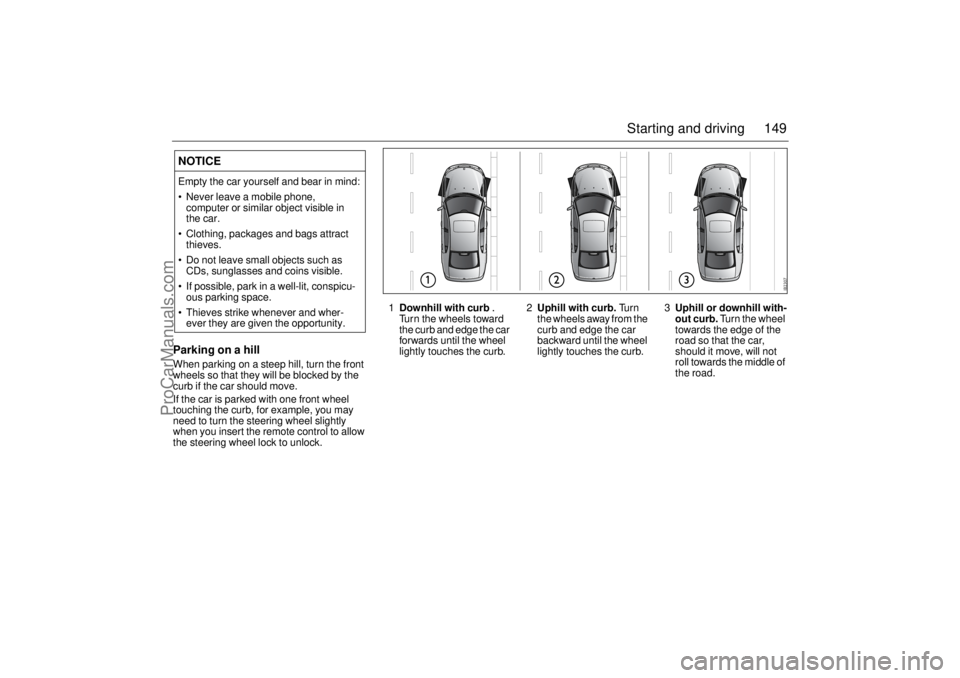
Parking on a hillWhen parking on a steep hill, turn the front
wheels so that they will be blocked by the
curb if the car should move.
If the car is parked with one front wheel
touching the curb, for example, you may
need to turn the steering wheel slightly
when you insert the remote control to allow
the steering wheel lock to unlock.NOTICEEmpty the car yourself and bear in mind:
Never leave a mobile phone,
computer or similar object visible in
the car.
Clothing, packages and bags attract
thieves.
Do not leave small objects such as
CDs, sunglasses and coins visible.
If possible, park in a well-lit, conspicu-
ous parking space.
Thieves strike whenever and wher-
ever they are given the opportunity.
1Downhill with curb
.
Turn the wheels toward
the curb and edge the car
forwards until the wheel
lightly touches the curb.2Uphill with curb. Tu r n
the wheels away from the
curb and edge the car
backward until the wheel
lightly touches the curb.3Uphill or downhill with-
out curb. Turn the wheel
towards the edge of the
road so that the car,
should it move, will not
roll towards the middle of
the road.
ProCarManuals.com
Page 164 of 256
164 Starting and drivingTowing the car
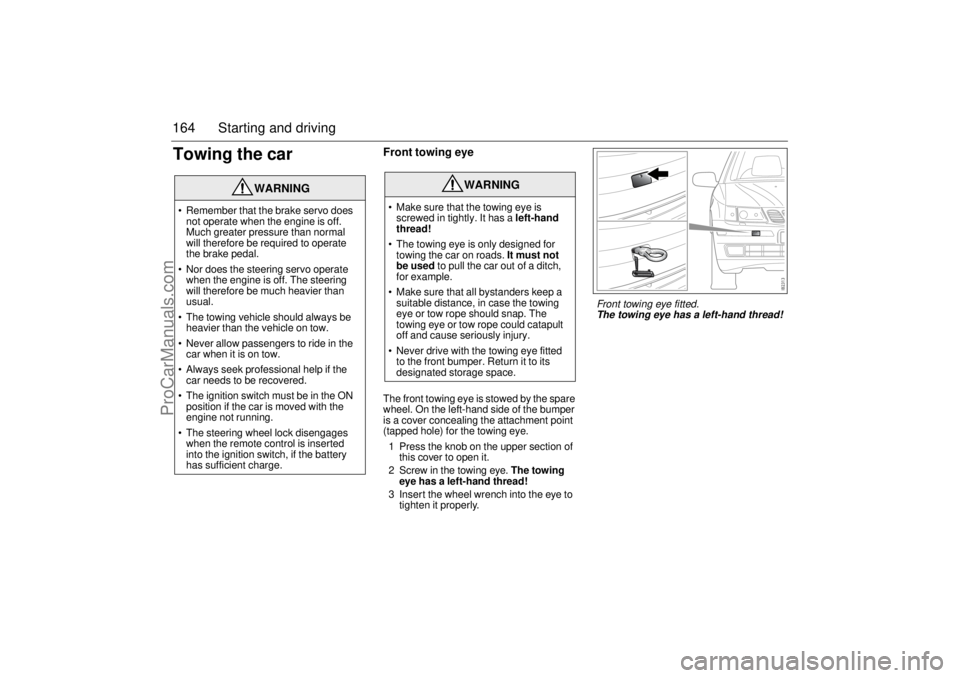
Front towing eyeThe front towing eye is stowed by the spare
wheel. On the left-hand side of the bumper
is a cover concealing the attachment point
(tapped hole) for the towing eye.
1 Press the knob on the upper section of
this cover to open it.
2 Screw in the towing eye. The towing
eye has a left-hand thread!
3 Insert the wheel wrench into the eye to
tighten it properly.
WARNING
Remember that the brake servo does
not operate when the engine is off.
Much greater pressure than normal
will therefore be required to operate
the brake pedal.
Nor does the steering servo operate
when the engine is off. The steering
will therefore be much heavier than
usual.
The towing vehicle should always be
heavier than the vehicle on tow.
Never allow passengers to ride in the
car when it is on tow.
Always seek professional help if the
car needs to be recovered.
The ignition switch must be in the ON
position if the car is moved with the
engine not running.
The steering wheel lock disengages
when the remote control is inserted
into the ignition switch, if the battery
has sufficient charge.
WARNING
Make sure that the towing eye is
screwed in tightly. It has a left-hand
thread!
The towing eye is only designed for
towing the car on roads. It must not
be used to pull the car out of a ditch,
for example.
Make sure that all bystanders keep a
suitable distance, in case the towing
eye or tow rope should snap. The
towing eye or tow rope could catapult
off and cause seriously injury.
Never drive with the towing eye fitted
to the front bumper. Return it to its
designated storage space.
Front towing eye fitted.
The towing eye has a left-hand thread!
ProCarManuals.com
Page 170 of 256

170 Starting and drivingFor long tripsBefore starting off on a long journey, it is
advisable to have your car inspected by
your Saab dealer.
Obtain a few important items to take along
on your journey, such as spare bulbs, wiper
blades, fuses, a drive belt (poly-V-belt) and
the like.
You can check some points yourself before-
hand:
Check that no oil or fuel leaks out of the
engine or gearbox/transmission.
Check the coolant and power steering
fluid levels. Check also for leaks.
Inspect the drive belt (poly-V-belt) and
replace if it shows any signs of wear.
Check the battery charge.
Check the tires for tread pattern and air
pressure, including the compact spare
wheel.
Take an extra remote control and keep it
separate.
Check the brakes.
Check all bulbs.
Check for the presence of the tool kit and
jack in the car.
ProCarManuals.com
Page 248 of 256

248 Technical dataSeveral of the systems in your Saab
can be customized to better suit
your individual needs. Contact your
Saab dealerCentral locking system
Some functions are governed by legal
requirements and cannot therefore be
reprogrammed.
Consult a Saab dealer for further informa-
tion.
Listed below are a number of examples of
programmable functions.
Audible confirmation of arming/disarming
the car alarm.
Automatic unlocking when car stopped
and remote control removed from the igni-
tion switch.
Trunk lid locked when car driven off or
30 s after being shut.
Length of audible and visual acknowl-
edgements.
Possibility to have the trunk lid unlocked
when doors unlocked, yes/no.
Central locking relocks the car automati-
cally if a door or the trunk lid is not opened,
yes/no. If the car has an alarm, this is
rearmed.Car alarm
Listed below are a number of examples of
programmable functions.
Cabin lighting switched on when the car
alarm is tripped.
Sensitivity of the movement sensor.
Audible signal produced by horn or car
alarm siren.
ProCarManuals.com
Page 249 of 256
249 Technical data
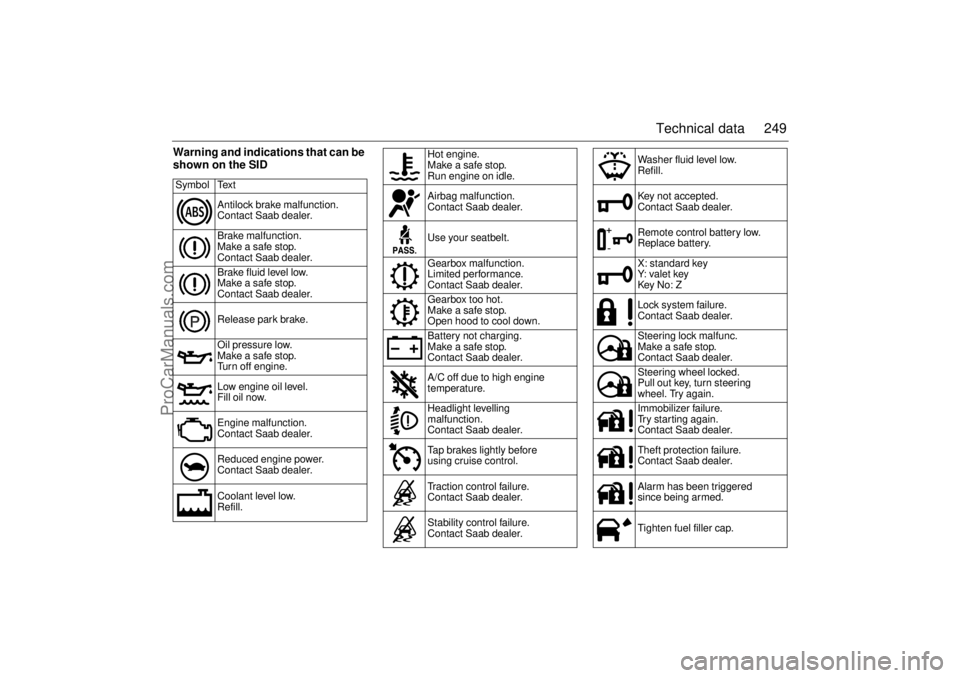
Warning and indications that can be
shown on the SIDSymbol Text
Antilock brake malfunction.
Contact Saab dealer.
Brake malfunction.
Make a safe stop.
Contact Saab dealer.
Brake fluid level low.
Make a safe stop.
Contact Saab dealer.
Release park brake.
Oil pressure low.
Make a safe stop.
Turn off engine.
Low engine oil level.
Fill oil now.
Engine malfunction.
Contact Saab dealer.
Reduced engine power.
Contact Saab dealer.
Coolant level low.
Refill.
Hot engine.
Make a safe stop.
Run engine on idle.
Airbag malfunction.
Contact Saab dealer.
Use your seatbelt.
Gearbox malfunction.
Limited performance.
Contact Saab dealer.
Gearbox too hot.
Make a safe stop.
Open hood to cool down.
Battery not charging.
Make a safe stop.
Contact Saab dealer.
A/C off due to high engine
temperature.
Headlight levelling
malfunction.
Contact Saab dealer.
Tap brakes lightly before
using cruise control.
Traction control failure.
Contact Saab dealer.
Stability control failure.
Contact Saab dealer.
Washer fluid level low.
Refill.
Key not accepted.
Contact Saab dealer.
Remote control battery low.
Replace battery.
X: standard key
Y: va l e t key
Key No: Z
Lock system failure.
Contact Saab dealer.
Steering lock malfunc.
Make a safe stop.
Contact Saab dealer.
Steering wheel locked.
Pull out key, turn steering
wheel. Try again.
Immobilizer failure.
Try starting again.
Contact Saab dealer.
Theft protection failure.
Contact Saab dealer.
Alarm has been triggered
since being armed.
Tighten fuel filler cap.
ProCarManuals.com
Page 251 of 256

251 Index
Index
AA/C
__________________________ 82
ABS brakes
___________________ 142
ACC
_________________________ 84
Adjustment, steering wheel
________ 98
Air conditioning
_________________ 82
Air filter
______________________ 178
Air pressure, tyres
______________ 207
Airbag
________________________ 26
Anchorage eyes
_______________ 118
Anti-corrosion treatment
_________ 220
Antilock braking system _________ 142
Anti-spin
_____________________ 144
Ashtrays _____________________ 108
Autochecking of lights, warning and
indicator lights
_________________ 58
Autodimming
______________ 111
, 112
Automatic climate control (ACC)
____ 84
Automatic transmission
__________ 134
Automatic tyre pressure monitoring
207
BBattery
______________________ 182
Bedding-in of new brake pads
____ 132
Before towing a trailer
___________ 160
Bonnet
______________________ 172Bootlid, driving when open
_______ 163
Bootlid, opening
________________ 41
Brake fluid, grade ______________ 242
Brakes
_______________________ 141
Braking ______________________ 141
Bulb changing
_________________ 188
Bulb table
____________________ 198
CCabin lighting
_________________ 105
Car alarm
_____________________ 46
Car transport __________________ 166
Care of air conditioning
__________ 225
Change of address notification
____ 232
Changing bulbs
________________ 188
Changing engine oil
____________ 177
Changing the battery, remote control
44
Changing wheels
______________ 214
Changing wiper blades
__________ 186
Checking the number of
remote controls
________________ 43
Checks before towing a trailer
____ 160
Child safety
____________________ 21
Child safety locks, rear doors
______ 42
Child seats
____________________ 21
Cigarette lighter
________________ 108
Cleaning the engine bay
_________ 218
Cleaning upholstery
____________ 217
Climate control system, manual
____ 79
Compact spare
________________ 212Compass
_____________________ 115
Condensation water, A/C
_________ 82
Coolant
______________________ 179
Cruise control
_________________ 140
Cup holder
____________________ 107
DDate codes, tyres
______________ 212
Deep water, driving through
______ 163
Direction indicator stalk switch _____ 75
Direction indicators
______________ 75
Donor battery, boost starting
______ 168
Door handles
___________________ 38
Door mirrors __________________ 110
Drive belt
_____________________ 185
Drive belt, length
_______________ 240
Driver’s seat with memory
_________ 19
Driving at night
________________ 163
Driving in cold climates
__________ 155
Driving in deep water
____________ 163
Driving in hot climates ___________ 156
Driving techniques
______________ 153
Driving with a heavy load on
hilly roads
___________________ 136
Driving with a load
______________ 162
Driving with a roof load
__________ 161
Driving with the bootlid open
______ 163
Driving with the compact
spare wheel
__________________ 167
ProCarManuals.com
Page 253 of 256

253 Index
LLATCH (child safety)
_____________ 22
Labels and plates, location
_______ 246
Lashing eyes
__________________ 118
Laying the car up
______________ 150
Leather upholstery, cleaning
______ 218
Limp-home
___________________ 126
Limp-home, automatic transmission
137
Load carriers, roof
______________ 161
Load indices, tyres _____________ 209
Load-through hatch _____________ 117
Locking a car with flat battery
______ 41
Locks
________________________ 38
Long-term parking
______________ 150
Luggage compartment
__________ 116
Luggage compartment lighting
106
, 119
Luggage compartment lighting,
changing
____________________ 197
MMAXI fuses
___________________ 200
Main instrument panel
___________ 54
Main/dipped beam
______________ 72
Maintenance schedule __________ 230
Manual climate control ___________ 79
Manual gear selection ___________ 139
Manual gearbox
_______________ 133
Manual tripping of car alarm
_______ 49
Materials used in the car, reclamation
222Memory, driver’s seat
____________ 19
Milometer
_____________________ 59
Movement sensor, car alarm
______ 48
Mug holder
___________________ 107
NNight driving
__________________ 163
Number plate lighting, changing
___ 196
OORVR
_______________________ 174
Oil capacity, engine
_____________ 239
Opening handles
________________ 38
Opening the fuel filler flap manually
_52
Owner assistance
______________ 232
PPanic function, car alarm
_________ 49
Park Brake Shift Lock
___________ 135
Park Brake Shift Lock,
temporary override
____________ 137
Parking
______________________ 148
Parking aid ___________________ 151
Parking brake _________________ 148
Parking on a hill _______________ 149
Pinch protection, electric windows
_100
Pinch protection, sunroof
________ 104Plates and labels, location
________ 246
Polishing and waxing
____________ 219
Poly-V-belt
____________________ 185
Position lights __________________ 72
Power steering fluid, checking
_____ 181
Power steering fluid, grade
_______ 242
Pressure gauge
_________________ 61
Profiles, customized settings
_______ 64
Puncture, changing wheels _______ 214
QQuick guide, remote control
_______ 39
RRain sensor
____________________ 77
Rear fog light ___________________ 74
Rear seats, folding down
_________ 116
Rear towing eye
_______________ 165
Rear window heating
_____________ 83
Rearview mirrors
_______________ 110
Recirculation
___________________ 82
Recommendations for automatic
transmission, towing a trailer
____ 158
Recommendations for manual
gearbox, towing a trailer
________ 159
Recommended fuel grades _______ 128
Recommended snow chains ______ 243
Refueling
_____________________ 128
ProCarManuals.com