height SAAB 9-3 2003 Owners Manual
[x] Cancel search | Manufacturer: SAAB, Model Year: 2003, Model line: 9-3, Model: SAAB 9-3 2003Pages: 256, PDF Size: 21.66 MB
Page 13 of 256
13 Safety
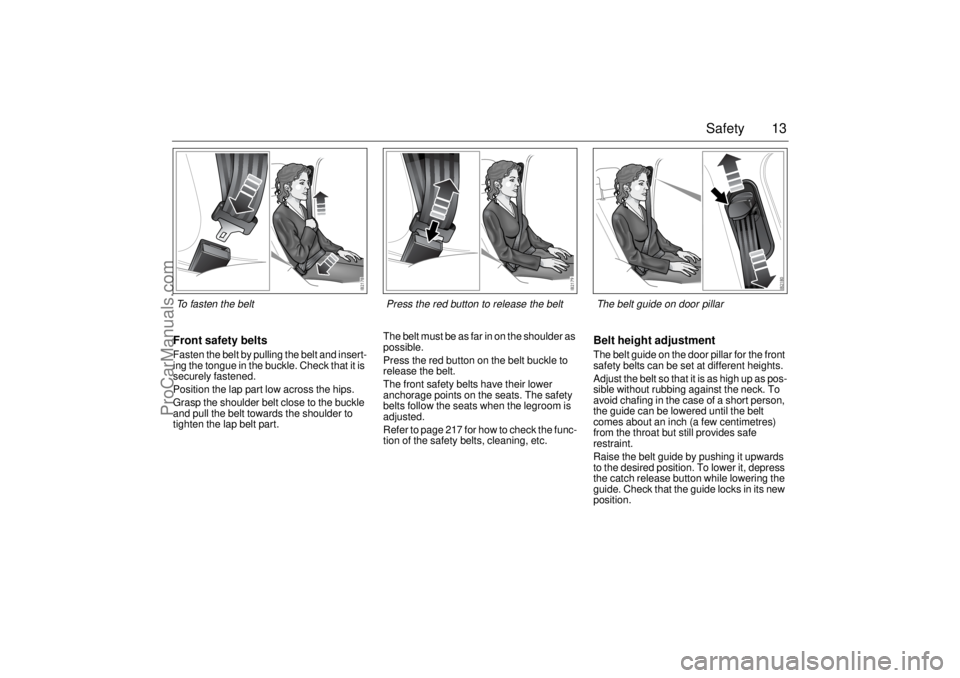
Front safety beltsFasten the belt by pulling the belt and insert-
ing the tongue in the buckle. Check that it is
securely fastened.
Position the lap part low across the hips.
Grasp the shoulder belt close to the buckle
and pull the belt towards the shoulder to
tighten the lap belt part.The belt must be as far in on the shoulder as
possible.
Press the red button on the belt buckle to
release the belt.
The front safety belts have their lower
anchorage points on the seats. The safety
belts follow the seats when the legroom is
adjusted.
Refer to page 217 for how to check the func-
tion of the safety belts, cleaning, etc.
Belt height adjustmentThe belt guide on the door pillar for the front
safety belts can be set at different heights.
Adjust the belt so that it is as high up as pos-
sible without rubbing against the neck. To
avoid chafing in the case of a short person,
the guide can be lowered until the belt
comes about an inch (a few centimetres)
from the throat but still provides safe
restraint.
Raise the belt guide by pushing it upwards
to the desired position. To lower it, depress
the catch release button while lowering the
guide. Check that the guide locks in its new
position.
To fasten the belt Press the red button to release the belt
The belt guide on door pillar
ProCarManuals.com
Page 16 of 256
16 SafetySeatsManually adjusted front seatsThe following seat adjustments can be
made to achieve a comfortable driving
position:
Height (driver’s seat)
Legroom
Backrest rake angle
Lumbar support (driver’s seat)
Head-restraint height
We recommend that adjustments to the
driver’s seat be performed in the following
order:
1 Height
2 Legroom
3 Backrest rake angle
4 Head restraint height
Lastly, adjust the position of the steering
wheel (see page 98).Electrically adjustable front seatsSee page 18.Electric heating, front seats (option)See pages 83 and 92.
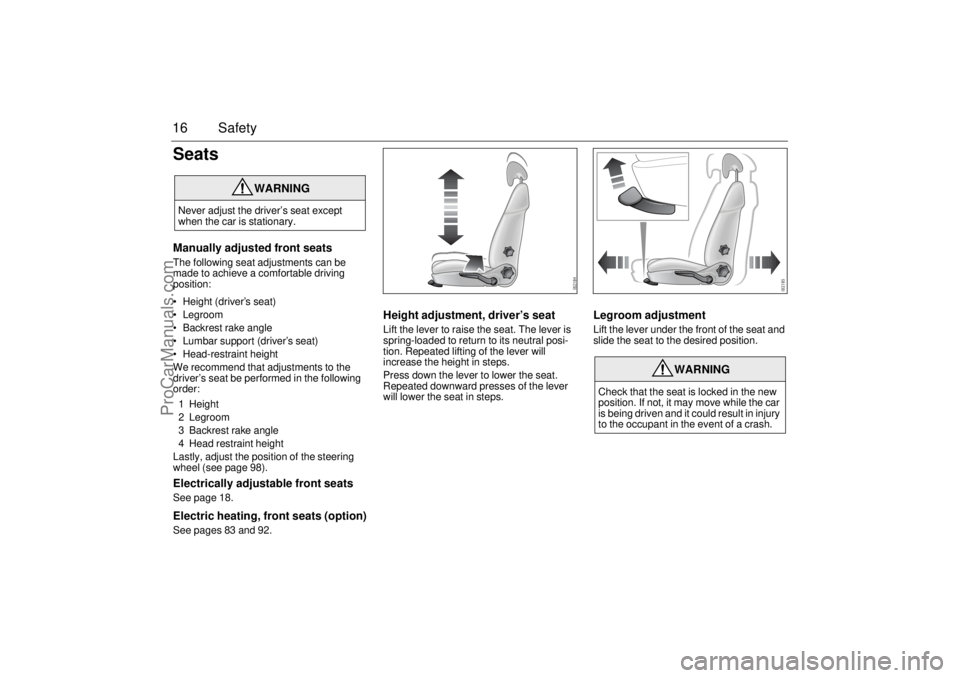
Height adjustment, driver’s seatLift the lever to raise the seat. The lever is
spring-loaded to return to its neutral posi-
tion. Repeated lifting of the lever will
increase the height in steps.
Press down the lever to lower the seat.
Repeated downward presses of the lever
will lower the seat in steps.
Legroom adjustmentLift the lever under the front of the seat and
slide the seat to the desired position.
WARNING
Never adjust the driver’s seat except
when the car is stationary.
WARNING
Check that the seat is locked in the new
position. If not, it may move while the car
is being driven and it could result in injury
to the occupant in the event of a crash.
ProCarManuals.com
Page 18 of 256
18 SafetyElectrically adjustable front seats
(option)With the doors closed the seats can only be
adjusted when the ignition is ON.
However, there are two exceptions:
To facilitate getting into the car, both seats
can be adjusted when either of the front
doors is open.
The seats can be adjusted up to
20 seconds after both doors have been
closed (applicable only to cars without
window and sunroof pinch protection).
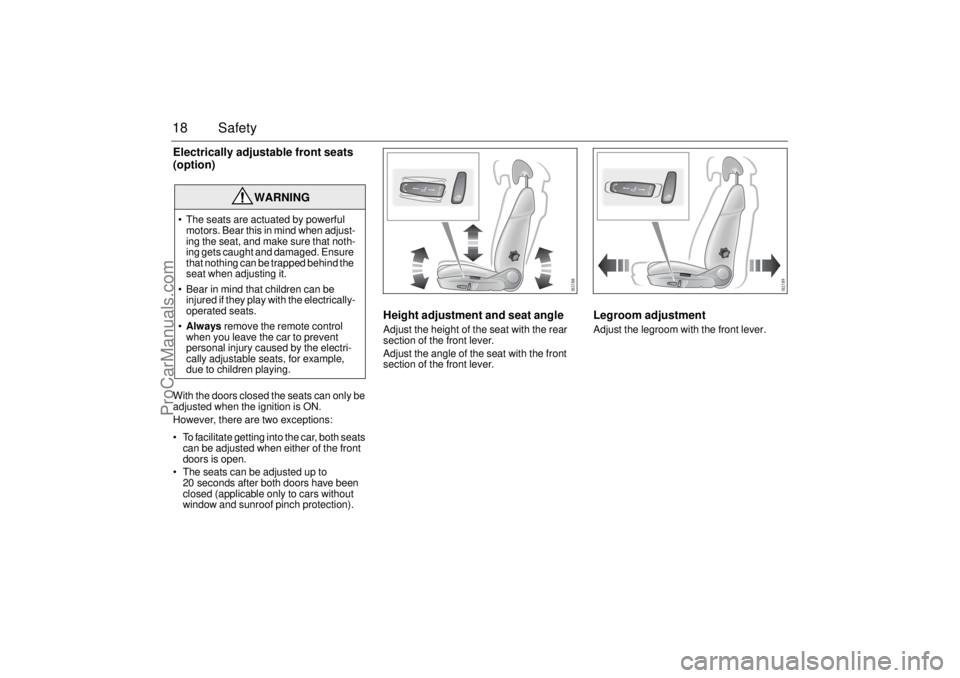
Height adjustment and seat angleAdjust the height of the seat with the rear
section of the front lever.
Adjust the angle of the seat with the front
section of the front lever.
Legroom adjustmentAdjust the legroom with the front lever.
WARNING
The seats are actuated by powerful
motors. Bear this in mind when adjust-
ing the seat, and make sure that noth-
ing gets caught and damaged. Ensure
that nothing can be trapped behind the
seat when adjusting it.
Bear in mind that children can be
injured if they play with the electrically-
operated seats.
Always remove the remote control
when you leave the car to prevent
personal injury caused by the electri-
cally adjustable seats, for example,
due to children playing.
ProCarManuals.com
Page 20 of 256
20 SafetyTo recall programmed settings, press and
hold the desired memory button while the
seat and door mirrors adopt their
programmed positions. The memory func-
tion also includes the door mirror settings.
To facilitate reversing, the passenger-side
door mirror can be angled down, refer to
page 110.
Head restraintsThe front seats are equipped with Saab
Active Head Restraints (SAHRs). These
reduce the risk of neck injury if the car is hit
from behind.
In the event of a rear-end crash, the body is
forced back against the backrest. This, in
turn, causes the mechanism to press the
head restraint forward and upward, thus lim-
iting the backward movement of the head.
The SAHR is a mechanical system, actu-
ated by body weight. The mechanism is built
into the top of the backrest, where it is con-
nected to the head restraint.Therefore, the SAHR does not normally
need to be replaced or repaired after a rear-
end crash.
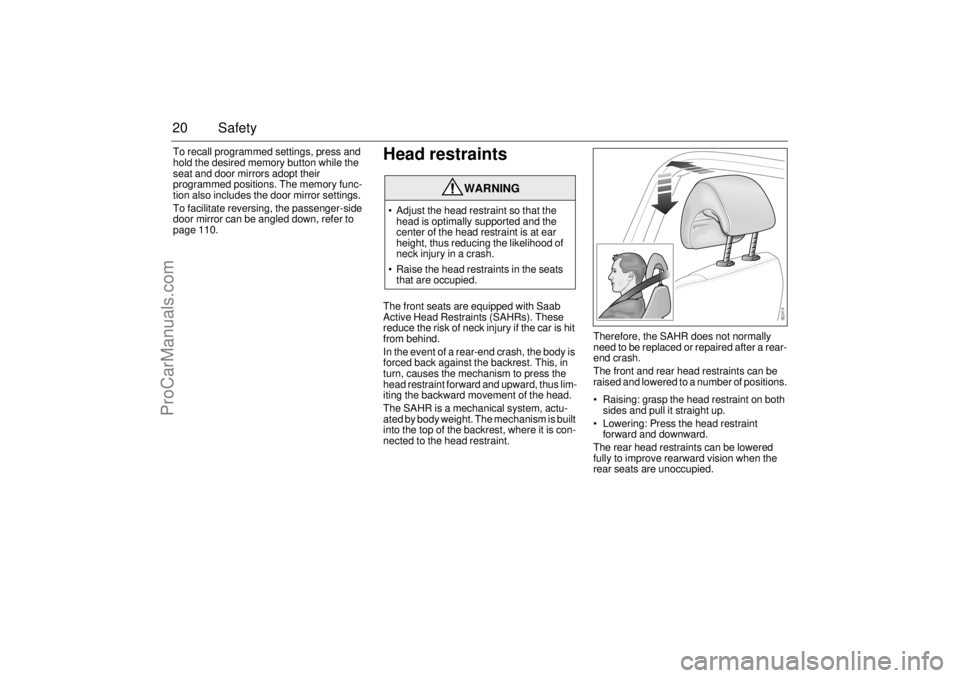
The front and rear head restraints can be
raised and lowered to a number of positions.
Raising: grasp the head restraint on both
sides and pull it straight up.
Lowering: Press the head restraint
forward and downward.
The rear head restraints can be lowered
fully to improve rearward vision when the
rear seats are unoccupied.
WARNING
Adjust the head restraint so that the
head is optimally supported and the
center of the head restraint is at ear
height, thus reducing the likelihood of
neck injury in a crash.
Raise the head restraints in the seats
that are occupied.
ProCarManuals.com
Page 98 of 256
98 Interior equipmentSteering wheel
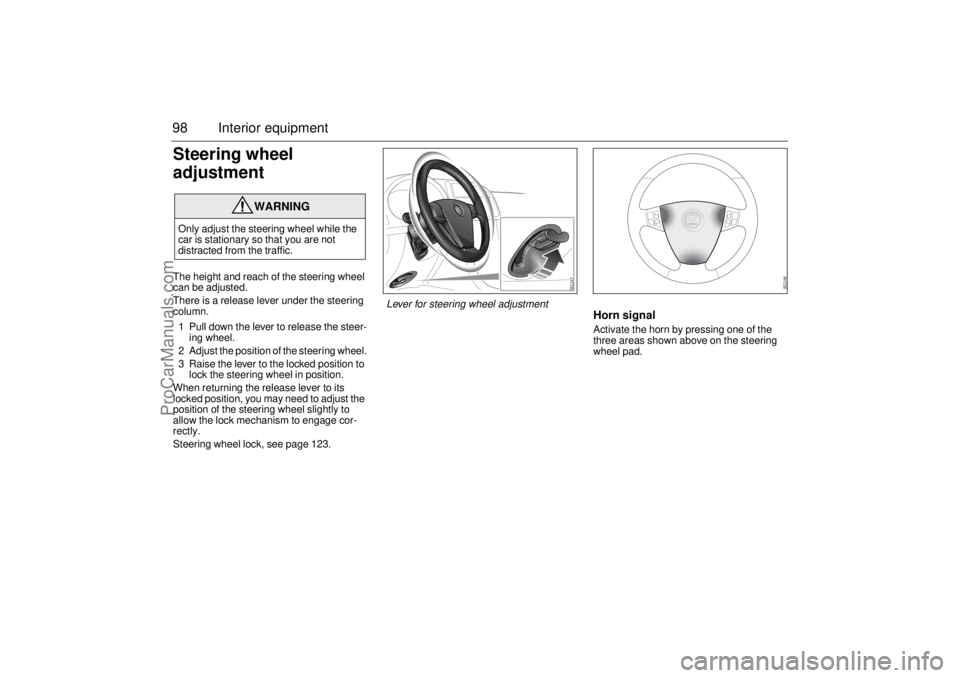
adjustmentThe height and reach of the steering wheel
can be adjusted.
There is a release lever under the steering
column.
1 Pull down the lever to release the steer-
ing wheel.
2 Adjust the position of the steering wheel.
3 Raise the lever to the locked position to
lock the steering wheel in position.
When returning the release lever to its
locked position, you may need to adjust the
position of the steering wheel slightly to
allow the lock mechanism to engage cor-
rectly.
Steering wheel lock, see page 123.
Horn signalActivate the horn by pressing one of the
three areas shown above on the steering
wheel pad.
WARNING
Only adjust the steering wheel while the
car is stationary so that you are not
distracted from the traffic.
Lever for steering wheel adjustment
ProCarManuals.com
Page 117 of 256
117 Interior equipment
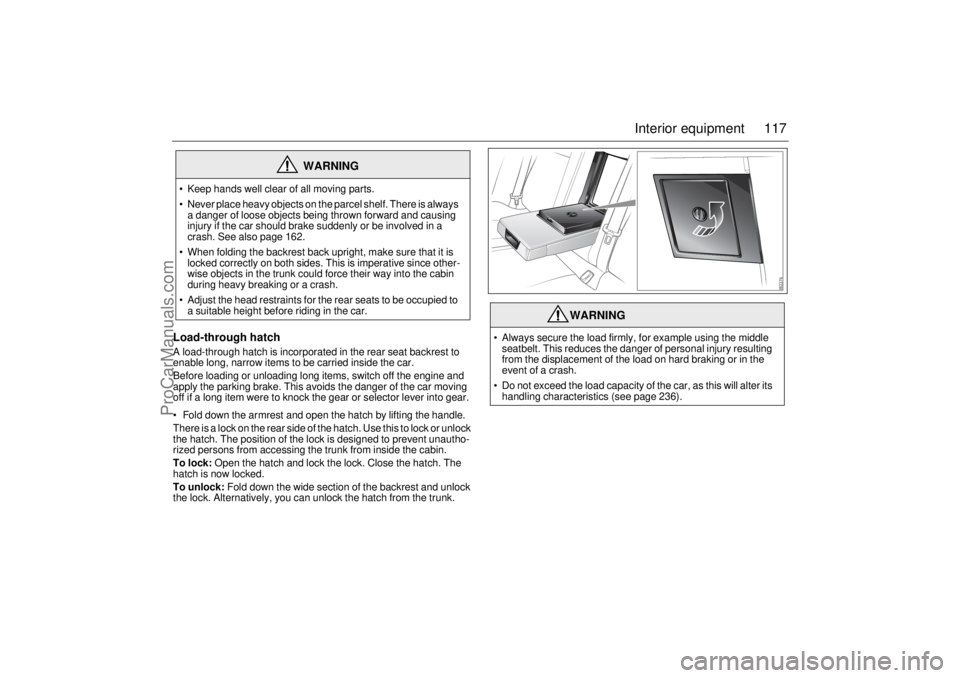
Load-through hatchA load-through hatch is incorporated in the rear seat backrest to
enable long, narrow items to be carried inside the car.
Before loading or unloading long items, switch off the engine and
apply the parking brake. This avoids the danger of the car moving
off if a long item were to knock the gear or selector lever into gear.
Fold down the armrest and open the hatch by lifting the handle.
There is a lock on the rear side of the hatch. Use this to lock or unlock
the hatch. The position of the lock is designed to prevent unautho-
rized persons from accessing the trunk from inside the cabin.
To lock: Open the hatch and lock the lock. Close the hatch. The
hatch is now locked.
To unlock: Fold down the wide section of the backrest and unlock
the lock. Alternatively, you can unlock the hatch from the trunk.
WARNING
Keep hands well clear of all moving parts.
Never place heavy objects on the parcel shelf. There is always
a danger of loose objects being thrown forward and causing
injury if the car should brake suddenly or be involved in a
crash. See also page 162.
When folding the backrest back upright, make sure that it is
locked correctly on both sides. This is imperative since other-
wise objects in the trunk could force their way into the cabin
during heavy breaking or a crash.
Adjust the head restraints for the rear seats to be occupied to
a suitable height before riding in the car.
WARNING
Always secure the load firmly, for example using the middle
seatbelt. This reduces the danger of personal injury resulting
from the displacement of the load on hard braking or in the
event of a crash.
Do not exceed the load capacity of the car, as this will alter its
handling characteristics (see page 236).
ProCarManuals.com
Page 172 of 256
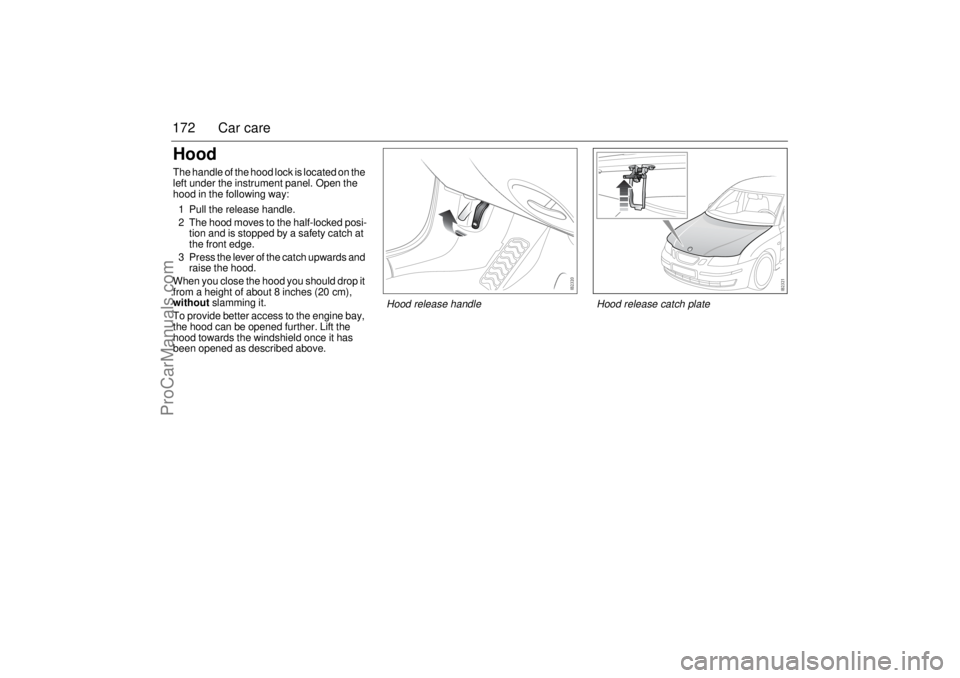
172 Car careHoodThe handle of the hood lock is located on the
left under the instrument panel. Open the
hood in the following way:
1 Pull the release handle.
2 The hood moves to the half-locked posi-
tion and is stopped by a safety catch at
the front edge.
3 Press the lever of the catch upwards and
raise the hood.
When you close the hood you should drop it
from a height of about 8 inches (20 cm),
without slamming it.
To provide better access to the engine bay,
the hood can be opened further. Lift the
hood towards the windshield once it has
been opened as described above.
Hood release catch plate
Hood release handle
ProCarManuals.com
Page 193 of 256

193 Car care
Side-mounted turn signal bulbs1 Slide the lamp fitting forward so that its
rear end can be pulled out.
2 Turn the bulb holder counterclockwise
and withdraw it from the lamp fitting.
Change the bulb.
3 To fit, engage the two catches on the
rear edge of the lamp fitting with the
edge of the opening. Then press in the
front edge of the lamp fitting so that the
groove in the spring engages the plastic
edge.
Front fog lights
1 Undo one screw in the wheel housing.
Lower the air shield.
2 Remove the protective cover. Release
the two spring clips securing the bulb.
3 Unplug the connector.
4 Change the bulb. Try not to touch the
glass part of the bulb with your fingers.
The height of the beam can be adjusted
using a screwdriver inserted through the
hole in the lower grille adjacent to the lens.
WARNING
Never crawl under a car that is
supported only by a jack.
Always use axle stands. Refer to
the information on jacks on pages 214
and 215.
ProCarManuals.com
Page 209 of 256

209 Car care
Malfunction
The message shown above will be dis-
played on the SID if:
a wheel without pressure sensor is fitted
(e.g. spare wheel)
one, two or three pressure sensors are
broken or missing
two or more detectors are missing or
broken
the receiver malfunctions
a fault arises in the system.
The message shown above is not displayed
if none of the wheels have sensors, such as
if winter wheels without sensors are fitted.
Shifting the wheelsBecause of front wheel drive, the front tires
tend to wear faster than the rear ones. New
tires should always be fitted in pairs, so that
tires on the same axle have the same
amount of tread.
The wheels should be marked, L (left) and
R (right), when changing between summer
and winter (snow) tires. This ensures that
the direction of rotation of the wheels is the
same when they are refitted. Fit the tires in
best condition to the rear wheels.
Store wheels lying flat or hanging – never
standing upright.
Tire markingsAn example of the meaning of the different
markings in a tire size is given below for a
tire size of 195/65 R15 91H: Tire pressure
system failure.
Contact Saab dealer.
WARNING
When fitting just one new pair of tires,
these should be fitted to the rear wheels,
as these are more critical to the direc-
tional stability of the car (e.g. on braking
or in a skid). The existing rear wheels
should therefore be moved to the front.
Always move rear left to front left and rear
right to front right, so that the direction of
rotation remains the same.
195 Tire section width, mm
65 Aspect ratio, i.e. the section height
as a percentage of the section
width
R Radial ply
15 Wheel rim diameter 15 in at bead
seats
91 Tire load index
H Speed rating
Tire load indices
91 Tire approved for max. 1355 lbs.
(615 kg)
93 Max. 1433 lbs. (650 kg)
94 Max. 1477 lbs. (670 kg)
Speed ratings
S Tire approved for speeds up to
110 mph (180 km/h)
T Max. 118 mph (190 km/h)
H Max. 130 mph (210 km/h)
V Max. 149 mph (240 km/h)
W Max. 168 mph (270 km/h)
Y Max. 186 mph (300 km/h)
ProCarManuals.com
Page 215 of 256
215 Car care
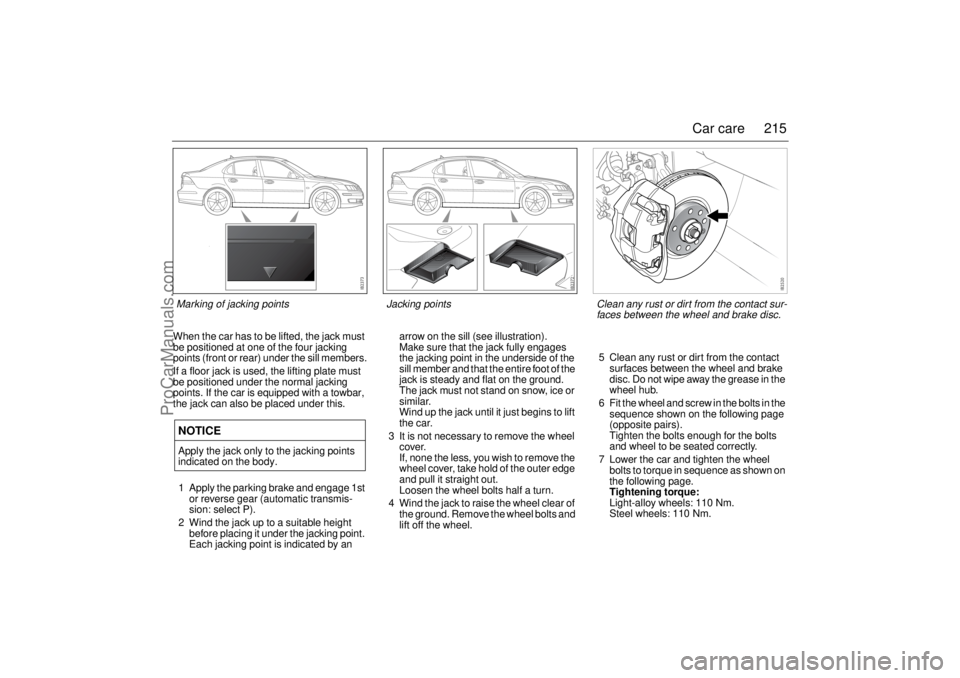
When the car has to be lifted, the jack must
be positioned at one of the four jacking
points (front or rear) under the sill members.
If a floor jack is used, the lifting plate must
be positioned under the normal jacking
points. If the car is equipped with a towbar,
the jack can also be placed under this.
1 Apply the parking brake and engage 1st
or reverse gear (automatic transmis-
sion: select P).
2 Wind the jack up to a suitable height
before placing it under the jacking point.
Each jacking point is indicated by an arrow on the sill (see illustration).
Make sure that the jack fully engages
the jacking point in the underside of the
sill member and that the entire foot of the
jack is steady and flat on the ground.
The jack must not stand on snow, ice or
similar.
Wind up the jack until it just begins to lift
the car.
3 It is not necessary to remove the wheel
cover.
If, none the less, you wish to remove the
wheel cover, take hold of the outer edge
and pull it straight out.
Loosen the wheel bolts half a turn.
4 Wind the jack to raise the wheel clear of
the ground. Remove the wheel bolts and
lift off the wheel.5 Clean any rust or dirt from the contact
surfaces between the wheel and brake
disc. Do not wipe away the grease in the
wheel hub.
6 Fit the wheel and screw in the bolts in the
sequence shown on the following page
(opposite pairs).
Tighten the bolts enough for the bolts
and wheel to be seated correctly.
7 Lower the car and tighten the wheel
bolts to torque in sequence as shown on
the following page.
Tightening torque:
Light-alloy wheels: 110 Nm.
Steel wheels: 110 Nm.NOTICEApply the jack only to the jacking points
indicated on the body.
Jacking points
Marking of jacking points
Clean any rust or dirt from the contact sur-
faces between the wheel and brake disc.
ProCarManuals.com