light SAAB 9-3 2003 Owners Manual
[x] Cancel search | Manufacturer: SAAB, Model Year: 2003, Model line: 9-3, Model: SAAB 9-3 2003Pages: 256, PDF Size: 21.66 MB
Page 3 of 256
3
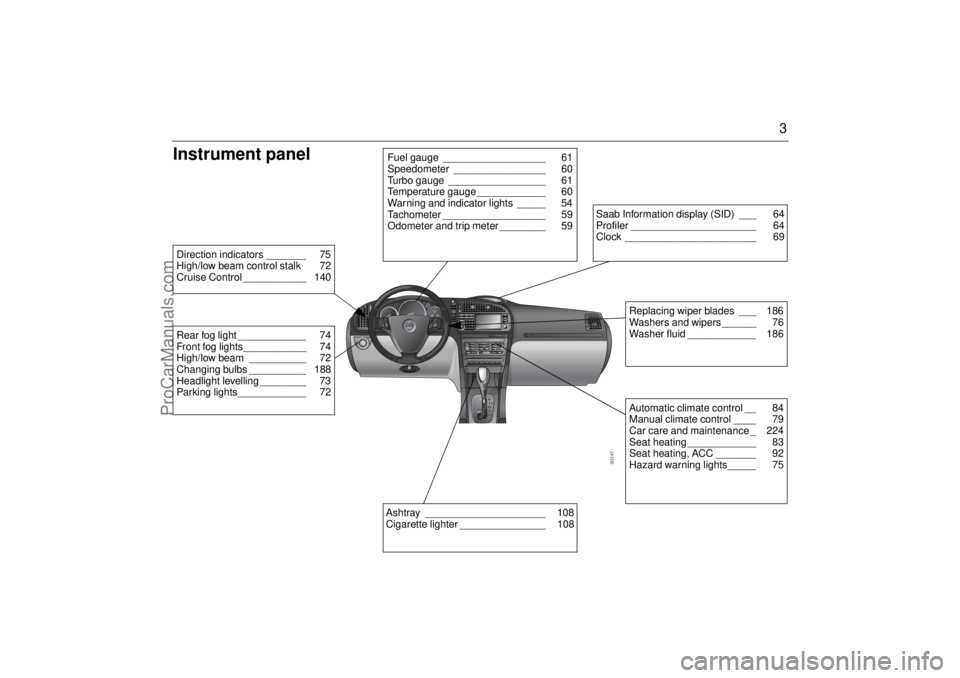
Instrument panelRear fog light ____________ 74
Front fog lights___________ 74
High/low beam __________ 72
Changing bulbs __________ 188
Headlight levelling ________ 73
Parking lights____________ 72Direction indicators _______ 75
High/low beam control stalk 72
Cruise Control ___________ 140
Fuel gauge __________________ 61
Speedometer ________________ 60
Turbo gauge _________________ 61
Temperature gauge ____________ 60
Warning and indicator lights _____ 54
Tachometer __________________ 59
Odometer and trip meter ________ 59Ashtray _____________________ 108
Cigarette lighter _______________ 108
Saab Information display (SID) ___ 64
Profiler ______________________ 64
Clock _______________________ 69
Replacing wiper blades ___ 186
Washers and wipers ______ 76
Washer fluid ____________ 186Automatic climate control __ 84
Manual climate control ____ 79
Car care and maintenance _ 224
Seat heating ____________ 83
Seat heating, ACC _______ 92
Hazard warning lights_____ 75
ProCarManuals.com
Page 4 of 256
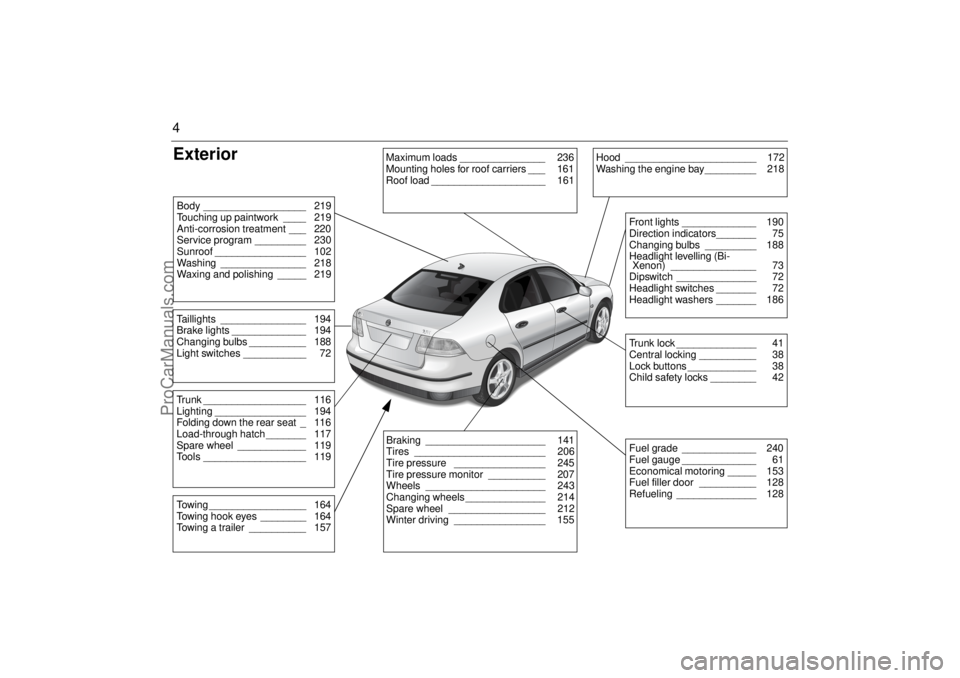
4ExteriorBody __________________ 219
Touching up paintwork ____ 219
Anti-corrosion treatment ___ 220
Service program _________ 230
Sunroof ________________ 102
Washing _______________ 218
Waxing and polishing _____ 219Taillights _______________ 194
Brake lights _____________ 194
Changing bulbs __________ 188
Light switches ___________ 72Towing _________________ 164
Towing hook eyes ________ 164
Towing a trailer __________ 157Trunk __________________ 116
Lighting ________________ 194
Folding down the rear seat _ 116
Load-through hatch _______ 117
Spare wheel ____________ 119
Tools __________________ 119
Maximum loads _______________ 236
Mounting holes for roof carriers ___ 161
Roof load ____________________ 161
Hood _______________________ 172
Washing the engine bay_________ 218
Trunk lock ______________ 41
Central locking __________ 38
Lock buttons ____________ 38
Child safety locks ________ 42Front lights _____________ 190
Direction indicators_______ 75
Changing bulbs _________ 188
Headlight levelling (Bi-
Xenon) _______________ 73
Dipswitch ______________ 72
Headlight switches _______ 72
Headlight washers _______ 186Fuel grade _____________ 240
Fuel gauge _____________ 61
Economical motoring _____ 153
Fuel filler door __________ 128
Refueling ______________ 128
Braking _____________________ 141
Tires _______________________ 206
Tire pressure ________________ 245
Tire pressure monitor __________ 207
Wheels _____________________ 243
Changing wheels ______________ 214
Spare wheel _________________ 212
Winter driving ________________ 155
ProCarManuals.com
Page 5 of 256
5
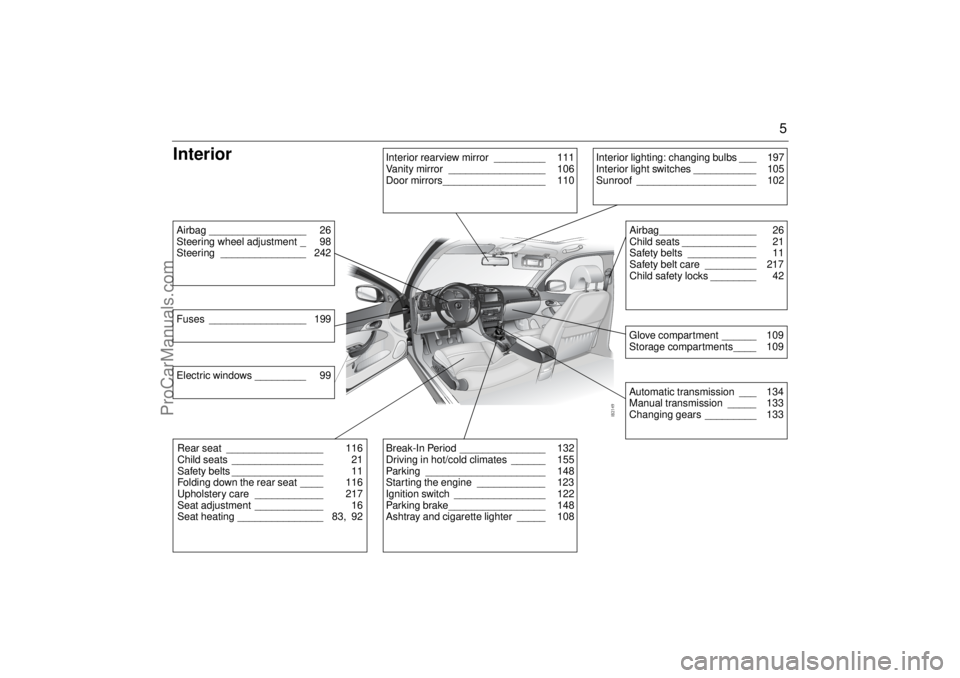
InteriorAirbag _________________ 26
Steering wheel adjustment _ 98
Steering _______________ 242
Interior rearview mirror _________ 111
Vanity mirror _________________ 106
Door mirrors__________________ 110
Airbag_________________ 26
Child seats _____________ 21
Safety belts ____________ 11
Safety belt care _________ 217
Child safety locks ________ 42Glove compartment ______ 109
Storage compartments____ 109Automatic transmission ___ 134
Manual transmission _____ 133
Changing gears _________ 133
Rear seat _________________ 116
Child seats ________________ 21
Safety belts ________________ 11
Folding down the rear seat ____ 116
Upholstery care ____________ 217
Seat adjustment ____________ 16
Seat heating _______________ 83, 92
Interior lighting: changing bulbs ___ 197
Interior light switches ___________ 105
Sunroof _____________________ 102
Break-In Period _______________ 132
Driving in hot/cold climates ______ 155
Parking _____________________ 148
Starting the engine ____________ 123
Ignition switch ________________ 122
Parking brake_________________ 148
Ashtray and cigarette lighter _____ 108
Fuses _________________ 199Electric windows _________ 99
ProCarManuals.com
Page 8 of 256
8
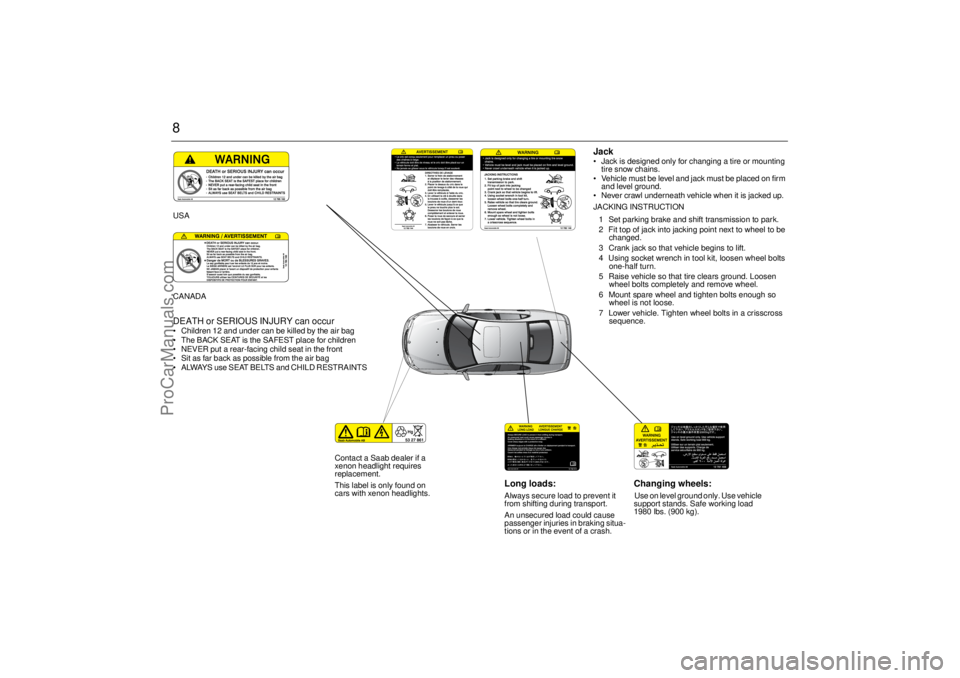
Long loads:Always secure load to prevent it
from shifting during transport.
An unsecured load could cause
passenger injuries in braking situa-
tions or in the event of a crash.
Changing wheels:Use on level ground only. Use vehicle
support stands. Safe working load
1980 lbs. (900 kg).
Contact a Saab dealer if a
xenon headlight requires
replacement.
This label is only found on
cars with xenon headlights.
DEATH or SERIOUS INJURY can occur Children 12 and under can be killed by the air bag
The BACK SEAT is the SAFEST place for children
NEVER put a rear-facing child seat in the front
Sit as far back as possible from the air bag
ALWAYS use SEAT BELTS and CHILD RESTRAINTSUSA
CANADA
Jack Jack is designed only for changing a tire or mounting
tire snow chains.
Vehicle must be level and jack must be placed on firm
and level ground.
Never crawl underneath vehicle when it is jacked up.
JACKING INSTRUCTION
1 Set parking brake and shift transmission to park.
2 Fit top of jack into jacking point next to wheel to be
changed.
3 Crank jack so that vehicle begins to lift.
4 Using socket wrench in tool kit, loosen wheel bolts
one-half turn.
5 Raise vehicle so that tire clears ground. Loosen
wheel bolts completely and remove wheel.
6 Mount spare wheel and tighten bolts enough so
wheel is not loose.
7 Lower vehicle. Tighten wheel bolts in a crisscross
sequence.
ProCarManuals.com
Page 9 of 256
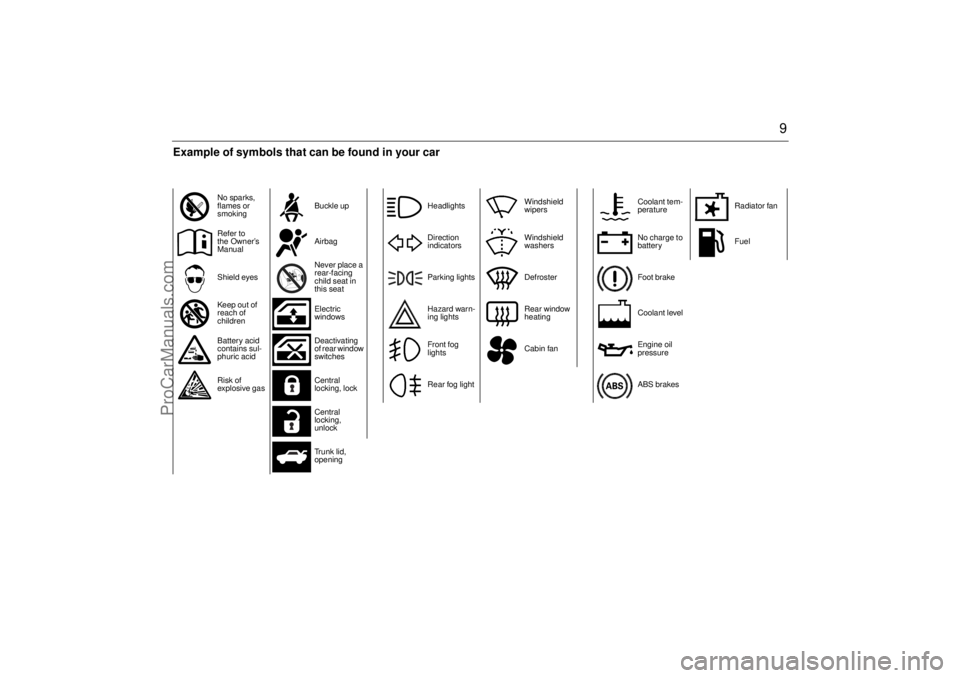
9
No sparks,
flames or
smokingBuckle up
Refer to
the Owner’s
ManualAirbag
Shield eyesNever place a
rear-facing
child seat in
this seat
Keep out of
reach of
childrenElectric
windows
Battery acid
contains sul-
phuric acidDeactivating
of rear window
switches
Risk of
explosive gasCentral
locking, lock
Central
locking,
unlock
Trunk lid,
opening
HeadlightsWindshield
wipers
Direction
indicatorsWindshield
washers
Parking lights Defroster
Hazard warn-
ing lightsRear window
heating
Front fog
lightsCabin fan
Rear fog light
Coolant tem-
peratureRadiator fan
No charge to
batteryFuel
Foot brake
Coolant level
Engine oil
pressure
ABS brakes
Example of symbols that can be found in your car
ProCarManuals.com
Page 14 of 256
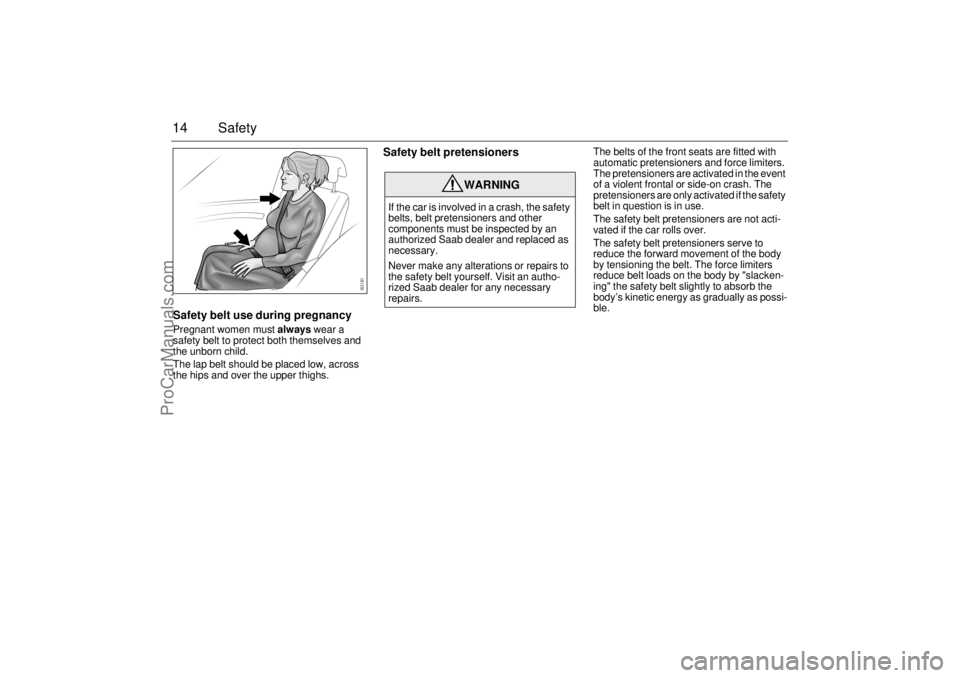
14 SafetySafety belt use during pregnancyPregnant women must always wear a
safety belt to protect both themselves and
the unborn child.
The lap belt should be placed low, across
the hips and over the upper thighs.
Safety belt pretensioners
The belts of the front seats are fitted with
automatic pretensioners and force limiters.
The pretensioners are activated in the event
of a violent frontal or side-on crash. The
pretensioners are only activated if the safety
belt in question is in use.
The safety belt pretensioners are not acti-
vated if the car rolls over.
The safety belt pretensioners serve to
reduce the forward movement of the body
by tensioning the belt. The force limiters
reduce belt loads on the body by "slacken-
ing" the safety belt slightly to absorb the
body’s kinetic energy as gradually as possi-
ble.
WARNING
If the car is involved in a crash, the safety
belts, belt pretensioners and other
components must be inspected by an
authorized Saab dealer and replaced as
necessary.
Never make any alterations or repairs to
the safety belt yourself. Visit an autho-
rized Saab dealer for any necessary
repairs.
ProCarManuals.com
Page 29 of 256

29 Safety
WARNING
Even if the car is equipped with
AIRBAGS, safety belts must still
always be worn by all occupants.
Note that because an airbag inflates
and deflates extremely rapidly, it will
not provide protection against a
second impact occurring in the same
incident. Always use your safety belt.
Always sit with the whole of your back
in contact with the backrest of the seat,
and with your seat as far back as is
practical.Otherwise you will be thrown
back against the backrest when the
airbag inflates which could cause you
injury or death. The airbag needs
room in which to inflate.
Never attach anything to the steering
wheel or passenger side of the instru-
ment panel, as this could result in
injury if the airbag should inflate. The
same applies to anything you might
have in your mouth, such as a pipe, for
instance.
Some components of the airbag will
be warm for a short time. In some
circumstances the airbag can cause
minor burns or abrasions to the body
when the airbag inflates/deflates.
Never rest your hands or forearms on
the steering-wheel center padding.
If the airbag warning light remains
on after the car has been started or
comes on while you are driving, have
the car checked immediately by an
authorized Saab dealer. The warning
light could signify that the airbags may
not inflate in a crash, or they could
even inflate without a crash. See page
57.
Fumes are generated by the chemical
reaction that inflates the airbag.
Skin surfaces that show signs of irrita-
tion should be washed with clean
water and a mild soap as soon as
possible.
In the event of eye irritation, flush the
eyes thoroughly with clean water for at
least 20 minutes.
In case of persistent irritation, consult
a doctor.
ProCarManuals.com
Page 30 of 256
30 Safety
Front passenger seatThe system is the same as that used on the
driver’s side.
The airbag systems are interconnected and
have a common warning light . The pas-
senger airbag module is housed in the
fascia above the glove compartment and is
marked "AIRBAG".
Both airbags will be inflated in the event of a
moderate to severe frontal, or near-frontal
crash, even if the passenger seat is unoccu-
pied.
The car is equipped as standard with
a passenger airbag.
WARNING
Never secure a rear-facing child seat in
the right front seat of a car equipped with
a passenger airbag. Inflation of the airbag
in the event of a crash could seriously
injure or kill a child.
WARNING
DEATH or SERIOUS
INJURY can occur
Children 12 and under or
shorter than 55 inches
(140 cm) can be killed by the airbag
The BACK SEAT is the SAFEST place
for children
NEVER put a rear-facing child seat in
the front
Sit as far back as possible from the
airbag
ALWAYS use SAFETY BELTS and
CHILD RESTRAINTS
Never allow a child to stand in front of
the seat or to sit on the lap of a front
seat passenger. Serious injury or
death could result if the airbag is
inflated in a crash.
The glove compartment must be
closed while travelling. An open glove
compartment door could cause leg
injuries in the event of a crash.
Never place anything on the dash or in
front of the seat as, in addition to being
a hazard to passengers, this could
interfere with the function of the airbag
in the event of a crash. The same
applies to the mounting of accessories
on the dash.
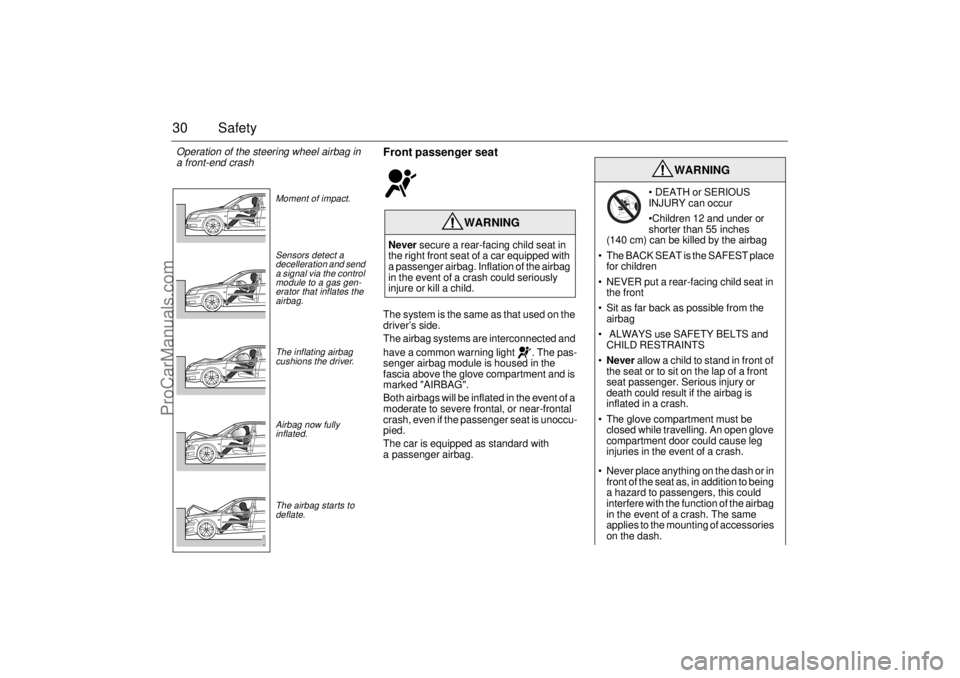
Operation of the steering wheel airbag in
a front-end crash
Moment of impact.
Sensors detect a
decelleration and send
a signal via the control
module to a gas gen-
erator that inflates the
airbag.
The inflating airbag
cushions the driver.
Airbag now fully
inflated.
The airbag starts to
deflate.
ProCarManuals.com
Page 32 of 256
32 Safety
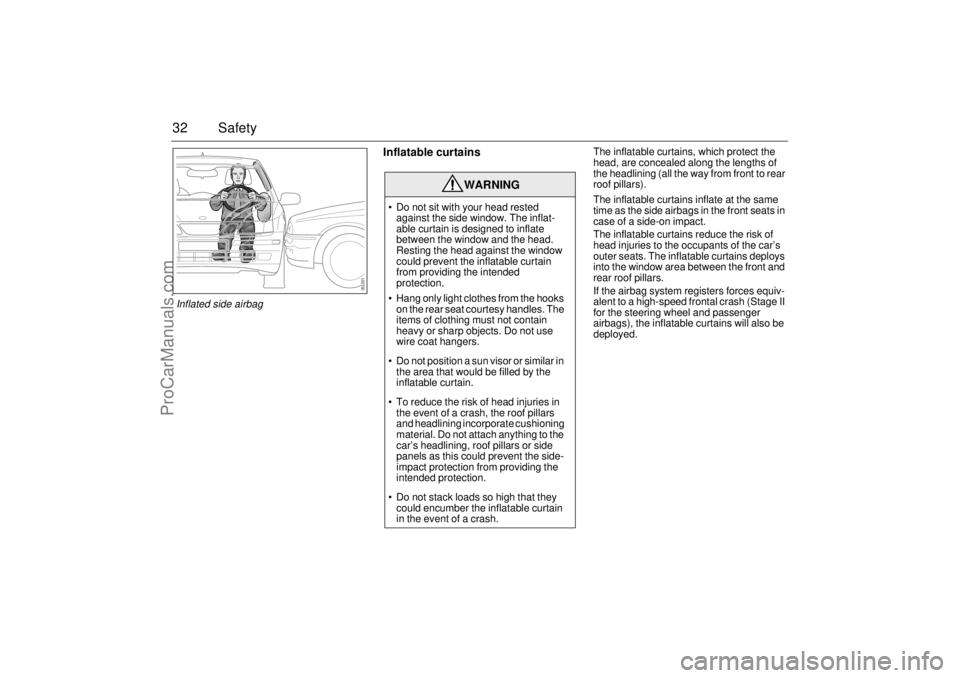
Inflatable curtains
The inflatable curtains, which protect the
head, are concealed along the lengths of
the headlining (all the way from front to rear
roof pillars).
The inflatable curtains inflate at the same
time as the side airbags in the front seats in
case of a side-on impact.
The inflatable curtains reduce the risk of
head injuries to the occupants of the car’s
outer seats. The inflatable curtains deploys
into the window area between the front and
rear roof pillars.
If the airbag system registers forces equiv-
alent to a high-speed frontal crash (Stage II
for the steering wheel and passenger
airbags), the inflatable curtains will also be
deployed.
WARNING
Do not sit with your head rested
against the side window. The inflat-
able curtain is designed to inflate
between the window and the head.
Resting the head against the window
could prevent the inflatable curtain
from providing the intended
protection.
Hang only light clothes from the hooks
on the rear seat courtesy handles. The
items of clothing must not contain
heavy or sharp objects. Do not use
wire coat hangers.
Do not position a sun visor or similar in
the area that would be filled by the
inflatable curtain.
To reduce the risk of head injuries in
the event of a crash, the roof pillars
and headlining incorporate cushioning
material. Do not attach anything to the
car’s headlining, roof pillars or side
panels as this could prevent the side-
impact protection from providing the
intended protection.
Do not stack loads so high that they
could encumber the inflatable curtain
in the event of a crash.
Inflated side airbag
ProCarManuals.com
Page 34 of 256

34 SafetyAirbag warning lamp Crash sensing
Crash sensing and diagnostic modules
have been used in automobiles since air-
bags were first produced. The technical
information gained from these modules can
be useful to understanding the circum-
stances that led to the airbag deployment. In
addition, information from many field events
can be used in the aggregate to help manu-
facturers and others better understand real
world crashes. This, in turn, can lead to
improved automotive safety.
Your vehicle is equipped with two electronic
frontal sensors, which helps the sensing
system distinguish between a moderate
frontal impact and a more severe frontal
impact. Your vehicle is also equipped with a
crash sensing and diagnostic module,
which records information about the frontal
airbag system. The module records infor-
mation about the readiness of the system,
when the system commands airbag inflation
and driver’s safety belt usage at deployment
or in a near-deployment crash. The module
also records speed, engine rpm, brake and
throttle data etc.
Servicing the airbag systemThe airbag system must be inspected as
part of the normal service program but oth-
erwise may be regarded as maintenance-
free.
WARNING
If the airbag readiness light stays on
after you start your vehicle, it means
the airbag system may not be working
properly. See page 57.
The airbags in your vehicle may not
inflate in a crash, or they could even
inflate without a crash.
To help avoid injury to yourself or
others, have your vehicle serviced
right away if the airbag readiness light
stays on after you start your vehicle.
ProCarManuals.com