child seat SAAB 9-3 2004 User Guide
[x] Cancel search | Manufacturer: SAAB, Model Year: 2004, Model line: 9-3, Model: SAAB 9-3 2004Pages: 288, PDF Size: 23.54 MB
Page 24 of 288
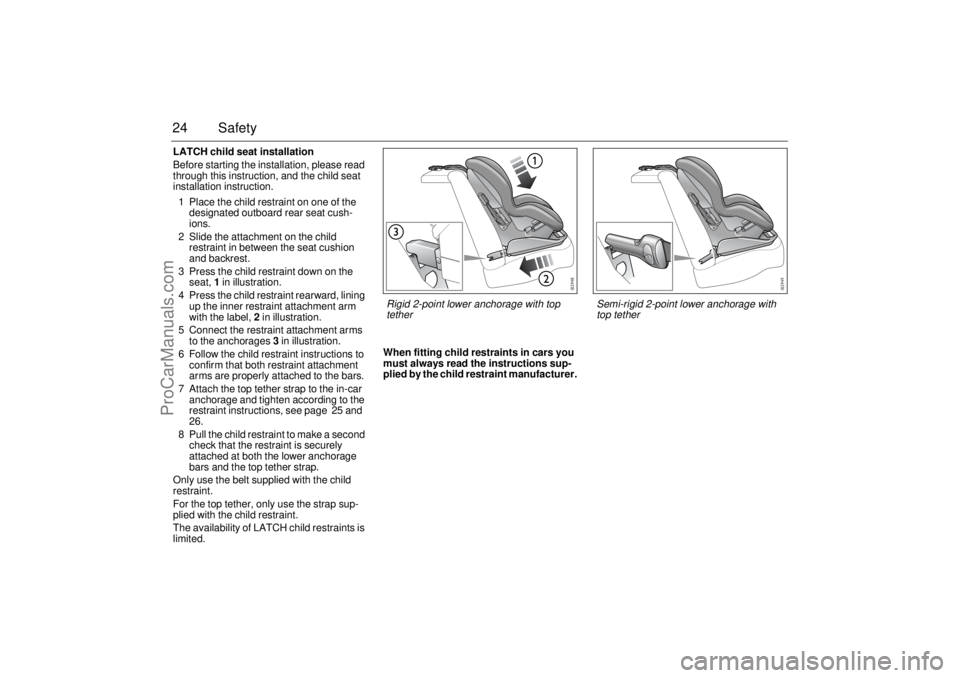
24 SafetyLATCH child seat installation
Before starting the installation, please read
through this instruction, and the child seat
installation instruction.
1 Place the child restraint on one of the
designated outboard rear seat cush-
ions.
2 Slide the attachment on the child
restraint in between the seat cushion
and backrest.
3 Press the child restraint down on the
seat, 1 in illustration.
4 Press the child restraint rearward, lining
up the inner restraint attachment arm
with the label, 2 in illustration.
5 Connect the restraint attachment arms
to the anchorages 3 in illustration.
6 Follow the child restraint instructions to
confirm that both restraint attachment
arms are properly attached to the bars.
7 Attach the top tether strap to the in-car
anchorage and tighten according to the
restraint instructions, see page 25 and
26.
8 Pull the child restraint to make a second
check that the restraint is securely
attached at both the lower anchorage
bars and the top tether strap.
Only use the belt supplied with the child
restraint.
For the top tether, only use the strap sup-
plied with the child restraint.
The availability of LATCH child restraints is
limited.When fitting child restraints in cars you
must always read the instructions sup-
plied by the child restraint manufacturer.
Rigid 2-point lower anchorage with top
tetherSemi-rigid 2-point lower anchorage with
top tether
ProCarManuals.com
Page 25 of 288
25 Safety
Child tether anchorages for forward
facing child seatsSport Sedan
Convertible, see page 26
Child restraints with a tether strap must be
attached according to Canadian and U.S.
safety standards.
If you have any questions regarding child
anchorages please contact your Saab
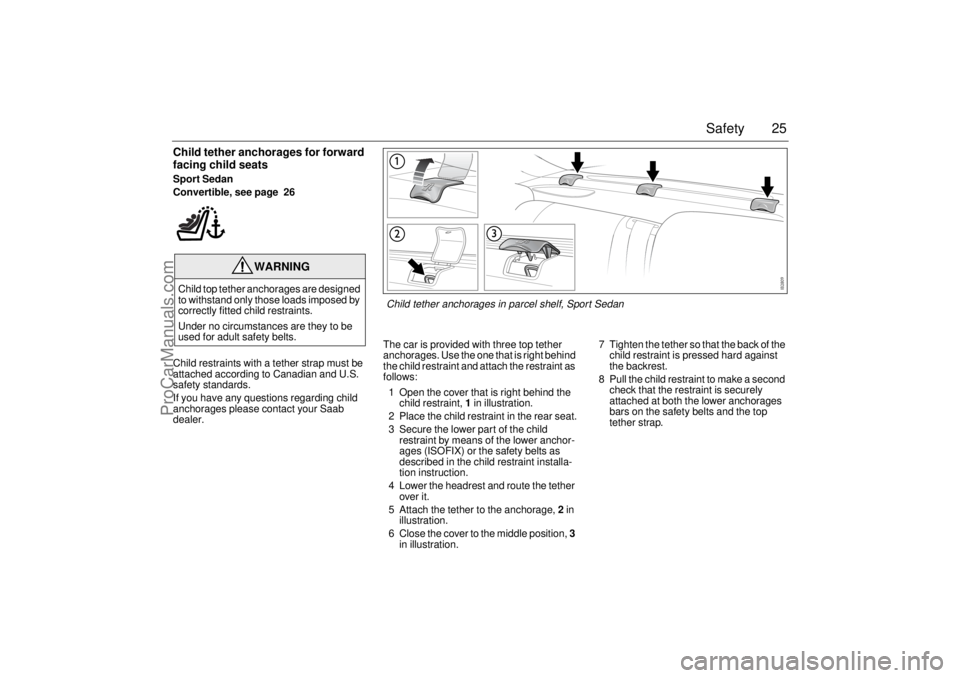
dealer.The car is provided with three top tether
anchorages. Use the one that is right behind
the child restraint and attach the restraint as
follows:
1 Open the cover that is right behind the
child restraint, 1 in illustration.
2 Place the child restraint in the rear seat.
3 Secure the lower part of the child
restraint by means of the lower anchor-
ages (ISOFIX) or the safety belts as
described in the child restraint installa-
tion instruction.
4 Lower the headrest and route the tether
over it.
5 Attach the tether to the anchorage, 2 in
illustration.
6 Close the cover to the middle position, 3
in illustration.7 Tighten the tether so that the back of the
child restraint is pressed hard against
the backrest.
8 Pull the child restraint to make a second
check that the restraint is securely
attached at both the lower anchorages
bars on the safety belts and the top
tether strap.
WARNING
Child top tether anchorages are designed
to withstand only those loads imposed by
correctly fitted child restraints.
Under no circumstances are they to be
used for adult safety belts.
Child tether anchorages in parcel shelf, Sport Sedan
ProCarManuals.com
Page 26 of 288
26 SafetyChild tether anchorages for forward
facing child seatsConvertible
Child restraints with a tether strap must be
attached according to Canadian and U.S.
safety standards.
If you have any questions regarding child
anchorages please contact your Saab
dealer.
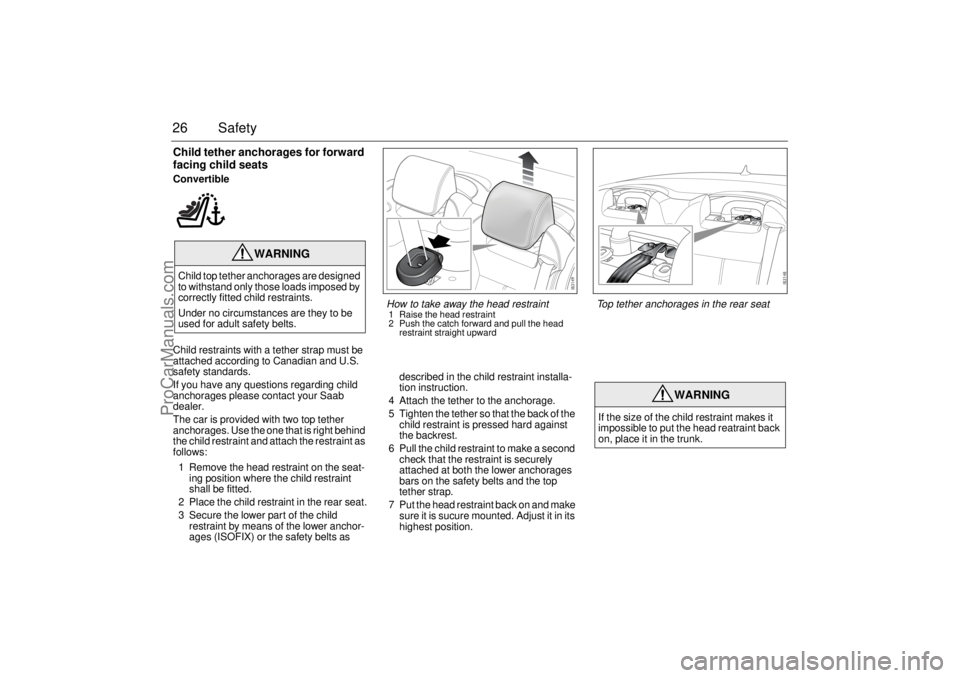
The car is provided with two top tether
anchorages. Use the one that is right behind
the child restraint and attach the restraint as
follows:
1 Remove the head restraint on the seat-
ing position where the child restraint
shall be fitted.
2 Place the child restraint in the rear seat.
3 Secure the lower part of the child
restraint by means of the lower anchor-
ages (ISOFIX) or the safety belts as described in the child restraint installa-
tion instruction.
4 Attach the tether to the anchorage.
5 Tighten the tether so that the back of the
child restraint is pressed hard against
the backrest.
6 Pull the child restraint to make a second
check that the restraint is securely
attached at both the lower anchorages
bars on the safety belts and the top
tether strap.
7 Put the head restraint back on and make
sure it is sucure mounted. Adjust it in its
highest position.
WARNING
Child top tether anchorages are designed
to withstand only those loads imposed by
correctly fitted child restraints.
Under no circumstances are they to be
used for adult safety belts.
WARNING
If the size of the child restraint makes it
impossible to put the head reatraint back
on, place it in the trunk.
How to take away the head restraint1 Raise the head restraint
2 Push the catch forward and pull the head
restraint straight upward
Top tether anchorages in the rear seat
ProCarManuals.com
Page 27 of 288
27 Safety
Installation of child restraint using
the standard safety beltChild restraints that are approved for rear-
ward facing installation in the rear seat can
be positioned in any of the three rear places.
Make sure that it is possible to fit it in accor-
dance with the manufacturer’s instructions.
When fitting child restraints in cars you
must always read the instructions sup-
plied by the child restraint manufacturer.If fitting a child restraint that is intended to be
secured in position by the standard safety
belt, make use of the locking function of the
belt.
Locking the belt lessens the risk that the
seat will work loose while the car is in
motion.
1 Position the child restraint in the back
seat.
2 Route the belt in the restraint according
to the installation instruction of the
restraint.
3 Pull out the belt completely until it stops.
Then let the belt slowly pull in the slack.
Clicking sound indicates that the lock
function is in work.
4 Pull the shoulder belt tight to secure the
child restraint in position.
5 Check for correct locking function by
pulling on the belt. The belt must not
unreel.The safety belt locking function will be deac-
tivated when the safety belt is retracted.
1 Disengage the safety belt latch from the
buckle.
2 Disengage the safety belt from the child
restraint, according to the instructions
from the child restraint manufacturer.
3 Let the safety belt retract until the click-
ing sound ceases.
WARNING
Failure to follow all the manufacturer’s
instructions on the use of this child
restraint system can cause your child to
strike the vehicle´s interior during a
sudden stop or crash.
ProCarManuals.com
Page 28 of 288
28 SafetyAirbag
Airbag system components Airbag in steering wheel
Airbag in instrument panel in front of
passenger seat
Side airbags in front seat backrests
Convertible: The side airbags help
protect the head also.
Inflatable curtains along length of headlin-
ing (from front to rear roof pillars)
(Sport Sedan only)
Safety belt pretensioners for front seats
and outer rear seats.
The airbag system supplements the protec-
tion provided by the safety belts to further
enhance the safety of occupants taller than
55 in. (140 cm).
When the system is activated at the moment
of impact, the airbag inflates and then
deflates through holes in the back. The
whole operation takes roughly 0.1 second,
quicker than the blink of an eye.
The steering wheel and passenger airbags
are so-called smart airbags. The driver and
passenger airbag system compensates for
safety belt usage and the force of the crash
at the moment of impact.Note:
The sensor reacts differently depending on
whether or not the front safety belts on the
driver’s and passenger sides are used. Sit-
uations can therefore arise where only one
of the airbags inflates. It is also possible for
only the safety belt pretensioners to be acti-
vated and for the airbags to remain unin-
flated.
If only Stage I is activated at the moment of
impact, Stage II will automatically be acti-
vated later to neutralize the gas generator in
the airbag.
WARNING
To reduce risk of death or serious injury:
Always wear your safety belt.
Always adjust your seat so that you
are as far back as possible but still
able to operate the pedals and reach
the steering wheel and controls
comfortably.
Passengers 12 and under or shorter
than 55 inches (140 cm) must always
travel in the rear seat as the car is fitted
with a passenger airbag.
Never fit a child seat in front of the
passenger airbag.
ProCarManuals.com
Page 32 of 288
32 Safety
Front passenger seatThe system is the same as that used on the
driver’s side.
The airbag systems are interconnected and
have a common warning light . The pas-
senger airbag module is housed in the
fascia above the glove compartment and is
marked "AIRBAG".
Both airbags will be inflated in the event of a
moderate to severe frontal, or near-frontal
crash, even if the passenger seat is unoccu-
pied.
The car is equipped as standard with
a passenger airbag.
WARNING
Never secure a rear-facing child seat in
the right front seat of a car equipped with
a passenger airbag. Inflation of the airbag
in the event of a crash could seriously
injure or kill a child.
WARNING
DEATH or SERIOUS
INJURY can occur
Children 12 and under or
shorter than 55 inches
(140 cm) can be killed by the
airbag
The BACK SEAT is the SAFEST place
for children
NEVER put a rear-facing child seat in
the front
Sit as far back as possible from the
airbag
ALWAYS use SAFETY BELTS and
CHILD RESTRAINTS
Never allow a child to stand in front of
the seat or to sit on the lap of a front
seat passenger. Serious injury or
death could result if the airbag is
inflated in a crash.
The glove compartment must be
closed while travelling. An open glove
compartment door could cause leg
injuries in the event of a crash.
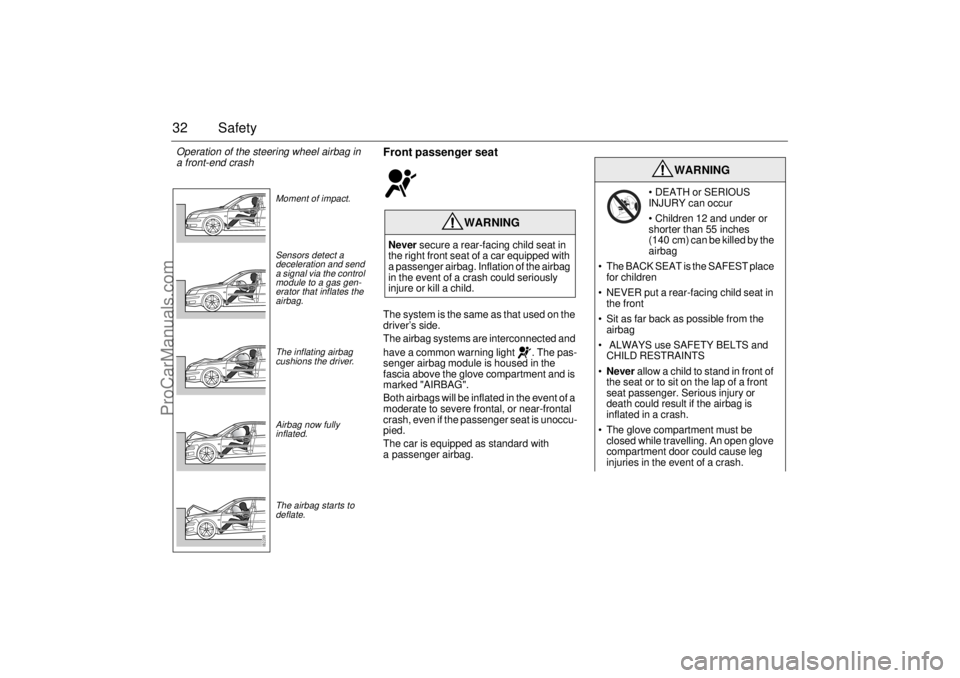
Operation of the steering wheel airbag in
a front-end crash
Moment of impact.
Sensors detect a
deceleration and send
a signal via the control
module to a gas gen-
erator that inflates the
airbag.
The inflating airbag
cushions the driver.
Airbag now fully
inflated.
The airbag starts to
deflate.
ProCarManuals.com
Page 38 of 288

38 SafetyHow loud is the inflation? The noise of the inflation is certainly loud,
but it is of an very short duration and will not
damage your hearing. For a short time after-
wards you could experience a buzzing
noise in your ears.
Most people who have experienced it
cannot remember the noise of the inflation
at all – all they remember is the noise of the
crash. Can you still use a child seat in the front if a
passenger airbag is installed? Definitely not!
Children 12 and under or shorter than
55 inches (140 cm) can be killed by the air-
bag.
The back seat is the safest place for chil-
dren.
Never put a rear-facing child seat in the
front.
Sit as far back as possible from the air bag.
Always use seat belts and child restraints.
What should I do if the AIR-BAG warning
light comes on? If the warning light is on, it means that a fault
has been detected in the system. The
airbag cannot be relied on to operate as
intended and it might even be activated
erroneously. You should therefore take the
car to an authorized Saab dealer as soon as
possible.
Are the dust and fumes given off when the
airbag operates at all harmful? Most people who have remained in a car
with little or no ventilation for several min-
utes complained only of minor irritation of
the throat and eyes. Avoid as much as pos-
sible getting dust on your skin as there is a
risk of skin irritation.
If you suffer from asthma, the incident may
bring on an attack, in which case you should
follow the normal procedure advised by
your doctor. It is advisable to consult a
doctor afterwards.
ProCarManuals.com
Page 44 of 288
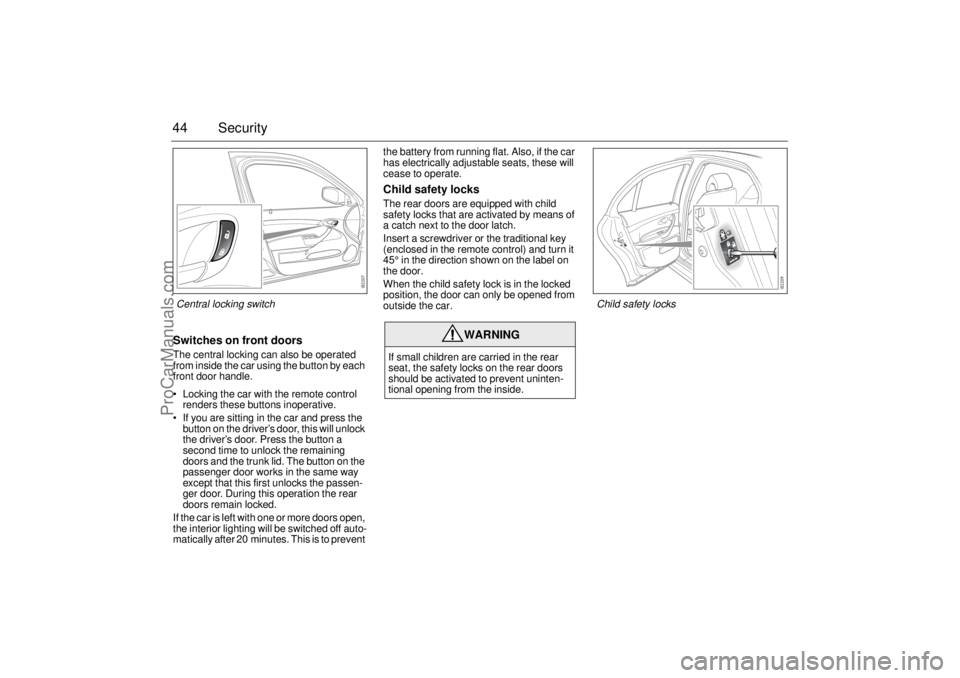
44 SecuritySwitches on front doorsThe central locking can also be operated
from inside the car using the button by each
front door handle.
Locking the car with the remote control
renders these buttons inoperative.
If you are sitting in the car and press the
button on the driver’s door, this will unlock
the driver’s door. Press the button a
second time to unlock the remaining
doors and the trunk lid. The button on the
passenger door works in the same way
except that this first unlocks the passen-
ger door. During this operation the rear
doors remain locked.
If the car is left with one or more doors open,
the interior lighting will be switched off auto-
matically after 20 minutes. This is to prevent the battery from running flat. Also, if the car
has electrically adjustable seats, these will
cease to operate.
Child safety locksThe rear doors are equipped with child
safety locks that are activated by means of
a catch next to the door latch.
Insert a screwdriver or the traditional key
(enclosed in the remote control) and turn it
45° in the direction shown on the label on
the door.
When the child safety lock is in the locked
position, the door can only be opened from
outside the car.
WARNING
If small children are carried in the rear
seat, the safety locks on the rear doors
should be activated to prevent uninten-
tional opening from the inside.
Child safety locks
Central locking switch
ProCarManuals.com
Page 65 of 288
65 9-3 Convertible
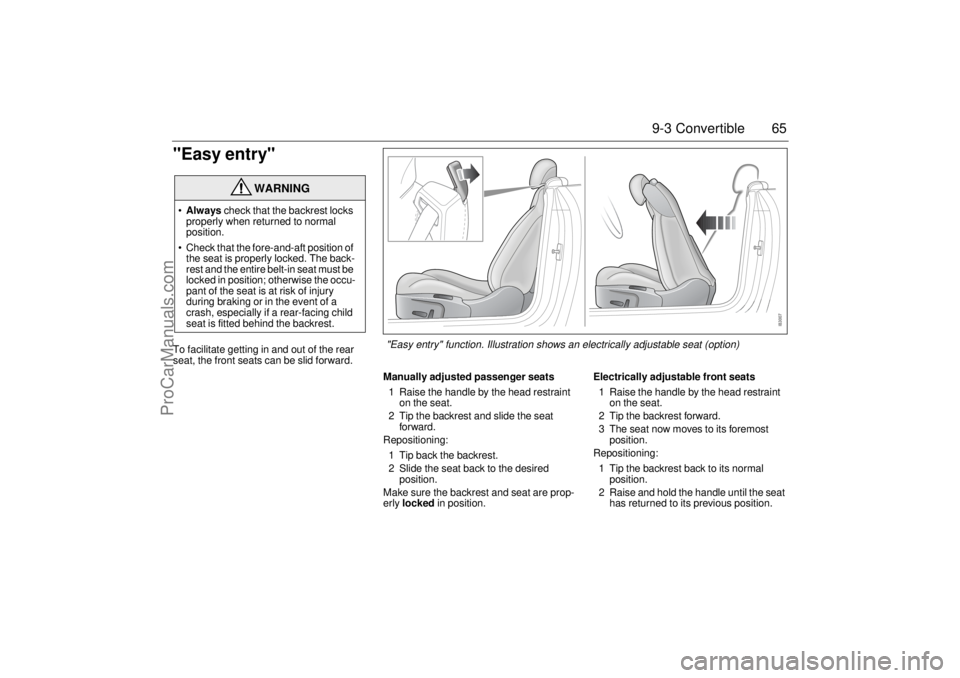
"Easy entry"To facilitate getting in and out of the rear
seat, the front seats can be slid forward.
Manually adjusted passenger seats
1 Raise the handle by the head restraint
on the seat.
2 Tip the backrest and slide the seat
forward.
Repositioning:
1 Tip back the backrest.
2 Slide the seat back to the desired
position.
Make sure the backrest and seat are prop-
erly locked in position.Electrically adjustable front seats
1 Raise the handle by the head restraint
on the seat.
2 Tip the backrest forward.
3 The seat now moves to its foremost
position.
Repositioning:
1 Tip the backrest back to its normal
position.
2 Raise and hold the handle until the seat
has returned to its previous position.
WARNING
Always check that the backrest locks
properly when returned to normal
position.
Check that the fore-and-aft position of
the seat is properly locked. The back-
rest and the entire belt-in seat must be
locked in position; otherwise the occu-
pant of the seat is at risk of injury
during braking or in the event of a
crash, especially if a rear-facing child
seat is fitted behind the backrest.
"Easy entry" function. Illustration shows an electrically adjustable seat (option)
ProCarManuals.com
Page 134 of 288
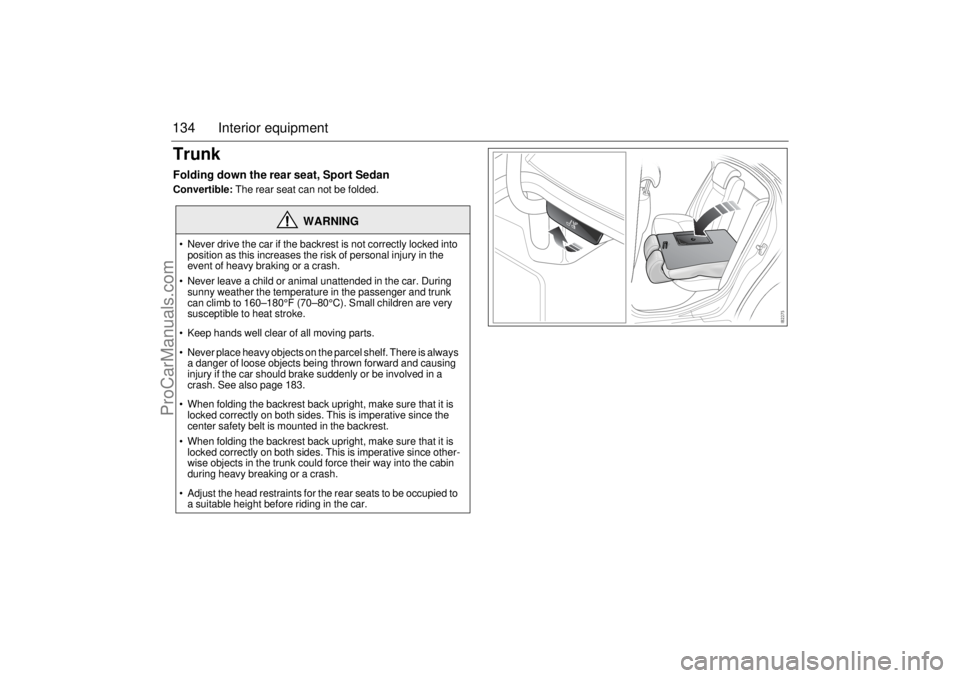
134 Interior equipmentTrunkFolding down the rear seat, Sport SedanConvertible: The rear seat can not be folded.
WARNING
Never drive the car if the backrest is not correctly locked into
position as this increases the risk of personal injury in the
event of heavy braking or a crash.
Never leave a child or animal unattended in the car. During
sunny weather the temperature in the passenger and trunk
can climb to 160–180°F (70–80°C). Small children are very
susceptible to heat stroke.
Keep hands well clear of all moving parts.
Never place heavy objects on the parcel shelf. There is always
a danger of loose objects being thrown forward and causing
injury if the car should brake suddenly or be involved in a
crash. See also page 183.
When folding the backrest back upright, make sure that it is
locked correctly on both sides. This is imperative since the
center safety belt is mounted in the backrest.
When folding the backrest back upright, make sure that it is
locked correctly on both sides. This is imperative since other-
wise objects in the trunk could force their way into the cabin
during heavy breaking or a crash.
Adjust the head restraints for the rear seats to be occupied to
a suitable height before riding in the car.
ProCarManuals.com