warning SAAB 9-3 2004 User Guide
[x] Cancel search | Manufacturer: SAAB, Model Year: 2004, Model line: 9-3, Model: SAAB 9-3 2004Pages: 288, PDF Size: 23.54 MB
Page 18 of 288
18 SafetyElectrically adjustable front seats
(option)With the doors closed the seats can only be
adjusted when the ignition is ON.
However, there are two exceptions:
To facilitate getting into the car, both seats
can be adjusted when either of the front
doors is open.
The seats can be adjusted up to
2 minutes after both doors have been
closed (applicable only to cars without
window and sunroof pinch protection).
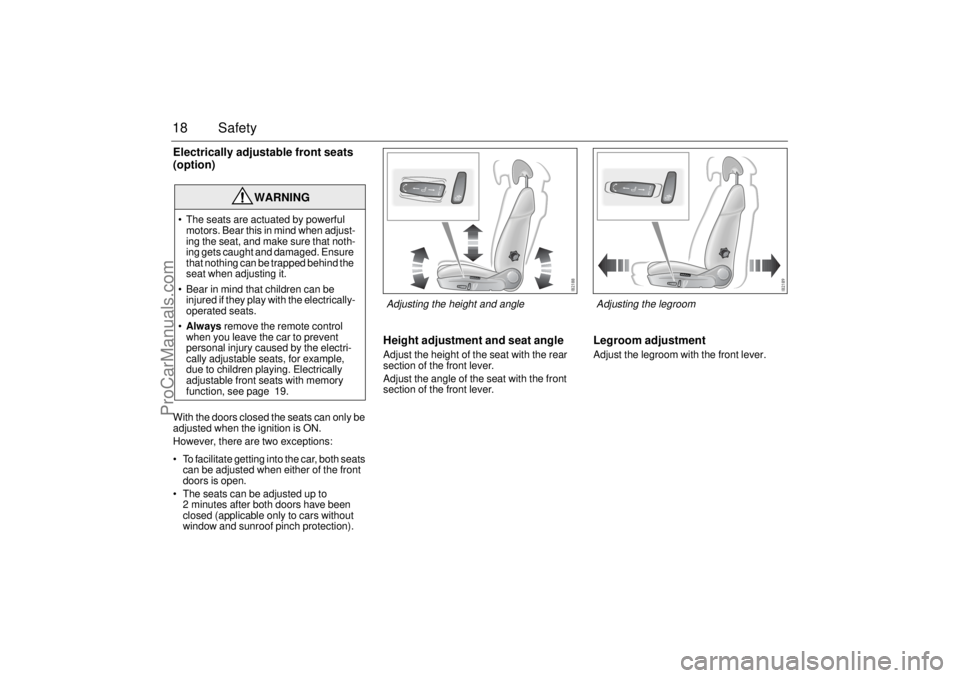
Height adjustment and seat angleAdjust the height of the seat with the rear
section of the front lever.
Adjust the angle of the seat with the front
section of the front lever.
Legroom adjustmentAdjust the legroom with the front lever.
WARNING
The seats are actuated by powerful
motors. Bear this in mind when adjust-
ing the seat, and make sure that noth-
ing gets caught and damaged. Ensure
that nothing can be trapped behind the
seat when adjusting it.
Bear in mind that children can be
injured if they play with the electrically-
operated seats.
Always remove the remote control
when you leave the car to prevent
personal injury caused by the electri-
cally adjustable seats, for example,
due to children playing. Electrically
adjustable front seats with memory
function, see page 19.
Adjusting the height and angle Adjusting the legroom
ProCarManuals.com
Page 19 of 288
19 Safety
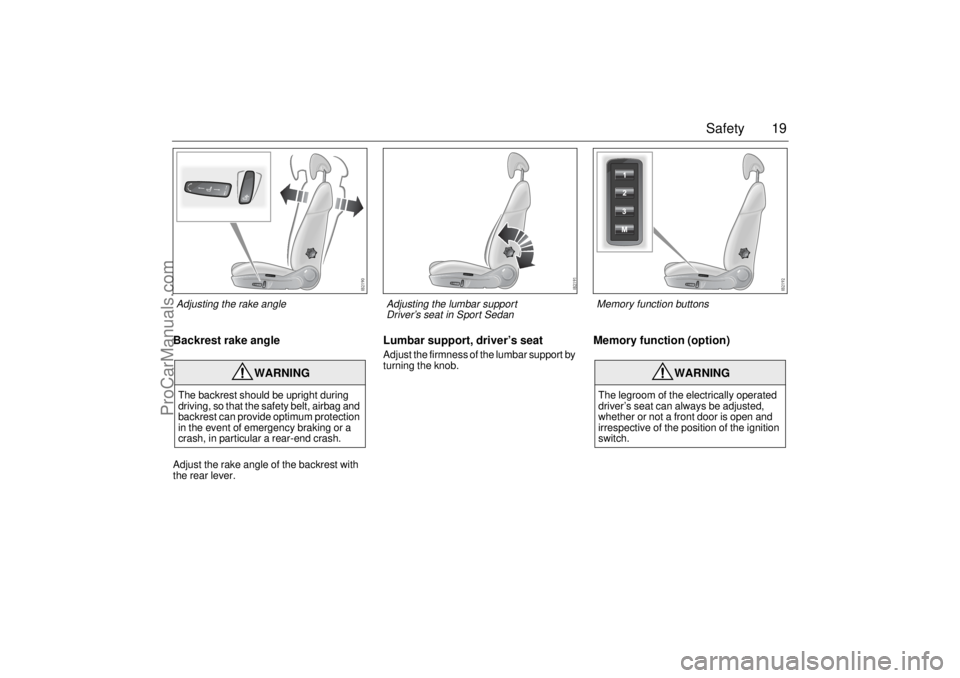
Backrest rake angleAdjust the rake angle of the backrest with
the rear lever.
Lumbar support, driver’s seatAdjust the firmness of the lumbar support by
turning the knob.
Memory function (option)
WARNING
The backrest should be upright during
driving, so that the safety belt, airbag and
backrest can provide optimum protection
in the event of emergency braking or a
crash, in particular a rear-end crash.
WARNING
The legroom of the electrically operated
driver’s seat can always be adjusted,
whether or not a front door is open and
irrespective of the position of the ignition
switch.
Adjusting the rake angle Adjusting the lumbar support
Driver’s seat in Sport SedanMemory function buttons
ProCarManuals.com
Page 20 of 288
20 SafetyWhen the ignition is ON, all seat settings
can be adjusted. When the door is open and
before the remote control has been inserted
into the ignition switch, all seat settings can
be adjusted for up to 20 minutes.
The memory also includes the door mirror
settings.
Storing and restoring settings
1 Adjust the seat and the door mirrors.
The lumbar support is not included by
the memory function.
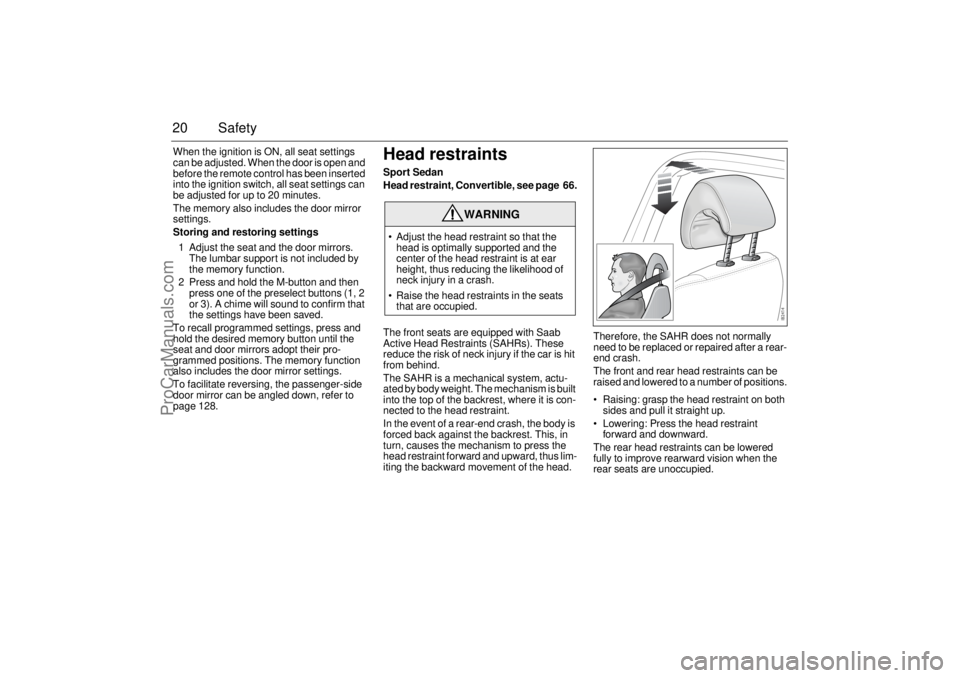
2 Press and hold the M-button and then
press one of the preselect buttons (1, 2
or 3). A chime will sound to confirm that
the settings have been saved.
To recall programmed settings, press and
hold the desired memory button until the
seat and door mirrors adopt their pro-
grammed positions. The memory function
also includes the door mirror settings.
To facilitate reversing, the passenger-side
door mirror can be angled down, refer to
page 128.
Head restraintsSport Sedan
Head restraint, Convertible, see page 66.
The front seats are equipped with Saab
Active Head Restraints (SAHRs). These
reduce the risk of neck injury if the car is hit
from behind.
The SAHR is a mechanical system, actu-
ated by body weight. The mechanism is built
into the top of the backrest, where it is con-
nected to the head restraint.
In the event of a rear-end crash, the body is
forced back against the backrest. This, in
turn, causes the mechanism to press the
head restraint forward and upward, thus lim-
iting the backward movement of the head.Therefore, the SAHR does not normally
need to be replaced or repaired after a rear-
end crash.
The front and rear head restraints can be
raised and lowered to a number of positions.
Raising: grasp the head restraint on both
sides and pull it straight up.
Lowering: Press the head restraint
forward and downward.
The rear head restraints can be lowered
fully to improve rearward vision when the
rear seats are unoccupied.
WARNING
Adjust the head restraint so that the
head is optimally supported and the
center of the head restraint is at ear
height, thus reducing the likelihood of
neck injury in a crash.
Raise the head restraints in the seats
that are occupied.
ProCarManuals.com
Page 21 of 288
21 Safety
Child safety
WARNING
Children must always be suitably
restrained in the car.
DEATH or SERIOUS
INJURY can occur
Children 12 and under or
shorter than 55 inches
(140 cm) can be killed by the
airbag
The BACK SEAT is the SAFEST place
for children
NEVER put a rear-facing child seat in
the front
Sit as far back as possible from the
airbag
ALWAYS use SAFETY BELTS and
CHILD RESTRAINTS
WARNING
Never leave children unattended in a
car, even for a shor t time.
– Children can suffer heat stroke,
perhaps die, in a matter of minutes.
– Children can put the car into gear and
hurt themselves or others.
At gas stations, take the remote
control out of the car while filling the
tank.
Never allow children to climb on top of
or under motor vehicles.
Always look for children before back-
ing your car out of a garage or drive-
way.
To avoid carbon monoxide poisoning,
never let a car idle in the garage.
Supervise young children around
buckets of water while washing your
car. Small children can drown in a
short time in less than an inch of water.
WARNING
Protect children from getting
trapped in the trunk of your car
Teach children not to play in or around
cars.
Watch children when loading or
unloading the car so they don´t get
locked in by mistake.
Always lock the doors and trunk of
your car, and keep the keys out of chil-
dren´s sight and reach.
Keep the rear fold-down seat closed to
help prevent children from getting into
the trunk from inside the car.
ProCarManuals.com
Page 25 of 288
25 Safety
Child tether anchorages for forward
facing child seatsSport Sedan
Convertible, see page 26
Child restraints with a tether strap must be
attached according to Canadian and U.S.
safety standards.
If you have any questions regarding child
anchorages please contact your Saab
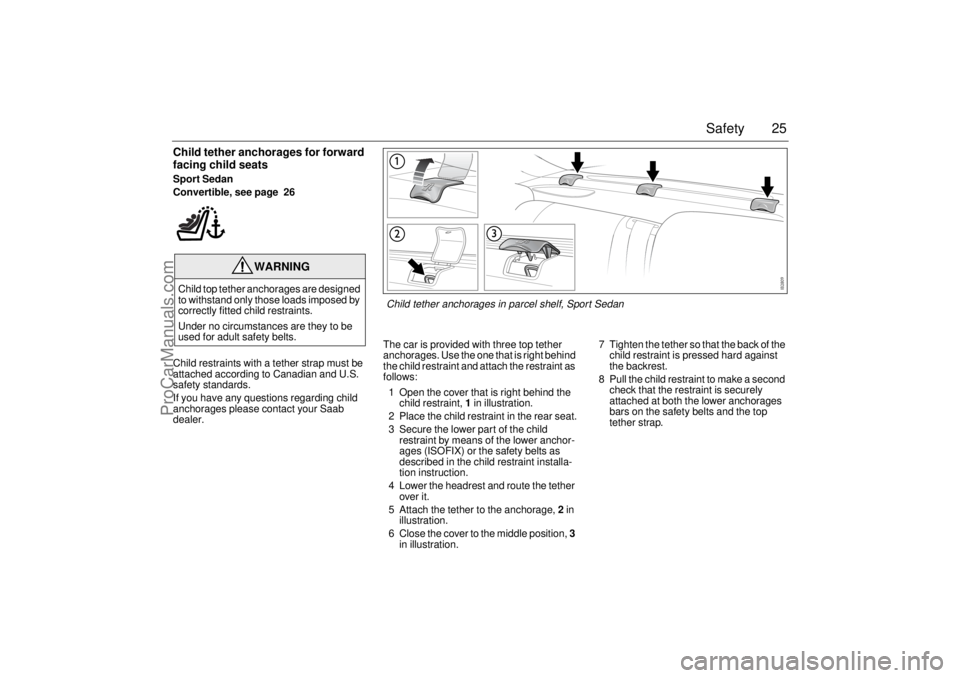
dealer.The car is provided with three top tether
anchorages. Use the one that is right behind
the child restraint and attach the restraint as
follows:
1 Open the cover that is right behind the
child restraint, 1 in illustration.
2 Place the child restraint in the rear seat.
3 Secure the lower part of the child
restraint by means of the lower anchor-
ages (ISOFIX) or the safety belts as
described in the child restraint installa-
tion instruction.
4 Lower the headrest and route the tether
over it.
5 Attach the tether to the anchorage, 2 in
illustration.
6 Close the cover to the middle position, 3
in illustration.7 Tighten the tether so that the back of the
child restraint is pressed hard against
the backrest.
8 Pull the child restraint to make a second
check that the restraint is securely
attached at both the lower anchorages
bars on the safety belts and the top
tether strap.
WARNING
Child top tether anchorages are designed
to withstand only those loads imposed by
correctly fitted child restraints.
Under no circumstances are they to be
used for adult safety belts.
Child tether anchorages in parcel shelf, Sport Sedan
ProCarManuals.com
Page 26 of 288
26 SafetyChild tether anchorages for forward
facing child seatsConvertible
Child restraints with a tether strap must be
attached according to Canadian and U.S.
safety standards.
If you have any questions regarding child
anchorages please contact your Saab
dealer.
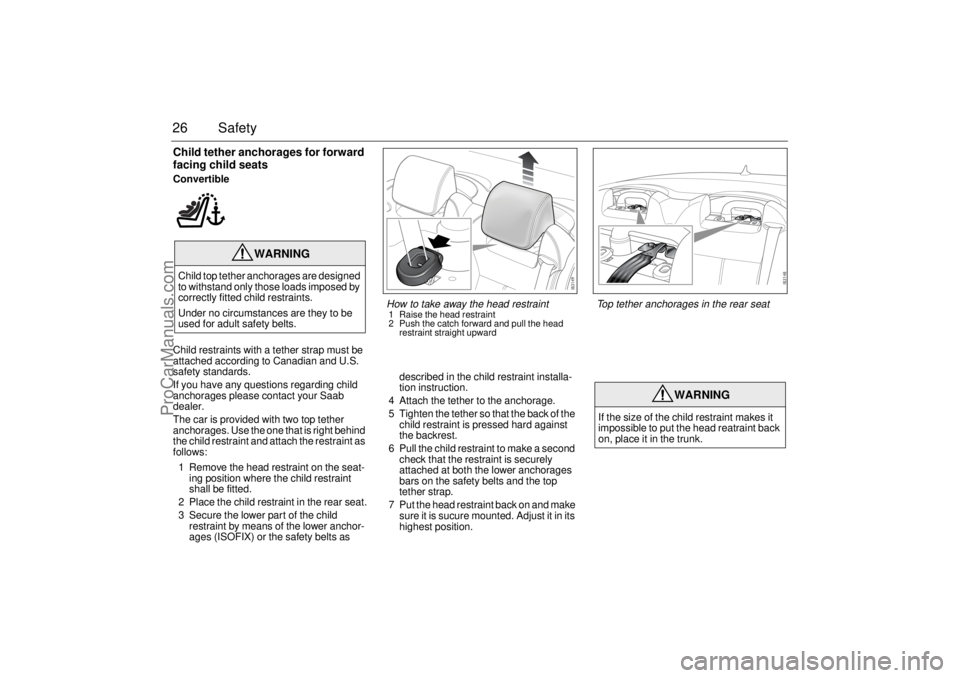
The car is provided with two top tether
anchorages. Use the one that is right behind
the child restraint and attach the restraint as
follows:
1 Remove the head restraint on the seat-
ing position where the child restraint
shall be fitted.
2 Place the child restraint in the rear seat.
3 Secure the lower part of the child
restraint by means of the lower anchor-
ages (ISOFIX) or the safety belts as described in the child restraint installa-
tion instruction.
4 Attach the tether to the anchorage.
5 Tighten the tether so that the back of the
child restraint is pressed hard against
the backrest.
6 Pull the child restraint to make a second
check that the restraint is securely
attached at both the lower anchorages
bars on the safety belts and the top
tether strap.
7 Put the head restraint back on and make
sure it is sucure mounted. Adjust it in its
highest position.
WARNING
Child top tether anchorages are designed
to withstand only those loads imposed by
correctly fitted child restraints.
Under no circumstances are they to be
used for adult safety belts.
WARNING
If the size of the child restraint makes it
impossible to put the head reatraint back
on, place it in the trunk.
How to take away the head restraint1 Raise the head restraint
2 Push the catch forward and pull the head
restraint straight upward
Top tether anchorages in the rear seat
ProCarManuals.com
Page 27 of 288
27 Safety
Installation of child restraint using
the standard safety beltChild restraints that are approved for rear-
ward facing installation in the rear seat can
be positioned in any of the three rear places.
Make sure that it is possible to fit it in accor-
dance with the manufacturer’s instructions.
When fitting child restraints in cars you
must always read the instructions sup-
plied by the child restraint manufacturer.If fitting a child restraint that is intended to be
secured in position by the standard safety
belt, make use of the locking function of the
belt.
Locking the belt lessens the risk that the
seat will work loose while the car is in
motion.
1 Position the child restraint in the back
seat.
2 Route the belt in the restraint according
to the installation instruction of the
restraint.
3 Pull out the belt completely until it stops.
Then let the belt slowly pull in the slack.
Clicking sound indicates that the lock
function is in work.
4 Pull the shoulder belt tight to secure the
child restraint in position.
5 Check for correct locking function by
pulling on the belt. The belt must not
unreel.The safety belt locking function will be deac-
tivated when the safety belt is retracted.
1 Disengage the safety belt latch from the
buckle.
2 Disengage the safety belt from the child
restraint, according to the instructions
from the child restraint manufacturer.
3 Let the safety belt retract until the click-
ing sound ceases.
WARNING
Failure to follow all the manufacturer’s
instructions on the use of this child
restraint system can cause your child to
strike the vehicle´s interior during a
sudden stop or crash.
ProCarManuals.com
Page 28 of 288
28 SafetyAirbag
Airbag system components Airbag in steering wheel
Airbag in instrument panel in front of
passenger seat
Side airbags in front seat backrests
Convertible: The side airbags help
protect the head also.
Inflatable curtains along length of headlin-
ing (from front to rear roof pillars)
(Sport Sedan only)
Safety belt pretensioners for front seats
and outer rear seats.
The airbag system supplements the protec-
tion provided by the safety belts to further
enhance the safety of occupants taller than
55 in. (140 cm).
When the system is activated at the moment
of impact, the airbag inflates and then
deflates through holes in the back. The
whole operation takes roughly 0.1 second,
quicker than the blink of an eye.
The steering wheel and passenger airbags
are so-called smart airbags. The driver and
passenger airbag system compensates for
safety belt usage and the force of the crash
at the moment of impact.Note:
The sensor reacts differently depending on
whether or not the front safety belts on the
driver’s and passenger sides are used. Sit-
uations can therefore arise where only one
of the airbags inflates. It is also possible for
only the safety belt pretensioners to be acti-
vated and for the airbags to remain unin-
flated.
If only Stage I is activated at the moment of
impact, Stage II will automatically be acti-
vated later to neutralize the gas generator in
the airbag.
WARNING
To reduce risk of death or serious injury:
Always wear your safety belt.
Always adjust your seat so that you
are as far back as possible but still
able to operate the pedals and reach
the steering wheel and controls
comfortably.
Passengers 12 and under or shorter
than 55 inches (140 cm) must always
travel in the rear seat as the car is fitted
with a passenger airbag.
Never fit a child seat in front of the
passenger airbag.
ProCarManuals.com
Page 29 of 288
29 Safety
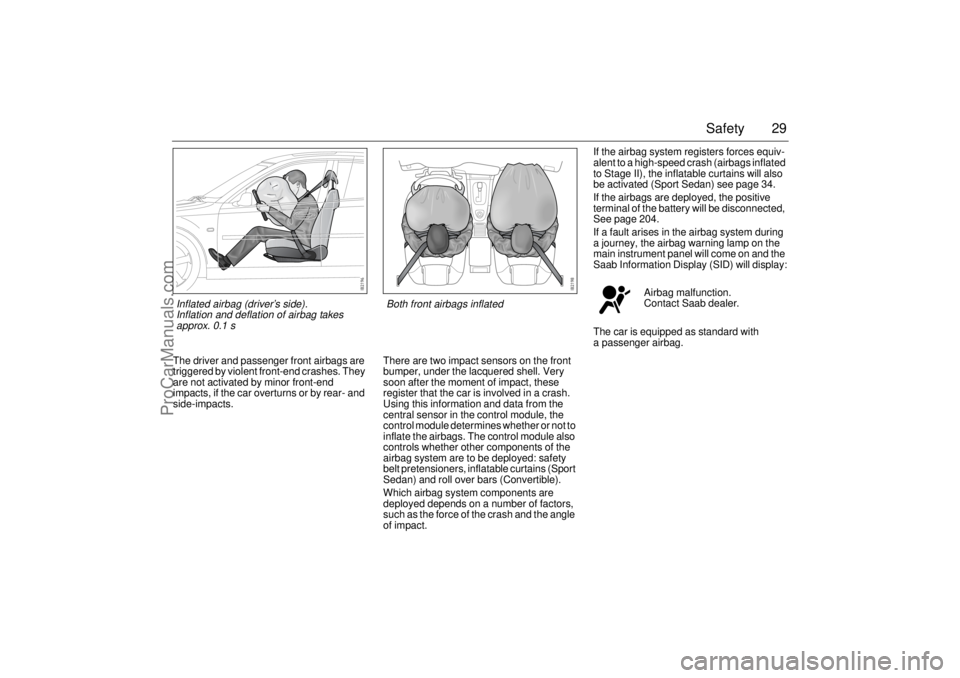
The driver and passenger front airbags are
triggered by violent front-end crashes. They
are not activated by minor front-end
impacts, if the car overturns or by rear- and
side-impacts.There are two impact sensors on the front
bumper, under the lacquered shell. Very
soon after the moment of impact, these
register that the car is involved in a crash.
Using this information and data from the
central sensor in the control module, the
control module determines whether or not to
inflate the airbags. The control module also
controls whether other components of the
airbag system are to be deployed: safety
belt pretensioners, inflatable curtains (Sport
Sedan) and roll over bars (Convertible).
Which airbag system components are
deployed depends on a number of factors,
such as the force of the crash and the angle
of impact.If the airbag system registers forces equiv-
alent to a high-speed crash (airbags inflated
to Stage II), the inflatable curtains will also
be activated (Sport Sedan) see page 34.
If the airbags are deployed, the positive
terminal of the battery will be disconnected,
See page 204.
If a fault arises in the airbag system during
a journey, the airbag warning lamp on the
main instrument panel will come on and the
Saab Information Display (SID) will display:
The car is equipped as standard with
a passenger airbag.Airbag malfunction.
Contact Saab dealer.
Both front airbags inflated
Inflated airbag (driver’s side).
Inflation and deflation of airbag takes
approx. 0.1 s
ProCarManuals.com
Page 31 of 288
31 Safety
WARNING
Even if the car is equipped with
AIRBAGS, safety belts must still
always be worn by all occupants.
Note that because an airbag inflates
and deflates extremely rapidly, it will
not provide protection against a
second impact occurring in the same
incident. Always use your safety belt.
Always sit with the whole of your back
in contact with the backrest of the seat,
and with your seat as far back as is
practical.Otherwise you will be thrown
back against the backrest when the
airbag inflates which could cause you
injury or death. The airbag needs
room in which to inflate.
Never attach anything to the steering
wheel or passenger side of the instru-
ment panel, as this could result in
injury if the airbag should inflate. The
same applies to anything you might
have in your mouth, such as a pipe, for
instance.
Some components of the airbag will
be warm for a short time. In some
circumstances the airbag can cause
minor burns or abrasions to the body
when the airbag inflates/deflates.
Never rest your hands or forearms on
the steering-wheel center padding.
If the airbag warning light remains
on after the car has been started or
comes on while you are driving, have
the car checked immediately by an
authorized Saab dealer. The warning
light could signify that the airbags may
not inflate in a crash, or they could
even inflate without a crash. See page
77.
Fumes are generated by the chemical
reaction that inflates the airbag.
Skin surfaces that show signs of irrita-
tion should be washed with clean
water and a mild soap as soon as
possible.
In the event of eye irritation, flush the
eyes thoroughly with clean water for at
least 20 minutes.
In case of persistent irritation, consult
a doctor.
ProCarManuals.com