oil SAAB 9-3 2004 Owner's Manual
[x] Cancel search | Manufacturer: SAAB, Model Year: 2004, Model line: 9-3, Model: SAAB 9-3 2004Pages: 288, PDF Size: 23.54 MB
Page 249 of 288

249 Car care
Upholstery and trimTo remove fluff and hairs from the seats,
door armrests and headlining, use a
vacuum cleaner, a moist lint-free cloth, or a
clothes brush. Remove spots and dirt using
a cloth moistened with lukewarm soapy
water.
When using a stain remover, always work
from the outside towards the centre to avoid
leaving a ring. If a soiled ring or spot should
remain, it can usually be removed using
lukewarm soapy water or water alone.
Spots left by liquids, such as soft drinks or
thin oil, must be removed at once with an
absorbent material, such as kitchen towel-
ling. Then clean with a stain remover.
White spirit is recommended for removing
grease and oil stains. A medium stiff brush
may also be used.
Cleaning and caring for leather
upholsteryThe principal reason for treating leather
upholstery is to maintain its elegant appear-
ance and to provide it with a protective film.
Discolouration caused by dust and wear
mainly affects the lighter shades, although
this is not detrimental to the leather, indeed,
the patina resulting from use is often consid-
ered desirable in leather. But if the leather is
allowed to become too grubby, it can start to
look shabby.
The leather upholstery should be cleaned
and reconditioned twice a year in conjunc-
tion with spring and autumn inspections. In
very warm, dry climates the leather may
need more regular reconditioning. Recom-
mended conditioner – Saab Leather Care
Lotion.
Do not use unknown harsh polishing
agents, cleaning agents, sprays, coarse
soap or hot water.
Textile carpetingTextile carpeting should be vacuum
cleaned regularly. Carpeting can also be
cleaned using a brush or sponge and carpet
shampoo.
For safety reasons, vacuum cleaners that
are not earthed (grounded) must not be
used out of doors.Engine bayThe engine bay should be cleaned with an
engine degreasant and rinsed with hot
water. The headlights must be covered
over. Do not use a pressure washer. Avoid
spraying electrical components and con-
nectors.
Do not use petrol as a cleaning agent or sol-
vent when carrying out repairs or mainte-
nance. Saab recommends the use of envi-
ronmentally-friendly degreasants.
ProCarManuals.com
Page 253 of 288

253 Car care
Anti-corrosion
treatmentThe entire car undergoes a series of anti-
corrosion processes during production.
These include electrophoretic priming,
PVC-based coating to protect against stone
chip damage and corrosion, and treatment
of body cavities and members with thin,
penetrating rustproofing oil.
In addition, most body panels, such as the
hood, doors and floor pan are galvanized.
The anti-corrosion treatment on some parts
of the car is constantly exposed to wear and
prone to damage. This applies particularly
to the underside of the car and inside the
wheel arches, where grit, road salt and the
like that are thrown up can give rise to cor-
rosion where the underseal has worn away.
The extent of this obviously depends on the
conditions in which the car is used.
Accordingly, make it a habit to hose the
underside of the car often and to inspect the
condition of the underseal. The anti-corro-
sion warranty does not relieve the car owner
of the need to carry out normal maintenance
to the rustproofing and to make good any
damage.Use a hose to clean the underside of the car
thoroughly. After it has dried, use a brush or
spray to apply a viscous anti-corrosion
agent to any worn or damaged areas, to
prevent the onset of corrosion.
Even after the anti-corrosion warranty has
expired, it makes good sense to continue to
maintain the rustproofing.
Seams in the body, especially those in the
doors and trunk lid, are particularly vulnera-
ble to corrosion from the outside, caused by
grit and salt thrown up from the road, and to
corrosion from the inside, largely as a result
of condensation. Keep the seams clean and
at the first sign of any rust, apply a thin, pen-
etrating, anti-corrosion oil. Your Saab
dealer will be pleased to give you further
advice.
What causes rust?Steel body panels of automobiles are sub-
ject to rusting whenever air and moisture
manage to penetrate the protective finish.
Body panels may rust through if the process
is unchecked. Rusting can occur wherever
water is trapped or where the car’s panels
are continuously damp.
Damage to paint and undercoating by
stones, gravel and minor crashes immedi-
ately exposes metal to air and moisture.
Road salts used for de-icing will collect on
the bottom of the car and promote rusting.
Areas of the country with high humidity have
a greater potential for rust problems, espe-
cially where salt is used on roads or there is
moist sea air. Industrial pollution (fallout)
may also damage paint and promote rust-
ing.
ProCarManuals.com
Page 256 of 288

256 Car careInadequate coolinga Check that the controls for temperature
and air distribution are correctly set; see
“Manual climate-control system” on
page 98.
b Check that the condenser (in front of the
radiator) has not become clogged with
dirt and insects.
c Make sure that the compressor drive
belt does not slip (see page 205).
d Check the fuses for the ventilation fans
and compressor (see page 224).
Maintenance The compressor drive belt should be
inspected under the regular service
program.
Clean away dirt and insects from the
condenser and radiator to prevent clog-
ging. When washing the car, use the hose
to spray the radiator and condenser
(located in front of the radiator) from both
sides (both from the front of the car and
from inside the engine bay). Do not use a
pressure washer.
Caution: Do not hose down the radia-
tor and condenser while the engine is
hot.Other than in extremely cold weather, do not
screen the radiator, e.g. with netting, as this
will greatly diminish its cooling capacity.
Applicable to the manual climate control
system - During cold months the air condi-
tioning should be switched on once or
twice a month and run for 5–10 minutes
during highway driving once the engine is
warm.
This action saves the gaskets in the
compressor from being spoiled. The
compressor uses a lubricant that circu-
lates with the coolant.
Note:
The A/C system cannot be switched on
when the outside temperature is below 32°F
(0°C). Turn on the A/C system when the car
is standing in a warm place. Simplest is to
always have the A/C button pressed in. The
A/C system will then cut in automatically
when the outside temperature is high
enough.NOTICEDo not use a pressure washer when
cleaning the condenser or radiator due to
the risk of damage.
ProCarManuals.com
Page 262 of 288

262 Customer Assistance and InformationMaintenance scheduleThe Maintenance Schedule prescribes a
service program to the purchaser/operator
of a Saab that is reasonable and necessary
to ensure the proper emission control sys-
tems function, safety and reliability of the
Saab automobile in normal use. Additional
maintenance is recommended for specific
components when the car is operated under
certain severe conditions. Proper mainte-
nance is always a good practice!
Authorized Saab dealers are equipped and
trained to meet your Saab’s service needs.
They regularly receive up-to-date Saab ser-
vice manuals and parts and technical ser-
vice bulletins from Saab and are able,
through their franchise agreement, to attend
Saab service schools, obtain Saab special
tools and technical assistance and pur-
chase original equipment service and
replacement parts.
Today’s complex automobiles should only
be entrusted to the most knowledgeable
service professionals. A Saab dealer is your
best choice.
SERVICE INTERVALSThe maintenance schedule begins with an
Inspection Service at 30 days. A time for
service message will illuminate on the Saab
Instrument Display (SID) when the car is
due for regular maintenance. There are
three different messages that will appear:
TIME FOR INTERMEDIATE SERVICE
indicates that an oil/filter change is required
along with several inspections. This mes-
sage is set by the engine management
system which calculates service intervals
based on several factors including driving
habits, ambient temperature, number of
cold starts, mileage driven and elapsed time
since the last service. If mileage accumula-
tion does not occur, the message will be set,
and maintenance required at a maximum of
2 years.
TIME FOR MAIN AND INTERMEDIATE
SERVICE
indicates that an oil/filter change is required
along with several inspections and addi-
tional maintenance such as air filter or spark
plug replacement.TIME FOR MAIN SERVICE will be set when
additional maintenance is necessary, such
as air filter or spark plug replacement. When
the message Time for service. is displayed,
contact your Saab Dealer for a service
appointment.
Failure to perform scheduled maintenance
in a timely manner may result in serious
damage to key components or systems.
NOTICEThe Check-up will be done by your Saab
dealer at no charge and should be done
as close as possible to the scheduled 30
days.
ProCarManuals.com
Page 263 of 288

263 Customer Assistance and Information
Engine oil and filter changesChanging the engine oil and filter is required
at every service point. Use only a Saab
approved long-life oil filter and engine oils
meeting the SAE viscosity ratings and API
service classifications stated in the “Techni-
cal data” section of this Owner’s Manual.
The use of extra additives in the oil is not
necessary and is not recommended, and
may be harmful to turbochargers.
More frequent oil changes are recom-
mended if your vehicle is operated under
any of the following conditions:
Most trips are less than 5–10 miles (8–
16 km). This is particularly important
when outside temperatures are below
freezing.
Most trips include extensive idling
(frequent stop-and-go traffic).
Most trips are through dusty areas (such
as construction zones).
If the vehicle is used for delivery service,
police, taxi or other commercial applica-
tions.
If your driving habits match this description,
have the engine oil and filter changed in-
between normal services. These conditions
cause the engine oil to break down faster.
The Warranties and Service Record Book-
let has provisions to record extra oil
changes.
Service record retentionIt is the owner’s responsibility to retain ser-
vice records. If possible, you should keep
copies of all shop work orders for all service
and repairs, whenever performed. As indi-
cated in the new car and emission control
system warranties, it is important to docu-
ment that all necessary maintenance has
been done.
HOW THE SERVICE RECORD IS ORGA-
NIZED
The service record is comprised of a series
of coupons on which to record services as
they are performed. There are additional
coupons for documenting extra engine oil
and filter changes, extra automatic trans-
mission fluid services necessary for severe
service conditions, and brake fluid changes.
HOW TO USE THE SERVICE RECORD
COUPONS
When the car is brought to a Saab dealer for
scheduled maintenance, present the War-
ranties & Service Record Booklet to the ser-
vice manager. When the technician has
completed the service, the technician will
sign the maintenance record. The person
responsible for quality assurance at the
dealership will also sign and stamp the
record with the dealer identification stamp.
Service costsDealer pricing practices and labor for ser-
vice work vary. Saab’s recommended ser-
vice times for each service point do not
include the labor required to replace wear
items, such as wiper blades, brake pads or
tires. Nor is labor to perform other service or
repairs found to be necessary as a result of
the inspections included in these times.
Additional labor and parts will be charged
for such work when necessary, except as
covered under an applicable Saab warranty
or any optional extended service contract.
Transmission fluid changes or suspension
alignment, when necessary, are also addi-
tional.
Dealer charges for general shop material,
regulated hazardous waste removal, recy-
cling expenses or other operation costs may
also be applied to service and repair
invoices and are apt to vary by dealer and
location.
ProCarManuals.com
Page 267 of 288
267 Technical data
General data __________ 268
Engine _______________ 270
Engine oil _____________ 270
Fuel__________________ 271
Engines ______________ 271
Electrical system_______ 272
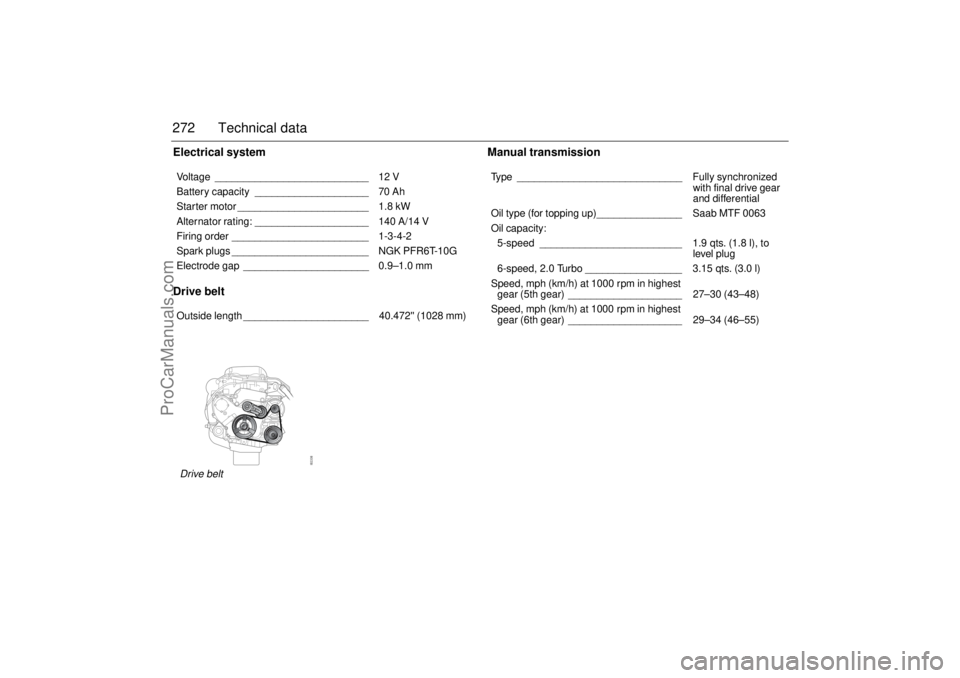
Drive belt _____________ 272
Manual transmission ___ 272
Automatic transmission _ 273
Suspension ___________ 273
Steering ______________ 273
Brake system__________ 274
Wheels and tires _______ 275
Plates and labels _______ 278
Technical data
ProCarManuals.com
Page 270 of 288

270 Technical dataEngine Engine oilType: Four cylinders,
double overhead
camshafts,
16 valves, two
balancer shafts,
dual-mass flywheel
Cylinder bore_______________________ 3.386'' (86 mm)
Stroke ____________________________ 3.386'' (86 mm)
Swept volume ______________________ 122 cu.in. (1.998 l)
Idling speed________________________ 720 rpm.
When the engine
load increases, e.g.
the steering wheel is
turned, the idling
speed is raised to
900 rpm.
Antifreeze _________________________ Saab-approved
antifreeze
Coolant capacity ____________________ 7.5 qts. (7.1 l)To meet demands in Saab's extended service intervals all en-
gines are filled with specially designed synthetic factory fill oils.
Long service intervals, fuel economy and environmental issues
are the base for our choice of oil. By using oils approved by
Saab you minimise the tendencies for oil sludge build, by that
protecting the engine from harmful, wear increasing, deposits.
Approved oils:
All gasoline engines - Fully Synthetic Engine Oil fulfilling GM-
LL-A-025 requirements.
To ensure being able to take advantage of the Saab specified
service intervals, be sure to select a fully synthetic engine oil
fulfilling GM-LL-A-025 requirements.
Servicing/Oil changes:
To be able to use recommended service intervals the need to
use only approved engine oils is vital. Use only engine oils ap-
proved for your engine. Service should be done according to
the recommended service intervals to optimize your engine's
function through out its entire life. Saab Automobile AB will not
take responsibility for any damage that might occur due to ne-
glecting to meet above mentioned requirements.
At your Saab dealers you can find Saab Genuine or Mobil en-
gine oils. Among those there are oils specially designed to meet
your engines specific needs. We recommend that you, with the
help of our skilled service personnel, choose your oil from that
selection.
Other oil companies also have engine oils approved according
to the table above. Oils meeting these standards may be identi-
fied as synthetic. However, not all synthetic oils will meet your
engines requirements. You should only use oil that meets your
engines specific requirements
ProCarManuals.com
Page 271 of 288

271 Technical data
Fuel
Engines
Recommended oil viscosities.
Viscosity is a measurement of the oils thickness. The thickness
influences, among other things, the fuel economy. For best
function Saab recommends:
For gasoline engines, SAE 0W-30 engine oil.
Some oil companies have engine oils meeting our requirements
(GM-LL-A-025) but with other viscosities than what we recom-
mend as a first choice. Those engine oils are also accepted.
Extra engine oil additives.
Don't add anything to your oil. The recommended oils are all
you will need for good engine performance and protection.
When to change engine oil.
Your vehicle has a display (SID) where time for service will be
shown. Based not only on mileage but also on driving condi-
tions the mileage at which a service will be indicated can vary
considerably.
Under normal circumstances the service indication will come on
at or around 15 000 miles or 2 years.
For this service system to work it is of outmost importance that
the right engine oil is used.
When the message for service is displayed you need to have
the required service done as soon as possible.
After the service your service personnel will reset the service in-
dicator. It is important to reset the service indicator in order to
optimize the time to the next service.
Oil capacity, including filter (oil change) __ 6.3 qts. (6.0 l)Fuel tank capacity ___________________ 16.05 U.S. gal. (61 l)
For optimum performance
Saab recommends:
2.0t (175 hp) ______________________ Unleaded 90 AON
2.0 Turbo (210 hp) _________________ Unleaded 90 AON
2.0t EcopowerRating, EEC at 5500 rpm ____________ 175 hp (129 kW)
Maximum torque, EEC at 2500 rpm ____ 195 ft.lb. (265 Nm)
Compression ratio _________________ 9.5:12.0 Turbo EcopowerRating, EEC at 5300 rpm ____________ 210 hp (155 kW)
Maximum torque, EEC at 2500 rpm ____ 221 ft.lb. (300 Nm)
Compression ratio _________________ 9.5:1
ProCarManuals.com
Page 272 of 288
272 Technical dataElectrical system
Drive belt
Manual transmission
Voltage ___________________________ 12 V
Battery capacity ____________________ 70 Ah
Starter motor _______________________ 1.8 kW
Alternator rating: ____________________ 140 A/14 V
Firing order ________________________ 1-3-4-2
Spark plugs ________________________ NGK PFR6T-10G
Electrode gap ______________________ 0.9–1.0 mm
Outside length ______________________ 40.472'' (1028 mm)Drive belt
Type _____________________________ Fully synchronized
with final drive gear
and differential
Oil type (for topping up)_______________ Saab MTF 0063
Oil capacity:
5-speed _________________________ 1.9 qts. (1.8 l), to
level plug
6-speed, 2.0 Turbo _________________ 3.15 qts. (3.0 l)
Speed, mph (km/h) at 1000 rpm in highest
gear (5th gear) ____________________ 27–30 (43–48)
Speed, mph (km/h) at 1000 rpm in highest
gear (6th gear) ____________________ 29–34 (46–55)
ProCarManuals.com
Page 273 of 288

273 Technical data
Automatic transmission Suspension
SteeringType _____________________________ Electronically con-
trolled, 5-speed,
fully-automatic with
hydraulic torque
converter, planetary
gears and integral
final drive.
Lock-up function in
selector positions 3,
4 and 5.
Selector lever positions _______________ P, R, N, D, M
Oil capacity, total ____________________ 7.6 qts. (7.2 litres)
Oil type ___________________________ Saab 3309
Clutch type ________________________ Hydraulic plate
clutches, brake
bands and one-way
couplings
Speed (mph/km/h) at 1000 rpm in top gear:
2.0t and 2.0T _____________________ 28–30/46–49Spring type, front and rear ____________ Coil springs
Maximum deflection of springs:
Front ____________________________ 7.0'' (178 mm)
Rear ____________________________ 8.3'' (212 mm)
Dampers, front and rear ______________ Gas-filled dampers
Steering __________________________ Power-assisted
steering gear of
rack-pinion type and
telescopic jointed
steering column
Number of turns, lock to lock___________ 3.0
Oil type ___________________________ Power steering fluid
CHF 11S
ProCarManuals.com