tires SAAB 9-3 2004 Owner's Manual
[x] Cancel search | Manufacturer: SAAB, Model Year: 2004, Model line: 9-3, Model: SAAB 9-3 2004Pages: 288, PDF Size: 23.54 MB
Page 242 of 288

242 Car careSteps for Determining Correct Load
Limit
1 Locate the statement “The
combined weight of occupants and
cargo should never exceed
XXX pounds” on your vehicle´s
placard.
2 Determine the combined weight of
the driver and passengers that will
be riding in your vehicle.
3 Substract the combined weight of
the driver and passengers from
XXX kilograms or XXX pounds.
4 The resulting figure equals the avail-
able amount of cargo and luggage
load capacity. For example, if the
“XXX” amount equals 1400 lbs. and
there will be five 150 lb. passengers
in your vehicle, the amount of avail-
able cargo and luggage load capac-
ity is 650 lbs. (1400–750 (5x150) =
650 lbs.).5 Determine the combined weight of
luggage and cargo being loaded on
the vehicle. That weight may not
safely exceed the available cargo
and luggage load capacity calcu-
lated in Step 4.
6 If your vehicle will be towing a trailer,
load from your trailer will be trans-
ferred to your vehicle. Consult this
manual to determine how this
reduces the available cargo and
luggage load capacity of your vehi-
cle.Winter tires
Winter (snow) tires are recommended for
winter climates where the majority of your
driving will be done on snow and ice. Winter
tires should be fitted to all four wheels to
maintain a proper balance. Your Saab
dealer can advise you of to the correct size
tire for your car (if different from the original
size) and also supply Saab approved winter
tires pre-mounted on steel or alloy rims.
ProCarManuals.com
Page 243 of 288
243 Car care
Tire date codeTires should be regarded as perishable
goods. As the tires age, the rubber becomes
progressively harder, and the roadholding
ability of the tires diminishes. This is partic-
ularly true on winter tires.
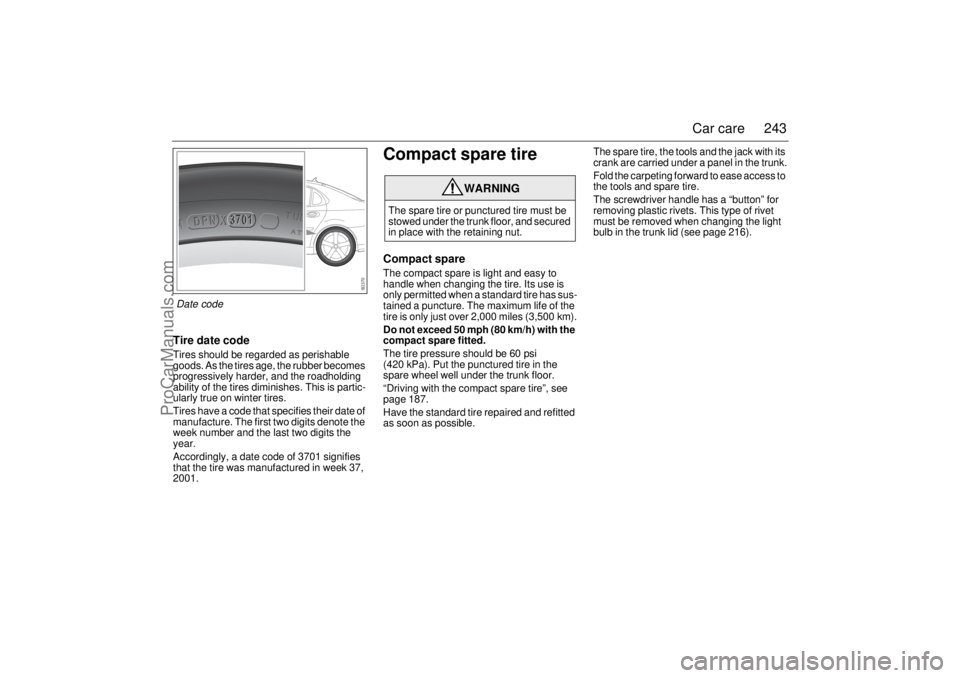
Tires have a code that specifies their date of
manufacture. The first two digits denote the
week number and the last two digits the
year.
Accordingly, a date code of 3701 signifies
that the tire was manufactured in week 37,
2001.
Compact spare tireCompact spareThe compact spare is light and easy to
handle when changing the tire. Its use is
only permitted when a standard tire has sus-
tained a puncture. The maximum life of the
tire is only just over 2,000 miles (3,500 km).
Do not exceed 50 mph (80 km/h) with the
compact spare fitted.
The tire pressure should be 60 psi
(420 kPa). Put the punctured tire in the
spare wheel well under the trunk floor.
“Driving with the compact spare tire”, see
page 187.
Have the standard tire repaired and refitted
as soon as possible.The spare tire, the tools and the jack with its
crank are carried under a panel in the trunk.
Fold the carpeting forward to ease access to
the tools and spare tire.
The screwdriver handle has a “button” for
removing plastic rivets. This type of rivet
must be removed when changing the light
bulb in the trunk lid (see page 216).
WARNING
The spare tire or punctured tire must be
stowed under the trunk floor, and secured
in place with the retaining nut.
Date code
ProCarManuals.com
Page 257 of 288

257 Car care
Headlight aimingThe vehicle has a visual optical headlight
aiming system equipped with vertical
aiming device. The aim has been preset at
the factory and should normally not need
further adjustments.
If your headlights are damaged in a crash,
the headlight aim may be affected. If you
believe your headlights need to be re-
aimed, we recommend that you take it to
your Saab dealer for service. However, it is
possible for you to re-aim your headlights as
described in the following procedure.To check the aim, the vehicle should be
properly prepared as follows:
The vehicle shall be placed so that the
headlights are 25 ft (7.6 m) from a light
colored wall or other flat surface. The
aiming area should be darkened, this will
improve your ability to see the beam of the
low beam headlight being aimed.
An optical headlamp aimer can also be
used and will than replace the wall.
The vehicle must have all four wheels on
a perfectly level surface which is level all
the way to the wall or other flat surface.
The vehicle should be placed so it is per-
pendicular to the wall or other flat surface.
The vehicle should be unloaded and fuel
tank full, and one person or 160 lbs.
(75 kg) on the drivers seat. The vehicle should be fully assembled
and all other work stopped while headlight
aiming is being done.
The vehicle should not have any snow, ice
or mud attached to it.
Tires should be inflated to the prescribed
pressure.
Close all doors.
Rock the vehicle to stabilize the suspen-
sion.
Headlight aiming is done with the vehicle
low beam lamps. The high beam lamps will
be correctly aimed if the low beam lamps
are aimed properly.
WARNING
Before checking/adjusting the headlight
aiming, switch off the engine to avoid
danger of fingers and hands being injured
by moving parts.
The radiator fan can start up even when
the engine is switched off.NOTICETo make sure that your headlights are
aimed properly read all instructions
before beginning. Failure to follow these
instructions could cause damage to
headlight parts or a not correctly aimed
headlight.
ProCarManuals.com
Page 263 of 288

263 Customer Assistance and Information
Engine oil and filter changesChanging the engine oil and filter is required
at every service point. Use only a Saab
approved long-life oil filter and engine oils
meeting the SAE viscosity ratings and API
service classifications stated in the “Techni-
cal data” section of this Owner’s Manual.
The use of extra additives in the oil is not
necessary and is not recommended, and
may be harmful to turbochargers.
More frequent oil changes are recom-
mended if your vehicle is operated under
any of the following conditions:
Most trips are less than 5–10 miles (8–
16 km). This is particularly important
when outside temperatures are below
freezing.
Most trips include extensive idling
(frequent stop-and-go traffic).
Most trips are through dusty areas (such
as construction zones).
If the vehicle is used for delivery service,
police, taxi or other commercial applica-
tions.
If your driving habits match this description,
have the engine oil and filter changed in-
between normal services. These conditions
cause the engine oil to break down faster.
The Warranties and Service Record Book-
let has provisions to record extra oil
changes.
Service record retentionIt is the owner’s responsibility to retain ser-
vice records. If possible, you should keep
copies of all shop work orders for all service
and repairs, whenever performed. As indi-
cated in the new car and emission control
system warranties, it is important to docu-
ment that all necessary maintenance has
been done.
HOW THE SERVICE RECORD IS ORGA-
NIZED
The service record is comprised of a series
of coupons on which to record services as
they are performed. There are additional
coupons for documenting extra engine oil
and filter changes, extra automatic trans-
mission fluid services necessary for severe
service conditions, and brake fluid changes.
HOW TO USE THE SERVICE RECORD
COUPONS
When the car is brought to a Saab dealer for
scheduled maintenance, present the War-
ranties & Service Record Booklet to the ser-
vice manager. When the technician has
completed the service, the technician will
sign the maintenance record. The person
responsible for quality assurance at the
dealership will also sign and stamp the
record with the dealer identification stamp.
Service costsDealer pricing practices and labor for ser-
vice work vary. Saab’s recommended ser-
vice times for each service point do not
include the labor required to replace wear
items, such as wiper blades, brake pads or
tires. Nor is labor to perform other service or
repairs found to be necessary as a result of
the inspections included in these times.
Additional labor and parts will be charged
for such work when necessary, except as
covered under an applicable Saab warranty
or any optional extended service contract.
Transmission fluid changes or suspension
alignment, when necessary, are also addi-
tional.
Dealer charges for general shop material,
regulated hazardous waste removal, recy-
cling expenses or other operation costs may
also be applied to service and repair
invoices and are apt to vary by dealer and
location.
ProCarManuals.com
Page 267 of 288
267 Technical data
General data __________ 268
Engine _______________ 270
Engine oil _____________ 270
Fuel__________________ 271
Engines ______________ 271
Electrical system_______ 272
Drive belt _____________ 272
Manual transmission ___ 272
Automatic transmission _ 273
Suspension ___________ 273
Steering ______________ 273
Brake system__________ 274
Wheels and tires _______ 275
Plates and labels _______ 278
Technical data
ProCarManuals.com
Page 269 of 288

269 Technical data
Maximum axle load:
Sport Sedan, front _________________ 2480 lbs. (1125 kg)
Sport Sedan, rear __________________ 2230 lbs. (1010 kg)
Convertible, front __________________ 2540 lbs. (1150 kg)
Convertible, rear ___________________ 2310 lbs. (1050 kg)
Weight distribution:
Curb weight + driver (150 lbs. (68 kg)),
front/rear (Sport Sedan and Convertible) approx. 60/40 %
GVW, front/rear (Sport Sedan and Con-
vertible) __________________________ approx. 50/50 %
Maximum roof load, Sport Sedan _______ 220 lbs. (100 kg)
Maximum load in trunk:
Sport Sedan ______________________ 175 lbs. (80 kg)
Convertible _______________________ 220 lbs. (100 kg)
The combined weight of occupants and
cargo should never exceed:
Sport Sedan ______________________ 925 lbs. (420 kg)
Convertible _______________________ 820 lbs. (372 kg)
Maximum combined weight of driver and
passengers ______________________
Sport Sedan (5x150 lbs.) ____________ 750 lbs. (340 kg)
Convertible (4x150 lbs.) _____________ 600 lbs. (272 kg)
WARNING
The GVW and maximum axle loads must not be exceeded.
Note that if some accessories (e.g. towbar, CD changer) are
fitted, the available load capacity is reduced by the weight of
these.
When carrying a load in the trunk, make sure that it is lashed
down securely, particularly when part or all of the rear seat is
folded down.
Trailer:
Trailer with brakes ___________________ Max. 3500 lbs.
(1588 kg)
Trailer without brakes ________________ Max. 1000 lbs.
(450 kg)
Recommended towball load ___________ 110–165 lbs.
(50–75 kg)
See also page 180.
Maximum theoretical towing speed, trailer
with brakes _______________________ 60 mph (100 km/h)
When towing a trailer, increase the pressure
of the rear tires by 20 kPa (3 psi).
The above speed and weight restrictions are those specified by
Saab Automobile AB.
Note that national restrictions may apply to trailer speeds and
weights (see page 178).
ProCarManuals.com
Page 275 of 288

275 Technical data
Wheels and tires Summer tires
6.5 x 15" _________________________ 205/65 R15 94 H
6.5 x 16" _________________________ 215/55 R16 93 H
7 x 17"___________________________ 225/45 R17 94 W
RF/XL
Always contact a Saab dealer if you plan to fit other wheels or
tires than those fitted as standard.
Winter (snow) tires:
6.5 x 15" wheel ____________________ 205/65 R15 91 Q
M+S
6.5 x 16" wheel ____________________ 205/55 R16 91 Q
M+S or
215/55 R16 93 Q
7 x 17" wheel _____________________ 225/45 R17 94 Q
M+S RF/XL
Compact spare:
Wheel ___________________________ 4 x 16"
Tire _____________________________ 125/85 R16 99 M
Pressure _________________________ 420 kPa (60 psi)
Maximum life______________________ 2200 miles
(3500 km)
Maximum speed ___________________ 50 mph (80 km/h)
NOTICESnow chains:
Snow chains must not be fitted to the rear wheels, and may only
be used with the following wheel-tire combinations:
Wheels Tires
6.5 x 15"_______ 205/65 R15 M+S or
205/65 R15
6.5 x 16"_______ 205/55 R16 M+S or
215/55 R16
Contact your Saab dealer regarding suitable snow chains.
Max. permissible speed with snow chains fitted is 30 mph
(50 km/h).
Snow chains must not be fitted to wheels larger than 17".NOTICEWheels larger than 17" must not be fitted for reasons stated on
page 234.
Exercise care when driving on uneven roads or against the curb
if the car is heavily laden. This particularly applies to cars with
17" wheels.
Permitted wheel offset is 41 mm.
ProCarManuals.com
Page 276 of 288

276 Technical dataRecommended tire/engine combinations*) Not recommended in combination with sport chassis.
RF/XL = Reinforced (or Extra Load) tire.
2.0t 2.0 Turbo
Summer tires
205/65 R15 94 H x –
215/55 R16 93 H x –
225/45 R17 94 W RF/XL x x
Winter (snow) tires
205/65 R15 94 Q x –
205/55 R16 91 Q *) x x
215/55 R16 93 Q x x
225/45 R17 94 Q RF/XL x x
Wheel sizes
6.5 x 15" x –
6.5 x 16" x x
7 x 17" x x
ProCarManuals.com
Page 277 of 288

277 Technical data
Recommended lowest tire pressure, cold tiresTire size Load/speed
mph (km/h)
*)
Front
kPa/psiRear
kPa/psi
Summer tires
205/65 R15 94 H 1–3 pers./0–100 (0–160)
4–5 pers./0–100 (0–160)
1–5 pers./100– (160–)220/32
220/32
260/38220/32
220/32
260/38
215/55 R16 93 H 1–3 pers./0–100 (0–160)
4–5 pers./0–100 (0–160)
1–5 pers./100– (160–)240/35
240/35
280/41220/32
220/32
260/38
225/45 R17 94 W
RF/XL1–3 pers./0–120 (0–190)
4–5 pers./0–120 (0–190)
1–5 pers./120– (190–)240/35
240/35
280/41240/35
240/35
280/41
Winter tires
205/65 R15 91 Q 1–3 pers./0–100 (0–160)
4–5 pers./0–100 (0–160)240/35
280/41240/35
280/41
205/55 R16 91 Q 1–3 pers./0–100 (0–160)
4–5 pers./0–100 (0–160)240/35
280/41240/35
280/41
215/55 R16 93 Q 1–3 pers./0–100 (0–160)
4–5 pers./0–100 (0–160)240/35
280/41240/35
280/41
225/45 R17 94 Q
RF/XL1–3 pers./0–100 (0–160)
4–5 pers./0–100 (0–160)250/36
290/42250/36
290/42
Spare wheel
125/85 R16 99 M Max 50 (80) 420/60 420/60
*) Do not exceed posted speed limits.
By cold tires is meant tires that are the same temperature as the sur-
rounding air temperature.
The values for tire pressure in table above are for tires at 68°F
(20°C).
The tire pressure will increase as the tires become warm (e.g. during
highway driving), and decrease as they cool.
When the temperature of the tires increases or decreases by 10
degrees the tire pressure will correspondingly increase or decrease
by 2 psi/10 kPa.
ProCarManuals.com
Page 282 of 288
282 Technical data
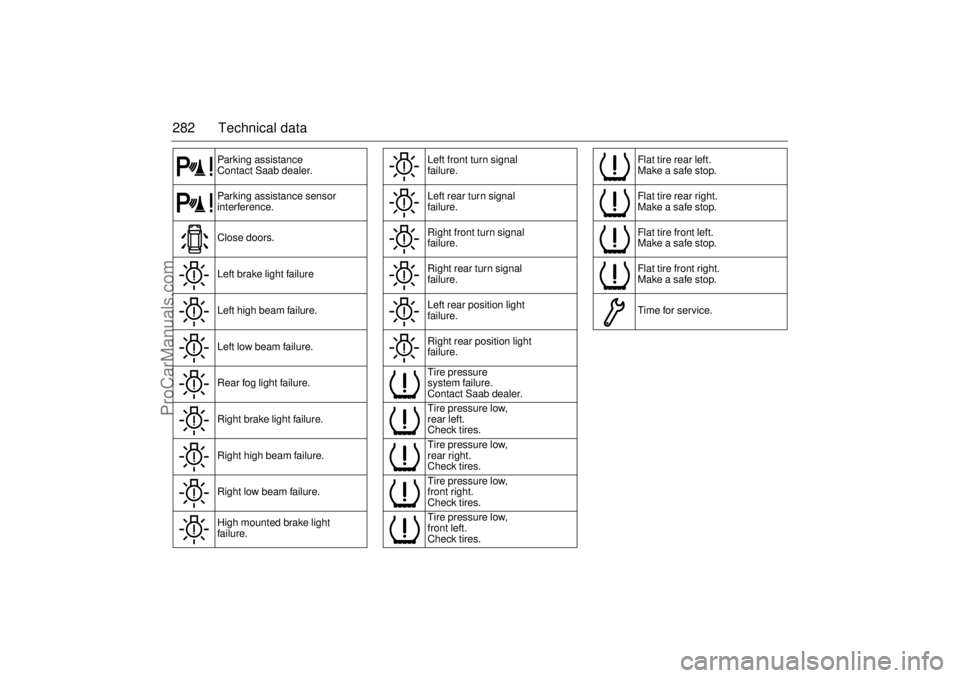
Parking assistance
Contact Saab dealer.
Parking assistance sensor
interference.
Close doors.
Left brake light failure
Left high beam failure.
Left low beam failure.
Rear fog light failure.
Right brake light failure.
Right high beam failure.
Right low beam failure.
High mounted brake light
failure.
Left front turn signal
failure.
Left rear turn signal
failure.
Right front turn signal
failure.
Right rear turn signal
failure.
Left rear position light
failure.
Right rear position light
failure.
Tire pressure
system failure.
Contact Saab dealer.
Tire pressure low,
rear left.
Check tires.
Tire pressure low,
rear right.
Check tires.
Tire pressure low,
front right.
Check tires.
Tire pressure low,
front left.
Check tires.
Flat tire rear left.
Make a safe stop.
Flat tire rear right.
Make a safe stop.
Flat tire front left.
Make a safe stop.
Flat tire front right.
Make a safe stop.
Time for service.
ProCarManuals.com