park assist SAAB 9-3 2004 Owners Manual
[x] Cancel search | Manufacturer: SAAB, Model Year: 2004, Model line: 9-3, Model: SAAB 9-3 2004Pages: 288, PDF Size: 23.54 MB
Page 84 of 288
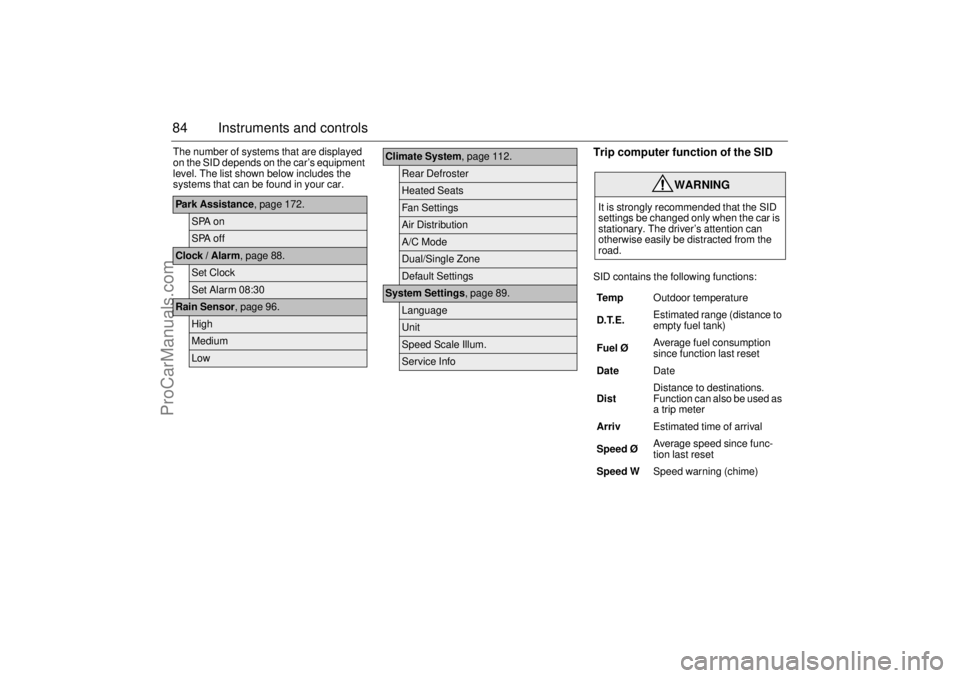
84 Instruments and controlsThe number of systems that are displayed
on the SID depends on the car’s equipment
level. The list shown below includes the
systems that can be found in your car.
Trip computer function of the SIDSID contains the following functions:
Park Assistance, page 172.
SPA onSPA off
Clock / Alarm, page 88.
Set ClockSet Alarm 08:30
Rain Sensor, page 96.
HighMediumLow
Climate System, page 112.
Rear DefrosterHeated SeatsFan SettingsAir DistributionA/C ModeDual/Single ZoneDefault Settings
System Settings, page 89.
LanguageUnitSpeed Scale Illum.Service Info
WARNING
It is strongly recommended that the SID
settings be changed only when the car is
stationary. The driver’s attention can
otherwise easily be distracted from the
road.
Te m pOutdoor temperature
D.T.E. Estimated range (distance to
empty fuel tank)
Fuel ØAverage fuel consumption
since function last reset
DateDate
DistDistance to destinations.
Function can also be used as
a trip meter
ArrivEstimated time of arrival
Speed Ø Average speed since func-
tion last reset
Speed WSpeed warning (chime)
ProCarManuals.com
Page 94 of 288
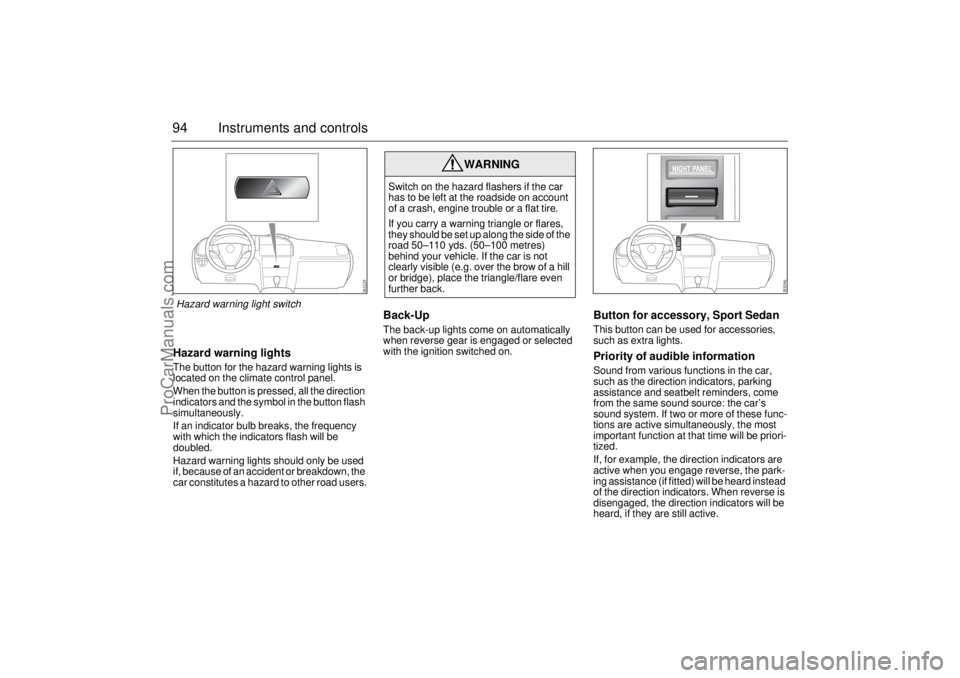
94 Instruments and controlsHazard warning lightsThe button for the hazard warning lights is
located on the climate control panel.
When the button is pressed, all the direction
indicators and the symbol in the button flash
simultaneously.
If an indicator bulb breaks, the frequency
with which the indicators flash will be
doubled.
Hazard warning lights should only be used
if, because of an accident or breakdown, the
car constitutes a hazard to other road users.
Back-Up The back-up lights come on automatically
when reverse gear is engaged or selected
with the ignition switched on.
Button for accessory, Sport SedanThis button can be used for accessories,
such as extra lights.Priority of audible informationSound from various functions in the car,
such as the direction indicators, parking
assistance and seatbelt reminders, come
from the same sound source: the car’s
sound system. If two or more of these func-
tions are active simultaneously, the most
important function at that time will be priori-
tized.
If, for example, the direction indicators are
active when you engage reverse, the park-
ing assistance (if fitted) will be heard instead
of the direction indicators. When reverse is
disengaged, the direction indicators will be
heard, if they are still active.
WARNING
Switch on the hazard flashers if the car
has to be left at the roadside on account
of a crash, engine trouble or a flat tire.
If you carry a warning triangle or flares,
they should be set up along the side of the
road 50–110 yds. (50–100 metres)
behind your vehicle. If the car is not
clearly visible (e.g. over the brow of a hill
or bridge), place the triangle/flare even
further back.
Hazard warning light switch
ProCarManuals.com
Page 139 of 288
139 Starting and driving
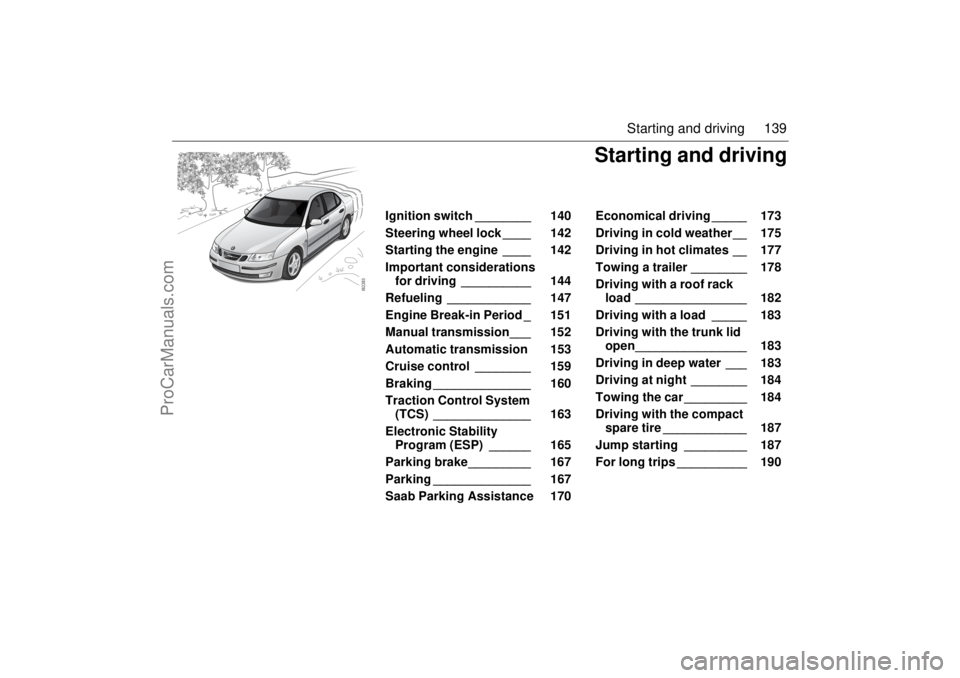
Ignition switch ________ 140
Steering wheel lock ____ 142
Starting the engine ____ 142
Important considerations
for driving __________ 144
Refueling ____________ 147
Engine Break-in Period _ 151
Manual transmission___ 152
Automatic transmission 153
Cruise control ________ 159
Braking ______________ 160
Traction Control System
(TCS) ______________ 163
Electronic Stability
Program (ESP) ______ 165
Parking brake_________ 167
Parking ______________ 167
Saab Parking Assistance 170 Economical driving _____ 173
Driving in cold weather__ 175
Driving in hot climates __ 177
Towing a trailer ________ 178
Driving with a roof rack
load ________________ 182
Driving with a load _____ 183
Driving with the trunk lid
open________________ 183
Driving in deep water ___ 183
Driving at night ________ 184
Towing the car _________ 184
Driving with the compact
spare tire ____________ 187
Jump starting _________ 187
For long trips __________ 190
Starting and driving
ProCarManuals.com
Page 161 of 288
161 Starting and driving
ABS brakesThe Antilock Braking System (ABS) modu-
lates the brake pressure to each wheel. The
pressure is automatically reduced just
before the wheel locks up and then
increases again to the point at which the
wheel is just about to lock. The wheel sen-
sors send information to the brake system’s
electronic control module for every 4 or so
inches (decimetre) that the car rolls. This
information is processed continuously to
ensure that the adjustment of the brake
pressure will be as exact as possible.
Adjustment takes place up to 12 times per
second.The brake system provides Electronic
Brakeforce Distribution (EBD). This distri-
butes the brake pressure between the front
and rear wheels, in such a way as to achieve
optimum braking performance irrespective
of the car’s speed or load.
The ABS has a built-in diagnostics function
which will switch on the ABS warning light
if a fault is detected in the system (see
page 74).
The following message will appear on the
SID (and corresponding symbol on main
instrument unit) if a fault is detected:
WARNING
It is prudent to try your brakes from
time to time, especially when driving in
heavy rain, through water collected on
the road, in snow, on a wet road
surface or in salty slush. In such condi-
tions, the brakes may take longer than
normal to take effect. To rectify this,
touch the brake pedal periodically to
dry the brakes out.
The same applies after the car has
been washed or when the weather is
very humid.
Avoid parking the car with wet brakes.
Before parking, and if the traffic condi-
tions allow, brake quite heavily so that
the brake discs and pads warm up and
dry.
The brakes are power assisted and it
should be kept in mind that the servo
unit only provides the power assis-
tance when the engine is running.
The brake pressure required when the
engine is off, (e.g. when the car is
being towed) is roughly four times the
normal pedal force required. The
pedal also feels hard and unrespon-
sive.
Overheating can cause the brakes to
fade!
WARNING
The additional safety afforded by the
ABS system is not designed to allow
drivers to drive faster but to make
normal driving safer.
To stop as quickly as possible, without
loss of directional stability, whether
the road surface is dry, wet or slippery,
press the brake pedal down hard
without letting up (do not pump the
pedal), declutching simulta-
neously, and steer the car to safety.
Antilock brake malfunction.
Contact Saab dealer.
ProCarManuals.com
Page 170 of 288
170 Starting and drivingSaab Parking
AssistanceSaab Parking Assistance
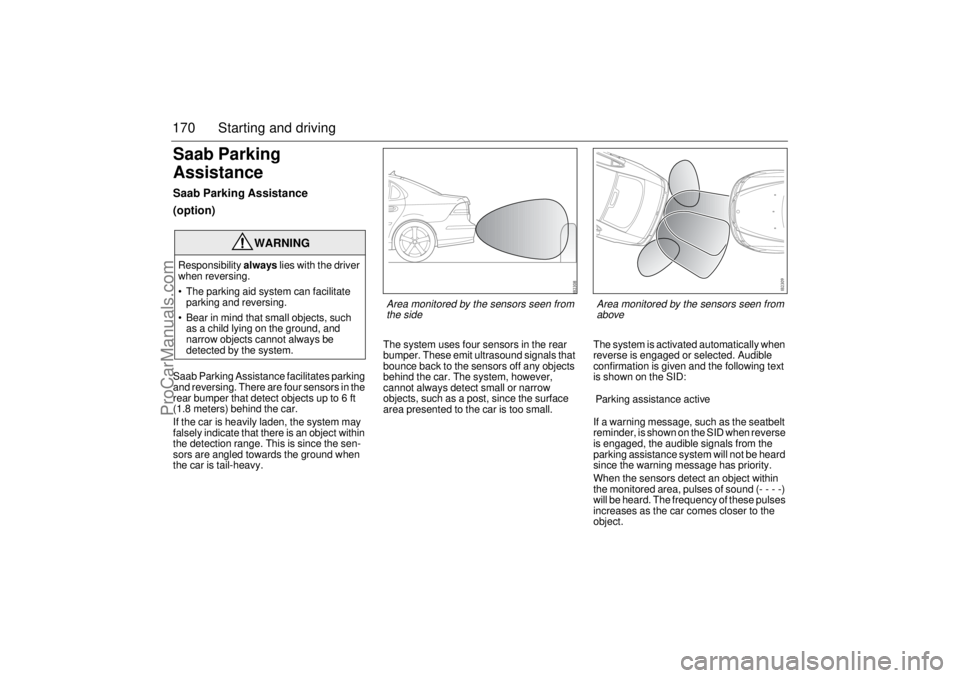
(option)Saab Parking Assistance facilitates parking
and reversing. There are four sensors in the
rear bumper that detect objects up to 6 ft
(1.8 meters) behind the car.
If the car is heavily laden, the system may
falsely indicate that there is an object within
the detection range. This is since the sen-
sors are angled towards the ground when
the car is tail-heavy.The system uses four sensors in the rear
bumper. These emit ultrasound signals that
bounce back to the sensors off any objects
behind the car. The system, however,
cannot always detect small or narrow
objects, such as a post, since the surface
area presented to the car is too small.The system is activated automatically when
reverse is engaged or selected. Audible
confirmation is given and the following text
is shown on the SID:
If a warning message, such as the seatbelt
reminder, is shown on the SID when reverse
is engaged, the audible signals from the
parking assistance system will not be heard
since the warning message has priority.
When the sensors detect an object within
the monitored area, pulses of sound (- - - -)
will be heard. The frequency of these pulses
increases as the car comes closer to the
object.
WARNING
Responsibility always lies with the driver
when reversing.
The parking aid system can facilitate
parking and reversing.
Bear in mind that small objects, such
as a child lying on the ground, and
narrow objects cannot always be
detected by the system.
Parking assistance active
Area monitored by the sensors seen from
the side
Area monitored by the sensors seen from
above
ProCarManuals.com
Page 171 of 288
171 Starting and driving
If you stop the car with reverse gear
engaged, the sound pulse will stop after
2 seconds. The sound pulses will return if
you continue to reverse. If the car rolls for-
ward while reverse is engaged, the system
is silenced.
When the distance to the object is less
than 1 ft. (30 cm), a continuous tone will
be heard.
When an object is approximately 3 ft.
(90 cm) from the car, the sound pulses
change character markedly (frequency
increases). A distance of about 3 ft. (90 cm)
is suitable if you wish to load or unload the
trunk.
If the distance between an object and a
corner sensor does not change for
3 seconds, for example if you are reversing
alongside a wall, the system will switch to
monitoring straight back. The system indi-
cates if the distance to the wall decreases
again.
If a trailer is hitched up and correctly con-
nected to the trailer contact by the tow bar,
the system is automatically deactivated.Reversing alongside a wall
If the distance between an object and a
corner sensor does not change for
2 seconds, for example if you are reversing
alongside a wall, the system will switch to
monitoring straight back. The system indi-
cates if the distance to the wall decreases
again.
Cars with trailer hitch
If the car has a ttrailer hitch and its wiring is
correctly connected to the car’s electrics,
the Saab Parking Assistance automatically
compensates for the protrusion of the tow
bar.
If a camper or trailer is hitched up and the
trailer hitch wiring is correctly connected to
the car’s electrics, the system is automati-
cally deactivated.You can temporarily deactivate the Saab
Parking Assistance as follows:
Engage reverse and press the CLEAR
button on the SID control panel.
The system will be reactivated the next time
you engage reverse.
Error messages
If the system malfunctions, the following
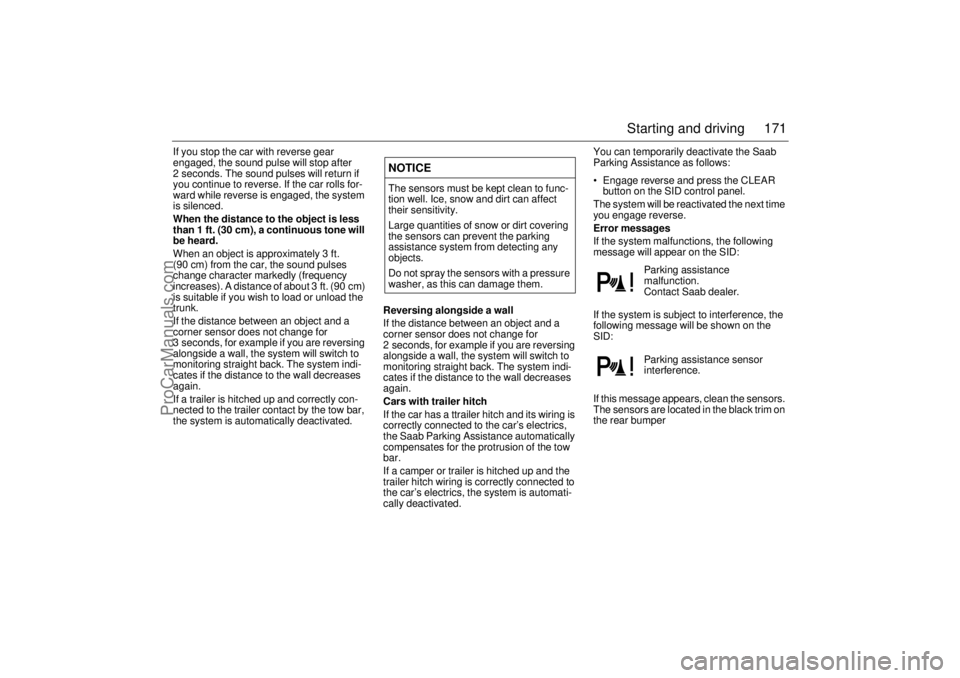
message will appear on the SID:
If the system is subject to interference, the
following message will be shown on the
SID:
If this message appears, clean the sensors.
The sensors are located in the black trim on
the rear bumper
NOTICEThe sensors must be kept clean to func-
tion well. Ice, snow and dirt can affect
their sensitivity.
Large quantities of snow or dirt covering
the sensors can prevent the parking
assistance system from detecting any
objects.
Do not spray the sensors with a pressure
washer, as this can damage them.
Parking assistance
malfunction.
Contact Saab dealer.
Parking assistance sensor
interference.
ProCarManuals.com
Page 172 of 288
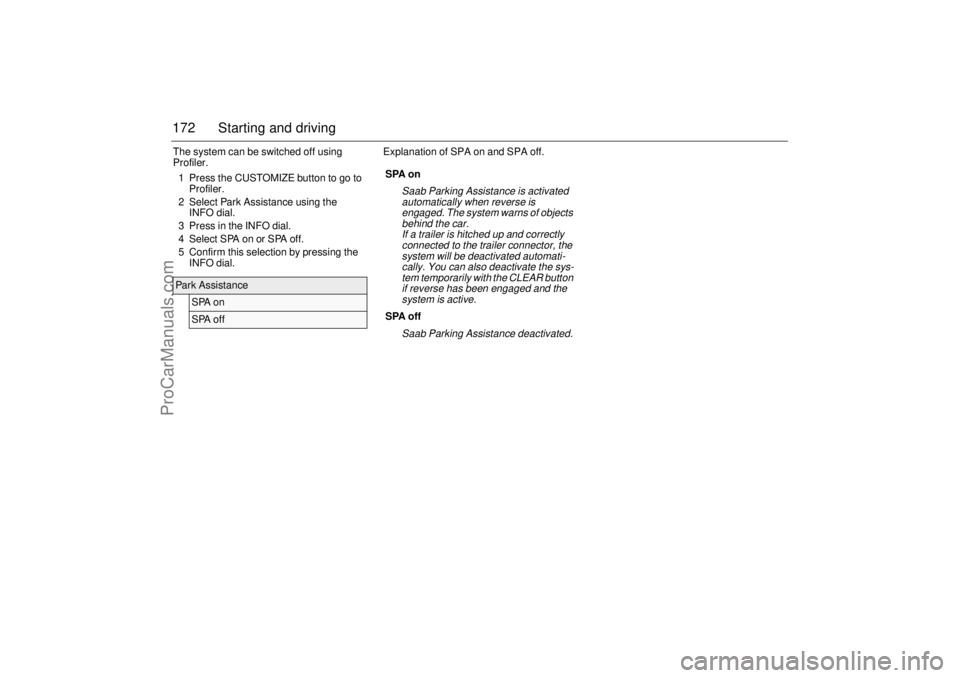
172 Starting and drivingThe system can be switched off using
Profiler.
1 Press the CUSTOMIZE button to go to
Profiler.
2 Select Park Assistance using the
INFO dial.
3 Press in the INFO dial.
4 Select SPA on or SPA off.
5 Confirm this selection by pressing the
INFO dial.Explanation of SPA on and SPA off.Park Assistance
SPA onSPA off
SPA on
Saab Parking Assistance is activated
automatically when reverse is
engaged. The system warns of objects
behind the car.
If a trailer is hitched up and correctly
connected to the trailer connector, the
system will be deactivated automati-
cally. You can also deactivate the sys-
tem temporarily with the CLEAR button
if reverse has been engaged and the
system is active.
SPA off
Saab Parking Assistance deactivated.
ProCarManuals.com
Page 225 of 288
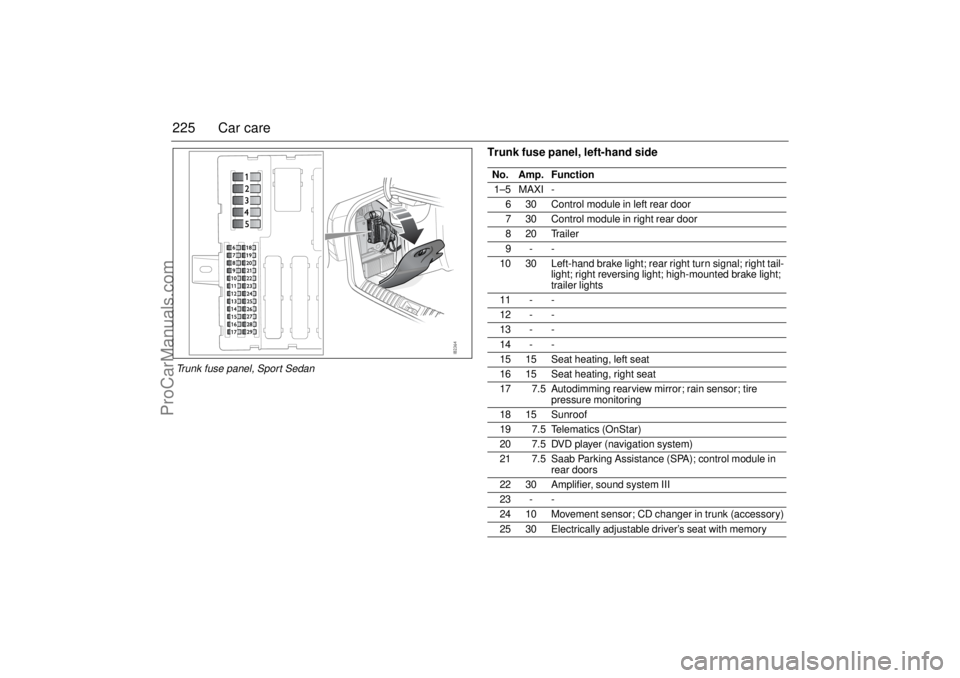
225 Car care
Trunk fuse panel, left-hand sideNo. Amp. Function
1–5 MAXI -
6 30 Control module in left rear door
7 30 Control module in right rear door
820Trailer
9--
10 30 Left-hand brake light; rear right turn signal; right tail-
light; right reversing light; high-mounted brake light;
trailer lights
11 - -
12 - -
13 - -
14 - -
15 15 Seat heating, left seat
16 15 Seat heating, right seat
17 7.5 Autodimming rearview mirror; rain sensor; tire
pressure monitoring
18 15 Sunroof
19 7.5 Telematics (OnStar)
20 7.5 DVD player (navigation system)
21 7.5 Saab Parking Assistance (SPA); control module in
rear doors
22 30 Amplifier, sound system III
23 - -
24 10 Movement sensor; CD changer in trunk (accessory)
25 30 Electrically adjustable driver’s seat with memory
Trunk fuse panel, Sport Sedan
ProCarManuals.com
Page 251 of 288

251 Car care
Convertible:
Wash the soft top with a mild soap solu-
tion and lukewarm water. For spot clean-
ing the top, a finger nail brush can also be
used. Stroke the brush in the direction of
the fabric, not across the threads.
If a pressure washer is used be heedful of
the following recommendations:
on the lower part of the car (not higher
than the door handles): max pressure
of 100 bar and not closer than 8 in.
(20 cm).
on the upper part of the car: max pres-
sure of 100 bar and not closer than
32 in. (80 cm).
Do not use any drying chemicals or water-
proofing agents.
Avoid automatic car washes
Waxing and polishingDo not wax a new car during the first three
or four months. In fact, there is no need to
polish the car before the paintwork has
started to dull through oxidation. Other than
in exceptional cases, do not use abrasive
polishes containing a cutting agent on a new
car. Always wash the car thoroughly before
waxing or polishing.
Touching up the paintDamaged paintwork should be treated as
soon as it is discovered: the longer it is left,
the greater the risk of corrosion. The anti-
corrosion warranty does not cover corrosion
resulting from untreated defects.
Paintwork damage sustained in a crash is
usually extensive and can only be properly
restored by professionals.
However, you can repair small scratches
and stone chip damage yourself. The nec-
essary tools and materials, such as primer,
touch-up paint and brushes, are available
from your Saab dealer.
In the case of minor flaws in the paintwork,
where the metal has not been exposed and
an undamaged layer of paint remains,
touch-up paint can usually be applied
directly, after any dirt has been scraped
away using a pointed knife.
NOTICE Try your brakes on leaving a car wash.
Wet brake discs reduce the perfor-
mance of the brakes.
Fixed antennae, such as for a mobile
phone, must be removed if the car
goes through an automatic car wash.
Cars with Saab Parking Assistance:
Do not spray the sensors or closer
than 8 in. (20 cm) to the sensors with
a pressure washer, as this can
damage them.
ProCarManuals.com
Page 262 of 288

262 Customer Assistance and InformationMaintenance scheduleThe Maintenance Schedule prescribes a
service program to the purchaser/operator
of a Saab that is reasonable and necessary
to ensure the proper emission control sys-
tems function, safety and reliability of the
Saab automobile in normal use. Additional
maintenance is recommended for specific
components when the car is operated under
certain severe conditions. Proper mainte-
nance is always a good practice!
Authorized Saab dealers are equipped and
trained to meet your Saab’s service needs.
They regularly receive up-to-date Saab ser-
vice manuals and parts and technical ser-
vice bulletins from Saab and are able,
through their franchise agreement, to attend
Saab service schools, obtain Saab special
tools and technical assistance and pur-
chase original equipment service and
replacement parts.
Today’s complex automobiles should only
be entrusted to the most knowledgeable
service professionals. A Saab dealer is your
best choice.
SERVICE INTERVALSThe maintenance schedule begins with an
Inspection Service at 30 days. A time for
service message will illuminate on the Saab
Instrument Display (SID) when the car is
due for regular maintenance. There are
three different messages that will appear:
TIME FOR INTERMEDIATE SERVICE
indicates that an oil/filter change is required
along with several inspections. This mes-
sage is set by the engine management
system which calculates service intervals
based on several factors including driving
habits, ambient temperature, number of
cold starts, mileage driven and elapsed time
since the last service. If mileage accumula-
tion does not occur, the message will be set,
and maintenance required at a maximum of
2 years.
TIME FOR MAIN AND INTERMEDIATE
SERVICE
indicates that an oil/filter change is required
along with several inspections and addi-
tional maintenance such as air filter or spark
plug replacement.TIME FOR MAIN SERVICE will be set when
additional maintenance is necessary, such
as air filter or spark plug replacement. When
the message Time for service. is displayed,
contact your Saab Dealer for a service
appointment.
Failure to perform scheduled maintenance
in a timely manner may result in serious
damage to key components or systems.
NOTICEThe Check-up will be done by your Saab
dealer at no charge and should be done
as close as possible to the scheduled 30
days.
ProCarManuals.com