roof SAAB 9-3 2005 User Guide
[x] Cancel search | Manufacturer: SAAB, Model Year: 2005, Model line: 9-3, Model: SAAB 9-3 2005Pages: 292, PDF Size: 23 MB
Page 110 of 292
108 Instruments and controlsAutomatic climate-
control system (ACC)Fresh air for the cabin is drawn in through an
inlet at the bottom edge of the windshield. It
passes through an effective filter before
reaching the climate control system and
delivery into the cabin. The air is evacuated
via openings in the parcel shelf. It is then led
through outlets on either side of the car
behind the rear bumper.
The Automatic Climate-Control system
(ACC) automatically maintains the desired
cabin temperature, regardless of the
weather outside.
The system will achieve the desired temper-
ature in the quickest possible way.
Note that heating or cooling is not
speeded up by setting the temperature
higher or lower than the final tempera-
ture you desire.
To optimize the performance of the air con-
ditioning system, all windows and the sun-
roof should be shut. The air vents in the
fascia must be open.
The incoming air is treated in three stages:
first it passes through a filter; it is then dehu-
midified and cooled; and finally, if required,
it is heated.To reduce potential misting on the insides of
the windows, the glass should be cleaned
with a quality glass cleaner. How often this
will need to be done depends on how clean
the air is - if there are smokers in the car, the
windows will need to be cleaned more
frequently.
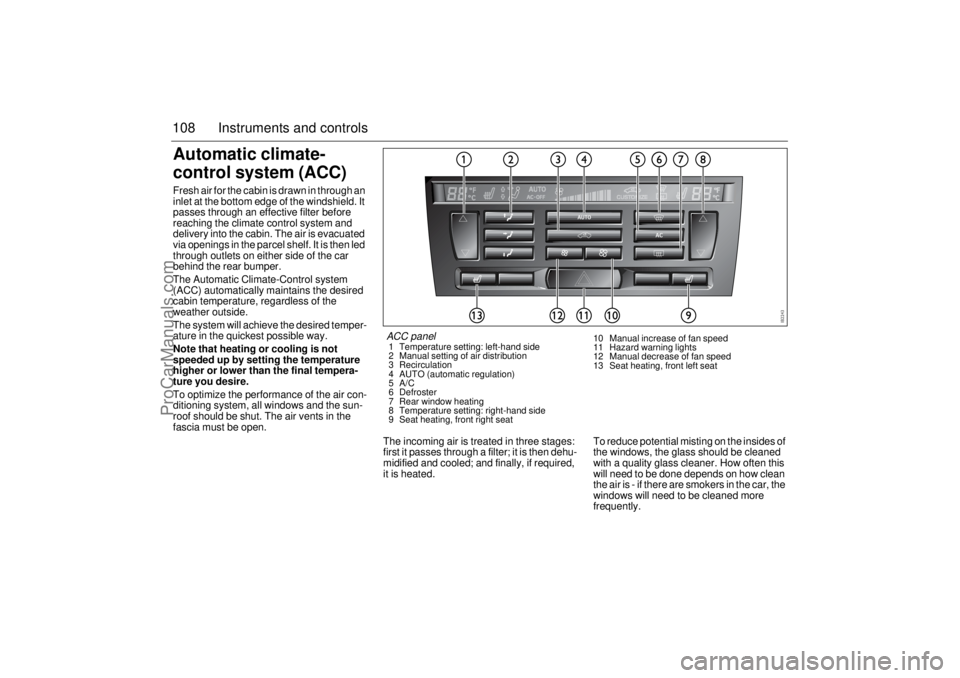
ACC panel1 Temperature setting: left-hand side
2 Manual setting of air distribution
3 Recirculation
4 AUTO (automatic regulation)
5A/C
6 Defroster
7 Rear window heating
8 Temperature setting: right-hand side
9 Seat heating, front right seat10 Manual increase of fan speed
11 Hazard warning lights
12 Manual decrease of fan speed
13 Seat heating, front left seat
ProCarManuals.com
Page 123 of 292
121 Interior equipment
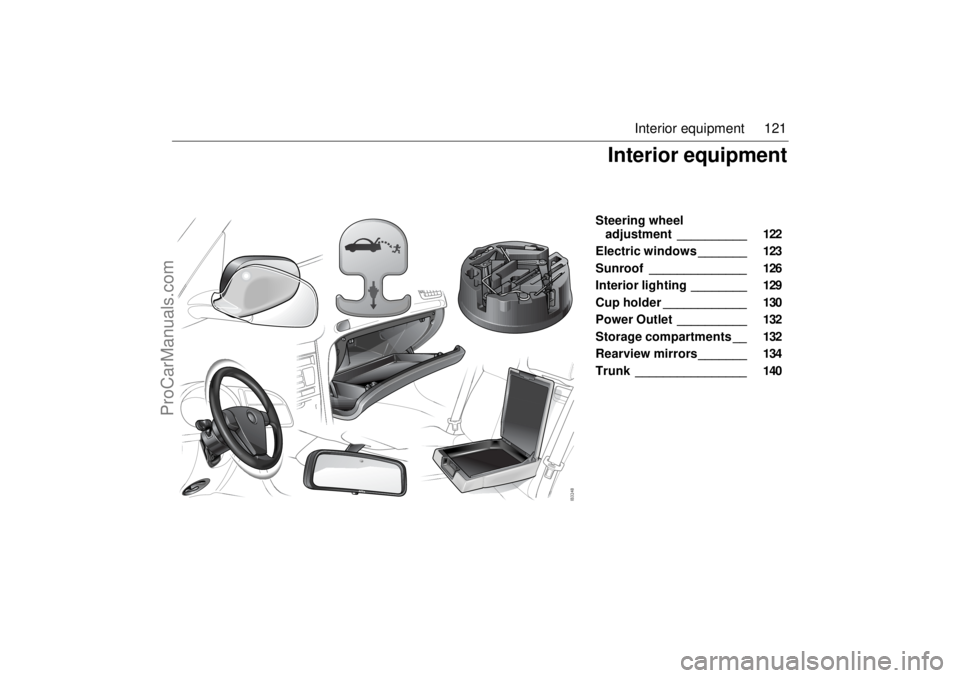
Steering wheel
adjustment __________ 122
Electric windows _______ 123
Sunroof ______________ 126
Interior lighting ________ 129
Cup holder ____________ 130
Power Outlet __________ 132
Storage compartments __ 132
Rearview mirrors_______ 134
Trunk ________________ 140
Interior equipment
ProCarManuals.com
Page 125 of 292
123 Interior equipment
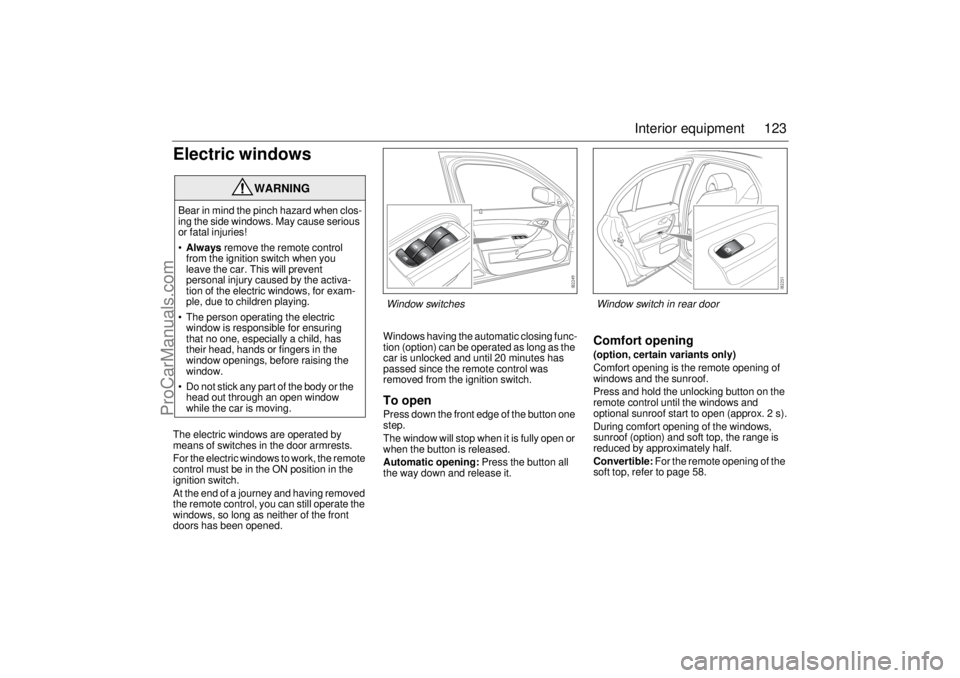
Electric windowsThe electric windows are operated by
means of switches in the door armrests.
For the electric windows to work, the remote
control must be in the ON position in the
ignition switch.
At the end of a journey and having removed
the remote control, you can still operate the
windows, so long as neither of the front
doors has been opened.Windows having the automatic closing func-
tion (option) can be operated as long as the
car is unlocked and until 20 minutes has
passed since the remote control was
removed from the ignition switch.
To openPress down the front edge of the button one
step.
The window will stop when it is fully open or
when the button is released.
Automatic opening: Press the button all
the way down and release it.
Comfort opening(option, certain variants only)
Comfort opening is the remote opening of
windows and the sunroof.
Press and hold the unlocking button on the
remote control until the windows and
optional sunroof start to open (approx. 2 s).
During comfort opening of the windows,
sunroof (option) and soft top, the range is
reduced by approximately half.
Convertible: For the remote opening of the
soft top, refer to page 58.
WARNING
Bear in mind the pinch hazard when clos-
ing the side windows. May cause serious
or fatal injuries!
Always remove the remote control
from the ignition switch when you
leave the car. This will prevent
personal injury caused by the activa-
tion of the electric windows, for exam-
ple, due to children playing.
The person operating the electric
window is responsible for ensuring
that no one, especially a child, has
their head, hands or fingers in the
window openings, before raising the
window.
Do not stick any part of the body or the
head out through an open window
while the car is moving.
Window switches
Window switch in rear door
ProCarManuals.com
Page 128 of 292
126 Interior equipmentSunroof(optional)
The sunroof is operated by the control in the
roof console. For the sunroof to work, the
remote control must be in the ON position in
the ignition switch.
If the car is equipped with windows having
the automatic closing function, the sunroof
can be opened and closed so long as the car
is unlocked until 20 minutes has passed
since the remote control was removed from
the ignition switch.
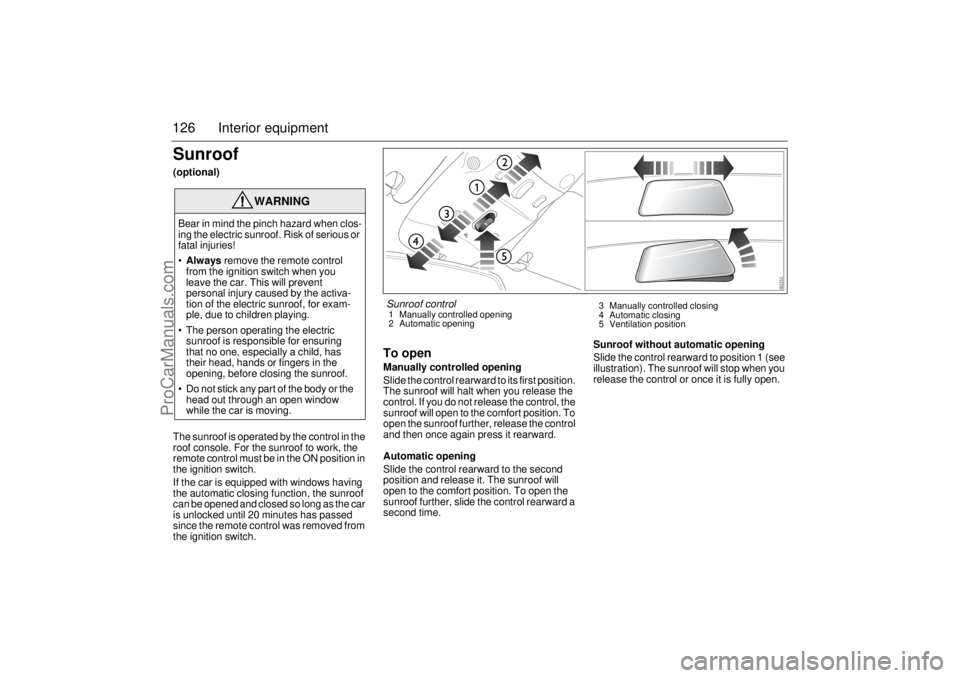
To openManually controlled opening
Slide the control rearward to its first position.
The sunroof will halt when you release the
control. If you do not release the control, the
sunroof will open to the comfort position. To
open the sunroof further, release the control
and then once again press it rearward.
Automatic opening
Slide the control rearward to the second
position and release it. The sunroof will
open to the comfort position. To open the
sunroof further, slide the control rearward a
second time.Sunroof without automatic opening
Slide the control rearward to position 1 (see
illustration). The sunroof will stop when you
release the control or once it is fully open.
WARNING
Bear in mind the pinch hazard when clos-
ing the electric sunroof. Risk of serious or
fatal injuries!
Always remove the remote control
from the ignition switch when you
leave the car. This will prevent
personal injury caused by the activa-
tion of the electric sunroof, for exam-
ple, due to children playing.
The person operating the electric
sunroof is responsible for ensuring
that no one, especially a child, has
their head, hands or fingers in the
opening, before closing the sunroof.
Do not stick any part of the body or the
head out through an open window
while the car is moving.
Sunroof control1 Manually controlled opening
2 Automatic opening3 Manually controlled closing
4 Automatic closing
5 Ventilation position
ProCarManuals.com
Page 129 of 292

127 Interior equipment
To closeManually controlled closing
Slide the control forward to its first position.
The sunroof will halt when you release the
control.
Automatic closing (certain variants only)
Slide the control forward to its second posi-
tion and release it. The sunroof will close
fully.
The sunroof pinch protection halts closing
and opens the sunroof slightly if something
obstructs closing.
Sunroof without automatic closing
Slide the control forward to position 3 (see
illustration). The sunroof will stop when you
release the control or once it is fully closed.Ventilation position (rear edge of
sunroof open)
To open – press in the control.
To close – slide the control forward to the
second position.
It is also possible to select the ventilation
position when the sunroof is open by press-
ing in the control. The sunroof will then close
automatically. Press the control once
more to open the sunroof to its ventilation
position.
If you wish to open the sunroof fully from
the ventilation position, you must first close
it (slide the control forward). You can then
slide the control rearward to open the sun-
roof.
The sunroof incorporates an interior, man-
ual, sliding sun blind.
Sunroof without automatic closing
To open – press the control up.
To close – slide the control forward to
position 3.
Comfort opening(option, certain variants only)
Comfort opening is the remote opening of
windows and the sunroof.
Press and hold the unlocking button on the
remote control until the windows and
optional sunroof start to open (approx. 2 s).
During comfort opening of the windows,
sunroof (option) and soft top, the range is
reduced by approximately half.
If the sunroof is in the ventilation position, it
will not open.
Convertible: For the remote opening of the
soft top, refer to page 58.
WARNING
Exercise great care when closing the
sunroof to ensure that nothing gets
trapped.
ProCarManuals.com
Page 130 of 292
128 Interior equipmentPinch protection(if equipped)
The sunroof is equipped with pinch protec-
tion. This is activated if something gets
trapped when the sunroof is being closed.
The sunroof will stop and open slightly.
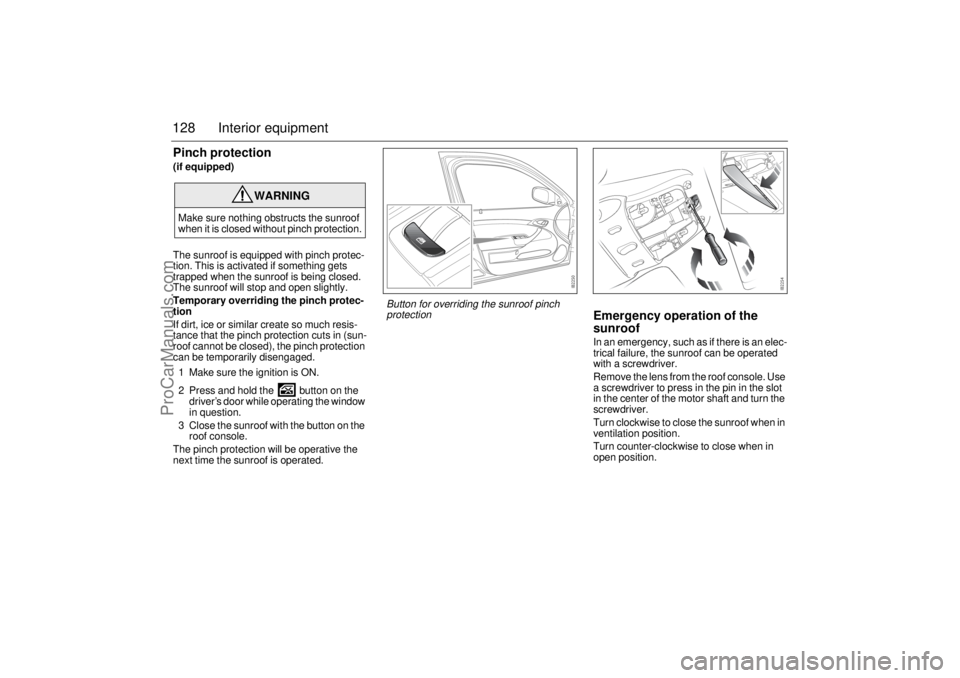
Temporary overriding the pinch protec-
tion
If dirt, ice or similar create so much resis-
tance that the pinch protection cuts in (sun-
roof cannot be closed), the pinch protection
can be temporarily disengaged.
1 Make sure the ignition is ON.
2 Press and hold the button on the
driver’s door while operating the window
in question.
3 Close the sunroof with the button on the
roof console.
The pinch protection will be operative the
next time the sunroof is operated.
Emergency operation of the
sunroofIn an emergency, such as if there is an elec-
trical failure, the sunroof can be operated
with a screwdriver.
Remove the lens from the roof console. Use
a screwdriver to press in the pin in the slot
in the center of the motor shaft and turn the
screwdriver.
Turn clockwise to close the sunroof when in
ventilation position.
Turn counter-clockwise to close when in
open position.
WARNING
Make sure nothing obstructs the sunroof
when it is closed without pinch protection.
Button for overriding the sunroof pinch
protection
ProCarManuals.com
Page 131 of 292
129 Interior equipment
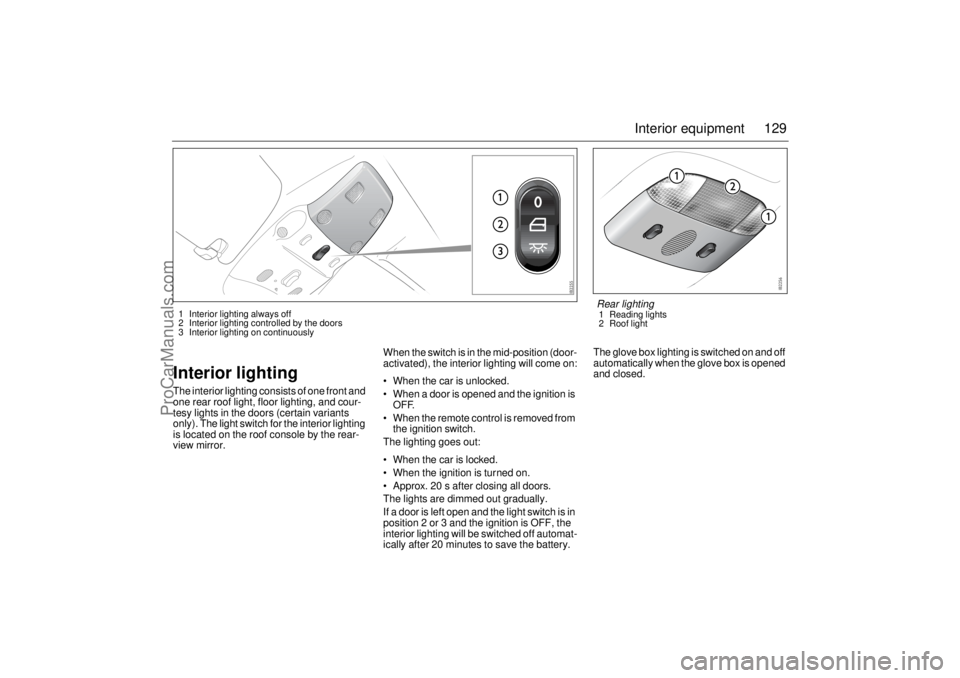
Interior lightingThe interior lighting consists of one front and
one rear roof light, floor lighting, and cour-
tesy lights in the doors (certain variants
only). The light switch for the interior lighting
is located on the roof console by the rear-
view mirror.When the switch is in the mid-position (door-
activated), the interior lighting will come on:
When the car is unlocked.
When a door is opened and the ignition is
OFF.
When the remote control is removed from
the ignition switch.
The lighting goes out:
When the car is locked.
When the ignition is turned on.
Approx. 20 s after closing all doors.
The lights are dimmed out gradually.
If a door is left open and the light switch is in
position 2 or 3 and the ignition is OFF, the
interior lighting will be switched off automat-
ically after 20 minutes to save the battery.The glove box lighting is switched on and off
automatically when the glove box is opened
and closed.1 Interior lighting always off
2 Interior lighting controlled by the doors
3 Interior lighting on continuously
Rear lighting1 Reading lights
2 Roof light
ProCarManuals.com
Page 147 of 292
145 Starting and driving
Ignition switch ________ 146
Steering wheel lock ____ 148
Starting the engine ____ 148
Important considerations
for driving __________ 150
Refueling ____________ 153
Engine Break-in Period _ 157
Manual transmission___ 158
Automatic transmission 159
Cruise control ________ 165
Braking ______________ 166
Traction Control System
(TCS) ______________ 169
Electronic Stability
Program (ESP) ______ 171
Parking brake_________ 173
Parking ______________ 173
Saab Parking Assistance 176 Economical driving _____ 179
Driving in cold weather__ 181
Driving in hot climates __ 183
Towing a trailer ________ 184
Driving with a roof rack
load ________________ 188
Driving with a load _____ 189
Driving with the trunk lid
open________________ 189
Driving in deep water ___ 189
Driving at night ________ 190
Towing the car _________ 190
Driving with the compact
spare tire ____________ 193
Jump starting _________ 193
For long trips __________ 196
Starting and driving
ProCarManuals.com
Page 181 of 292

179 Starting and driving
Economical drivingFactors affecting fuel
consumptionThe fuel consumption of a car is greatly
affected by driving conditions, climate, road
conditions, speed, driving technique, etc.Breaking-inFuel consumption may be somewhat
higher during the break-in period (the
first 3,000–4,000 miles (5,000–7,000 km)).Weather conditionsSummer temperatures give better fuel
economy than winter ones. The difference
can be as much as about 10%. Consump-
tion increases in cold weather because the
engine takes longer to reach its normal
operating temperature. The transmission
and wheel bearings also take longer to
warm up. Even distance affects consump-
tion: short journeys of 3–5 miles (5–8 km)
do not give the engine enough time to
reach its optimum temperature. Wind con-
ditions also have a marked effect on fuel
consumption.How to read the diagram:
If fuel consumption with the engine at
normal temperature is 28 mpg (10 l/
100 km), the actual fuel consumption
3 miles (5 km) after the engine has started
from cold will be:
– 23.5 mpg (12 l/100 km) at outside temp.
of 68°F (+20°C) (increase of 20%).
– 17.7 mpg (16 l/100 km) at outside temp.
of 32°F (0°C) (increase of 60%).
– 14 mpg (20 l/100 km) at outside temp.
of –4°F (–20°C) (increase of 100%).
It is clear from the diagram that both dis-
tance driven and outside temperature have
a significant impact on fuel consumption,
after a cold start.
If the car is normally driven on short jour-
neys, 3–5 miles (5–8 km), for example to
and from work, the average consumption
will be 60–80% above the normal level.
Driving techniques To obtain the best running economy, with
regard to fuel consumption and general
wear, the car must be serviced regularly.
High speed, unnecessary acceleration,
frequent braking and much changing
down all give higher fuel consumption.
Frequent gear changing in traffic, starting
in cold weather, the use of studded tires
and roof racks, and towing a camper all
increase fuel consumption.
Do not warm up the engine while the car
is stationary.
If idling, the engine will take much longer
to reach its optimum temperature, and Percentage increase in fuel consumption
of engine starting from cold compared to
engine at normal temperature.
ProCarManuals.com
Page 190 of 292
188 Starting and drivingDriving with a roof rack
loadThe maximum permissible roof load is
220 lbs. (100 kg). Note that the roof load
must be included in the car’s maximum per-
missible payload and axle load.
Strong, sturdy roof carriers designed spe-
cially for your car are available from your
Saab dealer. Always secure roof loads
securely.
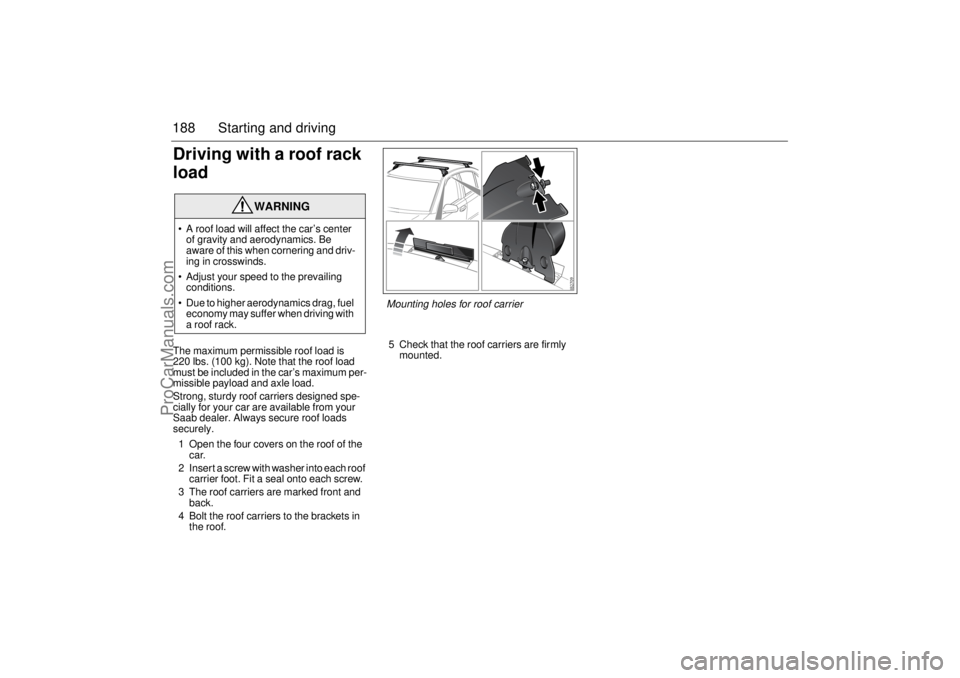
1 Open the four covers on the roof of the
car.
2 Insert a screw with washer into each roof
carrier foot. Fit a seal onto each screw.
3 The roof carriers are marked front and
back.
4 Bolt the roof carriers to the brackets in
the roof.5 Check that the roof carriers are firmly
mounted.
WARNING
A roof load will affect the car’s center
of gravity and aerodynamics. Be
aware of this when cornering and driv-
ing in crosswinds.
Adjust your speed to the prevailing
conditions.
Due to higher aerodynamics drag, fuel
economy may suffer when driving with
a roof rack.
Mounting holes for roof carrier
ProCarManuals.com