spare wheel SAAB 9-3 2005 User Guide
[x] Cancel search | Manufacturer: SAAB, Model Year: 2005, Model line: 9-3, Model: SAAB 9-3 2005Pages: 292, PDF Size: 23 MB
Page 239 of 292

237 Car care
The wheels and tires have been carefully
matched to the characteristics of the car and
play a key role in its outstanding roadhold-
ing and handling.
Do not take it for granted that a wheel/tire
combination will work in the best possible
way, just because it can be fitted to the car.
To ensure that the speedometer is as accu-
rate as possible it should be reprogrammed
if wheels of a different dimension are fitted.
Contact a Saab dealer.
Because of front wheel drive, the front tires
tend to wear faster than the rear ones. New
tires should always be fitted in pairs, so that
tires on the same axle have the same
amount of tread.
Store wheels lying flat or hanging – never
standing upright.
NOTICEAlways consult your Saab dealer before
changing the car’s wheels or tires on your
Saab.
Wide wheels and tires with side walls that
are too low can:
be damaged in potholes, etc.
cause springs, shock absorbers and
wheel bearings and body mountings
to be overloaded.
affect the function of the Electronic
Stability Program (ESP).
The speed and load limits of the tires
must not be exceeded; see page 242.
Wheels larger than 17" must not be fitted
on the Saab 9-3 for reasons above. The
permissible offset is 1.61 inch (41 mm).
WARNING
Mixing tires could cause you to lose
control while driving. If you mix tires of
different sizes or types (radial and bias-
belted tires), the vehicle may not handle
properly, and you could have a crash.
Using tires of different sizes may also
cause damage to your vehicle. Be sure to
use the same size and type tires on all
wheels. It’s all right to drive with your
compact spare temporarily, it was devel-
oped for use on your vehicle. See
“Compact spare” on page 246.
WARNING
If you use bias-ply tires on your vehicle,
the wheel rim flanges could develop
cracks after many miles of driving. A tire
and/or wheel could fail suddenly, causing
a crash. Use only radial-ply tires with the
wheels on your vehicle.
ProCarManuals.com
Page 240 of 292

238 Car careUniform Tire Quality GradingQuality grades can be found where applica-
ble on the tire sidewall between tread shoul-
der and maximum section width. For exam-
ple:
Treadwear 200 Traction AA Temperature
A
The following information relates to the
system developed by the United States
National Highway Traffic Safety Administra-
tion, which grades tires by treadwear, trac-
tion and temperature performance. (This
applies only to vehicles sold in the United
States.) The grades are molded on the side-
walls of most passenger car tires. The Uni-
form Tire Quality Grading system does not
apply to deep tread, winter-type snow tires,
space-saver or temporary use spare tires,
tires with nominal rim diameters of 10 to 12
inches (25 to 30 cm), or to some limited-pro-
duction tires.
While the tires available on General Motors
passenger cars and light trucks may vary
with respect to these grades, they must also
conform to federal safety requirements and
additional General Motors Tire Perfor-
mance Criteria (TPC) standards.Treadwear
The treadwear grade is a comparative
rating based on the wear rate of the tire
when tested under controlled conditions on
a specified government test course. For
example, a tire graded 150 would wear one
and a half (1.5) times as well on the govern-
ment course as a tire graded 100. The rela-
tive performance of tires depends upon the
actual conditions of their use, however, and
may depart significantly from the norm due
to variations in driving habits, service prac-
tices and differences in road characteristics
and climate.
Traction – AA, A, B, C
The traction grades, from highest to lowest,
are AA, A, B, and C. Those grades repre-
sent the tire’s ability to stop on wet pave-
ment as measured under controlled condi-
tions on specified government test surfaces
of asphalt and concrete. A tire marked C
may have poor traction performance. Warn-
ing: The traction grade assigned to this tire
is based on straight-ahead braking traction
tests, and does not include acceleration,
cornering, hydroplaning, or peak traction
characteristics.Temperature – A, B, C
The temperature grades are A (the highest),
B, and C, representing the tire’s resistance
to the generation of heat and its ability to dis-
sipate heat when tested under controlled
conditions on a specified indoor laboratory
test wheel. Sustained high temperature can
cause the material of the tire to degenerate
and reduce tire life, and excessive temper-
ature can lead to sudden tire failure. The
grade C corresponds to a level of perfor-
mance which all passenger car tires must
meet under the Federal Motor Vehicle
Safety Standard No. 109. Grades B and A
represent higher levels of performance on
the laboratory test wheel than the minimum
required by law.
Warning: The temperature grade for this tire
is established for a tire that is properly
inflated and not overloaded. Excessive
speed, underinflation, or excessive loading,
either separately or in combination, can
cause heat buildup and possible tire failure.
ProCarManuals.com
Page 248 of 292
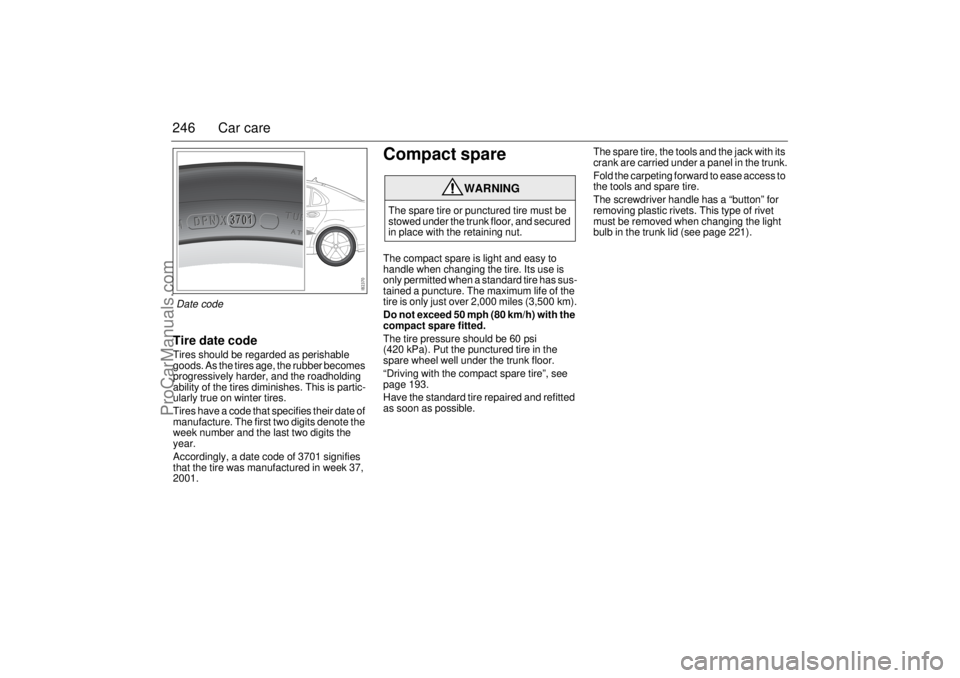
246 Car careTire date codeTires should be regarded as perishable
goods. As the tires age, the rubber becomes
progressively harder, and the roadholding
ability of the tires diminishes. This is partic-
ularly true on winter tires.
Tires have a code that specifies their date of
manufacture. The first two digits denote the
week number and the last two digits the
year.
Accordingly, a date code of 3701 signifies
that the tire was manufactured in week 37,
2001.
Compact spareThe compact spare is light and easy to
handle when changing the tire. Its use is
only permitted when a standard tire has sus-
tained a puncture. The maximum life of the
tire is only just over 2,000 miles (3,500 km).
Do not exceed 50 mph (80 km/h) with the
compact spare fitted.
The tire pressure should be 60 psi
(420 kPa). Put the punctured tire in the
spare wheel well under the trunk floor.
“Driving with the compact spare tire”, see
page 193.
Have the standard tire repaired and refitted
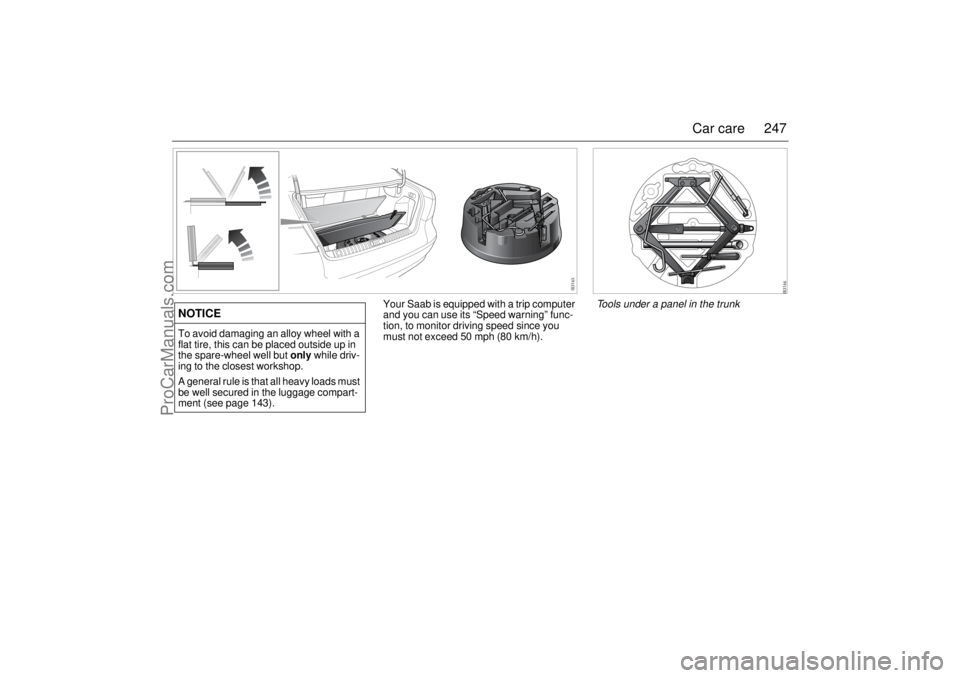
as soon as possible.The spare tire, the tools and the jack with its
crank are carried under a panel in the trunk.
Fold the carpeting forward to ease access to
the tools and spare tire.
The screwdriver handle has a “button” for
removing plastic rivets. This type of rivet
must be removed when changing the light
bulb in the trunk lid (see page 221).
WARNING
The spare tire or punctured tire must be
stowed under the trunk floor, and secured
in place with the retaining nut.
Date code
ProCarManuals.com
Page 249 of 292
247 Car care
Your Saab is equipped with a trip computer
and you can use its “Speed warning” func-
tion, to monitor driving speed since you
must not exceed 50 mph (80 km/h).
NOTICETo avoid damaging an alloy wheel with a
flat tire, this can be placed outside up in
the spare-wheel well but only while driv-
ing to the closest workshop.
A general rule is that all heavy loads must
be well secured in the luggage compart-
ment (see page 143).
Tools under a panel in the trunk
ProCarManuals.com
Page 250 of 292

248 Car careChanging a tire
WARNING
Lifting a vehicle and getting under it to do
maintenance or repairs is dangerous
without the appropriate safety equipment
and training. The jack provided with your
vehicle is designed only for changing a
flat tire. If it is used for anything else, you
or others could be badly injured or killed if
the vehicle slips off the jack. Use the jack
provided with your vehicle only for chang-
ing a flat tire.
Changing a tire can be dangerous. The
vehicle can slip off the jack and roll over
or fall on you or other people. You and
they could be badly injured or even killed.
Find a level place to change your tire. To
help prevent the vehicle from moving:
1 Set the parking brake firmly.
2 If you have an automatic transmis-
sion, put the shift lever in PARK (P).
For a manual transmission, leave the
car in gear (1st or REVERSE (R)).
3 Turn off the engine and do not restart
while the vehicle is raised.
4 Do not allow passengers to remain in
the vehicle.
To be even more certain the vehicle won't
move, you should put blocks at the front
and rear of the tire farthest away from the
one being changed. That would be the
tire, on the other side, at the opposite end
of the vehicle.
The car jack is designed solely for use
in changing a tire or fitting snow
chains. It must not be used to
support the car during repair work
or servicing.
Never crawl under a car that is
supported only by a jack. Always use
axle stands.
Raising your vehicle too high or with
the jack improperly positioned can
damage the vehicle and even make
the vehicle fall. To help avoid personal
injury and vehicle damage, be sure to
fit the jack lift head into the proper
location before raising the vehicle, and
raise the vehicle only far enough off
the ground so there is enough room for
the spare tire to fit (no more than
25 mm or 1 inch clearance between
the ground and the bottom of the tire).
Switch on the hazard warning lights if
the car is on a road.
The jack should be stored correctly
under the carpeting in the trunk. If it
lies loose in the car, it could thrown
forward and cause personal injury in
the event of a crash or if the car rolls
over.
Grit, salt and rust can clog the inner
threads of the wheel bolts if the car has
been driven for several years exclu-
sively with alloy wheels.
If steel wheels are being installed, the
bolt hole threads in the brake hubs
should be cleaned before the thinner
steel wheels are fitted. It may other-
wise not be possible to achieve the
correct clamping force, despite tight-
ening the wheel bolts to the correct
torque.
ProCarManuals.com
Page 270 of 292

268 Technical dataGeneral dataOverall length, including bumpers: ___ 182.5'' (4635 mm)
Overall width, including door mirrors __ 80.2'' (2038 mm)
Maximum height _________________ 57.8'' (1468 mm)
Wheelbase _____________________ 105.3'' (2675 mm)
Tr a c k :
Front ____________________________ 59.8'' (1521 mm)
Rear ____________________________ 59.3'' (1506 mm)
Ground clearance at GVW _________ approx. 120 mm
Number of seats (incl. driver):
Sport Sedan ______________________ 5
Convertible _______________________ 4
Turning circle:
Measured at vehicle extremities _______ 37.4 ft. (11.4 m)
Curb to curb ______________________ 35.4 ft. (10.8 m)
Trunk length:
Rear seat raised ___________________ 40.8'' (1036 mm)
Rear seat lowered__________________ 69.8'' (1774 mm)
Convertible _______________________ 29.1" (740 mm)
Trunk volume (SAE):
Sport Sedan ______________________ 15.0 cu.ft. (425 l)
Convertible, soft top raised ___________ 12.4 cu.ft. (352 l)
Convertible, soft top folded ___________ 8.3 cu.ft. (235 l)
Permissible load (in addition to the driver) = GVW minus curb weight. The maximum
permissible axle load, front or rear, must not be exceeded.
The precise curb weight of the vehicle and load capacity are specified in the vehicle
registration documents.V.I.N. labelCurb weight
(i.e. with full fuel tank, full washer fluid res-
ervoir, standard tools and spare wheel):
Sport Sedan ______________________ 3200–3420 lbs.
(1450–1550 kg)
Convertible _______________________ 3570–3700 lbs.
(1620–1680 kg)
Gross vehicle weight (GVW):
Sport Sedan ______________________ 4120–4340 lbs.
(1870–1970 kg)
Convertible _______________________ 4460–4520 lbs.
(2025–2050 kg)
ProCarManuals.com
Page 277 of 292

275 Technical data
Wheels and tires All season tires
6.5 x 15" _________________________ 205/65 R15 94 H
6.5 x 16" _________________________ 215/55 R16 93 H
7 x 17"___________________________ 225/45 R17 94 V
RF/XL
Summer tires
7 x 17"___________________________ 225/45 R17 94 W
RF/XL
Always contact a Saab dealer if you plan to fit other wheels or
tires than those fitted as standard.
Winter (snow) tires:
6.5 x 15" wheel ____________________ 205/65 R15 91 Q
M+S
6.5 x 16" wheel ____________________ 215/55 R16 93 Q
7 x 17" wheel _____________________ 225/45 R17 94 Q
M+S RF/XL
Compact spare:
Wheel ___________________________ 4 x 16"
Tire _____________________________ 125/85 R16 99 M
Pressure _________________________ 420 kPa (60 psi)
Maximum life______________________ 2200 miles
(3500 km)
Maximum speed ___________________ 50 mph (80 km/h)
NOTICESnow chains:
Snow chains must not be fitted to the rear wheels, and may only
be used with the following wheel-tire combinations:
Wheels Tires
6.5 x 15"_______ 205/65 R15 M+S or
205/65 R15
6.5 x 16"_______ 215/55 R16 M+S or
215/55 R16
Contact your Saab dealer regarding suitable snow chains.
Max. permissible speed with snow chains fitted is 30 mph
(50 km/h).
Snow chains must not be fitted to wheels larger than 16".NOTICEWheels larger than 17" must not be fitted for reasons stated on
page 237.
Exercise care when driving on uneven roads or against the curb
if the car is heavily laden. This particularly applies to cars with
17" wheels.
Permitted wheel offset is 41 mm.
ProCarManuals.com
Page 285 of 292

283 Index
Index
AA/C
__________________________ 106
ABS brakes
____________________ 167
ACC
_________________________ 108
Adjustment, steering wheel
________ 122
Air conditioning
_________________ 106
Air filter
_______________________ 204
Airbag
_________________________ 29
Anchorage eyes
________________ 143
Anti-corrosion treatment
__________ 254
Antilock braking system __________ 167
Anti-spin
______________________ 169
Ashtrays ______________________ 132
Autochecking of lights, warning and
indicator lights
__________________ 82
Autodimming
_______________ 135
, 136
Automatic climate control (ACC)
____ 108
Automatic transmission
___________ 159
BBattery
________________________ 208
Bedding-in of new brake pads
_____ 157
Before towing a trailer
____________ 187
Brake fluid, grade
_______________ 274
Brakes
________________________ 166Braking
_______________________ 166
Bulb changing
__________________ 213
Bulb table
_____________________ 226
Buying new tires
________________ 236
CCabin lighting
__________________ 129
Cabin lighting, Convertible
_________ 72
Car alarm
______________________ 50
Car transport ___________________ 192
Care of air conditioning
___________ 257
Change of address notification
_____ 264
Changing a tire
_________________ 248
Changing bulbs _________________ 213
Changing engine oil
_____________ 203
Changing the battery, remote control
_48
Changing wiper blades
___________ 211
Checking the number of remote
controls
_______________________ 47
Checks before towing a trailer
______ 187
Child safety
_____________________ 22
Child safety locks, rear doors
_______ 46
Child seats
_____________________ 22
Cigarette lighter
_________________ 132
Cleaning the engine bay
__________ 252
Cleaning upholstery
_____________ 251
Climate control system, manual
____ 103
Closing the soft top manually,
Convertible
____________________ 62
Closing the soft top, Convertible
_____ 58Clutch interlock
_________________ 158
Compact spare _________________ 246
Compass
______________________ 139
Condensation water, A/C
_________ 106
Convertible
_____________________ 55
Convertible, washing
_____________ 253
Coolant
_______________________ 205
Crash memory, see EDR
_________ 266
Cruise control
__________________ 165
Cup holder
_____________________ 130
DDate codes, tires
________________ 246
Deep water, driving through
_______ 189
Definitions and terminology, tire ____ 243
Determining correct load, tires
_____ 245
Direction indicator stalk switch ______ 98
Direction indicators
_______________ 98
Dome light, Convertible
___________ 223
Dome light, Sport Sedan __________ 222
Donor battery, boost starting
_______ 193
Door handles
____________________ 42
Door mirrors ___________________ 134
Drive belt
______________________ 210
Drive belt, length
________________ 272
Driver’s seat with memory
__________ 20
Driving at night
_________________ 190
Driving in cold climates
___________ 181
Driving in deep water
_____________ 189
Driving in hot climates ____________ 183
ProCarManuals.com
Page 286 of 292

284 IndexDriving techniques
______________ 179
Driving with a heavy load on hilly
roads
________________________ 161
Driving with a load
_______________ 189
Driving with a roof load
___________ 188
Driving with the compact spare wheel
193
Driving with the trunk lid open
______ 189
EEDR (Event Data Recorders)
______ 266
ESP, anti-skid system
____________ 171
Easy entry, Convertible ____________ 67
Economical motoring
____________ 179
Electric engine heater ____________ 180
Electric heating, front seats
____ 107
, 116
Electric windows
________________ 123
Electric windows, Convertible
_______ 71
Electrical system, technical data ____ 272
Electrically adjustable seats
________ 19
Electronic Stability Program (ESP)
__ 171
Electronic steering wheel lock
______ 148
Emergency opening of the narrow
backrest
_____________________ 144
Emergency operation of the sunroof
_ 128
Engine bay, cleaning
_____________ 252
Engine heater
__________________ 180
Engine immobilizer
_______________ 49
Engine number
_________________ 278
Engine oil, checking
_____________ 202
Engine oil, grade
________________ 270Engine oil, volume
_______________ 271
Engine temperature gauge
_________ 84
Engine, description
______________ 199
Engine, technical data ____________ 270
Engines
_______________________ 271
Event Data Recorders (EDR)
______ 266
Extra electrical socket
____________ 132
FFacilitating entry to rear seat,
Convertible
____________________ 67
Factors affecting fuel consumption
__ 179
Filler cap
______________________ 154
Filling a portable fuel container
_____ 155
Filling up
______________________ 153
Flat spots, tires
_________________ 235
Floor jack
______________________ 249
Folding down the rear seat
________ 140
Front fog lights
__________________ 98
Front towing eye ________________ 190
Fuel container
__________________ 155
Fuel gauge
_____________________ 85
Fuel grade _____________________ 271
Fuel information
________________ 155
Functions, car alarm ______________ 53
Fuse panel in luggage compartment
_230
Fuse table
_____________________ 229
Fuses
________________________ 227
GGDO, garage door opener
_________ 136
Gear selector indicator, automatic trans-
mission
_______________________ 86
Gearbox number
________________ 278
General safety instructions, Convertible
56
Glovebox
______________________ 132
Glovebox lighting
________________ 224
HHandbrake
_____________________ 173
Hazard warning lights
_____________ 99
Head restraint, Convertible
_________ 68
Head restraints
__________________ 21
Headlight flasher _________________ 97
Headlight levelling ________________ 96
Headlights
______________________ 96
Heated door mirrors
_____________ 107
Hood
_________________________ 198
Horn __________________________ 122
Horn button
____________________ 122
IIf a tire goes flat
_________________ 240
Ignition switch
__________________ 146
Immobilizer
_____________________ 49
Important considerations for driving
_ 150
ProCarManuals.com
Page 288 of 292

286 IndexPinch protection, sunroof
_________ 128
Plates and labels, location ________ 278
Polishing and waxing
____________ 253
Poly-V-belt
____________________ 210
Portable fuel container
___________ 155
Position lights
___________________ 96
Power steering fluid, checking
_____ 207
Power steering fluid, grade
________ 273
Pressure gauge
__________________ 84
Pressure, tires __________________ 234
Profiles, customized settings
_______ 87
QQuality grading, tires
_____________ 238
Quick guide, remote control
________ 43
RRain sensor
____________________ 101
Raising the soft top manually,
Convertible ____________________ 62
Reading lights, Convertible
_________ 72
Rear fog light
____________________ 98
Rear seats, folding down
_________ 140
Rear towing eye
________________ 191
Rear window heating
____________ 107
Rearview mirrors
________________ 134
Recirculation
___________________ 106Recommendations for automatic
transmission, towing a trailer
_____ 185
Recommendations for manual
gearbox, towing a trailer
_________ 186
Recommended snow chains _______ 275
Refueling
______________________ 153
Remote control
__________________ 42
Remote locking malfunction
________ 44
Replacement, wheel
_____________ 239
Reporting safety defects __________ 265
Rev counter
_____________________ 82
Reversing lights
__________________ 99
Rollover Pop-up Bars, Convertible
___ 70
Roof lighting
___________________ 129
Roof lighting, changing
___________ 222
Running-in
_____________________ 157
SSAHR, head restraint
_____________ 21
SDM
_________________________ 266
SID
___________________________ 87
SPA __________________________ 176
Saab Information Display
__________ 87
Saab Parking Assistance _________ 176
Saab Trionic engine management
system
_______________________ 200
Safety belts _____________________ 12
Seatbelts
_______________________ 12
Seatbelts in rear seat, Convertible
___ 69
Seatbelts, care
_________________ 251Seatbelts, checking
______________ 251
Seats
__________________________ 17
Securing a load
_________________ 143
Sentronic, manual gear selection
___ 164
Service costs
___________________ 263
Service information
______________ 264
Service intervals
________________ 262
Service record retention
__________ 263
Signalling, horn
_________________ 122
Ski hatch
______________________ 142
Spare wheel ___________________ 246
Speed ratings, tires
______________ 242
Speedometer
____________________ 83
Starting the engine
______________ 148
Steering wheel adjustment
________ 122
Steering wheel lock
______________ 148
Steps for determining correct load
limit
_________________________ 245
Storage compartments
___________ 132
Sun visor
______________________ 130
Sunroof
_______________________ 126
Switches _______________________ 96
TTCS
__________________________ 169
Technical data
__________________ 268
Textile carpeting, cleaning
_________ 252
Tie down eyes
__________________ 143
Tightening torque, wheels
_________ 250
ProCarManuals.com