tire pressure SAAB 9-3 2005 User Guide
[x] Cancel search | Manufacturer: SAAB, Model Year: 2005, Model line: 9-3, Model: SAAB 9-3 2005Pages: 292, PDF Size: 23 MB
Page 243 of 292

241 Car care
Tire Sidewall LabelingUseful information about a tire is molded
into it´s sidewall.
Tire size: The tire size ia a combination of
letters and numbers used to define a partic-
ular tire´s width, height, aspect ratio, con-
struction type and service description.
Department of Transportation (DOT):
The Department of Transportation (DOT)
code indicates that the tire is in compliance
with the U.S. Department of Transportation
Motor Vehicle Safety standards.
Tire Identification Number (TIN): The let-
ters and numbers following DOT code are
the Tire Identification Number (TIN). The
TIN shows the manufacturer and plant
code, tire size, and date the tire was manu-
factured. The TIN is molded onto both sides
of the tire.
Tire Ply Material: The type of cord and
number of plies in the sidewall and under
the tread.Uniform Tire Quality Grading (UTQG):
Tire manufacturers are required to grade
tires based on the performance factors:
treadwear, traction and temperature resis-
tance. For more information see “Uniform
Tire Quality Grading” on page 238.
Maximum Cold Inflation Load Limit: Max-
imum load that can be carried and the max-
imum pressure needed to support that load.
For information on recommended tire pres-
sure see “Recommended lowest tire pres-
sure, cold tires” on page 277 and “Loading
Your Vehicle” on page 243.
Tire SizeThe following illustration shows an example
of a typical passenger car tire size.
Tire Width: The three-digit number indi-
cates the tire section width in millimeters
from sidewall to sidewall.215/55 R 16 93 H
||||||
abcdef
aTire Width
b Aspect Ratio
c Belt Rating
d Rim diameter
e Load range
f Speed rating
ProCarManuals.com
Page 245 of 292
243 Car care
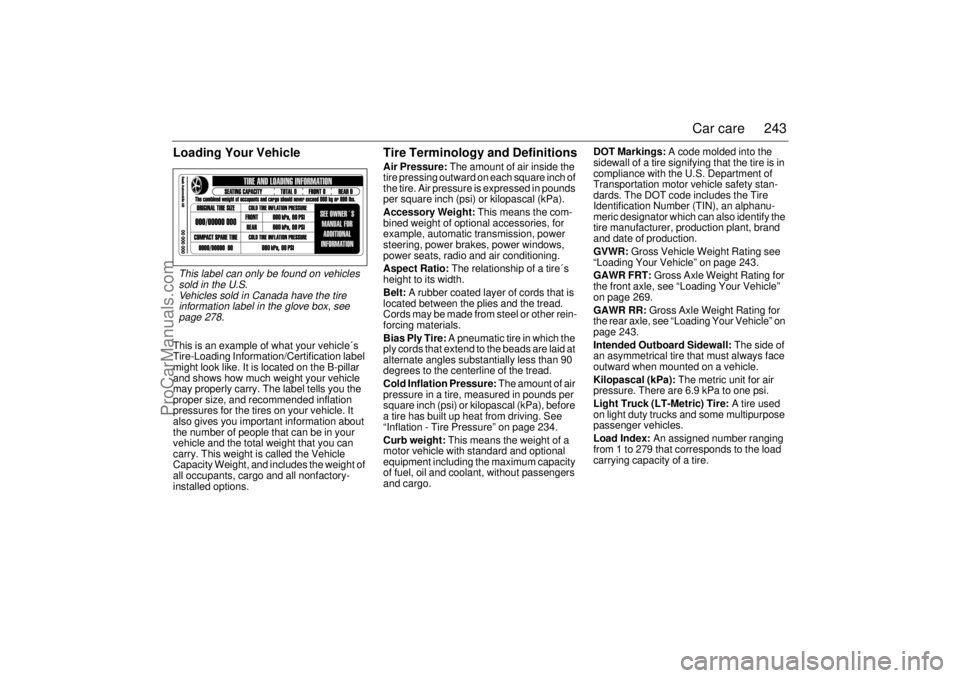
Loading Your VehicleThis is an example of what your vehicle´s
Tire-Loading Information/Certification label
might look like. It is located on the B-pillar
and shows how much weight your vehicle
may properly carry. The label tells you the
proper size, and recommended inflation
pressures for the tires on your vehicle. It
also gives you important information about
the number of people that can be in your
vehicle and the total weight that you can
carry. This weight is called the Vehicle
Capacity Weight, and includes the weight of
all occupants, cargo and all nonfactory-
installed options.
Tire Terminology and DefinitionsAir Pressure: The amount of air inside the
tire pressing outward on each square inch of
the tire. Air pressure is expressed in pounds
per square inch (psi) or kilopascal (kPa).
Accessory Weight: This means the com-
bined weight of optional accessories, for
example, automatic transmission, power
steering, power brakes, power windows,
power seats, radio and air conditioning.
Aspect Ratio: The relationship of a tire´s
height to its width.
Belt: A rubber coated layer of cords that is
located between the plies and the tread.
Cords may be made from steel or other rein-
forcing materials.
Bias Ply Tire: A pneumatic tire in which the
ply cords that extend to the beads are laid at
alternate angles substantially less than 90
degrees to the centerline of the tread.
Cold Inflation Pressure: The amount of air
pressure in a tire, measured in pounds per
square inch (psi) or kilopascal (kPa), before
a tire has built up heat from driving. See
“Inflation - Tire Pressure” on page 234.
Curb weight: This means the weight of a
motor vehicle with standard and optional
equipment including the maximum capacity
of fuel, oil and coolant, without passengers
and cargo.DOT Markings: A code molded into the
sidewall of a tire signifying that the tire is in
compliance with the U.S. Department of
Transportation motor vehicle safety stan-
dards. The DOT code includes the Tire
Identification Number (TIN), an alphanu-
meric designator which can also identify the
tire manufacturer, production plant, brand
and date of production.
GVWR: Gross Vehicle Weight Rating see
“Loading Your Vehicle” on page 243.
GAWR FRT: Gross Axle Weight Rating for
the front axle, see “Loading Your Vehicle”
on page 269.
GAWR RR: Gross Axle Weight Rating for
the rear axle, see “Loading Your Vehicle” on
page 243.
Intended Outboard Sidewall: The side of
an asymmetrical tire that must always face
outward when mounted on a vehicle.
Kilopascal (kPa): The metric unit for air
pressure. There are 6.9 kPa to one psi.
Light Truck (LT-Metric) Tire: A tire used
on light duty trucks and some multipurpose
passenger vehicles.
Load Index: An assigned number ranging
from 1 to 279 that corresponds to the load
carrying capacity of a tire.
This label can only be found on vehicles
sold in the U.S.
Vehicles sold in Canada have the tire
information label in the glove box, see
page 278.
ProCarManuals.com
Page 246 of 292

244 Car careMaximum Load rating: The load rating for
a tire at the maximum permissible inflation
pressure for that tire.
Maximum Loaded Vehicle Weight: The
sum of curb weight; accessory weight; vehi-
cle capacity weight; and production options
weight.
Maximum Permissible Inflation Pres-
sure: The maximum cold inflation pressure
to which a tire may be inflated.
Normal occupant weight: The number of
occupants a vehicle is designed to seat mul-
tipled by 150 pounds (68 kg). See “Loading
Your Vehicle” on page 243.
Occupant Distribution: Designated seat-
ing positions.
Outward Facing Sidewall: The side of a
asymmetrical tire that has a particular side
that faces outward when mounted on a vehi-
cle. The side of the tire that contains a white-
wall bears white lettering or bears manufac-
turer, brand and or model name molding on
the other sidewall of the tire.
Passenger (P-Metric) Tire: A tire used on
passenger cars and some light duty trucks
and multipurpose vehicles.Recommended Inflation Pressure: Vehi-
cle manufacturer´s recommended tire infla-
tion pressure shown on the tire placard, see
“Inflation - Tire Pressure” on page 234 and
“Loading Your Vehicle” on page 243.
Radial Ply Tire: A pneumatic tire in which
the ply cords that extend to the beads are
laid at substantially 90 degrees to the cen-
terline of the tread.
Rim: A metal support for a tire or a tire and
tube assembly upon which the tire beads
are seated.
Sidewall: The portion of a tire between the
tread and the bead.
Speed rating: An alphanumeric code
assigned to a tire indicating the maximum
speed at which a tire can operate.
Traction: The friction between the tire and
the road surface. The amount of grip pro-
vided.
Treadwear Indicators: Narrow bands,
sometimes called “wear bars”, that show
across the tread of a tire when only
2/32 inch of tread remains. See “When It Is
Time for New Tires” on page 236.Tread Width: The width of the tire´s tread.
UTQGS: Uniform Tire Quality Grade Stan-
dards, a tire information system that pro-
vides consumers with ratings for a tire´s
traction, temperature and treadwear. Rat-
ings are determined by tire manufacturers
using government testing procedures. The
rating are molded into the sidewall of the
tire. See “Uniform Tire Quality Grading” on
page 238.
Vehicle Capacity Weight: Is the number of
designated seating positions multipled by
150 pounds (68 kg) plus the rated cargo
load. See “Loading Your Vehicle” on
page 243.
Vehicle Maximum Load on the Tire: Load
on an individual tire due to curb weight,
accessory weight, occupant weight and
cargo weight.
Vehicle Placard: A label permanently
attached to a vehicle showing original
equipment tire size and the recommended
cold inflation pressure. See “Loading Your
Vehicle” on page 243.
ProCarManuals.com
Page 248 of 292
246 Car careTire date codeTires should be regarded as perishable
goods. As the tires age, the rubber becomes
progressively harder, and the roadholding
ability of the tires diminishes. This is partic-
ularly true on winter tires.
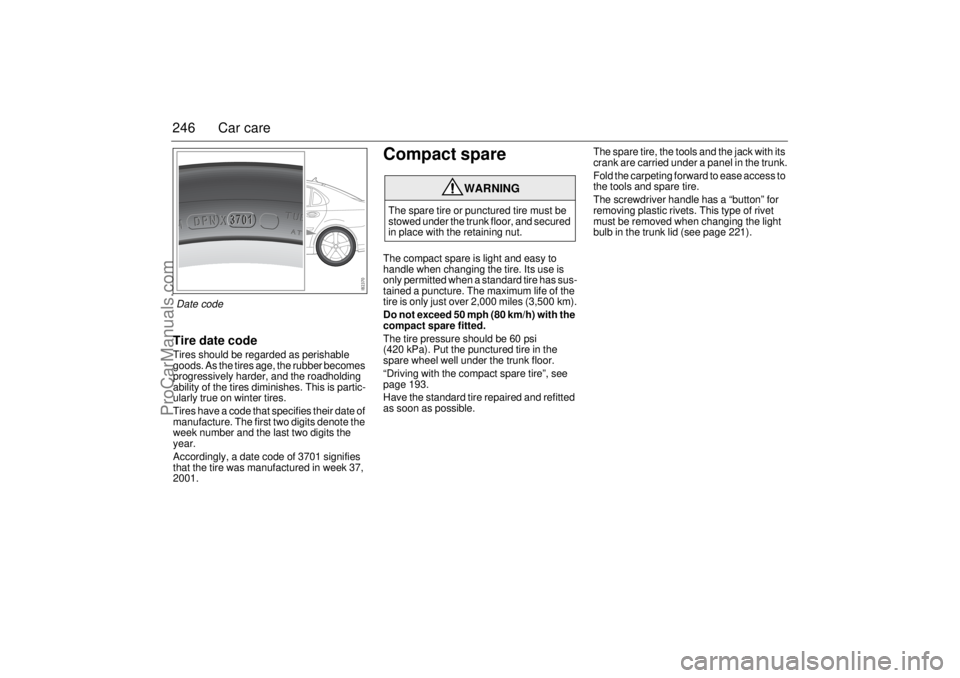
Tires have a code that specifies their date of
manufacture. The first two digits denote the
week number and the last two digits the
year.
Accordingly, a date code of 3701 signifies
that the tire was manufactured in week 37,
2001.
Compact spareThe compact spare is light and easy to
handle when changing the tire. Its use is
only permitted when a standard tire has sus-
tained a puncture. The maximum life of the
tire is only just over 2,000 miles (3,500 km).
Do not exceed 50 mph (80 km/h) with the
compact spare fitted.
The tire pressure should be 60 psi
(420 kPa). Put the punctured tire in the
spare wheel well under the trunk floor.
“Driving with the compact spare tire”, see
page 193.
Have the standard tire repaired and refitted
as soon as possible.The spare tire, the tools and the jack with its
crank are carried under a panel in the trunk.
Fold the carpeting forward to ease access to
the tools and spare tire.
The screwdriver handle has a “button” for
removing plastic rivets. This type of rivet
must be removed when changing the light
bulb in the trunk lid (see page 221).
WARNING
The spare tire or punctured tire must be
stowed under the trunk floor, and secured
in place with the retaining nut.
Date code
ProCarManuals.com
Page 260 of 292

258 Car careNote:
The A/C system cannot be switched on
when the outside temperature is below 32°F
(0°C). Turn on the A/C system when the car
is standing in a warm place. Simplest is to
always have the A/C button pressed in. The
A/C system will then cut in automatically
when the outside temperature is high
enough.
Headlight aimingThe vehicle has a visual optical headlight
aiming system equipped with vertical
aiming device. The aim has been preset at
the factory and should normally not need
further adjustments.
If your headlights are damaged in a crash,
the headlight aim may be affected. If you
believe your headlights need to be re-
aimed, we recommend that you take it to
your Saab dealer for service. However, it is
possible for you to re-aim your headlights as
described in the following procedure.To check the aim, the vehicle should be
properly prepared as follows:
The vehicle shall be placed so that the
headlights are 25 ft (7.6 m) from a light
colored wall or other flat surface. The
aiming area should be darkened, this will
improve your ability to see the beam of the
low beam headlight being aimed.
An optical headlamp aimer can also be
used and will than replace the wall.
The vehicle must have all four wheels on
a perfectly level surface which is level all
the way to the wall or other flat surface.
The vehicle should be placed so it is per-
pendicular to the wall or other flat surface.
The vehicle should be unloaded and fuel
tank full, and one person or 160 lbs.
(75 kg) on the drivers seat.
The vehicle should be fully assembled
and all other work stopped while headlight
aiming is being done.
The vehicle should not have any snow, ice
or mud attached to it.
Tires should be inflated to the prescribed
pressure.
Close all doors.
Rock the vehicle to stabilize the suspen-
sion.
Headlight aiming is done with the vehicle
low beam lamps. The high beam lamps will
be correctly aimed if the low beam lamps
are aimed properly.
If you find that the headlight needs adjust-
ment follow these steps:
WARNING
Before checking/adjusting the headlight
aiming, switch off the engine to avoid
danger of fingers and hands being injured
by moving parts.
The radiator fan can start up even when
the engine is switched off.NOTICETo make sure that your headlights are
aimed properly read all instructions
before beginning. Failure to follow these
instructions could cause damage to
headlight parts or a not correctly aimed
headlight.
ProCarManuals.com
Page 271 of 292

269 Technical data
Maximum axle load:
Sport Sedan, front _________________ 2480 lbs. (1125 kg)
Sport Sedan, rear __________________ 2230 lbs. (1010 kg)
Convertible, front __________________ 2540 lbs. (1150 kg)
Convertible, rear ___________________ 2310 lbs. (1050 kg)
Weight distribution:
Curb weight + driver (150 lbs. (68 kg)),
front/rear (Sport Sedan and Convertible) approx. 60/40 %
GVW, front/rear (Sport Sedan and Con-
vertible) __________________________ approx. 50/50 %
Maximum roof load, Sport Sedan ____ 220 lbs. (100 kg)
Maximum load in trunk:
Sport Sedan ______________________ 175 lbs. (80 kg)
Convertible _______________________ 220 lbs. (100 kg)
The combined weight of occupants and
cargo should never exceed:
Sport Sedan ______________________ 925 lbs. (420 kg)
Convertible _______________________ 820 lbs. (372 kg)
Maximum combined weight of driver and
passengers ___________________
Sport Sedan (5x150 lbs.) ____________ 750 lbs. (340 kg)
Convertible (4x150 lbs.) _____________ 600 lbs. (272 kg)
WARNING
The GVW and maximum axle loads must not be exceeded.
Note that if some accessories (e.g. towbar, CD changer) are
fitted, the available load capacity is reduced by the weight of
these.
When carrying a load in the trunk, make sure that it is lashed
down securely, particularly when part or all of the rear seat is
folded down.
Trailer:
Trailer with brakes ________________ Max. 3500 lbs.
(1588 kg)
Trailer without brakes _____________ Max. 1000 lbs.
(450 kg)
Recommended towball load ________ 110–165 lbs.
(50–75 kg)
See also page 186.
Maximum theoretical towing speed, trailer
with brakes ____________________ 60 mph (100 km/h)
When towing a trailer, increase the pressure
of the rear tires by 20 kPa (3 psi).
The above speed and weight restrictions are those specified by
Saab Automobile AB.
Note that national restrictions may apply to trailer speeds and
weights (see page 184).
ProCarManuals.com
Page 277 of 292

275 Technical data
Wheels and tires All season tires
6.5 x 15" _________________________ 205/65 R15 94 H
6.5 x 16" _________________________ 215/55 R16 93 H
7 x 17"___________________________ 225/45 R17 94 V
RF/XL
Summer tires
7 x 17"___________________________ 225/45 R17 94 W
RF/XL
Always contact a Saab dealer if you plan to fit other wheels or
tires than those fitted as standard.
Winter (snow) tires:
6.5 x 15" wheel ____________________ 205/65 R15 91 Q
M+S
6.5 x 16" wheel ____________________ 215/55 R16 93 Q
7 x 17" wheel _____________________ 225/45 R17 94 Q
M+S RF/XL
Compact spare:
Wheel ___________________________ 4 x 16"
Tire _____________________________ 125/85 R16 99 M
Pressure _________________________ 420 kPa (60 psi)
Maximum life______________________ 2200 miles
(3500 km)
Maximum speed ___________________ 50 mph (80 km/h)
NOTICESnow chains:
Snow chains must not be fitted to the rear wheels, and may only
be used with the following wheel-tire combinations:
Wheels Tires
6.5 x 15"_______ 205/65 R15 M+S or
205/65 R15
6.5 x 16"_______ 215/55 R16 M+S or
215/55 R16
Contact your Saab dealer regarding suitable snow chains.
Max. permissible speed with snow chains fitted is 30 mph
(50 km/h).
Snow chains must not be fitted to wheels larger than 16".NOTICEWheels larger than 17" must not be fitted for reasons stated on
page 237.
Exercise care when driving on uneven roads or against the curb
if the car is heavily laden. This particularly applies to cars with
17" wheels.
Permitted wheel offset is 41 mm.
ProCarManuals.com
Page 279 of 292

277 Technical data
Recommended lowest tire pressure, cold tires
Tire size Load/speed
mph (km/h)
*
Front
kPa/psiRear
kPa/psi
All season tires
205/65 R15 94 H 1–3 pers./0–100 (0–160)
4–5 pers./0–100 (0–160)
1–5 pers./100– (160–)220/32
220/32
260/38220/32
220/32
260/38
215/55 R16 93 H 1–3 pers./0–100 (0–160)
4–5 pers./0–100 (0–160)
1–5 pers./100– (160–)240/35
240/35
280/41220/32
220/32
260/38
225/45 R17 94 V
RF/XL1–3 pers./0–100 (0–160)
4–5 pers./0–100 (0–160)
1–5 pers./100– (160–)240/35
240/35
280/41240/35
240/35
280/41
Summer tires
225/45 R17 94 W
RF/XL1–3 pers./0–120 (0–190)
4–5 pers./0–120 (0–190)
1–5 pers./120– (190–)240/35
240/35
280/41240/35
240/35
280/41
Winter tires
205/65 R15 91 Q 1–3 pers./0–100 (0–160)
4–5 pers./0–100 (0–160)240/35
280/41240/35
280/41
215/55 R16 93 Q 1–3 pers./0–100 (0–160)
4–5 pers./0–100 (0–160)240/35
280/41240/35
280/41
225/45 R17 94 Q
RF/XL1–3 pers./0–100 (0–160)
4–5 pers./0–100 (0–160)250/36
290/42250/36
290/42
Compact spare
125/85 R16 99 M Max 50 (80) 420/60 420/60
* Do not exceed posted speed limits.
By cold tires is meant tires that are the same temperature as the sur-
rounding air temperature.
The values for tire pressure in table above are for tires at 68°F
(20°C).
The tire pressure will increase as the tires become warm (e.g. during
highway driving), and decrease as they cool.
When the temperature of the tires increases or decreases by 10
degrees the tire pressure will correspondingly increase or decrease
by 2 psi/10 kPa.
ProCarManuals.com
Page 280 of 292
278 Technical dataPlates and labelsWhen contacting your Saab dealer it may
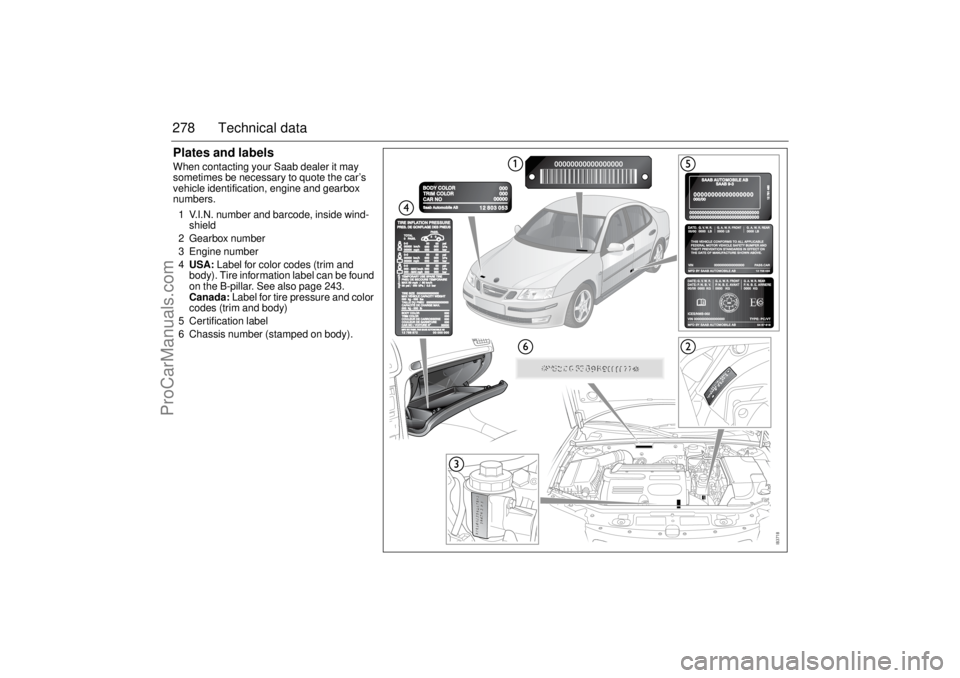
sometimes be necessary to quote the car’s
vehicle identification, engine and gearbox
numbers.
1 V.I.N. number and barcode, inside wind-
shield
2 Gearbox number
3 Engine number
4USA: Label for color codes (trim and
body). Tire information label can be found
on the B-pillar. See also page 243.
Canada: Label for tire pressure and color
codes (trim and body)
5 Certification label
6 Chassis number (stamped on body).
ProCarManuals.com
Page 288 of 292

286 IndexPinch protection, sunroof
_________ 128
Plates and labels, location ________ 278
Polishing and waxing
____________ 253
Poly-V-belt
____________________ 210
Portable fuel container
___________ 155
Position lights
___________________ 96
Power steering fluid, checking
_____ 207
Power steering fluid, grade
________ 273
Pressure gauge
__________________ 84
Pressure, tires __________________ 234
Profiles, customized settings
_______ 87
QQuality grading, tires
_____________ 238
Quick guide, remote control
________ 43
RRain sensor
____________________ 101
Raising the soft top manually,
Convertible ____________________ 62
Reading lights, Convertible
_________ 72
Rear fog light
____________________ 98
Rear seats, folding down
_________ 140
Rear towing eye
________________ 191
Rear window heating
____________ 107
Rearview mirrors
________________ 134
Recirculation
___________________ 106Recommendations for automatic
transmission, towing a trailer
_____ 185
Recommendations for manual
gearbox, towing a trailer
_________ 186
Recommended snow chains _______ 275
Refueling
______________________ 153
Remote control
__________________ 42
Remote locking malfunction
________ 44
Replacement, wheel
_____________ 239
Reporting safety defects __________ 265
Rev counter
_____________________ 82
Reversing lights
__________________ 99
Rollover Pop-up Bars, Convertible
___ 70
Roof lighting
___________________ 129
Roof lighting, changing
___________ 222
Running-in
_____________________ 157
SSAHR, head restraint
_____________ 21
SDM
_________________________ 266
SID
___________________________ 87
SPA __________________________ 176
Saab Information Display
__________ 87
Saab Parking Assistance _________ 176
Saab Trionic engine management
system
_______________________ 200
Safety belts _____________________ 12
Seatbelts
_______________________ 12
Seatbelts in rear seat, Convertible
___ 69
Seatbelts, care
_________________ 251Seatbelts, checking
______________ 251
Seats
__________________________ 17
Securing a load
_________________ 143
Sentronic, manual gear selection
___ 164
Service costs
___________________ 263
Service information
______________ 264
Service intervals
________________ 262
Service record retention
__________ 263
Signalling, horn
_________________ 122
Ski hatch
______________________ 142
Spare wheel ___________________ 246
Speed ratings, tires
______________ 242
Speedometer
____________________ 83
Starting the engine
______________ 148
Steering wheel adjustment
________ 122
Steering wheel lock
______________ 148
Steps for determining correct load
limit
_________________________ 245
Storage compartments
___________ 132
Sun visor
______________________ 130
Sunroof
_______________________ 126
Switches _______________________ 96
TTCS
__________________________ 169
Technical data
__________________ 268
Textile carpeting, cleaning
_________ 252
Tie down eyes
__________________ 143
Tightening torque, wheels
_________ 250
ProCarManuals.com