lights SAAB 9-3 2005 Service Manual
[x] Cancel search | Manufacturer: SAAB, Model Year: 2005, Model line: 9-3, Model: SAAB 9-3 2005Pages: 292, PDF Size: 23 MB
Page 233 of 292
231 Car care
26 30 Right-hand stop light; rear left turn signal; left taillight;
rear fog light; left reversing light; license plate light-
ing; trunk lighting; trailer lights
27 10Convertible: Lumbar support, electrically adjustable
front seat
28 - -
29 - -
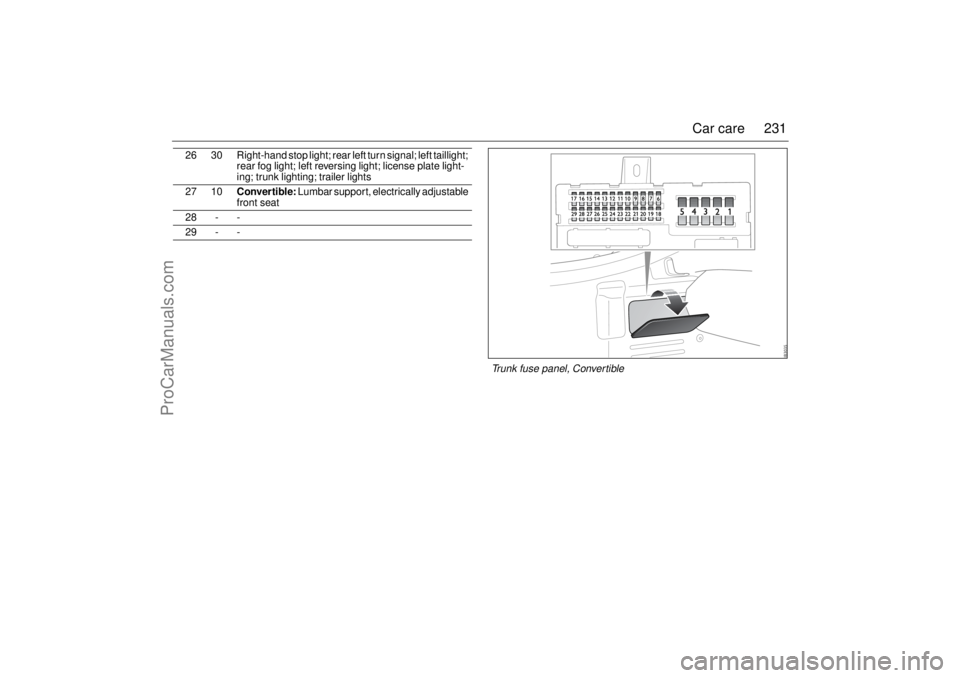
Trunk fuse panel, Convertible
ProCarManuals.com
Page 234 of 292
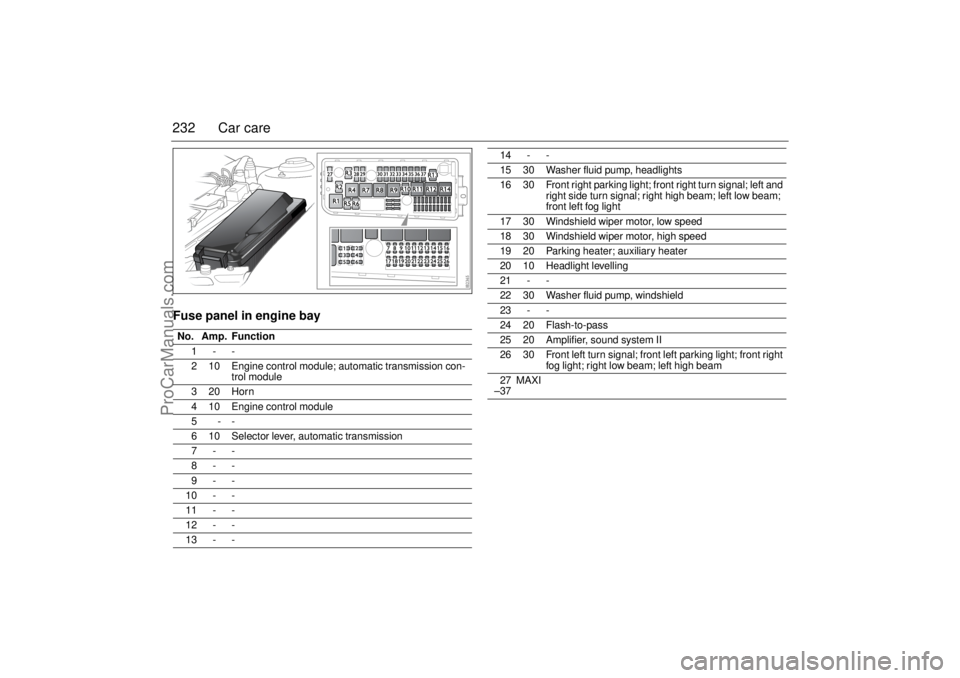
232 Car careFuse panel in engine bayNo. Amp. Function
1--
2 10 Engine control module; automatic transmission con-
trol module
320Horn
4 10 Engine control module
5--
6 10 Selector lever, automatic transmission
7--
8--
9--
10 - -
11 - -
12 - -
13 - -
14 - -
15 30 Washer fluid pump, headlights
16 30 Front right parking light; front right turn signal; left and
right side turn signal; right high beam; left low beam;
front left fog light
17 30 Windshield wiper motor, low speed
18 30 Windshield wiper motor, high speed
19 20 Parking heater; auxiliary heater
20 10 Headlight levelling
21 - -
22 30 Washer fluid pump, windshield
23 - -
24 20 Flash-to-pass
25 20 Amplifier, sound system II
26 30 Front left turn signal; front left parking light; front right
fog light; right low beam; left high beam
27
–37MAXI
ProCarManuals.com
Page 235 of 292
233 Car care
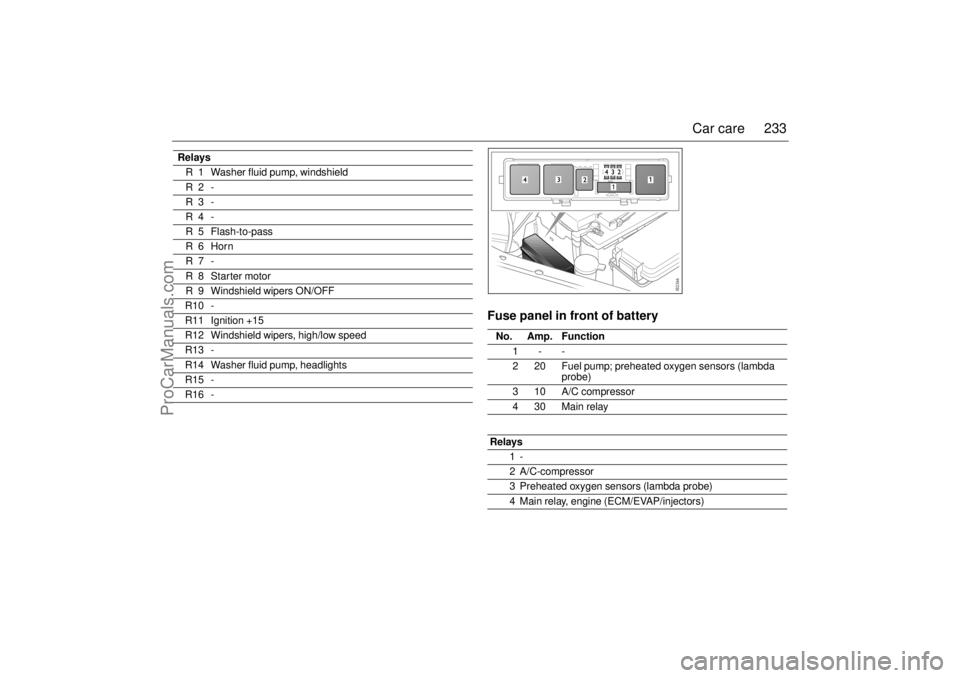
Fuse panel in front of battery
Relays
R 1 Washer fluid pump, windshield
R2 -
R3 -
R4 -
R 5 Flash-to-pass
R6 Horn
R7 -
R8 Starter motor
R 9 Windshield wipers ON/OFF
R10 -
R11 Ignition +15
R12 Windshield wipers, high/low speed
R13 -
R14 Washer fluid pump, headlights
R15 -
R16 -
No. Amp. Function
1--
2 20 Fuel pump; preheated oxygen sensors (lambda
probe)
310A/C compressor
430Main relay
Relays
1-
2 A/C-compressor
3 Preheated oxygen sensors (lambda probe)
4 Main relay, engine (ECM/EVAP/injectors)
ProCarManuals.com
Page 250 of 292

248 Car careChanging a tire
WARNING
Lifting a vehicle and getting under it to do
maintenance or repairs is dangerous
without the appropriate safety equipment
and training. The jack provided with your
vehicle is designed only for changing a
flat tire. If it is used for anything else, you
or others could be badly injured or killed if
the vehicle slips off the jack. Use the jack
provided with your vehicle only for chang-
ing a flat tire.
Changing a tire can be dangerous. The
vehicle can slip off the jack and roll over
or fall on you or other people. You and
they could be badly injured or even killed.
Find a level place to change your tire. To
help prevent the vehicle from moving:
1 Set the parking brake firmly.
2 If you have an automatic transmis-
sion, put the shift lever in PARK (P).
For a manual transmission, leave the
car in gear (1st or REVERSE (R)).
3 Turn off the engine and do not restart
while the vehicle is raised.
4 Do not allow passengers to remain in
the vehicle.
To be even more certain the vehicle won't
move, you should put blocks at the front
and rear of the tire farthest away from the
one being changed. That would be the
tire, on the other side, at the opposite end
of the vehicle.
The car jack is designed solely for use
in changing a tire or fitting snow
chains. It must not be used to
support the car during repair work
or servicing.
Never crawl under a car that is
supported only by a jack. Always use
axle stands.
Raising your vehicle too high or with
the jack improperly positioned can
damage the vehicle and even make
the vehicle fall. To help avoid personal
injury and vehicle damage, be sure to
fit the jack lift head into the proper
location before raising the vehicle, and
raise the vehicle only far enough off
the ground so there is enough room for
the spare tire to fit (no more than
25 mm or 1 inch clearance between
the ground and the bottom of the tire).
Switch on the hazard warning lights if
the car is on a road.
The jack should be stored correctly
under the carpeting in the trunk. If it
lies loose in the car, it could thrown
forward and cause personal injury in
the event of a crash or if the car rolls
over.
Grit, salt and rust can clog the inner
threads of the wheel bolts if the car has
been driven for several years exclu-
sively with alloy wheels.
If steel wheels are being installed, the
bolt hole threads in the brake hubs
should be cleaned before the thinner
steel wheels are fitted. It may other-
wise not be possible to achieve the
correct clamping force, despite tight-
ening the wheel bolts to the correct
torque.
ProCarManuals.com
Page 254 of 292

252 Car carevery warm, dry climates the leather may
need more regular reconditioning. Use con-
ventional leather care products. Follow the
instructions on the packaging.
Do not use unknown harsh polishing
agents, cleaning agents, sprays, coarse
soap or hot water.Textile carpetingTextile carpeting should be vacuum
cleaned regularly. Carpeting can also be
cleaned using a brush or sponge and carpet
shampoo.
For safety reasons, vacuum cleaners that
are not earthed (grounded) must not be
used out of doors.
Engine bayThe engine bay should be cleaned with an
engine decreasing and rinsed with hot
water. The headlights must be covered
over. Do not use a pressure washer. Avoid
spraying electrical components and con-
nectors.
Do not use petrol as a cleaning agent or sol-
vent when carrying out repairs or mainte-
nance. Saab recommends the use of envi-
ronmentally-friendly decrescendos.WashingThe bodywork must be washed frequently.
When the car is new, the body should be
washed by hand using plain cold water and
a clean, soft brush through which the water
flows. Automatic caresses should be
avoided when the car is new.
After 5–6 months the paintwork will have
hardened. To facilitate cleaning, a suitable
detergent can be added to the water, which
should be lukewarm.
Remove any bird droppings without delay,
as these can discolor the paintwork and
prove difficult to polish out. Lay a wad of wet
paper on the patch of dirt and leave it for a
minute or so. It will then be easy to wash off
the dirt.
Use a soft cloth moistened with white spirit
to remove splashes of tar or asphalt. Do not
use strong cleaners, as these can dry out
the paintwork.The underside of the car also needs wash-
ing regularly, and this should be done extra
thoroughly at the end of winter. Clean the
underside of the car by hand if the car is usu-
ally washed in an automatic car wash with-
out special facilities for underbody cleaning.
Never wash or leave the car to dry in the
sun, but wipe it dry with a chamois leather
immediately after washing to avoid smears
and streaks.
Clean the inside of window glass using a
proprietary window cleaner. This is particu-
larly important when the car is new, as
upholstery and trim have a tendency to
sweat a little at first.
Keep the glass well polished, as this helps
to prevent misting.
Clean the outside of the windows with Saab
washer fluid. This is especially important if
the car has been washed in an automatic
car wash, as sometimes a wax treatment is
used that can contaminate the windshield
and impair the performance of the wipers.
NOTICEDo not use alcohol-based cleaners on the
plastic lenses of the front or rear lights, as
these can cause a crackling effect on the
lenses.
The door mirrors should be folded in
before the car enters an automatic car
wash.
ProCarManuals.com
Page 260 of 292

258 Car careNote:
The A/C system cannot be switched on
when the outside temperature is below 32°F
(0°C). Turn on the A/C system when the car
is standing in a warm place. Simplest is to
always have the A/C button pressed in. The
A/C system will then cut in automatically
when the outside temperature is high
enough.
Headlight aimingThe vehicle has a visual optical headlight
aiming system equipped with vertical
aiming device. The aim has been preset at
the factory and should normally not need
further adjustments.
If your headlights are damaged in a crash,
the headlight aim may be affected. If you
believe your headlights need to be re-
aimed, we recommend that you take it to
your Saab dealer for service. However, it is
possible for you to re-aim your headlights as
described in the following procedure.To check the aim, the vehicle should be
properly prepared as follows:
The vehicle shall be placed so that the
headlights are 25 ft (7.6 m) from a light
colored wall or other flat surface. The
aiming area should be darkened, this will
improve your ability to see the beam of the
low beam headlight being aimed.
An optical headlamp aimer can also be
used and will than replace the wall.
The vehicle must have all four wheels on
a perfectly level surface which is level all
the way to the wall or other flat surface.
The vehicle should be placed so it is per-
pendicular to the wall or other flat surface.
The vehicle should be unloaded and fuel
tank full, and one person or 160 lbs.
(75 kg) on the drivers seat.
The vehicle should be fully assembled
and all other work stopped while headlight
aiming is being done.
The vehicle should not have any snow, ice
or mud attached to it.
Tires should be inflated to the prescribed
pressure.
Close all doors.
Rock the vehicle to stabilize the suspen-
sion.
Headlight aiming is done with the vehicle
low beam lamps. The high beam lamps will
be correctly aimed if the low beam lamps
are aimed properly.
If you find that the headlight needs adjust-
ment follow these steps:
WARNING
Before checking/adjusting the headlight
aiming, switch off the engine to avoid
danger of fingers and hands being injured
by moving parts.
The radiator fan can start up even when
the engine is switched off.NOTICETo make sure that your headlights are
aimed properly read all instructions
before beginning. Failure to follow these
instructions could cause damage to
headlight parts or a not correctly aimed
headlight.
ProCarManuals.com
Page 261 of 292
259 Car care
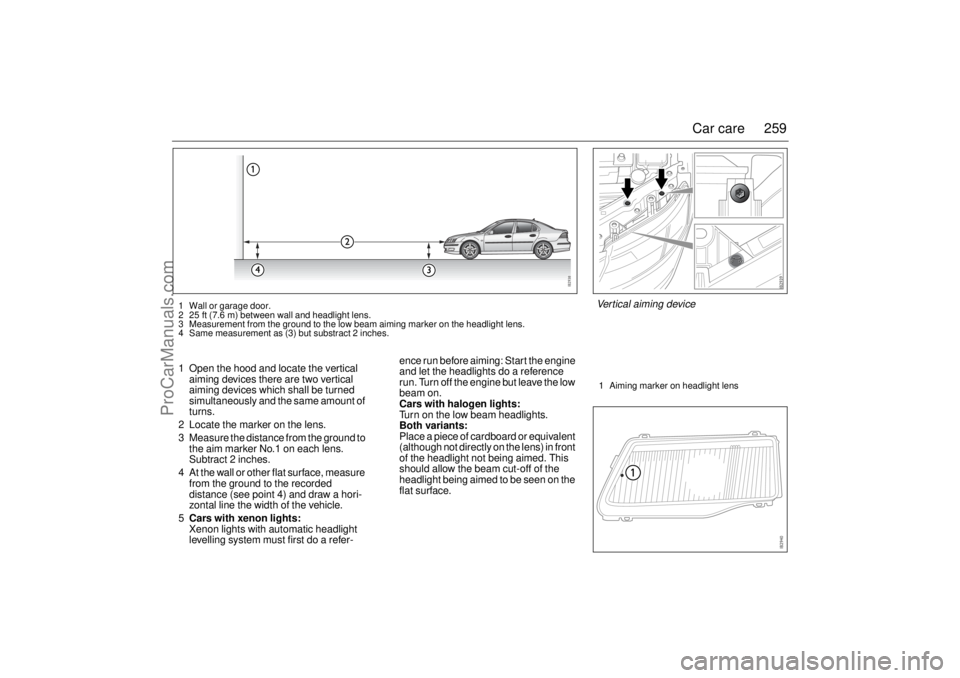
1 Open the hood and locate the vertical
aiming devices there are two vertical
aiming devices which shall be turned
simultaneously and the same amount of
turns.
2 Locate the marker on the lens.
3 Measure the distance from the ground to
the aim marker No.1 on each lens.
Subtract 2 inches.
4 At the wall or other flat surface, measure
from the ground to the recorded
distance (see point 4) and draw a hori-
zontal line the width of the vehicle.
5Cars with xenon lights:
Xenon lights with automatic headlight
levelling system must first do a refer-ence run before aiming: Start the engine
and let the headlights do a reference
run. Turn off the engine but leave the low
beam on.
Cars with halogen lights:
Turn on the low beam headlights.
Both variants:
Place a piece of cardboard or equivalent
(although not directly on the lens) in front
of the headlight not being aimed. This
should allow the beam cut-off of the
headlight being aimed to be seen on the
flat surface.1 Wall or garage door.
2 25 ft (7.6 m) between wall and headlight lens.
3 Measurement from the ground to the low beam aiming marker on the headlight lens.
4 Same measurement as (3) but substract 2 inches.
Vertical aiming device1 Aiming marker on headlight lens
ProCarManuals.com
Page 282 of 292

280 Technical dataSeveral of the systems in your
Saab can be customized to better
suit your individual needs.
Contact your Saab dealerCentral locking system
Some functions are governed by legal
requirements and cannot therefore be
reprogrammed.
Consult a Saab dealer for further informa-
tion.
Listed below are a number of examples of
programmable functions.
Audible confirmation of arming/disarming
the car alarm.
Automatic unlocking when car stopped
and remote control removed from the igni-
tion switch.
Trunk lid locked when car driven off or
30 s after being shut.Courtesy Headlamp Feature
The length of time the lights are on.
Whether the reversing light or tail lights
should come on as well as the dipped
beam.
Automatic Climate System (ACC)
To prevent the smell of washer fluid from
entering the car, recirculation can be acti-
vated automatically while the windshield
is washed. The recirculation symbol will
however not light up. This function is
optional; contact a Saab dealer.
Convertible: A/C compressor not
switched off when the soft top is open.
ProCarManuals.com
Page 285 of 292

283 Index
Index
AA/C
__________________________ 106
ABS brakes
____________________ 167
ACC
_________________________ 108
Adjustment, steering wheel
________ 122
Air conditioning
_________________ 106
Air filter
_______________________ 204
Airbag
_________________________ 29
Anchorage eyes
________________ 143
Anti-corrosion treatment
__________ 254
Antilock braking system __________ 167
Anti-spin
______________________ 169
Ashtrays ______________________ 132
Autochecking of lights, warning and
indicator lights
__________________ 82
Autodimming
_______________ 135
, 136
Automatic climate control (ACC)
____ 108
Automatic transmission
___________ 159
BBattery
________________________ 208
Bedding-in of new brake pads
_____ 157
Before towing a trailer
____________ 187
Brake fluid, grade
_______________ 274
Brakes
________________________ 166Braking
_______________________ 166
Bulb changing
__________________ 213
Bulb table
_____________________ 226
Buying new tires
________________ 236
CCabin lighting
__________________ 129
Cabin lighting, Convertible
_________ 72
Car alarm
______________________ 50
Car transport ___________________ 192
Care of air conditioning
___________ 257
Change of address notification
_____ 264
Changing a tire
_________________ 248
Changing bulbs _________________ 213
Changing engine oil
_____________ 203
Changing the battery, remote control
_48
Changing wiper blades
___________ 211
Checking the number of remote
controls
_______________________ 47
Checks before towing a trailer
______ 187
Child safety
_____________________ 22
Child safety locks, rear doors
_______ 46
Child seats
_____________________ 22
Cigarette lighter
_________________ 132
Cleaning the engine bay
__________ 252
Cleaning upholstery
_____________ 251
Climate control system, manual
____ 103
Closing the soft top manually,
Convertible
____________________ 62
Closing the soft top, Convertible
_____ 58Clutch interlock
_________________ 158
Compact spare _________________ 246
Compass
______________________ 139
Condensation water, A/C
_________ 106
Convertible
_____________________ 55
Convertible, washing
_____________ 253
Coolant
_______________________ 205
Crash memory, see EDR
_________ 266
Cruise control
__________________ 165
Cup holder
_____________________ 130
DDate codes, tires
________________ 246
Deep water, driving through
_______ 189
Definitions and terminology, tire ____ 243
Determining correct load, tires
_____ 245
Direction indicator stalk switch ______ 98
Direction indicators
_______________ 98
Dome light, Convertible
___________ 223
Dome light, Sport Sedan __________ 222
Donor battery, boost starting
_______ 193
Door handles
____________________ 42
Door mirrors ___________________ 134
Drive belt
______________________ 210
Drive belt, length
________________ 272
Driver’s seat with memory
__________ 20
Driving at night
_________________ 190
Driving in cold climates
___________ 181
Driving in deep water
_____________ 189
Driving in hot climates ____________ 183
ProCarManuals.com
Page 286 of 292

284 IndexDriving techniques
______________ 179
Driving with a heavy load on hilly
roads
________________________ 161
Driving with a load
_______________ 189
Driving with a roof load
___________ 188
Driving with the compact spare wheel
193
Driving with the trunk lid open
______ 189
EEDR (Event Data Recorders)
______ 266
ESP, anti-skid system
____________ 171
Easy entry, Convertible ____________ 67
Economical motoring
____________ 179
Electric engine heater ____________ 180
Electric heating, front seats
____ 107
, 116
Electric windows
________________ 123
Electric windows, Convertible
_______ 71
Electrical system, technical data ____ 272
Electrically adjustable seats
________ 19
Electronic Stability Program (ESP)
__ 171
Electronic steering wheel lock
______ 148
Emergency opening of the narrow
backrest
_____________________ 144
Emergency operation of the sunroof
_ 128
Engine bay, cleaning
_____________ 252
Engine heater
__________________ 180
Engine immobilizer
_______________ 49
Engine number
_________________ 278
Engine oil, checking
_____________ 202
Engine oil, grade
________________ 270Engine oil, volume
_______________ 271
Engine temperature gauge
_________ 84
Engine, description
______________ 199
Engine, technical data ____________ 270
Engines
_______________________ 271
Event Data Recorders (EDR)
______ 266
Extra electrical socket
____________ 132
FFacilitating entry to rear seat,
Convertible
____________________ 67
Factors affecting fuel consumption
__ 179
Filler cap
______________________ 154
Filling a portable fuel container
_____ 155
Filling up
______________________ 153
Flat spots, tires
_________________ 235
Floor jack
______________________ 249
Folding down the rear seat
________ 140
Front fog lights
__________________ 98
Front towing eye ________________ 190
Fuel container
__________________ 155
Fuel gauge
_____________________ 85
Fuel grade _____________________ 271
Fuel information
________________ 155
Functions, car alarm ______________ 53
Fuse panel in luggage compartment
_230
Fuse table
_____________________ 229
Fuses
________________________ 227
GGDO, garage door opener
_________ 136
Gear selector indicator, automatic trans-
mission
_______________________ 86
Gearbox number
________________ 278
General safety instructions, Convertible
56
Glovebox
______________________ 132
Glovebox lighting
________________ 224
HHandbrake
_____________________ 173
Hazard warning lights
_____________ 99
Head restraint, Convertible
_________ 68
Head restraints
__________________ 21
Headlight flasher _________________ 97
Headlight levelling ________________ 96
Headlights
______________________ 96
Heated door mirrors
_____________ 107
Hood
_________________________ 198
Horn __________________________ 122
Horn button
____________________ 122
IIf a tire goes flat
_________________ 240
Ignition switch
__________________ 146
Immobilizer
_____________________ 49
Important considerations for driving
_ 150
ProCarManuals.com