warning light SAAB 9-3 2005 Workshop Manual
[x] Cancel search | Manufacturer: SAAB, Model Year: 2005, Model line: 9-3, Model: SAAB 9-3 2005Pages: 292, PDF Size: 23 MB
Page 210 of 292
208 Car careBattery
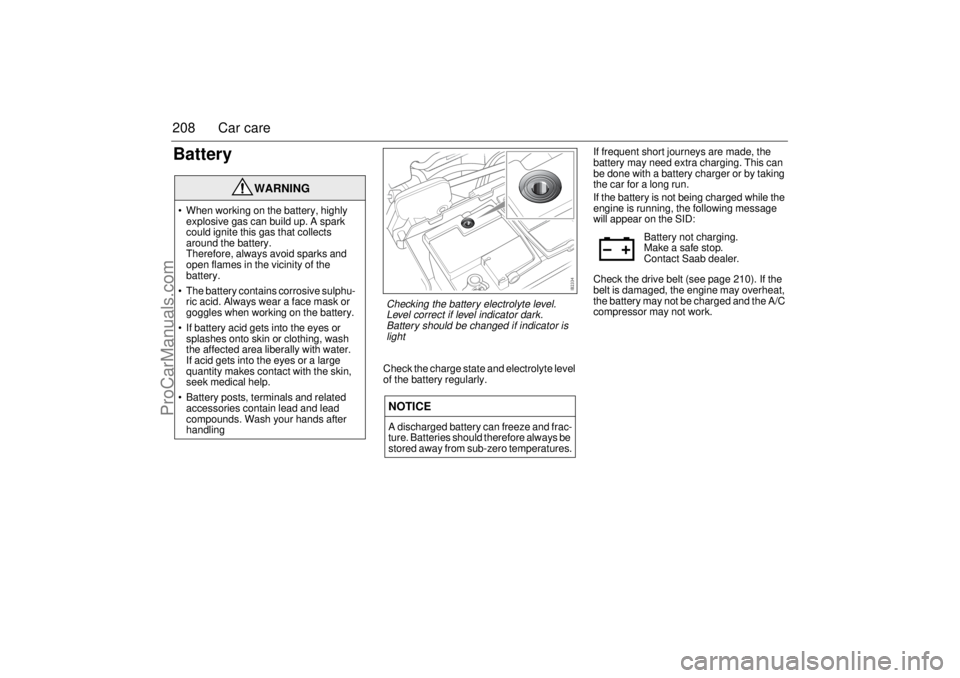
Check the charge state and electrolyte level
of the battery regularly.If frequent short journeys are made, the
battery may need extra charging. This can
be done with a battery charger or by taking
the car for a long run.
If the battery is not being charged while the
engine is running, the following message
will appear on the SID:
Check the drive belt (see page 210). If the
belt is damaged, the engine may overheat,
the battery may not be charged and the A/C
compressor may not work.
WARNING
When working on the battery, highly
explosive gas can build up. A spark
could ignite this gas that collects
around the battery.
Therefore, always avoid sparks and
open flames in the vicinity of the
battery.
The battery contains corrosive sulphu-
ric acid. Always wear a face mask or
goggles when working on the battery.
If battery acid gets into the eyes or
splashes onto skin or clothing, wash
the affected area liberally with water.
If acid gets into the eyes or a large
quantity makes contact with the skin,
seek medical help.
Battery posts, terminals and related
accessories contain lead and lead
compounds. Wash your hands after
handling
NOTICEA discharged battery can freeze and frac-
ture. Batteries should therefore always be
stored away from sub-zero temperatures.
Battery not charging.
Make a safe stop.
Contact Saab dealer.
Checking the battery electrolyte level.
Level correct if level indicator dark.
Battery should be changed if indicator is
light
ProCarManuals.com
Page 215 of 292
213 Car care
Changing bulbsAutochecking of lightsThe bulbs that are most important from the point of view of traffic
safety are monitored by the car’s electrical system. If one of these
bulbs should fail, a message will be displayed on the SID.
Example of SID message:
The following bulbs are not checked: parking lights, front fog lights,
reversing lights, license plate lighting, side marker lights and side
direction indicators.If a stop light bulb fails
If a stop light bulb fails, the adjacent taillight will act as a stop light to
ensure traffic safety. Change the broken bulb when possible.
All rear light bulbs are of the same type and rated 21 W, with the
exception of the license plate lighting which is rated 5 W.
Wrong bulb fitted
If a dipped or main beam bulb of too high a rating is fitted, a bulb
failure message will be shown on the SID (a too high wattage bulb
can damage the reflector).
If the following message is displayed but the bulb shines, it is most
likely that an incorrect bulb has been fitted.
Note:
When changing bulbs, fit the same type of bulb (e.g. Long-Life)
as that removed.
Headlight aiming, page 258.
WARNING
Before changing a bulb in the engine bay, switch off the engine
to avoid the danger of fingers and hands being injured by moving
parts.
The radiator fan can cut in even when the engine is switched off.NOTICESwitch off the ignition before changing a bulb, to avoid possible
short-circuiting.
Left low beam failure.
Right high beam failure.
ProCarManuals.com
Page 216 of 292
214 Car careXenon headlight, dipped beam(certain variants only)
Xenon headlights produce roughly two times as much light as halo-
gen bulbs and have a significantly longer service life.
The lamp units consist of a gas discharge lamp containing xenon.
When the lights are switched on a very high voltage activates the
xenon gas. The lamps soon reach full intensity.
Cars with xenon headlights have automatic levelling. The levelling
system is comprised of two sensors, one on the front suspension
and one on the rear suspension, and a control unit by the engine bay
fuse box. Headlight alignment is adjusted automatically to the car’s
load to prevent dazzling drivers in oncoming traffic.
If a fault is detected in the system, the following message will be dis-
played on the SID:
WARNING
Xenon headlights are high tension. All work on xenon headlights,
including changing bulbs, must be carried out by dealer person-
nel.
Headlight levelling
malfunction.
Contact Saab dealer.
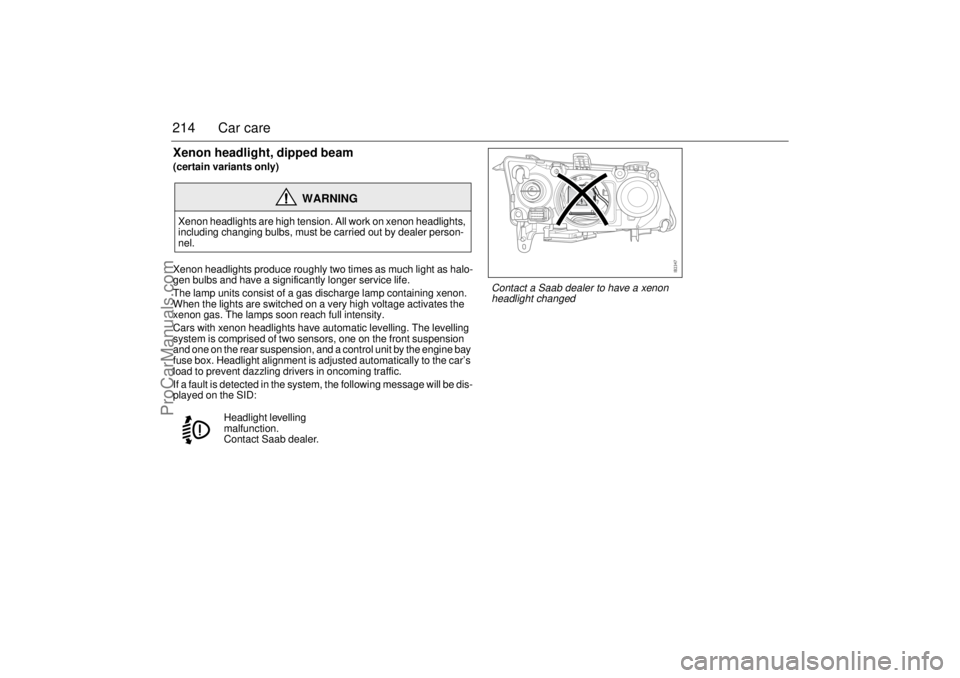
Contact a Saab dealer to have a xenon
headlight changed
ProCarManuals.com
Page 221 of 292
219 Car care
Front fog lights
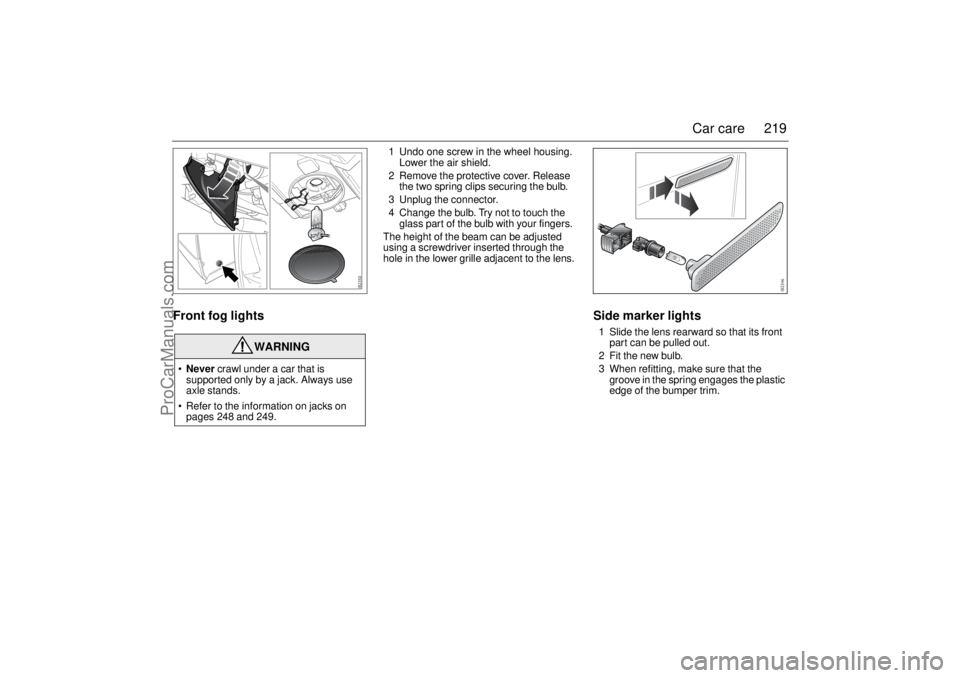
1 Undo one screw in the wheel housing.
Lower the air shield.
2 Remove the protective cover. Release
the two spring clips securing the bulb.
3 Unplug the connector.
4 Change the bulb. Try not to touch the
glass part of the bulb with your fingers.
The height of the beam can be adjusted
using a screwdriver inserted through the
hole in the lower grille adjacent to the lens.
Side marker lights1 Slide the lens rearward so that its front
part can be pulled out.
2 Fit the new bulb.
3 When refitting, make sure that the
groove in the spring engages the plastic
edge of the bumper trim.
WARNING
Never crawl under a car that is
supported only by a jack. Always use
axle stands.
Refer to the information on jacks on
pages 248 and 249.
ProCarManuals.com
Page 240 of 292

238 Car careUniform Tire Quality GradingQuality grades can be found where applica-
ble on the tire sidewall between tread shoul-
der and maximum section width. For exam-
ple:
Treadwear 200 Traction AA Temperature
A
The following information relates to the
system developed by the United States
National Highway Traffic Safety Administra-
tion, which grades tires by treadwear, trac-
tion and temperature performance. (This
applies only to vehicles sold in the United
States.) The grades are molded on the side-
walls of most passenger car tires. The Uni-
form Tire Quality Grading system does not
apply to deep tread, winter-type snow tires,
space-saver or temporary use spare tires,
tires with nominal rim diameters of 10 to 12
inches (25 to 30 cm), or to some limited-pro-
duction tires.
While the tires available on General Motors
passenger cars and light trucks may vary
with respect to these grades, they must also
conform to federal safety requirements and
additional General Motors Tire Perfor-
mance Criteria (TPC) standards.Treadwear
The treadwear grade is a comparative
rating based on the wear rate of the tire
when tested under controlled conditions on
a specified government test course. For
example, a tire graded 150 would wear one
and a half (1.5) times as well on the govern-
ment course as a tire graded 100. The rela-
tive performance of tires depends upon the
actual conditions of their use, however, and
may depart significantly from the norm due
to variations in driving habits, service prac-
tices and differences in road characteristics
and climate.
Traction – AA, A, B, C
The traction grades, from highest to lowest,
are AA, A, B, and C. Those grades repre-
sent the tire’s ability to stop on wet pave-
ment as measured under controlled condi-
tions on specified government test surfaces
of asphalt and concrete. A tire marked C
may have poor traction performance. Warn-
ing: The traction grade assigned to this tire
is based on straight-ahead braking traction
tests, and does not include acceleration,
cornering, hydroplaning, or peak traction
characteristics.Temperature – A, B, C
The temperature grades are A (the highest),
B, and C, representing the tire’s resistance
to the generation of heat and its ability to dis-
sipate heat when tested under controlled
conditions on a specified indoor laboratory
test wheel. Sustained high temperature can
cause the material of the tire to degenerate
and reduce tire life, and excessive temper-
ature can lead to sudden tire failure. The
grade C corresponds to a level of perfor-
mance which all passenger car tires must
meet under the Federal Motor Vehicle
Safety Standard No. 109. Grades B and A
represent higher levels of performance on
the laboratory test wheel than the minimum
required by law.
Warning: The temperature grade for this tire
is established for a tire that is properly
inflated and not overloaded. Excessive
speed, underinflation, or excessive loading,
either separately or in combination, can
cause heat buildup and possible tire failure.
ProCarManuals.com
Page 248 of 292
246 Car careTire date codeTires should be regarded as perishable
goods. As the tires age, the rubber becomes
progressively harder, and the roadholding
ability of the tires diminishes. This is partic-
ularly true on winter tires.
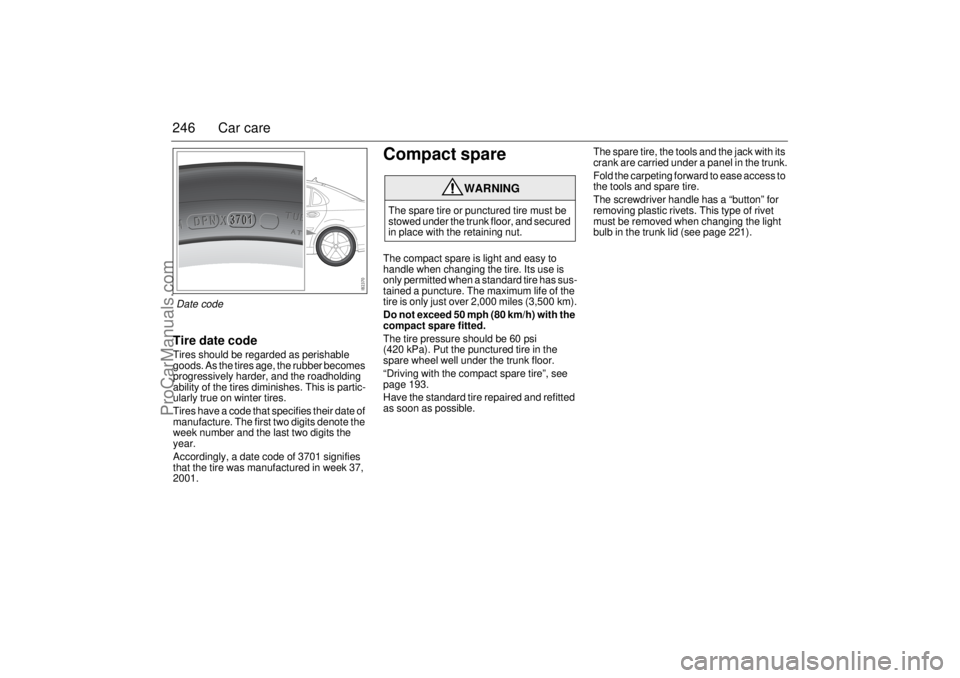
Tires have a code that specifies their date of
manufacture. The first two digits denote the
week number and the last two digits the
year.
Accordingly, a date code of 3701 signifies
that the tire was manufactured in week 37,
2001.
Compact spareThe compact spare is light and easy to
handle when changing the tire. Its use is
only permitted when a standard tire has sus-
tained a puncture. The maximum life of the
tire is only just over 2,000 miles (3,500 km).
Do not exceed 50 mph (80 km/h) with the
compact spare fitted.
The tire pressure should be 60 psi
(420 kPa). Put the punctured tire in the
spare wheel well under the trunk floor.
“Driving with the compact spare tire”, see
page 193.
Have the standard tire repaired and refitted
as soon as possible.The spare tire, the tools and the jack with its
crank are carried under a panel in the trunk.
Fold the carpeting forward to ease access to
the tools and spare tire.
The screwdriver handle has a “button” for
removing plastic rivets. This type of rivet
must be removed when changing the light
bulb in the trunk lid (see page 221).
WARNING
The spare tire or punctured tire must be
stowed under the trunk floor, and secured
in place with the retaining nut.
Date code
ProCarManuals.com
Page 250 of 292

248 Car careChanging a tire
WARNING
Lifting a vehicle and getting under it to do
maintenance or repairs is dangerous
without the appropriate safety equipment
and training. The jack provided with your
vehicle is designed only for changing a
flat tire. If it is used for anything else, you
or others could be badly injured or killed if
the vehicle slips off the jack. Use the jack
provided with your vehicle only for chang-
ing a flat tire.
Changing a tire can be dangerous. The
vehicle can slip off the jack and roll over
or fall on you or other people. You and
they could be badly injured or even killed.
Find a level place to change your tire. To
help prevent the vehicle from moving:
1 Set the parking brake firmly.
2 If you have an automatic transmis-
sion, put the shift lever in PARK (P).
For a manual transmission, leave the
car in gear (1st or REVERSE (R)).
3 Turn off the engine and do not restart
while the vehicle is raised.
4 Do not allow passengers to remain in
the vehicle.
To be even more certain the vehicle won't
move, you should put blocks at the front
and rear of the tire farthest away from the
one being changed. That would be the
tire, on the other side, at the opposite end
of the vehicle.
The car jack is designed solely for use
in changing a tire or fitting snow
chains. It must not be used to
support the car during repair work
or servicing.
Never crawl under a car that is
supported only by a jack. Always use
axle stands.
Raising your vehicle too high or with
the jack improperly positioned can
damage the vehicle and even make
the vehicle fall. To help avoid personal
injury and vehicle damage, be sure to
fit the jack lift head into the proper
location before raising the vehicle, and
raise the vehicle only far enough off
the ground so there is enough room for
the spare tire to fit (no more than
25 mm or 1 inch clearance between
the ground and the bottom of the tire).
Switch on the hazard warning lights if
the car is on a road.
The jack should be stored correctly
under the carpeting in the trunk. If it
lies loose in the car, it could thrown
forward and cause personal injury in
the event of a crash or if the car rolls
over.
Grit, salt and rust can clog the inner
threads of the wheel bolts if the car has
been driven for several years exclu-
sively with alloy wheels.
If steel wheels are being installed, the
bolt hole threads in the brake hubs
should be cleaned before the thinner
steel wheels are fitted. It may other-
wise not be possible to achieve the
correct clamping force, despite tight-
ening the wheel bolts to the correct
torque.
ProCarManuals.com
Page 253 of 292
251 Car care
Safety beltsCheck the function of the safety belts regu-
larly as follows:
Hold the diagonal strap and pull it sharply.
The safety belt should lock and it should
not be possible to withdraw it further.
Check the anchorage points in the floor.
They must not have suffered rust damage.
If a belt is worn or has any fraying edges, it
should be replaced.
Safety belts must not come into contact with
substances such as polishes, oil or chemi-
cals. If the belts get dirty, wash them with
warm water and a detergent or have them
replaced.
Upholstery and trimTo remove fluff and hairs from the seats,
door armrests and headlining, use a
vacuum cleaner, a moist lint-free cloth, or a
clothes brush. Remove spots and dirt using
a cloth moistened with lukewarm soapy
water.
When using a stain remover, always work
from the outside towards the centre to avoid
leaving a ring. If a soiled ring or spot should
remain, it can usually be removed using
lukewarm soapy water or water alone.
Spots left by liquids, such as soft drinks or
thin oil, must be removed at once with an
absorbent material, such as kitchen towel-
ling. Then clean with a stain remover.
White spirit is recommended for removing
grease and oil stains. A medium stiff brush
may also be used.Cleaning and caring for leather
upholsteryThe principal reason for treating leather
upholstery is to maintain its elegant appear-
ance and to provide it with a protective film.
Disco lour at ion caused by dust and wear
mainly affects the lighter shades, although
this is not detrimental to the leather, indeed,
the patina resulting from use is often consid-
ered desirable in leather. But if the leather is
allowed to become too grubby, it can start to
look shabby.
The leather upholstery should be cleaned
and reconditioned twice a year in conjunc-
tion with spring and autumn inspections. In
WARNING
If the car is involved in a crash, the safety
belts, belt pretensioners and other asso-
ciated components must be inspected at
a Saab dealer.
Never make any alterations or repairs to
the safety belts yourself but visit a Saab
dealer.
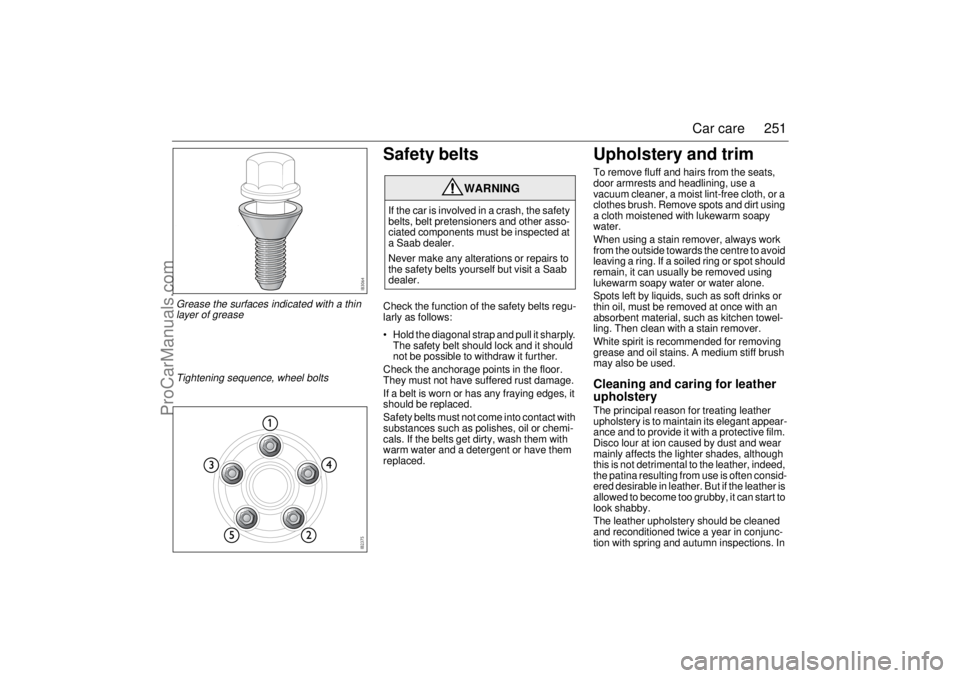
Tightening sequence, wheel boltsGrease the surfaces indicated with a thin
layer of grease
ProCarManuals.com
Page 260 of 292

258 Car careNote:
The A/C system cannot be switched on
when the outside temperature is below 32°F
(0°C). Turn on the A/C system when the car
is standing in a warm place. Simplest is to
always have the A/C button pressed in. The
A/C system will then cut in automatically
when the outside temperature is high
enough.
Headlight aimingThe vehicle has a visual optical headlight
aiming system equipped with vertical
aiming device. The aim has been preset at
the factory and should normally not need
further adjustments.
If your headlights are damaged in a crash,
the headlight aim may be affected. If you
believe your headlights need to be re-
aimed, we recommend that you take it to
your Saab dealer for service. However, it is
possible for you to re-aim your headlights as
described in the following procedure.To check the aim, the vehicle should be
properly prepared as follows:
The vehicle shall be placed so that the
headlights are 25 ft (7.6 m) from a light
colored wall or other flat surface. The
aiming area should be darkened, this will
improve your ability to see the beam of the
low beam headlight being aimed.
An optical headlamp aimer can also be
used and will than replace the wall.
The vehicle must have all four wheels on
a perfectly level surface which is level all
the way to the wall or other flat surface.
The vehicle should be placed so it is per-
pendicular to the wall or other flat surface.
The vehicle should be unloaded and fuel
tank full, and one person or 160 lbs.
(75 kg) on the drivers seat.
The vehicle should be fully assembled
and all other work stopped while headlight
aiming is being done.
The vehicle should not have any snow, ice
or mud attached to it.
Tires should be inflated to the prescribed
pressure.
Close all doors.
Rock the vehicle to stabilize the suspen-
sion.
Headlight aiming is done with the vehicle
low beam lamps. The high beam lamps will
be correctly aimed if the low beam lamps
are aimed properly.
If you find that the headlight needs adjust-
ment follow these steps:
WARNING
Before checking/adjusting the headlight
aiming, switch off the engine to avoid
danger of fingers and hands being injured
by moving parts.
The radiator fan can start up even when
the engine is switched off.NOTICETo make sure that your headlights are
aimed properly read all instructions
before beginning. Failure to follow these
instructions could cause damage to
headlight parts or a not correctly aimed
headlight.
ProCarManuals.com
Page 283 of 292
281 Technical data
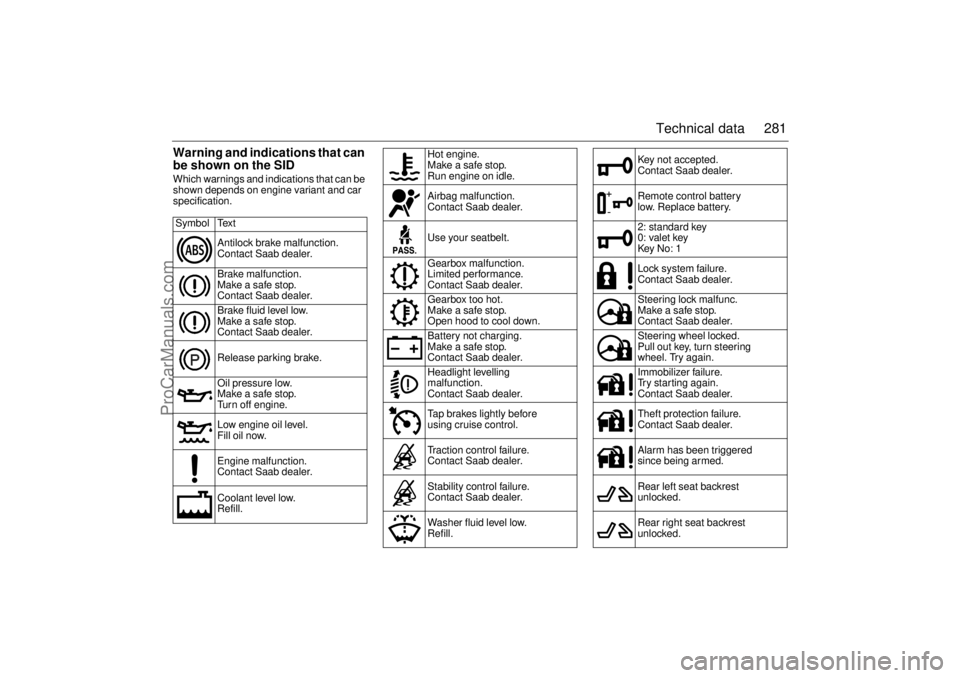
Warning and indications that can
be shown on the SIDWhich warnings and indications that can be
shown depends on engine variant and car
specification.
Symbol Text
Antilock brake malfunction.
Contact Saab dealer.
Brake malfunction.
Make a safe stop.
Contact Saab dealer.
Brake fluid level low.
Make a safe stop.
Contact Saab dealer.
Release parking brake.
Oil pressure low.
Make a safe stop.
Turn off engine.
Low engine oil level.
Fill oil now.
Engine malfunction.
Contact Saab dealer.
Coolant level low.
Refill.
Hot engine.
Make a safe stop.
Run engine on idle.
Airbag malfunction.
Contact Saab dealer.
Use your seatbelt.
Gearbox malfunction.
Limited performance.
Contact Saab dealer.
Gearbox too hot.
Make a safe stop.
Open hood to cool down.
Battery not charging.
Make a safe stop.
Contact Saab dealer.
Headlight levelling
malfunction.
Contact Saab dealer.
Tap brakes lightly before
using cruise control.
Traction control failure.
Contact Saab dealer.
Stability control failure.
Contact Saab dealer.
Washer fluid level low.
Refill.
Key not accepted.
Contact Saab dealer.
Remote control battery
low. Replace battery.
2: standard key
0: valet key
Key No: 1
Lock system failure.
Contact Saab dealer.
Steering lock malfunc.
Make a safe stop.
Contact Saab dealer.
Steering wheel locked.
Pull out key, turn steering
wheel. Try again.
Immobilizer failure.
Try starting again.
Contact Saab dealer.
Theft protection failure.
Contact Saab dealer.
Alarm has been triggered
since being armed.
Rear left seat backrest
unlocked.
Rear right seat backrest
unlocked.
ProCarManuals.com