air condition SAAB 9-3 2005 Owners Manual
[x] Cancel search | Manufacturer: SAAB, Model Year: 2005, Model line: 9-3, Model: SAAB 9-3 2005Pages: 292, PDF Size: 23 MB
Page 36 of 292
34 SafetyHead protectionThe pillar trim and headlining (not Converti-
ble soft top) are designed to absorb energy,
softening possible blows to the head. After
a crash, these items must be changed in the
seat positions that were occupied. Never fit
accessories to the pillar trim or headlining
as these could reduce the effectiveness of
the head protection and inflatable curtain
(Sport Sedan).
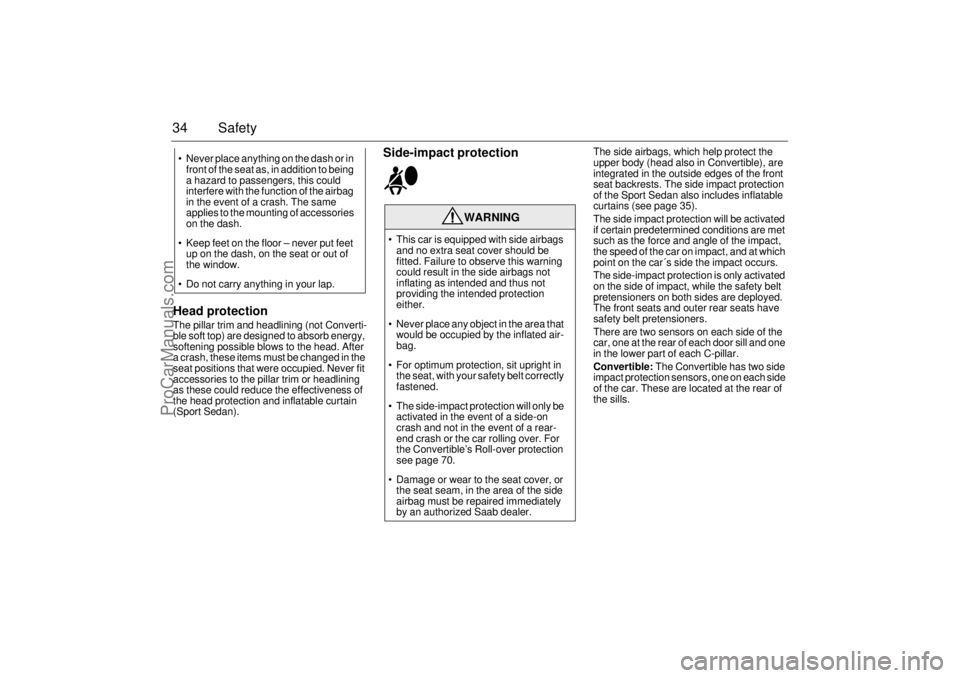
Side-impact protection
The side airbags, which help protect the
upper body (head also in Convertible), are
integrated in the outside edges of the front
seat backrests. The side impact protection
of the Sport Sedan also includes inflatable
curtains (see page 35).
The side impact protection will be activated
if certain predetermined conditions are met
such as the force and angle of the impact,
the speed of the car on impact, and at which
point on the car´s side the impact occurs.
The side-impact protection is only activated
on the side of impact, while the safety belt
pretensioners on both sides are deployed.
The front seats and outer rear seats have
safety belt pretensioners.
There are two sensors on each side of the
car, one at the rear of each door sill and one
in the lower part of each C-pillar.
Convertible: The Convertible has two side
impact protection sensors, one on each side
of the car. These are located at the rear of
the sills. Never place anything on the dash or in
front of the seat as, in addition to being
a hazard to passengers, this could
interfere with the function of the airbag
in the event of a crash. The same
applies to the mounting of accessories
on the dash.
Keep feet on the floor – never put feet
up on the dash, on the seat or out of
the window.
Do not carry anything in your lap.
WARNING
This car is equipped with side airbags
and no extra seat cover should be
fitted. Failure to observe this warning
could result in the side airbags not
inflating as intended and thus not
providing the intended protection
either.
Never place any object in the area that
would be occupied by the inflated air-
bag.
For optimum protection, sit upright in
the seat, with your safety belt correctly
fastened.
The side-impact protection will only be
activated in the event of a side-on
crash and not in the event of a rear-
end crash or the car rolling over. For
the Convertible’s Roll-over protection
see page 70.
Damage or wear to the seat cover, or
the seat seam, in the area of the side
airbag must be repaired immediately
by an authorized Saab dealer.
ProCarManuals.com
Page 40 of 292
38 Safety Let only qualified technicians work on
your airbag system. Improper service can
mean that your airbag system will not
work properly. See your dealer for
service.Notice:
If you damage the covering for
the driver's or the right front passenger's
airbag, or the side impact airbag cover-
ing on the ceiling near the side windows,
the bag may not work properly. You may
have to replace the airbag module in the
steering wheel, both the airbag module
and the instrument panel for the right
front passenger's airbag, or side impact
airbag module and ceiling covering for
the roof-mounted side impact airbag. Do
not open or break the airbag coverings.
Servicing the airbag systemThe airbag system must be inspected as
part of the normal service program but oth-
erwise may be regarded as maintenance-
free.
Scrapping or working on airbag
and belt pretensioners
WARNING
Under no circumstances should any
modifications be made that affect the
steering wheel or the airbag’s electri-
cal circuitry.
During any welding, both battery
cables must be disconnected and
covered.
Before quick drying paint in the vicinity
of the electronic control module, the
module’s grounding points and wiring
must be covered.
Airbags and safety belt pretensioners
must be deployed under controlled
conditions before the car is scrapped
or any of the system’s components are
removed. Airbags or belt pretension-
ers that have been deployed as a
result of a crash must be replaced by
new ones.
Airbag-system components must
never be transferred for use in another
vehicle.
All work involving the scrapping or
replacement of airbags or belt preten-
sioners must be carried out by autho-
rized personnel only.
ProCarManuals.com
Page 41 of 292

39 Safety
Frequently asked questions on
function of the airbagDo you still need to wear a safety belt if air-
bags are fitted?Yes, always! The airbag system compo-
nents merely supplement the car’s normal
safety system. Moreover, the front airbags
will only be actuated in a moderate to severe
frontal, or near-frontal crash, which means,
of course, that they provide no protection in
minor frontal crashes, major rear- or side-
crashes or if the car rolls over.
The safety belts help to reduce the sideway
movement of the body in a crash.
But they also ensure that, if a crash occurs
in which the airbags are inflated, the airbag
will make the optimum contact with the
occupant, i.e. square on from the front. If the
occupant meets the airbag in an offset posi-
tion, the protection afforded will be reduced.In addition, airbags provide no protection
against a secondary impact occurring in the
same incident. So there is no doubt about
the benefit of wearing safety belts at all
times.
Do not sit too close to the airbag: it needs
room to inflate.
The airbag inflates very quickly and power-
fully in order to protect an adult, before they
are thrown forward, in a serious frontal
crash.
How do I position the seat to leave room for
the airbag to inflate?Don’t have your seat too far forward.
Recline the seat back to increase the dis-
tance between you and the airbag. For short
drivers, special accessory pedal extensions
are available through your Saab dealer.
Airbags inflate extremely rapidly and with
great force – to be fast enough to protect an
adult in the seat.
When do the airbags in the steering wheel
and passenger side of the dash board
inflate? The airbag will only be inflated under certain
predetermined conditions in a moderate to
severe frontal, or near-frontal crash,
depending on such factors as the force and
angle of the impact, the speed of the car on
impact, and the resistance to deformation of
the impacting object.
The airbag can only be activated once in the
same incident.
Do not attempt to drive the car after an
airbag has been inflated, even if it is possi-
ble.What won’t trigger the airbag? The airbag will not be activated in all frontal
crashes. For instance, if the car has hit
something relatively soft and yielding (e.g. a
snow drift or a hedge) or a solid object at a
low impact speed, the airbag will not neces-
sarily be triggered.
ProCarManuals.com
Page 83 of 292
81 Instruments and controls
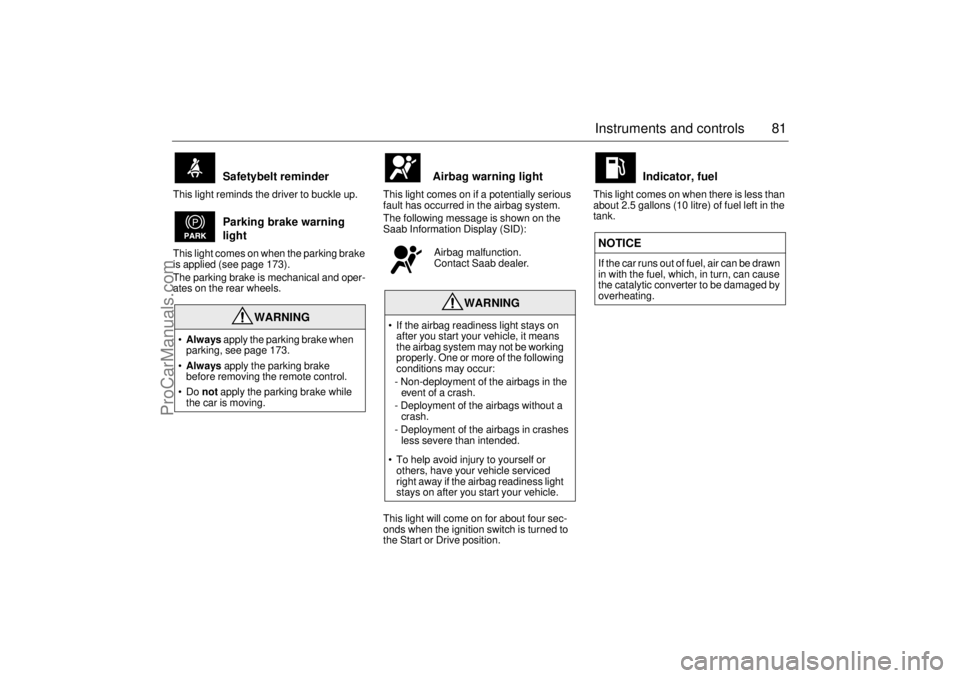
This light reminds the driver to buckle up.
This light comes on when the parking brake
is applied (see page 173).
The parking brake is mechanical and oper-
ates on the rear wheels.This light comes on if a potentially serious
fault has occurred in the airbag system.
The following message is shown on the
Saab Information Display (SID):
This light will come on for about four sec-
onds when the ignition switch is turned to
the Start or Drive position.This light comes on when there is less than
about 2.5 gallons (10 litre) of fuel left in the
tank.
Safetybelt reminder
Parking brake warning
light
WARNING
Always apply the parking brake when
parking, see page 173.
Always apply the parking brake
before removing the remote control.
Do not apply the parking brake while
the car is moving.
Airbag warning lightAirbag malfunction.
Contact Saab dealer.
WARNING
If the airbag readiness light stays on
after you start your vehicle, it means
the airbag system may not be working
properly. One or more of the following
conditions may occur:
- Non-deployment of the airbags in the
event of a crash.
- Deployment of the airbags without a
crash.
- Deployment of the airbags in crashes
less severe than intended.
To help avoid injury to yourself or
others, have your vehicle serviced
right away if the airbag readiness light
stays on after you start your vehicle.
Indicator, fuel
NOTICE
If the car runs out of fuel, air can be drawn
in with the fuel, which, in turn, can cause
the catalytic converter to be damaged by
overheating.
ProCarManuals.com
Page 86 of 292
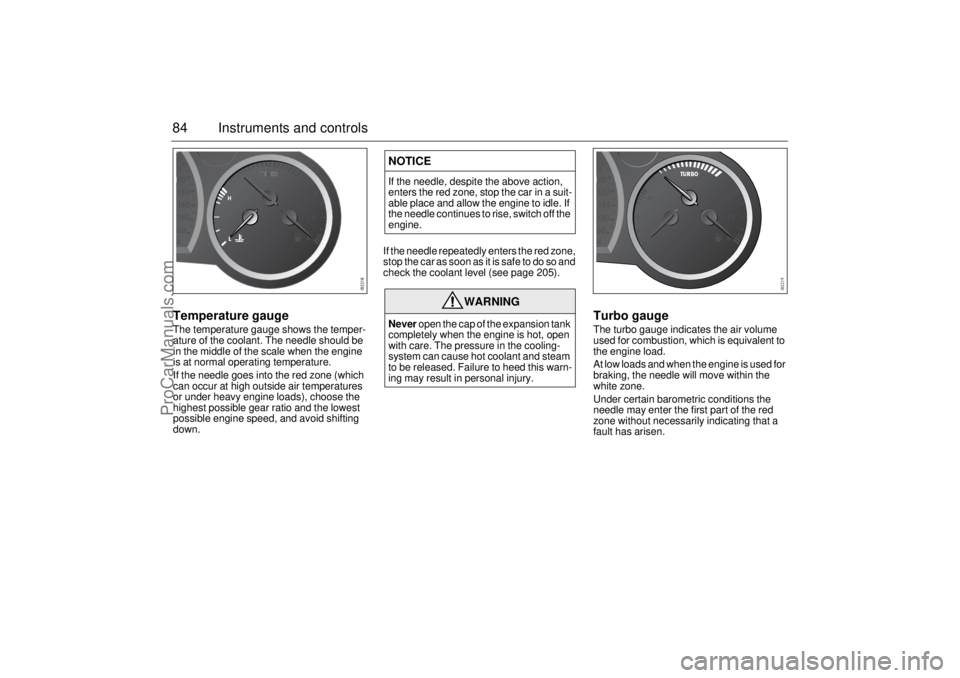
84 Instruments and controlsTemperature gaugeThe temperature gauge shows the temper-
ature of the coolant. The needle should be
in the middle of the scale when the engine
is at normal operating temperature.
If the needle goes into the red zone (which
can occur at high outside air temperatures
or under heavy engine loads), choose the
highest possible gear ratio and the lowest
possible engine speed, and avoid shifting
down.If the needle repeatedly enters the red zone,
stop the car as soon as it is safe to do so and
check the coolant level (see page 205).
Turbo gaugeThe turbo gauge indicates the air volume
used for combustion, which is equivalent to
the engine load.
At low loads and when the engine is used for
braking, the needle will move within the
white zone.
Under certain barometric conditions the
needle may enter the first part of the red
zone without necessarily indicating that a
fault has arisen.
NOTICEIf the needle, despite the above action,
enters the red zone, stop the car in a suit-
able place and allow the engine to idle. If
the needle continues to rise, switch off the
engine.
WARNING
Never open the cap of the expansion tank
completely when the engine is hot, open
with care. The pressure in the cooling-
system can cause hot coolant and steam
to be released. Failure to heed this warn-
ing may result in personal injury.
ProCarManuals.com
Page 105 of 292
103 Instruments and controls
Manual climate-control
systemFresh air for the cabin is drawn in through an
inlet grille at the bottom edge of the wind-
shield. It passes through a filter before
reaching the climate control system and
delivery into the cabin. The air is evacuated
via openings in the parcel shelf. It is then led
through outlets on either side of the car
behind the rear bumper.
The incoming air is treated in three stages:
first it passes through a filter; it is then dehu-
midified and cooled; and finally, if required,
it is heated.
To optimize the performance of the A/C sys-
tem, all windows and the sunroof should be
shut.
To reduce potential misting on the insides of
the windows, the glass should be cleaned
with a quality glass cleaner. How often this
will need to be done depends on how clean
the air is - if there are smokers in the car, the
windows will need to be cleaned more fre-
quently.
The output of air is controlled by the fan
speed.
Temperature controlThe temperature of the incoming air can
be infinitely varied using the temperature
control.
Fan
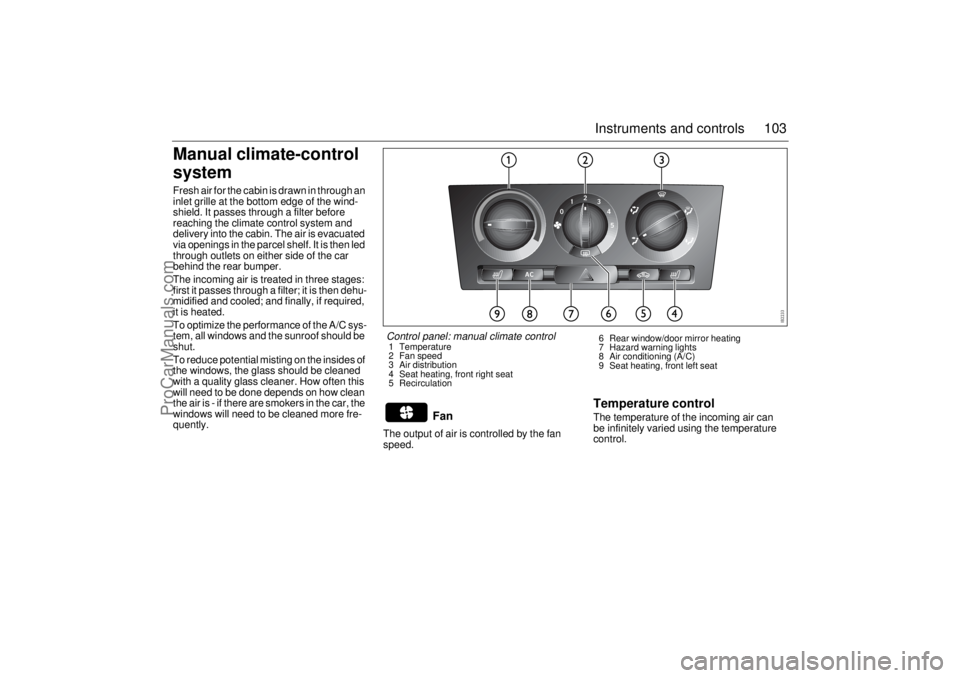
Control panel: manual climate control1 Temperature
2 Fan speed
3 Air distribution
4 Seat heating, front right seat
5 Recirculation6 Rear window/door mirror heating
7 Hazard warning lights
8 Air conditioning (A/C)
9 Seat heating, front left seat
ProCarManuals.com
Page 108 of 292
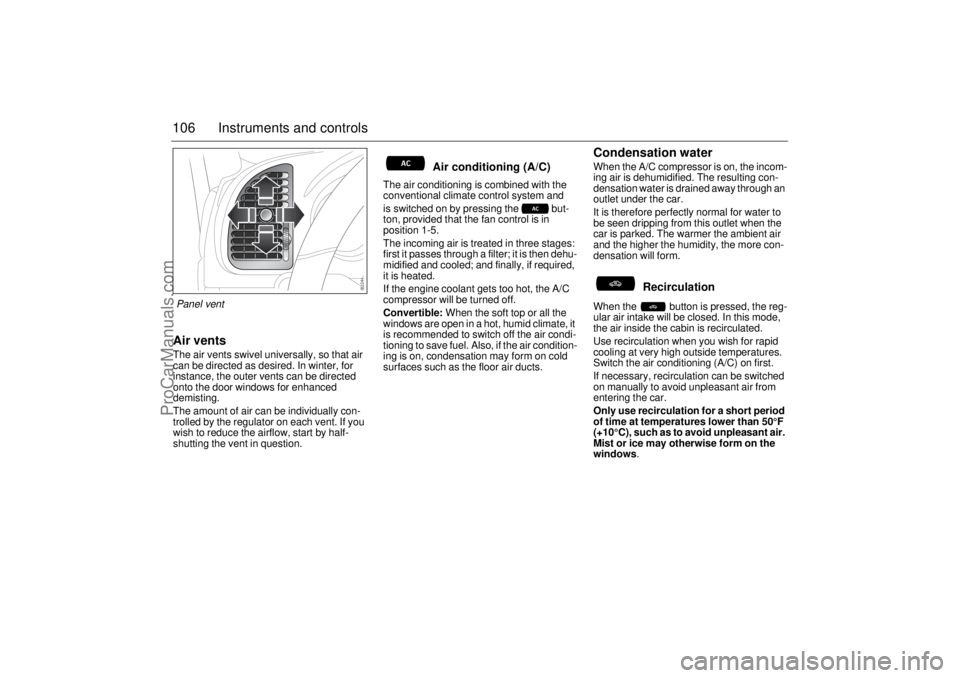
106 Instruments and controlsAir ventsThe air vents swivel universally, so that air
can be directed as desired. In winter, for
instance, the outer vents can be directed
onto the door windows for enhanced
demisting.
The amount of air can be individually con-
trolled by the regulator on each vent. If you
wish to reduce the airflow, start by half-
shutting the vent in question.The air conditioning is combined with the
conventional climate control system and
is switched on by pressing the but-
ton, provided that the fan control is in
position 1-5.
The incoming air is treated in three stages:
first it passes through a filter; it is then dehu-
midified and cooled; and finally, if required,
it is heated.
If the engine coolant gets too hot, the A/C
compressor will be turned off.
Convertible: When the soft top or all the
windows are open in a hot, humid climate, it
is recommended to switch off the air condi-
tioning to save fuel. Also, if the air condition-
ing is on, condensation may form on cold
surfaces such as the floor air ducts.
Condensation waterWhen the A/C compressor is on, the incom-
ing air is dehumidified. The resulting con-
densation water is drained away through an
outlet under the car.
It is therefore perfectly normal for water to
be seen dripping from this outlet when the
car is parked. The warmer the ambient air
and the higher the humidity, the more con-
densation will form.
When the button is pressed, the reg-
ular air intake will be closed. In this mode,
the air inside the cabin is recirculated.
Use recirculation when you wish for rapid
cooling at very high outside temperatures.
Switch the air conditioning (A/C) on first.
If necessary, recirculation can be switched
on manually to avoid unpleasant air from
entering the car.
Only use recirculation for a short period
of time at temperatures lower than 50°F
(+10°C), such as to avoid unpleasant air.
Mist or ice may otherwise form on the
windows.
Air conditioning (A/C)
Recirculation
Panel vent
ProCarManuals.com
Page 119 of 292
117 Instruments and controls
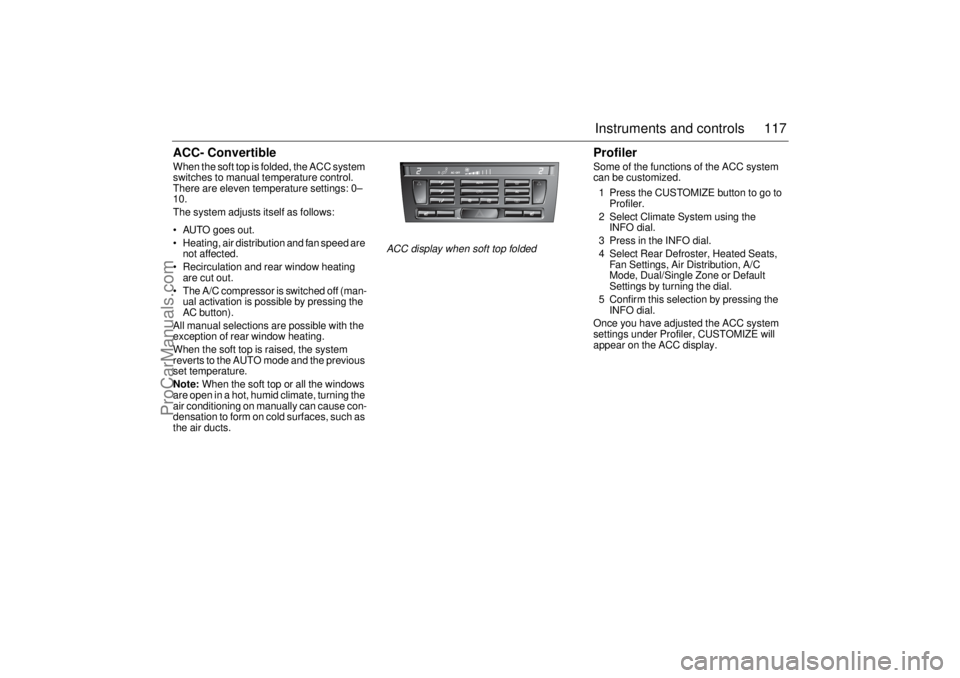
ACC- ConvertibleWhen the soft top is folded, the ACC system
switches to manual temperature control.
There are eleven temperature settings: 0–
10.
The system adjusts itself as follows:
AUTO goes out.
Heating, air distribution and fan speed are
not affected.
Recirculation and rear window heating
are cut out.
The A/C compressor is switched off (man-
ual activation is possible by pressing the
AC button).
All manual selections are possible with the
exception of rear window heating.
When the soft top is raised, the system
reverts to the AUTO mode and the previous
set temperature.
Note: When the soft top or all the windows
are open in a hot, humid climate, turning the
air conditioning on manually can cause con-
densation to form on cold surfaces, such as
the air ducts.
ProfilerSome of the functions of the ACC system
can be customized.
1 Press the CUSTOMIZE button to go to
Profiler.
2 Select Climate System using the
INFO dial.
3 Press in the INFO dial.
4 Select Rear Defroster, Heated Seats,
Fan Settings, Air Distribution, A/C
Mode, Dual/Single Zone or Default
Settings by turning the dial.
5 Confirm this selection by pressing the
INFO dial.
Once you have adjusted the ACC system
settings under Profiler, CUSTOMIZE will
appear on the ACC display.
ACC display when soft top folded
ProCarManuals.com
Page 121 of 292

119 Instruments and controls
Fan Settings
High speed:
This selection give a slightly higher
fan speed than Medium speed
though with continued automatic
regulation.
Medium speed:
Normal automatic fan speed. This is
one of the Default Settings.
Low speed:
This selection give a slightly lower
fan speed than Medium speed
though with continued automatic
regulation.
Convertible: Fan speed is not regulated
automatically when the soft top is open.
Air Distribution
Auto:
The ACC system adapts air tem-
perature and distribution to the pre-
vailing conditions. This is one of the
Default Settings
.
Manual:
Windshield:
The ACC system directs almost
all air to the windshield.
Panel:
The ACC system directs almost
all air to air vents in the fascia.
Floor:
The ACC system directs almost
all air to the floor.
A/C Mode
Auto:
Automatic engagement and disen-
gagement of the A/C. This is one of
the Default Settings.
A/C off:
A/C compressor OFF (see also
page 111). The A/C compressor
can be activated temporarily by
pressing the AC or AUTO button
while on the road and if the outside
temperature is above 41°F (+5°C).
The A/C will be off the next time the
engine is started, if the engine has
been switched off for more than
2hours.
Convertible: The A/C compressor is
switched off when the soft top is folded
down.
Further customizations to this function can
be made at a Saab dealer.
The A/C compressor can be on even
when the soft top is folded down.
The A/C compressor can be set to
operate as when the soft top was last
folded down.Dual/Single Zone
Dual zone:
Individual temperature setting for
each zone (see page 109). The sys-
tem saves the settings when the
engine is switched off. This is one of
the Default Settings.
Single zone:
Common temperature setting when
the engine is started. If the temper-
ature setting for the passenger zone
is changed, the system will switch to
Dual zone control. Single zone con-
trol will return the next time the
engine is started having been
switched off for more than 2 hours.
ProCarManuals.com
Page 154 of 292
152 Starting and driving Never park the car on dry grass or other
combustible material. The catalytic
converter gets very hot and could there-
fore start a fire.
Never drive off if the engine is misfiring.
If you bump start the car when the engine
is already at normal working temperature,
the engine must start to run on all cylin-
ders. Abort bump starting if the engine
fails to start immediately.
Failure to strictly follow these instructions
can result in damage to the catalytic con-
verter and associated components, and
could represent a breach of the warranty
conditions.
NOTICEIf the car runs out of gas, air may be drawn
in with the fuel, which, in turn, can cause
the catalytic converter to be damaged by
overheating.
WARNING
If the engine is being run with the car on a
rolling road or dynamometer, to ensure
adequate cooling, air must be blown into
the engine compartment and under the
car at a rate equivalent to the ram-air
effect that would obtain at the corre-
sponding road speed.
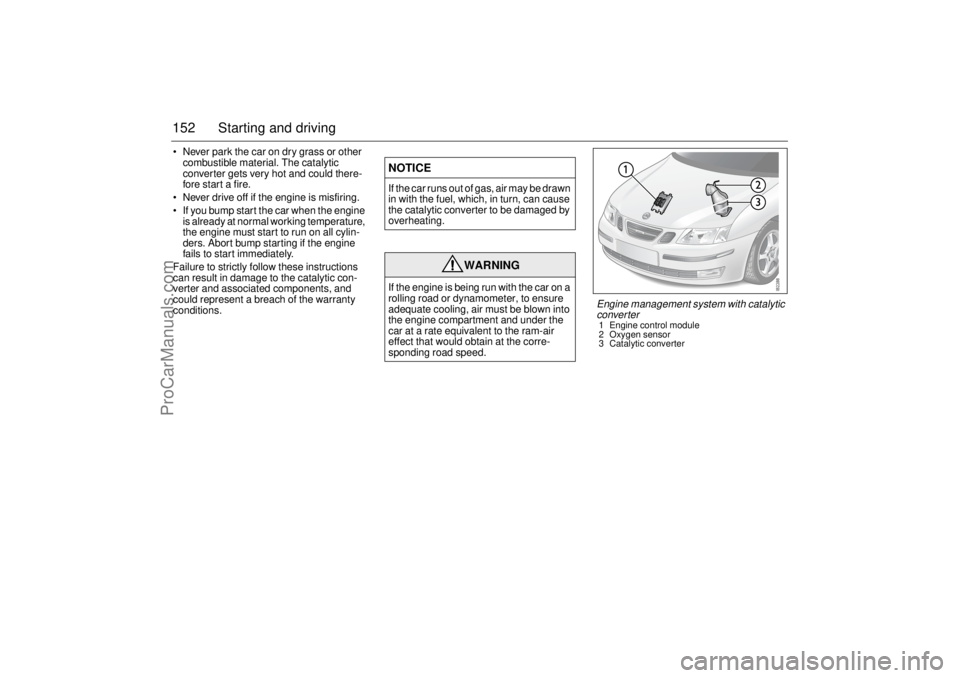
Engine management system with catalytic
converter1 Engine control module
2 Oxygen sensor
3 Catalytic converter
ProCarManuals.com