fuel pressure SAAB 9-3 2005 Owners Manual
[x] Cancel search | Manufacturer: SAAB, Model Year: 2005, Model line: 9-3, Model: SAAB 9-3 2005Pages: 292, PDF Size: 23 MB
Page 6 of 292
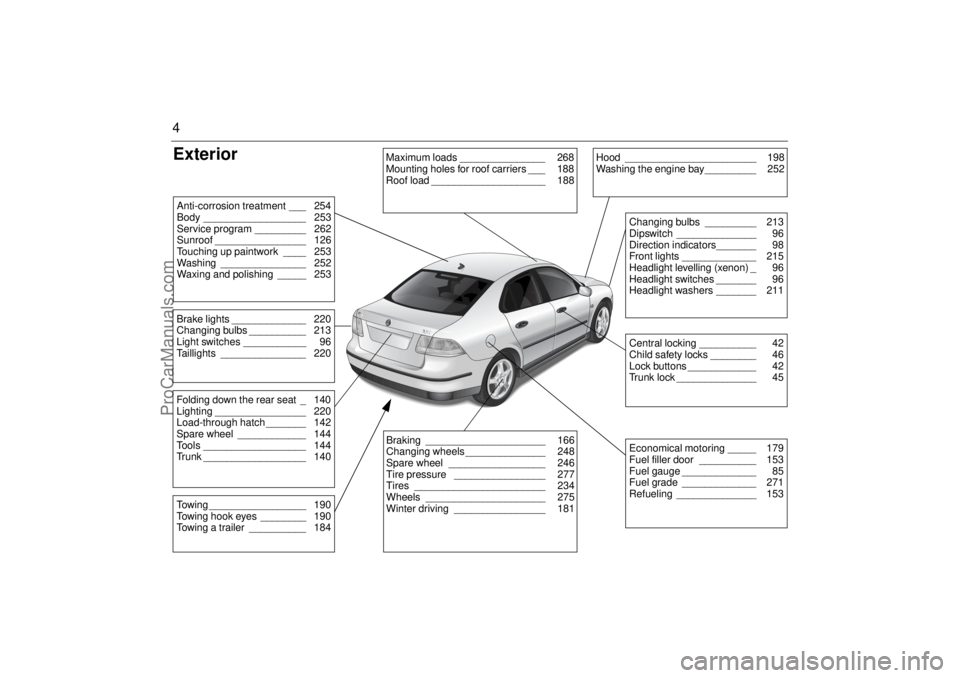
4ExteriorAnti-corrosion treatment ___ 254
Body __________________ 253
Service program _________ 262
Sunroof ________________ 126
Touching up paintwork ____ 253
Washing _______________ 252
Waxing and polishing _____ 253Brake lights _____________ 220
Changing bulbs __________ 213
Light switches ___________ 96
Taillights _______________ 220Towing _________________ 190
Towing hook eyes ________ 190
Towing a trailer __________ 184Folding down the rear seat _ 140
Lighting ________________ 220
Load-through hatch _______ 142
Spare wheel ____________ 144
Tools __________________ 144
Trunk __________________ 140
Maximum loads _______________ 268
Mounting holes for roof carriers ___ 188
Roof load ____________________ 188
Hood _______________________ 198
Washing the engine bay_________ 252
Central locking __________ 42
Child safety locks ________ 46
Lock buttons ____________ 42
Trunk lock ______________ 45Changing bulbs _________ 213
Dipswitch ______________ 96
Direction indicators_______ 98
Front lights _____________ 215
Headlight levelling (xenon) _ 96
Headlight switches _______ 96
Headlight washers _______ 211Economical motoring _____ 179
Fuel filler door __________ 153
Fuel gauge _____________ 85
Fuel grade _____________ 271
Refueling ______________ 153
Braking _____________________ 166
Changing wheels ______________ 248
Spare wheel _________________ 246
Tire pressure ________________ 277
Tires _______________________ 234
Wheels _____________________ 275
Winter driving ________________ 181
ProCarManuals.com
Page 11 of 292
9
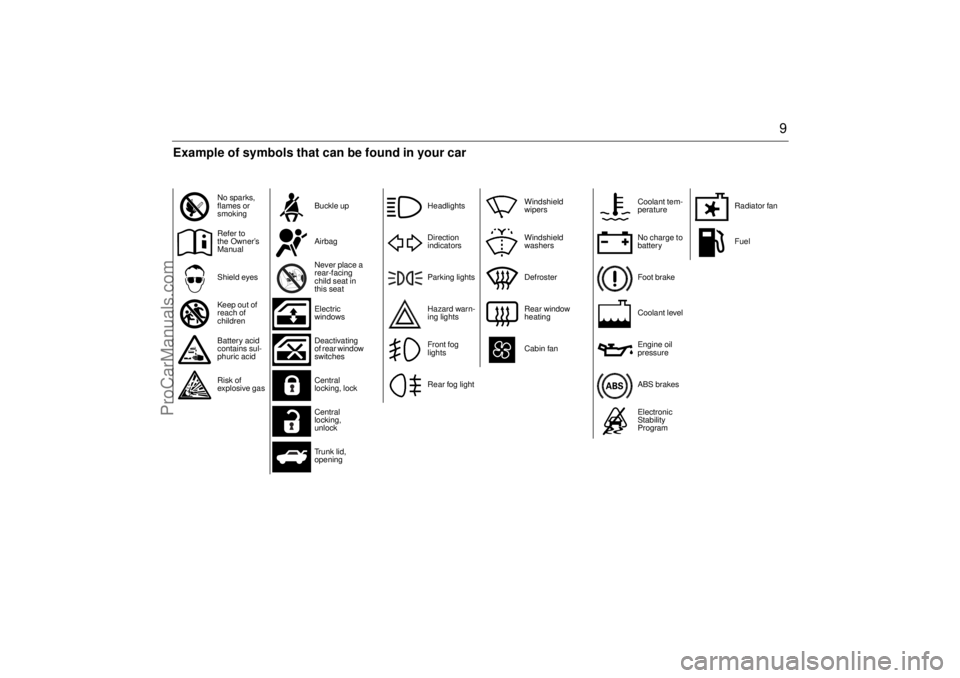
No sparks,
flames or
smokingBuckle up
Refer to
the Owner’s
ManualAirbag
Shield eyesNever place a
rear-facing
child seat in
this seat
Keep out of
reach of
childrenElectric
windows
Battery acid
contains sul-
phuric acidDeactivating
of rear window
switches
Risk of
explosive gasCentral
locking, lock
Central
locking,
unlock
Trunk lid,
opening
HeadlightsWindshield
wipers
Direction
indicatorsWindshield
washers
Parking lights Defroster
Hazard warn-
ing lightsRear window
heating
Front fog
lightsCabin fan
Rear fog light
Coolant tem-
peratureRadiator fan
No charge to
batteryFuel
Foot brake
Coolant level
Engine oil
pressure
ABS brakes
Electronic
Stability
Program
Example of symbols that can be found in your car
ProCarManuals.com
Page 81 of 292
79 Instruments and controls
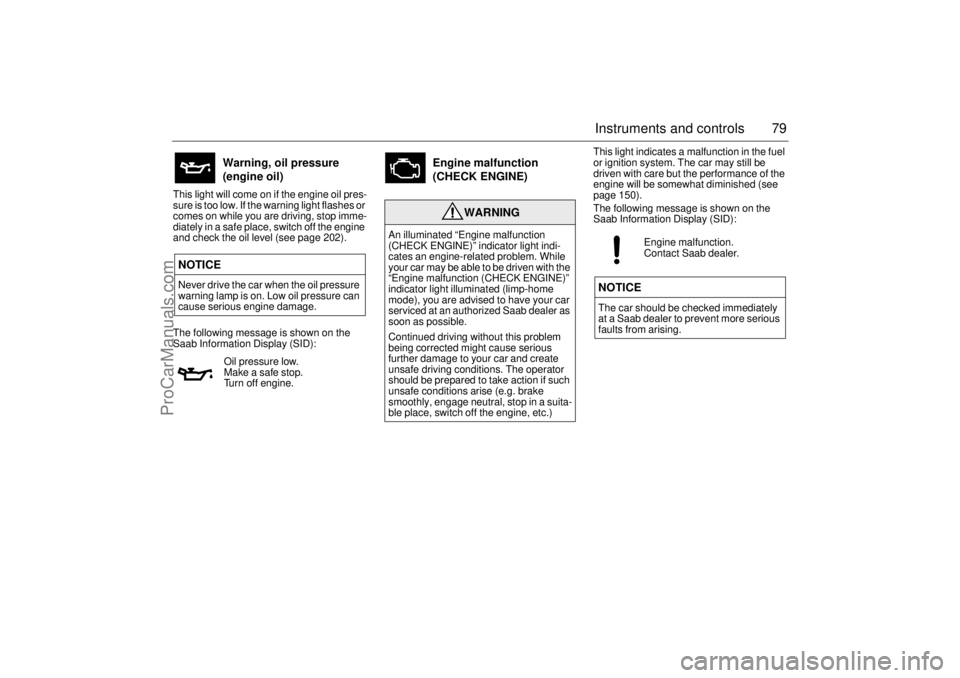
This light will come on if the engine oil pres-
sure is too low. If the warning light flashes or
comes on while you are driving, stop imme-
diately in a safe place, switch off the engine
and check the oil level (see page 202).
The following message is shown on the
Saab Information Display (SID):This light indicates a malfunction in the fuel
or ignition system. The car may still be
driven with care but the performance of the
engine will be somewhat diminished (see
page 150).
The following message is shown on the
Saab Information Display (SID):
Warning, oil pressure
(engine oil)
NOTICE
Never drive the car when the oil pressure
warning lamp is on. Low oil pressure can
cause serious engine damage.
Oil pressure low.
Make a safe stop.
Turn off engine.
Engine malfunction
(CHECK ENGINE)
WARNING
An illuminated “Engine malfunction
(CHECK ENGINE)” indicator light indi-
cates an engine-related problem. While
your car may be able to be driven with the
“Engine malfunction (CHECK ENGINE)”
indicator light illuminated (limp-home
mode), you are advised to have your car
serviced at an authorized Saab dealer as
soon as possible.
Continued driving without this problem
being corrected might cause serious
further damage to your car and create
unsafe driving conditions. The operator
should be prepared to take action if such
unsafe conditions arise (e.g. brake
smoothly, engage neutral, stop in a suita-
ble place, switch off the engine, etc.)
Engine malfunction.
Contact Saab dealer.
NOTICEThe car should be checked immediately
at a Saab dealer to prevent more serious
faults from arising.
ProCarManuals.com
Page 87 of 292
85 Instruments and controls
If the needle repeatedly enters the red zone
and the engine at the same time loses
power, because the monitoring system is
limiting the boost pressure, you should
contact a Saab dealer as soon as possible.
When the speed of the car exceeds
143 mph (230 km/h), acceleration is limited
by reducing the boost pressure. The pres-
sure gauge then moves towards the middle
of the white field, indicating a drop in engine
power and consequently the car’s speed.
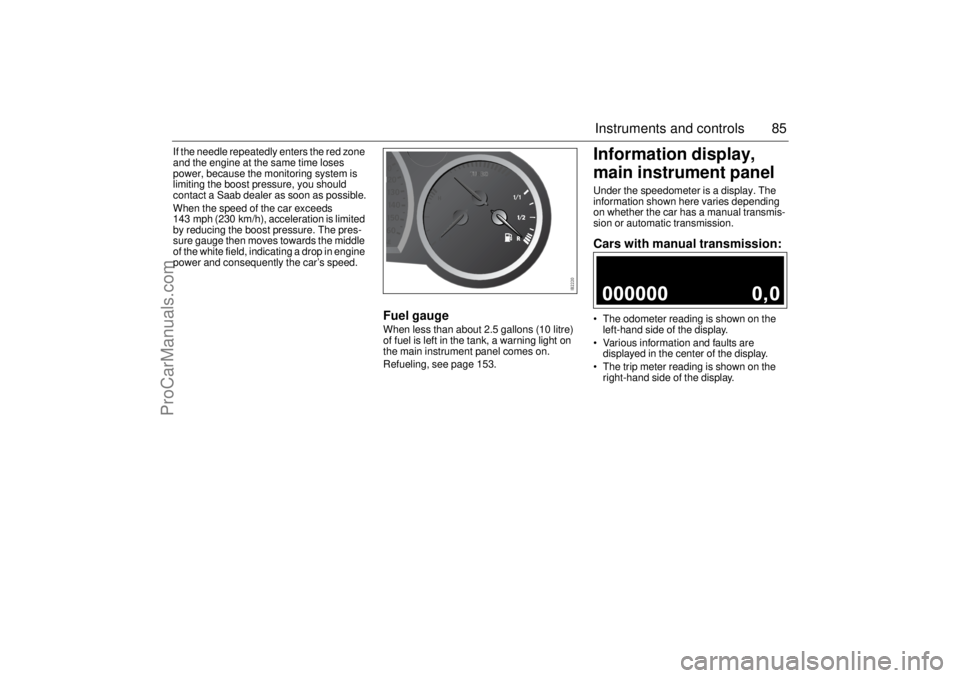
Fuel gaugeWhen less than about 2.5 gallons (10 litre)
of fuel is left in the tank, a warning light on
the main instrument panel comes on.
Refueling, see page 153.
Information display,
main instrument panelUnder the speedometer is a display. The
information shown here varies depending
on whether the car has a manual transmis-
sion or automatic transmission.Cars with manual transmission: The odometer reading is shown on the
left-hand side of the display.
Various information and faults are
displayed in the center of the display.
The trip meter reading is shown on the
right-hand side of the display.
ProCarManuals.com
Page 152 of 292

150 Starting and drivingImportant
considerations for
driving1 Starting and driving
Do not use full throttle until the engine
is warm, so as to avoid unnecessary
wear. If the needle of the turbo gauge
repeatedly enters the red zone, the
engine may suddenly lose power, due
to the initiation of a monitoring system
that limits the boost pressure. Contact
a Saab dealer as soon as possible.
Under certain barometric conditions
(high outside temperature and/or high
altitude) the needle may enter the first
part of the red zone without necessarily
indicating that a fault has arisen.
A protective function (interruption of the
fuel supply) limits the engine speed.2 Stopping the engine
Do not rev the engine immediately
before switching it off - stop the engine
when it is idling.
3 Regulating the boost pressure
One of the advantages of boost pres-
sure regulation is that the engine can
also be run safely on gasoline with a
lower octane rating, although not lower
than AON 87. However, engine perfor-
mance will fall slightly and heavy load-
ing and laboring should be avoided. For
optimum performance, use the recom-
mended grade of fuel.
The maximum boost pressure is regu-
lated according to the tendency of the
engine to knock. Short-lived knocking
is perfectly normal. This can occur
when the engine is running at about
3,000 rpm under a heavy load. The
extent of this knocking will depend on
the grade of fuel in the tank.
Isolated instances of knocking can
occur with low-octane fuel. This
controlled form of knocking, followed
by a reduction in the boost pressure, is
a sign that the control system is work-
ing normally, and is perfectly safe for
the engine.
Limp-homeThe engine management system has a
diagnostic feature that checks a number of
internal functions. If a fault is detected in the
throttle valve, the engine management
system will set the throttle system to the
limp-home mode. This means:
idling control will be poor (uneven idling
since regulated by ignition and fuel
supply)
engine performance will be reduced
the cruise control will not function
the capacity of the A/C compressor will be
limited.NOTICE If the engine sounds strange there is a
malfunction. Contact a Saab dealer
immediately.
The use of fuel with too low an octane
rating can cause serious engine
damage.
ProCarManuals.com
Page 177 of 292

175 Starting and driving
Long-term parkingIf the car is not going to be used for some
time, e.g. three to four months, the following
steps are recommended:
Drain the washer fluid reservoir and
hoses.
Wash and wax the car. Clean the rubber
seals on the hood, trunk lid and doors,
and lubricate them with glycerol
(glycerine).
After washing the car, dry the brake discs
to avoid corrosion by taking the car out on
the road and applying the brakes a few
times.
Fill the fuel tank to prevent condensation
forming in it.
Top up the coolant and check the anti-
freeze before the onset of winter. Park the car in a dry, covered and well-
ventilated building. Leave the parking
brake OFF!
Convertible: If the car is stored, the soft
top should be closed.
If necessary, use wheel chocks and leave
the parking brake off.
Disconnect the negative (–) battery lead.
If frost is likely to occur during the storage
period, remove the battery and store it in
a frost-free place.
If it is not possible to stand the car on axle
stands, increase the tire pressure to
43 psi (3 bar).
Leave all the door windows open a crack
and cover the car with a non-plastic
tarpaulin – not one made of plastic which will
not breath.
ProCarManuals.com
Page 182 of 292
180 Starting and drivingengine wear is at its greatest during this
period. Drive off as soon as possible after
starting the engine and avoid high engine
speeds.
Drive as smoothly and thoughtfully as
possible. Match your driving to the
prevailing traffic conditions.
Driving in a low gear gives rise to higher
fuel consumption than driving in a high
gear because of the higher engine speed
for any given road speed. Always shift up
as soon as traffic conditions allow and
drive in the highest gear as much as
possible.
Check the tire pressure once a month.
Incorrect tire pressure increases tire
wear. It is preferable for the tire pressure
to be slightly high than too low. Under-
pressure increases fuel consumption. Check the fuel consumption regularly.
Increased fuel consumption can indicate
that something is wrong and that the car
needs to be checked at a Saab dealer.
Practical road tests have demonstrated that
substantial savings in fuel consumption can
be made if the above advice is followed.
Road conditionsWet roads increase fuel consumption, as do
unpaved roads and driving in hilly country
(the amount of fuel saved driving downhill is
less than the additional amount required to
climb the hill).
Engine block heater (standard equipment in Canada, acces-
sory in U.S.)
The following are just some of the benefits
to the car and the environment of using an
engine block heater:
Lower fuel consumption.
Reduced wear on the engine.
Inside of car warms up faster.
Exhaust emissions substantially reduced
over short runs.
The engine heater is effective at outside
temperatures up to 60–70°F (+15–+20°C).
The warmer it is outside, the shorter the time
the engine heater needs to be connected.
Longer than 1.5 hours is unnecessary.
If the car is equipped with a removable,
electric cabin heater that is not in use, store
this in the trunk.
WARNING
Never switch off the engine while driving
as the effect of the brakes and power
steering will be greatly reduced.
ProCarManuals.com
Page 198 of 292

196 Starting and drivingFor long tripsBefore starting off on a long journey, it is
advisable to have your car inspected by
your Saab dealer.
Obtain a few important items to take along
on your journey, such as spare bulbs, wiper
blades, fuses, a drive belt (poly-V-belt) and
the like.
You can check some points yourself before-
hand:
Check that no oil or fuel leaks out of the
engine or gearbox/transmission.
Check the coolant and power steering
fluid levels. Check also for leaks.
Inspect the drive belt (poly-V-belt) and
replace if it shows any signs of wear.
Check the battery charge.
Check the tires for tread pattern and air
pressure, including the compact spare
tire.
Take an extra remote control and keep it
separate.
Check the brakes.
Check all bulbs.
Check for the presence of the tool kit and
jack in the car.
ProCarManuals.com
Page 202 of 292

200 Car careSaab Trionic engine
management systemThe Saab Trionic engine management
system is a unique Saab development that
combines sequential multiport fuel injection,
electronic distributorless ignition and turbo-
charger boost pressure control into one sys-
tem.
The Trionic engine control module (ECM)
monitors many different engine parameters
such as:
Intake manifold pressure.
Intake air temperature.
Crankshaft position.
Engine coolant temperature.
Throttle position.
The oxygen content of the exhaust gases.
The ECM receives information regarding
engine knocking from a sophisticated feed-
back function in the ignition discharge unit.
By processing all of this information, the Tri-
onic system can control fuel injector open-
ing duration, ignition timing and turbo-
charger boost pressure to provide excellent
engine performance while maintaining low
emissions and fuel consumption.
ORVR (Onboard Refueling Vapor
Recovery)All hydrocarbons formed when refueling will
be recovered by the car and not released
into the atmosphere. The hydrocarbons are
absorbed in an evaporative emission canis-
ter. When the engine is subsequently
started, the evaporative emission canister is
gradually purged as air is sucked into it
through a shut-off valve. The hydrocar-
bon/air mixture passes through the evap
canister purge valve and into the engine
where it is burned. “Refueling”, see
page 153.
When refueling, make sure you screw the
filler cap on and keep turning until it has
clicked 3 times.
NOTICEThe Trionic engine management system
continuously monitors the operation of
these systems and has on-board diag-
nostic capabilities (OBD II). If the Engine
malfunction (CHECK ENGINE) light in
the main instrument illuminates, the
Trionic ECM has detected a problem. The
car will continue to operate, but perfor-
mance may be diminished. You should
have your car checked by a Saab dealer
as soon as possible.
ProCarManuals.com
Page 236 of 292
234 Car careTiresYour new vehicle comes with high-quality
tires made by a leading tire manufacturer. If
you ever have questions about your tire
warranty and where to obtain service, see
your Saab Warranty and Service Record
Booklet for details.
Inflation - Tire PressureThe Tire-Loading Information label shows
the correct inflation pressures for your tires
when they’re cold. “Cold” means your vehi-
cle has been sitting for at least three hours
or driven no more than 1 mile (1.6 km).Notice:
Don’t let anyone tell you that
underinflation or overinflation is all
right. It’s not. If your tires don’t have
enough air (underinflation), you can get
the following:
Too much flexing
Too much heat
Tire overloading
Bad wear
Bad handling
Bad fuel economy
If your tires have too much air (overinfla-
tion), you can get the following:
Unusual wear
Bad handling
Rough ride
Needless damage from road hazardsAdjust the tire pressure to match the current
load and speed of the car (see page 277).
The stated tire pressures apply to cold tires,
i.e. tires that are the same temperature as
the outside air temperature. Tire pressure
increases as the tires become warm (e.g.
during highway driving) by approximately
0.3 bar (4 psi). When the temperature of the
tires changes by 50°F (10°C), the tire pres-
sure will change 0.1 bar (2 psi).
Never reduce the pressure of a hot tire. If the
tires are hot when you check them, only
increase the pressure, if necessary.
WARNING
Poor maintained and improperly used
tires are dangerous.
Overloading your tires can cause
overheating as a result of too much
friction. You could have an blow-out
and a serious accident. See “Loading
Your Vehicle” on page 243.
Underinflated tires pose the same
danger as overloaded tires. The
resulting accident could cause serious
injury. Check all tires frequently to
maintain the recommended pressure.
Tire pressure should be checked
when your tires are cold.
Overinflated tires are more likely to be
cut, punctured or broken by a sudden
impact – such as when you hit a
pothole. Keep tires at the recom-
mended pressure.
Worn, old tires can cause accidents. If
your tread is badly worn, or if your tires
have been damaged, replace them.
ProCarManuals.com