heating SAAB 9-3 2005 Owners Manual
[x] Cancel search | Manufacturer: SAAB, Model Year: 2005, Model line: 9-3, Model: SAAB 9-3 2005Pages: 292, PDF Size: 23 MB
Page 5 of 292
3
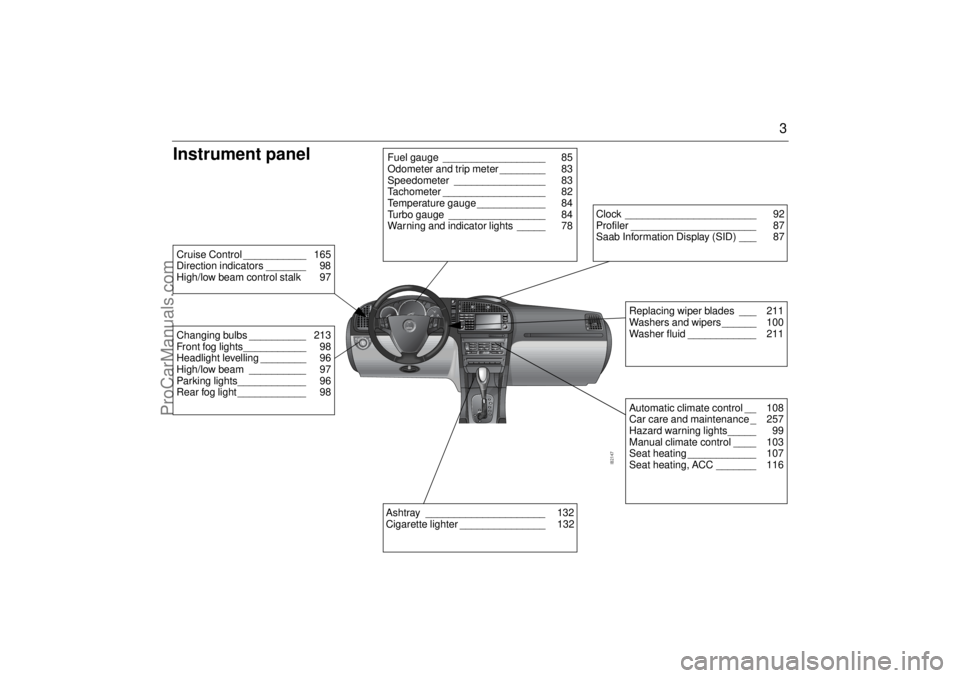
Instrument panelChanging bulbs __________ 213
Front fog lights___________ 98
Headlight levelling ________ 96
High/low beam __________ 97
Parking lights____________ 96
Rear fog light ____________ 98Cruise Control ___________ 165
Direction indicators _______ 98
High/low beam control stalk 97
Fuel gauge __________________ 85
Odometer and trip meter ________ 83
Speedometer ________________ 83
Tachometer __________________ 82
Temperature gauge ____________ 84
Turbo gauge _________________ 84
Warning and indicator lights _____ 78Ashtray _____________________ 132
Cigarette lighter _______________ 132
Clock _______________________ 92
Profiler ______________________ 87
Saab Information Display (SID) ___ 87
Replacing wiper blades ___ 211
Washers and wipers ______ 100
Washer fluid ____________ 211Automatic climate control __ 108
Car care and maintenance _ 257
Hazard warning lights_____ 99
Manual climate control ____ 103
Seat heating ____________ 107
Seat heating, ACC _______ 116
ProCarManuals.com
Page 7 of 292
5
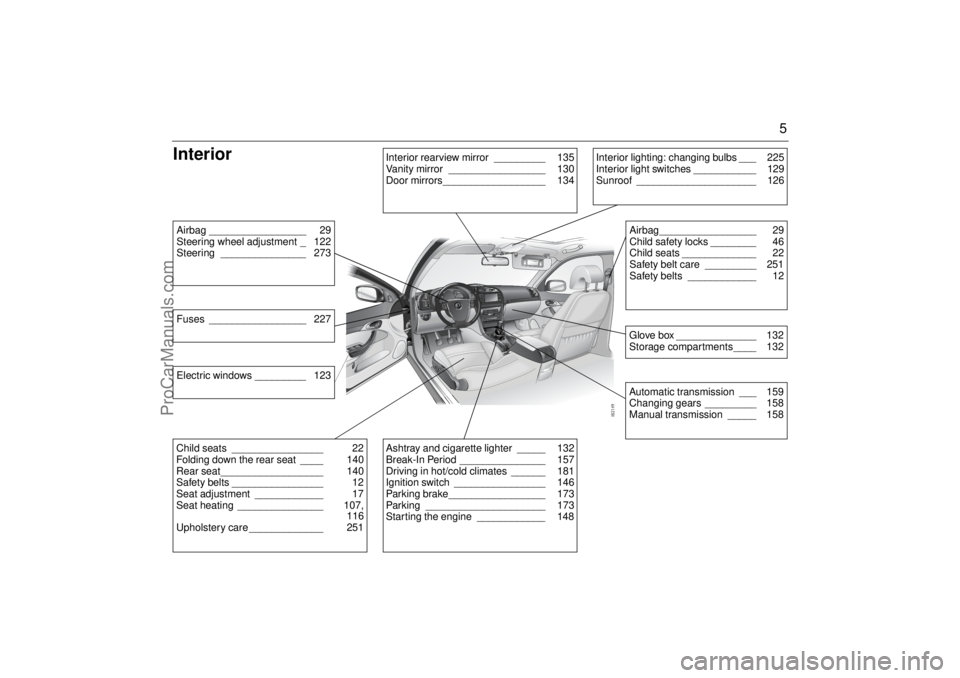
InteriorAirbag _________________ 29
Steering wheel adjustment _ 122
Steering _______________ 273
Interior rearview mirror _________ 135
Vanity mirror _________________ 130
Door mirrors__________________ 134
Airbag_________________ 29
Child safety locks ________ 46
Child seats _____________ 22
Safety belt care _________ 251
Safety belts ____________ 12Glove box ______________ 132
Storage compartments____ 132Automatic transmission ___ 159
Changing gears _________ 158
Manual transmission _____ 158
Child seats ________________ 22
Folding down the rear seat ____ 140
Rear seat__________________ 140
Safety belts ________________ 12
Seat adjustment ____________ 17
Seat heating _______________ 107,
116
Upholstery care _____________ 251
Interior lighting: changing bulbs ___ 225
Interior light switches ___________ 129
Sunroof _____________________ 126
Ashtray and cigarette lighter _____ 132
Break-In Period _______________ 157
Driving in hot/cold climates ______ 181
Ignition switch ________________ 146
Parking brake_________________ 173
Parking _____________________ 173
Starting the engine ____________ 148
Fuses _________________ 227Electric windows _________ 123
ProCarManuals.com
Page 11 of 292
9
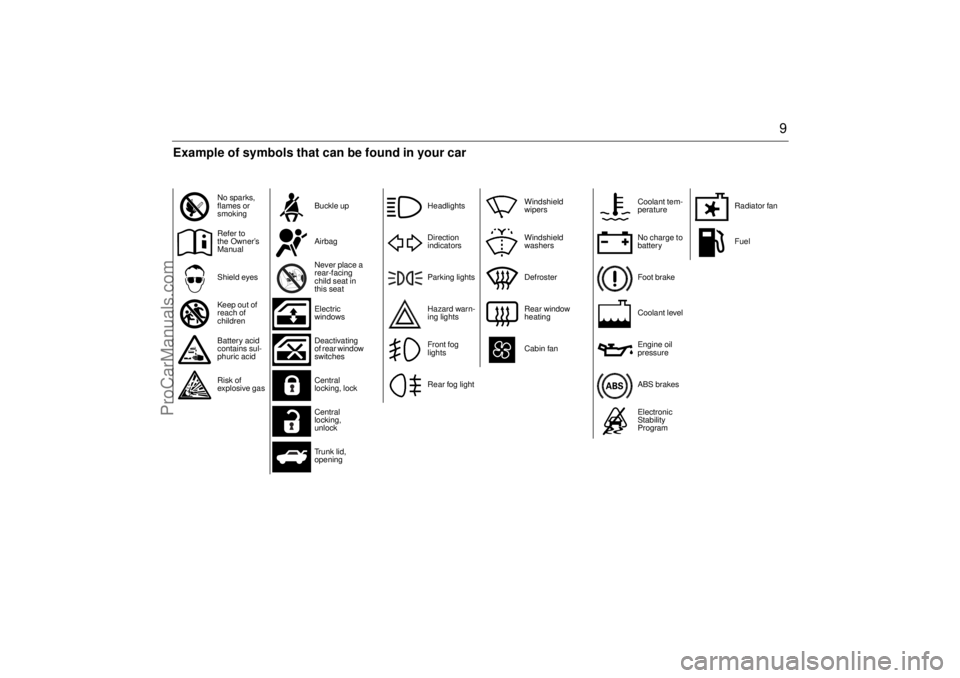
No sparks,
flames or
smokingBuckle up
Refer to
the Owner’s
ManualAirbag
Shield eyesNever place a
rear-facing
child seat in
this seat
Keep out of
reach of
childrenElectric
windows
Battery acid
contains sul-
phuric acidDeactivating
of rear window
switches
Risk of
explosive gasCentral
locking, lock
Central
locking,
unlock
Trunk lid,
opening
HeadlightsWindshield
wipers
Direction
indicatorsWindshield
washers
Parking lights Defroster
Hazard warn-
ing lightsRear window
heating
Front fog
lightsCabin fan
Rear fog light
Coolant tem-
peratureRadiator fan
No charge to
batteryFuel
Foot brake
Coolant level
Engine oil
pressure
ABS brakes
Electronic
Stability
Program
Example of symbols that can be found in your car
ProCarManuals.com
Page 19 of 292
17 Safety
SeatsManually adjusted front seats(if equipped)
The following front seat adjustments can be
made to achieve a comfortable driving
position:
Height
Sport Sedan - driver’s seat
Convertible - both seats
Legroom
Sport Sedan - both seats
Convertible - both seats
Backrest rake angle
Sport Sedan - both seats
Convertible - both seats
Lumbar support firmness
Sport Sedan - driver’s seat
Convertible - only electrically adjustable
front seats
Head restraint height
Sport Sedan - both seats
Convertible - both seatsWe recommend that adjustments to the
driver’s seat be performed in the following
order:
1Height
2 Legroom
3 Backrest rake angle
4 Head restraint height
Lastly, adjust the position of the steering
wheel (see page 122).
Electrically adjustable front seats
See page 19.
Electric heating, front seats (option)
See pages 107 and 116.
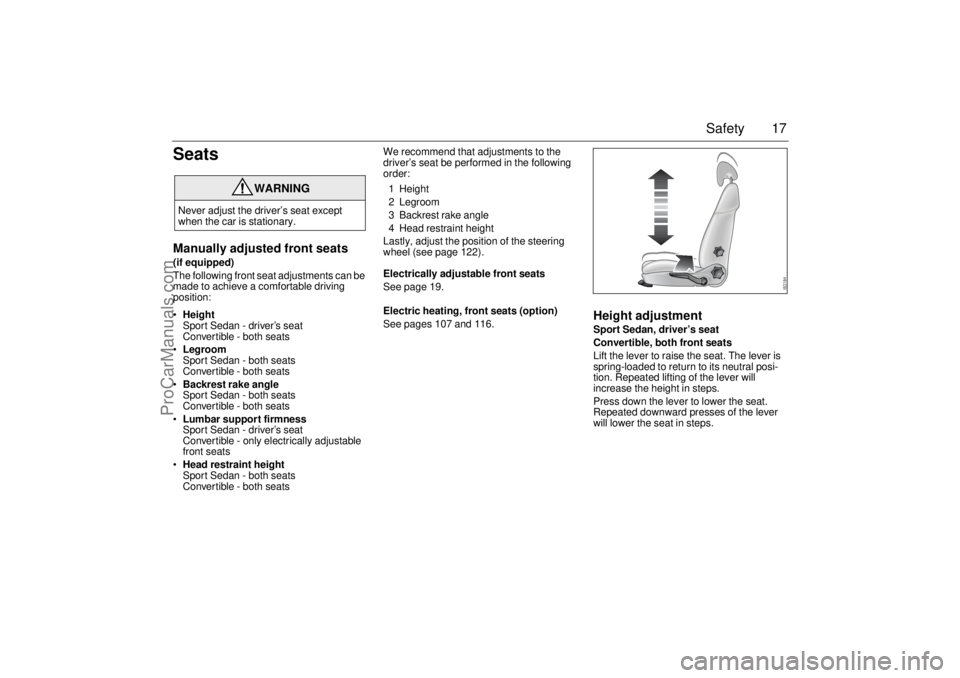
Height adjustmentSport Sedan, driver’s seat
Convertible, both front seats
Lift the lever to raise the seat. The lever is
spring-loaded to return to its neutral posi-
tion. Repeated lifting of the lever will
increase the height in steps.
Press down the lever to lower the seat.
Repeated downward presses of the lever
will lower the seat in steps.
WARNING
Never adjust the driver’s seat except
when the car is stationary.
ProCarManuals.com
Page 83 of 292
81 Instruments and controls
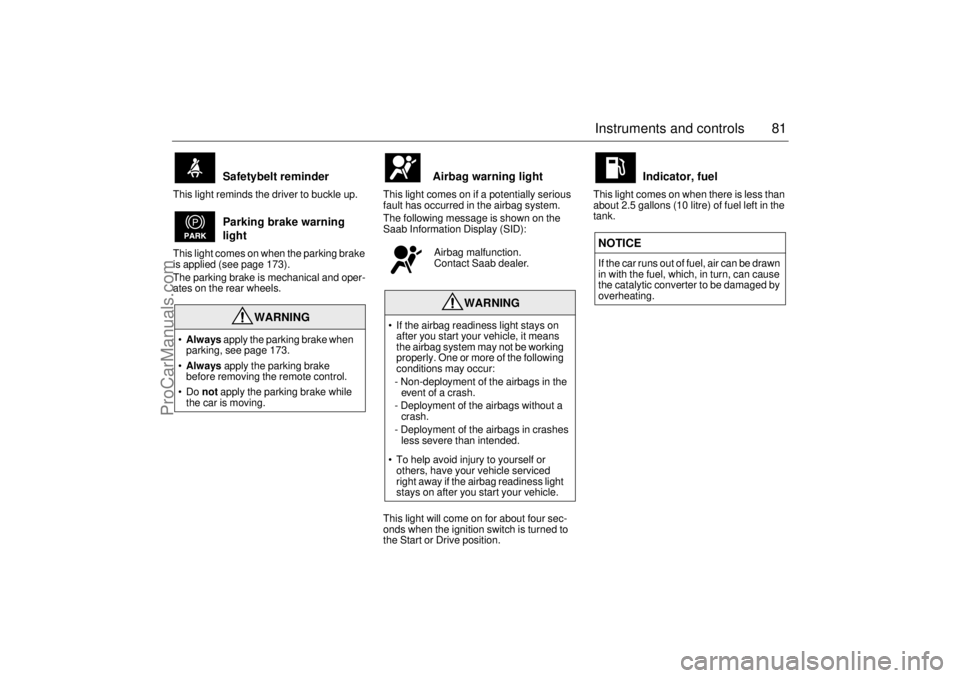
This light reminds the driver to buckle up.
This light comes on when the parking brake
is applied (see page 173).
The parking brake is mechanical and oper-
ates on the rear wheels.This light comes on if a potentially serious
fault has occurred in the airbag system.
The following message is shown on the
Saab Information Display (SID):
This light will come on for about four sec-
onds when the ignition switch is turned to
the Start or Drive position.This light comes on when there is less than
about 2.5 gallons (10 litre) of fuel left in the
tank.
Safetybelt reminder
Parking brake warning
light
WARNING
Always apply the parking brake when
parking, see page 173.
Always apply the parking brake
before removing the remote control.
Do not apply the parking brake while
the car is moving.
Airbag warning lightAirbag malfunction.
Contact Saab dealer.
WARNING
If the airbag readiness light stays on
after you start your vehicle, it means
the airbag system may not be working
properly. One or more of the following
conditions may occur:
- Non-deployment of the airbags in the
event of a crash.
- Deployment of the airbags without a
crash.
- Deployment of the airbags in crashes
less severe than intended.
To help avoid injury to yourself or
others, have your vehicle serviced
right away if the airbag readiness light
stays on after you start your vehicle.
Indicator, fuel
NOTICE
If the car runs out of fuel, air can be drawn
in with the fuel, which, in turn, can cause
the catalytic converter to be damaged by
overheating.
ProCarManuals.com
Page 105 of 292
103 Instruments and controls
Manual climate-control
systemFresh air for the cabin is drawn in through an
inlet grille at the bottom edge of the wind-
shield. It passes through a filter before
reaching the climate control system and
delivery into the cabin. The air is evacuated
via openings in the parcel shelf. It is then led
through outlets on either side of the car
behind the rear bumper.
The incoming air is treated in three stages:
first it passes through a filter; it is then dehu-
midified and cooled; and finally, if required,
it is heated.
To optimize the performance of the A/C sys-
tem, all windows and the sunroof should be
shut.
To reduce potential misting on the insides of
the windows, the glass should be cleaned
with a quality glass cleaner. How often this
will need to be done depends on how clean
the air is - if there are smokers in the car, the
windows will need to be cleaned more fre-
quently.
The output of air is controlled by the fan
speed.
Temperature controlThe temperature of the incoming air can
be infinitely varied using the temperature
control.
Fan
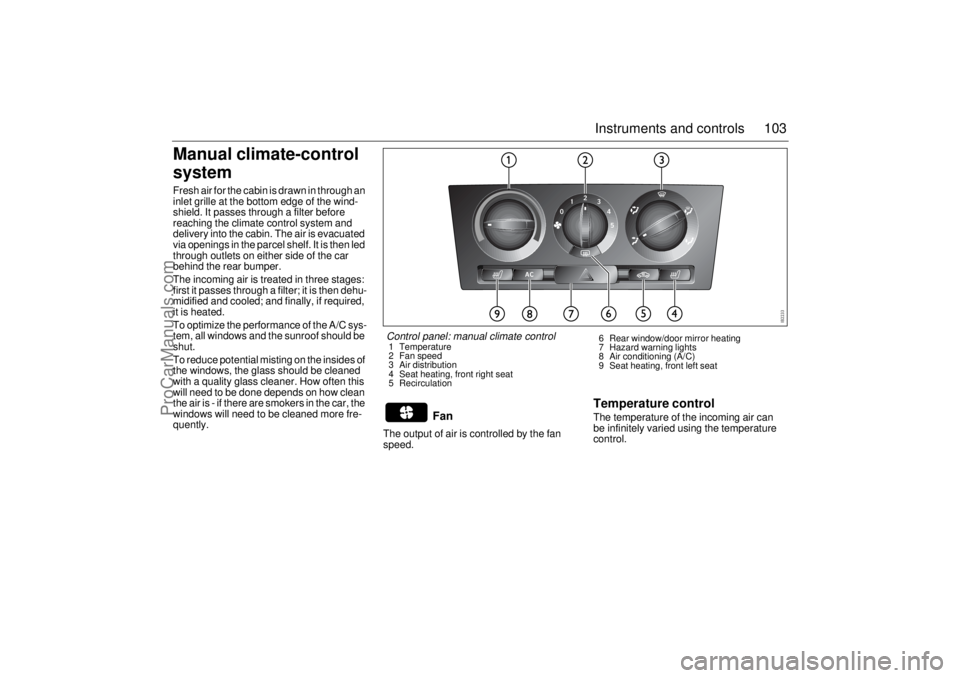
Control panel: manual climate control1 Temperature
2 Fan speed
3 Air distribution
4 Seat heating, front right seat
5 Recirculation6 Rear window/door mirror heating
7 Hazard warning lights
8 Air conditioning (A/C)
9 Seat heating, front left seat
ProCarManuals.com
Page 109 of 292

107 Instruments and controls
This button is located under the fan speed
control.
Always switch off the heating as soon as the
rear window is free from ice and mist. It will
be turned off automatically after 12 minutes.
Refrain from placing sharp objects on the
parcel shelf, to avoid damaging the heating
element.
Convertible: The rear window heating is
not turned on if the soft top is folded down.The seat cushions and backrests of the front
seats are heated.
The heating is thermostatically controlled
and set at approx. 104°F (40°C).
Switch off the seat heating once the seat is
warm.
Electrically heated rear
window/external mirrors
Electric heating, front
seats (option)
ProCarManuals.com
Page 110 of 292
108 Instruments and controlsAutomatic climate-
control system (ACC)Fresh air for the cabin is drawn in through an
inlet at the bottom edge of the windshield. It
passes through an effective filter before
reaching the climate control system and
delivery into the cabin. The air is evacuated
via openings in the parcel shelf. It is then led
through outlets on either side of the car
behind the rear bumper.
The Automatic Climate-Control system
(ACC) automatically maintains the desired
cabin temperature, regardless of the
weather outside.
The system will achieve the desired temper-
ature in the quickest possible way.
Note that heating or cooling is not
speeded up by setting the temperature
higher or lower than the final tempera-
ture you desire.
To optimize the performance of the air con-
ditioning system, all windows and the sun-
roof should be shut. The air vents in the
fascia must be open.
The incoming air is treated in three stages:
first it passes through a filter; it is then dehu-
midified and cooled; and finally, if required,
it is heated.To reduce potential misting on the insides of
the windows, the glass should be cleaned
with a quality glass cleaner. How often this
will need to be done depends on how clean
the air is - if there are smokers in the car, the
windows will need to be cleaned more
frequently.
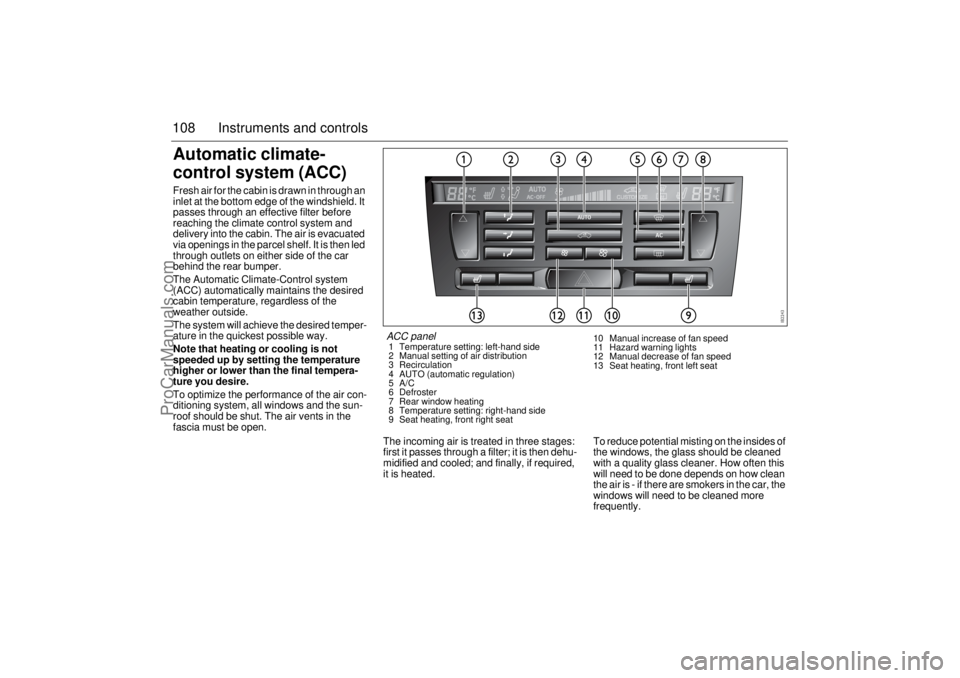
ACC panel1 Temperature setting: left-hand side
2 Manual setting of air distribution
3 Recirculation
4 AUTO (automatic regulation)
5A/C
6 Defroster
7 Rear window heating
8 Temperature setting: right-hand side
9 Seat heating, front right seat10 Manual increase of fan speed
11 Hazard warning lights
12 Manual decrease of fan speed
13 Seat heating, front left seat
ProCarManuals.com
Page 111 of 292
109 Instruments and controls
Temperature controlThe cabin is divided into two temperature
zones:
1 Driver’s zone.
2 Passenger zone.
The temperature in the rear seat will be a
mixture of the two zones.
If you choose the single zone setting, the
entire cabin is treated as one zone. If you
choose the dual zone setting, settings can
be made separately for the driver’s zone
and passenger zone.
Select between single and dual zone set-
tings under Profiler (see page 117).
The cabin temperature can be set to
between 58–82°F (15–27°C). In addition, HI
(maximum heating and high fan speed) and
LO (maximum cooling and maximum fan
speed) can be selected. HI and LO can only
be selected for the passenger zone if the
driver has selected the same setting.The displayed temperature is not the actual
air temperature but corresponds to the
comfort level normally experienced at that
temperature after allowance has been
made for the airflow, relative humidity, solar
radiation, and so on, currently prevailing
inside the car.
The most usual temperature setting is
between 66–74°F (19–23°C), depending
on personal preference and what clothing
is worn.
Change the temperature setting in 2°F
(1°C) steps.
Make sure the air vents are open when
cooling the cabin in warm weather.
Settings when HI is selected:
Maximum heat
Air distribution to windshield and floor
High fan speed (6 bars on the fan display).
Settings when LO is selected:
Maximum cooling
Air distribution to air vents in fascia
Maximum fan speed (8 bars on the fan
display).
Recirculation ON (depending on outside
temperature).
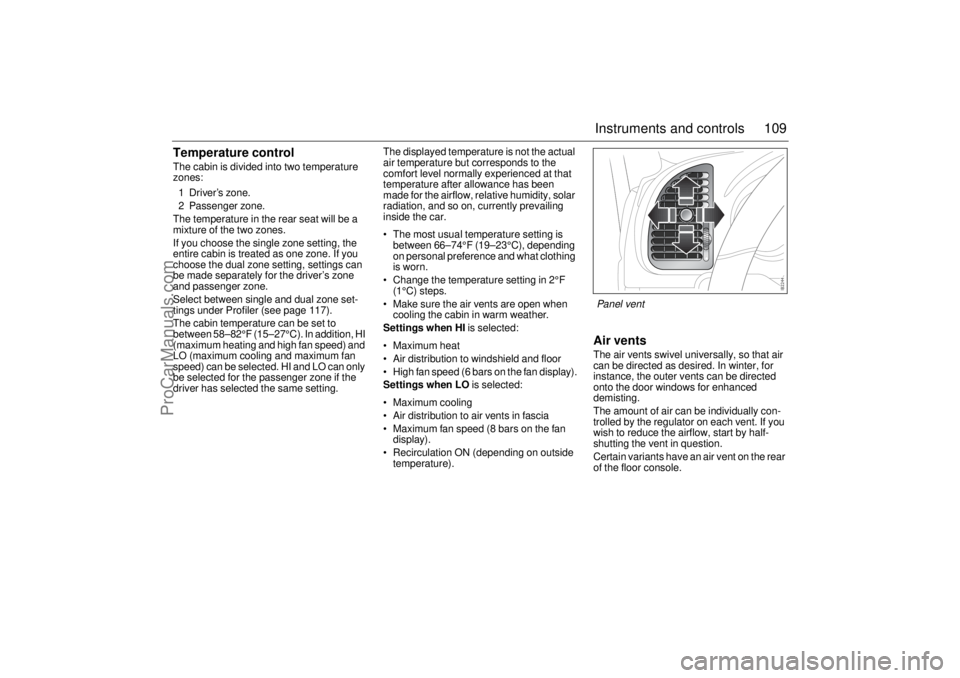
Air ventsThe air vents swivel universally, so that air
can be directed as desired. In winter, for
instance, the outer vents can be directed
onto the door windows for enhanced
demisting.
The amount of air can be individually con-
trolled by the regulator on each vent. If you
wish to reduce the airflow, start by half-
shutting the vent in question.
Certain variants have an air vent on the rear
of the floor console.Panel vent
ProCarManuals.com
Page 114 of 292
112 Instruments and controls
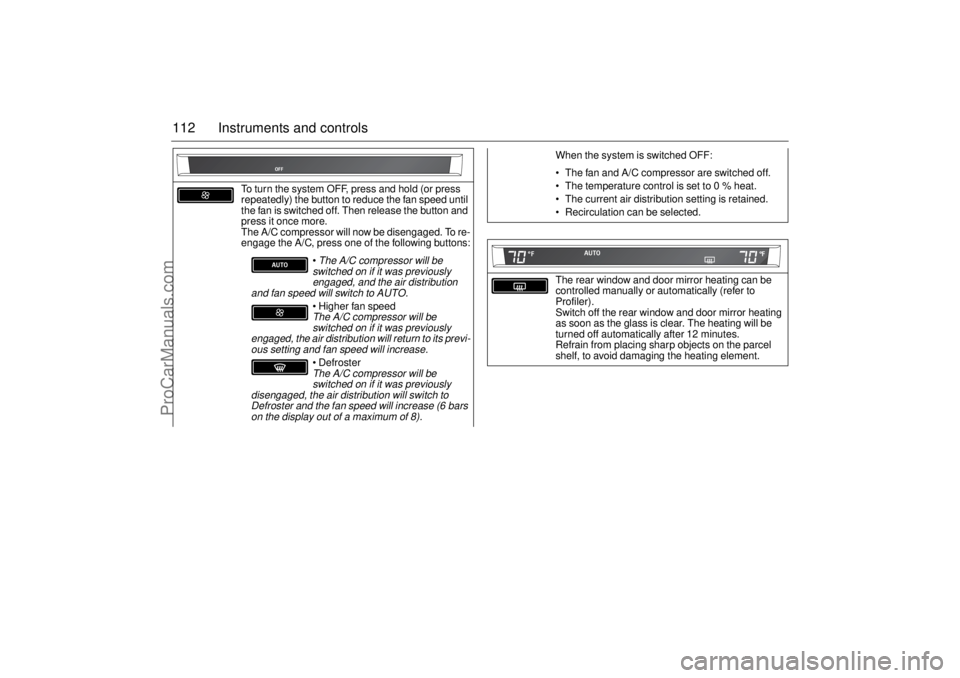
To turn the system OFF, press and hold (or press
repeatedly) the button to reduce the fan speed until
the fan is switched off. Then release the button and
press it once more.
The A/C compressor will now be disengaged. To re-
engage the A/C, press one of the following buttons:
The A/C compressor will be
switched on if it was previously
engaged, and the air distribution
and fan speed will switch to AUTO. Higher fan speed The A/C compressor will be
switched on if it was previously
engaged, the air distribution will return to its previ-
ous setting and fan speed will increase. Defroster The A/C compressor will be
switched on if it was previously
disengaged, the air distribution will switch to
Defroster and the fan speed will increase (6 bars
on the display out of a maximum of 8).
When the system is switched OFF:
The fan and A/C compressor are switched off.
The temperature control is set to 0 % heat.
The current air distribution setting is retained.
Recirculation can be selected.
The rear window and door mirror heating can be
controlled manually or automatically (refer to
Profiler).
Switch off the rear window and door mirror heating
as soon as the glass is clear. The heating will be
turned off automatically after 12 minutes.
Refrain from placing sharp objects on the parcel
shelf, to avoid damaging the heating element.
ProCarManuals.com