warning SAAB 9-3 2006 Owners Manual
[x] Cancel search | Manufacturer: SAAB, Model Year: 2006, Model line: 9-3, Model: SAAB 9-3 2006Pages: 318, PDF Size: 28.05 MB
Page 187 of 318
187 Starting and driving
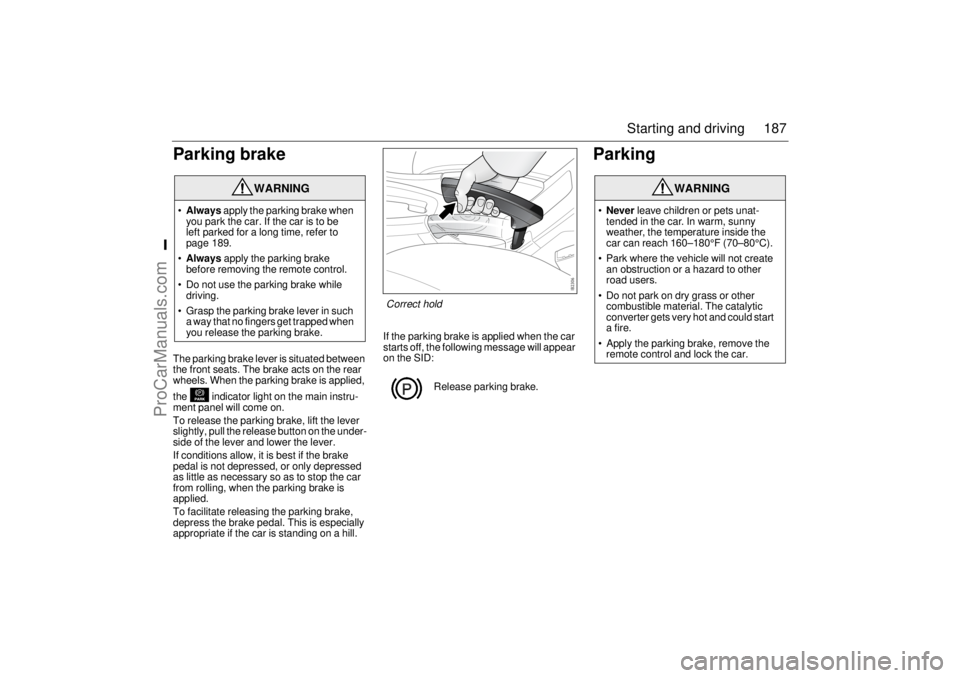
Parking brakeThe parking brake lever is situated between
the front seats. The brake acts on the rear
wheels. When the parking brake is applied,
the indicator light on the main instru-
ment panel will come on.
To release the parking brake, lift the lever
slightly, pull the release button on the under-
side of the lever and lower the lever.
If conditions allow, it is best if the brake
pedal is not depressed, or only depressed
as little as necessary so as to stop the car
from rolling, when the parking brake is
applied.
To facilitate releasing the parking brake,
depress the brake pedal. This is especially
appropriate if the car is standing on a hill.If the parking brake is applied when the car
starts off, the following message will appear
on the SID:
Parking
WARNING
Always apply the parking brake when
you park the car. If the car is to be
left parked for a long time, refer to
page 189.
Always apply the parking brake
before removing the remote control.
Do not use the parking brake while
driving.
Grasp the parking brake lever in such
a way that no fingers get trapped when
you release the parking brake.
Release parking brake.
WARNING
Never leave children or pets unat-
tended in the car. In warm, sunny
weather, the temperature inside the
car can reach 160–180°F (70–80°C).
Park where the vehicle will not create
an obstruction or a hazard to other
road users.
Do not park on dry grass or other
combustible material. The catalytic
converter gets very hot and could start
a fire.
Apply the parking brake, remove the
remote control and lock the car.
Correct hold
93U S M 06.book Page 187 Friday, February 18, 2005 1:15 PM
ProCarManuals.com
Page 190 of 318
190 Starting and drivingSaab Parking
Assistance3Saab Parking Assistance
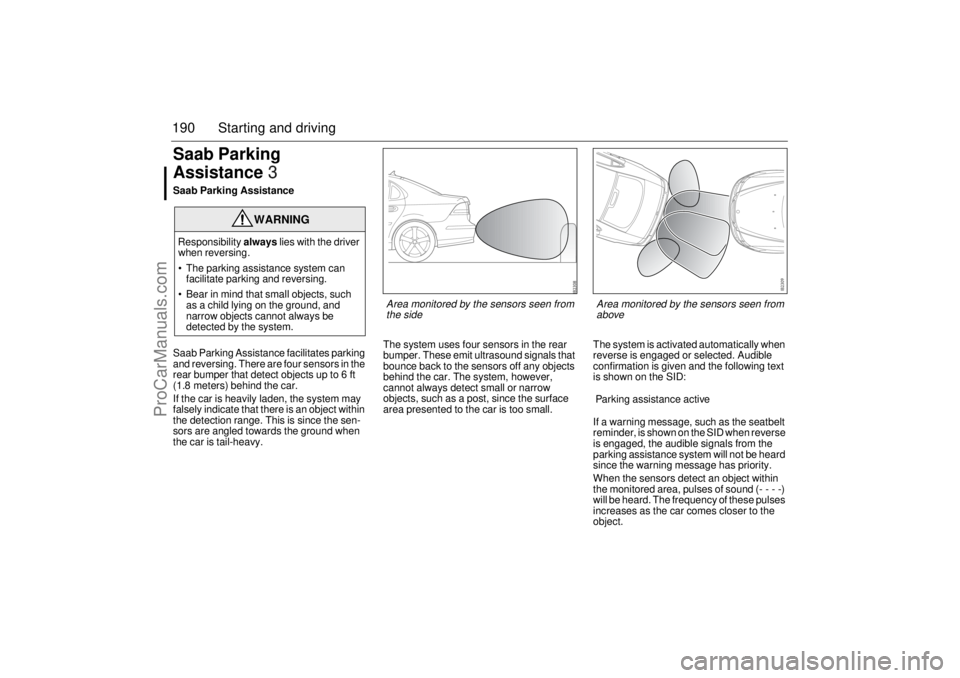
Saab Parking Assistance facilitates parking
and reversing. There are four sensors in the
rear bumper that detect objects up to 6 ft
(1.8 meters) behind the car.
If the car is heavily laden, the system may
falsely indicate that there is an object within
the detection range. This is since the sen-
sors are angled towards the ground when
the car is tail-heavy.The system uses four sensors in the rear
bumper. These emit ultrasound signals that
bounce back to the sensors off any objects
behind the car. The system, however,
cannot always detect small or narrow
objects, such as a post, since the surface
area presented to the car is too small.The system is activated automatically when
reverse is engaged or selected. Audible
confirmation is given and the following text
is shown on the SID:
If a warning message, such as the seatbelt
reminder, is shown on the SID when reverse
is engaged, the audible signals from the
parking assistance system will not be heard
since the warning message has priority.
When the sensors detect an object within
the monitored area, pulses of sound (- - - -)
will be heard. The frequency of these pulses
increases as the car comes closer to the
object.
WARNING
Responsibility always lies with the driver
when reversing.
The parking assistance system can
facilitate parking and reversing.
Bear in mind that small objects, such
as a child lying on the ground, and
narrow objects cannot always be
detected by the system.
Parking assistance active
Area monitored by the sensors seen from
the side
Area monitored by the sensors seen from
above
93U S M 06.book Page 190 Friday, February 18, 2005 1:15 PM
ProCarManuals.com
Page 194 of 318

194 Starting and drivingengine wear is at its greatest during this
period. Drive off as soon as possible after
starting the engine and avoid high engine
speeds.
Drive as smoothly and thoughtfully as
possible. Match your driving to the prevail-
ing traffic conditions.
Driving in a low gear gives rise to higher
fuel consumption than driving in a high
gear because of the higher engine speed
for any given road speed. Always shift up
as soon as traffic conditions allow and
drive in the highest gear as much as
possible.
Check the tire pressure once a month.
Incorrect tire pressure increases tire
wear. It is preferable for the tire pressure
to be slightly high than too low. Under-
pressure increases fuel consumption. Check the fuel consumption regularly.
Increased fuel consumption can indicate
that something is wrong and that the car
needs to be checked. We recommend
that you contact a Saab dealer.
Practical road tests have demonstrated that
substantial savings in fuel consumption can
be made if the above advice is followed.
Road conditionsWet roads increase fuel consumption, as do
unpaved roads and driving in hilly country
(the amount of fuel saved driving downhill is
less than the additional amount required to
climb the hill).
Engine block heater3The following are just some of the benefits
to the car and the environment of using an
engine block heater:
Lower fuel consumption.
Reduced wear on the engine.
Inside of car warms up faster.
Exhaust emissions substantially reduced
over short runs.
The engine heater is effective at outside
temperatures up to 60–70°F (+15–+20°C).
The warmer it is outside, the shorter the time
the engine heater needs to be connected.
Longer than 1.5 hours is unnecessary.
If the car is equipped with a removable,
electric cabin heater that is not in use, store
this in the trunk.
WARNING
Never switch off the engine while driving
as the effect of the brakes and power
steering will be greatly reduced.
93U S M 06.book Page 194 Friday, February 18, 2005 1:15 PM
ProCarManuals.com
Page 196 of 318

196 Starting and drivingRemember that tires age: it may therefore
be necessary to change winter tires before
they reach the legal wear limit, as they grad-
ually lose their friction properties with age.
If you get into a front wheel skid and the car
has a manual transmission, the best
response is to freewheel, which means
declutching so that the wheels neither drive
nor brake, and to cautiously steer in the
desired direction.
If the car has automatic transmission, ease
off the accelerator slightly and steer cau-
tiously in the desired direction.
If you get into a rear wheel skid, steer in the
same direction as the movement of the rear
of the car.
Driving with tire chains3Snow chains must only be fitted to the wheel
and tire dimensions that Saab recommends
in "Technical data" on page 293.
We recommend that you contact a Saab
dealer regarding approved tire chains. See
also page 263.
WARNING
Do not drive at speeds above 30 mph
(50 km/h) when tire chains are fitted.
Tire chains can reduce directional
stability.
Do not fit tire chains to the car’s rear
wheels.NOTICE Check the links frequently for wear.
Check that the chains do not foul the
wheel arch liner at full lock.
Refer to the "Technical data" section
on page 293, for information on wheel
and tire dimensions approved for the
fitting of tire chains.
93U S M 06.book Page 196 Friday, February 18, 2005 1:15 PM
ProCarManuals.com
Page 197 of 318

197 Starting and driving
Driving in hot climatesAlways check the coolant level before start-
ing a journey. When the engine is cold, the
coolant must not lie above the KALT/COLD
mark on the expansion tank (boundary
between the upper and lower sections of the
tank).
At the end of a journey, allow the engine to
idle for 2–3 minutes before switching it off.
If the needle on the temperature gauge
enters the red zone, the following message
will be shown on the SID:
1 Stop the car but do not switch off the
engine. Do not remove the cap on the
cooling system expansion tank, even if
the tank is empty. The engine tempera-
ture should decrease. If the temperature
continues to rise with the engine idling,
the engine must be switched off.2 If the engine is idling and the needle on
the temperature gauge falls, wait until a
normal temperature is shown (about in
the middle of the scale) before switching
off the engine. If the coolant needs to be
topped up, carefully unscrew the
expansion tank cap.
Fill as required with a mixture of 50 %
antifreeze and 50 % clean water. Use an
antifreeze approved by Saab.
3 Have the car’s cooling system checked.
We recommend that you contact a Saab
dealer. Hot engine.
Make a safe stop.
Run engine on idle.
WARNING
Exercise care when opening the hood
if the engine is overheated. Never
remove the expansion tank cap
completely when the engine is hot.
The cooling system is pressurized -
hot coolant and vapour can escape.
These can cause injury to your eyes
and burns. Open the cap slowly to
release the pressure before removing
it.
93U S M 06.book Page 197 Friday, February 18, 2005 1:15 PM
ProCarManuals.com
Page 198 of 318
198 Starting and drivingTowing a trailer3Make sure you are familiar with the legal
requirements regarding speed limits for
towing, maximum trailer weights, trailer
braking requirements, and also any spe-
cial driving licence provisions.
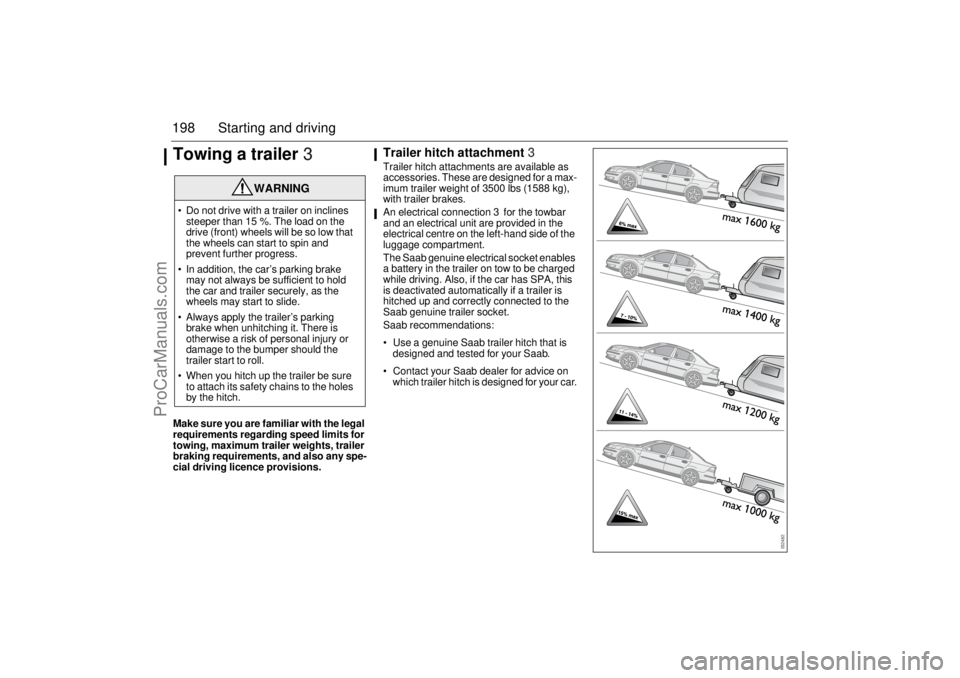
Trailer hitch attachment3Trailer hitch attachments are available as
accessories. These are designed for a max-
imum trailer weight of 3500 lbs (1588 kg),
with trailer brakes.
An electrical connection3 for the towbar
and an electrical unit are provided in the
electrical centre on the left-hand side of the
luggage compartment.
The Saab genuine electrical socket enables
a battery in the trailer on tow to be charged
while driving. Also, if the car has SPA, this
is deactivated automatically if a trailer is
hitched up and correctly connected to the
Saab genuine trailer socket.
Saab recommendations:
Use a genuine Saab trailer hitch that is
designed and tested for your Saab.
Contact your Saab dealer for advice on
which trailer hitch is designed for your car.
WARNING
Do not drive with a trailer on inclines
steeper than 15 %. The load on the
drive (front) wheels will be so low that
the wheels can start to spin and
prevent further progress.
In addition, the car’s parking brake
may not always be sufficient to hold
the car and trailer securely, as the
wheels may start to slide.
Always apply the trailer’s parking
brake when unhitching it. There is
otherwise a risk of personal injury or
damage to the bumper should the
trailer start to roll.
When you hitch up the trailer be sure
to attach its safety chains to the holes
by the hitch.93U S M 06.book Page 198 Friday, February 18, 2005 1:15 PM
ProCarManuals.com
Page 199 of 318
199 Starting and driving
Recommendations for cars with
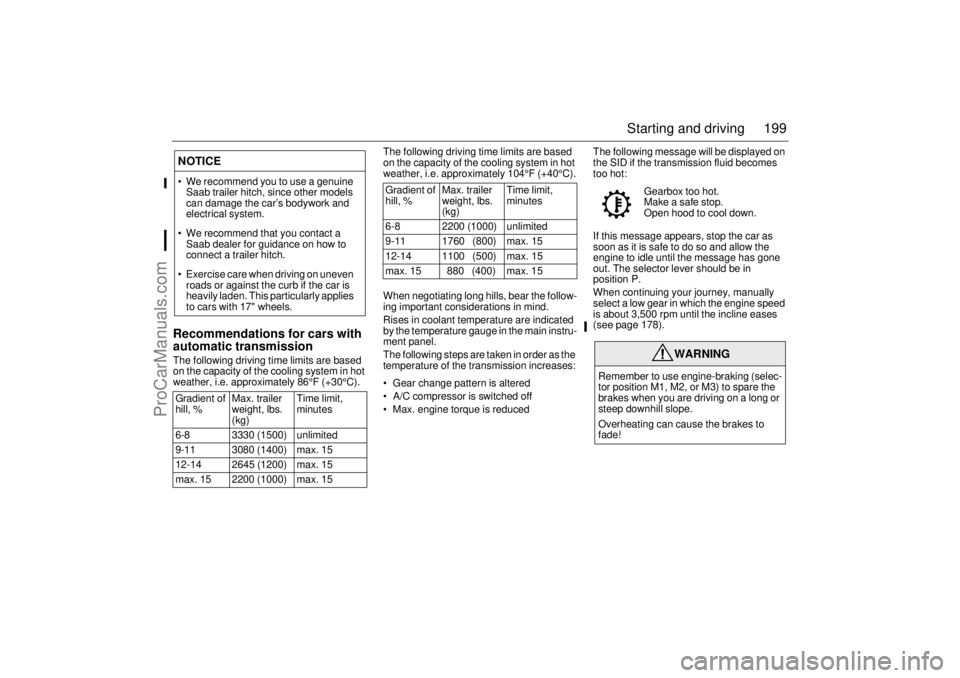
automatic transmissionThe following driving time limits are based
on the capacity of the cooling system in hot
weather, i.e. approximately 86°F (+30°C).The following driving time limits are based
on the capacity of the cooling system in hot
weather, i.e. approximately 104°F (+40°C).
When negotiating long hills, bear the follow-
ing important considerations in mind.
Rises in coolant temperature are indicated
by the temperature gauge in the main instru-
ment panel.
The following steps are taken in order as the
temperature of the transmission increases:
Gear change pattern is altered
A/C compressor is switched off
Max. engine torque is reducedThe following message will be displayed on
the SID if the transmission fluid becomes
too hot:
If this message appears, stop the car as
soon as it is safe to do so and allow the
engine to idle until the message has gone
out. The selector lever should be in
position P.
When continuing your journey, manually
select a low gear in which the engine speed
is about 3,500 rpm until the incline eases
(see page 178).NOTICE We recommend you to use a genuine
Saab trailer hitch, since other models
can damage the car’s bodywork and
electrical system.
We recommend that you contact a
Saab dealer for guidance on how to
connect a trailer hitch.
Exercise care when driving on uneven
roads or against the curb if the car is
heavily laden. This particularly applies
to cars with 17" wheels.
Gradient of
hill, %Max. trailer
weight, lbs.
(kg)Time limit,
minutes
6-8 3330 (1500) unlimited
9-11 3080 (1400) max. 15
12-14 2645 (1200) max. 15
max. 15 2200 (1000) max. 15
Gradient of
hill, %Max. trailer
weight, lbs.
(kg)Time limit,
minutes
6-8 2200 (1000) unlimited
9-11 1760 (800) max. 15
12-14 1100 (500) max. 15
max. 15 880 (400) max. 15
Gearbox too hot.
Make a safe stop.
Open hood to cool down.
WARNING
Remember to use engine-braking (selec-
tor position M1, M2, or M3) to spare the
brakes when you are driving on a long or
steep downhill slope.
Overheating can cause the brakes to
fade!
93U S M 06.book Page 199 Friday, February 18, 2005 1:15 PM
ProCarManuals.com
Page 200 of 318
200 Starting and drivingRecommendations for cars with
manual transmissionRises in coolant temperature are indicated
by the temperature gauge in the main instru-
ment panel.
When the needle is just outside the red
zone, the A/C compressor will be switched
off and, on certain engine variants, the max-
imum engine torque will be limited.
When continuing your journey, select a low
gear in which the engine speed is about
3,500 rpm until the incline eases.
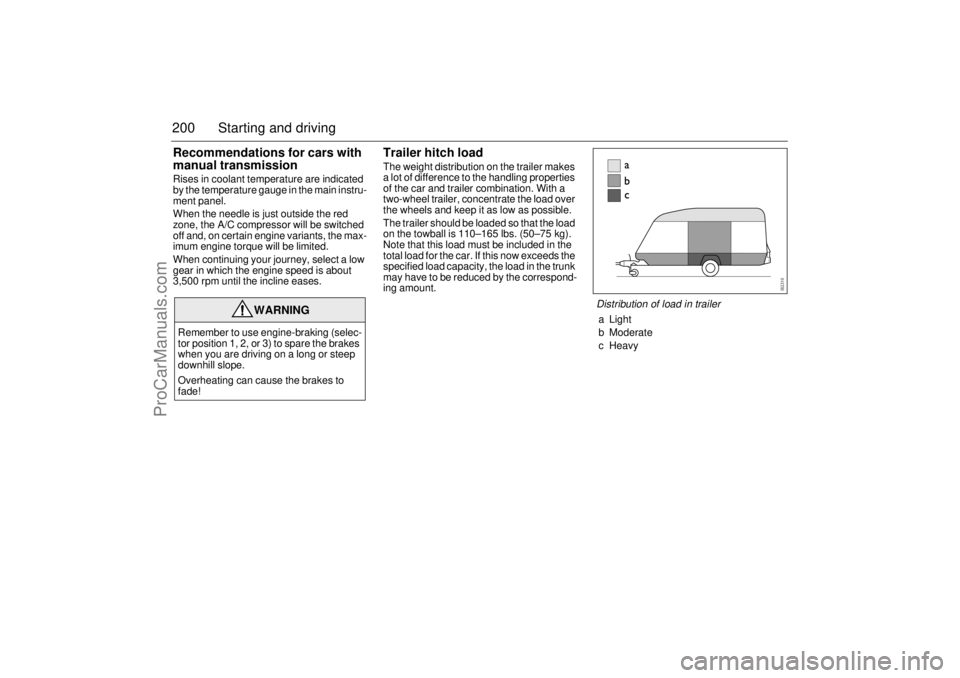
Trailer hitch loadThe weight distribution on the trailer makes
a lot of difference to the handling properties
of the car and trailer combination. With a
two-wheel trailer, concentrate the load over
the wheels and keep it as low as possible.
The trailer should be loaded so that the load
on the towball is 110–165 lbs. (50–75 kg).
Note that this load must be included in the
total load for the car. If this now exceeds the
specified load capacity, the load in the trunk
may have to be reduced by the correspond-
ing amount.
WARNING
Remember to use engine-braking (selec-
tor position 1, 2, or 3) to spare the brakes
when you are driving on a long or steep
downhill slope.
Overheating can cause the brakes to
fade!
Distribution of load in trailera Light
b Moderate
cHeavy
93U S M 06.book Page 200 Friday, February 18, 2005 1:15 PM
ProCarManuals.com
Page 202 of 318
202 Starting and drivingDriving with a roof rack
loadThe maximum permissible roof load is
220 lbs. (100 kg). Note that the roof load
must be included in the car’s maximum per-
missible payload and axle load.
Strong, sturdy roof carriers designed spe-
cially for your car are available from your
Saab dealer. Always secure roof loads
securely.
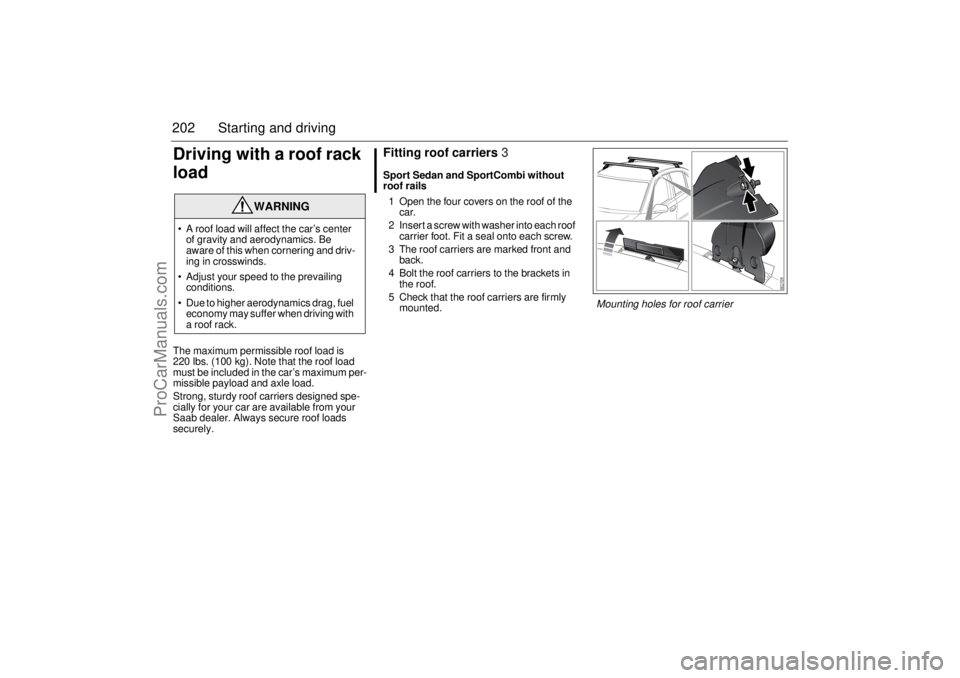
Fitting roof carriers3Sport Sedan and SportCombi without
roof rails
1 Open the four covers on the roof of the
car.
2 Insert a screw with washer into each roof
carrier foot. Fit a seal onto each screw.
3 The roof carriers are marked front and
back.
4 Bolt the roof carriers to the brackets in
the roof.
5 Check that the roof carriers are firmly
mounted.
WARNING
A roof load will affect the car’s center
of gravity and aerodynamics. Be
aware of this when cornering and driv-
ing in crosswinds.
Adjust your speed to the prevailing
conditions.
Due to higher aerodynamics drag, fuel
economy may suffer when driving with
a roof rack.
Mounting holes for roof carrier
93U S M 06.book Page 202 Friday, February 18, 2005 1:15 PM
ProCarManuals.com
Page 204 of 318

204 Starting and drivingDriving with a loadThe handling characteristics are affected by
how the car is loaded.
Driving with the trunk lid
openIf you must drive with the trunk lid open,
close all windows and the sunroof (if
equipped) and set the cabin fan to its high-
est speed setting.
Driving in deep water
NOTICE Place the heaviest load as far forward
and as low as possible in the trunk.
Secure the load to the lashing eyes
(see page 149).
Heavy loads mean that the car’s
center of gravity is further back. As a
result, the car will sway more during
evasive steering.
Never exceed the permissible load of
the roof box, even if there is room for
more.
Ensure that the tire pressure is correct
– slight overinflation is preferable to
underinflation.
The braking distance of a loaded car is
always greater. Keep your distance
from the vehicle in front.
Do not exceed the car’s permissible
gross vehicle weight or axle load (see
page 294).
Roof loads can negatively affect tele-
communication.
For further information on tires see
page 256.
WARNING
Avoid driving with the trunk lid partly or
fully open, since exhaust fumes can be
drawn into the cabin.
NOTICEDo not drive in puddles or water deeper
than 7 in. (20 cm) and do not drive faster
than 3–4 mph. Water can otherwise be
sucked into the engine. The engine will be
seriously damaged if water enters the
intake system.
93U S M 06.book Page 204 Friday, February 18, 2005 1:15 PM
ProCarManuals.com