steering wheel SAAB 9-3 2006 Owner's Manual
[x] Cancel search | Manufacturer: SAAB, Model Year: 2006, Model line: 9-3, Model: SAAB 9-3 2006Pages: 318, PDF Size: 28.05 MB
Page 162 of 318
162 Starting and drivingSteering wheel lockThe steering wheel lock is electronic. The
lock engages when the remote control is
removed from the ignition and unlocks when
the remote control is inserted. A click can be
heard when the steering wheel lock locks
and unlocks.
If the car is parked with one front wheel
touching the curb, for example, you may
need to turn the steering wheel slightly
when you insert the remote control to allow
the steering wheel lock to unlock. If you do
not succeed on first attempt you must
remove the remote control before trying
again. Turn the steering wheel and insert
the remote control into the ignition switch.
If the steering wheel lock does not disen-
gage it will not be possible to turn the remote
control in the ignition switch.
The following message is shown on the SID:If a fault arises affecting the steering wheel
lock, the following message will be
displayed on the SID:
If the steering wheel lock malfunctions while
the remote control is in the ignition switch,
this may prevent the removal of the remote
control or prevent the car from being
restarted once the engine has been
switched off.
If you have to leave the car, lock the car by
pressing down the lock buttons on the
doors. Lock the front left door from outside
with the traditional key (see page 52). The
car is now locked but the alarm is inactive.
Starting the engine
Steering wheel locked.
Pull out key, turn steering
wheel. Try again.
Steering lock malfunc.
Make a safe stop.
Contact Saab dealer.
WARNING
When starting the engine:
- Sit down in the driver’s seat.
- Depress the clutch pedal fully (M/T). If
the gear lever is not in the neutral posi-
tion, the clutch pedal must be fully
depressed or the car will jump
forwards or backwards, which may
cause a crash.
- Never start the car from outside the
vehicle, e.g. through a window that is
down. This could lead to serious
personal injury.
Cars with automatic transmission:
select position P to remove the ignition
key. The key can only be removed in
this gear position.
Carbon monoxide (CO) is a colorless,
odorless, poisonous gas. Be alert to
the danger of CO – always open the
garage doors before starting the
engine in the garage.
Do not rest or sleep in the car when
parked with the engine running. There
is a risk of depressing the accelerator
which could lead to engine damage.
There is also a danger of CO poison-
ing if the exhaust system is leaking.
93U S M 06.book Page 162 Friday, February 18, 2005 1:15 PM
ProCarManuals.com
Page 178 of 318
178 Starting and driving
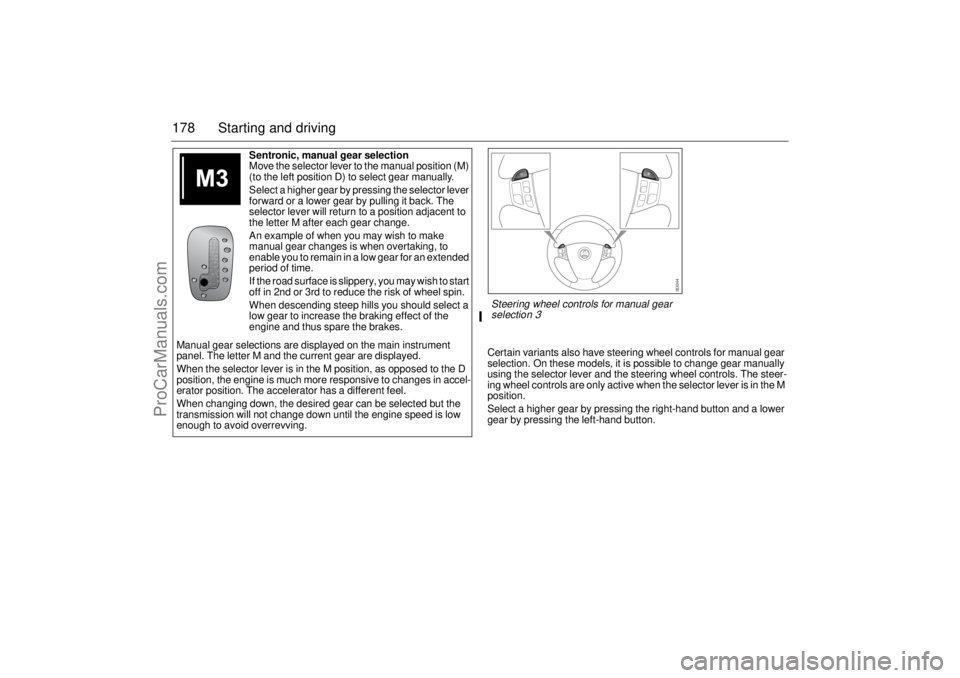
Certain variants also have steering wheel controls for manual gear
selection. On these models, it is possible to change gear manually
using the selector lever and the steering wheel controls. The steer-
ing wheel controls are only active when the selector lever is in the M
position.
Select a higher gear by pressing the right-hand button and a lower
gear by pressing the left-hand button. Sentronic, manual gear selection
Move the selector lever to the manual position (M)
(to the left position D) to select gear manually.
Select a higher gear by pressing the selector lever
forward or a lower gear by pulling it back. The
selector lever will return to a position adjacent to
the letter M after each gear change.
An example of when you may wish to make
manual gear changes is when overtaking, to
enable you to remain in a low gear for an extended
period of time.
If the road surface is slippery, you may wish to start
off in 2nd or 3rd to reduce the risk of wheel spin.
When descending steep hills you should select a
low gear to increase the braking effect of the
engine and thus spare the brakes.
Manual gear selections are displayed on the main instrument
panel. The letter M and the current gear are displayed.
When the selector lever is in the M position, as opposed to the D
position, the engine is much more responsive to changes in accel-
erator position. The accelerator has a different feel.
When changing down, the desired gear can be selected but the
transmission will not change down until the engine speed is low
enough to avoid overrevving.Steering wheel controls for manual gear
selection
3
93U S M 06.book Page 178 Friday, February 18, 2005 1:15 PM
ProCarManuals.com
Page 182 of 318
182 Starting and drivingThe ABS system will not reduce the braking
distance on loose gravel, snow or ice but,
because the wheels cannot lock up, steer-
ing control is retained.
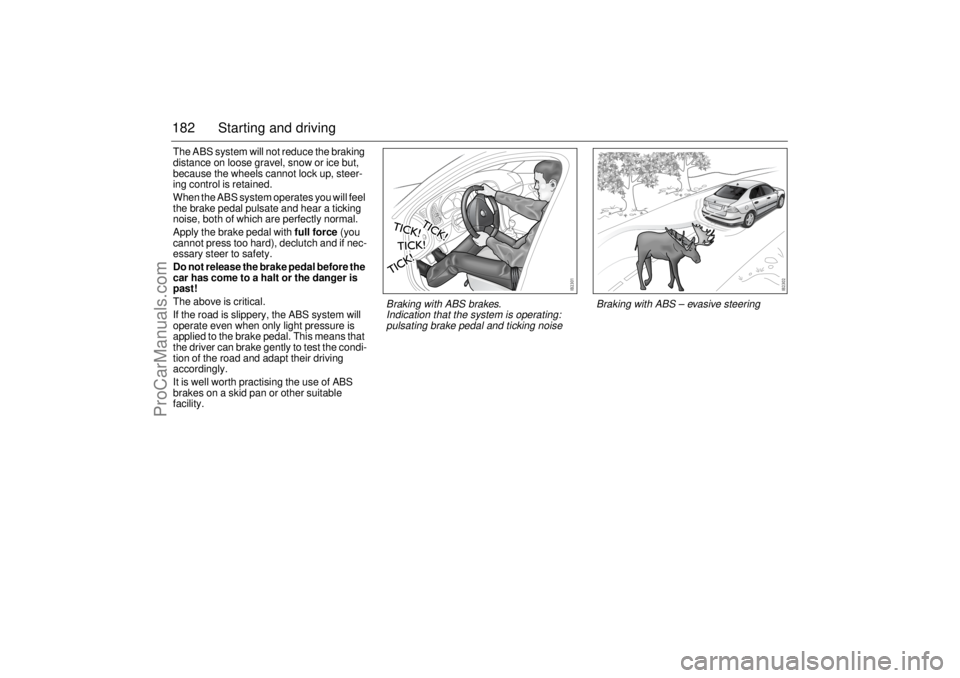
When the ABS system operates you will feel
the brake pedal pulsate and hear a ticking
noise, both of which are perfectly normal.
Apply the brake pedal with full force (you
cannot press too hard), declutch and if nec-
essary steer to safety.
Do not release the brake pedal before the
car has come to a halt or the danger is
past!
The above is critical.
If the road is slippery, the ABS system will
operate even when only light pressure is
applied to the brake pedal. This means that
the driver can brake gently to test the condi-
tion of the road and adapt their driving
accordingly.
It is well worth practising the use of ABS
brakes on a skid pan or other suitable
facility.
Braking with ABS – evasive steering
Braking with ABS brakes.
Indication that the system is operating:
pulsating brake pedal and ticking noise
93U S M 06.book Page 182 Friday, February 18, 2005 1:15 PM
ProCarManuals.com
Page 185 of 318
185 Starting and driving
Electronic Stability
Program (ESP)3Anti-skid system
The Electronic Stability Program employs
both the antilock braking system (ABS) and
the traction control system (TCS). It is a
system that helps the driver to stabilize the
car in unusual circumstances that can oth-
erwise be difficult to handle.
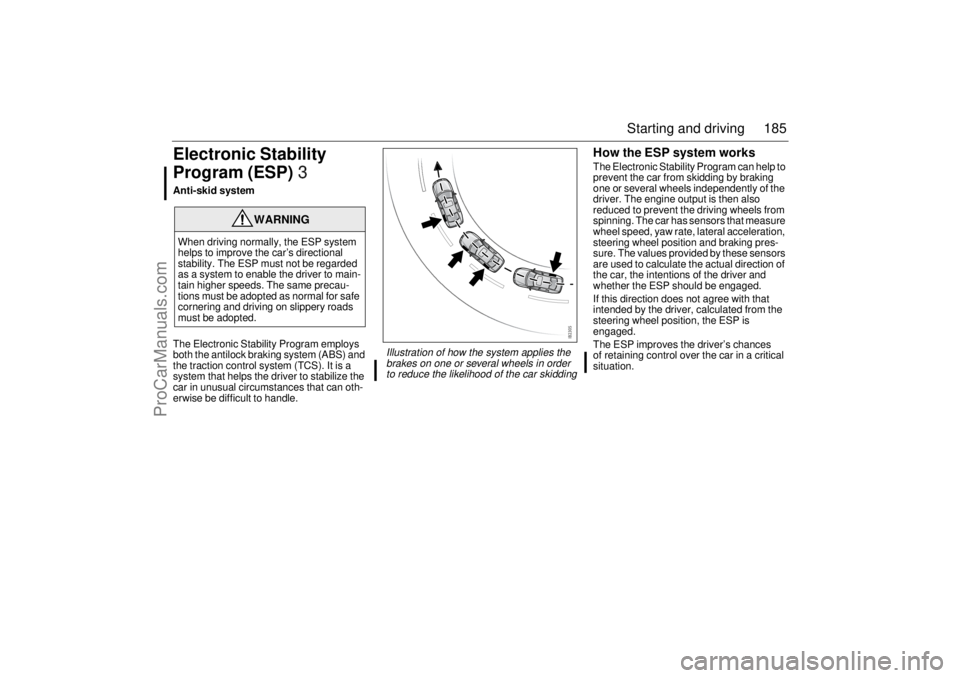
How the ESP system worksThe Electronic Stability Program can help to
prevent the car from skidding by braking
one or several wheels independently of the
driver. The engine output is then also
reduced to prevent the driving wheels from
spinning. The car has sensors that measure
wheel speed, yaw rate, lateral acceleration,
steering wheel position and braking pres-
sure. The values provided by these sensors
are used to calculate the actual direction of
the car, the intentions of the driver and
whether the ESP should be engaged.
If this direction does not agree with that
intended by the driver, calculated from the
steering wheel position, the ESP is
engaged.
The ESP improves the driver’s chances
of retaining control over the car in a critical
situation.
WARNING
When driving normally, the ESP system
helps to improve the car’s directional
stability. The ESP must not be regarded
as a system to enable the driver to main-
tain higher speeds. The same precau-
tions must be adopted as normal for safe
cornering and driving on slippery roads
must be adopted.
Illustration of how the system applies the
brakes on one or several wheels in order
to reduce the likelihood of the car skidding
93U S M 06.book Page 185 Friday, February 18, 2005 1:15 PM
ProCarManuals.com
Page 188 of 318
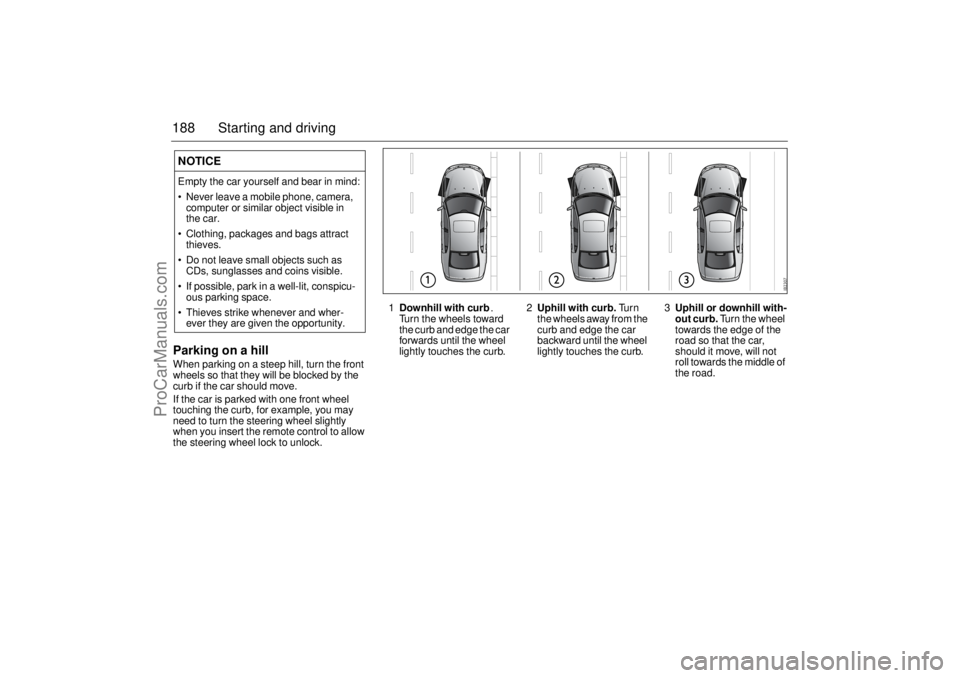
188 Starting and drivingParking on a hillWhen parking on a steep hill, turn the front
wheels so that they will be blocked by the
curb if the car should move.
If the car is parked with one front wheel
touching the curb, for example, you may
need to turn the steering wheel slightly
when you insert the remote control to allow
the steering wheel lock to unlock.NOTICEEmpty the car yourself and bear in mind:
Never leave a mobile phone, camera,
computer or similar object visible in
the car.
Clothing, packages and bags attract
thieves.
Do not leave small objects such as
CDs, sunglasses and coins visible.
If possible, park in a well-lit, conspicu-
ous parking space.
Thieves strike whenever and wher-
ever they are given the opportunity.
1Downhill with curb
.
Turn the wheels toward
the curb and edge the car
forwards until the wheel
lightly touches the curb.2Uphill with curb. Tu r n
the wheels away from the
curb and edge the car
backward until the wheel
lightly touches the curb.3Uphill or downhill with-
out curb. Turn the wheel
towards the edge of the
road so that the car,
should it move, will not
roll towards the middle of
the road.
93U S M 06.book Page 188 Friday, February 18, 2005 1:15 PM
ProCarManuals.com
Page 205 of 318
205 Starting and driving
Driving at nightBear in mind the following points, especially
when driving at night:
Nighttime driving requires your full
concentration
Do not rush. Count on your journey taking
slightly longer.
The number of drivers under the influence
of drugs is likely to be greater at night than
during the day.
Do not stare at the headlights of oncom-
ing vehicles.
Avoid driving at night if you have poor
eyesight. Night vision deteriorates with
age.
Keep your car’s headlights, windows and
mirrors clean. Also, if you wear glasses,
make sure they are clean.
Make sure you are well rested before
starting a long journey. Take a break every
other hour.
Only eat light meals. Heavy meals have a
tendency to induce tiredness.
Wild animals prefer to move at dusk and
dawn.
Check the headlight levelling setting (see
page 102).
Towing the car
Front towing eye
WARNING
Remember that the brake servo does
not operate when the engine is off.
Much greater pressure than normal
will therefore be required to operate
the brake pedal.
Nor does the steering servo operate
when the engine is off. The steering
will therefore be much heavier than
usual.
The towing vehicle should always be
heavier than the vehicle on tow.
Never allow passengers to ride in the
car when it is on tow.
Always seek professional help if the
car needs to be recovered.
The ignition switch must be in the ON
position if the car is moved with the
engine not running.
The steering wheel lock must be
disengaged before towing the car.
The steering wheel lock disengages
when the remote control is inserted
into the ignition switch, if the battery
has sufficient charge.
WARNING
Make sure that the towing eye is
screwed in tightly. It has a left-hand
thread!
The towing eye is only designed for
towing the car on roads. It must not
be used to pull the car out of a ditch,
for example.
Make sure that all bystanders keep a
suitable distance, in case the towing
eye or tow rope should snap. The
towing eye or tow rope could catapult
off and cause seriously injury.
Never drive with the towing eye fitted
to the front bumper. Return it to its
designated storage space.
93U S M 06.book Page 205 Friday, February 18, 2005 1:15 PM
ProCarManuals.com
Page 225 of 318

225 Car care
Power steeringCheck the level of the power steering fluid in
the reservoir regularly, in accordance with
the service program.
The wheels should point directly forwards
during this check.
Clean round the cap before unscrewing it.
Wipe the dipstick. To check the level, screw
down the cap completely and then remove
it again.
The oil level should lie between the MAX
and MIN marks when the oil temperature is
about 68°F (+20°C). If the oil is colder, the
level will be lower, and at a higher tempera-
tures the level will be higher.
Top up with CHF 11S or CHF 202 power
steering fluid.
WARNING
Power steering fluid on hot engine
components constitutes a fire risk.
Power steering fluid reservoir, 4-cyl
engine
Power steering fluid reservoir, V6 engine
93U S M 06.book Page 225 Friday, February 18, 2005 1:15 PM
ProCarManuals.com
Page 249 of 318
249 Car care
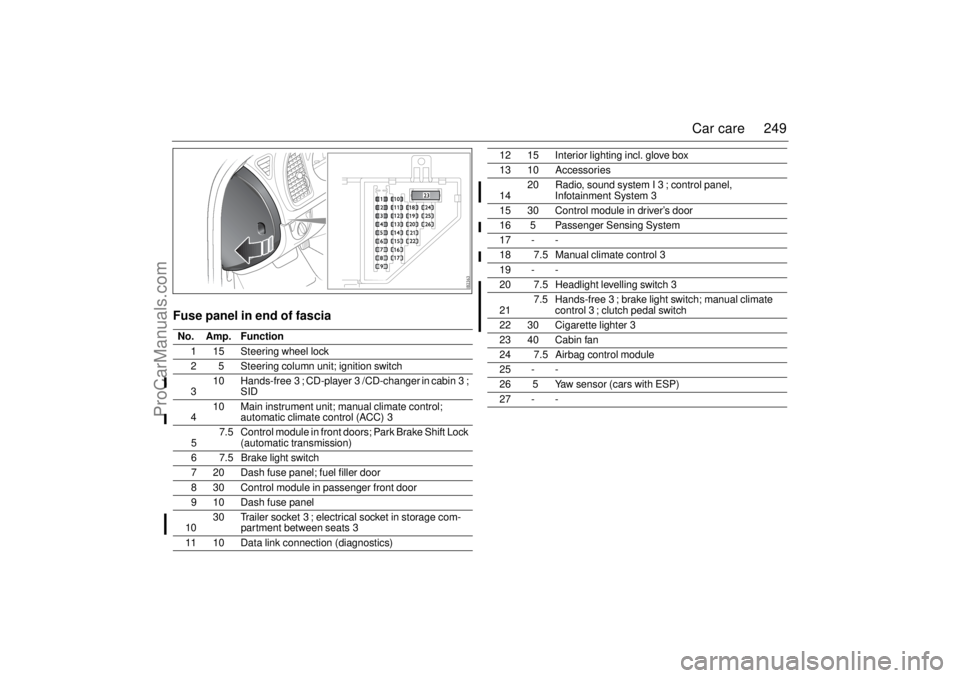
Fuse panel in end of fasciaNo. Amp. Function
1 15 Steering wheel lock
2 5 Steering column unit; ignition switch
310 Hands-free3; CD-player3/CD-changer in cabin3;
SID
410 Main instrument unit; manual climate control;
automatic climate control (ACC)3
57.5 Control module in front doors; Park Brake Shift Lock
(automatic transmission)
6 7.5 Brake light switch
7 20 Dash fuse panel; fuel filler door
8 30 Control module in passenger front door
9 10 Dash fuse panel
1030 Trailer socket3; electrical socket in storage com-
partment between seats3
11 10 Data link connection (diagnostics)
12 15 Interior lighting incl. glove box
13 10 Accessories
1420 Radio, sound system I3; control panel,
Infotainment System3
15 30 Control module in driver’s door
16 5 Passenger Sensing System
17 - -
18 7.5 Manual climate control3
19 - -
20 7.5 Headlight levelling switch3
217.5 Hands-free3; brake light switch; manual climate
control3; clutch pedal switch
22 30 Cigarette lighter3
23 40 Cabin fan
24 7.5 Airbag control module
25 - -
26 5 Yaw sensor (cars with ESP)
27 - -
93U S M 06.book Page 249 Friday, February 18, 2005 1:15 PM
ProCarManuals.com
Page 256 of 318
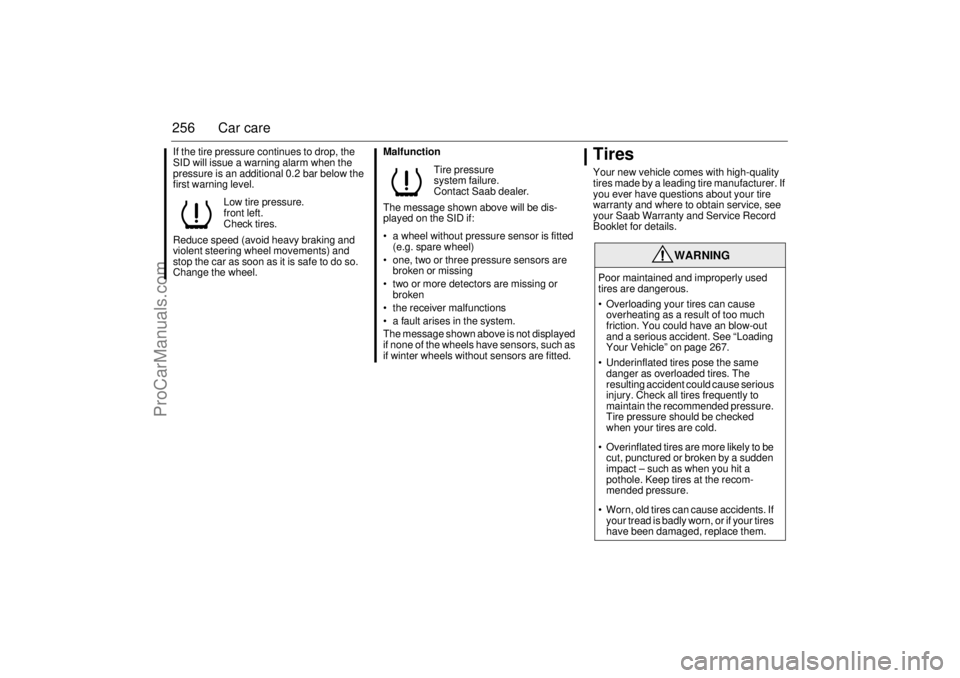
256 Car careIf the tire pressure continues to drop, the
SID will issue a warning alarm when the
pressure is an additional 0.2 bar below the
first warning level.
Reduce speed (avoid heavy braking and
violent steering wheel movements) and
stop the car as soon as it is safe to do so.
Change the wheel.Malfunction
The message shown above will be dis-
played on the SID if:
a wheel without pressure sensor is fitted
(e.g. spare wheel)
one, two or three pressure sensors are
broken or missing
two or more detectors are missing or
broken
the receiver malfunctions
a fault arises in the system.
The message shown above is not displayed
if none of the wheels have sensors, such as
if winter wheels without sensors are fitted.
TiresYour new vehicle comes with high-quality
tires made by a leading tire manufacturer. If
you ever have questions about your tire
warranty and where to obtain service, see
your Saab Warranty and Service Record
Booklet for details. Low tire pressure.
front left.
Check tires.
Tire pressure
system failure.
Contact Saab dealer.
WARNING
Poor maintained and improperly used
tires are dangerous.
Overloading your tires can cause
overheating as a result of too much
friction. You could have an blow-out
and a serious accident. See “Loading
Your Vehicle” on page 267.
Underinflated tires pose the same
danger as overloaded tires. The
resulting accident could cause serious
injury. Check all tires frequently to
maintain the recommended pressure.
Tire pressure should be checked
when your tires are cold.
Overinflated tires are more likely to be
cut, punctured or broken by a sudden
impact – such as when you hit a
pothole. Keep tires at the recom-
mended pressure.
Worn, old tires can cause accidents. If
your tread is badly worn, or if your tires
have been damaged, replace them.
93U S M 06.book Page 256 Friday, February 18, 2005 1:15 PM
ProCarManuals.com
Page 259 of 318
259 Car care
Flat spottingAll tires get hot, especially on long journeys
or when the car is driven hard. After the car
has been parked with hot tires and the tires
have cooled down, a flat spot can form in the
tire, where it is in contact with the ground.
The same can occur if the car has not been
moved for a long time.
Flat spots can cause vibration that can be
felt through the steering wheel, similar to
that experienced when the wheels need bal-
ancing.
Flat spots of this type disappear once the
tires get hot again, usually after 10–15 miles
(20–25 km) of driving at cruising speed. If
the outdoor temperature is low it takes a
longer distance.
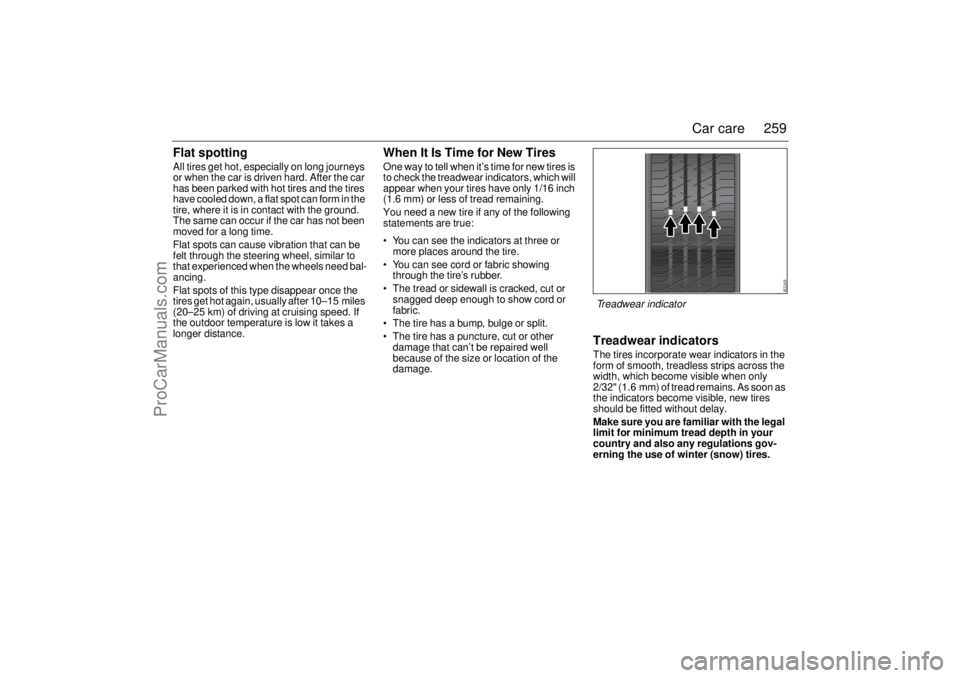
When It Is Time for New TiresOne way to tell when it’s time for new tires is
to check the treadwear indicators, which will
appear when your tires have only 1/16 inch
(1.6 mm) or less of tread remaining.
You need a new tire if any of the following
statements are true:
You can see the indicators at three or
more places around the tire.
You can see cord or fabric showing
through the tire’s rubber.
The tread or sidewall is cracked, cut or
snagged deep enough to show cord or
fabric.
The tire has a bump, bulge or split.
The tire has a puncture, cut or other
damage that can’t be repaired well
because of the size or location of the
damage.
Treadwear indicatorsThe tires incorporate wear indicators in the
form of smooth, treadless strips across the
width, which become visible when only
2/32" (1.6 mm) of tread remains. As soon as
the indicators become visible, new tires
should be fitted without delay.
Make sure you are familiar with the legal
limit for minimum tread depth in your
country and also any regulations gov-
erning the use of winter (snow) tires.Treadwear indicator
93U S M 06.book Page 259 Friday, February 18, 2005 1:15 PM
ProCarManuals.com