tires SAAB 9-3 2006 Owner's Manual
[x] Cancel search | Manufacturer: SAAB, Model Year: 2006, Model line: 9-3, Model: SAAB 9-3 2006Pages: 318, PDF Size: 28.05 MB
Page 264 of 318

264 Car careNotice:
If your vehicle does not have
235/45R17 size tires, use tire chains only
where legal and only when you must.
Contact your Saab dealer regarding suit-
able snow chains. Install them on the
front tires and tighten them as tightly as
possible with the ends securely
fastened. Drive slowly and follow the
chain manufacturer’s instructions. If you
can hear the chains contacting your
vehicle, stop and retighten them. If the
contact continues, slow down until it
stops. Driving too fast or spinning the
wheels with chains on will damage your
vehicle.
If a Tire Goes FlatIt’s unusual for a tire to “blowout” while
you’re driving, especially if you maintain
your tires properly. If air goes out of a tire,
it’s much more likely to leak out slowly. But
if you should ever have a “blowout”, here are
a few tips about what to expect and what to
do:
If a front tire fails, the flat tire will create a
drag that pulls the vehicle toward that side.
Take your foot off the accelerator pedal and
grip the steering wheel firmly. Steer to main-
tain lane position, and then gently brake to
a stop well out of the traffic lane.
A rear blowout, particularly on a curve, acts
much like a skid and may require the same
correction you’d use in a skid. In any rear
blowout, remove your foot from the acceler-
ator pedal. Get the vehicle under control by
steering the way you want the vehicle to go.
It may be very bumpy and noisy, but you can
still steer. Gently brake to a stop – well off
the road if possible.
If a tire goes flat, the next part shows how to
use your jacking equipment to change a flat
tire safely.
Tire Sidewall LabelingUseful information about a tire is molded
into it´s sidewall.
Tire size: The tire size ia a combination of
letters and numbers used to define a partic-
ular tire´s width, height, aspect ratio, con-
struction type and service description.
Department of Transportation (DOT):
The Department of Transportation (DOT)
code indicates that the tire is in compliance
with the U.S. Department of Transportation
Motor Vehicle Safety standards.
Tire Identification Number (TIN): The let-
ters and numbers following DOT code are
the Tire Identification Number (TIN). The
TIN shows the manufacturer and plant
code, tire size, and date the tire was manu-
factured. The TIN is molded onto both sides
of the tire.
Tire Ply Material: The type of cord and
number of plies in the sidewall and under
the tread.
93U S M 06.book Page 264 Friday, February 18, 2005 1:15 PM
ProCarManuals.com
Page 265 of 318

265 Car care
Uniform Tire Quality Grading (UTQG):
Tire manufacturers are required to grade
tires based on the performance factors:
treadwear, traction and temperature resis-
tance. For more information see “Uniform
Tire Quality Grading” on page 261.
Maximum Cold Inflation Load Limit: Max-
imum load that can be carried and the max-
imum pressure needed to support that load.
For information on recommended tire pres-
sure see “Recommended lowest tire pres-
sure, cold tires” on page 306 and “Loading
Your Vehicle” on page 267.
Tire SizeThe following illustration shows an example
of a typical passenger car tire size.
Tire Width: The three-digit number indi-
cates the tire section width in millimeters
from sidewall to sidewall.Aspect ratio: A two-digit number that indi-
cates the tire height-to-width measure-
ments. For example, if the tire size aspect
ratio is “55”, as shown in item “C” of the illus-
tration, it would mean that the tire´s sidewall
is 55% as high as it is wide.
Belt Rating: A letter code is used to indicate
the type of ply construction in the tire. The
letter “R” means radial ply construction; the
letter “D” means diagonal or bias ply con-
struction; and the letter “B” means belted-
bias ply construction.
Rim Diameter: Diameter of the wheel in
inches.
Load range: The load range represents the
load carry capacity a tire is certified to carry.
Speed Rating: The maximum speed that a
tire is certified to carry a load. Speed ratings
range from “A” to “Z”. 215/55 R 16 93 H
||||||
abcdef
aTire Width
b Aspect Ratio
c Belt Rating
d Rim diameter
e Load range
f Speed rating
93U S M 06.book Page 265 Friday, February 18, 2005 1:15 PM
ProCarManuals.com
Page 267 of 318
267 Car care
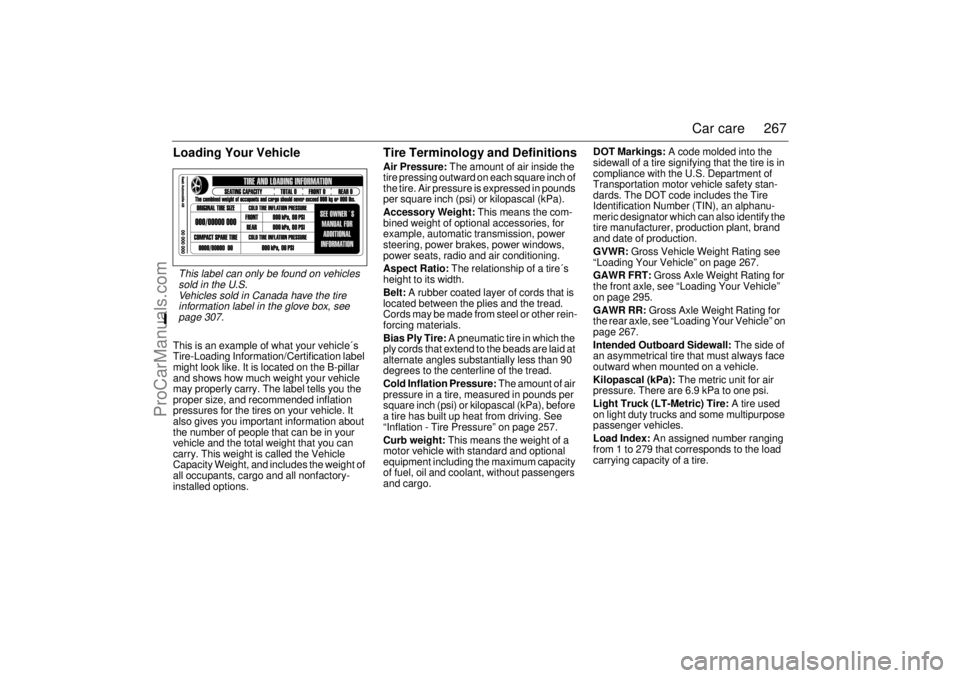
Loading Your VehicleThis is an example of what your vehicle´s
Tire-Loading Information/Certification label
might look like. It is located on the B-pillar
and shows how much weight your vehicle
may properly carry. The label tells you the
proper size, and recommended inflation
pressures for the tires on your vehicle. It
also gives you important information about
the number of people that can be in your
vehicle and the total weight that you can
carry. This weight is called the Vehicle
Capacity Weight, and includes the weight of
all occupants, cargo and all nonfactory-
installed options.
Tire Terminology and DefinitionsAir Pressure: The amount of air inside the
tire pressing outward on each square inch of
the tire. Air pressure is expressed in pounds
per square inch (psi) or kilopascal (kPa).
Accessory Weight: This means the com-
bined weight of optional accessories, for
example, automatic transmission, power
steering, power brakes, power windows,
power seats, radio and air conditioning.
Aspect Ratio: The relationship of a tire´s
height to its width.
Belt: A rubber coated layer of cords that is
located between the plies and the tread.
Cords may be made from steel or other rein-
forcing materials.
Bias Ply Tire: A pneumatic tire in which the
ply cords that extend to the beads are laid at
alternate angles substantially less than 90
degrees to the centerline of the tread.
Cold Inflation Pressure: The amount of air
pressure in a tire, measured in pounds per
square inch (psi) or kilopascal (kPa), before
a tire has built up heat from driving. See
“Inflation - Tire Pressure” on page 257.
Curb weight: This means the weight of a
motor vehicle with standard and optional
equipment including the maximum capacity
of fuel, oil and coolant, without passengers
and cargo.DOT Markings: A code molded into the
sidewall of a tire signifying that the tire is in
compliance with the U.S. Department of
Transportation motor vehicle safety stan-
dards. The DOT code includes the Tire
Identification Number (TIN), an alphanu-
meric designator which can also identify the
tire manufacturer, production plant, brand
and date of production.
GVWR: Gross Vehicle Weight Rating see
“Loading Your Vehicle” on page 267.
GAWR FRT: Gross Axle Weight Rating for
the front axle, see “Loading Your Vehicle”
on page 295.
GAWR RR: Gross Axle Weight Rating for
the rear axle, see “Loading Your Vehicle” on
page 267.
Intended Outboard Sidewall: The side of
an asymmetrical tire that must always face
outward when mounted on a vehicle.
Kilopascal (kPa): The metric unit for air
pressure. There are 6.9 kPa to one psi.
Light Truck (LT-Metric) Tire: A tire used
on light duty trucks and some multipurpose
passenger vehicles.
Load Index: An assigned number ranging
from 1 to 279 that corresponds to the load
carrying capacity of a tire.
This label can only be found on vehicles
sold in the U.S.
Vehicles sold in Canada have the tire
information label in the glove box, see
page 307.93U S M 06.book Page 267 Friday, February 18, 2005 1:15 PM
ProCarManuals.com
Page 268 of 318

268 Car careMaximum Load rating: The load rating for
a tire at the maximum permissible inflation
pressure for that tire.
Maximum Loaded Vehicle Weight: The
sum of curb weight; accessory weight; vehi-
cle capacity weight; and production options
weight.
Maximum Permissible Inflation Pres-
sure: The maximum cold inflation pressure
to which a tire may be inflated.
Normal occupant weight: The number of
occupants a vehicle is designed to seat mul-
tipled by 150 pounds (68 kg). See “Loading
Your Vehicle” on page 267.
Occupant Distribution: Designated seat-
ing positions.
Outward Facing Sidewall: The side of a
asymmetrical tire that has a particular side
that faces outward when mounted on a vehi-
cle. The side of the tire that contains a white-
wall bears white lettering or bears manufac-
turer, brand and or model name molding on
the other sidewall of the tire.
Passenger (P-Metric) Tire: A tire used on
passenger cars and some light duty trucks
and multipurpose vehicles.Recommended Inflation Pressure: Vehi-
cle manufacturer´s recommended tire infla-
tion pressure shown on the tire placard, see
“Inflation - Tire Pressure” on page 257 and
“Loading Your Vehicle” on page 267.
Radial Ply Tire: A pneumatic tire in which
the ply cords that extend to the beads are
laid at substantially 90 degrees to the cen-
terline of the tread.
Rim: A metal support for a tire or a tire and
tube assembly upon which the tire beads
are seated.
Sidewall: The portion of a tire between the
tread and the bead.
Speed rating: An alphanumeric code
assigned to a tire indicating the maximum
speed at which a tire can operate.
Traction: The friction between the tire and
the road surface. The amount of grip pro-
vided.
Treadwear Indicators: Narrow bands,
sometimes called “wear bars”, that show
across the tread of a tire when only
2/32 inch of tread remains. See “When It Is
Time for New Tires” on page 259.Tread Width: The width of the tire´s tread.
UTQGS: Uniform Tire Quality Grade Stan-
dards, a tire information system that pro-
vides consumers with ratings for a tire´s
traction, temperature and treadwear. Rat-
ings are determined by tire manufacturers
using government testing procedures. The
rating are molded into the sidewall of the
tire. See “Uniform Tire Quality Grading” on
page 261.
Vehicle Capacity Weight: Is the number of
designated seating positions multipled by
150 pounds (68 kg) plus the rated cargo
load. See “Loading Your Vehicle” on
page 267.
Vehicle Maximum Load on the Tire: Load
on an individual tire due to curb weight,
accessory weight, occupant weight and
cargo weight.
Vehicle Placard: A label permanently
attached to a vehicle showing original
equipment tire size and the recommended
cold inflation pressure. See “Loading Your
Vehicle” on page 267.93U S M 06.book Page 268 Friday, February 18, 2005 1:15 PM
ProCarManuals.com
Page 269 of 318

269 Car care
Steps for Determining Correct
Load Limit1 Locate the statement “The
combined weight of occupants and
cargo should never exceed
XXX pounds” on your vehicle´s
placard.
2 Determine the combined weight of
the driver and passengers that will
be riding in your vehicle.
3 Substract the combined weight of
the driver and passengers from
XXX kilograms or XXX pounds.
4 The resulting figure equals the avail-
able amount of cargo and luggage
load capacity. For example, if the
“XXX” amount equals 1400 lbs. and
there will be five 150 lb. passengers
in your vehicle, the amount of avail-
able cargo and luggage load capac-
ity is 650 lbs. (1400–750 (5x150) =
650 lbs.).5 Determine the combined weight of
luggage and cargo being loaded on
the vehicle. That weight may not
safely exceed the available cargo
and luggage load capacity calcu-
lated in Step 4.
6 If your vehicle will be towing a trailer,
load from your trailer will be trans-
ferred to your vehicle. Consult this
manual to determine how this
reduces the available cargo and
luggage load capacity of your vehi-
cle.
Winter tiresWinter (snow) tires are recommended for
winter climates where the majority of your
driving will be done on snow and ice. Winter
tires should be fitted to all four wheels to
maintain a proper balance. Your Saab
dealer can advise you of to the correct size
tire for your car (if different from the original
size) and also supply Saab approved winter
tires pre-mounted on steel or alloy rims.
Winter tires normally use a different speed
rating compared to summer/all season tires.
Make sure not to exceed the stated speed
rating on the tires you use.
93U S M 06.book Page 269 Friday, February 18, 2005 1:15 PM
ProCarManuals.com
Page 270 of 318
270 Car careTire date codeTires should be regarded as perishable
goods. As the tires age, the rubber becomes
progressively harder, and the roadholding
ability of the tires diminishes. This is partic-
ularly true on winter tires.
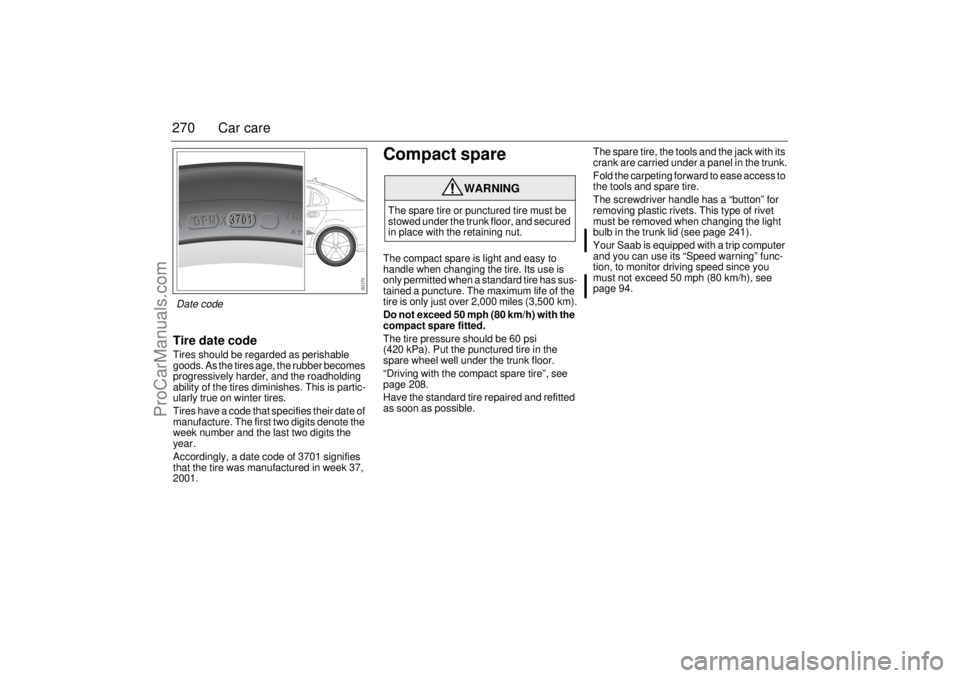
Tires have a code that specifies their date of
manufacture. The first two digits denote the
week number and the last two digits the
year.
Accordingly, a date code of 3701 signifies
that the tire was manufactured in week 37,
2001.
Compact spareThe compact spare is light and easy to
handle when changing the tire. Its use is
only permitted when a standard tire has sus-
tained a puncture. The maximum life of the
tire is only just over 2,000 miles (3,500 km).
Do not exceed 50 mph (80 km/h) with the
compact spare fitted.
The tire pressure should be 60 psi
(420 kPa). Put the punctured tire in the
spare wheel well under the trunk floor.
“Driving with the compact spare tire”, see
page 208.
Have the standard tire repaired and refitted
as soon as possible.The spare tire, the tools and the jack with its
crank are carried under a panel in the trunk.
Fold the carpeting forward to ease access to
the tools and spare tire.
The screwdriver handle has a “button” for
removing plastic rivets. This type of rivet
must be removed when changing the light
bulb in the trunk lid (see page 241).
Your Saab is equipped with a trip computer
and you can use its “Speed warning” func-
tion, to monitor driving speed since you
must not exceed 50 mph (80 km/h), see
page 94.
WARNING
The spare tire or punctured tire must be
stowed under the trunk floor, and secured
in place with the retaining nut.
Date code93U S M 06.book Page 270 Friday, February 18, 2005 1:15 PM
ProCarManuals.com
Page 284 of 318
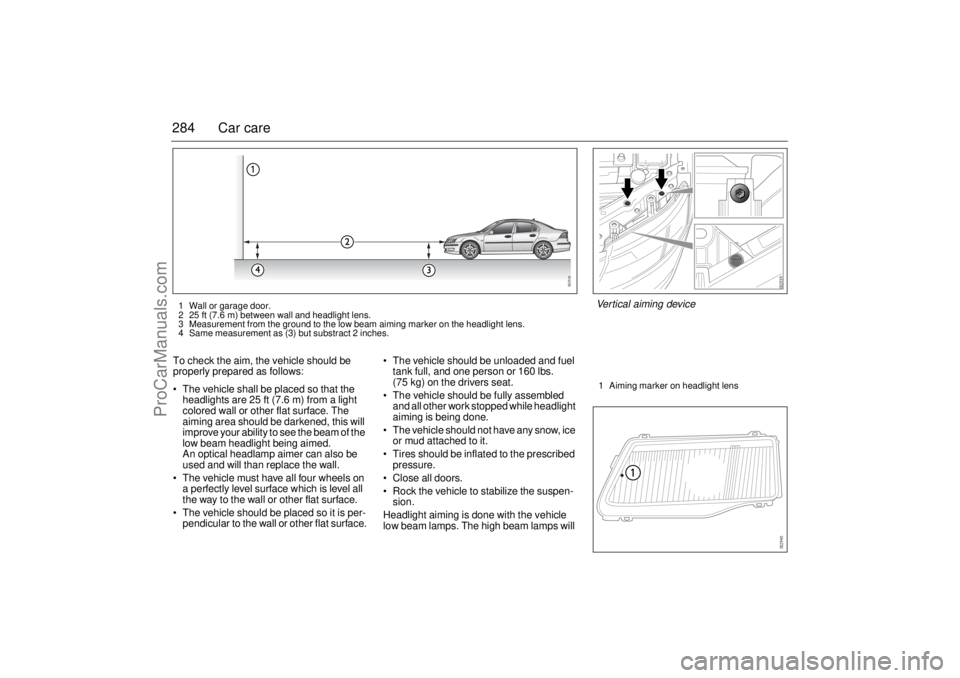
284 Car careTo check the aim, the vehicle should be
properly prepared as follows:
The vehicle shall be placed so that the
headlights are 25 ft (7.6 m) from a light
colored wall or other flat surface. The
aiming area should be darkened, this will
improve your ability to see the beam of the
low beam headlight being aimed.
An optical headlamp aimer can also be
used and will than replace the wall.
The vehicle must have all four wheels on
a perfectly level surface which is level all
the way to the wall or other flat surface.
The vehicle should be placed so it is per-
pendicular to the wall or other flat surface. The vehicle should be unloaded and fuel
tank full, and one person or 160 lbs.
(75 kg) on the drivers seat.
The vehicle should be fully assembled
and all other work stopped while headlight
aiming is being done.
The vehicle should not have any snow, ice
or mud attached to it.
Tires should be inflated to the prescribed
pressure.
Close all doors.
Rock the vehicle to stabilize the suspen-
sion.
Headlight aiming is done with the vehicle
low beam lamps. The high beam lamps will 1 Wall or garage door.
2 25 ft (7.6 m) between wall and headlight lens.
3 Measurement from the ground to the low beam aiming marker on the headlight lens.
4 Same measurement as (3) but substract 2 inches.
Vertical aiming device1 Aiming marker on headlight lens
93U S M 06.book Page 284 Friday, February 18, 2005 1:15 PM
ProCarManuals.com
Page 289 of 318

289 Customer Assistance and Information
Engine oil and filter changesChanging the engine oil and filter is required
at every service point. Use only a Saab
approved long-life oil filter and engine oils
meeting the SAE viscosity ratings and API
service classifications stated in the “Techni-
cal data” section of this Owner’s Manual.
The use of extra additives in the oil is not
necessary and is not recommended, and
may be harmful to turbochargers.
More frequent oil changes are recom-
mended if your vehicle is operated under
any of the following conditions:
Most trips are less than 5–10 miles (8–
16 km). This is particularly important
when outside temperatures are below
freezing.
Most trips include extensive idling
(frequent stop-and-go traffic).
Most trips are through dusty areas (such
as construction zones).
If the vehicle is used for delivery service,
police, taxi or other commercial applica-
tions.
If your driving habits match this description,
have the engine oil and filter changed in-
between normal services. These conditions
cause the engine oil to break down faster.
The Warranties and Service Record Book-
let has provisions to record extra oil
changes.
Service record retentionIt is the owner’s responsibility to retain ser-
vice records. If possible, you should keep
copies of all shop work orders for all service
and repairs, whenever performed. As indi-
cated in the new car and emission control
system warranties, it is important to docu-
ment that all necessary maintenance has
been done.
HOW THE SERVICE RECORD IS ORGA-
NIZED
The service record is comprised of a series
of coupons on which to record services as
they are performed. There are additional
coupons for documenting extra engine oil
and filter changes, extra automatic trans-
mission fluid services necessary for severe
service conditions, and brake fluid changes.
HOW TO USE THE SERVICE RECORD
COUPONS
When the car is brought to a Saab dealer for
scheduled maintenance, present the War-
ranties & Service Record Booklet to the ser-
vice manager. When the technician has
completed the service, the technician will
sign the maintenance record. The person
responsible for quality assurance at the
dealership will also sign and stamp the
record with the dealer identification stamp.
Service costsDealer pricing practices and labor for ser-
vice work vary. Saab’s recommended ser-
vice times for each service point do not
include the labor required to replace wear
items, such as wiper blades, brake pads or
tires. Nor is labor to perform other service or
repairs found to be necessary as a result of
the inspections included in these times.
Additional labor and parts will be charged
for such work when necessary, except as
covered under an applicable Saab warranty
or any optional extended service contract.
Transmission fluid changes or suspension
alignment, when necessary, are also addi-
tional.
Dealer charges for general shop material,
regulated hazardous waste removal, recy-
cling expenses or other operation costs may
also be applied to service and repair
invoices and are apt to vary by dealer and
location.
93U S M 06.book Page 289 Friday, February 18, 2005 1:15 PM
ProCarManuals.com
Page 293 of 318
293 Technical data
General data __________ 294
Engine _______________ 297
Engine oil _____________ 298
Fuel__________________ 299
Engines ______________ 300
Electrical system_______ 300
Drive belt _____________ 301
Manual transmission ___ 301
Automatic transmission _ 302
Suspension ___________ 302
Steering ______________ 302
Brake system__________ 303
Wheels and tires _______ 304
Plates and labels _______ 307
Technical data
3Asterisk means: equipment not fitted in all cars
(can depend on model variant, engine variant,
market specification, options or accessories).93U S M 06.book Page 293 Friday, February 18, 2005 1:15 PM
ProCarManuals.com
Page 296 of 318

296 Technical data
WARNING
The GVW and maximum axle loads must not be exceeded.
Note that if some accessories (e.g. towbar, CD changer) are
fitted, the available load capacity is reduced by the weight of
these.
When carrying a load in the trunk, make sure that it is lashed
down securely, particularly when part or all of the rear seat is
folded down.
Trailer:
Trailer with brakes ________________ Max. 3500 lbs.
(1588 kg)
Trailer without brakes _____________ Max. 1000 lbs.
(450 kg)
Recommended towball load ________ 110–165 lbs.
(50–75 kg)
See also page 200.
Maximum theoretical towing speed, trailer
with brakes ____________________ 60 mph (100 km/h)
When towing a trailer, increase the pressure
of the rear tires by 20 kPa (3 psi).
The above speed and weight restrictions are those specified by
Saab Automobile AB.
Note that national restrictions may apply to trailer speeds and
weights (see page 198).
93U S M 06.book Page 296 Friday, February 18, 2005 1:15 PM
ProCarManuals.com